REVIEW 2 major objections 6 minor 50 references
Search for an all-sky and a Galactic Ridge diffuse neutrino emission with the first 2 years of KM3NeT/ARCA data
T0 review · 2 major / 6 minor · reviewed 2026-08-07 · deepseek-v4-flash
Pith's one-line read After 640 days with six to twenty-one lines, KM3NeT/ARCA finds no significant cosmic-neutrino excess in an all-sky search or toward the Galactic Ridge, and its 90% upper limits remain compatible with IceCube and ANTARES measurements.
desk verdict First KM3NeT/ARCA diffuse flux search is a careful null result with competitive limits; the all-sky background normalization has a real period-dependent mismatch, but the central no-excess conclusion holds. read the letter →
The pith
A machine-rendered reading of the paper's core claim, the machinery that carries it, and where it could break.
The reading
What carries the argument
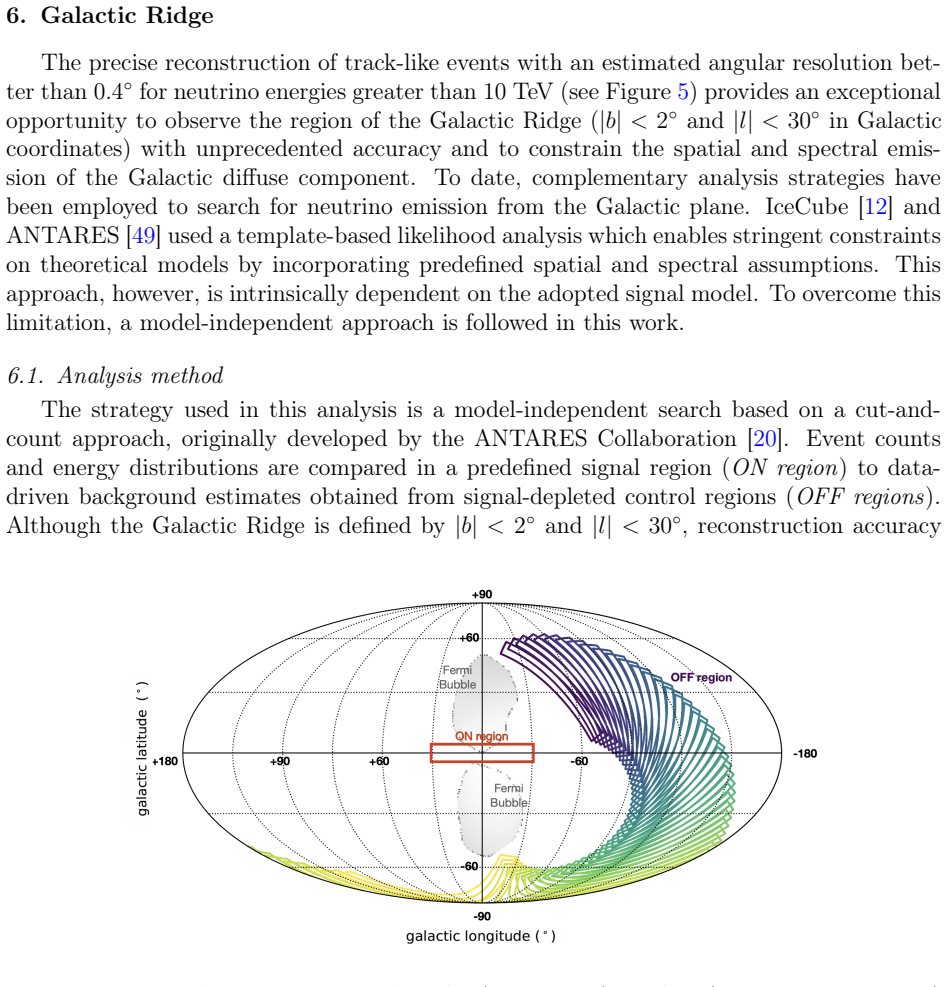
The argument is carried by two complementary background-estimation pipelines built on a common event selection. Up-going track-like $\nu_\mu$ charged-current events are selected through multi-stage reconstruction, a Boosted Decision Tree trained against atmospheric muons, and energy cuts optimised with the Model Rejection Factor technique. For the all-sky search the expected background, conventional and prompt atmospheric neutrinos (Honda and Enberg models) plus atmospheric muons (MUPAGE), comes from Monte Carlo, with a single global background normalisation $N_{\mathrm{bkg}} = 1.53 \pm 0.24$ fitted to ARCA19/21 data to absorb a data/MC discrepancy. For the Galactic Ridge search the background is measured from the data itself, using a cut-and-count ON/OFF design originally developed by ANTARES, in which the ON region, optimised to reconstructed Galactic coordinates $|b| < 3^\circ$ to $5^\circ$ and $|l| < 30^\circ$ to $31^\circ$, is compared with OFF regions built from random time shifts in right ascension so that the exposure is identical and no signal is expected. Both searches are interpreted with a Bayesian likelihood, with Gaussian priors on background and signal acceptance and a flat prior on the flux parameters, cross-checked by a frequentist $\chi^2$ fit.
What would settle it
One calculation would settle the all-sky claim: bin the ARCA21 data and Monte Carlo in fine reconstructed-energy bins and test whether the data/MC ratio is constant in energy at the fitted $N_{\mathrm{bkg}} = 1.53$. If the ratio varies systematically with energy, the assumed background shape is wrong and the fitted cosmic flux and upper limits shift; if it is flat, the background-only interpretation survives. For the Galactic Ridge claim, re-running the same ON/OFF selection with OFF regions that sample right ascension uniformly, or with a doubled livetime, would test whether the null result persists.
Extended reading notes
Core claim
The paper establishes that, with the first 640 days of KM3NeT/ARCA data, the observed sample of up-going track-like neutrinos is consistent with atmospheric background with at most a subdominant cosmic component, in both an all-sky analysis and a targeted analysis of the Galactic Ridge. The all-sky Bayesian fit, combining the four detector configurations and allowing a single global background normalisation $N_{\mathrm{bkg}} = 1.53 \pm 0.24$ for the two largest configurations, gives $\phi_0^{1f} = 3.0^{+2.1}_{-2.0} \times 10^{-18}$ GeV$^{-1}$ cm$^{-2}$ s$^{-1}$ sr$^{-1}$ and $\gamma = 3.00^{+0.30}_{-0.35}$ at 68% credible level; the frequentist cross-check returns $\phi_0 = 1.16 \times 10^{-18}$ GeV$^{-1}$ cm$^{-2}$ s$^{-1}$ sr$^{-1}$ and $\gamma = 3.04$, consistent within uncertainties. Because these best-fit parameters are not statistically significant, the paper reports 90% C.L. upper limits: for the all-sky flux, $4.35$ to $6.85 \times 10^{-18}$ GeV$^{-1}$ cm$^{-2}$ s$^{-1}$ sr$^{-1}$ at 100 TeV across spectral indices $\gamma \in [2.2, 2.7]$, and for the Galactic Ridge, $1.1 \times 10^{-5}$ to $2.1 \times 10^{-3}$ GeV$^{-1}$ cm$^{-2}$ s$^{-1}$ sr$^{-1}$ at 1 GeV. The Galactic Ridge fit yields no constraint on flux parameters, and the ANTARES hint of TeV ridge emission can be neither confirmed nor excluded.
Load-bearing premise
The all-sky limits assume the simulated atmospheric neutrino and muon background has the correct energy and angular shape, with only its overall normalisation left free ($N_{\mathrm{bkg}} = 1.53 \pm 0.24$); the Galactic Ridge limits separately assume that time-shifted OFF regions have exactly the same exposure as the ON region and contain no signal.
Editorial extensions
If this is right
- The combined 90% C.L. all-sky upper limits, $4.35$ to $6.85 \times 10^{-18}$ GeV$^{-1}$ cm$^{-2}$ s$^{-1}$ sr$^{-1}$ at 100 TeV for $\gamma \in [2.2, 2.7]$, bound single-power-law models of the cosmic neutrino flux and are compatible with, though less constraining than, the flux measured by IceCube.
- The Galactic Ridge analysis neither confirms nor excludes the ANTARES TeV hint: at the ANTARES best-fit flux only about 0.3 to 2.9 signal events are expected across the four configurations, against 8 to 16 observed ON-region events.
- ARCA21 dominates the combined result, and its data indicate that the simulated atmospheric background is underestimated by roughly 50%, so the single-normalisation correction will need to give way to a simultaneous fit of cosmic and background parameters as statistics grow.
- The quoted limits carry explicit energy ranges of validity (roughly $10^4$ to $10^6$ GeV for the all-sky limits), so the constraints apply specifically to the TeV–PeV regime where an astrophysical signal is expected.
- The Monte Carlo and ON/OFF analysis pipelines are now fully specified for the growing detector, meaning additional ARCA livetime and detection units translate directly into tighter limits without redesigning the selection.
Reading between the lines
- (Editorial) If the missing background in ARCA19/21 is concentrated at low reconstructed energies rather than flat, the fitted cosmic spectrum would appear softer than its true shape; testing whether the data/MC ratio is energy-independent at the quoted $N_{\mathrm{bkg}} = 1.53$ would resolve this, and the reported $\gamma \approx 3.0$ (softer than IceCube's 2.37) makes this a live concern.
- (Editorial) The null Galactic Ridge result is not yet in tension with ANTARES, since the expected ridge signal is only about three events in the largest configuration; roughly a tripling of exposure would be needed before ARCA's current effective area can test the ridge excess.
- (Editorial) Because the two searches use different background assumptions, running the ON/OFF method on the all-sky sample and the Monte Carlo method on the ridge region would provide an internal, data-driven cross-check of the background shape that currently anchors the all-sky limits.
- (Editorial) The per-spectral-index limits are ready-made inputs for a joint likelihood combining ARCA's public energy distributions with other telescopes' measurements, which would tighten the global all-sky flux constraint before ARCA reaches its full instrumented volume.
Editorial analysis
A structured set of objections, weighed in public.
Referee Report
Summary. This manuscript reports a search for a diffuse astrophysical neutrino flux from the full sky and from the Galactic Ridge using 640 days of KM3NeT/ARCA data from the 6, 8, 19, and 21 detection-unit configurations. The all-sky analysis uses Monte Carlo background estimates and a Bayesian fit, yielding a single-flavour flux normalisation phi0 = 3.0(+2.1/-2.0) x 10^-18 GeV^-1 cm^-2 s^-1 sr^-1 and spectral index gamma = 3.00(+0.30/-0.35) at 68% credible level, with 90% C.L. upper limits for spectral indices in [2.2, 2.7]. The Galactic Ridge analysis uses a data-driven OFF-region background and, finding no significant excess, reports upper limits rather than best-fit parameters. The paper concludes that neither search shows a statistically significant excess and presents the methods as a basis for future measurements.
Significance. If the results are taken at face value, the paper provides the first competitive diffuse neutrino flux constraints from KM3NeT/ARCA partial configurations and demonstrates the detector's ability to reach the relevant sensitivity. The analysis is careful in several respects: the event selection is optimised with a blind strategy, the statistical framework is standard and includes systematic priors, the Galactic Ridge background is estimated from data in time-shifted OFF regions, and all claims are appropriately hedged (the best fit is not called a detection and the unconstrained Galactic Ridge parameters are not quoted). The main weakness is the treatment of the all-sky Monte Carlo background normalisation, which affects the quoted flux parameters and limits; this does not overturn the no-excess conclusion but limits confidence in the central numeric results.
major comments (2)
- [Section 5.2, Table 4] The single global background normalisation Nbkg = 1.53 +/- 0.24 is fitted using ARCA19/21 data only, but Table 4 shows a period-dependent data/MC mismatch that this one-parameter correction cannot represent. ARCA6 has 14 observed events against an expected 29.7 atmospheric background plus 0.9 cosmic signal before the fit, a deficit of about 16.6 events; ARCA21 has 48 observed against 29.4 atmospheric plus 4.5 signal, an excess of about 14 events. Applying the reported best-fit cosmic expectations together with Nbkg = 1.53 makes ARCA6 even more discrepant (about 33.2 predicted versus 14 observed), indicating that the background model has a shape or period-dependent problem. Because the quoted Bayesian credible intervals and upper limits do not include an equivalent per-configuration or per-bin shape-mismatch term (such as the alpha_A,i and alpha_M,i terms in Eq. 5 of the frequentist analysis), the central all-sky results are not demonstrably robust against the background model choice. The authors should either extend the Bayesian model with per-configuration background normalisations, include a shape-mismatch systematic, or show explicitly that the flux and limits are unchanged under such extensions.
- [Section 5.2, background normalisation procedure] The manuscript is ambiguous about whether Nbkg is marginalised simultaneously with phi0 and gamma or fixed before the final fit. The sentence 'With higher statistics, a simultaneous fit of all three parameters (phi0, gamma, Nbkg) would be feasible' suggests the reported posterior may not include the Nbkg uncertainty, yet Appendix B presents a correlation matrix for Nbkg, phi0, and gamma. If Nbkg is fixed at 1.53 when computing the credible regions and upper limits in Table 5, the quoted intervals underestimate the total uncertainty. The authors should specify the exact fitting procedure and, if Nbkg is not marginalised, propagate its uncertainty into the results.
minor comments (6)
- [Section 5.2, Figure 6 caption] The caption states that 'the total background is upscaled by a factor obtained from background normalisation estimation' but does not give the factor or its uncertainty; adding this would help the reader assess the correction.
- [Section 5.2, background description] The sentence 'For ARCA19 and ARCA21, the background is assumed to fluctuate across energy bins through a single global background normalisation' is imprecise: a single global normalisation does not fluctuate across bins; the intended meaning is that bin-to-bin variations are not modelled by additional parameters.
- [Table 4 caption] The caption says the expected numbers are given 'before the best-fit estimation', but the text later quotes expected cosmic events using the best-fit parameters; clarifying which values are used in the table would avoid confusion.
- [Section 6.1, OFF-region construction] The description of the OFF-region construction should include a validation that the time-shifted OFF regions have the same exposure as the ON region (for example, a relative-exposure map or a data/MC comparison), since this assumption is central to the Galactic Ridge background estimate.
- [Figures 8 and 12] Both figures show duplicate legend entries for the same dataset; please remove the redundant entries.
- [Throughout] The paper alternates between 'credible level' and 'confidence level' for the 90% upper limits; please use consistent terminology, reserving 'credible level' for Bayesian results and 'confidence level' for frequentist results.
Circularity Check
No circularity: the flux parameters and upper limits are fitted measurements, not predictions derived from their own inputs.
full rationale
The paper is a search measurement. The all-sky analysis fits the signal normalisation phi0 and spectral index gamma directly to the observed event counts via the Poisson likelihood of Eq. 2, and the same data determine the 90% CL upper limits. The background normalisation Nbkg = 1.53 +/- 0.24 (Section 5.2) is a fitted nuisance parameter estimated with the cosmic parameters profiled; the paper explicitly presents it as a best estimate, not as a prediction, and it is used only to rescale the MC background in ARCA19/21. This is statistically conditional but not circular: the quoted flux, gamma, and limits are not equal to Nbkg by construction, and the frequentist analysis of Section 5.2.1 re-fits with per-bin nuisance parameters as an independent cross-check. The Galactic Ridge analysis determines its background from data in time-shifted OFF regions and uses the ANTARES best-fit flux only as an external comparison spectrum, so there is no self-defined 'prediction'. Self-citations to theses [36,39,50] provide methodological details only and are not load-bearing. The only limitation relevant to robustness, the single-global-normalisation assumption and the period-dependent data/MC spread visible in Table 4, is a model-uncertainty concern, not a circularity. No derivation step reduces to its own inputs, so the circularity score is 0.
Assumptions & free parameters
free parameters (3)
- phi0 (all-sky single-flavour normalisation) =
3.0e-18 GeV^-1 cm^-2 s^-1 sr^-1
- gamma (all-sky spectral index) =
3.00
- Nbkg (global background normalisation for ARCA19/21) =
1.53 +/- 0.24
assumptions (4)
- domain assumption Single power-law astrophysical neutrino flux model (Eq. 1)
- domain assumption Atmospheric neutrino flux models (Honda et al. conventional, Enberg et al. prompt, H3a knee correction)
- domain assumption Detector simulation (MUPAGE and gSeaGen) accurately models acceptance and reconstruction
- domain assumption ON and OFF regions have equal exposure and negligible signal in OFF regions
Cite this review
Pith. "Pith review of Search for an all-sky and a Galactic Ridge diffuse neutrino emission with the first 2 years of KM3NeT/ARCA data." pith.science (2026). https://pith.science/paper/LLKF7YKX
@misc{pith2026260806163,
  author       = {Pith},
  title        = {Pith review of: Search for an all-sky and a Galactic Ridge diffuse neutrino emission with the first 2 years of KM3NeT/ARCA data},
  year         = {2026},
  howpublished = {\url{https://pith.science/paper/LLKF7YKX}},
  note         = {Machine review of arXiv:2608.06163}
}
abstract
We report on the search performed for a diffuse astrophysical neutrino flux from the full sky and from a specific region of the Galactic plane, the Galactic Ridge. The study uses the dataset collected with the first KM3NeT/ARCA configurations with 6, 8, 19, and 21 active detection units, corresponding to a total livetime of 640 days. For the all-sky analysis, the fitted single-flavour astrophysical neutrino flux parameters, under the single power-law assumption, are $\phi_0^{1f} = 3.0^{+2.1}_{-2.0} \times 10^{-18}$ GeV$^{-1}$ cm$^{-2}$ s$^{-1}$ sr$^{-1}$ with spectral index $\gamma = 3.00^{+0.30}_{-0.35}$ at 68% credible level. The Galactic Ridge fit does not yield constraints for the flux parameters with the current sensitivity. For both analyses upper limits are derived and compared with state-of-the-art measurements. While the analysis of these datasets has not yielded statistically significant results, the developed methods provide a solid basis for future measurements with the KM3NeT detector.
Figures


Figures from the paper (9 more)




Reference graph
Works this paper leans on
-
[1]
F. Halzen, High-energy neutrinos from the cosmos, Annalen der Physik 533 (2021) 2100309.doi:10.1002/andp.202100309
-
[2]
M. Ackermann, et al., High-energy and ultra-high-energy neutrinos: a Snowmass white paper, JHEAp 36 (2022) 55.arXiv:2203.08096,doi:10.1016/j.jheap.2022.08.001
arXiv 2022
-
[3]
A. Palladino, et al., Neutrino telescopes and high-energy cosmic neutrinos, Universe 6 (2020) 30.arXiv:2009.01919,doi:10.3390/universe6020030
arXiv 2020
-
[4]
M. G. Aartsen, et al., Evidence for high-energy extraterrestrial neutrinos at the Ice- Cube detector, Science 342 (2013) 1242856.arXiv:1311.5238,doi:10.1126/science. 1242856
arXiv 2013
-
[5]
R. Abbasi, et al., The IceCube high-energy starting event sample: description and flux characterization with 7.5 years of data, Phys. Rev. D 104 (2021) 022002.arXiv: 2011.03545,doi:10.1103/PhysRevD.104.022002
arXiv 2021
-
[6]
R. Abbasi, et al., Improved characterization of the astrophysical muon-neutrino flux with 9.5 years of IceCube data, Astrophys. J. 928 (2022) 50.arXiv:2111.10299,doi: 10.3847/1538-4357/ac4d29
arXiv 2022
-
[7]
M. G. Aartsen, et al., Characteristics of the diffuse astrophysical electron and tau neu- trino flux with six years of IceCube high-energy cascade data, Phys. Rev. Lett. 125 (2020) 121104.arXiv:2001.09520,doi:10.1103/PhysRevLett.125.121104
arXiv 2020
-
[8]
R. Abbasi, et al., Characterization of the astrophysical diffuse neutrino flux using start- ing track events in IceCube, Phys. Rev. D 110 (2024) 022001.arXiv:2402.18026, doi:10.1103/PhysRevD.110.022001
arXiv 2024
Show all 50 references
-
[9]
V. A. Allakhverdyan, et al., Diffuse neutrino flux measurements with Baikal-GVD neu- trino telescope, Phys. Rev. D 107 (2023) 042005.arXiv:2211.09447,doi:10.1103/ PhysRevD.107.042005
2023 arXiv
-
[10]
A. Albert, et al., Constraints on the energy spectrum of the diffuse cosmic neutrino flux from the ANTARES neutrino telescope, JCAP 08 (2024) 038.arXiv:2407.00328, doi:10.1088/1475-7516/2024/08/038
2024 arXiv
-
[11]
Palladino, et al., On the IceCube spectral anomaly, JCAP 12 (2016) 045.arXiv: 1610.07015,doi:10.1088/1475-7516/2016/12/045
A. Palladino, et al., On the IceCube spectral anomaly, JCAP 12 (2016) 045.arXiv: 1610.07015,doi:10.1088/1475-7516/2016/12/045
2016 arXiv
-
[12]
Abbasi, et al., Observation of high-energy neutrinos from the Galactic Plane, Science 380 (2023) 1338.doi:10.1126/science.adc9818
R. Abbasi, et al., Observation of high-energy neutrinos from the Galactic Plane, Science 380 (2023) 1338.doi:10.1126/science.adc9818
2023 doi
-
[13]
Mascaretti, et al., On the relevance of prompt neutrinos for the interpretation of the IceCube signals, JCAP 08 (2019) 004.arXiv:1904.11938,doi:10.1088/1475-7516/ 2019/08/004
C. Mascaretti, et al., On the relevance of prompt neutrinos for the interpretation of the IceCube signals, JCAP 08 (2019) 004.arXiv:1904.11938,doi:10.1088/1475-7516/ 2019/08/004. 28
2019 arXiv
-
[14]
Gaggero, et al., The gamma-ray and neutrino sky: a consistent picture of Fermi-LAT, Milagro, and IceCube results, Astrophys
D. Gaggero, et al., The gamma-ray and neutrino sky: a consistent picture of Fermi-LAT, Milagro, and IceCube results, Astrophys. J. Lett. 815 (2015) L25.arXiv:1504.00227, doi:10.1088/2041-8205/815/2/L25
2015 arXiv
-
[15]
Schwefer, et al., Diffuse emission of Galactic high-energy neutrinos from a global fit of cosmic rays, Astrophys
G. Schwefer, et al., Diffuse emission of Galactic high-energy neutrinos from a global fit of cosmic rays, Astrophys. J. 949 (2023) 16.arXiv:2211.15607,doi:10.3847/ 1538-4357/acc1e2
2023 arXiv
-
[16]
Evoli, et al., Diffuse neutrino and gamma-ray emissions of the Galaxy above the TeV, JCAP 2007 (2007) 003.doi:10.1088/1475-7516/2007/06/003
C. Evoli, et al., Diffuse neutrino and gamma-ray emissions of the Galaxy above the TeV, JCAP 2007 (2007) 003.doi:10.1088/1475-7516/2007/06/003
2007 doi
-
[17]
Ackermann, et al., Fermi-LAT observations of the diffuse gamma-ray emission: im- plications for cosmic rays and the interstellar medium, Astrophys
M. Ackermann, et al., Fermi-LAT observations of the diffuse gamma-ray emission: im- plications for cosmic rays and the interstellar medium, Astrophys. J. 750 (2012) 3. doi:10.1088/0004-637X/750/1/3
2012 doi
-
[18]
Amenomori, et al., First detection of sub-PeV diffuse gamma rays from the Galactic disk: evidence for ubiquitous Galactic cosmic rays beyond PeV energies, Phys
M. Amenomori, et al., First detection of sub-PeV diffuse gamma rays from the Galactic disk: evidence for ubiquitous Galactic cosmic rays beyond PeV energies, Phys. Rev. Lett. 126 (2021) 141101.doi:10.1103/PhysRevLett.126.141101
2021 doi
-
[19]
Cao, et al., Measurement of ultra-high-energy diffuse gamma-ray emission of the Galactic plane from 10 TeV to 1 PeV with LHAASO-KM2A, Phys
Z. Cao, et al., Measurement of ultra-high-energy diffuse gamma-ray emission of the Galactic plane from 10 TeV to 1 PeV with LHAASO-KM2A, Phys. Rev. Lett. 131 (2023) 151001.doi:10.1103/PhysRevLett.131.151001
2023 doi
-
[20]
Albert, et al., Hint for a TeV neutrino emission from the Galactic Ridge with ANTARES, Phys
A. Albert, et al., Hint for a TeV neutrino emission from the Galactic Ridge with ANTARES, Phys. Lett. B 841 (2023) 137951.arXiv:2212.11876,doi:10.1016/j. physletb.2023.137951
2023 arXiv
-
[21]
Adrián-Martínez, et al., Letter of intent for KM3NeT 2.0, J
S. Adrián-Martínez, et al., Letter of intent for KM3NeT 2.0, J. Phys. G 43 (2016) 084001.arXiv:1601.07459,doi:10.1088/0954-3899/43/8/084001
2016 arXiv
-
[22]
Albert, et al., The ANTARES detector: two decades of neutrino searches in the Mediterranean Sea, Phys
A. Albert, et al., The ANTARES detector: two decades of neutrino searches in the Mediterranean Sea, Phys. Rept. 1121 (2025) 1.doi:10.1016/j.physrep.2025.04.001
2025 doi
-
[23]
Aiello, et al., Astronomy potential of KM3NeT/ARCA, Eur
S. Aiello, et al., Astronomy potential of KM3NeT/ARCA, Eur. Phys. J. C 84 (2024) 885.arXiv:2402.08363,doi:10.1140/epjc/s10052-024-13137-2
2024 arXiv
-
[24]
Aiello, et al., Measurement of neutrino oscillation parameters with the first six detec- tion units of KM3NeT/ORCA, JHEP 10 (2024) 206.doi:10.1007/JHEP10(2024)206
S. Aiello, et al., Measurement of neutrino oscillation parameters with the first six detec- tion units of KM3NeT/ORCA, JHEP 10 (2024) 206.doi:10.1007/JHEP10(2024)206
2024 doi
-
[25]
Aiello, et al., The KM3NeT multi-PMT optical module, JINST 17 (2022) P07038
S. Aiello, et al., The KM3NeT multi-PMT optical module, JINST 17 (2022) P07038. arXiv:2203.10048,doi:10.1088/1748-0221/17/07/P07038
2022 arXiv
-
[26]
Melis, et al., KM3NeT/ARCA event reconstruction algorithms, PoS ICRC2017 (2018) 950.doi:10.22323/1.301.0950
K. Melis, et al., KM3NeT/ARCA event reconstruction algorithms, PoS ICRC2017 (2018) 950.doi:10.22323/1.301.0950
2018 doi
-
[27]
Aiello, et al., Observation of an ultra-high-energy cosmic neutrino with KM3NeT, Nature 638 (2025) 376.doi:10.1038/s41586-024-08543-1
S. Aiello, et al., Observation of an ultra-high-energy cosmic neutrino with KM3NeT, Nature 638 (2025) 376.doi:10.1038/s41586-024-08543-1
2025 doi
-
[28]
de Jong, et al., The probability density function of the arrival time of Čerenkov light (2023).arXiv:2305.19626
M. de Jong, et al., The probability density function of the arrival time of Čerenkov light (2023).arXiv:2305.19626. 29
2023 arXiv
-
[29]
Bretaudeau, et al., Dynamical position and orientation calibration of the KM3NeT telescope, PoS ICRC2023 (2023) 1033.doi:10.22323/1.444.1033
F. Bretaudeau, et al., Dynamical position and orientation calibration of the KM3NeT telescope, PoS ICRC2023 (2023) 1033.doi:10.22323/1.444.1033
2023 doi
-
[30]
Carminati, et al., Atmospheric MUons from PArametric formulas: a fast GEnerator for neutrino telescopes (MUPAGE), Comput
G. Carminati, et al., Atmospheric MUons from PArametric formulas: a fast GEnerator for neutrino telescopes (MUPAGE), Comput. Phys. Commun. 179 (2008) 915.doi: 10.1016/j.cpc.2008.07.014
2008 doi
-
[31]
Aiello, et al., gSeaGen: the KM3NeT GENIE-based code for neutrino telescopes, Comput
S. Aiello, et al., gSeaGen: the KM3NeT GENIE-based code for neutrino telescopes, Comput. Phys. Commun. 256 (2020) 107477.doi:10.1016/j.cpc.2020.107477
2020
-
[32]
S. Aiello, et al., gSeaGen code by KM3NeT: an efficient tool to propagate muons simu- latedwithCORSIKA,Comput.Phys.Commun.314(2025)109660.arXiv:2410.24115, doi:10.1016/j.cpc.2025.109660
2025 arXiv
-
[33]
Honda, et al., Calculation of atmospheric neutrino flux using the interaction model calibrated with atmospheric muon data, Phys
M. Honda, et al., Calculation of atmospheric neutrino flux using the interaction model calibrated with atmospheric muon data, Phys. Rev. D 75 (2007) 043006.doi:10.1103/ PhysRevD.75.043006
2007
-
[34]
Enberg, et al., Prompt neutrino fluxes from atmospheric charm, Phys
R. Enberg, et al., Prompt neutrino fluxes from atmospheric charm, Phys. Rev. D 78 (2008) 043005.doi:10.1103/PhysRevD.78.043005
2008 doi
-
[35]
Gaisser, et al., Cosmic ray energy spectrum from measurements of air showers, Front
T. Gaisser, et al., Cosmic ray energy spectrum from measurements of air showers, Front. Phys. 8 (2013) 748.doi:10.1007/s11467-013-0319-7
2013 doi
-
[36]
Tsourapis, Development of methods and study of the neutrino flux with the KM3NeT neutrino telescope, Ph.D
V. Tsourapis, Development of methods and study of the neutrino flux with the KM3NeT neutrino telescope, Ph.D. thesis, National Technical University of Athens, NCSR Demokritos (2025).doi:10.12681/eadd/60033
2025 doi
-
[37]
TMVA 4, toolkit for multivariate data analysis with root,https://root.cern.ch/ download/doc/tmva/TMVAUsersGuide.pdf(2026)
2026
-
[38]
Pedregosa, et al., Scikit-learn: machine learning in Python, JMLR 12 (2011) 2825
F. Pedregosa, et al., Scikit-learn: machine learning in Python, JMLR 12 (2011) 2825
2011
-
[39]
Stavropoulos, Measurement of the atmospheric muon neutrino flux with the KM3NeT/ORCA6 detector, Ph.D
D. Stavropoulos, Measurement of the atmospheric muon neutrino flux with the KM3NeT/ORCA6 detector, Ph.D. thesis, National Technical University of Athens, NCSR Demokritos (2024).doi:10.12681/eadd/57393
2024 doi
-
[40]
scikit-learn developers, sklearn.metrics.f1_score - scikit-learn api reference,https:// scikit-learn.org/stable/modules/generated/sklearn.metrics.f1_score.html (2026)
2026
-
[41]
G. C. Hill, et al., Unbiased cut selection for optimal upper limits in neutrino de- tectors: the model rejection potential technique, Astropart. Phys. 19 (2003) 393. arXiv:astro-ph/0209350,doi:10.1016/S0927-6505(02)00240-2
2003 arXiv
-
[42]
Riccobene, et al., Deep seawater inherent optical properties in the Southern Ionian Sea, Astropart
G. Riccobene, et al., Deep seawater inherent optical properties in the Southern Ionian Sea, Astropart. Phys. 27 (2007) 1.doi:10.1016/j.astropartphys.2006.08.006. 30
2007 doi
-
[43]
Anassontzis, et al., Light transmission measurements with LAMS in the Mediter- ranean Sea, Nucl
E. Anassontzis, et al., Light transmission measurements with LAMS in the Mediter- ranean Sea, Nucl. Instrum. Methods Phys. Res. A 626 (2011) S120.doi:https: //doi.org/10.1016/j.nima.2010.06.353
2011 doi
-
[44]
Adrián-Martínez, et al., Long term monitoring of the optical background in the Capo Passero deep-sea site with the NEMO tower prototype, Eur
S. Adrián-Martínez, et al., Long term monitoring of the optical background in the Capo Passero deep-sea site with the NEMO tower prototype, Eur. Phys. J. C 76 (2016) 68. arXiv:1507.05024,doi:10.1140/epjc/s10052-016-3908-0
2016 arXiv
-
[45]
Ageron, et al., ANTARES: The first undersea neutrino telescope, NIM A 656 (2011) 11.doi:https://doi.org/10.1016/j.nima.2011.06.103
M. Ageron, et al., ANTARES: The first undersea neutrino telescope, NIM A 656 (2011) 11.doi:https://doi.org/10.1016/j.nima.2011.06.103
2011 doi
-
[46]
Adrían-Martínez, et al., Measurement of the atmosphericνµ energy spectrum from 100 GeV to 200 TeV with the ANTARES telescope, Eur
S. Adrían-Martínez, et al., Measurement of the atmosphericνµ energy spectrum from 100 GeV to 200 TeV with the ANTARES telescope, Eur. Phys. J. C 73 (2013) 2606. arXiv:1308.1599,doi:10.1140/epjc/s10052-013-2606-4
2013 arXiv
-
[47]
G. L. Fogli, et al., Getting the most from the statistical analysis of solar neutrino oscillations, Phys. Rev. D 66 (2002) 053010.arXiv:hep-ph/0206162,doi:10.1103/ PhysRevD.66.053010
2002 arXiv
-
[48]
R. L. Workman, et al., Review of particle physics, PTEP 2022 (2022) 083C01.doi: 10.1093/ptep/ptac097
2022 doi
-
[49]
Albert, et al., Search for diffuse galactic neutrinos with the full ANTARES telescope dataset, JHEAp 53 (2026) 100565.arXiv:2511.01687,doi:10.1016/j.jheap.2026
A. Albert, et al., Search for diffuse galactic neutrinos with the full ANTARES telescope dataset, JHEAp 53 (2026) 100565.arXiv:2511.01687,doi:10.1016/j.jheap.2026. 100565
2026
-
[50]
F. Filippini, Search for a diffuse astrophysical neutrino emission from the Galactic Ridge with the first KM3NeT/ARCA data and strategies for realtime follow-up searches of rapid transient phenomena, Ph.D. thesis, Università di Bologna (2024).doi:10.48676/ unibo/amsdottorato/1...
2024
Reviewed August 7, 2026 · model on record in the stance chip above.
Discussion (0). Sign in to comment.