Multi-objective Bayesian optimization of rigid and flexible nozzles for energy-efficient pulsed jet propulsion
Pith reviewed 2026-06-26 18:56 UTC · model grok-4.3
The pith
Flexible nozzles achieve 1.8 times higher impulse-to-energy efficiency than rigid nozzles in pulsed jet propulsion.
A machine-rendered reading of the paper's core claim, the machinery that carries it, and where it could break.
Core claim
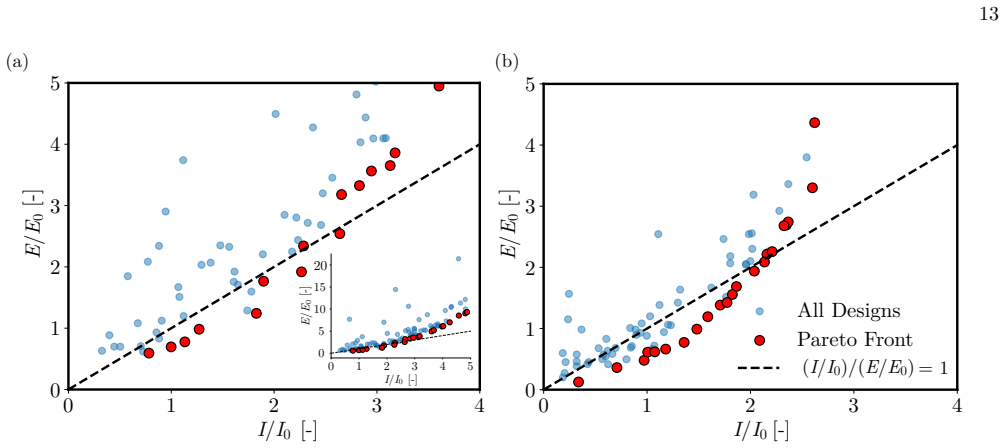
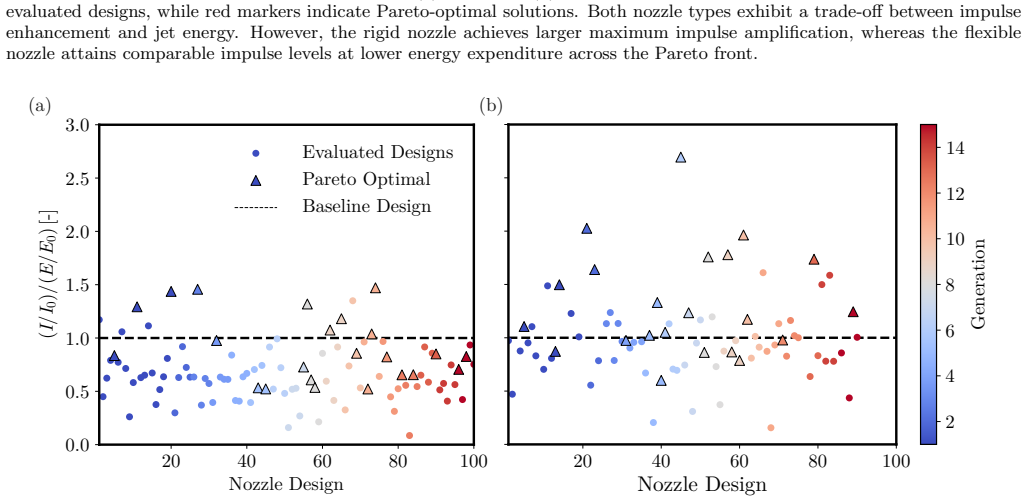
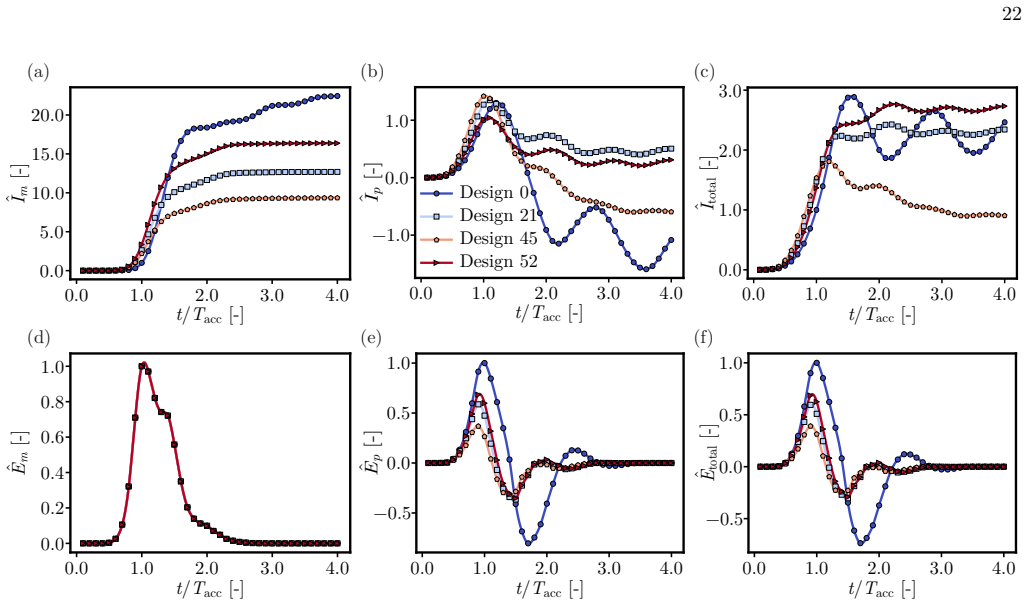
Rigid nozzles achieve the highest impulse amplification, up to 5 times that of a baseline cylindrical nozzle, but at substantially increased energy expenditure. In contrast, flexible nozzles yield lower peak impulse enhancement of about 2.5 times while achieving significantly greater propulsion efficiency. The maximum normalized impulse-to-energy ratio for flexible nozzles is about 1.8 times higher than that of rigid configurations, indicating more effective conversion of input energy into useful propulsive output.
What carries the argument
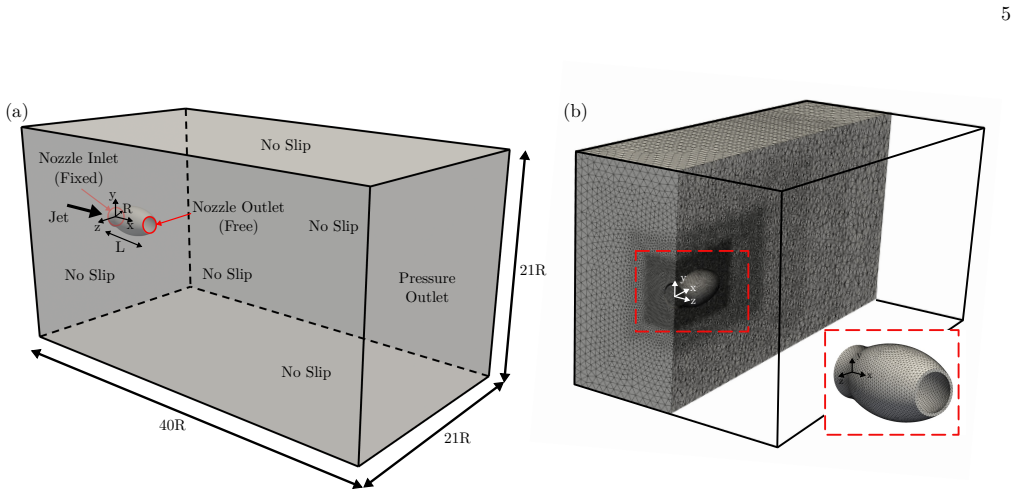
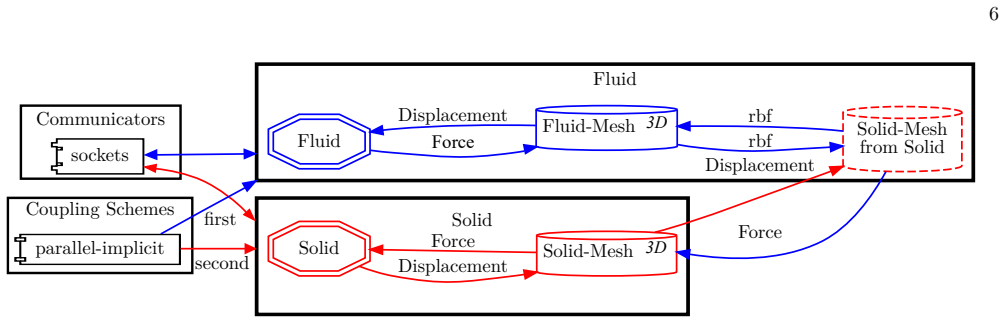
Multi-objective Bayesian optimization framework integrated with three-dimensional fluid-structure interaction simulations that identifies nozzle designs maximizing hydrodynamic impulse while minimizing jet energy input.
If this is right
- Rigid nozzles enhance performance through geometry-induced internal entrainment, secondary vortex formation, and contraction-driven jet acceleration, producing stronger vortex circulation and downstream convection.
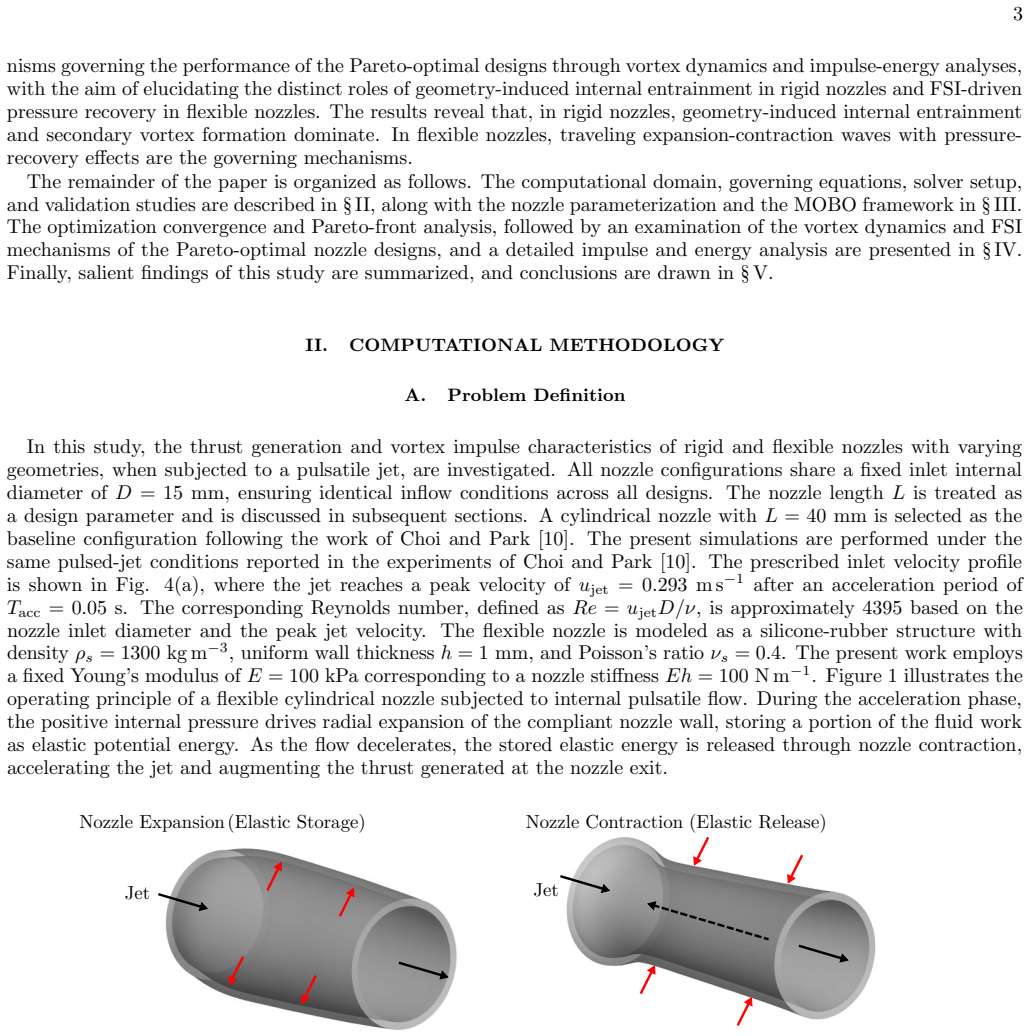
- Flexible nozzles use traveling expansion-contraction deformation waves that promote additional entrainment during expansion and accelerate internally entrained fluid during contraction.
- Flexible nozzles improve pressure recovery, reduce pressure-energy expenditure, and mitigate negative pressure impulse contributions.
- Flexible nozzles achieve greater propulsion efficiency despite lower peak impulse than rigid nozzles.
Where Pith is reading between the lines
- The efficiency advantage of flexible nozzles may inform design choices for other underwater propulsion devices that face similar impulse-versus-energy trade-offs.
- Extending the optimization to include objectives such as maneuverability or durability could identify further nozzle variants.
- Direct comparison of simulation predictions against laboratory measurements on physical models would test whether the reported efficiency gap persists outside the computational setting.
Load-bearing premise
The three-dimensional fluid-structure interaction simulations accurately capture the performance trade-offs between rigid and flexible nozzle geometries in pulsed-jet propulsion systems.
What would settle it
Physical prototypes of the optimized rigid and flexible nozzles tested in a pulsed-jet experiment to measure actual impulse and energy input and determine whether the normalized impulse-to-energy ratio is 1.8 times higher for the flexible case.
Figures
read the original abstract
The biomechanics of pulsed-jet propulsion in aquatic animals, including squids and jellyfish, provide valuable insights into energy-efficient locomotion. In these organisms, flexible funnel deformation enables rapid acceleration and maneuverability while minimizing energy use. Drawing inspiration from these biological systems, this study investigates performance trade-offs between rigid and flexible nozzle geometries in pulsed-jet propulsion systems. A multi-objective Bayesian optimization framework integrated with three-dimensional fluid-structure interaction (FSI) simulations identifies nozzle designs that maximize hydrodynamic impulse and minimize jet energy input. The optimization reveals fundamentally distinct performance characteristics for rigid and flexible nozzles. Rigid nozzles achieve the highest impulse amplification, up to 5 times that of a baseline cylindrical nozzle, but at substantially increased energy expenditure. In contrast, flexible nozzles yield lower peak impulse enhancement of about 2.5 times while achieving significantly greater propulsion efficiency. The maximum normalized impulse-to-energy ratio for flexible nozzles is about 1.8 times higher than that of rigid configurations, indicating more effective conversion of input energy into useful propulsive output. Analysis of the flow physics shows that optimized rigid nozzles enhance performance through geometry-induced internal entrainment, secondary vortex formation, and contraction-driven jet acceleration. This results in stronger vortex circulation and downstream convection. Flexible nozzles use traveling expansion-contraction deformation waves that promote additional entrainment during expansion and accelerate the internally entrained fluid during contraction to improve pressure recovery, reduce pressure-energy expenditure, and mitigate negative pressure impulse contributions.
Editorial analysis
A structured set of objections, weighed in public.
Referee Report
Summary. The manuscript applies multi-objective Bayesian optimization coupled to 3D fluid-structure interaction simulations to identify rigid and flexible nozzle geometries that maximize hydrodynamic impulse while minimizing input energy for pulsed-jet propulsion. It reports that optimized rigid nozzles achieve up to 5× the impulse of a baseline cylindrical nozzle (at higher energy cost), while flexible nozzles reach ~2.5× impulse with a maximum normalized impulse-to-energy ratio ~1.8× higher than rigid designs, attributing the difference to geometry-induced entrainment and traveling deformation waves.
Significance. If the 3D FSI predictions are quantitatively reliable, the work would usefully quantify performance trade-offs between rigid and deforming nozzles and identify distinct flow mechanisms (internal entrainment, secondary vortices, expansion-contraction waves) that could guide bio-inspired propulsor design. The Bayesian optimization framework itself is a methodological strength for high-dimensional design exploration. However, the central 1.8× efficiency claim rests entirely on unvalidated simulation outputs, limiting the current significance.
major comments (2)
- [Abstract] Abstract: the quantitative multipliers (5× impulse for rigid, 2.5× for flexible, 1.8× normalized impulse-to-energy ratio) are the load-bearing results, yet no mesh-convergence data, time-step independence tests, or experimental benchmarks for the baseline or optimized cases are referenced. Any systematic bias in vortex capture or pressure recovery that differs between rigid and deforming geometries would directly alter the reported 1.8× ratio.
- [Methods and Results] Methods/Results sections: the three-dimensional FSI model is used to compute both impulse and energy for the efficiency comparison, but the manuscript supplies no validation (grid resolution, boundary-condition sensitivity, or comparison to known rigid-nozzle experiments) that would confirm the simulations are accurate enough for relative performance statements between the two classes of geometry.
minor comments (2)
- [Abstract] Notation for the normalized impulse-to-energy ratio should be defined explicitly (including any normalization constants) the first time it appears.
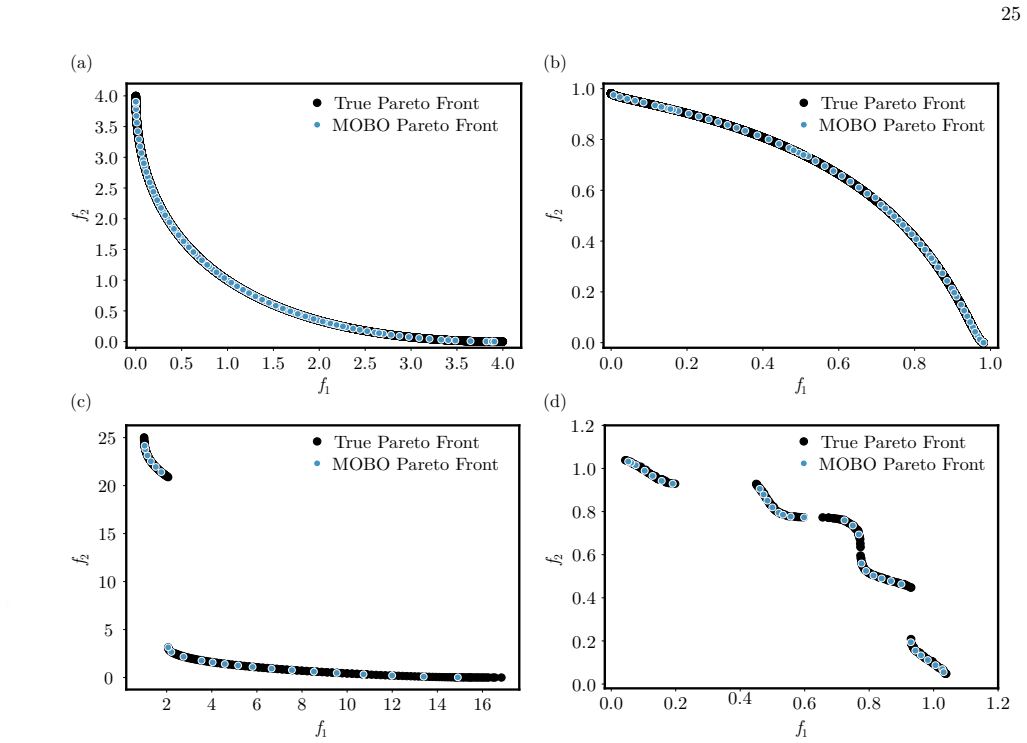
- [Figures] Figure captions should state the number of optimization evaluations or Pareto-front points shown to allow readers to assess sampling density.
Simulated Author's Rebuttal
We thank the referee for the constructive comments on validation requirements for the FSI simulations. We agree that supporting numerical evidence is needed to strengthen the quantitative claims and will revise the manuscript accordingly. Below we respond point by point.
read point-by-point responses
-
Referee: [Abstract] Abstract: the quantitative multipliers (5× impulse for rigid, 2.5× for flexible, 1.8× normalized impulse-to-energy ratio) are the load-bearing results, yet no mesh-convergence data, time-step independence tests, or experimental benchmarks for the baseline or optimized cases are referenced. Any systematic bias in vortex capture or pressure recovery that differs between rigid and deforming geometries would directly alter the reported 1.8× ratio.
Authors: We accept that the abstract multipliers require supporting convergence evidence. In the revised manuscript we will add dedicated mesh-convergence and time-step independence studies performed on both representative rigid and flexible geometries, reporting L2 norms or integrated impulse/energy changes under successive refinement. These tests will be placed in a new subsection of Methods and referenced from the abstract and results. Regarding differential bias between rigid and deforming cases, the same solver, turbulence model, and boundary conditions are applied uniformly; any residual discretization error is therefore expected to affect both classes similarly, preserving the relative 1.8× ratio. Experimental benchmarks are outside the present computational scope but will be noted as future work. revision: yes
-
Referee: [Methods and Results] Methods/Results sections: the three-dimensional FSI model is used to compute both impulse and energy for the efficiency comparison, but the manuscript supplies no validation (grid resolution, boundary-condition sensitivity, or comparison to known rigid-nozzle experiments) that would confirm the simulations are accurate enough for relative performance statements between the two classes of geometry.
Authors: We agree that explicit validation details are currently insufficient. The revised Methods section will include (i) grid-resolution studies with quantitative convergence metrics for impulse and energy, (ii) boundary-condition sensitivity tests (inlet waveform, far-field placement), and (iii) direct comparison of baseline rigid-nozzle results against published experimental and numerical data for pulsed jets. These additions will be used to justify the reliability of relative performance statements. The multi-objective Bayesian optimization itself samples many geometries under identical numerical settings, providing internal consistency checks on trends. revision: yes
Circularity Check
No circularity; claims rest on independent FSI simulations and optimization
full rationale
The paper derives its central 1.8x impulse-to-energy ratio and performance comparisons directly from outputs of 3D fluid-structure interaction simulations coupled to multi-objective Bayesian optimization. These are external computational procedures whose results are not defined in terms of the target metrics or reduced to self-citations. No equations, fitted parameters renamed as predictions, or load-bearing self-citations appear in the abstract or described methodology. The derivation chain is therefore self-contained against the simulation framework rather than tautological.
Axiom & Free-Parameter Ledger
Reference graph
Works this paper leans on
-
[1]
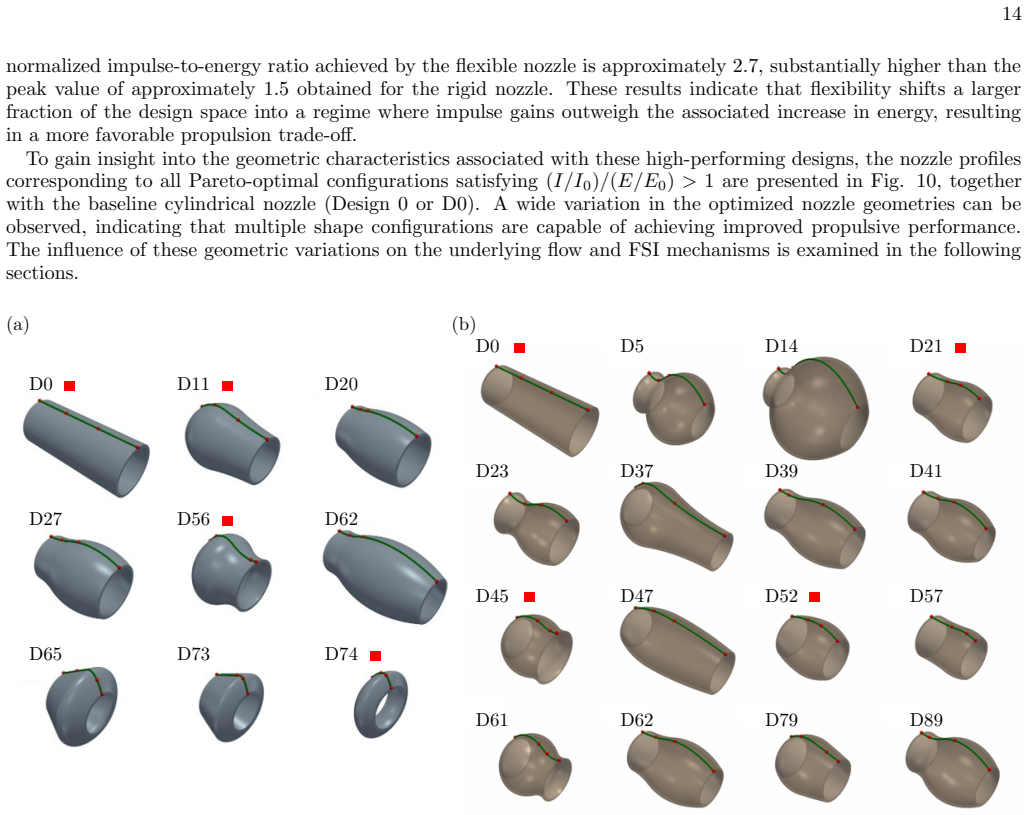
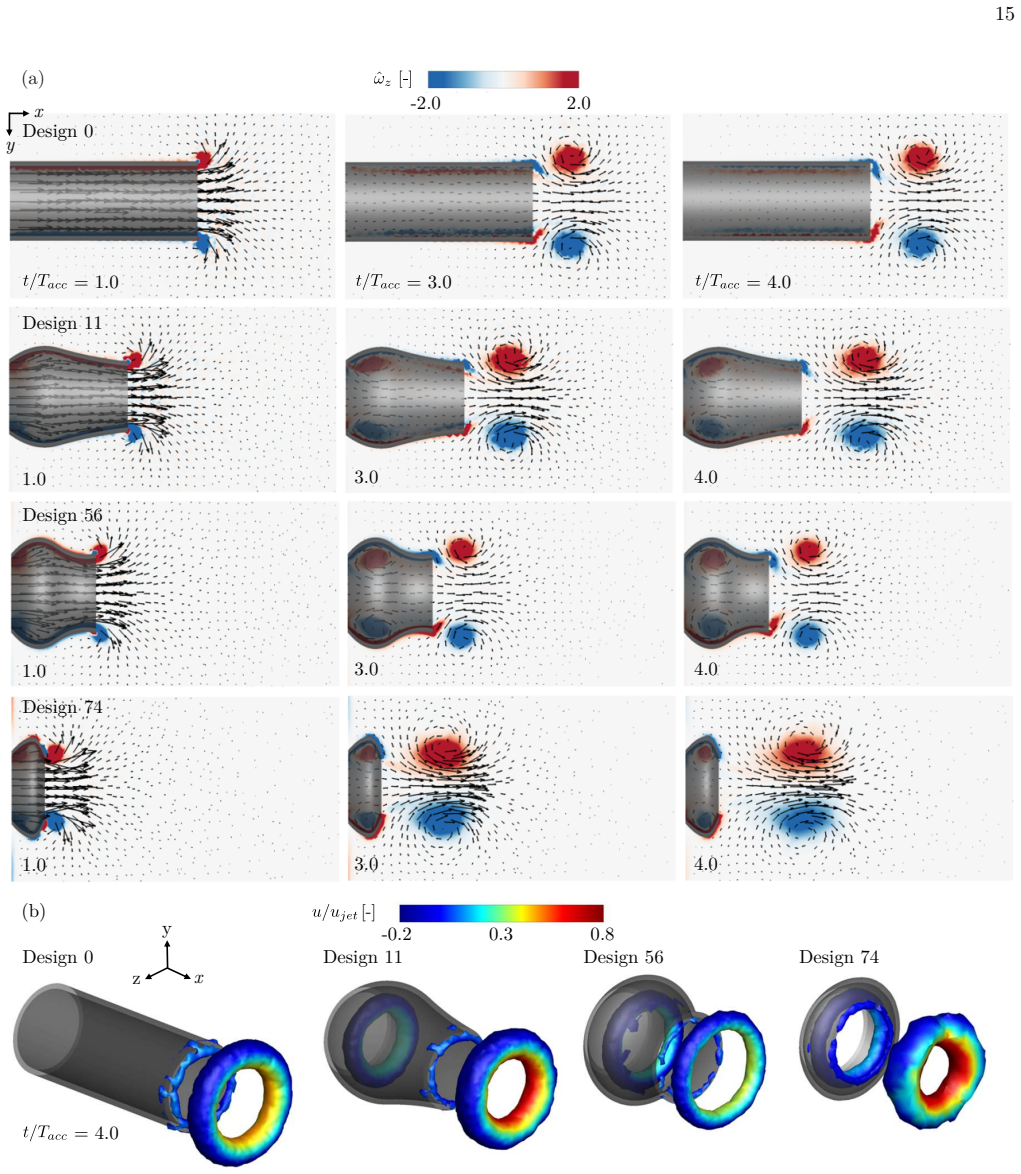
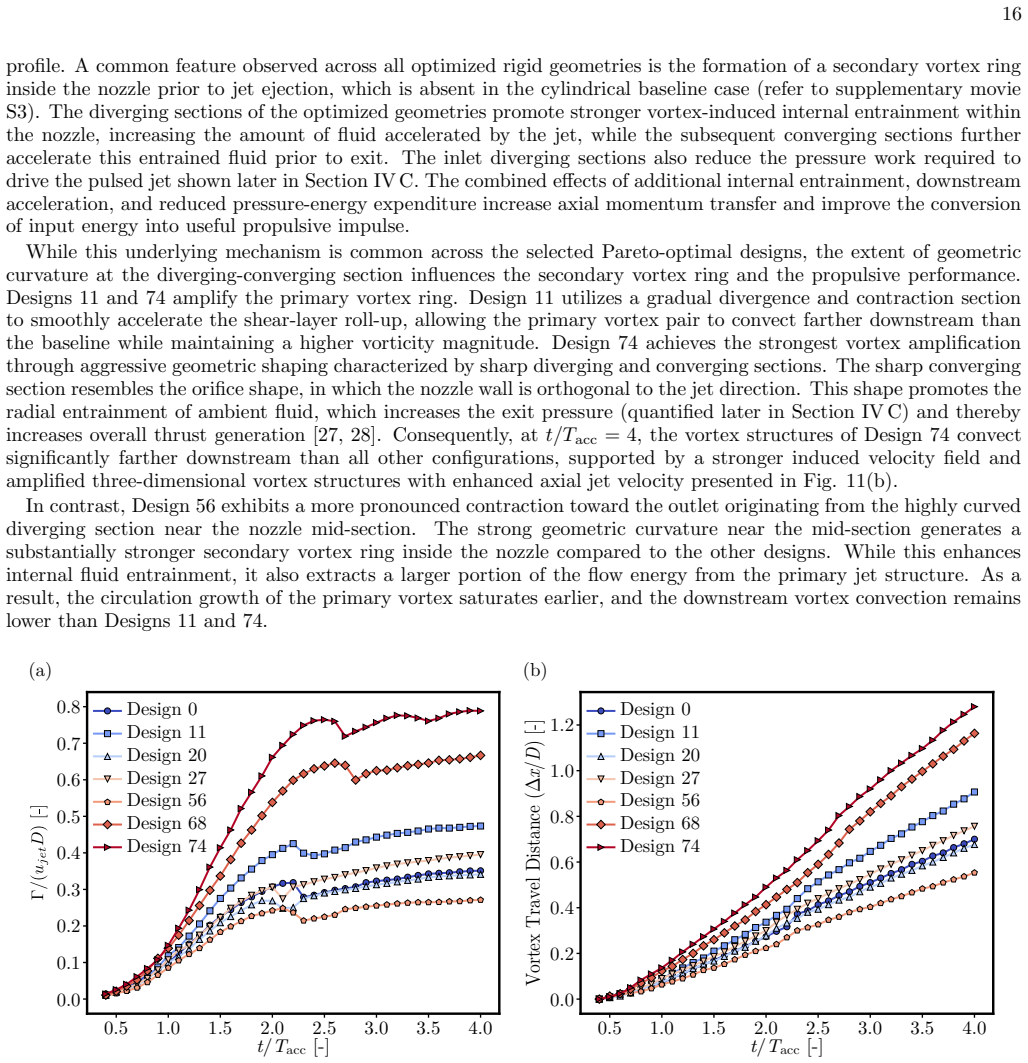
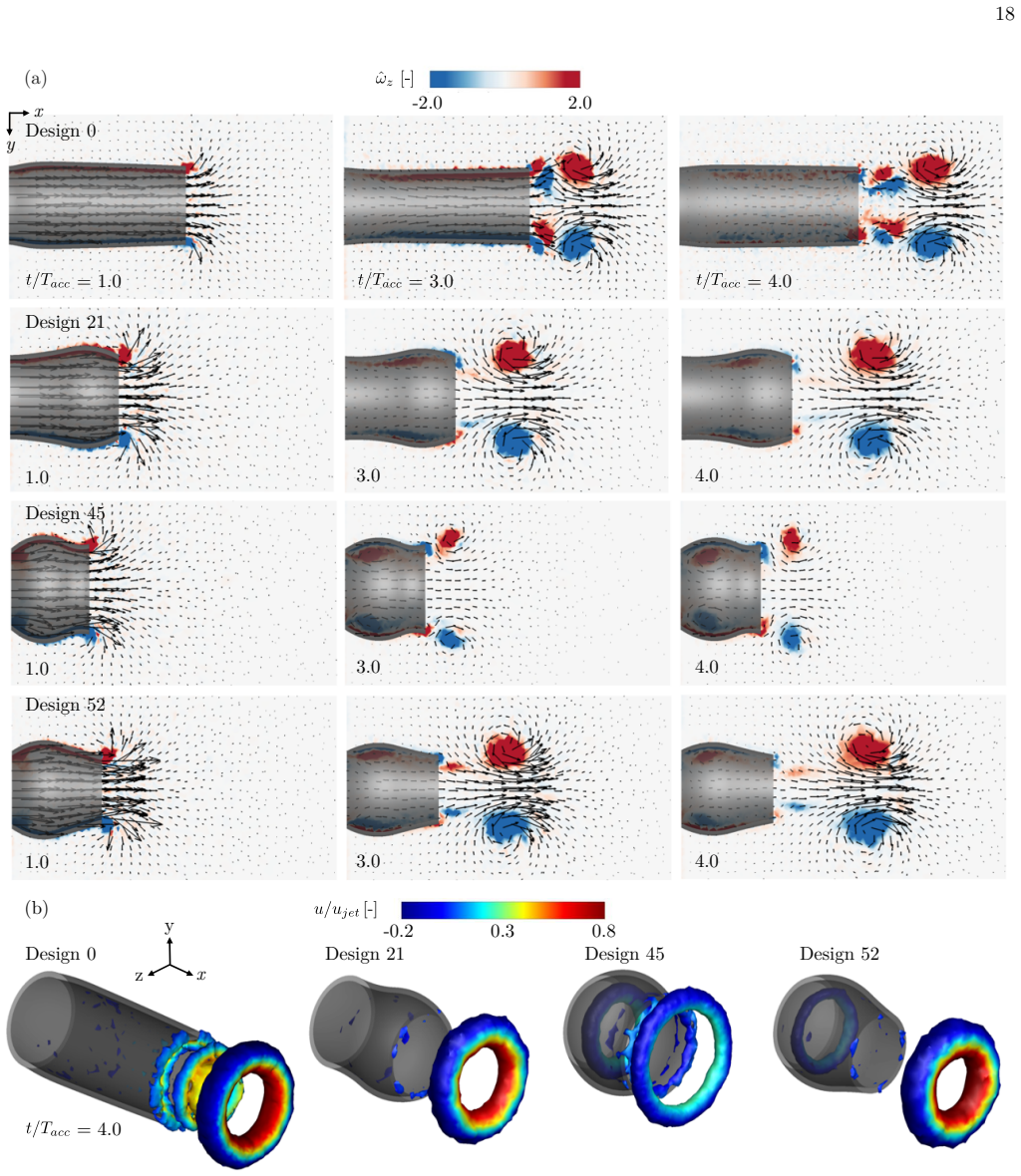
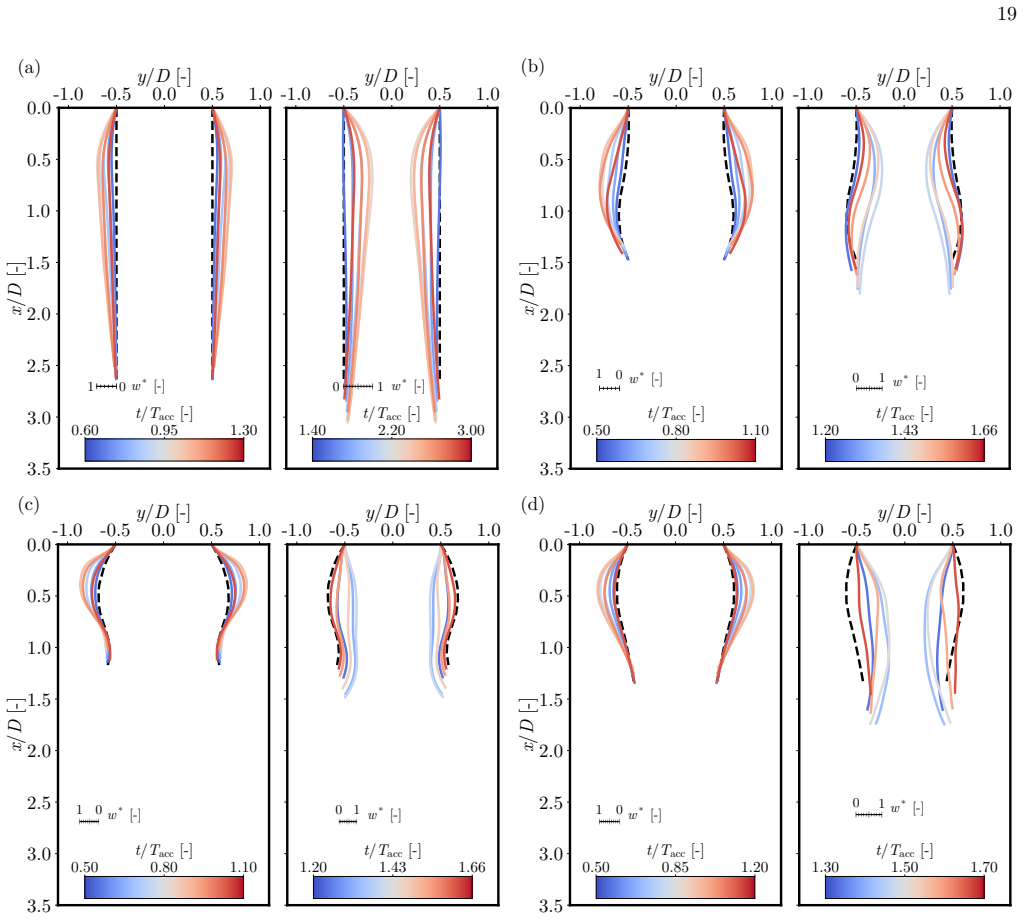
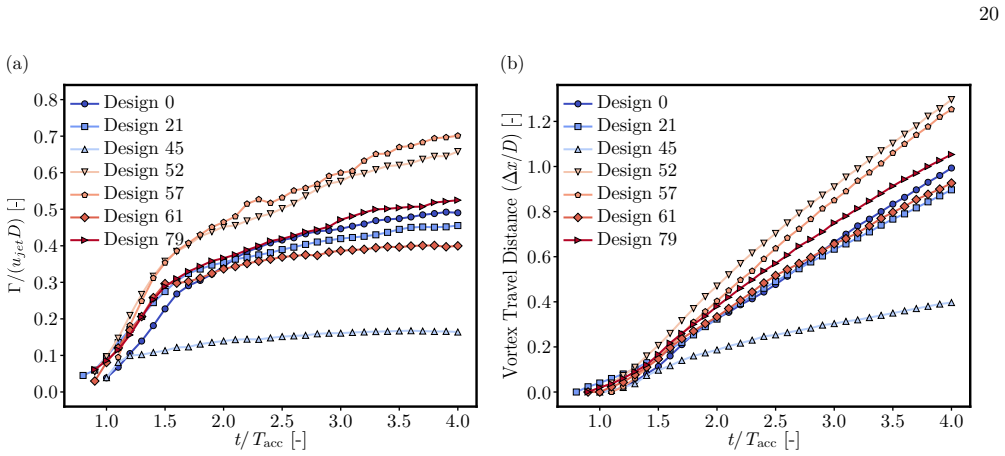
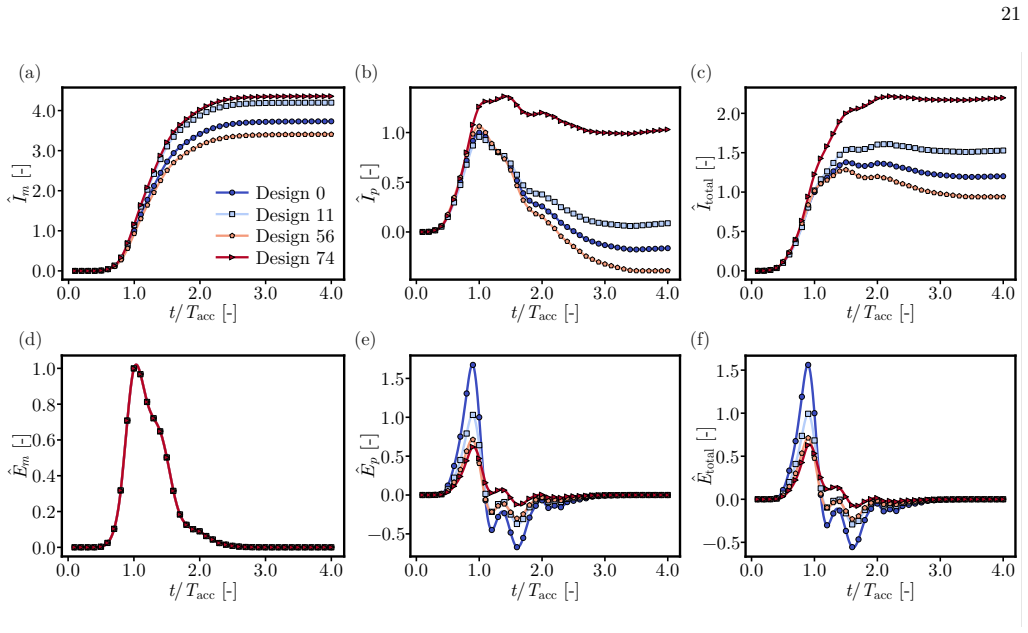
Rigid Nozzles For the rigid nozzles, we select Designs 11, 56, and 74 with (I/I0)/(E/E0) values of 1.29, 1.32, and 1.47, respectively. The influence of the optimized rigid geometries on the jet dynamics is investigated through the out-of-plane normalized vorticity contours, ˆωz =ω zD/ujet, with velocity vectors on the centralx-ycross-sectional plane shown...
-
[2]
13(a), along with the corresponding three-dimensional vortex struc- tures visualized using theQ-criterion iso-surfaces in Fig
Flexible Nozzles Similar to the rigid nozzles, the vortex dynamics of the flexible nozzles are analyzed using the normalized vorticity contours and velocity-vector fields shown in Fig. 13(a), along with the corresponding three-dimensional vortex struc- tures visualized using theQ-criterion iso-surfaces in Fig. 13(b). For the Pareto-optimal flexible nozzle...
2022
-
[3]
J. H. Costello, S. P. Colin, J. O. Dabiri, B. J. Gemmell, K. N. Lucas, and K. R. Sutherland, The hydrodynamics of jellyfish swimming, Annual Review of Marine Science13, 375 (2021)
2021
-
[4]
Bujard, F
T. Bujard, F. Giorgio-Serchi, and G. D. Weymouth, A resonant squid-inspired robot unlocks biological propulsive efficiency, Science Robotics6, eabd2971 (2021)
2021
-
[5]
P. S. Krueger and M. Gharib, The significance of vortex ring formation to the impulse and thrust of a starting jet, Physics of Fluids15, 1271 (2003)
2003
-
[6]
Krieg and K
M. Krieg and K. Mohseni, Modelling circulation, impulse and kinetic energy of starting jets with non-zero radial velocity, Journal of Fluid Mechanics719, 488 (2013)
2013
-
[7]
Didden, On the formation of vortex rings: rolling-up and production of circulation, Zeitschrift f¨ ur angewandte Mathe- matik und Physik ZAMP30, 101 (1979)
N. Didden, On the formation of vortex rings: rolling-up and production of circulation, Zeitschrift f¨ ur angewandte Mathe- matik und Physik ZAMP30, 101 (1979). 25 (a) (b) (c) (d) 0.0 0.2 0.4 0.6 0.8 1.0 0.0 0.2 0.4 0.6 0.8 1.0 t 2 4 6 8 10 12 14 16 0 5 10 15 20 25f2 f2 f1 0.0 0.5 1.0 1.5 2.0 2.5 3.0 3.5 4.0 0.0 0.5 1.0 1.5 2.0 2.5 3.0 3.5 4.0 True Pareto ...
1979
-
[8]
Gharib, E
M. Gharib, E. Rambod, and K. Shariff, A universal time scale for vortex ring formation, Journal of Fluid Mechanics360, 121 (1998)
1998
-
[9]
J. O. Dabiri, Optimal vortex formation as a unifying principle in biological propulsion, Annual Review of Fluid Mechanics 41, 17 (2009)
2009
-
[10]
L. Gao, X. Wang, C. Simon, and M. K. Chyu, Development of the impulse and thrust for laminar starting jets with finite discharged volume, Journal of Fluid Mechanics902, A27 (2020)
2020
-
[11]
Choi and H
D. Choi and H. Park, Flow–structure interaction of a starting jet through a flexible circular nozzle, Journal of Fluid Mechanics949, A39 (2022)
2022
-
[12]
Choi and H
D. Choi and H. Park, Mechanism of enhanced impulse and entrainment of a pulsed jet through a flexible nozzle, Journal of Fluid Mechanics996, A6 (2024)
2024
-
[13]
D. Choi, P. Singh, I. Bergerson, M. Kim, J. Park, H. J. Wallace, K. Zhang, S. Y. Hsieh, A. T. Asberry, T. A. Uyeno,et al., Squid-inspired soft superpropulsion, arXiv preprint arXiv:2605.03239 (2026)
work page internal anchor Pith review Pith/arXiv arXiv 2026
-
[14]
Elastic wave propagation governs impulse enhancement in pulsed jets through flexible nozzles
P. Singh, D. Choi, S. Bhamla, and C. Bose, Elastic wave propagation governs impulse enhancement in pulsed jets through flexible nozzles, arXiv preprint arXiv:2605.17319 (2026)
work page internal anchor Pith review Pith/arXiv arXiv 2026
-
[15]
Mitchell and S
B. Mitchell and S. Morris, Formation of multiple vortex rings from passively flexible nozzles, Journal of Fluid Mechanics 1011, A3 (2025)
2025
-
[16]
Morita, S
Y. Morita, S. Rezaeiravesh, N. Tabatabaei, R. Vinuesa, K. Fukagata, and P. Schlatter, Applying bayesian optimization with gaussian process regression to computational fluid dynamics problems, Journal of Computational Physics449, 110788 (2022)
2022
-
[17]
P. I. Frazier, A tutorial on bayesian optimization, arXiv preprint arXiv:1807.02811 (2018)
work page internal anchor Pith review Pith/arXiv arXiv 2018
-
[18]
Konakovic Lukovic, Y
M. Konakovic Lukovic, Y. Tian, and W. Matusik, Diversity-guided multi-objective bayesian optimization with batch evaluations, Advances in Neural Information Processing Systems33, 17708 (2020). 26
2020
-
[19]
P. P. Galuzio, E. H. de Vasconcelos Segundo, L. dos Santos Coelho, and V. C. Mariani, Mobopt—multi-objective bayesian optimization, SoftwareX12, 100520 (2020)
2020
-
[20]
H. G. Weller, G. Tabor, H. Jasak, and C. Fureby, A tensorial approach to computational continuum mechanics using object-oriented techniques, Computers in Physics12, 620 (1998)
1998
-
[21]
Dhondt, Calculix crunchix user’s manual version 2.12, Munich, Germany, accessed Sept21, 2017 (2017)
G. Dhondt, Calculix crunchix user’s manual version 2.12, Munich, Germany, accessed Sept21, 2017 (2017)
2017
-
[22]
Miranda, R
I. Miranda, R. M. Ferencz, and T. J. Hughes, An improved implicit-explicit time integration method for structural dynamics, Earthquake engineering & structural dynamics18, 643 (1989)
1989
-
[23]
Chourdakis, D
G. Chourdakis, D. Schneider, and B. Uekermann, Openfoam-precice: Coupling openfoam with external solvers for multi- physics simulations, OpenFOAM®Journal3, 1 (2023)
2023
-
[24]
I. B. Celik, U. Ghia, P. J. Roache, and C. J. Freitas, Procedure for estimation and reporting of uncertainty due to discretization in CFD applications, Journal of Fluids Engineering-Transactions of the ASME130(2008)
2008
-
[25]
Balandat, B
M. Balandat, B. Karrer, D. R. Jiang, S. Daulton, B. Letham, A. G. Wilson, and E. Bakshy, BoTorch: A Framework for Efficient Monte-Carlo Bayesian Optimization, inAdvances in Neural Information Processing Systems 33(2020)
2020
-
[26]
Ament, S
S. Ament, S. Daulton, D. Eriksson, M. Balandat, and E. Bakshy, Unexpected improvements to expected improvement for bayesian optimization, Advances in Neural Information Processing Systems36, 20577 (2023)
2023
-
[27]
Daulton, M
S. Daulton, M. Balandat, and E. Bakshy, Differentiable expected hypervolume improvement for parallel multi-objective bayesian optimization, Advances in Neural Information Processing Systems33, 9851 (2020)
2020
-
[28]
K. Yang, M. Emmerich, A. Deutz, and T. B¨ ack, Efficient computation of expected hypervolume improvement using box decomposition algorithms, Journal of Global Optimization75, 3 (2019)
2019
-
[29]
Krieg and K
M. Krieg and K. Mohseni, Pressure and work analysis of unsteady, deformable, axisymmetric, jet producing cavity bodies, Journal of Fluid Mechanics769, 337 (2015)
2015
-
[30]
Limbourg and J
R. Limbourg and J. Nedi´ c, Formation of an orifice-generated vortex ring, Journal of Fluid Mechanics913, A29 (2021)
2021
-
[31]
P. P. Galuzio, E. H. de Vasconcelos Segundo, L. dos Santos Coelho, and V. C. Mariani, MOBOpt — multi-objective Bayesian optimization, SoftwareX12, 100520 (2020)
2020
discussion (0)
Sign in with ORCID, Apple, or X to comment. Anyone can read and Pith papers without signing in.