REVIEW 3 major objections 6 minor 132 references
Analysis of Forbidden Neon Emission lines in HAeBe Stars using Spitzer IRS spectra
T0 review · 3 major / 6 minor · reviewed 2026-08-07 · deepseek-v4-flash
Pith's one-line read The paper argues that in 25 of 78 Herbig Ae/Be stars, extreme ultraviolet radiation, not X-ray irradiation, drives forbidden neon emission, implicating EUV photoevaporation or irradiated disk atmospheres in disk dispersal.
desk verdict The neon catalog is real and useful; the EUV-driver conclusion is plausible but under-supported by the X-ray data. read the letter →
The pith
A machine-rendered reading of the paper's core claim, the machinery that carries it, and where it could break.
The reading
What carries the argument
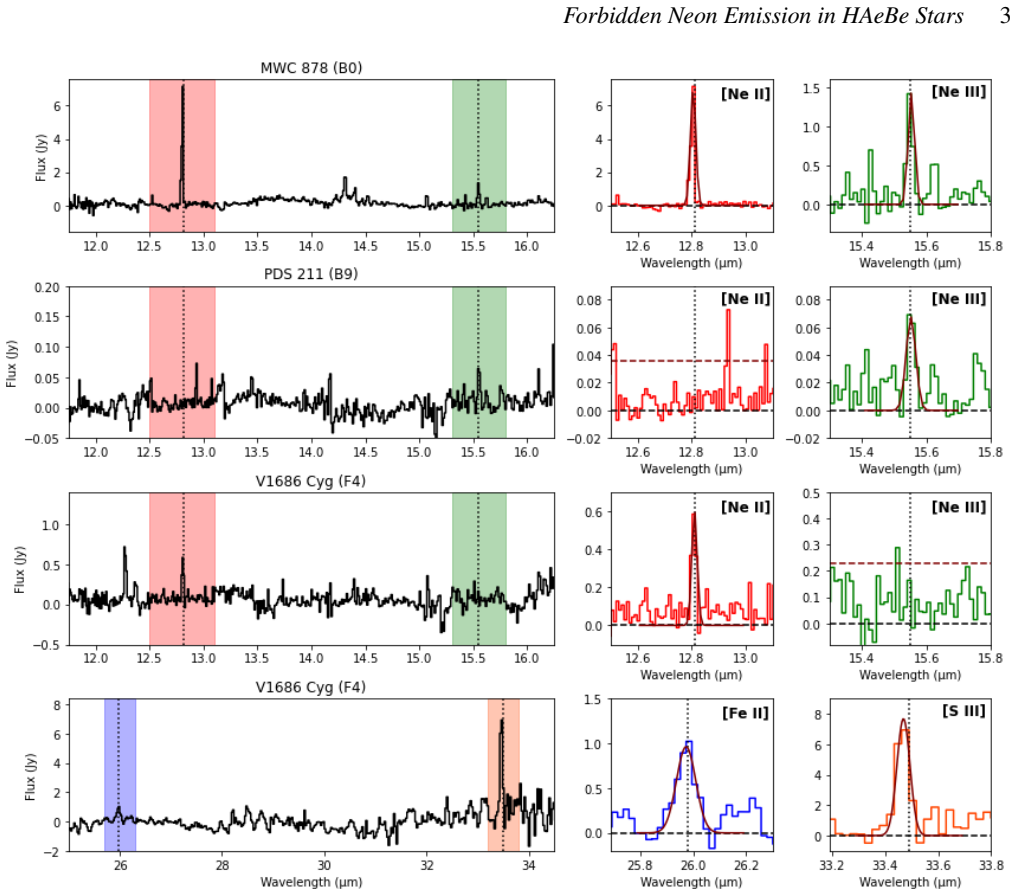
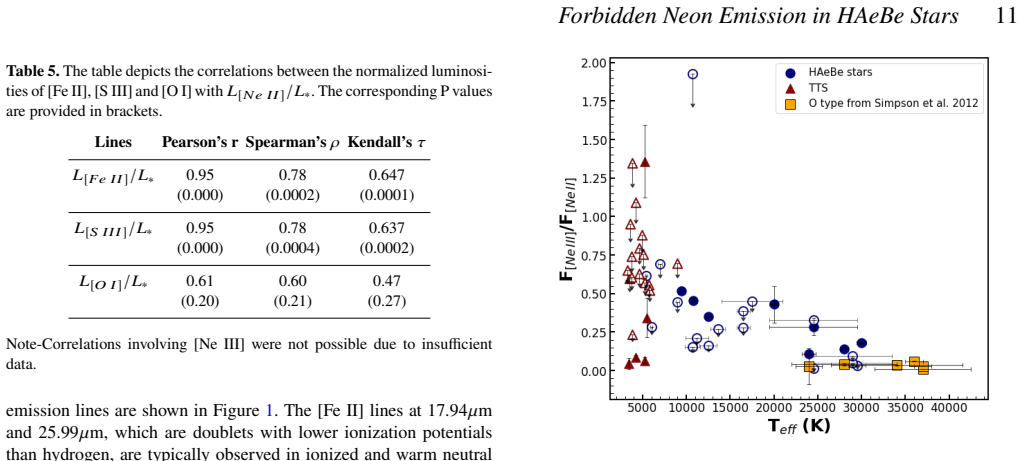
The central diagnostic object is the [Ne III]-to-[Ne II] line flux ratio, calibrated for T Tauri disks in the models of Glassgold et al. (2007) and Hollenbach & Gorti (2009). The calibration separates ionization regimes: X-ray-dominated regions give ratios below 0.1 because charge exchange with neutral hydrogen converts Ne III back to Ne II, whereas EUV-dominated regions are more fully ionized, keeping the ratio above 0.1 and potentially above 1. The paper applies this threshold to its 25 Herbig Ae/Be detections — eight sources with both lines, all with ratios between 0.1 and 1 — and combines it with the absence of any X-ray luminosity correlation to single out the EUV interpretation. Supporting machinery includes the Meeus Group I/II classification of flared versus settled disks, which organizes the finding that flared Group I sources dominate the detections while settled Group II sources show higher neon output per stellar luminosity.
What would settle it
Measure the EUV luminosities of the 25 neon-emitting stars, the data the paper explicitly lacks: if EUV flux does not scale with the measured [Ne II] and [Ne III] luminosities across the sample, the claim that EUV drives the emission fails. A second decisive test is deep X-ray exposure of the 14 neon-detected stars with no X-ray detection, which would show whether their absence is real or a sensitivity limit.
Extended reading notes
Core claim
The paper's central claim is that forbidden neon emission in Herbig Ae/Be stars is produced by EUV radiation rather than by X-ray irradiation. In support, the authors show that the relative [Ne II] luminosity has no significant correlation with X-ray luminosity (Pearson $r = -0.12$, Spearman $\rho = -0.22$) or with accretion luminosity, that neon-detected sources preferentially show the EUV-associated lines [Fe II] at 25.99 $\mu$m (17 of 25 sources) and [S III] at 33.49 $\mu$m (19 of 25 sources), which in turn correlate strongly with [Ne II] ($r = 0.95$), and that the eight sources with both neon lines have [Ne III]/[Ne II] flux ratios between 0.1 and 1, the regime previously calibrated for T Tauri disks as indicating hard X-ray or soft EUV dominance. Because the X-ray correlation tests rule out the X-ray branch of that diagnostic, the paper concludes that EUV radiation drives the emission, originating from photoevaporative winds or irradiated disk atmospheres. The authors further connect neon emission to the disk dispersal phase: detection is more frequent at low relative accretion luminosity ($L_{\mathrm{acc}}/L_* < 0.1$), and 75% of the classified neon emitters belong to the flared Group I disk morphology.
Load-bearing premise
The argument rests on the assumption that the [Ne III]-to-[Ne II] ratio thresholds calibrated for T Tauri disks transfer correctly to Herbig Ae/Be disks, and that the 14 neon-emitting stars with no detected X-rays are genuinely X-ray weak rather than merely not observed deeply enough.
Editorial extensions
If this is right
- If EUV radiation is the primary driver, disk dispersal in Herbig Ae/Be stars is governed by the star's EUV output rather than its X-ray activity, changing which intermediate-mass young stars are predicted to lose their planet-forming material first.
- Neon emission becomes a practical tracer of the disk dispersal phase: detection prefers sources with low relative accretion luminosity ($L_{\mathrm{acc}}/L_* < 0.1$), so [Ne II] can mark disks nearing the end of their accretion lifetime.
- The higher median [Ne II] output per stellar luminosity in settled Group II disks suggests photoevaporation can be more efficient in those geometries, a trend the authors caution requires larger samples to confirm.
- The reported 3$\sigma$ upper limits imply that more sensitive JWST-MIRI observations may reveal fainter neon emission in the 53 non-detected stars, but are unlikely to find line fluxes exceeding these limits.
Reading between the lines
- If the EUV-primary claim generalizes, disk-evolution models for intermediate-mass stars should adopt EUV-driven photoevaporation mass-loss rates rather than scaling X-ray-driven rates calibrated on T Tauri disks, which shifts predicted disk lifetimes depending on the EUV-to-X-ray ratio.
- The ratio diagnostic validated here could be run over JWST-MIRI samples to map which disks are EUV- versus X-ray-dominated across a wider stellar-mass range, turning a two-line ratio into a population-level disk-dispersal census.
- The paper's disk-geometry argument yields a spatial prediction testable with integral-field mid-infrared spectroscopy: neon emission should trace the outer flared surface in Group I disks but concentrate near the inner rim in Group II disks.
- The 14 neon-emitting stars without X-ray detections are the key tension point; a dedicated deep X-ray campaign on those specific targets would determine whether the claimed X-ray independence reflects genuine X-ray weakness or survey sensitivity limits.
Editorial analysis
A structured set of objections, weighed in public.
Referee Report
Summary. This paper presents a homogeneous mid-infrared spectroscopic survey of forbidden neon emission in 78 HAeBe stars using Spitzer IRS high-resolution spectra drawn from the SSHC catalog. The authors detect [Ne II] 12.81 μm or [Ne III] 15.55 μm in 25 sources, making this the largest HAeBe neon sample to date; they measure fluxes and luminosities, place 3σ upper limits for the 53 non-detections, and compare neon properties with accretion luminosity, X-ray luminosity, disk morphology (Meeus groups, n(2−25)), and other forbidden lines. Based on the absence of an X-ray correlation, the high detection rates of [Fe II] and [S III], and [Ne III]/[Ne II] ratios between 0.1 and 1, the paper concludes that EUV radiation, rather than X-rays, is the primary driver of neon emission and that photoevaporative winds or irradiated disk atmospheres are the likely emission sites.
Significance. The observational catalog is a genuine contribution: the detection criteria are explicit (3σ peak threshold, Gaussian fits), the upper-limit tables are complete for non-detections, and the comparison with T Tauri data is useful. If the EUV conclusion were established, it would materially revise the common view that X-ray irradiation dominates [Ne II] in intermediate-mass disks, so the paper addresses an important question. However, as argued below, the decisive step—excluding X-ray driving—is built on censored data treated as detections of absence, and the line-ratio diagnostic cannot by itself distinguish hard X-rays from soft EUV. The strength of the catalog stands independently of the physical conclusion.
major comments (3)
- [§3.2.2, Figure 5, Table 1] The conclusion that X-rays are not the primary driver ('only 40% showed X-ray detection... statistically indicates...') treats non-detections as meaningful absences, but no X-ray upper limits are provided for the 14 neon-emitting stars that lack X-ray detections—Table 1 lists '...' in the L_X column for those sources, and Table C1 provides limits only for the 53 non-neon stars. A non-detection in heterogeneous Chandra/XMM-Newton/eROSITA observations with different exposures, spectral responses, and line-of-sight N_H is not equivalent to a low L_X; if these stars have faint or absorbed X-ray emission, the absence of a L_X–L[NeII] correlation in Figure 5 is uninformative. The paper must either derive per-source X-ray upper limits and re-run the correlation with survival analysis, or explicitly restrict the conclusion to X-ray-detected subsamples.
- [§3.2.5 and §4] The EUV conclusion also relies on the [Ne III]/[Ne II] ratio, but the paper itself states that ratios between 0.1 and 1 can be produced by either hard X-rays or soft EUV radiation. Since the X-ray exclusion is invalid without upper limits (Major Comment 1), the remaining evidence—high [S III] and [Fe II] detection rates and strong correlations among these lines—is consistent with EUV but does not rule out hard X-ray ionization in a partly ionized layer. A model-based comparison that folds in the actual stellar EUV luminosities and X-ray upper limits is needed before 'EUV radiation is the primary driver' can be stated as a conclusion rather than a hypothesis.
- [Section 3.2.3 and Abstract] The statement that Group II sources exhibit a higher median L[NeII]/L* (5.35 × 10^-6 versus 2.33 × 10^-6) is based on 5 versus 15 detections with no significance test or quoted uncertainty on the medians. This is presented as evidence for enhanced photoevaporation in settled disks, but the small samples cannot support that inference; a bootstrap or rank test should be reported, and the sentence should be phrased as a tentative trend. A similar caution applies to the L_acc/L* < 0.1 detection-frequency claim in §3.2.1, where the threshold is introduced without justification or a test of its robustness.
minor comments (6)
- [Table 2] The header line '[Ne III]& [Ne III]' appears to be a formatting error; the three column groups should be labeled [Ne II], [Ne III], and both lines.
- [Table 1 caption] The meaning of '...' in the L_X column should be stated explicitly (no observation, non-detection, or not applicable), since the paper's X-ray argument depends on this distinction.
- [Section 3.2.3] The text cites '75% (15 out of 20) belong to Group I' with the denominator Meeus-classified neon sources, but elsewhere the same fraction is quoted without the denominator; please clarify in both the abstract and text.
- [Section 3.2.4] The in-text reference 'Table 3.2.4' should be 'Table 4'.
- [Figure 2] The lower panel includes upper limits for non-detections, but the statement that L[NeII]/L* is uniform across spectral types is not supported by any statistical test; adding a rank correlation or quoting the scatter would strengthen the claim.
- [References] Several references in the bibliography are incomplete or non-standard (for example 'Meeus Waters...' and 'Rigliaco E., et al., 2015'), and the citation style is not consistently MNRAS; a careful reference cleanup would improve the manuscript.
Circularity Check
No significant circularity: neon measurements are independent and the EUV interpretation is externally benchmarked; self-citations are data sources, not load-bearing results.
full rationale
The neon detections are raw measurements: the paper identifies lines by a 3-sigma threshold and fits Gaussians (Section 3.1), and the flux/luminosity values in Tables 1 and 2 are not constructed from the EUV conclusion. The central claim that EUV radiation is the primary driver is benchmarked against external models, Glassgold et al. (2007) and Hollenbach & Gorti (2009), for the [Ne III]-to-[Ne II] ratio diagnostic, and against the high detection rates of [Fe II] and [S III] (Sections 3.2.4-3.2.5). No parameter is fitted to a subset of the neon data and then predicted for another subset; no uniqueness theorem from the authors' prior work is invoked; and no ansatz is smuggled in via self-citation. The self-referenced inputs are data products, not conclusions: the SSHC catalog (Arun et al. 2023, overlapping authors) supplies the parent Spitzer IRS sample, and Anilkumar et al. (2024, overlapping authors) supplies Chandra X-ray luminosities. Neither is equivalent to the paper's target result. The paper's own limitation statements, notably 'our sample lacked direct measurements of EUV emission' (Section 4) and the treatment of 14 neon-emitting stars without X-ray detections as non-detections without quoted upper limits (Section 3.2.2), create a robustness gap in the X-ray exclusion argument, but this is evidential underdetermination rather than a circular reduction. No circular step can be exhibited from the paper's equations or citations.
Assumptions & free parameters
free parameters (1)
- L_acc/L_* < 0.1 threshold =
<0.1
assumptions (4)
- domain assumption The [NeIII]/[NeII] flux ratio diagnostic from Glassgold et al. (2007) and Hollenbach & Gorti (2009) correctly separates X-ray from EUV ionization regimes in HAeBe disks.
- domain assumption X-ray non-detections in 14 neon-emitting stars indicate negligible X-ray luminosity rather than survey sensitivity limits.
- domain assumption The Cardelli et al. (1989) extinction law and stellar, accretion, and distance parameters from Vioque et al. (2018) and Guzman-Diaz et al. (2021) are accurate.
- domain assumption The Pontoppidan et al. (2010) H2O contamination criterion correctly identifies whether [NeIII] is blended with water lines.
Cite this review
Pith. "Pith review of Analysis of Forbidden Neon Emission lines in HAeBe Stars using Spitzer IRS spectra." pith.science (2026). https://pith.science/paper/LNHWKUUU
@misc{pith2026250601036,
  author       = {Pith},
  title        = {Pith review of: Analysis of Forbidden Neon Emission lines in HAeBe Stars using Spitzer IRS spectra},
  year         = {2026},
  howpublished = {\url{https://pith.science/paper/LNHWKUUU}},
  note         = {Machine review of arXiv:2506.01036}
}
abstract
We analyzed high-resolution mid-infrared spectra of 78 well-known Herbig Ae/Be (HAeBe) stars using Spitzer InfraRed Spectrograph data, focusing on the detection of [Ne {\sc II}] and [Ne {\sc III}] emission lines as indicators of ionized outflows or disk winds. Emission from [Ne {\sc II}] at 12.81 $\mu$m or [Ne {\sc III}] at 15.55 $\mu$m was identified in 25 sources, constituting the largest sample of HAeBe stars with these detected lines. Our analysis revealed a higher detection frequency of [Ne {\sc II}] in sources with lower relative accretion luminosity (L$_{acc}$/L$_*$ $<$ 0.1), suggesting a connection to the disk dispersal phase. We examined correlations between neon lines and various spectral features and investigated [Ne {\sc III}]-to-[Ne {\sc II}] line flux ratios to explore potential emission mechanisms. Neon emission is predominantly observed in Group I sources (75\%), where their flared disk geometry likely contributes to the observed emission, potentially originating from the irradiated disk atmosphere. Interestingly, we also find that Group II sources exhibit a higher median relative [Ne\,\textsc{ii}] line luminosity (L$_\mathrm{[Ne\,II]}$/L$_*$), suggesting enhanced photoevaporation rates possibly associated with their more settled disk structures. However, larger samples and higher-resolution spectra are required to confirm this trend definitively. The high detection rate of the [Fe {\sc II}] and [S {\sc III}] lines, commonly associated with EUV-dominated regions, alongside a [Ne {\sc III}]-to-[Ne {\sc II}] emission ratio greater than 0.1 in sources where both lines detected, suggests that EUV radiation is the primary driver of neon emission in our sample.
Figures


Figures from the paper (5 more)


Reference graph
Works this paper leans on
-
[1]
write newline
" write newline "" before.all 'output.state := FUNCTION fin.entry write newline FUNCTION new.block output.state before.all = 'skip after.block 'output.state := if FUNCTION new.sentence output.state after.block = 'skip output.state before.all = 'skip after.sentence 'output.state := if if FUNCTION not #0 #1 if FUNCTION and 'skip pop #0 if FUNCTION or pop #1...
-
[2]
Ababakr K. M., Fairlamb J. R., Oudmaijer R. D., van den Ancker M. E., 2015, @doi [ ] 10.1093/mnras/stv1483 , https://ui.adsabs.harvard.edu/abs/2015MNRAS.452.2566A 452, 2566
-
[3]
Acke van den Ancker, M. E. Dullemond, C. P. 2005, @doi [A&A] 10.1051/0004-6361:20042484 , 436, 209
-
[4]
Adams S. C., Ádámkovics M., Carr J. S., Najita J. R., Brittain S. D., 2019, @doi [The Astrophysical Journal] 10.3847/1538-4357/aaf9a4 , 871, 173
-
[5]
Alcolea Neri, R. Bujarrabal, V. 2007, @doi [A&A] 10.1051/0004-6361:20066956 , 468, L41
-
[6]
Alexander R. D., 2008, @doi [ ] 10.1111/j.1745-3933.2008.00556.x , https://ui.adsabs.harvard.edu/abs/2008MNRAS.391L..64A 391, L64
arXiv 2008
-
[7]
Alexander R. D., Clarke C. J., Pringle J. E., 2005, @doi [ ] 10.1111/j.1365-2966.2005.08786.x , https://ui.adsabs.harvard.edu/abs/2005MNRAS.358..283A 358, 283
arXiv 2005
-
[9]
Allard F., Homeier D., Freytag B., 2011, in Johns-Krull C., Browning M. K., West A. A., eds, Astronomical Society of the Pacific Conference Series Vol. 448, 16th Cambridge Workshop on Cool Stars, Stellar Systems, and the Sun. p. 91 ( @eprint arXiv 1011.5405 ), @doi 10.48550/arXiv.1011.5405
Show all 132 references
-
[10]
Allard F., Homeier D., Freytag B., 2012, @doi [Philosophical Transactions of the Royal Society of London Series A] 10.1098/rsta.2011.0269 , https://ui.adsabs.harvard.edu/abs/2012RSPTA.370.2765A 370, 2765
2012
-
[11]
S., Manoj P., Narang M., Chavali M., 2024, @doi [ ] 10.1093/mnras/stae938 , https://ui.adsabs.harvard.edu/abs/2024MNRAS.530.3020A 530, 3020
Anilkumar H., Mathew B., Jithesh V., Kartha S. S., Manoj P., Narang M., Chavali M., 2024, @doi [ ] 10.1093/mnras/stae938 , https://ui.adsabs.harvard.edu/abs/2024MNRAS.530.3020A 530, 3020
2024 doi
-
[12]
Antonellini et al., 2016, @doi [A&A] 10.1051/0004-6361/201526787 , 585, A61
2016 doi
-
[13]
A., 1996, in Jacoby G
Arnaud K. A., 1996, in Jacoby G. H., Barnes J., eds, Astronomical Society of the Pacific Conference Series Vol. 101, Astronomical Data Analysis Software and Systems V. p. 17
1996
-
[14]
S., Narang M., 2023, @doi [Monthly Notices of the Royal Astronomical Society] 10.1093/mnras/stad1511 , 523, 1601
Arun R., Mathew B., Manoj P., Maheswar G., Shridharan B., Kartha S. S., Narang M., 2023, @doi [Monthly Notices of the Royal Astronomical Society] 10.1093/mnras/stad1511 , 523, 1601
2023 doi
-
[15]
J., Scott P., 2009, @doi [ ] 10.1146/annurev.astro.46.060407.145222 , https://ui.adsabs.harvard.edu/abs/2009ARA&A..47..481A 47, 481
Asplund M., Grevesse N., Sauval A. J., Scott P., 2009, @doi [ ] 10.1146/annurev.astro.46.060407.145222 , https://ui.adsabs.harvard.edu/abs/2009ARA&A..47..481A 47, 481
2009
-
[16]
Astropy Collaboration et al., 2022, @doi [ ] 10.3847/1538-4357/ac7c74 , https://ui.adsabs.harvard.edu/abs/2022ApJ...935..167A 935, 167
2022 doi
-
[17]
Babel J., Montmerle T., 1997, , https://ui.adsabs.harvard.edu/abs/1997A&A...323..121B 323, 121
1997
-
[18]
S., et al., 2024, @doi [The Astronomical Journal] 10.3847/1538-3881/ad22e1 , 167, 127
Bajaj N. S., et al., 2024, @doi [The Astronomical Journal] 10.3847/1538-3881/ad22e1 , 167, 127
2024 doi
-
[19]
Baldovin-Saavedra C., et al., 2011, @doi [Astronomy & amp; Astrophysics] 10.1051/0004-6361/201015622 , 528, A22
2011 doi
-
[20]
M., Skinner S
Baldovin-Saavedra C., Audard M., Carmona A., G \"u del M., Briggs K., Rebull L. M., Skinner S. L., Ercolano B., 2012, @doi [ ] 10.1051/0004-6361/201118329 , https://ui.adsabs.harvard.edu/abs/2012A&A...543A..30B 543, A30
2012 doi
-
[21]
D., Cuello N., Pinte C., Price D
Ballabio G., Nealon R., Alexander R. D., Cuello N., Pinte C., Price D. J., 2021, @doi [Monthly Notices of the Royal Astronomical Society] 10.1093/mnras/stab922 , 504, 888
2021 doi
-
[22]
J., Tennyson J., Harris G
Barber R. J., Tennyson J., Harris G. J., Tolchenov R. N., 2006, @doi [ ] 10.1111/j.1365-2966.2006.10184.x , https://ui.adsabs.harvard.edu/abs/2006MNRAS.368.1087B 368, 1087
2006
-
[23]
Bastian U., Mundt R., 1979, , https://ui.adsabs.harvard.edu/abs/1979A&AS...36...57B 36, 57
1979
-
[24]
Bayo A., Rodrigo C., Barrado Y Navascu \'e s D., Solano E., Guti \'e rrez R., Morales-Calder \'o n M., Allard F., 2008, @doi [ ] 10.1051/0004-6361:200810395 , https://ui.adsabs.harvard.edu/abs/2008A&A...492..277B 492, 277
2008 doi
-
[25]
Benisty M., et al., 2013, @doi [Astronomy and Astrophysics] 10.1051/0004-6361/201219893 , 555
2013 doi
-
[26]
McGraw-Hill Education, https://books.google.co.in/books?id=0poQAQAAIAAJ
Bevington P., Robinson D., 2003, Data Reduction and Error Analysis for the Physical Sciences. McGraw-Hill Education, https://books.google.co.in/books?id=0poQAQAAIAAJ
2003
-
[27]
Bouwman J., Meeus G., de Koter A., Hony S., Dominik C., Waters L. B. F. M., 2001, @doi [ ] 10.1051/0004-6361:20010878 , https://ui.adsabs.harvard.edu/abs/2001A&A...375..950B 375, 950
2001 doi
-
[28]
R., Gould R
Burbidge G. R., Gould R. J., Pottasch S. R., 1963, @doi [Astrophysical Journal (U.S.)] 10.1086/147697
1963 doi
-
[29]
E., Dalgarno A., 1980, @doi [ ] 10.1086/158395 , https://ui.adsabs.harvard.edu/abs/1980ApJ...241..838B 241, 838
Butler S. E., Dalgarno A., 1980, @doi [ ] 10.1086/158395 , https://ui.adsabs.harvard.edu/abs/1980ApJ...241..838B 241, 838
1980 doi
-
[30]
A., Clayton G
Cardelli J. A., Clayton G. C., Mathis J. S., 1989, @doi [ ] 10.1086/167900 , https://ui.adsabs.harvard.edu/abs/1989ApJ...345..245C 345, 245
1989 doi
-
[31]
A., Krause M
Carlson T. A., Krause M. O., 1965, @doi [Phys. Rev.] 10.1103/PhysRev.137.A1655 , 137, A1655
1965 doi
-
[32]
D'Alessio P., Calvet N., Hartmann L., Lizano S., Cant \'o J., 1999, @doi [ ] 10.1086/308103 , https://ui.adsabs.harvard.edu/abs/1999ApJ...527..893D 527, 893
1999 doi
-
[33]
P., Dominik C., 2004, @doi [ ] 10.1051/0004-6361:20031768 , https://ui.adsabs.harvard.edu/abs/2004A&A...417..159D 417, 159
Dullemond C. P., Dominik C., 2004, @doi [ ] 10.1051/0004-6361:20031768 , https://ui.adsabs.harvard.edu/abs/2004A&A...417..159D 417, 159
2004 doi
-
[34]
Earl N., et al., 2023, astropy/specutils: v1.12.0, @doi 10.5281/zenodo.10016569 , https://doi.org/10.5281/zenodo.10016569
2023 doi
-
[35]
J., Drake J
Ercolano B., Clarke C. J., Drake J. J., 2009, @doi [The Astrophysical Journal] 10.1088/0004-637X/699/2/1639 , 699, 1639
2009 doi
-
[36]
Espaillat C., et al., 2007, @doi [ ] 10.1086/520879 , https://ui.adsabs.harvard.edu/abs/2007ApJ...664L.111E 664, L111
2007 doi
-
[37]
Espaillat C., et al., 2012, @doi [The Astrophysical Journal] 10.1088/0004-637X/762/1/62 , 762, 62
2012 doi
-
[38]
C., et al., 2023, @doi [The Astrophysical Journal Letters] 10.3847/2041-8213/ad023d , 958, L4
Espaillat C. C., et al., 2023, @doi [The Astrophysical Journal Letters] 10.3847/2041-8213/ad023d , 958, L4
2023 doi
-
[39]
R., Oudmaijer R
Fairlamb J. R., Oudmaijer R. D., Mendigutia I., Ilee J. D., van den Ancker M. E., 2016, @doi [Monthly Notices of the Royal Astronomical Society] 10.1093/mnras/stw2643 , 464, 4721
2016 doi
-
[40]
P., Dent W
Fedele D., Pascucci I., Brittain S., Kamp I., Woitke P., Williams J. P., Dent W. R. F., Thi W.-F., 2011, @doi [The Astrophysical Journal] 10.1088/0004-637X/732/2/106 , 732, 106
2011 doi
-
[41]
Sciortino, S
Flaccomio Stelzer, B. Sciortino, S. Micela, G. Pillitteri, I. Testi, L. 2009, @doi [A&A] 10.1051/0004-6361/200810972 , 505, 695
2009 doi
-
[42]
Gabriel C., 2017, in Ness J.-U., Migliari S., eds, The X-ray Universe 2017. p. 84
2017
-
[43]
V., et al., 2005, @doi [ ] 10.1086/432092 , https://ui.adsabs.harvard.edu/abs/2005ApJS..160..319G 160, 319
Getman K. V., et al., 2005, @doi [ ] 10.1086/432092 , https://ui.adsabs.harvard.edu/abs/2005ApJS..160..319G 160, 319
2005 doi
-
[44]
Ghosh A., et al., 2023, @doi [Journal of Astrophysics and Astronomy] 10.1007/s12036-023-09939-7 , https://ui.adsabs.harvard.edu/abs/2023JApA...44...50G 44, 50
2023 doi
-
[45]
E., Najita J
Glassgold A. E., Najita J. R., Igea J., 2007, @doi [The Astrophysical Journal] 10.1086/510013 , 656, 515
2007 doi
-
[46]
W., 1993, @doi [ ] 10.1086/191788 , https://ui.adsabs.harvard.edu/abs/1993ApJS...86..499G 86, 499
Goodrich R. W., 1993, @doi [ ] 10.1086/191788 , https://ui.adsabs.harvard.edu/abs/1993ApJS...86..499G 86, 499
1993 doi
-
[47]
P., Hollenbach D., 2009, @doi [The Astrophysical Journal] 10.1088/0004-637X/705/2/1237 , 705, 1237
Gorti U., Dullemond C. P., Hollenbach D., 2009, @doi [The Astrophysical Journal] 10.1088/0004-637X/705/2/1237 , 705, 1237
2009 doi
-
[48]
P., Wilking B
Greene T. P., Wilking B. A., Andre P., Young E. T., Lada C. J., 1994, @doi [ ] 10.1086/174763 , https://ui.adsabs.harvard.edu/abs/1994ApJ...434..614G 434, 614
1994 doi
-
[49]
G., Donati J
Gregory S. G., Donati J. F., Morin J., Hussain G. A. J., Mayne N. J., Hillenbrand L. A., Jardine M., 2012, @doi [ ] 10.1088/0004-637X/755/2/97 , https://ui.adsabs.harvard.edu/abs/2012ApJ...755...97G 755, 97
2012 doi
-
[50]
J., 1998, @doi [ ] 10.1023/A:1005161325181 , https://ui.adsabs.harvard.edu/abs/1998SSRv...85..161G 85, 161
Grevesse N., Sauval A. J., 1998, @doi [ ] 10.1023/A:1005161325181 , https://ui.adsabs.harvard.edu/abs/1998SSRv...85..161G 85, 161
1998 doi
-
[51]
E., et al., 2000, @doi [Advances in Space Research] 10.1016/S0273-1177(99)00854-6 , https://ui.adsabs.harvard.edu/abs/2000AdSpR..25..853G 25, 853
Griffiths R. E., et al., 2000, @doi [Advances in Space Research] 10.1016/S0273-1177(99)00854-6 , https://ui.adsabs.harvard.edu/abs/2000AdSpR..25..853G 25, 853
2000 doi
-
[52]
P., Kozlova O
Grinin V. P., Kozlova O. V., Natta A., Ilyin I., Tuominen I., Rostopchina A. N., Shakhovskoy D. N., 2001, @doi [ ] 10.1051/0004-6361:20011280 , https://ui.adsabs.harvard.edu/abs/2001A&A...379..482G 379, 482
2001 doi
-
[53]
P., Rostopchina A
Grinin V. P., Rostopchina A. N., Barsunova O. Y., Demidova T. V., 2010, @doi [Astrophysics] 10.1007/s10511-010-9128-7 , https://ui.adsabs.harvard.edu/abs/2010Ap.....53..367G 53, 367
2010 doi
-
[54]
G \"u del M., et al., 2010, @doi [ ] 10.1051/0004-6361/200913971 , https://ui.adsabs.harvard.edu/abs/2010A&A...519A.113G 519, A113
2010 doi
-
[55]
M., Schmitt J
G \"u nther H. M., Schmitt J. H. M. M., 2009, @doi [ ] 10.1051/0004-6361:200811007 , https://ui.adsabs.harvard.edu/abs/2009A&A...494.1041G 494, 1041
2009 doi
-
[56]
Guzman-Diaz J., et al., 2021, @doi [VizieR Online Data Catalog] 10.26093/cds/vizier.36500182 , https://ui.adsabs.harvard.edu/abs/2021yCat..36500182G pp J/A+A/650/A182
2021 doi
-
[57]
E., 1992, @doi [ ] 10.1086/191716 , https://ui.adsabs.harvard.edu/abs/1992ApJS...82..285H 82, 285
Hamann F., Persson S. E., 1992, @doi [ ] 10.1086/191716 , https://ui.adsabs.harvard.edu/abs/1992ApJS...82..285H 82, 285
1992 doi
-
[58]
Hartigan P., Raymond J., Hartmann L., 1987, @doi [ ] 10.1086/165204 , https://ui.adsabs.harvard.edu/abs/1987ApJ...316..323H 316, 323
1987 doi
-
[59]
Hartigan P., Edwards S., Ghandour L., 1995, @doi [ ] 10.1086/176344 , https://ui.adsabs.harvard.edu/abs/1995ApJ...452..736H 452, 736
1995 doi
-
[60]
Hartmann L., Calvet N., Gullbring E., D'Alessio P., 1998, @doi [ ] 10.1086/305277 , https://ui.adsabs.harvard.edu/abs/1998ApJ...495..385H 495, 385
1998 doi
-
[61]
H., 1960, @doi [ ] 10.1086/190050 , https://ui.adsabs.harvard.edu/abs/1960ApJS....4..337H 4, 337
Herbig G. H., 1960, @doi [ ] 10.1086/190050 , https://ui.adsabs.harvard.edu/abs/1960ApJS....4..337H 4, 337
1960 doi
-
[62]
Hern \'a ndez J., Calvet N., Brice \ n o C., Hartmann L., Berlind P., 2004, @doi [ ] 10.1086/381908 , https://ui.adsabs.harvard.edu/abs/2004AJ....127.1682H 127, 1682
2004 doi
-
[63]
C., Keto E., 2007, @doi [The Astrophysical Journal] 10.1086/511260 , 658, 314
Ho L. C., Keto E., 2007, @doi [The Astrophysical Journal] 10.1086/511260 , 658, 314
2007 doi
-
[64]
Hollenbach D., Gorti U., 2009, @doi [The Astrophysical Journal] 10.1088/0004-637X/703/2/1203 , 703, 1203
2009 doi
-
[65]
Hollenbach D., Mckee 1989, @doi [Astrophysical Journal; (USA)] 10.1086/167595 , 342
1989 doi
-
[66]
R., et al., 2004, @doi [The Astrophysical Journal Supplement Series] 10.1086/423134 , 154, 18
Houck J. R., et al., 2004, @doi [The Astrophysical Journal Supplement Series] 10.1086/423134 , 154, 18
2004 doi
-
[68]
Imanishi K., Nakajima H., Tsujimoto M., Koyama K., Tsuboi Y., 2003, @doi [ ] 10.1093/pasj/55.3.653 , https://ui.adsabs.harvard.edu/abs/2003PASJ...55..653I 55, 653
2003 doi
-
[69]
J., Neufeld D
Kaufman M. J., Neufeld D. A., 1996, @doi [ ] 10.1086/176683 , https://ui.adsabs.harvard.edu/abs/1996ApJ...456..611K 456, 611
1996 doi
-
[70]
H., et al., 2016, @doi [The Astrophysical Journal Supplement Series] 10.3847/0067-0049/226/1/8 , 226, 8
Kim K. H., et al., 2016, @doi [The Astrophysical Journal Supplement Series] 10.3847/0067-0049/226/1/8 , 226, 8
2016 doi
-
[71]
Koumpia et al., 2019, @doi [A&A] 10.1051/0004-6361/201834624 , 623, L5
2019 doi
-
[72]
D., Weigelt G., 2012, @doi [The Astrophysical Journal Letters] 10.1088/2041-8205/746/1/L2 , 746, L2
Kraus S., Calvet N., Hartmann L., Hofmann K.-H., Kreplin A., Monnier J. D., Weigelt G., 2012, @doi [The Astrophysical Journal Letters] 10.1088/2041-8205/746/1/L2 , 746, L2
2012 doi
-
[73]
O., Vestal M
Krause M. O., Vestal M. L., Johnston W. H., Carlson T. A., 1964, @doi [Phys. Rev.] 10.1103/PhysRev.133.A385 , 133, A385
1964 doi
-
[74]
J., 1987, in Peimbert M., Jugaku J., eds, IAU Symposium Vol
Lada C. J., 1987, in Peimbert M., Jugaku J., eds, IAU Symposium Vol. 115, Star Forming Regions. p. 1
1987
-
[75]
F., Blake G
Lahuis F., van Dishoeck E. F., Blake G. A., Neal J. Evans I., Kessler-Silacci J. E., Pontoppidan K. M., 2007, @doi [The Astrophysical Journal] 10.1086/518931 , 665, 492
2007 doi
-
[76]
J., Spoon H
Lebouteiller V., Barry D. J., Spoon H. W. W., Bernard-Salas J., Sloan G. C., Houck J. R., Weedman D. W., 2011, @doi [ ] 10.1088/0067-0049/196/1/8 , https://ui.adsabs.harvard.edu/abs/2011ApJS..196....8L 196, 8
2011 doi
-
[77]
J., Goes C., Sloan G
Lebouteiller V., Barry D. J., Goes C., Sloan G. C., Spoon H. W. W., Weedman D. W., Bernard-Salas J., Houck J. R., 2015, @doi [The Astrophysical Journal Supplement Series] 10.1088/0067-0049/218/2/21 , 218, 21
2015 doi
-
[78]
A., 1976, @doi [ ] 10.1086/130015 , https://ui.adsabs.harvard.edu/abs/1976PASP...88..712L 88, 712
Levato H., Abt H. A., 1976, @doi [ ] 10.1086/130015 , https://ui.adsabs.harvard.edu/abs/1976PASP...88..712L 88, 712
1976 doi
-
[79]
M., 2014, @doi [ ] 10.1088/0004-637X/796/2/74 , https://ui.adsabs.harvard.edu/abs/2014ApJ...796...74L 796, 74
Li D., Mari \ n as N., Telesco C. M., 2014, @doi [ ] 10.1088/0004-637X/796/2/74 , https://ui.adsabs.harvard.edu/abs/2014ApJ...796...74L 796, 74
2014 doi
-
[80]
M., Herczeg G
Liu C.-F., Shang H., Walter F. M., Herczeg G. J., 2014, @doi [The Astrophysical Journal] 10.1088/0004-637X/786/2/99 , 786, 99
2014 doi
-
[81]
C., 2002, Bulletin of the Astronomical Society of India, https://ui.adsabs.harvard.edu/abs/2002BASI...30..657M 30, 657
Manoj P., Maheswar G., Bhatt H. C., 2002, Bulletin of the Astronomical Society of India, https://ui.adsabs.harvard.edu/abs/2002BASI...30..657M 30, 657
2002
-
[82]
Manoj P., et al., 2011, @doi [The Astrophysical Journal Supplement Series] 10.1088/0067-0049/193/1/11 , 193, 11
2011 doi
-
[83]
Mathew B., et al., 2018, @doi [The Astrophysical Journal] 10.3847/1538-4357/aab3d8 , 857, 30
2018 doi
-
[84]
Meeus Waters, L. B. F. M. Bouwman, J. van den Ancker, M. E. Waelkens, C. Malfait, K. 2001, @doi [A&A] 10.1051/0004-6361:20000144 , 365, 476
2001 doi
-
[85]
Mehner et al., 2016, @doi [A&A] 10.1051/0004-6361/201527180 , 585, A81
2016 doi
-
[86]
E., Najita J
Meijerink R., Glassgold A. E., Najita J. R., 2008, @doi [ ] 10.1086/527411 , https://ui.adsabs.harvard.edu/abs/2008ApJ...676..518M 676, 518
2008 doi
-
[87]
D., Rigliaco E., Fairlamb J
Mendigutía I., Oudmaijer R. D., Rigliaco E., Fairlamb J. R., Calvet N., Muzerolle J., Cunningham N., Lumsden S. L., 2015, @doi [Monthly Notices of the Royal Astronomical Society] 10.1093/mnras/stv1540 , 452, 2837
2015 doi
-
[88]
Merloni A., et al., 2024, @doi [ ] 10.1051/0004-6361/202347165 , https://ui.adsabs.harvard.edu/abs/2024A&A...682A..34M 682, A34
2024 doi
-
[89]
R., Carr J
Najita J. R., Carr J. S., Strom S. E., Watson D. M., Pascucci I., Hollenbach D., Gorti U., Keller L., 2010, @doi [ ] 10.1088/0004-637X/712/1/274 , https://ui.adsabs.harvard.edu/abs/2010ApJ...712..274N 712, 274
2010 doi
-
[90]
Narang M., et al., 2024, @doi [The Astrophysical Journal Letters] 10.3847/2041-8213/ad1de3 , 962, L16
2024 doi
-
[91]
Nisini B., et al., 2024, @doi [The Astrophysical Journal] 10.3847/1538-4357/ad3d5a , 967, 168
2024 doi
-
[92]
Oliveira I., et al., 2010, @doi [ ] 10.1088/0004-637X/714/1/778 , https://ui.adsabs.harvard.edu/abs/2010ApJ...714..778O 714, 778
2010 doi
-
[93]
D., Drew J
Oudmaijer R. D., Drew J. E., 1999, @doi [ ] 10.1046/j.1365-8711.1999.02383.x , https://ui.adsabs.harvard.edu/abs/1999MNRAS.305..166O 305, 166
1999
-
[94]
Pascucci I., et al., 2007, @doi [The Astrophysical Journal] 10.1086/518535 , 663, 383
2007 doi
-
[95]
Pascucci I., et al., 2011, @doi [ ] 10.1088/0004-637X/736/1/13 , https://ui.adsabs.harvard.edu/abs/2011ApJ...736...13P 736, 13
2011 doi
-
[96]
P., Brooks K
Pascucci I., Ricci L., Gorti U., Hollenbach D., Hendler N. P., Brooks K. J., Contreras Y., 2014, @doi [ ] 10.1088/0004-637X/795/1/1 , https://ui.adsabs.harvard.edu/abs/2014ApJ...795....1P 795, 1
2014 doi
-
[97]
Pascucci I., et al., 2020, @doi [The Astrophysical Journal] 10.3847/1538-4357/abba3c , 903, 78
2020 doi
-
[98]
K., 2023, in Inutsuka S., Aikawa Y., Muto T., Tomida K., Tamura M., eds, Astronomical Society of the Pacific Conference Series Vol
Pascucci I., Cabrit S., Edwards S., Gorti U., Gressel O., Suzuki T. K., 2023, in Inutsuka S., Aikawa Y., Muto T., Tomida K., Tamura M., eds, Astronomical Society of the Pacific Conference Series Vol. 534, Protostars and Planets VII. p. 567 ( @eprint arXiv 2203.10068 ), @doi 10...
-
[99]
Pogodin M., Malanushenko V., Kozlova O., Tarasova T., Franco G., 2006, @doi [Astronomy & Astrophysics - ASTRON ASTROPHYS] 10.1051/0004-6361:20053704 , 452, 551
2006 doi
-
[100]
M., Salyk C., Blake G
Pontoppidan K. M., Salyk C., Blake G. A., Meijerink R., Carr J. S., Najita J., 2010, @doi [ ] 10.1088/0004-637X/720/1/887 , https://ui.adsabs.harvard.edu/abs/2010ApJ...720..887P 720, 887
2010 doi
-
[101]
H., ed., Society of Photo-Optical Instrumentation Engineers (SPIE) Conference Series Vol
Predehl P., et al., 2007, in Siegmund O. H., ed., Society of Photo-Optical Instrumentation Engineers (SPIE) Conference Series Vol. 6686, UV, X-Ray, and Gamma-Ray Space Instrumentation for Astronomy XV. p. 668617, @doi 10.1117/12.733583
2007 doi
-
[102]
Rab C., Baldovin-Saavedra C., Dionatos O., Vorobyov E., G \"u del M., 2016, @doi [ ] 10.1007/s11214-016-0325-5 , https://ui.adsabs.harvard.edu/abs/2016SSRv..205....3R 205, 3
2016 doi
-
[103]
P., Ferreira J., 2021, @doi [ ] 10.1016/j.newar.2021.101615 , https://ui.adsabs.harvard.edu/abs/2021NewAR..9301615R 93, 101615
Ray T. P., Ferreira J., 2021, @doi [ ] 10.1016/j.newar.2021.101615 , https://ui.adsabs.harvard.edu/abs/2021NewAR..9301615R 93, 101615
2021
-
[104]
Rigliaco E., Pascucci I., Gorti U., Edwards S., Hollenbach D., 2013, @doi [The Astrophysical Journal] 10.1088/0004-637X/772/1/60 , 772, 60
2013 doi
-
[105]
Rigliaco E., et al., 2015, @doi [ ] 10.1088/0004-637X/801/1/31 , https://ui.adsabs.harvard.edu/abs/2015ApJ...801...31R 801, 31
2015 doi
-
[106]
M., et al., 2010, @doi [ ] 10.1051/0004-6361/201014856 , https://ui.adsabs.harvard.edu/abs/2010A&A...522A.113R 522, A113
Rucinski S. M., et al., 2010, @doi [ ] 10.1051/0004-6361/201014856 , https://ui.adsabs.harvard.edu/abs/2010A&A...522A.113R 522, A113
2010 doi
-
[107]
E., 1996, @doi [ ] 10.1007/BF00645150 , https://ui.adsabs.harvard.edu/abs/1996Ap&SS.236..285R 236, 285
Ryter C. E., 1996, @doi [ ] 10.1007/BF00645150 , https://ui.adsabs.harvard.edu/abs/1996Ap&SS.236..285R 236, 285
1996 doi
-
[108]
G., et al., 2012, @doi [The Astrophysical Journal] 10.1088/0004-637X/747/2/142 , 747, 142
Sacco G. G., et al., 2012, @doi [The Astrophysical Journal] 10.1088/0004-637X/747/2/142 , 747, 142
2012 doi
-
[109]
M., Blake G
Salyk C., Pontoppidan K. M., Blake G. A., Najita J. R., Carr J. S., 2011, @doi [The Astrophysical Journal] 10.1088/0004-637X/731/2/130 , 731, 130
2011 doi
-
[110]
Sarmiento M. H., Ar \'e valo M., Arviset C., Baines D., Colomo E., Loiseau N., Merin B., Salgado J., 2019, in Molinaro M., Shortridge K., Pasian F., eds, Astronomical Society of the Pacific Conference Series Vol. 521, Astronomical Data Analysis Software and Systems XXVI. p. 104
2019
-
[111]
F., 2011, @doi [Astronomy & Astrophysics] 10.1051/0004-6361/201016396 , 533, A54
Schütz O., Meeus G., Carmona A., Juhász A., Sterzik M. F., 2011, @doi [Astronomy & Astrophysics] 10.1051/0004-6361/201016396 , 533, A54
2011 doi
-
[112]
D., et al., 2024, @doi [ ] 10.3847/1538-3881/ad34ae , https://ui.adsabs.harvard.edu/abs/2024AJ....167..223S 167, 223
Sellek A. D., et al., 2024, @doi [ ] 10.3847/1538-3881/ad34ae , https://ui.adsabs.harvard.edu/abs/2024AJ....167..223S 167, 223
2024 doi
-
[113]
E., Lin W.-C., Liu C.-F
Shang H., Glassgold A. E., Lin W.-C., Liu C.-F. J., 2010, @doi [The Astrophysical Journal] 10.1088/0004-637X/714/2/1733 , 714, 1733
2010 doi
-
[114]
P., Cotera A
Simpson J. P., Cotera A. S., Burton M. G., Cunningham M. R., Lo N., Bains I., 2011, @doi [Monthly Notices of the Royal Astronomical Society] 10.1111/j.1365-2966.2011.19686.x , 419, 211
2011
-
[115]
K., Brickhouse N
Smith R. K., Brickhouse N. S., Liedahl D. A., Raymond J. C., 2001, @doi [The Astrophysical Journal] 10.1086/322992 , 556, L91
2001 doi
-
[116]
Fischer, C
Sperling Eislöffel, J. Fischer, C. Nisini, B. Giannini, T. Krabbe, A. 2021, @doi [A&A] 10.1051/0004-6361/202040048 , 650, A173
2021 doi
-
[117]
M., Hogerheijde M
Stapper L. M., Hogerheijde M. R., van Dishoeck E. F., Paneque-Carre \ n o T., 2023, @doi [ ] 10.1051/0004-6361/202245137 , https://ui.adsabs.harvard.edu/abs/2023A&A...669A.158S 669, A158
2023 doi
-
[118]
M., et al., 2024, @doi [ ] 10.1051/0004-6361/202347271 , https://ui.adsabs.harvard.edu/abs/2024A&A...682A.149S 682, A149
Stapper L. M., et al., 2024, @doi [ ] 10.1051/0004-6361/202347271 , https://ui.adsabs.harvard.edu/abs/2024A&A...682A.149S 682, A149
2024 doi
-
[119]
Str \"u der L., et al., 2001, @doi [ ] 10.1051/0004-6361:20000066 , https://ui.adsabs.harvard.edu/abs/2001A&A...365L..18S 365, L18
2001 doi
-
[120]
Sturm B., et al., 2013, @doi [ ] 10.1051/0004-6361/201220243 , https://ui.adsabs.harvard.edu/abs/2013A&A...553A...5S 553, A5
2013 doi
-
[121]
Szulágyi J., Pascucci I., Ábrahám P., Apai D., Bouwman J., Moór A., 2012, @doi [The Astrophysical Journal] 10.1088/0004-637X/759/1/47 , 759, 47
2012 doi
-
[122]
Turner M. J. L., et al., 2001, @doi [ ] 10.1051/0004-6361:20000087 , https://ui.adsabs.harvard.edu/abs/2001A&A...365L..27T 365, L27
2001 doi
- [123]
-
[124]
Varga J., Gerj \'a k T., \'A brah \'a m P., Chen L., Gab \'a nyi K., K \'o sp \'a l \'A ., 2019, @doi [ ] 10.1093/mnras/stz486 , https://ui.adsabs.harvard.edu/abs/2019MNRAS.485.3112V 485, 3112
2019 doi
-
[125]
Vernet J., et al., 2011, @doi [ ] 10.1051/0004-6361/201117752 , https://ui.adsabs.harvard.edu/abs/2011A&A...536A.105V 536, A105
2011 doi
-
[126]
D., Baines D., Mendigut \' a I., P \'e rez-Mart \' nez R., 2018, @doi [ ] 10.1051/0004-6361/201832870 , https://ui.adsabs.harvard.edu/abs/2018A&A...620A.128V 620, A128
Vioque M., Oudmaijer R. D., Baines D., Mendigut \' a I., P \'e rez-Mart \' nez R., 2018, @doi [ ] 10.1051/0004-6361/201832870 , https://ui.adsabs.harvard.edu/abs/2018A&A...620A.128V 620, A128
2018 doi
-
[127]
H., 1990, @doi [ ] 10.1086/132752 , https://ui.adsabs.harvard.edu/abs/1990PASP..102.1217W 102, 1217
Waller W. H., 1990, @doi [ ] 10.1086/132752 , https://ui.adsabs.harvard.edu/abs/1990PASP..102.1217W 102, 1217
1990 doi
-
[128]
C., Tananbaum H
Weisskopf M. C., Tananbaum H. D., Van Speybroeck L. P., O'Dell S. L., 2000, in Truemper J. E., Aschenbach B., eds, Society of Photo-Optical Instrumentation Engineers (SPIE) Conference Series Vol. 4012, X-Ray Optics, Instruments, and Missions III. pp 2--16 ( @eprint arXiv astro...
2000 arXiv
-
[129]
W., et al., 2004, @doi [The Astrophysical Journal Supplement Series] 10.1086/422992 , 154, 1
Werner M. W., et al., 2004, @doi [The Astrophysical Journal Supplement Series] 10.1086/422992 , 154, 1
2004 doi
-
[130]
E., Oudmaijer R
Wheelwright H. E., Oudmaijer R. D., Goodwin S. P., 2010, @doi [ ] 10.1111/j.1365-2966.2009.15708.x , https://ui.adsabs.harvard.edu/abs/2010MNRAS.401.1199W 401, 1199
2010
-
[131]
E., Vink J
Wheelwright H. E., Vink J. S., Oudmaijer R. D., Drew J. E., 2011, @doi [ ] 10.1051/0004-6361/201116996 , https://ui.adsabs.harvard.edu/abs/2011A&A...532A..28W 532, A28
2011 doi
-
[132]
A., 1989, @doi [ ] 10.1086/132427 , https://ui.adsabs.harvard.edu/abs/1989PASP..101..229W 101, 229
Wilking B. A., 1989, @doi [ ] 10.1086/132427 , https://ui.adsabs.harvard.edu/abs/1989PASP..101..229W 101, 229
1989 doi
-
[133]
Wilms J., Allen A., McCray R., 2000, @doi [The Astrophysical Journal] 10.1086/317016 , 542, 914
2000 doi
-
[134]
Zinnecker H., Preibisch T., 1994, , https://ui.adsabs.harvard.edu/abs/1994A&A...292..152Z 292, 152
1994
Reviewed August 7, 2026 · model on record in the stance chip above.
Discussion (0). Continue with ORCID to comment.