REVIEW 3 major objections 5 minor 2 cited by
From the far-ultraviolet to the far-infrared -- galaxy emission at $0\le z \le 10$ in the Shark semi-analytic model
T0 review · 3 major / 5 minor · reviewed 2026-08-14 · deepseek-v4-flash
Pith's one-line read The Shark galaxy-formation model reproduces observed UV-to-FIR galaxy emission from z=0 to z=10 without changing the stellar initial mass function.
desk verdict A serious, broad panchromatic SAM validation that mostly delivers, with the high-z agreement resting on an unproven dust-to-metal scaling that the authors themselves flag. read the letter →
The pith
A machine-rendered reading of the paper's core claim, the machinery that carries it, and where it could break.
The reading
What carries the argument
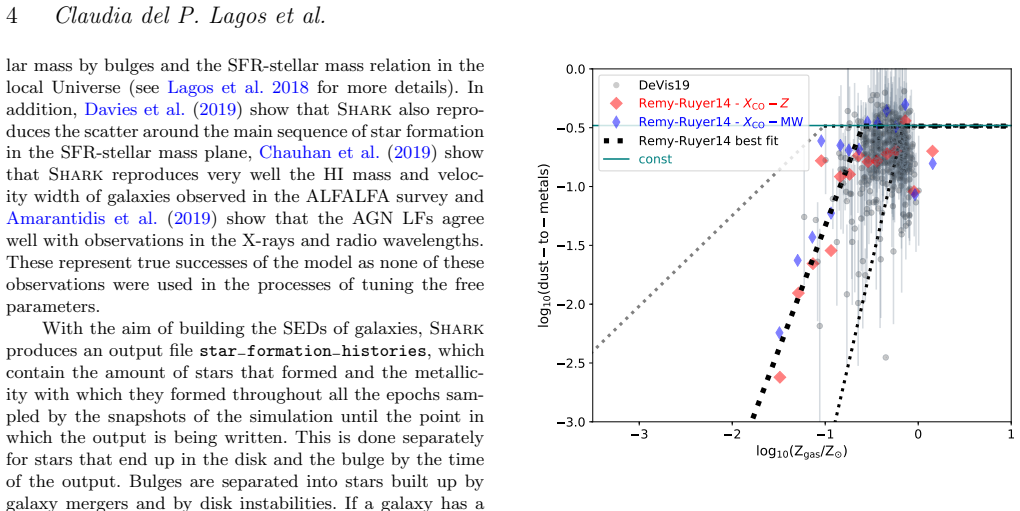
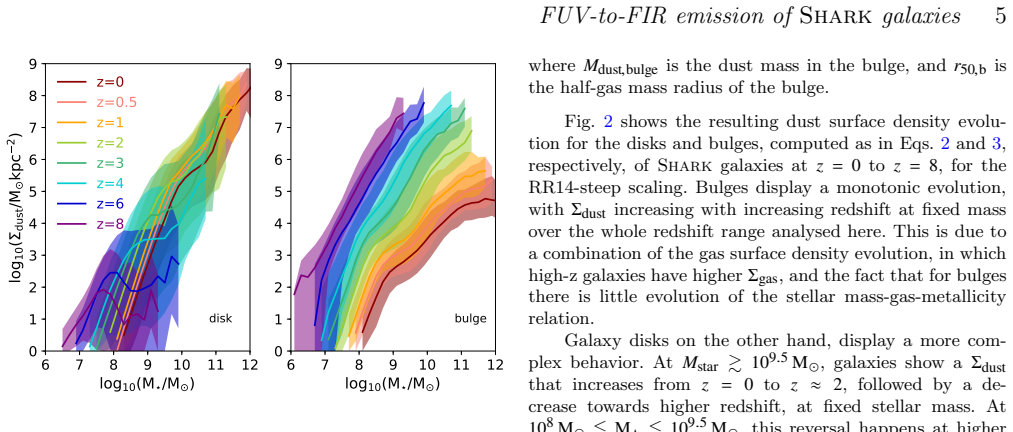
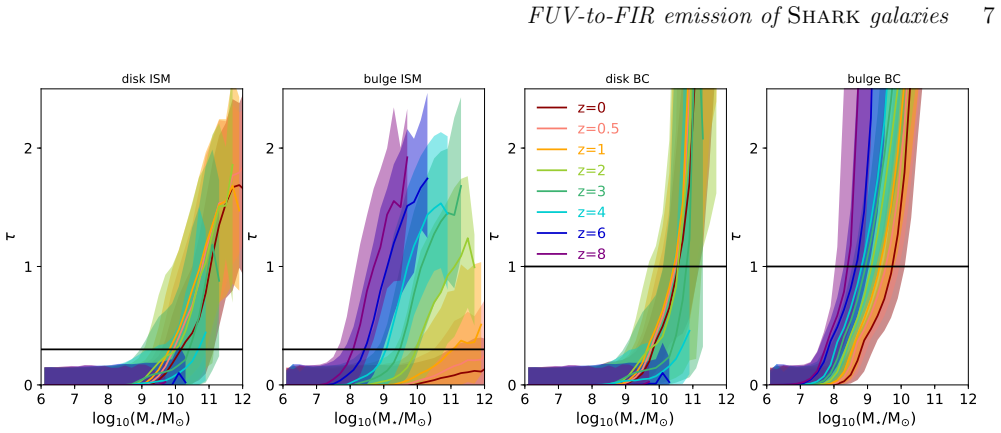
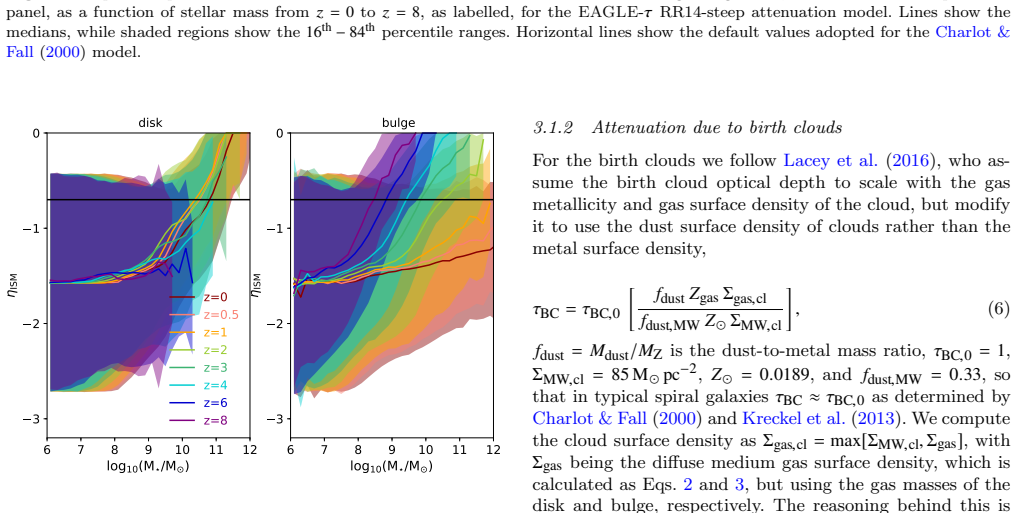
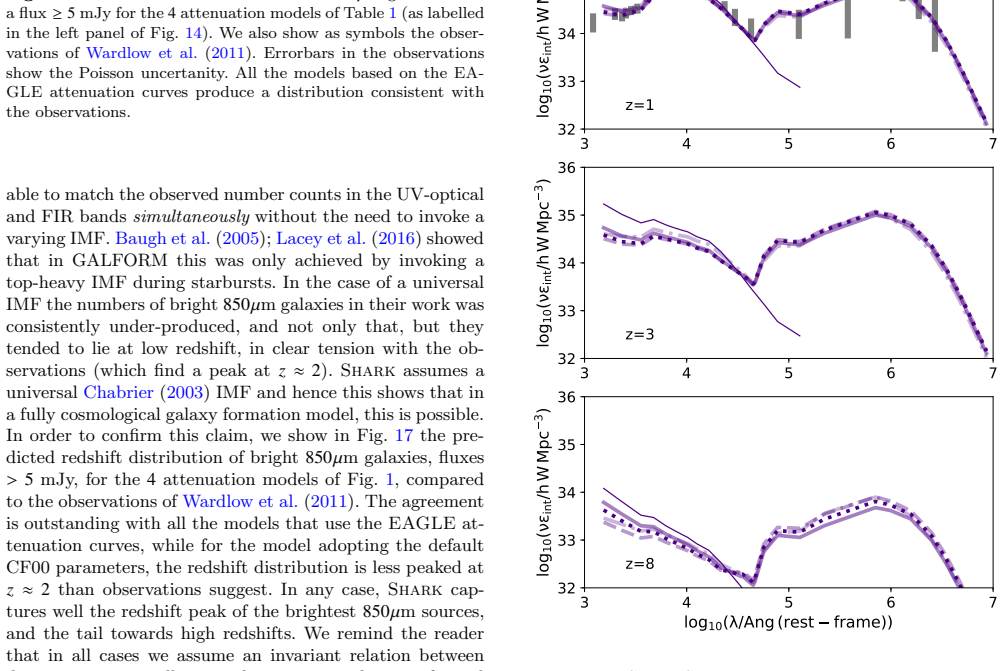
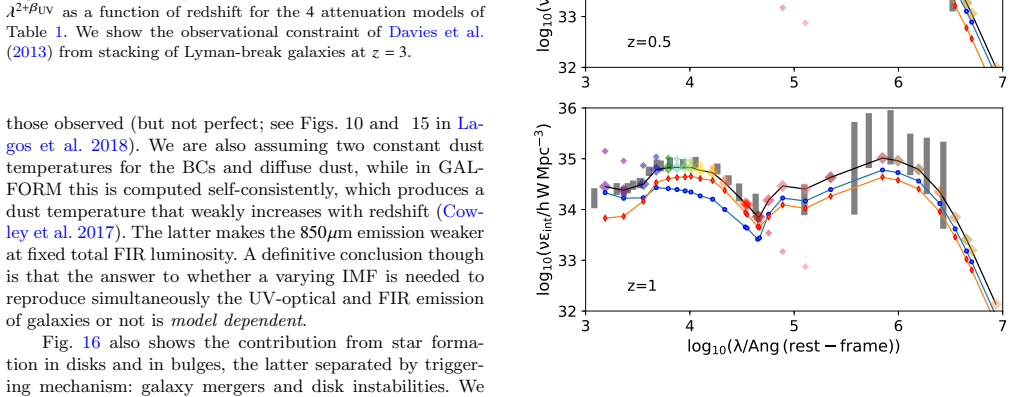
The load-bearing object is the attenuation chain that maps a simulated Shark galaxy's physical state to an SED. Dust masses come from the local dust-to-metal vs metallicity scaling of Remy-Ruyer et al. (2014), assumed to hold to z=10. Diffuse ISM optical depth and power-law index, tau_ISM and eta_ISM, are sampled from the EAGLE radiative-transfer parametrisation of Trayford et al. (2019) as functions of dust surface density, separately for disks and bulges; birth-cloud optical depth scales with the dust surface density of molecular clouds following Lacey et al. (2016). The absorbed light is re-emitted using Dale et al. (2014) templates at fixed effective temperatures for diffuse ISM and birth clouds, ensuring energy balance. This machinery produces attenuation that grows with stellar mass, peaks at z~1-2, and declines at high redshift as galaxies become metal poor, which is what allows the UV and FIR to fit simultaneously.
What would settle it
Measure the dust-to-metal mass ratio of galaxies at z=4-8 using ALMA dust-continuum observations and JWST/NIRSpec gas metallicities; if the ratio falls roughly 1.5 dex below the local Remy-Ruyer relation at fixed metallicity, as some dust-formation models predict, the model's high-redshift UV slopes and 850-micron counts would not be reproduced with the assumed invariant scaling.
Extended reading notes
Core claim
The paper's central claim is that Shark, a semi-analytic galaxy formation model with a universal Chabrier IMF, is capable of reproducing the observed panchromatic emission of galaxies from the FUV to the FIR across 0<=z<=10 without retuning or changing physical assumptions. The authors construct SEDs from simulated star formation and metallicity histories, compute dust masses from a local empirical relation between dust-to-metal ratio and gas metallicity (Remy-Ruyer et al. 2014), derive diffuse-ISM attenuation parameters from radiative transfer calculations of EAGLE galaxies (Trayford et al. 2019), and re-emit attenuated light in the infrared using energy-conserving Dale et al. (2014) templates. They find the model matches observed luminosity functions, number counts, UV slopes, the redshift distribution of bright 850-micron galaxies, and the cosmic SED. Their key discovery is that the long-standing tension between simultaneously reproducing UV-optical and FIR emission, which earlier models resolved by invoking a top-heavy IMF in starbursts, is not required here; the answer is model dependent. They attribute the difference to the combination of realistic gas metallicities, galaxy sizes, dust surface densities, attenuation curves, and dust temperatures in Shark.
Load-bearing premise
The model assumes that the relation between dust mass, gas metals, and gas metallicity measured in nearby galaxies holds unchanged out to redshift 10; if dust production or destruction changes that ratio with time, the claimed joint fit to ultraviolet and 850-micron observations could be an artifact of the assumed scaling.
Editorial extensions
If this is right
- The model can be used to build panchromatic lightcones for upcoming surveys, since the SED machinery requires no retuning when new bands or redshifts are considered.
- The 850-micron number counts and the redshift distribution of bright submillimetre galaxies are reproduced without a top-heavy IMF, so current and future submm surveys can be interpreted within a universal-IMF galaxy formation model.
- Predicted cosmic SEDs at z>1 are genuine predictions awaiting observation; if JWST and ALMA confirm the steep UV slopes and FIR dominance by starbursts, the model's attenuation prescriptions will be validated.
- The observed cosmic SEDs at z<=1 are matched within about 0.1-0.15 dex, providing a benchmark for interpreting the extragalactic background light.
- The model demonstrates that complex, non-parametric star-formation histories from a semi-analytic model can be used directly for SED generation, rather than assuming simple analytic forms.
Reading between the lines
- If the local dust-to-metal scaling is truly invariant, then high-redshift UV-selected galaxies should be nearly dust-free at fixed stellar mass, a prediction that can be tested with ALMA dust-continuum observations of z~6-8 galaxies.
- The model's success suggests the earlier need for a top-heavy IMF in other models was partly due to those models' gas metallicities and sizes, not an intrinsic constraint; applying the same attenuation prescription across different galaxy-formation models would isolate the cause.
- The fixed dust temperatures adopted for re-emission mean the model's 850-micron counts are sensitive to the assumed dust SED, so allowing a redshift-dependent dust temperature would sharpen the claim of a simultaneous fit.
- A direct extension is to use the same machinery to generate mock catalogues for JWST and Euclid to predict colour-selection biases and photometric-redshift systematics.
Signed reviews
Editorial analysis
A structured set of objections, weighed in public.
Referee Report
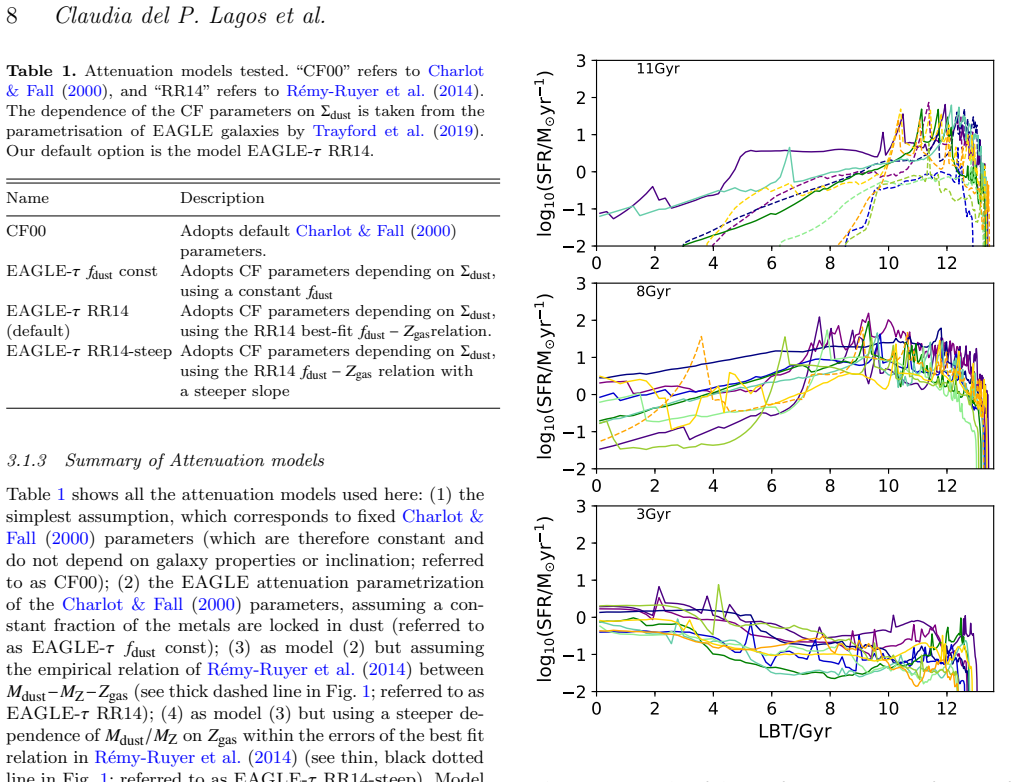
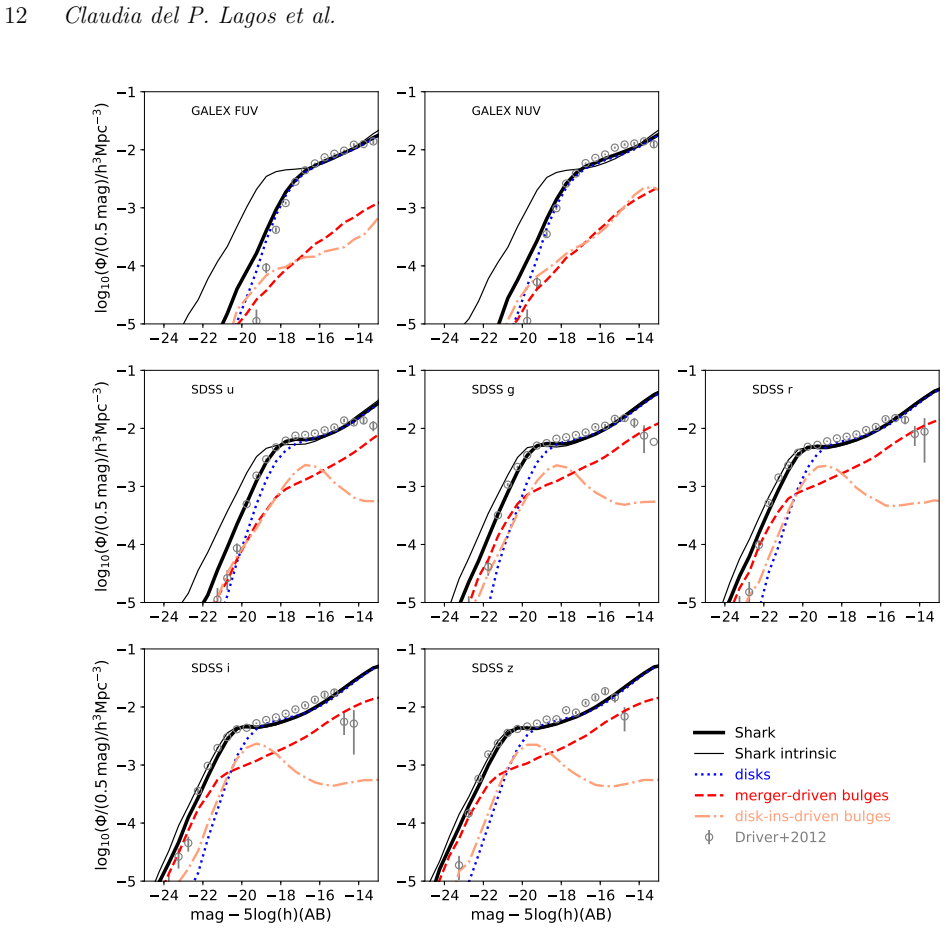
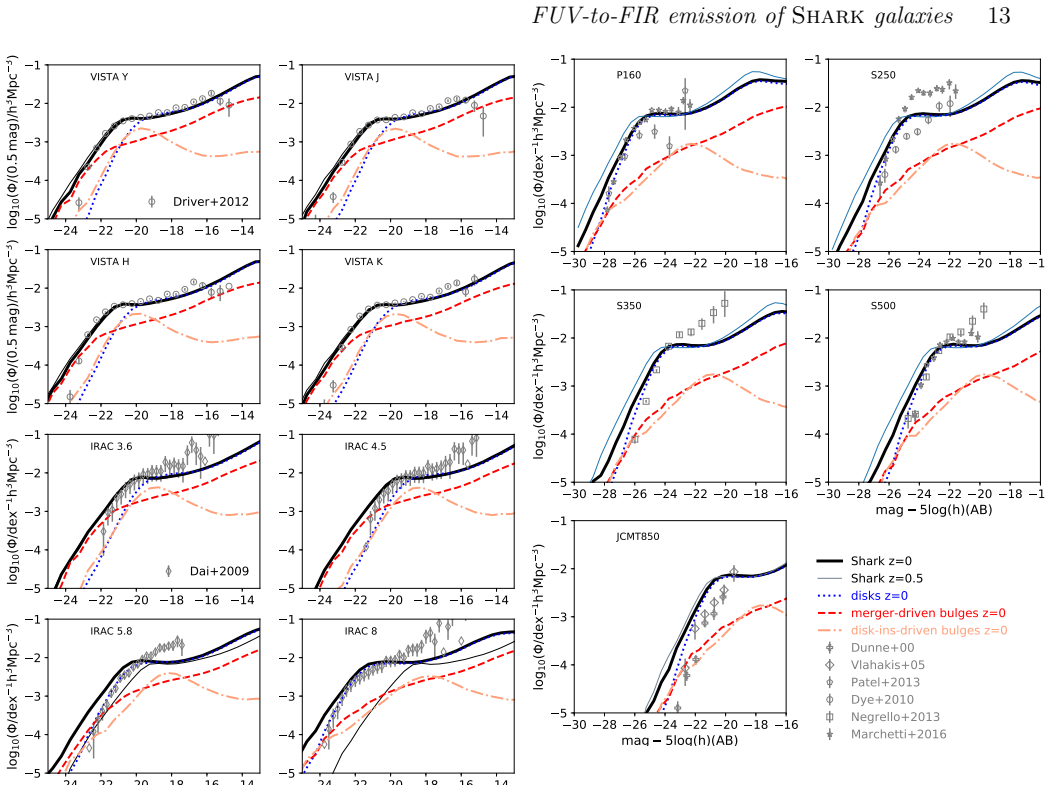
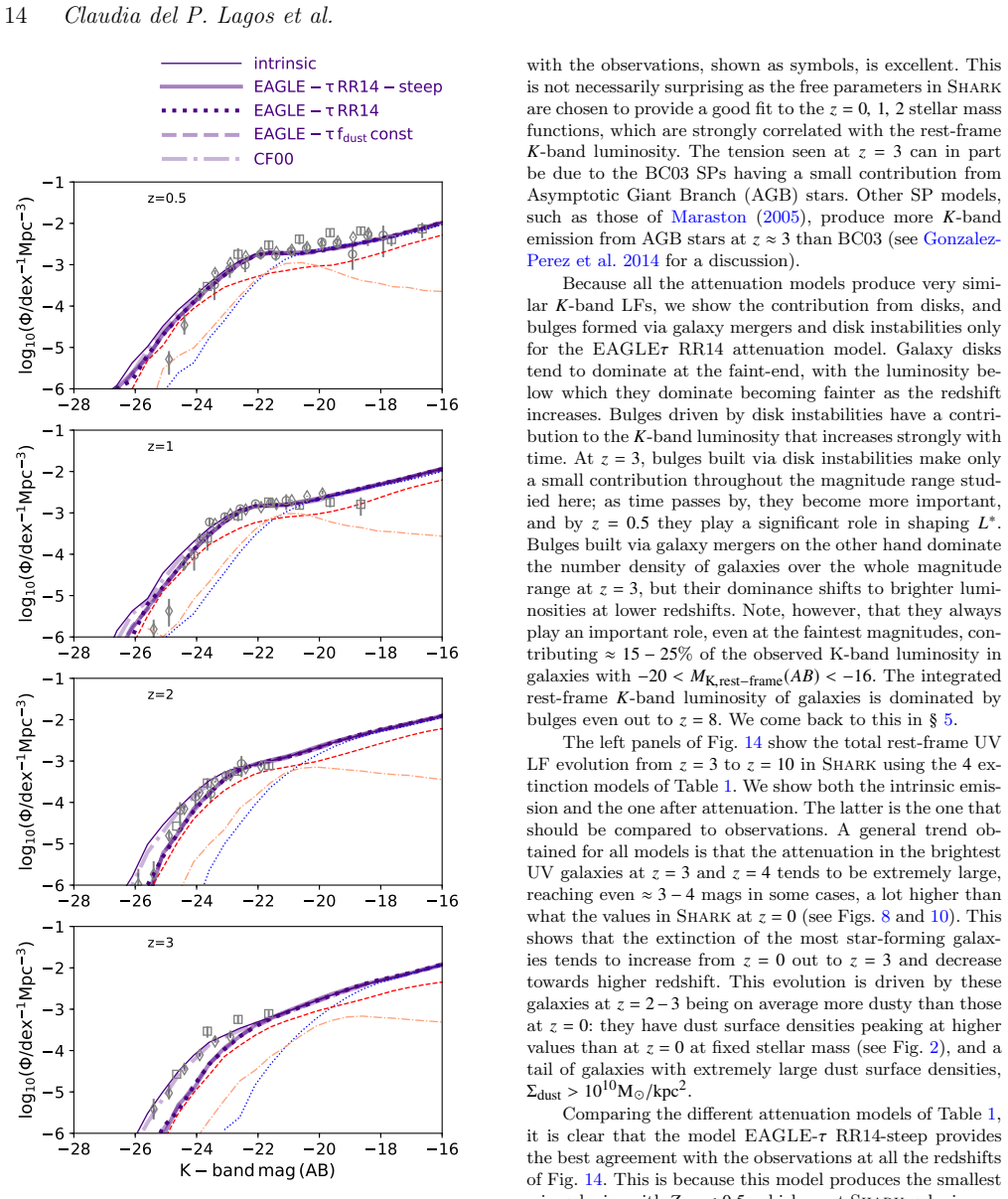
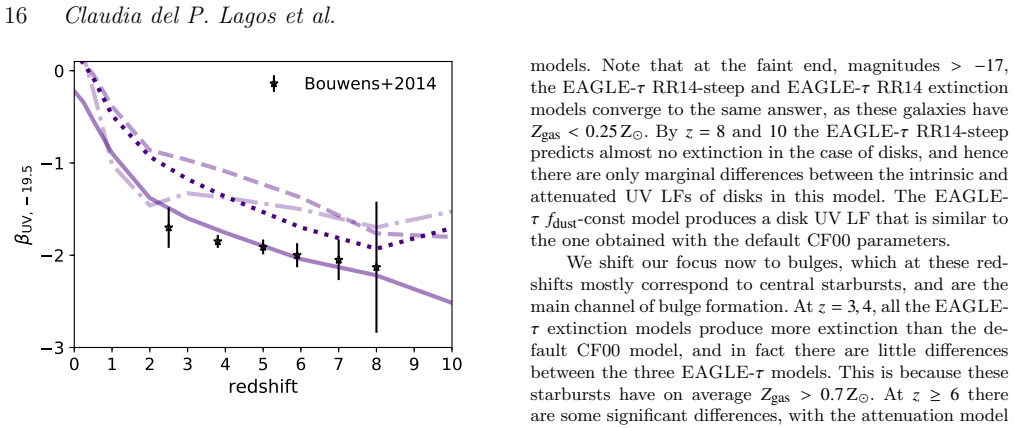
Summary. The paper combines the Shark semi-analytic model of galaxy formation with the ProSpect SED generation code to predict galaxy emission from the FUV to the FIR over 0 ≤ z ≤ 10. Dust attenuation is built from radiative-transfer-derived Charlot & Fall parameters calibrated on EAGLE galaxies, dust masses are computed from gas mass and metallicity using local empirical relations (Rémy-Ruyer et al. 2014), and absorbed light is re-emitted with Dale et al. (2014) templates under energy balance. The authors compare four attenuation variants against a wide set of observations: z=0 FUV-to-FIR luminosity functions, rest-frame K-band and FUV luminosity functions out to z=3 and z=10, UV slopes, number counts from the NUV to 850 µm, the redshift distribution of bright 850 µm galaxies, and the cosmic SED. The central claim is that Shark reproduces these observations simultaneously with a universal Chabrier IMF, without retuning to SED data and without invoking a varying IMF or a redshift-dependent dust-to-metal scaling.
Significance. If the central claim holds, this is a significant advance: it would show that a full cosmological galaxy formation model can simultaneously match UV-to-optical and FIR observations without a varying IMF, and it would provide a generative, panchromatic tool for interpreting upcoming surveys. The paper's strengths include the open-source software infrastructure (Shark, ProSpect, Viperfish), the systematic comparison in 27 bands, the explicit decomposition into disk, merger-driven bulge, and disk-instability-driven bulge contributions, and the unusually candid discussion of model limitations, including the dust-to-metal scaling and dust temperature assumptions. The claim of being 'unprecedented' is plausible but needs sharper qualification because some comparisons (K-band, near-IR) partly inherit the model's tuning to the stellar mass function, and because the headline high-redshift result is obtained with a specific steep variant of the local dust-to-metal relation.
major comments (3)
- [§2.2, §6, Figs. 14–15] The central conclusion that no redshift-dependent dust-to-metal scaling is needed is not fully established. The attenuation chain assumes the local Rémy-Ruyer et al. (2014) dust-to-metal ratio versus gas metallicity relation is invariant out to z=10, as the paper itself states in §6. The manuscript also cites Vijayan et al. (2019), who predict a dust-to-metal ratio about 1.5 dex lower at z=8–10 at fixed stellar mass, while Popping et al. (2017) find little evolution. Because the high-redshift UV LFs and UV slopes are the main probes of this regime, the claimed simultaneous match could be an artifact of the assumed redshift-invariant scaling rather than a success of Shark's baryon physics. Please add a sensitivity test in which the dust-to-metal ratio evolves with redshift within the published range and re-evaluate the UV LFs, the 850 µm counts, and the SMG redshift distribution; if the conclusions survive, state this explicitly, and otherwise soften the abstract and conclusion claims accordingly.
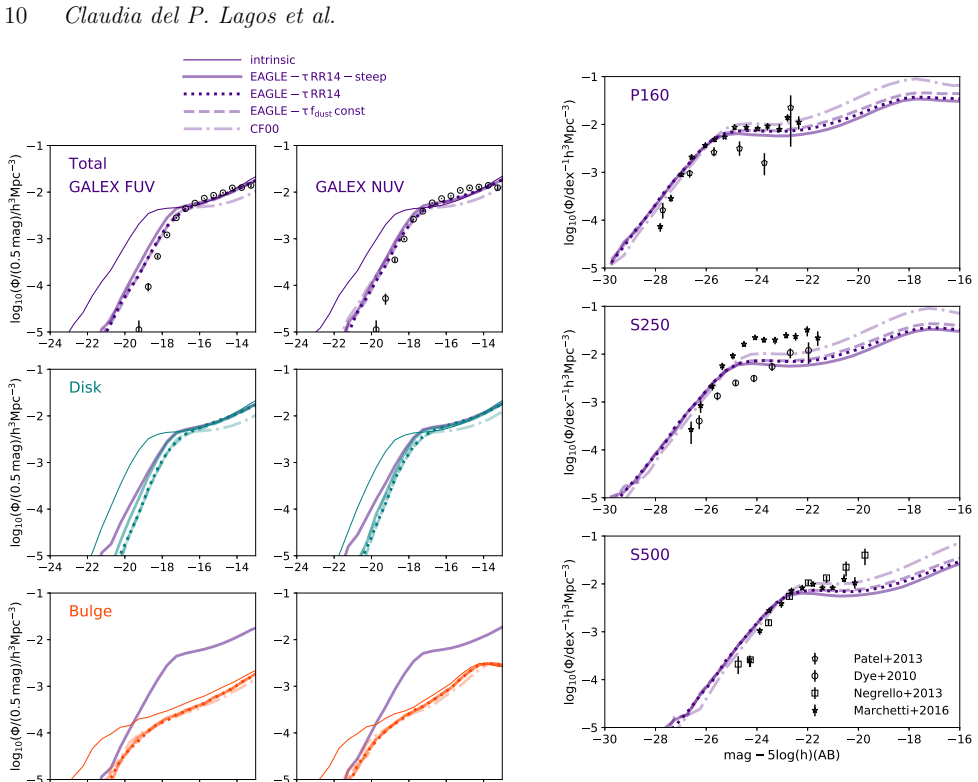
- [§4.3, Fig. 14] The high-redshift agreement is obtained with the EAGLE-τ RR14-steep variant, not with the model labelled as the default (EAGLE-τ RR14). At z=3–6 the default RR14 and fdust-const models over-attenuate bright galaxies, with differences of up to ~1.5 mag at z=3 and ~2 mag at z=6 in the disk contribution to the UV LF. The paper is transparent about this in the text and captions, but the abstract and conclusions present the high-z match without saying that it depends on selecting one particular steep variant within the local scatter of the Rémy-Ruyer relation. This makes the 'without retuning' claim less clean: choosing among variants after inspecting the comparisons is a mild form of model selection even if no parameter is re-fit. Please clarify throughout that the headline high-redshift result refers to a specified steep variant, and discuss the extent to which that choice is motivated a priori by De Vis et al. (2019) versus selected after comparing with the observed LFs.
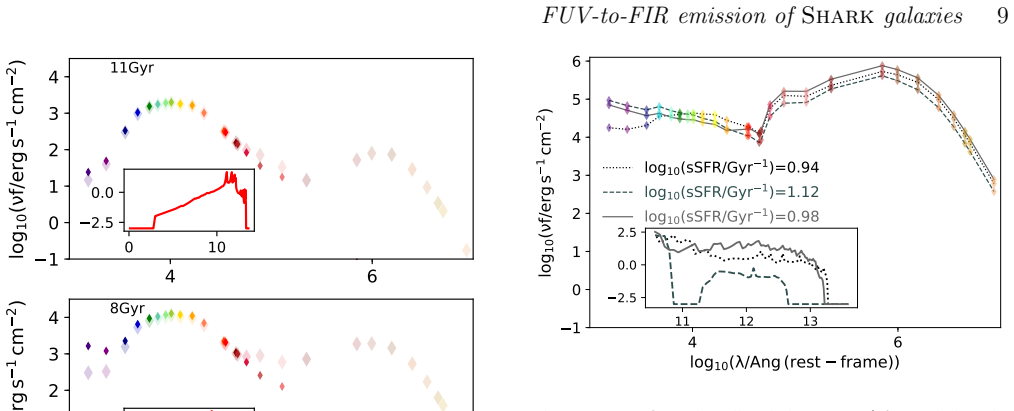
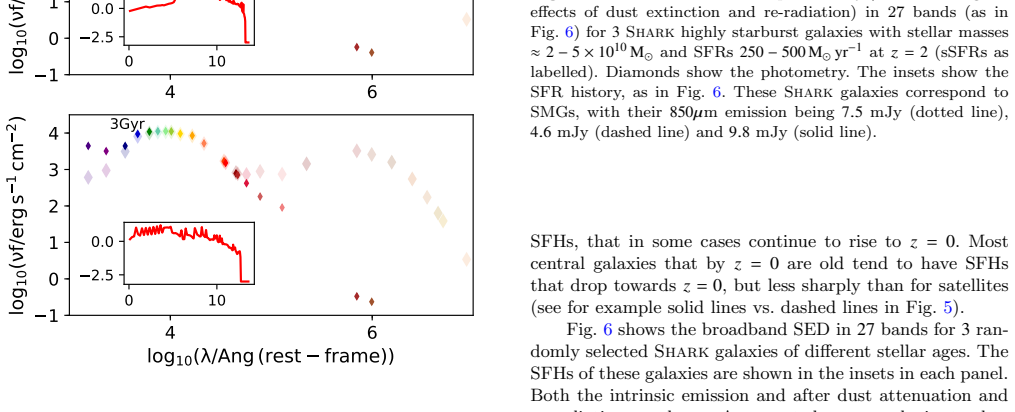
- [§3.2, §5.1, Figs. 16–17] The FIR predictions that support the 'no varying IMF' conclusion assume a fixed Dale et al. (2014) dust SED with two constant effective dust temperatures (≈20–25 K for the diffuse ISM and ≈50–60 K for birth clouds) at all redshifts. The 850 µm number counts and the redshift distribution of bright 850 µm galaxies are temperature-sensitive, and the paper itself notes that GALFORM's self-consistently computed dust temperature evolves with redshift. Please quantify how much the predicted 850 µm counts and N(z) change if the dust temperature or the αSF parameters evolve with redshift within a plausible range, or explicitly restrict the claim of no varying IMF to the fixed-temperature model adopted here. As written, the FIR side of the headline claim contains an additional untested invariance assumption beyond the dust-to-metal scaling.
minor comments (5)
- [§5.1, Fig. 16] The lightcone area is printed as '107 deg2' and the caption says '107 deg2 deep lightcone'. If this is meant to be 10^7 deg2, it exceeds the whole sky (~4.1×10^4 deg2) and is unphysical; if it is meant to be 10^7 arcmin2 or another value, please state the correct units explicitly.
- [Abstract, §4.2, §4.3] The near-infrared and K-band luminosity function agreement is partly inherited from tuning Shark to the z=0, 1, and 2 stellar mass functions and to the mass-size relations; the text acknowledges this ('not necessarily surprising'), but the abstract's broad 'without retuning' claim should be qualified so readers can see which comparisons are truly independent of the tuning.
- [Figs. 10–17] The comparisons are assessed visually, with qualitative statements such as 'excellent' and 'very good'. Adding a quantitative goodness-of-fit measure (including model cosmic variance and observed systematic uncertainties) would make the 'unprecedented agreement' claim easier to evaluate.
- [Fig. 1] The caption should define the 'Remy-Ruyer14 - XCO Z' and 'Remy-Ruyer14 - XCO MW' variants, since these labels are not self-explanatory without going to the Rémy-Ruyer et al. paper.
- [Fig. 8 caption and figure] The y-axis of the GALEX UV LFs is presented without normalization by bin size, while later figures normalize by bin size; this inconsistency should be flagged in the caption to avoid confusion.
Circularity Check
K-band LF agreement is self-admittedly inherited from SMF tuning; the central FUV-to-FIR chain otherwise rests on independent inputs.
-
fitted input called prediction
[Section 4.3, after Fig. 13 (rest-frame K-band LF comparison)]
"This is not necessarily surprising as the free parameters in Shark are chosen to provide a good fit to the z = 0, 1, 2 stellar mass functions, which are strongly correlated with the rest-frame K-band luminosity."
Shark's default parameters were tuned to the z=0,1,2 stellar mass functions (Section 2). Rest-frame K-band luminosity is essentially stellar mass times a mass-to-light ratio, so the K-band LF is not an independent prediction: at the masses that dominate the SMF fit it is largely forced by the same tuning inputs. The paper concedes this explicitly. Since the abstract lists the 0<=z<=3 rest-frame K-band LF among the reproduced observables, that specific comparison partially reduces to the fitted input rather than to the new SED/attenuation modelling.
full rationale
The central FUV-to-FIR derivation is not circular. The attenuation parameters come from radiative transfer on the independent EAGLE hydrodynamical simulation suite (Trayford et al. 2019), not from Shark or from the observed luminosity functions being compared; the dust masses come from the local Remy-Ruyer et al. (2014) scaling; and the FIR re-emission uses energy balance with fixed Dale et al. (2014) templates. No free parameter of the SED pipeline is fitted to the target LFs or number counts. The paper also honestly flags the redshift-invariance of the dust-to-metal relation as an assumption, noting that competing models disagree by about 1.5 dex at z=8-10. The only in-sample element is the underlying Shark tuning to the z=0,1,2 stellar mass functions, which the paper itself identifies as making the K-band LF agreement unsurprising; that specific 'prediction' is therefore partly forced by construction. The selection of the RR14-steep variant as the best-performing attenuation model is a model-choice caveat but not a definitional reduction, since its parameters still come from local data. Overall, the central simultaneous UV-to-FIR claim has independent content, with one admitted tuning-correlated comparison.
Assumptions & free parameters
free parameters (4)
- epsilon_disk (disk instability threshold) =
0.8
- tau_BC,z0 (birth cloud optical depth normalization) =
1.0
- Dale et al. (2014) alpha_SF parameters =
alpha_SF = 3 (diffuse ISM), 1 (birth clouds)
- Remy-Ruyer et al. (2014) dust-to-metal versus Zgas relation and its steep variant =
RR14 best fit; RR14-steep variant
assumptions (6)
- domain assumption Charlot and Fall (2000) two-phase dust attenuation model with power-law optical depths (Eqs. 4-5) applies to all Shark galaxies at all redshifts.
- domain assumption Dale et al. (2014) IR templates with two fixed alpha_SF values represent dust re-emission at all redshifts.
- domain assumption The Trayford et al. (2019) parametrization of EAGLE attenuation curves, tau_ISM and eta_ISM as functions of dust surface density, is transferable to Shark galaxies.
- domain assumption The local dust-to-metal ratio versus gas metallicity relation holds at all redshifts out to z=10.
- domain assumption Dust surface density of disks and bulges is computed using the half-gas mass radius and an assumed disk scaleheight ratio of 7.3 (Eqs. 2-3).
- domain assumption Shark's default baryon physics model, as tuned in Lagos et al. (2018), provides the correct star formation histories, gas masses, metallicities, and sizes.
Cite this review
Pith. "Pith review of From the far-ultraviolet to the far-infrared -- galaxy emission at $0\le z \le 10$ in the Shark semi-analytic model." pith.science (2026). https://pith.science/paper/LNII5PB4
@misc{pith2026190803423,
  author       = {Pith},
  title        = {Pith review of: From the far-ultraviolet to the far-infrared -- galaxy emission at $0\le z \le 10$ in the Shark semi-analytic model},
  year         = {2026},
  howpublished = {\url{https://pith.science/paper/LNII5PB4}},
  note         = {Machine review of arXiv:1908.03423}
}
abstract
We combine the Shark semi-analytic model of galaxy formation with the ProSpect software tool for spectral energy distribution (SED) generation to study the multi-wavelength emission of galaxies from the far-ultraviolet (FUV) to the far-infrared (FIR) at $0\le z\le 10$. We produce a physical model for the attenuation of galaxies across cosmic time by combining a local Universe empirical relation to compute the dust mass of galaxies from their gas metallicity and mass, attenuation curves derived from radiative transfer calculations of galaxies in the EAGLE hydrodynamic simulation suite, and the properties of Shark galaxies. We are able to produce a wide range of galaxies, from the $z=8$ star-forming galaxies with almost no extinction, $z=2$ submillimeter galaxies, down to the normal star-forming and red sequence galaxies at $z=0$. Quantitatively, we find that Shark reproduces the observed (i) the $z=0$ FUV-to-FIR, (ii) $0\le z\le 3$ rest-frame $K$-band, and (iii) $0\le z\le 10$ rest-frame FUV luminosity functions, (iv) $z\le 8$ UV slopes, (v) the FUV-to-FIR number counts (including the widely disputed 850$\mu$m), (vi) redshift distribution of bright $850\mu$m galaxies and (vii) the integrated cosmic SED from $z=0$ to $z=1$ to an unprecedented level. This is achieved without the need to invoke changes in the stellar initial mass function, dust-to-metal mass ratio, or metal enrichment timescales. Our model predicts star formation in galaxy disks to dominate in the FUV-to-optical, while bulges dominate at the NIR at all redshifts. The FIR sees a strong evolution in which disks dominate at $z\le 1$ and starbursts (triggered by both galaxy mergers and disk instabilities, in an even mix) dominate at higher redshifts, even out to $z=10$.
Figures
Figures from the paper (16 more)





Forward citations
Cited by 2 Pith papers
-
First Light and Assembly of GalaxieS (FLAGS) I: The JWST/NIRCam Number Counts and IGL as Constraints on Galaxy Formation Models
FLAGS-I delivers the deepest JWST/NIRCam number counts to date, new 2.77 and 4.10 micron IGL constraints, and a model comparison that ranks SC-SAM first.
-
Fade to grey: systematic variation of the galaxy attenuation curves with galaxy properties in EAGLE
Using EAGLE and SKIRT radiative transfer, the paper shows that a galaxy's dust attenuation strength and curve slope are largely set by its dust surface density, and that adding a birth-cloud term reproduces the observ...
Reference graph
Works this paper leans on
-
[1]
, " * write output.state after.block = add.period write newline
ENTRY address author booktitle chapter edition editor howpublished institution journal key month note number organization pages publisher school series title type volume year label extra.label sort.label short.list INTEGERS output.state before.all mid.sentence after.sentence after.block FUNCTION init.state.consts #0 'before.all := #1 'mid.sentence := #2 '...
-
[2]
write newline
" write newline "" before.all 'output.state := FUNCTION n.dashify 't := "" t empty not t #1 #1 substring "-" = t #1 #2 substring "--" = not "--" * t #2 global.max substring 't := t #1 #1 substring "-" = "-" * t #2 global.max substring 't := while if t #1 #1 substring * t #2 global.max substring 't := if while FUNCTION word.in bbl.in " " * FUNCTION format....
-
[3]
write newline
" write newline "" before.all 'output.state := FUNCTION fin.entry write newline FUNCTION new.block output.state before.all = 'skip after.block 'output.state := if FUNCTION new.sentence output.state after.block = 'skip output.state before.all = 'skip after.sentence 'output.state := if if FUNCTION not #0 #1 if FUNCTION and 'skip pop #0 if FUNCTION or pop #1...
-
[4]
write newline
" write newline "" before.all 'output.state := FUNCTION fin.entry write newline FUNCTION new.block output.state before.all = 'skip after.block 'output.state := if FUNCTION new.sentence output.state after.block = 'skip output.state before.all = 'skip after.sentence 'output.state := if if FUNCTION not #0 #1 if FUNCTION and 'skip pop #0 if FUNCTION or pop #1...
-
[5]
N., 2013, Journal of Improbable Astronomy, 1, 1
Author A. N., 2013, Journal of Improbable Astronomy, 1, 1
2013
-
[6]
D., 2015, Journal of Interesting Stuff, 17, 198
Jones C. D., 2015, Journal of Interesting Stuff, 17, 198
2015
-
[7]
B., 2014, The Example Journal, 12, 345 (Paper I)
Smith A. B., 2014, The Example Journal, 12, 345 (Paper I)
2014
-
[8]
Amarantidis S., Afonso J., Messias H., Henriques B., Griffin A., Lacey C., Lagos C. d. P., Gonzalez-Perez V. et al , 2019, , 485, 2694
2019
Show all 113 references
-
[9]
K., Driver S
Andrews S. K., Driver S. P., Davies L. J. M., Kafle P. R., Robotham A. S. G., Vinsen K., Wright A. H., Bland-Hawthorn J. et al , 2017, , 470, 1342
2017
-
[10]
Baes M., Tr c ka A., Camps P., Nersesian A., Trayford J., Theuns T., Dobbels W., 2019, , 484, 4069
2019
-
[11]
M., Lacey C
Baugh C. M., Lacey C. G., Frenk C. S., Granato G. L., Silva L., Bressan A., Benson A. J., Cole S., 2005, , 356, 1191
2005
-
[12]
Blitz L., Fukui Y., Kawamura A., Leroy A., Mizuno N., Rosolowsky E., 2007, Protostars and Planets V, 81
2007
-
[13]
Blitz L., Rosolowsky E., 2006, , 650, 933
2006
-
[14]
D., Leroy A
Bolatto A. D., Leroy A. K., Rosolowsky E., Walter F., Blitz L., 2008, , 686, 948
2008
-
[15]
C., Elmegreen B
Bournaud F., Chapon D., Teyssier R., Powell L. C., Elmegreen B. G., Elmegreen D. M., Duc P.-A., Contini T. et al , 2011, , 730, 4
2011
-
[16]
J., Illingworth G
Bouwens R. J., Illingworth G. D., Oesch P. A., Labb \'e I., van Dokkum P. G., Trenti M., Franx M., Smit R. et al , 2014, , 793, 115
2014
-
[17]
J., Illingworth G
Bouwens R. J., Illingworth G. D., Oesch P. A., Trenti M., Labb \'e I., Bradley L., Carollo M., van Dokkum P. G. et al , 2015, , 803, 34
2015
-
[18]
Bruzual G., Charlot S., 2003, , 344, 1000
2003
-
[19]
J., Welker C., del P Lagos C., Power C., Dubois Y., Pichon C., 2019, , 482, 2039
Ca \ n as R., Elahi P. J., Welker C., del P Lagos C., Power C., Dubois Y., Pichon C., 2019, , 482, 2039
2019
-
[20]
W., Baes M., Theuns T., Schaller M., Schaye J., 2016, , 462, 1057
Camps P., Trayford J. W., Baes M., Theuns T., Schaller M., Schaye J., 2016, , 462, 1057
2016
-
[21]
L., Carilli C., Jones G., Casey C
Capak P. L., Carilli C., Jones G., Casey C. M., Riechers D., Sheth K., Carollo C. M., Ilbert O. et al , 2015, , 522, 455
2015
-
[22]
M., Berta S., B \'e thermin M., Bock J., Bridge C., Budynkiewicz J., Burgarella D., Chapin E
Casey C. M., Berta S., B \'e thermin M., Bock J., Bridge C., Budynkiewicz J., Burgarella D., Chapin E. et al , 2012, , 761, 140
2012
-
[23]
Chabrier G., 2003, , 115, 763
2003
-
[24]
M., 2000, , 539, 718
Charlot S., Fall S. M., 2000, , 539, 718
2000
-
[25]
Chauhan G., Lagos C. D. P., Obreschkow D., Power C., Oman K., Elahi P. J., 2019, arXiv:1906.06130, arXiv:1906.06130
2019 arXiv
-
[26]
J., Dunlop J
Cirasuolo M., McLure R. J., Dunlop J. S., Almaini O., Foucaud S., Simpson C., 2010, , 401, 1166
2010
-
[27]
G., Baugh C
Cole S., Lacey C. G., Baugh C. M., Frenk C. S., 2000, , 319, 168
2000
-
[28]
Conroy C., 2013, , 51, 393
2013
-
[29]
I., B \'e thermin M., Lagos C
Cowley W. I., B \'e thermin M., Lagos C. d. P., Lacey C. G., Baugh C. M., Cole S., 2017, , 467, 1231
2017
-
[30]
I., Lacey C
Cowley W. I., Lacey C. G., Baugh C. M., Cole S., Frenk C. S., Lagos C. d. P., 2019, , 487, 3082
2019
-
[31]
J., Stevens A
Croton D. J., Stevens A. R. H., Tonini C., Garel T., Bernyk M., Bibiano A., Hodkinson L., Mutch S. J. et al , 2016, , 222, 22
2016
-
[32]
da Cunha E., Charlot S., Elbaz D., 2008, , 388, 1595
2008
-
[33]
J., Kochanek C
Dai X., Assef R. J., Kochanek C. S., Brodwin M., Brown M. J. I., Caldwell N., Cool R. J., Dey A. et al , 2009, , 697, 506
2009
-
[34]
A., Helou G., Magdis G
Dale D. A., Helou G., Magdis G. E., Armus L., D \' az-Santos T., Shi Y., 2014, , 784, 83
2014
-
[35]
Davies L. J. M., Bremer M. N., Stanway E. R., Lehnert M. D., 2013, , 433, 2588
2013
-
[36]
Davies L. J. M., Driver S. P., Robotham A. S. G., Baldry I. K., Lange R., Liske J., Meyer M., Popping A. et al , 2015, , 447, 1014
2015
-
[37]
Davies L. J. M., Lagos C. d. P., Katsianis A., Robotham A. S. G., Cortese L., Driver S. P., Bremer M. N., Brown M. J. I. et al , 2019, , 483, 1881
2019
-
[38]
Davies L. J. M., Robotham A. S. G., Driver S. P., Lagos C. P., Cortese L., Mannering E., Foster C., Lidman C. et al , 2018, , 480, 768
2018
-
[39]
De Lucia G., Blaizot J., 2007, , 375, 2
2007
-
[40]
De Vis P., Jones A., Viaene S., Casasola V., Clark C. J. R., Baes M., Bianchi S., Cassara L. P. et al , 2019, , 623, A5
2019
-
[41]
P., Andrews S
Driver S. P., Andrews S. K., da Cunha E., Davies L. J., Lagos C., Robotham A. S. G., Vinsen K., Wright A. H. et al , 2018, , 475, 2891
2018
-
[42]
P., Andrews S
Driver S. P., Andrews S. K., Davies L. J., Robotham A. S. G., Wright A. H., Windhorst R. A., Cohen S., Emig K. et al , 2016 a , , 827, 108
2016
-
[43]
P., Davies L
Driver S. P., Davies L. J., Meyer M., Power C., Robotham A. S. G., Baldry I. K., Liske J., Norberg P., 2016 b , The Universe of Digital Sky Surveys, 42, 205
2016
-
[44]
P., Norberg P., Baldry I
Driver S. P., Norberg P., Baldry I. K., Bamford S. P., Hopkins A. M., Liske J., Loveday J., Peacock J. A. et al , 2009, Astronomy and Geophysics, 50, 050000
2009
-
[45]
P., Robotham A
Driver S. P., Robotham A. S. G., 2010, , 407, 2131
2010
-
[46]
P., Robotham A
Driver S. P., Robotham A. S. G., Kelvin L., Alpaslan M., Baldry I. K., Bamford S. P., Brough S., Brown M. et al , 2012, , 427, 3244
2012
-
[47]
S., McLure R
Dunlop J. S., McLure R. J., Robertson B. E., Ellis R. S., Stark D. P., Cirasuolo M., de Ravel L., 2012, , 420, 901
2012
-
[48]
L., 2000, , 315, 115
Dunne L., Eales S., Edmunds M., Ivison R., Alexander P., Clements D. L., 2000, , 315, 115
2000
-
[49]
Dye S., Dunne L., Eales S., Smith D. J. B., Amblard A., Auld R., Baes M., Baldry I. K. et al , 2010, , 518, L10
2010
-
[50]
Efstathiou G., Lake G., Negroponte J., 1982, , 199, 1069
1982
-
[51]
J., Ca \ n as R., Poulton R
Elahi P. J., Ca \ n as R., Poulton R. J. J., Tobar R. J., Willis J. S., Lagos C. d. P., Power C., Robotham A. S. G., 2019 a , Publications of the Astronomical Society of Australia, 36, e021
2019
-
[52]
J., Poulton R
Elahi P. J., Poulton R. J. J., Tobar R. J., Ca \ n as R., Lagos C. d. P., Power C., Robotham A. S. G., 2019 b , Publications of the Astronomical Society of Australia, 36, e028
2019
-
[53]
J., Power C., Lagos C
Elahi P. J., Power C., Lagos C. d. P., Poulton R., Robotham A. S. G., 2018 a , Monthly Notices of the Royal Astronomical Society, 477, 616
2018
-
[54]
J., Welker C., Power C., del P Lagos C., Robotham A
Elahi P. J., Welker C., Power C., del P Lagos C., Robotham A. S. G., Ca \ n as R., Poulton R., 2018 b ,
2018
-
[55]
M., Benson A
Fanidakis N., Baugh C. M., Benson A. J., Bower R. G., Cole S., Done C., Frenk C. S., Hickox R. C. et al , 2012, , 419, 2797
2012
-
[56]
L., Ryan Jr
Finkelstein S. L., Ryan Jr. R. E., Papovich C., Dickinson M., Song M., Somerville R. S., Ferguson H. C., Salmon B. et al , 2015, , 810, 71
2015
-
[57]
E., Dunlop J
Geach J. E., Dunlop J. S., Halpern M., Smail I., van der Werf P., Alexander D. M., Almaini O., Aretxaga I. et al , 2017, , 465, 1789
2017
-
[58]
G., Baugh C
Gonzalez-Perez V., Lacey C. G., Baugh C. M., Lagos C. D. P., Helly J., Campbell D. J. R., Mitchell P. D., 2014,
2014
-
[59]
L., Lacey C
Granato G. L., Lacey C. G., Silva L., Bressan A., Baugh C. M., Cole S., Frenk C. S., 2000, , 542, 710
2000
-
[60]
J., Lacey C
Griffin A. J., Lacey C. G., Gonzalez-Perez V., Lagos C. d. P., Baugh C. M., Fanidakis N., 2018, ArXiv:1806.08370
2018 arXiv
-
[61]
G., Cole S., Crain R
Guo Q., Gonzalez-Perez V., Guo Q., Schaller M., Furlong M., Bower R. G., Cole S., Crain R. A. et al , 2016, , 461, 3457
2016
-
[62]
Henriques B. M. B., White S. D. M., Thomas P. A., Angulo R., Guo Q., Lemson G., Springel V., Overzier R., 2015, , 451, 2663
2015
-
[63]
M., Faber S
Koekemoer A. M., Faber S. M., Ferguson H. C., Grogin N. A., Kocevski D. D., Koo D. C., Lai K., Lotz J. M. et al , 2011, , 197, 36
2011
-
[64]
D., Aniano G., Calzetti D., Croxall K
Kreckel K., Groves B., Schinnerer E., Johnson B. D., Aniano G., Calzetti D., Croxall K. V., Draine B. T. et al , 2013, , 771, 62
2013
-
[65]
C., de Grijs R., 2002, , 334, 646
Kregel M., van der Kruit P. C., de Grijs R., 2002, , 334, 646
2002
-
[66]
R., 2014, , 539, 49
Krumholz M. R., 2014, , 539, 49
2014
-
[67]
R., McKee C
Krumholz M. R., McKee C. F., Tumlinson J., 2009, , 699, 850
2009
-
[68]
G., Baugh C
Lacey C. G., Baugh C. M., Frenk C. S., Benson A. J., Bower R. G., Cole S., Gonzalez-Perez V., Helly J. C. et al , 2016, , 462, 3854
2016
-
[69]
Lagos C. d. P., Tobar R. J., Robotham A. S. G., Obreschkow D., Mitchell P. D., Power C., Elahi P. J., 2018, , 481, 3573
2018
-
[70]
P., Robotham A
Lange R., Driver S. P., Robotham A. S. G., Kelvin L. S., Graham A. W., Alpaslan M., Andrews S. K., Baldry I. K. et al , 2015, , 447, 2603
2015
-
[71]
T., 2012, , 760, L35
Li A., Draine B. T., 2012, , 760, L35
2012
-
[72]
Madau P., Dickinson M., 2014, , 52, 415
2014
-
[73]
et al , 2013, ArXiv:1303.4436
Magnelli B., Popesso P., Berta S., Pozzi F., Elbaz D., Lutz D., Dickinson M., Altieri B. et al , 2013, ArXiv:1303.4436
2013 arXiv
-
[74]
Maraston C., 2005, , 362, 799
2005
-
[75]
et al , 2016, , 456, 1999
Marchetti L., Vaccari M., Franceschini A., Arumugam V., Aussel H., B \'e thermin M., Bock J., Boselli A. et al , 2016, , 456, 1999
2016
-
[76]
D., Lacey C
Mitchell P. D., Lacey C. G., Baugh C. M., Cole S., 2013, Monthly Notices of the Royal Astronomical Society, 435, 87
2013
-
[77]
et al , 2013, , 429, 1309
Negrello M., Clemens M., Gonzalez-Nuevo J., De Zotti G., Bonavera L., Cosco G., Guarese G., Boaretto L. et al , 2013, , 429, 1309
2013
-
[78]
et al , 2018, , 475, 624
Nelson D., Pillepich A., Springel V., Weinberger R., Hernquist L., Pakmor R., Genel S., Torrey P. et al , 2018, , 475, 624
2018
-
[79]
C., 2009, , 507, 1793
Noll S., Burgarella D., Giovannoli E., Buat V., Marcillac D., Mu \ n oz-Mateos J. C., 2009, , 507, 1793
2009
-
[80]
A., Bouwens R
Oesch P. A., Bouwens R. J., Illingworth G. D., Labb \'e I., Stefanon M., 2018, , 855, 105
2018
-
[81]
P., Peebles P
Ostriker J. P., Peebles P. J. E., 1973, , 186, 467
1973
-
[82]
Pacifici C., Charlot S., Blaizot J., Brinchmann J., 2012, , 421, 2002
2012
-
[83]
Pacifici C., da Cunha E., Charlot S., Rix H.-W., Fumagalli M., Wel A. v. d., Franx M., Maseda M. V. et al , 2015, , 447, 786
2015
-
[84]
L., Vaccari M., Mortlock D
Patel H., Clements D. L., Vaccari M., Mortlock D. J., Rowan-Robinson M., P \'e rez-Fournon I., Afonso-Luis A., 2013, , 428, 291
2013
-
[85]
L., Riedinger J
Pilbratt G. L., Riedinger J. R., Passvogel T., Crone G., Doyle D., Gageur U., Heras A. M., Jewell C. et al , 2010, , 518, L1
2010
-
[86]
Planck Collaboration , Ade P. A. R., Aghanim N., Arnaud M., Ashdown M., Aumont J., Baccigalupi C., Banday A. J. et al , 2016, , 594, A13
2016
-
[87]
S., Galametz M., 2017, , 471, 3152
Popping G., Somerville R. S., Galametz M., 2017, , 471, 3152
2017
-
[88]
Poulton R. J. J., Robotham A. S. G., Power C., Elahi P. J., 2018, Publications of the Astronomical Society of Australia, 35, 42
2018
-
[89]
et al , 2003, , 402, 837
Pozzetti L., Cimatti A., Zamorani G., Daddi E., Menci N., Fontana A., Renzini A., Mignoli M. et al , 2003, , 402, 837
2003
-
[90]
J., da Cunha E., Poole G
Qiu Y., Mutch S. J., da Cunha E., Poole G. B., Wyithe J. S. B., 2019, Monthly Notices of the Royal Astronomical Society, 2156
2019
-
[91]
A., Steidel C
Reddy N. A., Steidel C. C., 2009, , 692, 778
2009
-
[92]
C., Galliano F., Galametz M., Takeuchi T
R \'e my-Ruyer A., Madden S. C., Galliano F., Galametz M., Takeuchi T. T., Asano R. S., Zhukovska S., Lebouteiller V. et al , 2014, , 563, A31
2014
-
[93]
B., Mogotsi K
Romeo A. B., Mogotsi K. M., 2018, , 480, L23
2018
-
[94]
B., Wiegert J., 2011, , 416, 1191
Romeo A. B., Wiegert J., 2011, , 416, 1191
2011
-
[95]
et al , 2014, , 562, A30
Santini P., Maiolino R., Magnelli B., Lutz D., Lamastra A., Li Causi G., Eales S., Andreani P. et al , 2014, , 562, A30
2014
-
[96]
et al , 2006, , 367, 349
Saracco P., Fiano A., Chincarini G., Vanzella E., Longhetti M., Cristiani S., Fontana A., Giallongo E. et al , 2006, , 367, 349
2006
-
[97]
Sawicki M., Thompson D., 2006, , 642, 653
2006
-
[98]
M., Elvis M., Giavalisco M., Guzzo L
Scoville N., Aussel H., Brusa M., Capak P., Carollo C. M., Elvis M., Giavalisco M., Guzzo L. et al , 2007, , 172, 1
2007
-
[99]
M., Murchikova L
Scoville N., Sheth K., Aussel H., Vanden Bout P., Capak P., Bongiorno A., Casey C. M., Murchikova L. et al , 2016, , 820, 83
2016
-
[100]
S., Gilmore R
Somerville R. S., Gilmore R. C., Primack J. R., Dom \' nguez A., 2012, , 423, 1992
2012
-
[101]
S., Popping G., Trager S
Somerville R. S., Popping G., Trager S. C., 2015, , 453, 4337
2015
-
[102]
W., Camps P., Theuns T., Baes M., Bower R
Trayford J. W., Camps P., Theuns T., Baes M., Bower R. G., Crain R. A., Gunawardhana M. L. P., Schaller M. et al , 2017, , 470, 771
2017
-
[103]
W., Lagos C
Trayford J. W., Lagos C. d. P., Robotham A. S. G., Obreschkow D., 2019, arXiv:1908.08956, arXiv:1908.08956
2019 arXiv
-
[104]
W., Theuns T., Bower R
Trayford J. W., Theuns T., Bower R. G., Schaye J., Furlong M., Schaller M., Frenk C. S., Crain R. A. et al , 2015, , 452, 2879
2015
-
[105]
Vazdekis A., Koleva M., Ricciardelli E., R \"o ck B., Falc \'o n-Barroso J., 2016, , 463, 3409
2016
-
[106]
P., Clay S
Vijayan A. P., Clay S. J., Thomas P. A., Yates R. M., Wilkins S. M., Henriques B. M., 2019, arXiv e-prints, arXiv:1904.02196
2019 arXiv
-
[107]
Vlahakis C., Dunne L., Eales S., 2005, , 364, 1253
2005
-
[108]
et al , 2019, arXiv e-prints, arXiv:1904.07238
Vogelsberger M., Nelson D., Pillepich A., Shen X., Marinacci F., Springel V., Pakmor R., Tacchella S. et al , 2019, arXiv e-prints, arXiv:1904.07238
2019
-
[109]
J., Cowley W., Trayford J
Wang L., Pearson W. J., Cowley W., Trayford J. W., B \'e thermin M., Gruppioni C., Hurley P., Micha owski M. J., 2019, , 624, A98
2019
-
[110]
L., Smail I., Coppin K
Wardlow J. L., Smail I., Coppin K. E. K., Alexand er D. M., Brandt W. N., Danielson A. L. R., Luo B., Swinbank A. M. et al , 2011, , 415, 1479
2011
-
[111]
Wild V., Charlot S., Brinchmann J., Heckman T., Vince O., Pacifici C., Chevallard J., 2011, , 417, 1760
2011
-
[112]
Xie L., De Lucia G., Hirschmann M., Fontanot F., Zoldan A., 2017, , 469, 968
2017
-
[113]
Yung L. Y. A., Somerville R. S., Finkelstein S. L., Popping G., Dav \'e R., 2019, , 483, 2983
2019
Reviewed August 14, 2026 · model on record in the stance chip above.
Discussion (0). Continue with ORCID to comment.