REVIEW 2 major objections 4 minor 1 cited by
Relativistic recoil corrections of order \boldmath$m(Z\alpha)^6(m/M)$: Hydrogen-like atom and hydrogen molecular ion
T0 review · 2 major / 4 minor · reviewed 2026-08-07 · deepseek-v4-flash
Pith's one-line read Finite operators make the relativistic recoil correction of order $m(Z\alpha)^6(m/M)$ computable for hydrogenlike atoms and hydrogen molecular ions.
desk verdict Hydrogen part is solid; the H2+ extension is a plausible but unproven additivity step that a careful referee should probe. read the letter →
The pith
A machine-rendered reading of the paper's core claim, the machinery that carries it, and where it could break.
The reading
What carries the argument
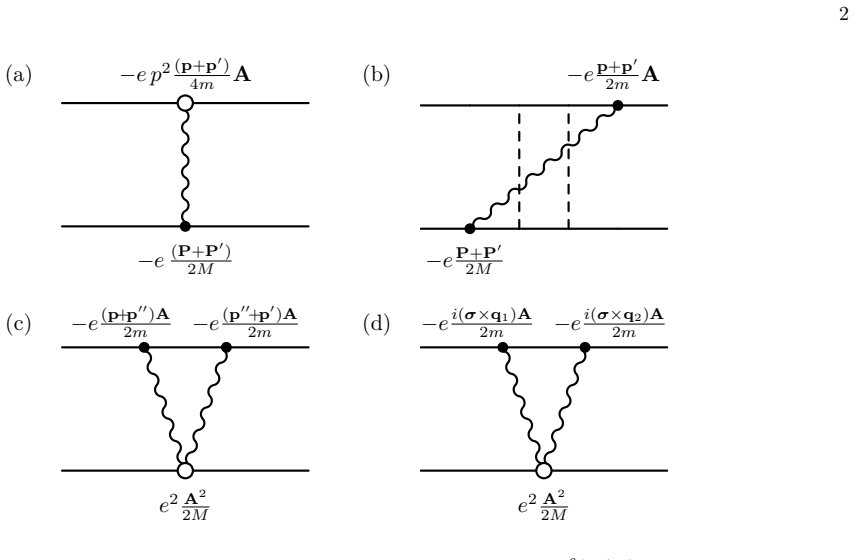
The load-bearing object is the regularization of the two singular integrals $\langle 1/r^3\rangle$ and $\langle 1/r^4\rangle$ in Eq. (24), together with the notation $[p^2]_\mu = p^2 + 2\mu V$, which turns the singular operator combinations into regular functions when acting on the Schr\"odinger wave function. The paper separates the soft-photon contributions, expressed through the operators $H_a, H_b, H_c, H_d$, from the hard-photon contribution $H_H$, whose coefficient is fixed by the hydrogen 1S result. The key identity is that the combination $\langle E^2\rangle - 2\mu\langle V^3\rangle + \langle V(4\pi\rho)\rangle$ is finite and scheme independent, so coordinate-cutoff and dimensional regularizations give the same final operators. For numerical work, $\langle [p^2]_\mu H_{\mathrm{ret}}\rangle$ is evaluated by inserting a finite set of intermediate states, as in Eq. (39).
What would settle it
The decisive check is to derive the hard-photon (high-energy) contribution to the $m(Z\alpha)^6(m/M)$ recoil shift directly from the three-body NRQED diagrams for $\mathrm{H}_2^+$: if any three-body term survives or the coefficient of $\pi\delta(r_1)+\pi\delta(r_2)$ differs from $4\ln2-3$, Eqs. (35) and (36) are incomplete. A shorter test is to evaluate the final operators for the 1S state of a hydrogenlike atom, where the analytic result is known, and confirm the matching that determines $C$.
Extended reading notes
Core claim
The central claim is that the order-$m(Z\alpha)^6(m/M)$ recoil correction is fully captured by a finite operator set once the divergent distributions are handled by the regularization of Eq. (24). For hydrogenlike atoms the sum of soft-photon and hard-photon contributions reproduces the known 1S recoil result of $Z^6\alpha^4/M\,(4\ln 2 - 7/2)$, which fixes the previously unknown coefficient $C_s = 4\ln2 - 3$ in coordinate-cutoff regularization. For the molecular ion the same procedure yields Eqs. (35) and (36), with all operators having finite expectation values on any bound state of the nonrelativistic Schr\"odinger problem; the cross terms between the two nuclei are finite, so the high-energy part reduces to the pairwise $\delta$-function Hamiltonian of Eq. (31). This is precisely the main result stated in Section VI: a set of finite operators that makes the recoil correction numerically computable.
Load-bearing premise
The load-bearing premise is that the high-energy contribution for the molecular ion is exactly the pairwise sum of hydrogen-atom $\delta$-functions, $(4\ln2-3)Z^3/M\,[\pi\delta(r_1)+\pi\delta(r_2)]$, with no extra three-body hard-photon term and no modification of the coefficient by the second nucleus.
Editorial extensions
If this is right
- Eqs. (35) and (36) allow a direct numerical computation of the $m(Z\alpha)^6(m/M)$ recoil shift for rovibrational bound states of $\mathrm{H}_2^+$, going beyond the adiabatic approximation for this order.
- For hydrogenlike atoms, the derived operators reproduce the known pure-recoil energy shift, which checks the whole construction and fixes the $\delta$-function coefficient $C_s = 4\ln2 - 3$.
- The finiteness of the cross terms $\langle V_1 H_{\mathrm{ret},2}\rangle$ and $\langle V_2 H_{\mathrm{ret},1}\rangle$ means the three-body problem reduces to pairwise interactions at this order, simplifying the molecular-ion calculation.
- The same operator set can be combined with the previously derived $m\alpha^6$ finite operators to provide the full relativistic correction of this size for molecular ions.
Reading between the lines
- If Eq. (31) is correct, the formulas already contain $M_1, M_2, Z_1, Z_2$, so they extend immediately to $\mathrm{HD}^+$ and $\mathrm{D}_2^+$ with no new derivation except numerical evaluation.
- A direct three-body NRQED calculation of the hard-photon region would test the paper's pairwise assumption; that test is not performed here and is the most direct way to falsify the molecular-ion extension.
- With numerical values in hand for $\mathrm{H}_2^+$, the recoil correction could be combined with existing $m\alpha^6$ calculations to sharpen tests of QED in molecular spectroscopy and, plausibly, the determination of $m/M$ from rovibrational transitions.
Editorial analysis
A structured set of objections, weighed in public.
Referee Report
Summary. The paper derives finite operators for spin-averaged relativistic recoil corrections of order mα^6(m/M) in hydrogenlike atoms and in the hydrogen molecular ion. For the two-body case it separates the singular parts of the NRQED effective Hamiltonian, regularizes the divergent expectation values, fixes the unknown δ-function coefficient by matching the known 1S recoil shift in Eq. (25), and independently reproduces the same coefficient in Appendix A using dimensionally regularized NRQED. The molecular-ion part extends the operators to the three-body system, introduces a high-energy term HH in Eq. (31) as a pairwise sum of atomic δ(r_i) terms, and assembles the finite operators in Eqs. (35) and (36). No numerical evaluation is presented.
Significance. If the molecular-ion extension is correct, the paper provides a practically useful route to the mα^6(m/M) recoil correction for H2+ beyond the adiabatic approximation, which is directly relevant to high-precision spectroscopy of hydrogen molecular ions. The hydrogenlike part is well supported: the final expression is checked against the known pure-recoil 1S result, and Appendix A gives an independent dimensional-regularization derivation of the same two-body answer. The molecular-ion part, however, rests on the asserted pairwise form of the hard-photon Hamiltonian, Eq. (31), which is not derived from three-body NRQED. That assumption is load-bearing for the central claim that Eqs. (35) and (36) make the recoil correction numerically computable.
major comments (2)
- [§V.B, Eq. (31)] The high-energy Hamiltonian for the molecular ion, Eq. (31), is asserted as the pairwise sum (4 ln 2 − 3) Z^3/M [πδ(r1)+πδ(r2)] with the same coefficient as in the hydrogen atom. This additivity is not derived from the three-body NRQED diagrams. The sentence following Eq. (30), that the cross terms are finite and can be calculated numerically, concerns soft matrix elements such as ⟨V_i H_ret,j⟩; it does not exclude hard-photon diagrams in which the electron exchanges hard transverse photons with both nuclei or in which the second nucleus modifies the short-distance electron propagation. Appendix A derives the hard-photon term only for the two-body atom (Eq. A9). Because Eqs. (35)–(36) incorporate Eq. (31) directly, the central claim of numerical computability for H2+ is incomplete unless this pairwise form is derived or the omitted three-body hard-photon terms are shown to vanish.
- [§V.D and Eq. (24)] The statement that the only requirement is to use the regularized divergent integrals as defined in Eq. (24) is not quite sufficient as written. Eq. (24) gives both a cutoff prescription and closed-form results for hydrogen nS states; the closed forms contain hydrogen-state-specific quantities (ψ(n), n, and ln(2Z)). For a general molecular wavefunction the expectation values must be defined by the limiting procedure applied to the actual three-body wavefunction, not by the hydrogen analytic expressions. The paper should state this explicitly, since the numerical evaluation of Eq. (35) depends on it.
minor comments (4)
- [§III.A, Eq. (10)] The coefficient in the first term of Eq. (10) appears inconsistent with the identity [p^2]_µ = p^2 + 2µV and with the definition H_ret = −Z/(mM) p_i W^ij p_j; as written, Eq. (11) does not follow from Eq. (10). Since the final two-body result is benchmarked against the known 1S shift, this is likely a typo, but it should be corrected.
- [§V.B, Eq. (32)] Eq. (32) writes ΔE_ret = 2α^2 ⟨H_B Q(E0−H0)^{-1}Q H_ret⟩, whereas the hydrogen analog in Eq. (19) and the final molecular expression in Eq. (36) carry α^4 for the same second-order contribution. The α^2 factor in Eq. (32) is inconsistent with the notation used elsewhere and should be repaired.
- [§V.B, Eq. (31)] For three-particle systems with different nuclear charges or masses (e.g., HD+), Eq. (31) should presumably read a sum over nuclei with Z_a^3/M_a multiplying πδ(r_a). The present writing with a common Z^3/M is only valid for a symmetric ion; the intended scope should be stated.
- [General] There are several typographical slips, including “diverent” in §V.D and the ambiguous phrase “can now be calculated numerically” in §V.D, which should be checked during revision.
Circularity Check
No significant circularity: the δ-function coefficient is externally calibrated and independently reproduced, while the H2+ additivity assumption is a derivation gap, not a circular step.
full rationale
The derivation chain does not exhibit definitional circularity. The δ-function coefficient C_s in Eqs. (21) and (31) is not fitted to the molecular-ion result; it is fixed by the external hydrogen 1S benchmark (Eq. (25), from Ref. [8]) and independently reproduced by dimensional regularization in Appendix A, whose hard-photon term (Eq. (A9)) is taken from Ref. [9]. The hydrogen-atom finite-operator results are cross-checked against the independent dimensionally regularized NRQED expressions of Ref. [11]. The molecular-ion operators in Eqs. (35)–(36) are obtained by substituting the pairwise effective Hamiltonian (29) from Ref. [12] and regularizing the 1/r^3 and 1/r^4 integrals via Eq. (24); the novel content—cross terms, second-order subtraction, and finite operators—is not an input. The main caveat, that the hard-photon H2+ term HH in Eq. (31) is assumed to be the pairwise sum of atomic δ-functions without derivation from three-body NRQED, is a completeness/derivation gap rather than a circularity, because the H2+ energy shift is not used to determine any parameter in HH. The self-citations [10] and [12] are to previously published derivations and do not by themselves make the argument circular.
Assumptions & free parameters
free parameters (1)
- C_s (delta-function coefficient, coordinate cutoff regularization) =
4 ln 2 - 3
assumptions (4)
- domain assumption The NRQED expansion in orders of Zalpha and m/M applies to the bound states considered.
- domain assumption The high-energy recoil contribution for the molecular ion is a sum of pairwise single-nucleus delta-function terms.
- domain assumption The known hydrogen 1S pure recoil shift, Eq. (25) from Ref. [8], is correct and can be used to calibrate the delta-function coefficient.
- standard math The dimensional regularization identities in Eqs. (A1) and in Ref. [11], Eqs. (A22) and (A24), are valid.
Cite this review
Pith. "Pith review of Relativistic recoil corrections of order \boldmath$m(Z\alpha)^6(m/M)$: Hydrogen-like atom and hydrogen molecular ion." pith.science (2026). https://pith.science/paper/LODGCOTD
@misc{pith2026250603644,
  author       = {Pith},
  title        = {Pith review of: Relativistic recoil corrections of order \boldmath$m(Z\alpha)^6(m/M)$: Hydrogen-like atom and hydrogen molecular ion},
  year         = {2026},
  howpublished = {\url{https://pith.science/paper/LODGCOTD}},
  note         = {Machine review of arXiv:2506.03644}
}
abstract
The finite operators are derived for the recoil $m\alpha^6(m/M)$ order relativistic corrections (to spin-averaged energy levels) in hydrogen-like atoms and ions in the two- and three-body formalism beyond the adiabatic approximation. Results are presented in a form suitable for numerical evaluation.
Figures
Forward citations
Cited by 1 Pith paper
-
Second-order corrections of orders $m\alpha^6$ and $m\alpha^6(m/M)$ to the spin-averaged energy in the HD$^+$ and H$_2^+$ ions
New variational calculations provide the second-order mα^6 and mα^6(m/M) energy corrections for H2+ and HD+ ro-vibrational states with relative numerical uncertainty below 10^-5.
Reference graph
Works this paper leans on
-
[1]
Korobov, Relativistic corrections of mα6 order to the rovibrational spectrum of H + 2 and HD + molecular ions
V.I. Korobov, Relativistic corrections of mα6 order to the rovibrational spectrum of H + 2 and HD + molecular ions. Phys. Rev. A 77, 022509 (2008)
2008
-
[2]
V.I. Korobov and J.-Ph. Karr, Rovibrational spin-averaged transitions in the hydrogen molecular ions, Phys. Rev. A 104, 032806 (2021)
work page 2021
-
[3]
Z.-X. Zhong, W.-P. Zhou, and X.-S. Mei. Spin-averaged effective Hamiltonian of orders mα6 and mα6(m/M) for hydrogen molecular ions. Phys. Rev. A 98, 032502 (2018)
work page 2018
-
[4]
Salpeter, Mass corrections to the fine structure of hydrogen-like atoms
E.E. Salpeter, Mass corrections to the fine structure of hydrogen-like atoms. Phys. Rev. 87, 328 (1952)
work page 1952
-
[5]
H. Grotch and D.R. Yennie, Effective potential model for calculating nuclear corrections to the energy levels of hydrogen. Rev. Mod. Phys. 41, 350 (1969)
work page 1969
-
[6]
Shabaev, Mass recoil in a strong nuclear field
V.M. Shabaev, Mass recoil in a strong nuclear field. Theor. Math. Phys. 63, 588 (1985)
work page 1985
-
[7]
Recoil Correction in the Dirac-Coulomb Problem
A.S. Yelkhovsky, Recoil Correction in the Dirac-Coulomb Problem. hep-th/9403095
-
[8]
K. Pachucki and H. Grotch. Pure recoil corrections to the hydrogen energy levels. Phys. Rev. A 51, 1854 (1995)
work page 1995
Show all 12 references
-
[9]
Blockland, A
I. Blockland, A. Czarnecki, and K. Melnikov, Expansion of bound-state energies in powers of m/M and (1−m/M). Phys. Rev. D 65, 073015 (2002)
2002
-
[10]
Korobov, Relativistic corrections of order mα6: singular operators and regularization
V.I. Korobov, Relativistic corrections of order mα6: singular operators and regularization. arXiv:2505.16645, submitted to Phy. Rev. A
-
[11]
Patk´ oˇ s, V.A
V. Patk´ oˇ s, V.A. Yerokhin, K. Pachucki. Higher-order recoil corrections for triplet states of the helium atom. Phys. Rev. A 94, 052508 (2016)
2016
-
[12]
Korobov, J.-Ph
V.I. Korobov, J.-Ph. Karr, M. Haidar, and Z.-X. Zhong. Hyperfine structure in the H + 2 and HD+ molecular ions at order mα6, Phys. Rev. A 102, 022804 (2020)
2020
Reviewed August 7, 2026 · model on record in the stance chip above.
Discussion (0). Sign in to comment.