REVIEW 3 major objections 5 minor 97 references
A Bi-fidelity Surrogate Modeling Approach for Uncertainty Propagation in Three-Dimensional Hemodynamic Simulations
T0 review · 3 major / 5 minor · reviewed 2026-08-14 · deepseek-v4-flash
Pith's one-line read A bi-fidelity surrogate that combines cheap low-fidelity simulations with a few dozen high-fidelity runs can propagate high-dimensional inflow uncertainties in 3D hemodynamics to full-field wall shear stress statistics at about one to two…
desk verdict A capable applied demonstration of bi-fidelity UQ for full-field 3D hemodynamics; the numerics are convincing but the method's key transferable assumptions are under-analyzed. read the letter →
The pith
A machine-rendered reading of the paper's core claim, the machinery that carries it, and where it could break.
The reading
What carries the argument
The object that carries the argument is the coefficient-sharing projection of the bi-fidelity surrogate. During offline training, $M$ low-fidelity solutions are computed on a sample set $\Gamma$, and a greedy algorithm based on the pivoted Cholesky decomposition of the low-fidelity Gramian matrix $G_{ij} = \langle v_L(z_i), v_L(z_j)\rangle$ selects $m$ important points whose low-fidelity solutions are farthest from the subspace of previously selected ones; high-fidelity solutions at exactly those points form the high-fidelity basis. At a new parameter point $z$, only a low-fidelity solve is needed: the solution is projected onto the low-fidelity basis via $c_L = G^{-1}(V_L(\gamma_m))^T v_L(z)$, and the surrogate reconstructs $v_B(z) = \sum_k c_k v_H(z_k)$ by reusing the same coefficients. The empirical error bound monitors $R_s$, the ratio of high- to low-fidelity relative distances to their respective subspaces, and $R_e$, the balance between in-plane error and distance error, to decide whether the low-fidelity model is informative and when to stop collecting high-fidelity samples.
What would settle it
Choose a low-fidelity model that is deliberately uninformative, for example a coarse-mesh or 2D model that cannot represent a vortex or secondary flow present in the 3D high-fidelity solution, and compute the bi-fidelity surrogate at validation points where the coefficient-sharing relation is known to fail. If the surrogate's relative error fails to drop below the low-fidelity baseline, or if the projection coefficients $c_L$ differ substantially from the coefficients of the high-fidelity solution projected onto the high-fidelity basis, the central claim would be refuted.
Extended reading notes
Core claim
The central claim is that the high- and low-fidelity solutions share enough structure that the same projection coefficients can serve both: after projecting a new low-fidelity solution onto the low-fidelity basis, those coefficients are used, without modification, to form a combination of high-fidelity basis functions, producing the bi-fidelity surrogate $v_B(z) = \sum_{k=1}^m c_k v_H(z_k)$. The high-fidelity snapshots at the selected points therefore act as a full-field basis, which is why the surrogate returns three-dimensional velocity, pressure, and wall shear stress fields rather than a few scalar outputs. On the patient-specific aneurysm case the surrogate matched statistics computed from a 600-run high-fidelity Monte Carlo ensemble, with relative error dropping by an order of magnitude below the low-fidelity baseline, using only 40 high-fidelity training runs. The paper also proposes an empirical a priori error estimate, based on the model-similarity ratio $R_s$ and the in-plane-to-distance error ratio $R_e$, that is intended to tell a user when the low-fidelity model is informative enough and when adding more high-fidelity samples stops helping.
Load-bearing premise
Everything rests on the assumption that the low-fidelity and high-fidelity reconstructions share the same projection coefficients: coefficients obtained by projecting a cheap low-fidelity solution onto the low-fidelity basis can be reused unmodified to combine high-fidelity basis functions at that parameter point.
Editorial extensions
If this is right
- Clinically useful uncertainty maps, such as means and standard deviations of velocity, pressure, and wall shear stress plus locations of extreme WSS, can be obtained with tens of high-fidelity simulations instead of hundreds or thousands.
- The method accepts a wide range of low-fidelity models, including coarse meshes, unconverged iterations, and even 2D geometry, so it can ride on existing CFD solvers without code changes.
- The selected high-fidelity snapshots carry three-dimensional information the low-fidelity model lacks; in the 2D/3D bifurcation case the surrogate recovered z-direction flow that was absent from the low-fidelity solutions.
- The two error metrics $R_s$ and $R_e$ provide a practical stopping rule: keep adding high-fidelity important points as long as the low-fidelity model looks similar to the high-fidelity one and the in-plane error is not dominant, and stop when it is.
Reading between the lines
- If coefficient sharing holds whenever a cheap model captures the dominant parameter response, the same bi-fidelity construction could transfer to other expensive PDE-based UQ settings, such as cardiac electrophysiology or patient-specific structural mechanics, where a coarser or simplified model is readily available.
- The success of recovering a whole missing velocity component in the 2D/3D case suggests the high-fidelity basis stores physical features absent from the low-fidelity model; a sharper test is to check whether the surrogate can also recover a flow feature that appears in the high-fidelity snapshots only at points outside the selected subset.
- The empirical error estimate is explicitly heuristic, as the paper concedes; a natural next step would be a systematic comparison of the estimated bound against true errors across many low-fidelity/high-fidelity pairs to calibrate when the $R_s\approx1$ and $R_e<10$ thresholds are safe.
- Because the surrogate needs only one cheap solve per new parameter sample, it converts the dominant cost of Monte Carlo propagation from running the expensive solver into a bandwidth problem: how cheaply the low-fidelity model can be evaluated at scale.
Signed reviews
Editorial analysis
A structured set of objections, weighed in public.
Referee Report
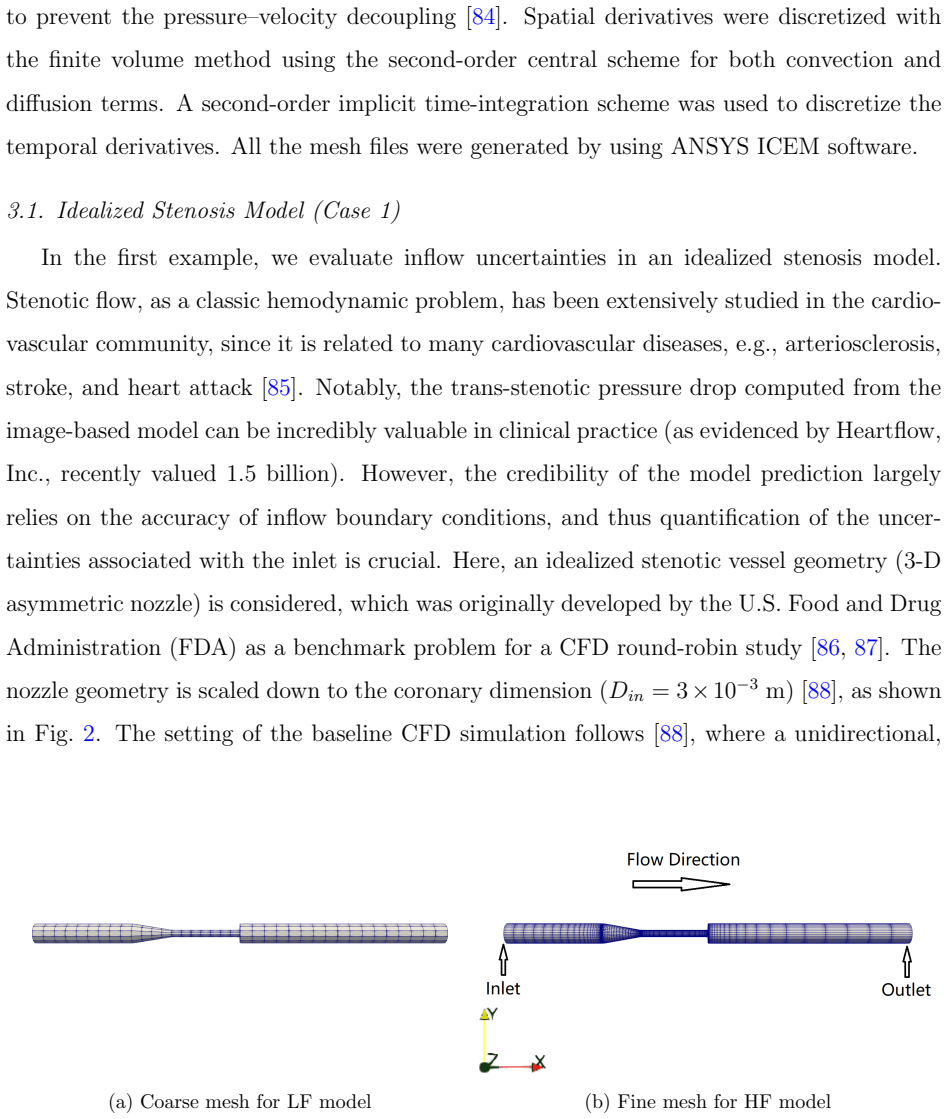
Summary. This paper proposes a bi-fidelity surrogate modeling framework for uncertainty propagation in three-dimensional cardiovascular CFD. The method uses many cheap low-fidelity (LF) simulations to select a small number of 'important' parameter points via pivoted Cholesky decomposition of the LF Gramian, then uses the LF projection coefficients on those points to combine high-fidelity (HF) basis functions, yielding full-field velocity/pressure/WSS predictions. The framework is demonstrated on three vascular cases: an idealized stenosis with converged/unconverged and coarse/fine mesh pairs, an idealized bifurcation aneurysm with a 3D/2D model pair, and a patient-specific middle cerebral artery aneurysm with coarse/fine meshes. The authors report that the bi-fidelity surrogate reproduces Monte Carlo benchmark statistics (means, standard deviations, extreme-value distributions) with relative errors near 1–2% using only 6–40 HF runs, while achieving large computational speedups. They also propose an 'empirical error bound estimation' procedure based on a model similarity metric Rs and an in-plane/distance error ratio Re, and they test this estimator on the three cases.
Significance. If the reported accuracy transfers to practical clinical geometries, the proposed approach would be an important step toward making full-field, high-dimensional forward UQ in image-based hemodynamics computationally feasible. The paper's strengths are its focus on full-field predictions rather than scalar quantities of interest, its use of independent HF test sets to validate the surrogate, and its exploration of several distinct LF/HF pairings, including a challenging 2D-to-3D case and a 9-dimensional patient-specific case. The reported results are specific and falsifiable, and the method is non-intrusive to the CFD solver. However, the second claimed contribution, the a priori error bound, is presented as a conjecture rather than a proven bound, and the central coefficient-sharing assumption is asserted without direct validation; these issues limit the strength of the manuscript in its current form.
major comments (3)
- [Section 2.2.3, Eqs. (9)–(10)] The method's core premise is that the LF and HF reconstructions share the same projection coefficients, but this assumption is never checked against data. The authors state 'Since we assume the HF and LF reconstructions share the same reconstruction coefficients' and proceed to Eq. (10), but no numerical comparison between c_L(z) and the actual HF coefficients c_H(z) = [V_H(γ_m)^T V_H(γ_m)]^{-1} V_H(γ_m)^T v_H(z) is reported. The heuristic Rs≈1 condition in Eq. (12) compares relative distances to the respective spans, which does not imply coordinate-coefficient equality. This is load-bearing for the central claim: in the 2D-to-3D case (Section 3.2), the LF model has no z-velocity component, so the successful recovery of z-direction flow (Figs. 6c and 6f) is not guaranteed by Eq. (10); the test geometry is nearly planar, and the result may not transfer to strongly three-dimensional patient geometries. I request a direct diagnostic of coefficient-sharing on the test sets (e.g., scatter plots of c_L versus c_H at a few parameter points, or a reported norm of their difference), or a theoretical condition under which the sharing is justified.
- [Section 2.2.4, Theorem 1 and Eq. (14)] The paper's second contribution, the 'empirical error bound estimation', is not actually a bound after the step where constants are introduced. Theorem 1 is stated with the proof 'rather trivial and omitted here', which is not acceptable for a formal theorem in a methods paper; at minimum the triangle-inequality steps should be shown. More importantly, Eq. (14) is labeled a conjecture, and the constants c1 and c2 are set to 1 'based on numerical experience' from the same experiments used to evaluate the estimator. This makes the reported 'bound' an a posteriori heuristic indicator rather than an a priori bound. Numerical evidence in Section 4 and Fig. 15(d)–(f) shows only that the estimator captures the qualitative trend of the true error; in Cases 1 and 2 the estimated curve is not consistently above the true error for all m, which contradicts the term 'bound'. The authors do add a Remark acknowledging the estimate is 'not rigorous', but the abstract and Section 1 still describe it as an 'empirical error bound estimation approach'. I recommend either reframing the contribution as an empirical error indicator and removing the word 'bound', or providing a rigorous derivation with explicit, verifiable constants and validating the inequality pointwise on the test sets.
- [Section 3.3 and Fig. 14] The headline claim that 40 HF runs suffice for the patient-specific 9-dimensional case is presented against an HF-MC benchmark of 600 samples, but no uncertainty quantification of that benchmark is given. Since the ground truth itself is a Monte Carlo estimate, the reported 1–2% relative errors are only meaningful if the MC statistics are sufficiently converged; a convergence check or bootstrap confidence intervals for the MC means/standard deviations would strengthen the comparison. This is not a fatal issue, but it affects the precision with which the central claim can be stated.
minor comments (5)
- [Eq. (11)] The typesetting of Eq. (11) appears garbled: after the second equality the denominator '||vH(z*)||' is repeated without a clear operator, and the grouping of the factor (1 + ...) is hard to parse. Please rewrite the equation with unambiguous parentheses or split it into two lines.
- [Eq. (14) and surrounding text] There are notation inconsistencies: the first factor on the right-hand side uses 'vL(z)' instead of 'vL(z*)', and the text after Eq. (14) refers to 'Re(z) = (12)' while Re is first defined in Eq. (15); please correct these cross-references.
- [Fig. 8 caption] The caption reads 'relative root mean squared error (RMSE)' but the label in the figure says 'RSME'; please use the correct acronym consistently.
- [Section 5 and Acknowledgments] The heading 'Aknowledgement' is misspelled; it should be 'Acknowledgments'.
- [Fig. 15 caption] The caption says 'error bound estimation (d-e)' but there are three subpanels (d), (e), and (f); please change to '(d–f)'.
Circularity Check
The main surrogate-accuracy claim is validated against independent HF test samples and is not circular, but the claimed a priori error bound is calibrated on the same numerical experiments it is then used to describe.
-
fitted input called prediction
[Section 2.2.4 (Eqs. 14-16), validated in Section 4 (Fig. 15d-f)]
"Numerical experiments we have conducted in the Section 4 support our conjectures above and indicate that when c1 and c2 are set to be 1, if Rs≈ 1 and Re < 10, the BF approximation can usually deliver good results (better than the low-fidelity solutions)."
The conjectured error bound in Eqs. (14)-(16) contains undetermined constants c1 and c2. The paper fixes these constants as c1 = c2 = 1 based on the numerical experiments reported in Section 4, and then presents those same Section 4 results as confirmation: 'the empirical error bound estimations can basically capture the trends of the true errors in terms of the number of HF training samples in all cases.' Therefore the agreement between the 'error bound' and the true errors in Fig. 15 is not an independent a priori prediction; the free constants were chosen after inspecting the same true-error curves. The paper's own caveat that 'the error bound estimation is not rigorous' confirms that this is a calibrated empirical description rather than a derived bound.
full rationale
The central claim of the paper, that the bi-fidelity surrogate can propagate inflow uncertainties to full-field hemodynamic quantities using few high-fidelity runs, is not circular. In each test case the surrogate is evaluated on independently sampled HF Monte Carlo test sets (e.g., 600 HF simulations in the patient-specific case), and the reported accuracy is an empirical comparison against those ground-truth samples. The coefficient-sharing assumption in Eq. (10) is an unproved heuristic, but it is not a tautology: the surrogate could fail and the paper checks it against data, so the main accuracy result has independent content. The method is imported from prior works [76-78], including coauthored references, but those are published methodological papers and the present manuscript supplies its own implementations, geometries, and independent validation; self-citation alone is not circular. The one genuine circular element is the 'empirical error bound estimation' advertised as a novel contribution: the constants c1 and c2 in the conjectured bound are set to 1 by inspecting the same numerical experiments that are then used to demonstrate that the bound captures the true-error trends. That makes the error-bound demonstration a calibration exercise rather than a prediction. Because this affects only the secondary a priori-error contribution and not the main surrogate-accuracy claim, the appropriate score is 4.
Assumptions & free parameters
free parameters (2)
- c1, c2 (error bound constants) =
1, 1
- Re threshold (<10) =
10
assumptions (4)
- domain assumption HF and LF reconstructions share the same coefficients (Eqs. 9-10).
- domain assumption The LF model is informative for important-point selection (Rs≈1, Eq. 12).
- ad hoc to paper The error bound conjecture (Eq. 14) with bounded constants.
- domain assumption Steady, rigid-wall, Newtonian incompressible Navier-Stokes equations (Eq. 1).
Cite this review
Pith. "Pith review of A Bi-fidelity Surrogate Modeling Approach for Uncertainty Propagation in Three-Dimensional Hemodynamic Simulations." pith.science (2026). https://pith.science/paper/LPPKBTHW
@misc{pith2026190810197,
  author       = {Pith},
  title        = {Pith review of: A Bi-fidelity Surrogate Modeling Approach for Uncertainty Propagation in Three-Dimensional Hemodynamic Simulations},
  year         = {2026},
  howpublished = {\url{https://pith.science/paper/LPPKBTHW}},
  note         = {Machine review of arXiv:1908.10197}
}
read the original abstract
Image-based computational fluid dynamics (CFD) modeling enables derivation of hemodynamic information, which has become a paradigm in cardiovascular research and healthcare. Nonetheless, the predictive accuracy largely depends on precisely specified boundary conditions and model parameters, which, however, are usually uncertain in most patient-specific cases. Quantifying the uncertainties in model predictions due to input randomness can provide predictive confidence and is critical to promote the transition of CFD modeling in clinical applications. In the meantime, forward propagation of input uncertainties often involves numerous expensive CFD simulations, which is computationally prohibitive in most practical scenarios. This paper presents an efficient bi-fidelity surrogate modeling framework for uncertainty quantification (UQ) in cardiovascular simulations, by leveraging the accuracy of high-fidelity models and efficiency of low-fidelity models. Contrary to most data-fit surrogate models with several scalar quantities of interest, this work aims to provide high-resolution, full-field predictions. Moreover, a novel empirical error bound estimation approach is introduced to evaluate the performance of the surrogate a priori. The proposed framework is tested on a number of vascular flows with both standardized and patient-specific vessel geometries, and different combinations of high- and low-fidelity models are investigated. The results show that the bi-fidelity approach can achieve high predictive accuracy with a significant reduction of computational cost, exhibiting its merit and effectiveness. Particularly, the uncertainties from a high-dimensional input space can be accurately propagated to clinically relevant quantities of interest in the patient-specific case using only a limited number of high-fidelity simulations, suggesting a good potential in practical clinical applications.
Figures


Figures from the paper (12 more)


Reference graph
Works this paper leans on
-
[1]
Mozaffarian, E
D. Mozaffarian, E. J. Benjamin, A. S. Go, D. K. Arnett, M. J. Blaha, M. Cushman, S. De Ferranti, J.-P. Despr´ es, H. J. Fullerton, V. J. Howard, et al., Executive summary: heart disease and stroke statistics-2015 update: a report from the american heart asso- ciation, Circulation 131 (4) (2015) 434–441
2015
-
[2]
D. A. Steinman, C. A. Taylor, Flow imaging and computing: large artery hemodynam- ics, Annals of biomedical engineering 33 (12) (2005) 1704–1709. 33
2005
-
[3]
D. A. Steinman, F. Migliavacca, Special issue on verification, validation, and uncer- tainty quantification of cardiovascular models: Towards effective vvuq for translating cardiovascular modelling to clinical utility, Cardiovascular engineering and technology 9 (4) (2018) 539–543
2018
-
[4]
Quarteroni, A
A. Quarteroni, A. Manzoni, C. Vergara, The cardiovascular system: Mathematical mod- elling, numerical algorithms and clinical applications, Acta Numerica 26 (2017) 365–590
2017
-
[5]
Valen-Sendstad, A
K. Valen-Sendstad, A. W. Bergersen, Y. Shimogonya, L. Goubergrits, J. Bruening, J. Pallares, S. Cito, S. Piskin, K. Pekkan, A. J. Geers, et al., Real-world variability in the prediction of intracranial aneurysm wall shear stress: the 2015 international aneurysm CFD challenge, Cardiovascular engineering and technology 9 (4) (2018) 544–564
2018
-
[6]
K. R. Moyle, L. Antiga, D. A. Steinman, Inlet conditions for image-based CFD models of the carotid bifurcation: is it reasonable to assume fully developed flow?, Journal of biomechanical engineering 128 (3) (2006) 371–379
2006
-
[7]
Marzo, P
A. Marzo, P. Singh, P. Reymond, N. Stergiopulos, U. Patel, R. Hose, Influence of inlet boundary conditions on the local haemodynamics of intracranial aneurysms, Computer methods in biomechanics and biomedical engineering 12 (4) (2009) 431–444
2009
-
[8]
Karmonik, C
C. Karmonik, C. Yen, O. Diaz, R. Klucznik, R. G. Grossman, G. Benndorf, Tempo- ral variations of wall shear stress parameters in intracranial aneurysmsimportance of patient-specific inflow waveforms for CFD calculations, Acta neurochirurgica 152 (8) (2010) 1391–1398
2010
Show all 97 references
-
[9]
Troianowski, C
G. Troianowski, C. A. Taylor, J. A. Feinstein, I. E. Vignon-Clementel, Three- dimensional simulations in glenn patients: clinically based boundary conditions, hemo- dynamic results and sensitivity to input data, Journal of biomechanical engineering 133 (11) (2011) 111006
2011
-
[10]
Jansen, J
I. Jansen, J. Schneiders, W. Potters, P. van Ooij, R. van den Berg, E. van Bavel, H. Mar- quering, C. Majoie, Generalized versus patient-specific inflow boundary conditions in 34 computational fluid dynamics simulations of cerebral aneurysmal hemodynamics, Amer- ican Journal of N...
2014
-
[11]
H. G. Morales, O. Bonnefous, Unraveling the relationship between arterial flow and intra-aneurysmal hemodynamics, Journal of biomechanics 48 (4) (2015) 585–591
2015
-
[12]
Sarrami-Foroushani, T
A. Sarrami-Foroushani, T. Lassila, A. Gooya, A. J. Geers, A. F. Frangi, Uncertainty quantification of wall shear stress in intracranial aneurysms using a data-driven statis- tical model of systemic blood flow variability, Journal of biomechanics 49 (16) (2016) 3815–3823
2016
-
[13]
Brault, L
A. Brault, L. Dumas, D. Lucor, Uncertainty quantification of inflow boundary condition and proximal arterial stiffness–coupled effect on pulse wave propagation in a vascular network, International journal for numerical methods in biomedical engineering 33 (10) (2017) e2859
2017
-
[14]
Bozzi, U
S. Bozzi, U. Morbiducci, D. Gallo, R. Ponzini, G. Rizzo, C. Bignardi, G. Passoni, Un- certainty propagation of phase contrast-MRI derived inlet boundary conditions in com- putational hemodynamics models of thoracic aorta, Computer methods in biomechanics and biomedical enginee...
2017
-
[15]
Bruening, F
J. Bruening, F. Hellmeier, P. Yevtushenko, M. Kelm, S. Nordmeyer, S. H. S¨ undermann, T. Kuehne, L. Goubergrits, Impact of patient-specific lvot inflow profiles on aortic valve prosthesis and ascending aorta hemodynamics, Journal of computational science 24 (2018) 91–100
2018
-
[16]
Madhavan, E
S. Madhavan, E. M. C. Kemmerling, The effect of inlet and outlet boundary conditions in image-based CFD modeling of aortic flow, Biomedical engineering online 17 (1) (2018) 66
2018
-
[17]
Pirola, O
S. Pirola, O. Jarral, D. O’Regan, G. Asimakopoulos, J. Anderson, J. Pepper, T. Athana- siou, X. Xu, Computational study of aortic hemodynamics for patients with an abnor- 35 mal aortic valve: The importance of secondary flow at the ascending aorta inlet, APL Bioengineering 2 (2...
2018
-
[18]
Boccadifuoco, A
A. Boccadifuoco, A. Mariotti, S. Celi, N. Martini, M. Salvetti, Impact of uncertain- ties in outflow boundary conditions on the predictions of hemodynamic simulations of ascending thoracic aortic aneurysms, Computers & Fluids 165 (2018) 96–115
2018
-
[19]
J. A. Moore, D. A. Steinman, C. R. Ethier, Computational blood flow modelling: errors associated with reconstructing finite element models from magnetic resonance images, Journal of Biomechanics 31 (2) (1997) 179–184
1997
-
[20]
Moore, D
J. Moore, D. Steinman, D. Holdsworth, C. Ethier, Accuracy of computational hemody- namics in complex arterial geometries reconstructed from magnetic resonance imaging, Annals of biomedical engineering 27 (1) (1999) 32–41
1999
-
[21]
J. R. Cebral, M. A. Castro, S. Appanaboyina, C. M. Putman, D. Millan, A. F. Frangi, Efficient pipeline for image-based patient-specific analysis of cerebral aneurysm hemody- namics: technique and sensitivity, IEEE transactions on medical imaging 24 (4) (2005) 457–467
2005
-
[22]
Castro, C
M. Castro, C. M. Putman, J. Cebral, Computational fluid dynamics modeling of in- tracranial aneurysms: effects of parent artery segmentation on intra-aneurysmal hemo- dynamics, American Journal of Neuroradiology 27 (8) (2006) 1703–1709
2006
-
[23]
Y. Hoi, S. H. Woodward, M. Kim, D. B. Taulbee, H. Meng, Validation of CFD simula- tions of cerebral aneurysms with implication of geometric variations, Journal of biome- chanical engineering 128 (6) (2006) 844–851
2006
-
[24]
Omodaka, T
S. Omodaka, T. Inoue, K. Funamoto, S.-i. Sugiyama, H. Shimizu, T. Hayase, A. Taka- hashi, T. Tominaga, Influence of surface model extraction parameter on computational fluid dynamics modeling of cerebral aneurysms, Journal of biomechanics 45 (14) (2012) 2355–2361. 36
2012
-
[25]
Sankaran, L
S. Sankaran, L. Grady, C. A. Taylor, Fast computation of hemodynamic sensitivity to lumen segmentation uncertainty, IEEE transactions on medical imaging 34 (12) (2015) 2562–2571
2015
-
[26]
Sankaran, H
S. Sankaran, H. J. Kim, G. Choi, C. A. Taylor, Uncertainty quantification in coronary blood flow simulations: impact of geometry, boundary conditions and blood viscosity, Journal of biomechanics 49 (12) (2016) 2540–2547
2016
-
[27]
Nolte, C
D. Nolte, C. Bertoglio, Reducing the impact of geometric errors in flow computations using velocity measurements, International journal for numerical methods in biomedical engineering (2019) e3203
2019
-
[28]
Br¨ uning, F
J. Br¨ uning, F. Hellmeier, P. Yevtushenko, T. K¨ uhne, L. Goubergrits, Uncertainty quan- tification for non-invasive assessment of pressure drop across a coarctation of the aorta using CFD, Cardiovascular engineering and technology 9 (4) (2018) 582–596
2018
-
[29]
S.-W. Lee, D. A. Steinman, On the relative importance of rheology for image-based CFD models of the carotid bifurcation, Journal of biomechanical engineering 129 (2) (2007) 273–278
2007
-
[30]
V. Eck, J. Sturdy, L. Hellevik, Effects of arterial wall models and measurement uncer- tainties on cardiovascular model predictions, Journal of biomechanics 50 (2017) 188–194
2017
-
[31]
Pereira, J
J. Pereira, J. S. e Moura, A. Ervilha, J. Pereira, On the uncertainty quantification of blood flow viscosity models, Chemical Engineering Science 101 (2013) 253–265
2013
-
[32]
Biehler, S
J. Biehler, S. Kehl, M. W. Gee, F. Schmies, J. Pelisek, A. Maier, C. Reeps, H.-H. Eck- stein, W. A. Wall, Probabilistic noninvasive prediction of wall properties of abdominal aortic aneurysms using Bayesian regression, Biomechanics and modeling in mechanobi- ology 16 (1) (2017) 45–61
2017
-
[33]
D. A. Steinman, Y. Hoi, P. Fahy, L. Morris, M. T. Walsh, N. Aristokleous, A. S. Anayiotos, Y. Papaharilaou, A. Arzani, S. C. Shadden, et al., Variability of computa- tional fluid dynamics solutions for pressure and flow in a giant aneurysm: the asme 2012 37 summer bioengineering...
2013
-
[34]
Y. Yu, H. Baek, G. E. Karniadakis, Generalized fictitious methods for fluid–structure interactions: Analysis and simulations, Journal of Computational Physics 245 (2013) 317–346
2013
-
[35]
Y. Yu, P. Perdikaris, G. E. Karniadakis, Fractional modeling of viscoelasticity in 3D cerebral arteries and aneurysms, Journal of computational physics 323 (2016) 219–242
2016
-
[36]
Robinson, M
T. Robinson, M. Eldred, K. Willcox, R. Haimes, Surrogate-based optimization using multifidelity models with variable parameterization and corrected space mapping, Aiaa Journal 46 (11) (2008) 2814–2822
2008
-
[37]
Benner, S
P. Benner, S. Gugercin, K. Willcox, A survey of projection-based model reduction meth- ods for parametric dynamical systems, SIAM review 57 (4) (2015) 483–531
2015
-
[38]
Benner, A
P. Benner, A. Cohen, M. Ohlberger, K. Willcox, Model reduction and approximation: theory and algorithms, Vol. 15, SIAM, 2017
2017
-
[39]
D. Xiu, J. Shen, Efficient stochastic Galerkin methods for random diffusion equations, Journal of Computational Physics 228 (2) (2009) 266–281
2009
-
[40]
Le Maıtre, O
O. Le Maıtre, O. Knio, H. Najm, R. Ghanem, Uncertainty propagation using wiener– haar expansions, Journal of computational Physics 197 (1) (2004) 28–57
2004
-
[41]
S. D. Bond, R. B. Lehoucq, S. T. Rowe, A Galerkin radial basis function method for nonlocal diffusion, in: Meshfree methods for partial differential equations VII, Springer, 2015, pp. 1–21
2015
-
[42]
Manzoni, A
A. Manzoni, A. Quarteroni, G. Rozza, Model reduction techniques for fast blood flow simulation in parametrized geometries, International journal for numerical methods in biomedical engineering 28 (6-7) (2012) 604–625. 38
2012
-
[43]
Lassila, A
T. Lassila, A. Manzoni, A. Quarteroni, G. Rozza, A reduced computational and ge- ometrical framework for inverse problems in hemodynamics, International journal for numerical methods in biomedical engineering 29 (7) (2013) 741–776
2013
-
[44]
Ballarin, G
F. Ballarin, G. Rozza, POD–Galerkin monolithic reduced order models for parametrized fluid-structure interaction problems, International Journal for Numerical Methods in Fluids 82 (12) (2016) 1010–1034
2016
-
[45]
Ballarin, E
F. Ballarin, E. Faggiano, S. Ippolito, A. Manzoni, A. Quarteroni, G. Rozza, R. Scrofani, Fast simulations of patient-specific haemodynamics of coronary artery bypass grafts based on a POD–Galerkin method and a vascular shape parametrization, Journal of Computational Physics 315...
2016
-
[46]
P. Chen, A. Quarteroni, G. Rozza, Reduced basis methods for uncertainty quantifica- tion, SIAM/ASA Journal on Uncertainty Quantification 5 (1) (2017) 813–869
2017
-
[47]
Lassila, A
T. Lassila, A. Manzoni, A. Quarteroni, G. Rozza, Model order reduction in fluid dy- namics: challenges and perspectives, in: Reduced Order Methods for modeling and computational reduction, Springer, 2014, pp. 235–273
2014
-
[48]
Peherstorfer, Model reduction for transport-dominated problems via online adaptive bases and adaptive sampling, arXiv preprint arXiv:1812.02094
B. Peherstorfer, Model reduction for transport-dominated problems via online adaptive bases and adaptive sampling, arXiv preprint arXiv:1812.02094
-
[49]
Chaturantabut, D
S. Chaturantabut, D. C. Sorensen, Nonlinear model reduction via discrete empirical interpolation, SIAM Journal on Scientific Computing 32 (5) (2010) 2737–2764
2010
-
[50]
Updegrove, N
A. Updegrove, N. M. Wilson, J. Merkow, H. Lan, A. L. Marsden, S. C. Shadden, Sim- vascular: An open source pipeline for cardiovascular simulation, Annals of biomedical engineering 45 (3) (2017) 525–541
2017
-
[51]
M. C. Kennedy, A. O’Hagan, Predicting the output from a complex computer code when fast approximations are available, Biometrika 87 (1) (2000) 1–13. 39
2000
-
[52]
Atkinson, N
S. Atkinson, N. Zabaras, Structured bayesian gaussian process latent variable model: Applications to data-driven dimensionality reduction and high-dimensional inversion, Journal of Computational Physics 383 (2019) 166–195
2019
-
[53]
R. G. Regis, C. A. Shoemaker, A stochastic radial basis function method for the global optimization of expensive functions, INFORMS Journal on Computing 19 (4) (2007) 497–509
2007
-
[54]
L. Sun, H. Gao, S. Pan, J.-X. Wang, Surrogate modeling for fluid flows based on physics- constrained deep learning without simulation data, arXiv preprint arXiv:1906.02382
1906 arXiv
-
[55]
Y. Zhu, N. Zabaras, Bayesian deep convolutional encoder–decoder networks for surro- gate modeling and uncertainty quantification, Journal of Computational Physics 366 (2018) 415–447
2018
-
[56]
R. K. Tripathy, I. Bilionis, Deep uq: Learning deep neural network surrogate models for high dimensional uncertainty quantification, Journal of Computational Physics 375 (2018) 565–588
2018
-
[57]
D. Xiu, G. E. Karniadakis, The wiener–askey polynomial chaos for stochastic differential equations, SIAM journal on scientific computing 24 (2) (2002) 619–644
2002
-
[58]
X. Huan, Y. M. Marzouk, Simulation-based optimal Bayesian experimental design for nonlinear systems, Journal of Computational Physics 232 (1) (2013) 288–317
2013
-
[59]
X. Huan, Y. Marzouk, Gradient-based stochastic optimization methods in bayesian experimental design, International Journal for Uncertainty Quantification 4 (6)
-
[60]
H. Lei, X. Yang, B. Zheng, G. Lin, N. A. Baker, Constructing surrogate models of complex systems with enhanced sparsity: quantifying the influence of conformational uncertainty in biomolecular solvation, Multiscale Modeling & Simulation 13 (4) (2015) 1327–1353. 40
2015
-
[61]
Sankaran, A
S. Sankaran, A. L. Marsden, The impact of uncertainty on shape optimization of ideal- ized bypass graft models in unsteady flow, Physics of fluids 22 (12) (2010) 121902
2010
-
[62]
Sankaran, A
S. Sankaran, A. L. Marsden, A stochastic collocation method for uncertainty quantifica- tion and propagation in cardiovascular simulations, Journal of biomechanical engineer- ing 133 (3) (2011) 031001
2011
-
[63]
Sankaran, J
S. Sankaran, J. D. Humphrey, A. L. Marsden, An efficient framework for optimization and parameter sensitivity analysis in arterial growth and remodeling computations, Computer methods in applied mechanics and engineering 256 (2013) 200–210
2013
-
[64]
J. S. Tran, D. E. Schiavazzi, A. M. Kahn, A. L. Marsden, Uncertainty quantification of simulated biomechanical stimuli in coronary artery bypass grafts, Computer Methods in Applied Mechanics and Engineering 345 (2019) 402–428
2019
-
[65]
Schiavazzi, G
D. Schiavazzi, G. Arbia, C. Baker, A. M. Hlavacek, T.-Y. Hsia, A. Marsden, I. Vignon- Clementel, T. M. of Congenital Hearts Alliance (MOCHA) Investigators, Uncertainty quantification in virtual surgery hemodynamics predictions for single ventricle palliation, International jour...
2016
-
[66]
X. Ma, N. Zabaras, An adaptive hierarchical sparse grid collocation algorithm for the solution of stochastic differential equations, Journal of Computational Physics 228 (8) (2009) 3084–3113
2009
-
[67]
Schiavazzi, A
D. Schiavazzi, A. Doostan, G. Iaccarino, A. Marsden, A generalized multi-resolution ex- pansion for uncertainty propagation with application to cardiovascular modeling, Com- puter methods in applied mechanics and engineering 314 (2017) 196–221
2017
-
[68]
Sankaran, L
S. Sankaran, L. Grady, C. A. Taylor, Impact of geometric uncertainty on hemodynamic simulations using machine learning, Computer Methods in Applied Mechanics and En- gineering 297 (2015) 167–190. 41
2015
-
[69]
M. C. Kennedy, A. O’Hagan, Bayesian calibration of computer models, Journal of the Royal Statistical Society: Series B (Statistical Methodology) 63 (3) (2001) 425–464
2001
-
[70]
Huang, T
D. Huang, T. T. Allen, W. I. Notz, R. A. Miller, Sequential kriging optimization us- ing multiple-fidelity evaluations, Structural and Multidisciplinary Optimization 32 (5) (2006) 369–382
2006
-
[71]
Le Gratiet, Bayesian analysis of hierarchical multifidelity codes, SIAM/ASA Journal on Uncertainty Quantification 1 (1) (2013) 244–269
L. Le Gratiet, Bayesian analysis of hierarchical multifidelity codes, SIAM/ASA Journal on Uncertainty Quantification 1 (1) (2013) 244–269
2013
-
[72]
M. B. Giles, Multilevel Monte Carlo methods, Acta Numerica 24 (2015) 259–328
2015
-
[73]
Peherstorfer, P
B. Peherstorfer, P. S. Beran, K. E. Willcox, Multifidelity Monte Carlo estimation for large-scale uncertainty propagation, in: 2018 AIAA Non-Deterministic Approaches Con- ference, 2018, p. 1660
2018
-
[74]
Biehler, M
J. Biehler, M. W. Gee, W. A. Wall, Towards efficient uncertainty quantification in com- plex and large-scale biomechanical problems based on a bayesian multi-fidelity scheme, Biomechanics and modeling in mechanobiology 14 (3) (2015) 489–513
2015
-
[75]
Fleeter, G
C. Fleeter, G. Geraci, D. Schiavazzi, A. Kahn, A. Marsden, Multilevel multifidelity approaches for uncertainty quantification in cardiovascular modeling, abstract presented at 2019 SIAM Conference on Computational Science and Engineering, Spokane, WA. (2019)
2019
-
[76]
Narayan, C
A. Narayan, C. Gittelson, D. Xiu, A stochastic collocation algorithm with multifidelity models, SIAM Journal on Scientific Computing 36 (2) (2014) A495–A521
2014
-
[77]
X. Zhu, A. Narayan, D. Xiu, Computational aspects of stochastic collocation with multifidelity models, SIAM/ASA Journal on Uncertainty Quantification 2 (1) (2014) 444–463
2014
-
[78]
X. Zhu, E. M. Linebarger, D. Xiu, Multi-fidelity stochastic collocation method for com- putation of statistical moments, Journal of Computational Physics 341 (2017) 386–396. 42
2017
-
[79]
Stein, Large sample properties of simulations using Latin hypercube sampling, Tech- nometrics 29 (2) (1987) 143–151
M. Stein, Large sample properties of simulations using Latin hypercube sampling, Tech- nometrics 29 (2) (1987) 143–151
1987
-
[80]
P. W. Glynn, D. L. Iglehart, Importance sampling for stochastic simulations, Manage- ment Science 35 (11) (1989) 1367–1392
1989
-
[81]
Nobile, R
F. Nobile, R. Tempone, C. G. Webster, A sparse grid stochastic collocation method for partial differential equations with random input data, SIAM Journal on Numerical Analysis 46 (5) (2008) 2309–2345
2008
-
[82]
Hampton, H
J. Hampton, H. R. Fairbanks, A. Narayan, A. Doostan, Practical error bounds for a non-intrusive bi-fidelity approach to parametric/stochastic model reduction, Journal of Computational Physics 368 (2018) 315–332
2018
-
[83]
Anderson, J
D. Anderson, J. C. Tannehill, R. H. Pletcher, Computational fluid mechanics and heat transfer, CRC Press, 2016
2016
-
[84]
C. Rhie, W. L. Chow, Numerical study of the turbulent flow past an airfoil with trailing edge separation, AIAA journal 21 (11) (1983) 1525–1532
1983
-
[85]
Berger, L.-D
S. Berger, L.-D. Jou, Flows in stenotic vessels, Annual review of fluid mechanics 32 (1) (2000) 347–382
2000
-
[86]
S. F. Stewart, E. G. Paterson, G. W. Burgreen, P. Hariharan, M. Giarra, V. Reddy, S. W. Day, K. B. Manning, S. Deutsch, M. R. Berman, et al., Assessment of CFD performance in simulations of an idealized medical device: results of FDAs first compu- tational interlaboratory study...
2012
-
[87]
S. F. Stewart, P. Hariharan, E. G. Paterson, G. W. Burgreen, V. Reddy, S. W. Day, M. Giarra, K. B. Manning, S. Deutsch, M. R. Berman, et al., Results of FDAs first interlaboratory computational study of a nozzle with a sudden contraction and conical diffuser, Cardiovascular Engi...
2013
-
[88]
Stiehm, C
M. Stiehm, C. W¨ ustenhagen, S. Siewert, N. Grabow, K.-P. Schmitz, Numerical sim- ulation of pulsatile flow through a coronary nozzle model based on FDAs benchmark geometry, Current Directions in Biomedical Engineering 3 (2) (2017) 775–778
2017
-
[89]
M. E. Tipping, C. M. Bishop, Probabilistic principal component analysis, Journal of the Royal Statistical Society: Series B (Statistical Methodology) 61 (3) (1999) 611–622
1999
-
[90]
D. M. Sforza, C. M. Putman, J. R. Cebral, Hemodynamics of cerebral aneurysms, Annual review of fluid mechanics 41 (2009) 91–107
2009
-
[91]
Weir, Unruptured intracranial aneurysms: a review, Journal of neurosurgery 96 (1) (2002) 3–42
B. Weir, Unruptured intracranial aneurysms: a review, Journal of neurosurgery 96 (1) (2002) 3–42
2002
-
[92]
R. H. Cole, Flow visualization and digital particle image velocimetry on model bifurca- tion aneurysms, University of California, Berkeley, 2001
2001
-
[93]
T. F. Sherman, On connecting large vessels to small. the meaning of murray’s law., The Journal of general physiology 78 (4) (1981) 431–453
1981
-
[94]
Valencia, Simulation of unsteady laminar flow in models of terminal aneurysm of the basilar artery, International Journal of Computational Fluid Dynamics 19 (4) (2005) 337–345
A. Valencia, Simulation of unsteady laminar flow in models of terminal aneurysm of the basilar artery, International Journal of Computational Fluid Dynamics 19 (4) (2005) 337–345
2005
-
[95]
Kaminogo, M
M. Kaminogo, M. Yonekura, S. Shibata, Incidence and outcome of multiple intracranial aneurysms in a defined population, Stroke 34 (1) (2003) 16–21
2003
-
[96]
Drexler, B
H. Drexler, B. Hornig, Endothelial dysfunction in human disease, Journal of molecular and cellular cardiology 31 (1) (1999) 51–60
1999
-
[97]
Dardik, L
A. Dardik, L. Chen, J. Frattini, H. Asada, F. Aziz, F. A. Kudo, B. E. Sumpio, Differ- ential effects of orbital and laminar shear stress on endothelial cells, Journal of vascular surgery 41 (5) (2005) 869–880. 44
2005
Reviewed August 14, 2026 · model on record in the stance chip above.
Discussion (0). Continue with ORCID to comment.