REVIEW 2 major objections 7 minor 39 references
Communicating Through Avatars in Industry 5.0: A Focus Group Study on Human-Robot Collaboration
T0 review · 2 major / 7 minor · reviewed 2026-08-07 · deepseek-v4-flash
Pith's one-line read Real-world workers find avatar-supported cobot collaboration mostly positive, with personalization as the key to acceptance.
desk verdict Honest small-scale qualitative study, but the scripted avatar demo makes the headline 'personalized communication' claim looser than it looks. read the letter →
The pith
A machine-rendered reading of the paper's core claim, the machinery that carries it, and where it could break.
The reading
What carries the argument
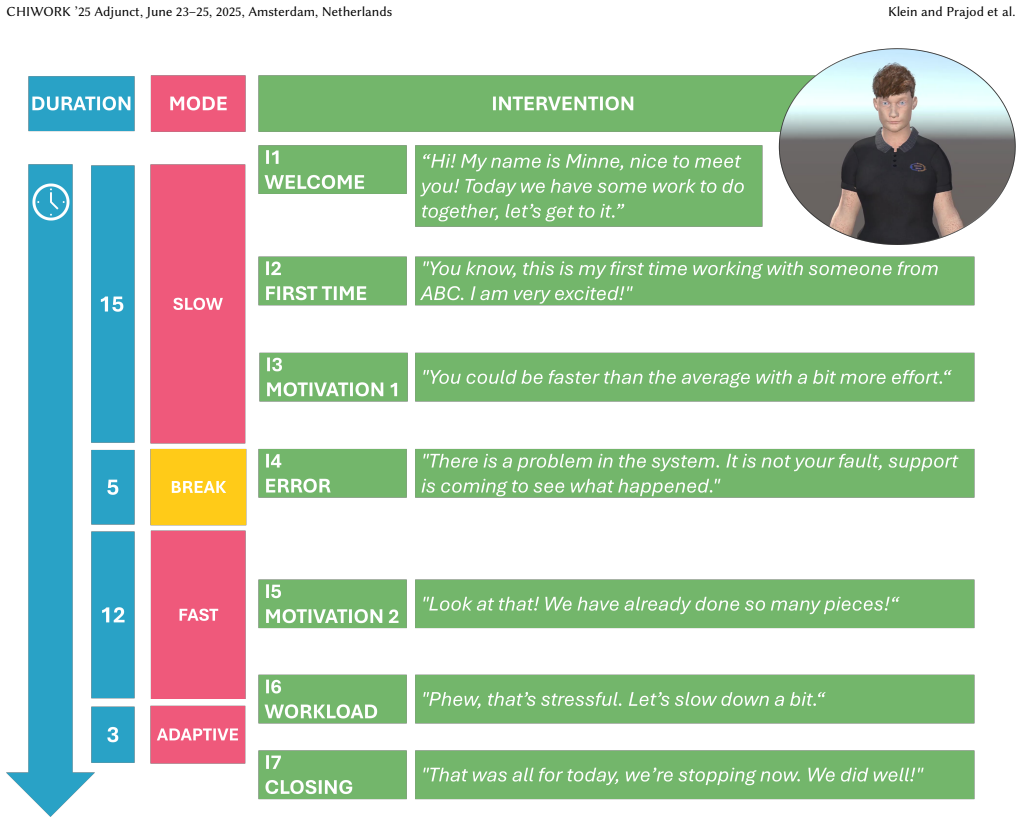
The carrying mechanism is the scripted avatar intervention sequence (I1–I7): an on-screen virtual character with idle breathing and blinking animations that speaks at seven fixed points while a cobot assembles gearboxes in three pacing modes (Slow, Fast, and Adaptive). The camera facing the operator was a prop—all interventions were scripted, so the avatar never actually sensed affect. The second mechanism is the focus group itself, analyzed with reflexive thematic analysis on a story-interview transcript, which turns the participants' walkthrough into the role taxonomy and the improvement and limitation categories.
What would settle it
A field study in which at least a dozen workers across several companies use a working, non-scripted avatar on a real production line would settle the claim: if acceptance and well-being do not improve, or if privacy objections dominate, then the positive focus-group findings do not transfer to real industrial environments.
Extended reading notes
Core claim
The central finding is that avatar interventions during a collaborative assembly task were received positively by real industrial employees, but only when the avatar's language felt personal and non-pressuring. The three participants assigned the avatar context-dependent roles—a supervisor who urged them to speed up, a relaxed colleague, and an impersonation of the worker—showing that the same system reads differently depending on what it says and when. Participants called for practical extensions: workload management, break reminders, error assistance, safety compliance reminders, and mood-adaptive emotional intelligence. At the same time, they rejected data recording and information sharing outright, doubted the avatar's voice would work in noisy plants, and insisted that avatar suggestions cannot override fixed cycle times and production quotas. The paper claims this is the first exploration of real-world perspectives on avatar-supported HRC and derives three lessons: personalize communication, add practical assistance, and respect real-world constraints.
Load-bearing premise
The load-bearing premise is that three employees from one German company, interacting with a fully scripted, camera-prop demo, can produce perspectives that meaningfully represent avatar-supported HRC in real industrial workplaces.
Editorial extensions
If this is right
- Avatar wording and tone must avoid pressure and criticism; the same intervention can read as bossy or collegial depending on phrasing.
- Personalized, context-aware communication is a key acceptance factor, so future avatars should adapt to the individual worker.
- Practical assistance—error correction, safety reminders, break and job-rotation suggestions—is what workers want from an avatar, not just motivational lines.
- Deployment must respect production cycle times and quotas; the avatar cannot stop the line or override output targets.
- Privacy is a hard boundary: recording and passing on worker data is a no-go for both management and workers.
Reading between the lines
- If personalized communication is as decisive as this focus group suggests, avatar systems that tailor wording to the worker's mood or history would likely outperform one-size-fits-all scripts in acceptance and well-being.
- The privacy rejection implies that any practical avatar must be able to run with on-device processing or non-identifiable signals; otherwise the same features that enable personalization will trigger surveillance concerns.
- The three perceived roles suggest a design tension: the same avatar can be experienced as supervisor, colleague, or self-representation, so future systems may need to let workers choose or toggle the avatar's relational stance.
- Because the demo used a prop camera, a direct next test is whether a real affect-sensing version changes these perceptions, either improving personalization or amplifying privacy discomfort.
Editorial analysis
A structured set of objections, weighed in public.
Referee Report
Summary. The paper reports a focus group study in which three employees from a German manufacturing company (a cobot worker, a learning & development manager, and an ergonomics & health manager) first interacted with a scripted, lab-based human-robot collaboration scenario featuring a screen-projected avatar, and then took part in a story-interview focus group. The authors use reflexive thematic analysis by two coders to identify three perceived avatar roles (supervisor, colleague, impersonation), a set of desired improvements (speed adoption, workload management, personalized feedback, infotainment, error assistance, motivation, safety compliance, emotional intelligence), and three categories of real-world limitations (production constraints, speech clarity, privacy). The paper claims that the avatar was generally perceived positively, that personalized communication and task assistance are important acceptance factors, and that the results serve as an initial step toward adaptive, context-aware avatar interactions in real industrial workcells.
Significance. If the central findings survive the construct-validity concern raised below, the paper makes a modest but useful contribution: it provides early qualitative evidence from actual industrial stakeholders in an area where most prior work involved laboratory participants or simulated settings. The authors are transparent about the scripted nature of the demo, report verbatim quotes in the appendix, and follow a recognized qualitative analysis method with two independent coders. The acknowledged limitations (N=3, one company, controlled lab setting) are stated honestly. The main reservation is that the paper does not address the implications of the undisclosed illusion that the avatar was responding to the operator's affective state, which directly affects the validity of the central acceptance theme.
major comments (2)
- [§2.1, §2.2, and Conclusion lesson (1)] The avatar interventions are described as completely scripted, and the camera was placed only to create an illusion of affect-based responding. The paper does not report whether participants were informed about this or debriefed after the session. The abstract and Conclusion lesson (1) state that personalized communication substantially impacted the perception of the avatar, but the participants' positive comments about personalization may reflect their beliefs about an imagined adaptive system rather than an evaluation of the implemented deterministic script. This is a construct-validity threat to the central claim. Please either report the debriefing procedure and participant knowledge, or re-frame the finding as participants' perceptions of a hypothetical adaptive system, and add a limitation discussing this Wizard-of-Oz effect.
- [§3.1 and Table 1] The three roles are introduced as roles in which 'the participants viewed the avatar' during the demo, but the only quote supporting the 'impersonation' role is 'the avatar should in the end represent me' (CW), which expresses a future design desire rather than a perception of the current avatar. Presenting this as an observed role misrepresents the data. Please relabel the theme as a desired/imagined role, or provide a quote in which a participant attributes this role to the avatar as experienced.
minor comments (7)
- [§2.2] The 'Adaptive mode' is described as the cobot's picking rate being 'approximately matched to the operator's assembling speed,' but the entire demo was scripted; please clarify explicitly that this was a pre-programmed condition, not real-time adaptation, to avoid misleading readers about the system's capabilities.
- [Abstract and Introduction] The phrase 'real-world perspectives' may overstate the lab-based nature of the study; consider wording such as 'perspectives of employees from a cobot-deploying company' to distinguish the participant source from the setting.
- [§3.1] The quote 'It can be glad it was an avatar' (CW) is ambiguous without further context; please provide additional context or a paraphrase to clarify whether the participant meant the avatar was fortunate not to be a human target of frustration.
- [Appendix Table 1] The symbols ♂robot and /userAvatar in the table caption are not explained; please add a legend or use plain text labels such as 'Robot' and 'Avatar.'
- [§3.1 and Table 1] The 'Personal communication' category is illustrated with the quote 'I thought that was nice,' which does not convey personal communication; replacing it with the quote from intervention I2 ('it speaks to you very personally with stating the company name') would be more informative.
- [Introduction] The loneliness-performance citation [2] is about academicians, not industrial workers; a more directly relevant workplace-loneliness reference would strengthen the motivation.
- [§2.3] The paper should briefly describe the recursive coding process used in the reflexive thematic analysis (e.g., initial coding, theme development, refinement) rather than only stating that two researchers followed Braun and Clarke; this is standard for this method and does not require inter-rater reliability metrics.
Circularity Check
No circularity: the focus group findings are generated from participant interviews, not derived from the paper's own setup or citations.
full rationale
This paper contains no mathematical derivation, fitted parameters, or predictive model, so the circularity-burden axis is not triggered. The central results—avatar roles, improvements, and real-world limitations—are produced by reflexive thematic analysis of interview data from three employees who experienced a scripted demo. No equation or construction makes an output equal to an input, and no fitted quantity is renamed as a prediction. The authors cite their own prior work for the avatar-based experimental setup and for related industrial HRC studies, but those citations are used to justify the design of the demo, not to derive the qualitative findings. The paper explicitly acknowledges its key limitations: the interaction was scripted, the camera input was not used, and only stakeholders from one company participated. The skeptical concern that participant perceptions of personalization may reflect an imagined adaptive system is a construct-validity threat to the interpretability of the qualitative results, not a circularity in the derivation of those results. Because the findings are grounded in participant statements and the authors openly state the limitations of the scripted setup, there is no load-bearing circular step to flag.
Assumptions & free parameters
assumptions (3)
- domain assumption The scripted lab demo adequately simulates a real industrial HRC workcell for eliciting perceptions.
- domain assumption The perceptions of three employees from one company are informative about avatar-supported HRC more broadly.
- domain assumption Reflexive thematic analysis by two independent researchers yields reliable themes.
Cite this review
Pith. "Pith review of Communicating Through Avatars in Industry 5.0: A Focus Group Study on Human-Robot Collaboration." pith.science (2026). https://pith.science/paper/LPWQQ2GB
@misc{pith2026250608805,
  author       = {Pith},
  title        = {Pith review of: Communicating Through Avatars in Industry 5.0: A Focus Group Study on Human-Robot Collaboration},
  year         = {2026},
  howpublished = {\url{https://pith.science/paper/LPWQQ2GB}},
  note         = {Machine review of arXiv:2506.08805}
}
read the original abstract
The integration of collaborative robots (cobots) in industrial settings raises concerns about worker well-being, particularly due to reduced social interactions. Avatars - designed to facilitate worker interactions and engagement - are promising solutions to enhance the human-robot collaboration (HRC) experience. However, real-world perspectives on avatar-supported HRC remain unexplored. To address this gap, we conducted a focus group study with employees from a German manufacturing company that uses cobots. Before the discussion, participants engaged with a scripted, industry-like HRC demo in a lab setting. This qualitative approach provided valuable insights into the avatar's potential roles, improvements to its behavior, and practical considerations for deploying them in industrial workcells. Our findings also emphasize the importance of personalized communication and task assistance. Although our study's limitations restrict its generalizability, it serves as an initial step in recognizing the potential of adaptive, context-aware avatar interactions in real-world industrial environments.
Figures

Reference graph
Works this paper leans on
-
[1]
Amr Adel. 2022. Future of Industry 5.0 in society: Human-centric solutions, challenges and prospective research areas.Journal of Cloud Computing11, 1 (2022), 40
work page 2022
-
[2]
Volkan Akçit and Esin Barutçu. 2017. The relationship between performance and loneliness at workplace: A study on academicians.European Scientific Journal, Special Issue(2017), 235–243
work page 2017
-
[3]
Janis Arents, Valters Abolins, Janis Judvaitis, Oskars Vismanis, Aly Oraby, and Kaspars Ozols. 2021. Human–robot collaboration trends and safety aspects: A systematic review.Journal of Sensor and Actuator Networks10, 3 (2021), 48
work page 2021
-
[4]
Marjorie Armando, Magalie Ochs, and Isabelle Régner. 2022. The Impact of Ped- agogical Agents’ Gender on Academic Learning: A Systematic Review.Frontiers in Artificial Intelligence5 (2022), 862997
work page 2022
-
[5]
Rhythm Arora, Matteo Lavit Nicora, Pooja Prajod, Daniele Panzeri, Elisabeth André, Patrick Gebhard, and Matteo Malosio. 2022. Employing socially interactive agents for robotic neurorehabilitation training.arXiv preprint arXiv:2206.01587 (2022)
work page Pith review arXiv 2022
-
[6]
Rhythm Arora, Pooja Prajod, Matteo Lavit Nicora, Daniele Panzeri, Giovanni Tauro, Rocco Vertechy, Matteo Malosio, Elisabeth André, and Patrick Gebhard
-
[7]
Sebastian Beyrodt, Matteo Lavit Nicora, Fabrizio Nunnari, Lara Chehayeb, Pooja Prajod, Tanja Schneeberger, Elisabeth André, Matteo Malosio, Patrick Gebhard, and Dimitra Tsovaltzi. 2023. Socially interactive agents as cobot avatars: Devel- oping a model to support flow experiences and well-being in the workplace. In Proceedings of the 23rd ACM Internationa...
work page 2023
-
[8]
Kim Bosman, Tibor Bosse, and Daniel Formolo. 2019. Virtual agents for profes- sional social skills training: An overview of the state-of-the-art. InIntelligent Technologies for Interactive Entertainment: 10th EAI International Conference, IN- TETAIN 2018, Guimarães, Portugal, November 21-23, 2018, Proceedings 10. Springer, 75–84
work page 2019
Show all 39 references
-
[9]
Sara Bragança, Eric Costa, Ignacio Castellucci, and Pedro M Arezes. 2019. A brief overview of the use of collaborative robots in Industry 4.0: Human role and safety.Occupational and environmental safety and health(2019), 641–650
2019
-
[10]
Virginia Braun and Victoria Clarke. 2006. Using thematic analysis in psychology. Qualitative research in psychology3, 2 (2006), 77–101
2006
-
[11]
Mira El Kamali, Leonardo Angelini, Maurizio Caon, Francesco Carrino, Christina Röcke, Sabrina Guye, Giovanna Rizzo, Alfonso Mastropietro, Martin Sykora, Suzanne Elayan, et al . 2020. Virtual coaches for older adults’ wellbeing: A systematic review.IEEE Access8 (2020), 101884–101902
2020
-
[12]
Eric H Grosse, Fabio Sgarbossa, Cecilia Berlin, and W Patrick Neumann. 2023. Human-centric production and logistics system design and management: Tran- sitioning from Industry 4.0 to Industry 5.0.International Journal of Production Research61, 22 (2023), 7749–7759
2023
-
[13]
An error occurred!
Kasper Hald, Katharina Weitz, Elisabeth André, and Matthias Rehm. 2021. “An error occurred!”-trust repair with virtual robot using levels of mistake explanation. InProceedings of the 9th International Conference on Human-Agent Interaction. 218–226
2021
-
[14]
Maaike Harbers, Karel Van Den Bosch, and John-Jules Ch Meyer. 2009. A study into preferred explanations of virtual agent behavior. InInternational Workshop on Intelligent Virtual Agents. Springer, 132–145
2009
-
[15]
Daan Hovens. 2020. Workplace learning through human-machine interaction in a transient multilingual blue-collar work environment.Journal of Linguistic Anthropology30, 3 (2020), 369–388
2020
-
[16]
Stina Klein, Jenny Huch, Nadine Reißner, Pamina Zwolsky, Katharina Weitz, Matthias Kraus, and Elisabeth André. 2024. Creating a framework for a user- friendly cobot failure management in human-robot collaboration. InCompanion of the 2024 ACM/IEEE International Conference on Hu...
2024
-
[17]
Erlantz Loizaga, Aitor Toichoa Eyam, Leire Bastida, and José L Martínez Lastra
-
[18]
Wendy E Mackay. 2023. DOIT: The Design of Interactive Things. Selected methods for quickly and effectively designing interactive systems from the user’s perspective. InExtended Abstracts of the 2023 CHI Conference on Human Factors in Computing Systems. 1–3
2023
-
[19]
Antonia Meissner, Angelika Trübswetter, Antonia S Conti-Kufner, and Jonas Schmidtler. 2020. Friend or foe? Understanding assembly workers’ acceptance of human-robot collaboration.ACM Transactions on Human-Robot Interaction (THRI)10, 1 (2020), 1–30
2020
-
[20]
Marta Mondellini, Matteo Lavit Nicora, Pooja Prajod, Elisabeth André, Rocco Vertechy, Alessandro Antonietti, and Matteo Malosio. 2024. Exploring the dy- namics between cobot’s production rhythm, locus of control and emotional state in a collaborative assembly scenario. In2024 ...
2024
-
[21]
Marta Mondellini, Pooja Prajod, Matteo Lavit Nicora, Mattia Chiappini, Ettore Micheletti, Fabio Alexander Storm, Rocco Vertechy, Elisabeth André, and Matteo Malosio. 2023. Behavioral patterns in robotic collaborative assembly: comparing neurotypical and autism spectrum disorde...
2023
-
[22]
Christoph Mühlemeyer. 2020. Assessment and design of employees-cobot- interaction. InHuman Interaction and Emerging Technologies: Proceedings of the 1st International Conference on Human Interaction and Emerging Technologies (IHIET 2019), August 22-24, 2019, Nice, France. Spri...
2020
-
[23]
Matteo Lavit Nicora, Sebastian Beyrodt, Dimitra Tsovaltzi, Fabrizio Nunnari, Patrick Gebhard, and Matteo Malosio. 2023. Towards social embodied cobots: The integration of an industrial cobot with a social virtual agent.arXiv preprint arXiv:2301.06471(2023)
2023 arXiv
-
[24]
Fabrizio Nunnari, Dimitra Tsovaltzi, Matteo Lavit Nicora, Sebastian Beyrodt, Pooja Prajod, Lara Chehayeb, Ingrid Brdar, Antonella Delle Fave, Luca Negri, Elisabeth André, et al. 2025. Socially interactive industrial robots: a PAD model of flow for emotional co-regulation.Front...
2025
-
[25]
Grażyna Osika. 2023. HUMANISTIC SERVICES IN THE CONTEXT OF IMPLE- MENTATION SOCIETY 5.0.Scientific Papers of Silesian University of Technology. Organization & Management/Zeszyty Naukowe Politechniki Slaskiej. Seria Organi- zacji i Zarzadzanie183 (2023). CHIWORK ’25 Adjunct, Ju...
2023
-
[26]
Pooja Prajod. 2024. In the face and heart of data scarcity in Industry 5.0: exploring applicability of facial and physiological AI models for operator well-being in human-robot collaboration. (2024)
2024
-
[27]
Pooja Prajod, Matteo Lavit Nicora, Marta Mondellini, Matteo Meregalli Falerni, Rocco Vertechy, Matteo Malosio, and Elisabeth André. 2024. Flow in human- robot collaboration—multimodal analysis and perceived challenge detection in industrial scenarios.Frontiers in Robotics and ...
2024
-
[28]
Sandra Robla-Gómez, Victor M Becerra, José Ramón Llata, Esther Gonzalez- Sarabia, Carlos Torre-Ferrero, and Juan Perez-Oria. 2017. Working together: A review on safe human-robot collaboration in industrial environments.IEEE Access5 (2017), 26754–26773
2017
-
[29]
Jože M Rožanec, Inna Novalija, Patrik Zajec, Klemen Kenda, Hooman Tavakoli Ghinani, Sungho Suh, Entso Veliou, Dimitrios Papamartzivanos, Thanas- sis Giannetsos, Sofia Anna Menesidou, et al . 2023. Human-centric artificial intelligence architecture for Industry 5.0 applications...
2023
-
[30]
Ashwani Sharma and Bikram Jit Singh. 2020. Evolution of industrial revolutions: A review.International Journal of Innovative Technology and Exploring Engineering 9, 11 (2020), 66–73
2020
-
[31]
Fabio A Storm, Mattia Chiappini, Carla Dei, Caterina Piazza, Elisabeth André, Na- dine Reißner, Ingrid Brdar, Antonella Delle Fave, Patrick Gebhard, Matteo Malosio, et al. 2022. Physical and mental well-being of cobot workers: A scoping review using the Software-Hardware-Envir...
2022
-
[32]
Kentaro Watanabe. 2023. Augmented telework with avatar technology: Impact on workplace and required actions. InA research agenda for workplace innovation. Edward Elgar Publishing, 51–66
2023
-
[33]
Let me explain!
Katharina Weitz, Dominik Schiller, Ruben Schlagowski, Tobias Huber, and Elisa- beth André. 2021. “Let me explain!”: exploring the potential of virtual agents in explainable AI interaction design.Journal on Multimodal User Interfaces15, 2 (2021), 87–98
2021
-
[34]
Katharina Weitz, Ruben Schlagowski, Elisabeth André, Maris Männiste, and Ceenu George. 2024. Explaining it your way-findings from a co-creative design workshop on designing XAI applications with AI end-users from the public sector. InProceedings of the 2024 CHI Conference on H...
2024
-
[35]
Katherine S Welfare, Matthew R Hallowell, Julie A Shah, and Laurel D Riek. 2019. Consider the human work experience when integrating robotics in the workplace. In2019 14th ACM/IEEE international conference on human-robot interaction (HRI). IEEE, 75–84
2019
-
[36]
Xun Xu, Yuqian Lu, Birgit Vogel-Heuser, and Lihui Wang. 2021. Industry 4.0 and Industry 5.0—Inception, conception and perception. 530–535 pages
2021
-
[37]
So the avatar was always very neutral when I looked at it
Muhammad Hamza Zafar, Even Falkenberg Langås, and Filippo Sanfilippo. 2024. Exploring the synergies between collaborative robotics, digital twins, augmenta- tion, and industry 5.0 for smart manufacturing: A state-of-the-art review.Robotics and Computer-Integrated Manufacturing...
2024
-
[2023]
IEEE Access(2023)
A Comprehensive study of human factors, sensory principles and com- mercial solutions for future human-centered working operations in Industry 5.0. IEEE Access(2023)
2023
-
[2024]
Socially interactive agents for robotic neurorehabilitation training: concep- tualization and proof-of-concept study.Frontiers in Artificial Intelligence7 (2024), 1441955
2024
Reviewed August 7, 2026 · model on record in the stance chip above.
Discussion (0). Sign in to comment.