REVIEW 2 major objections 4 minor 17 references
How Prime Factors Form Fractals
T0 review · 2 major / 4 minor · reviewed 2026-08-08 · deepseek-v4-flash
Pith's one-line read This paper claims that the exponents of a fixed prime in the integers form fractal sequences, and that the 2-adic valuation sequence draws the Lévy Dragon.
desk verdict A clean, honest synthesis of known p-adic valuation patterns with dragon curves; the discrete math is solid, but the geometric conclusion outruns the proof. read the letter →
The pith
A machine-rendered reading of the paper's core claim, the machinery that carries it, and where it could break.
The reading
What carries the argument
The engine is the duplicate-concatenate-increment rule. For each prime p, begin with the one-term sequence ⟨0⟩; at each stage make p−1 copies of the current sequence, concatenate them after it, and add 1 to the final term. The nth entry of the resulting sequence is the exponent of p in n, so the sieve's rows are exactly the p-adic valuations. Fractality is certified by a decimation rule that selects indices that are multiples of p+1; because p never divides p+1, the term at f(p+1) equals the term at f, giving a predictable copy of the sequence inside itself. For the Lévy Dragon, the matching object is the turn algorithm that starts with ⟨3⟩, increments every entry, inserts a new 3 between adjacent entries, and appends 3s at both ends; Theorem 15 shows this sequence is identical to the 2-adic valuation sequence at indices that are multiples of 8.
What would settle it
Compute the turtle path for the 2-adic valuation sequence at 90-degree turns over the first 8^N indices and measure its Hausdorff distance to the Lévy Dragon polyline after N iterations; if that distance does not tend to 0 as N grows, the paper's convergence claim fails even though the turn sequence matches.
Extended reading notes
Core claim
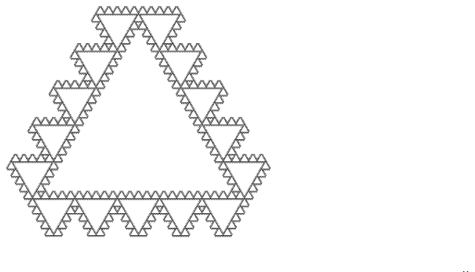
The paper's central discovery is that the exponents of any fixed prime p across the positive integers—the p-adic valuation sequence—form a fractal sequence, and that for p=2 the same sequence, drawn as a path that turns v2(n) quarter-turns at step n, produces the Lévy Dragon. The sieve that reaches this conclusion starts from a single 0 and repeatedly expands it by making p−1 copies, appending them, and increasing the final term by 1; Theorem 6 shows this reproduces prime factorizations without division. Lemma 12 exhibits a simple decimation rule—take every (p+1)-st term—that locates a copy of the whole sequence inside itself, and Lemma 13 shows no periodic block generates it. Theorem 15 proves that the terms at indices divisible by 8 exactly match an algorithm for the Lévy Dragon's turn sequence, with the intervening terms forming small 'T' detours. In the appendix, the same construction is carried for the odd part of n, whose values modulo 4 match the Heighway Dragon's turns.
Load-bearing premise
The geometric conclusion rests on the unproven claim that the 'T'-shaped detours in the v2 curve become negligible relative to the whole figure as more indices are added.
Editorial extensions
If this is right
- A student can generate prime factorizations by mechanical copying rather than division, making the exponent pattern visible.
- Every prime's exponent sequence is predictably self-containing and aperiodic, so each prime contributes its own fractal layer to the natural numbers.
- The 2-adic valuation sequence encodes the Lévy Dragon's turns at every index divisible by 8; the intervening 'T' shapes are the only difference from the standard construction.
- The odd part of n, taken modulo 4, reproduces the Heighway Dragon's turn sequence, tying the other classical dragon curve to integer factorization.
- The paper's open questions point to a family of angle-and-prime combinations that generate additional fractal figures, and to a possible L-system translation of the sieve.
Reading between the lines
- I infer that if the spike-shrinking claim is formalized in a Hausdorff-metric or length-ratio sense, the v2 curve converges to the Lévy Dragon exactly; the paper states the tendency but leaves the metric unspecified.
- The duplicate-concatenate-increment rule is morphic in flavor, so a natural extension is a string-replacement proof that p-adic valuation sequences are automatic or morphic words, connecting them to the paperfolding literature.
- The matching at multiples of 8 may yield an explicit formula: the Lévy turn sequence is the 2-adic valuation of 8n, which could simplify dragon-curve turn computations.
Editorial analysis
A structured set of objections, weighed in public.
Referee Report
Summary. The paper introduces a table-based sieve that successively generates, for each prime p, the sequence of p-adic valuations v_p(n), and proves (Theorem 6) that the sieve outputs exactly the primes and the prime factorizations. It then defines a fractal sequence as one that is predictably self-containing and aperiodic, proves (Theorem 14) that every v_p sequence is fractal via the decimation rule selecting indices f(p+1) and via unboundedness of the terms, and claims (Section 4) that v_2, read as the number of 90-degree counterclockwise turns at each integer, generates the Lévy Dragon. The main supporting result (Theorem 15) is that the terms of v_2 at indices divisible by 8 follow exactly the algorithm for the Lévy dragon's turn sequence. An appendix relates the odd part of n modulo 4 to the Heighway Dragon turn sequence.
Significance. If fully established, the paper would provide a clean exposition of a known but underappreciated fact: p-adic valuation sequences are self-similar in a precise subsequence sense, and v_2's turn sequence is related to the Lévy Dragon. The discrete portions are largely correct and self-contained, and the paper is honest in not fitting parameters and in comparing against OEIS benchmarks. However, the geometric equivalence in Section 4.5 is asserted rather than proved, and the paper's own Section 5 acknowledges that the other 'fractal figures' are not formalized. The contribution is therefore a useful set of exact identities and a suggestive geometric conjecture, rather than a complete proof of the headline geometric claim.
major comments (2)
- [Section 4.5] The sentence 'the size of these deviations, relative to the overall figure, becomes negligible as the number of iterations increases' is the load-bearing step connecting Theorem 15 to the claim that the curve generated by v_2 is the Lévy Dragon, but no metric or convergence theorem is supplied. Theorem 15 proves that the finite turn sequence generated by the Lévy-dragon algorithm at iteration m equals v_2(8i) for i=1..2^m-1; it does not describe the curve generated by all terms of v_2, and the intervening block v_2(8k+1..8k+7)=0,1,0,2,0,1,0 has zero net turn but a bounded nonzero excursion. To establish the claimed limit, the paper needs a precise notion, such as Hausdorff metric on normalized curves or a path-length accounting showing that the extra T-excursions vanish as m tends to infinity, together with a proof that they do so. Without this, the paper proves a turn-subsequence identity, not geometric equivalence of the full v_2 curve.
- [Section 4.1] The geometric interpretation of v_2 is introduced informally: terms are said to represent 'the number of 90-degree turns to make at n,' but the formal curve construction is never defined, and the equivalence 'four 90-degree turns are the same as none' is used without proof. Since v_2 contains arbitrarily large terms, the curve is only defined up to congruence modulo 4, and that reduction should be stated explicitly as part of the definition of the map from sequences to curves. This clarification is needed before the equivalence with A346070 or with the Lévy Dragon can be made rigorous.
minor comments (4)
- [Section 2.4, Proposition 4] The sentence 'we want p + 1 at that index' should read 'we want j + 1 at that index'; the surrounding argument is otherwise clear.
- [Definition 7] There is a duplicated article in 'the the number returned by vp(ni)'; this should be corrected.
- [Section 4.5] The phrase 'can be confident that v2⟨⟩ produces the Lévy Dragon' appears to be missing a 'we' and should read 'can we be confident that v2⟨⟩ produces the Lévy Dragon.'
- [Theorem 15] The proof's 'leaves no gaps' step is persuasive but informal; stating the result as an explicit induction on the binary length of the index, or equivalently as l_i = v_2(8i) for every positive integer i, would make the argument easier to verify.
Circularity Check
No significant circularity: the sieve-to-valuations proof, the fractal-sequence theorems, and the dragon-curve identifications are self-contained; the only weak point is an unproved convergence assertion in Section 4.5, which is an evidence gap rather than a circular step.
full rationale
The derivation chain is self-contained and does not reduce to its inputs. Theorem 6 is proved by an explicit induction (Propositions 2 and 4) showing the sieve entries equal v_p(n); no parameter is fitted and no result of the present author is invoked. Theorem 14 proves the two defining properties of the paper's stipulative Definition 8 directly: Lemma 12 uses the decimation rule at indices f(p+1) together with the fact that p does not divide p+1, and Lemma 13 uses the unbounded growth of terms. Calling these sequences 'fractal' under a chosen definition is a definitional choice, not circularity. Theorem 15 derives the Levy-dragon turn algorithm from independent geometric sources (Alster, Riddle, Levy) and then proves equality with the v2 terms at multiples of 8; the Heighway-dragon appendix similarly derives the turn sequence from the paper-folding construction and proves equality with the odd part of n modulo 4 against the independent OEIS benchmark A000265/A099545. The one genuinely weak passage is Section 4.5, where the claim that the 'T' deviations 'become negligible as the number of iterations increases' is asserted without a metric or limit proof; however, that is an unsupported analytic-convergence assertion, not a case of a prediction being forced by construction or of a load-bearing self-citation. Accordingly, no circular step can be exhibited with a quote-and-reduction, and the circularity score is 0.
Assumptions & free parameters
assumptions (2)
- ad hoc to paper The paper's Definition 8: a sequence is fractal if it is predictably self-containing and aperiodic.
- domain assumption The identification of the Levy Dragon's turn sequence with the terms of v2 at indexes that are multiples of 8, together with the negligible-spike limit.
Cite this review
Pith. "Pith review of How Prime Factors Form Fractals." pith.science (2026). https://pith.science/paper/LRCMTIXP
@misc{pith2026250215743,
  author       = {Pith},
  title        = {Pith review of: How Prime Factors Form Fractals},
  year         = {2026},
  howpublished = {\url{https://pith.science/paper/LRCMTIXP}},
  note         = {Machine review of arXiv:2502.15743}
}
read the original abstract
We explore a new sieve that generates both primes and prime factorizations, without resorting to division. We demonstrate that the integer sequences generated by the sieve are the p-adic valuations of n, and that each is a fractal sequence. We then show that these sequences produce geometrical fractals like the Levy Dragon. We end by showing the connection between the odd part of n integer sequence and the Heighway Dragon.
Figures


Figures from the paper (17 more)






Reference graph
Works this paper leans on
-
[1]
Alster, The finite number of interior component shapes of the levy dragon, Discrete Comput
E. Alster, The finite number of interior component shapes of the levy dragon, Discrete Comput. Geom. 43 (2010), 855–875. 32
work page 2010
-
[2]
Cloitre, [comment on A007814 ], https://oeis.org/A007814, 2003-03-06
B. Cloitre, [comment on A007814 ], https://oeis.org/A007814, 2003-03-06. Accessed: 2024-08-01
work page 2003
-
[3]
I. Faye, On integer sequences related to a memorization technique, Journal of Applied Sciences 11 (2011), 1473–1475
work page 2011
-
[4]
A. F´ uster-Sabater and S. D. Cardell, Linear complexity of generalized sequences by comparison of pn-sequences, RACSAM 114 (2020), [18 pages]. Article 79. Accessed: 2024-08-01. Available from: https://doi.org/10.1007/s13398-020-00807-5
-
[5]
Gilleland, Some self-similar integer sequences, https://oeis.org/selfsimilar
M. Gilleland, Some self-similar integer sequences, https://oeis.org/selfsimilar. html, n/d. Accessed: 2024-08-01
work page 2024
-
[6]
Kimberling, Numeration systems and fractal sequences, Acta Arith
C. Kimberling, Numeration systems and fractal sequences, Acta Arith. 73 (1995), 103– 117
work page 1995
-
[7]
Kimberling, Fractal sequences and interspersions, Ars Combin
C. Kimberling, Fractal sequences and interspersions, Ars Combin. 45 (1997), 157–168
work page 1997
-
[8]
Kimberling, Self-containing sequences, fractal sequences, selection functions, and parasequences, J
C. Kimberling, Self-containing sequences, fractal sequences, selection functions, and parasequences, J. of Integer Seq. 25(2) (2022), [17 pages]. Article 22.2.1. Accessed: 2024-08-01. Available from: https://cs.uwaterloo.ca/journals/JIS/ VOL25/Kimberling/kimber16.pdf
work page 2022
Show all 17 references
-
[9]
L´ evy, Plane or space curves and surfaces consisting of parts similar to the whole
P. L´ evy, Plane or space curves and surfaces consisting of parts similar to the whole. In G. A. Edgar, editor, Classics on fractals , pp. 181–239. Westview Press, Boulder, CO, 2010
2010
-
[10]
Mandelbrot, The fractal geometry of nature , W
B. Mandelbrot, The fractal geometry of nature , W. H. Freeman, San Francisco, CA, 1982
1982
-
[11]
Mitchell, [comment on a000265], https://oeis.org/A000265, 2005-12-07
K. Mitchell, [comment on a000265], https://oeis.org/A000265, 2005-12-07. Accessed: 2025-02-06
2005
-
[12]
OEIS Foundation Inc, On-line encyclopedia of integer sequences, https://oeis.org,
-
[13]
Riddle, L´ evy dragon, https://larryriddle.agnesscott.org/ifs/levy/levy
L. Riddle, L´ evy dragon, https://larryriddle.agnesscott.org/ifs/levy/levy. htm, 2024-06-20. Accessed: 2024-08-02
2024
-
[14]
Stewart, The nature of fractal geometry
I. Stewart, The nature of fractal geometry. In N. Lesmoir-Gordon, editor, The Colours of Infinity: The Beauty and Power of Fractals , pp. 2–23. Springer-Verlag, London, 2010
2010
-
[15]
F. J. Taylor, Signal processing, digital. In R. A. Meyers, editor, Encyclopedia of telecom- munications, pp. 737–760. Academic Press, San Diego, CA, 1989. 33
1989
-
[16]
Knuth [with C
D. Knuth [with C. Davis], Number representations and dragon curves. In Selected papers on fun and games , pp. 571–614. Center for the Study of Language and Information, Stanford, CA, 2011. 34
2011
-
[2024]
Accessed: 2024-08-01
2024
Reviewed August 8, 2026 · model on record in the stance chip above.
Discussion (0). Continue with ORCID to comment.