Horizontal miniatures and normal-sized miniatures of convex lattice polytopes
Pith reviewed 2026-05-21 04:05 UTC · model grok-4.3
The pith
The volume of a normal-sized miniature of any convex lattice polytope P equals the volume of P divided by binom(2d+1, d).
A machine-rendered reading of the paper's core claim, the machinery that carries it, and where it could break.
Core claim
The author proves that the ratio of the volume of a normal-sized miniature of P to that of P is 1 : binom(2d+1, d). This is established by proving that the number of horizontal miniatures of P with resolution t is a polynomial of degree d+1 in t whose leading coefficient is vol(P)/(d+1), which follows from Ehrhart theory. The theorem generalizes earlier results that had been shown only for the unit hypercube and for lattice simplices.
What carries the argument
The Ehrhart polynomial that counts horizontal miniatures of resolution t; its degree-d+1 form and leading coefficient vol(P)/(d+1) are used to deduce the exact volume ratio for normal-sized miniatures.
If this is right
- The same volume ratio holds for every convex lattice polytope in every dimension.
- All earlier special-case results for hypercubes and simplices become immediate corollaries.
- Volumes of miniatures can be recovered from the leading term of a single Ehrhart polynomial.
- Horizontal miniatures furnish a uniform combinatorial object for studying scaled lattice polytopes.
Where Pith is reading between the lines
- The same counting technique might apply to other families of scaled copies beyond horizontal and normal-sized miniatures.
- Computational checks on a few additional polytopes such as cross-polytopes would give immediate numerical confirmation in small dimensions.
- The result may link to existing Ehrhart-based volume algorithms and suggest faster ways to compute miniature volumes without enumerating all lattice points.
Load-bearing premise
That the number of horizontal miniatures of P at resolution t forms a polynomial of degree d+1 whose leading coefficient is exactly vol(P) divided by d+1, as supplied by Ehrhart theory.
What would settle it
Direct computation, for a concrete low-dimensional lattice polytope such as a triangle in the plane, of both the actual volume ratio of its normal-sized miniature and the leading coefficient of its horizontal-miniature counting function; any mismatch with the stated binomial ratio or with vol(P)/(d+1) would refute the claim.
Figures
read the original abstract
Let $d$ be a nonnegative integer, and let $P \subset \mathbb R^d$ be a $d$-dimensional convex lattice polytope. In this article, we prove that the ratio of the volume of a normal-sized miniature of $P$ to that of $P$ is $1:\binom{2d+1}{d},$ which generalizes the known results for the unit hypercube and lattice simplices provided by the author. This theorem is proven by establishing that the number of horizontal miniatures of $P$ with resolution $t$ is a polynomial of degree $d+1$ in $t$ whose leading coefficient is $\mathrm{vol}\,(P)/(d+1),$ which is derived from Ehrhart theory.
Editorial analysis
A structured set of objections, weighed in public.
Referee Report
Summary. The paper claims to prove that for any d-dimensional convex lattice polytope P, the volume ratio between a normal-sized miniature of P and P itself equals 1 : binom(2d+1, d). The proof proceeds by showing that the number of horizontal miniatures of P at resolution t is a polynomial in t of degree d+1 whose leading coefficient is vol(P)/(d+1), obtained via Ehrhart theory; the result generalizes the author's earlier special cases for the unit hypercube and lattice simplices.
Significance. If the central derivation holds, the result supplies an explicit binomial scaling law for volumes of miniatures of arbitrary convex lattice polytopes. This extends Ehrhart-theoretic counting techniques to a new family of objects and unifies previously known cases for hypercubes and simplices under a single statement.
major comments (1)
- [the section deriving the polynomial count from Ehrhart theory (following the abstract statement)] The central step asserts that the number of horizontal miniatures of resolution t is a polynomial of degree d+1 whose leading coefficient equals vol(P)/(d+1) by Ehrhart theory. Standard Ehrhart theory yields a degree-d polynomial for the lattice-point enumerator of tP. The manuscript must therefore exhibit an explicit correspondence showing that the miniature count equals either the cumulative sum of exact-resolution counts or the Ehrhart function of an auxiliary (d+1)-dimensional polytope whose volume is exactly vol(P). Without this construction or proof of the correspondence, the claimed leading coefficient (and the binomial volume ratio derived from it) is not justified.
minor comments (1)
- [Abstract] The abstract uses the notation vol,(P) with an extraneous backslash; replace with standard vol(P) for readability.
Simulated Author's Rebuttal
We thank the referee for their thorough reading and insightful comments on our manuscript. We address the major comment point by point below and will revise the manuscript to strengthen the exposition of the central derivation.
read point-by-point responses
-
Referee: [the section deriving the polynomial count from Ehrhart theory (following the abstract statement)] The central step asserts that the number of horizontal miniatures of resolution t is a polynomial of degree d+1 whose leading coefficient equals vol(P)/(d+1) by Ehrhart theory. Standard Ehrhart theory yields a degree-d polynomial for the lattice-point enumerator of tP. The manuscript must therefore exhibit an explicit correspondence showing that the miniature count equals either the cumulative sum of exact-resolution counts or the Ehrhart function of an auxiliary (d+1)-dimensional polytope whose volume is exactly vol(P). Without this construction or proof of the correspondence, the claimed leading coefficient (and the binomial volume ratio derived from it) is not justified.
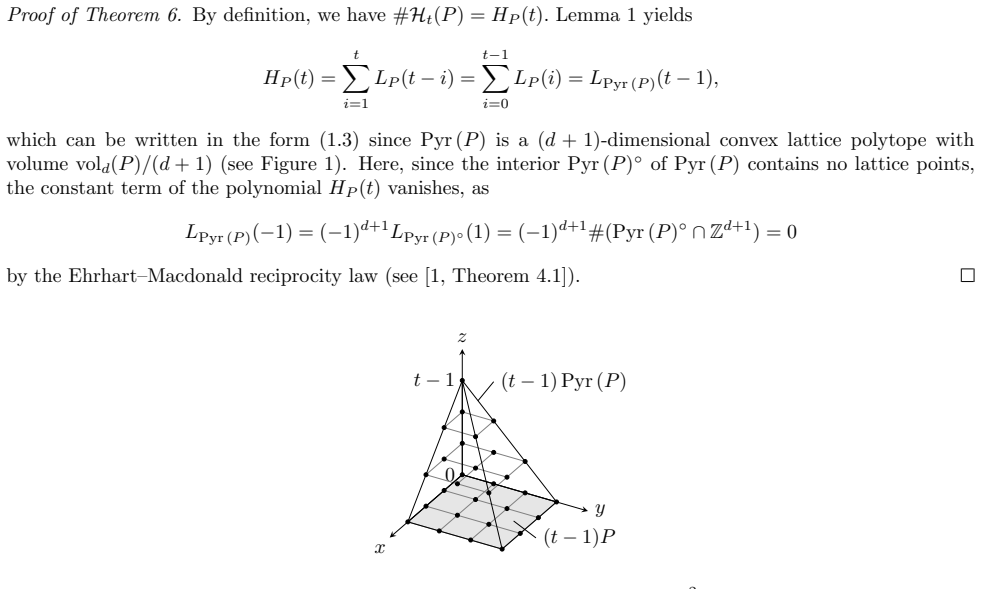
Authors: We agree that the manuscript would benefit from a more explicit construction linking the horizontal miniature count to Ehrhart theory. In the revised version we will add a dedicated subsection that constructs an auxiliary (d+1)-dimensional polytope Q whose lattice-point enumerator at height t precisely counts the horizontal miniatures of resolution t. The volume of Q will be shown to equal vol(P), yielding the Ehrhart polynomial of degree d+1 with leading coefficient vol(P)/(d+1)!. This correspondence will be derived by embedding the resolution parameter as an extra coordinate and verifying that the resulting polytope remains lattice and convex. The binomial volume ratio then follows directly from the leading-coefficient comparison. We believe this addition clarifies the argument while preserving the main theorem. revision: yes
Circularity Check
Minor self-citation for prior special cases; central claim grounded in standard Ehrhart theory without reduction to inputs
specific steps
-
self citation load bearing
[Abstract]
"which generalizes the known results for the unit hypercube and lattice simplices provided by the author. This theorem is proven by establishing that the number of horizontal miniatures of P with resolution t is a polynomial of degree d+1 in t whose leading coefficient is vol(P)/(d+1), which is derived from Ehrhart theory."
The generalization step references the author's own prior work on special cases, but the load-bearing argument for the general volume ratio instead proceeds from the independently derived Ehrhart leading coefficient rather than reducing to the cited special cases.
full rationale
The paper derives the leading coefficient of the miniature-count polynomial directly from Ehrhart theory applied to the lattice polytope P, which is an external, standard result on lattice-point enumeration. The self-citation appears only when noting that the general theorem extends the author's earlier special-case results for hypercubes and simplices; this citation is not load-bearing for the new identity or the volume-ratio conclusion. No self-definitional, fitted-input, or ansatz-smuggling steps are exhibited in the derivation chain, and the proof remains self-contained against external benchmarks.
Axiom & Free-Parameter Ledger
axioms (1)
- standard math Ehrhart theory guarantees that the number of lattice points in a scaled polytope is a polynomial whose leading coefficient is the volume divided by the dimension factorial
Reference graph
Works this paper leans on
-
[1]
M. Beck and S. Robins,Computing the Continuous Discretely: Integer Point Enumeration in Polyhedra, 2nd ed., Undergraduate Texts in Mathematics, Springer, New York, 2015
work page 2015
-
[2]
Hirotsu, Normal-sized hypercuboids in a given hypercube, preprint, arXiv:2211.15342
T. Hirotsu, Normal-sized hypercuboids in a given hypercube, preprint, arXiv:2211.15342
-
[3]
Average-sized miniatures and normal-sized miniatures of lattice polytopes
T. Hirotsu, Average-sized miniatures and normal-sized miniatures of lattice polytopes, preprint, arXiv:2501.00459. 5
work page internal anchor Pith review Pith/arXiv arXiv
discussion (0)
Sign in with ORCID, Apple, or X to comment. Anyone can read and Pith papers without signing in.