Collisionless dynamo seeds from phase mixing-induced electron slippage
Pith reviewed 2026-06-29 02:35 UTC · model grok-4.3
The pith
Phase mixing brakes electron flows to generate large-scale magnetic seeds in collisionless plasmas.
A machine-rendered reading of the paper's core claim, the machinery that carries it, and where it could break.
Core claim
In initially unmagnetized, collisionless plasmas, phase-mixing-induced braking of spatially varying electron flows produces electron-ion slippage that generates coherent magnetic seed fields on scales far larger than the characteristic kinetic scales of the plasma, with strengths comparable to or exceeding classical Biermann battery estimates; the process requires neither a finite initial magnetic field nor misaligned thermodynamic gradients and occurs naturally in electron-ion plasmas.
What carries the argument
phase-mixing-induced braking of spatially varying electron flows, which drives electron-ion slippage and net current
If this is right
- Magnetic seed fields appear on scales orders of magnitude larger than electron inertial length or gyroradius.
- Field amplitudes match or exceed Biermann estimates without requiring temperature or density gradients.
- The process operates in any electron-ion plasma that develops spatially varying flows.
- Seed fields are available for subsequent dynamo amplification in turbulent collisionless media.
Where Pith is reading between the lines
- Laboratory laser-plasma setups with controlled flow shear could test the predicted scaling of seed-field strength with flow amplitude.
- In astrophysical turbulence the mechanism may compete with or supplement other kinetic current-generation channels once flows develop.
- The same slippage current could modify the effective resistivity felt by larger-scale magnetic structures.
Load-bearing premise
Spatially varying electron flows must remain collisionless long enough for phase mixing to brake them before collisions or other processes erase the slippage.
What would settle it
A fully kinetic Vlasov simulation initialized with a sinusoidal electron flow in uniform density, collisionless plasma that develops no magnetic field after several electron plasma periods would falsify the mechanism.
Figures
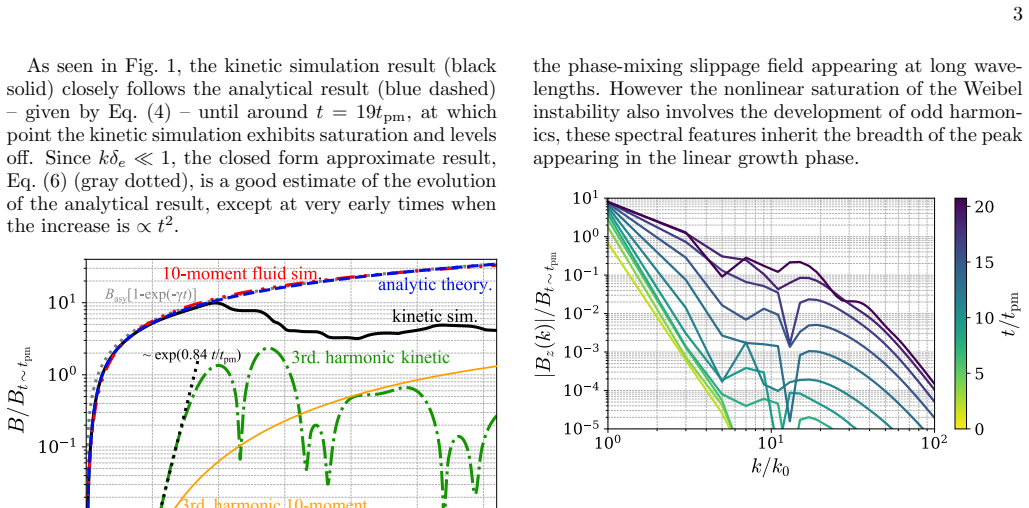
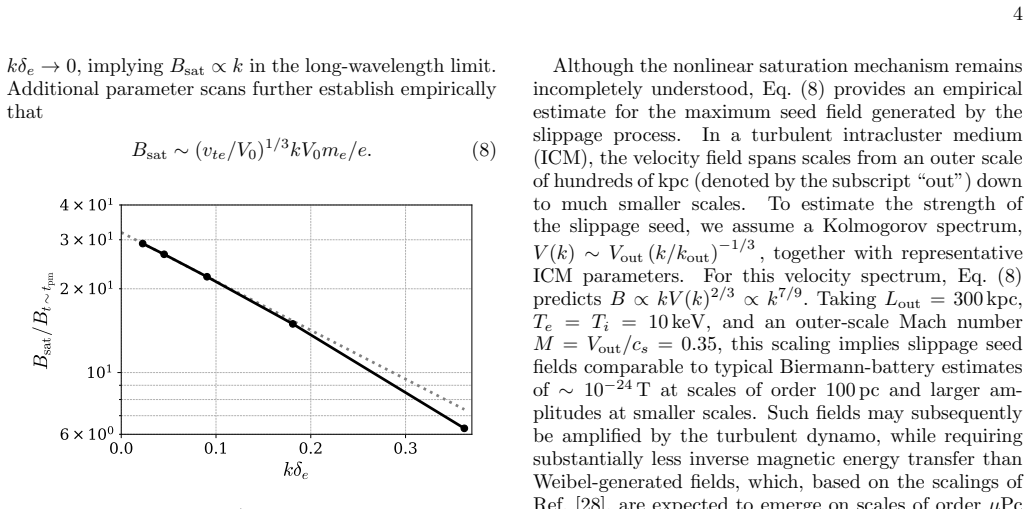
read the original abstract
Magnetic fields permeating the Universe on the largest astrophysical scales are thought to result from dynamo amplification in weakly collisional turbulence, but the origin of the seed fields remains an open problem of cosmic magnetogenesis. We identify a kinetic mechanism for magnetic-field generation in initially unmagnetized, collisionless plasmas, arising from phase-mixing-induced braking of spatially varying electron flows. Using analytical theory, fully kinetic Vlasov simulations, and turbulent scaling arguments, we show that this process generates coherent magnetic seed fields on scales far larger than the characteristic kinetic scales of the plasma, with strengths comparable to or exceeding classical Biermann battery estimates. The mechanism requires neither a finite initial magnetic field nor misaligned thermodynamic gradients and occurs naturally in electron--ion plasmas.
Editorial analysis
A structured set of objections, weighed in public.
Referee Report
Summary. The manuscript identifies a kinetic mechanism for generating seed magnetic fields in initially unmagnetized collisionless plasmas. The process originates from phase-mixing-induced braking of spatially varying electron flows, which produces net current and coherent B-fields on scales ≫ kinetic scales. Support is provided via analytical theory, fully kinetic Vlasov simulations, and turbulent scaling arguments; the mechanism requires neither initial B nor misaligned gradients and is claimed to yield fields comparable to or stronger than the classical Biermann battery.
Significance. If the central claim holds, the work supplies a collisionless, parameter-free route to seed fields that can operate in electron-ion plasmas under standard astrophysical conditions. The multi-method approach (analytic derivation, Vlasov runs, scaling) is a strength; the result would directly inform cosmic magnetogenesis models that rely on subsequent dynamo amplification.
minor comments (3)
- The abstract states that the mechanism 'occurs naturally in electron-ion plasmas,' yet the simulation section should explicitly confirm that ion inertia and finite ion mass do not quench the electron current on the reported timescales (e.g., via a dedicated ion-motion diagnostic).
- Figure captions and axis labels should state the precise values of the electron skin depth, Debye length, and box size in normalized units so that the claimed scale separation (B-field coherence ≫ kinetic scales) can be verified by the reader.
- The turbulent scaling arguments would benefit from a short appendix deriving the expected B-field amplitude from the phase-mixing braking term, including the explicit dependence on the initial flow shear spectrum.
Simulated Author's Rebuttal
We thank the referee for their supportive summary, recognition of the work's significance for cosmic magnetogenesis, and recommendation of minor revision. No specific major comments were raised in the report.
Circularity Check
No significant circularity detected
full rationale
The paper derives its claimed mechanism from standard Vlasov kinetic theory applied to an initially unmagnetized collisionless plasma with spatially varying electron flows that undergo phase mixing, producing net current and seed B fields. Support is provided via independent analytic theory, fully kinetic simulations, and turbulent scaling, with explicit regime conditions stated rather than smuggled assumptions. No equations reduce a prediction to a fitted input by construction, no self-citation chain is load-bearing for the central result, and the comparison to Biermann estimates is external. The derivation chain is therefore self-contained.
Axiom & Free-Parameter Ledger
axioms (2)
- standard math Validity of the Vlasov equation in the collisionless limit
- domain assumption Presence of spatially varying electron flows in initially unmagnetized plasma
Reference graph
Works this paper leans on
-
[1]
Collisionless dynamo seeds from phase mixing-induced electron slippage
operating in ionization fronts. However, the resulting field amplitudes are typically weak [3, 24, 25], motivating the search for additional sources of coherent seed fields. The Weibel instability [26] provides an alternative route to magnetic-field generation [27–30], efficiently con- verting free energy associated with pressure anisotropy into magnetic ...
work page internal anchor Pith review Pith/arXiv arXiv 2026
-
[2]
We perform Vlasov simulations of an electron–proton plasma with the physical mass ratiom i/me ≈1836, using one spatial and two velocity dimensions
of the continuum plasma simulation framework Gkeyll[46] to demonstrate that saturation occurs be- tween the boundsB t∼tpm andB kρe∼1, and to verify the expected linear scaling withkin the regimekδ e ≪1. We perform Vlasov simulations of an electron–proton plasma with the physical mass ratiom i/me ≈1836, using one spatial and two velocity dimensions. Both s...
2021
-
[3]
R. Beck, A. Brandenburg, D. Moss, A. Shukurov, and D. Sokoloff, Galactic magnetism: Recent developments and perspectives, Annual Review of Astronomy and As- trophysics34, 155 (1996)
1996
-
[4]
C. L. Carilli and G. B. Taylor, Cluster magnetic fields, Annual Review of Astronomy and Astrophysics40, 319 (2002)
2002
-
[5]
Subramanian, The origin, evolution and signatures of primordial magnetic fields, Reports on Progress in Physics79, 076901 (2016)
K. Subramanian, The origin, evolution and signatures of primordial magnetic fields, Reports on Progress in Physics79, 076901 (2016)
2016
-
[6]
F. Govoni and L. Feretti, Magnetic fields in clusters of galaxies, International Jour- nal of Modern Physics D13, 1549 (2004), https://doi.org/10.1142/S0218271804005080
-
[7]
R. M. Kulsrud and E. G. Zweibel, On the origin of cos- mic magnetic fields, Reports on Progress in Physics71, 046901 (2008)
2008
-
[8]
Brandenburg and E
A. Brandenburg and E. Ntormousi, Galactic dynamos, Annual Review of Astronomy and Astrophysics61, 561 (2023)
2023
-
[9]
M. W. Kunz, A. A. Schekochihin, and J. M. Stone, Fire- hose and mirror instabilities in a collisionless shearing plasma, Phys. Rev. Lett.112, 205003 (2014)
2014
-
[10]
Zhuravleva, E
I. Zhuravleva, E. Churazov, A. A. Schekochihin, S. W. Allen, A. Vikhlinin, and N. Werner, Suppressed effective viscosity in the bulk intergalactic plasma, Nature Astron- omy3, 832 (2019)
2019
-
[11]
S. V. Komarov, E. M. Churazov, M. W. Kunz, and A. A. Schekochihin, Thermal conduction in a mirror-unstable plasma, Monthly Notices of the Royal Astronomical So- ciety460, 467 (2016)
2016
-
[12]
G. T. Roberg-Clark, J. F. Drake, C. S. Reynolds, and M. Swisdak, Suppression of electron thermal conduction in the highβintracluster medium of galaxy clusters, The Astrophysical Journal Letters830, L9 (2016)
2016
-
[13]
G. T. Roberg-Clark, J. F. Drake, C. S. Reynolds, and M. Swisdak, Suppression of electron thermal conduction by whistler turbulence in a sustained thermal gradient, Phys. Rev. Lett.120, 035101 (2018)
2018
-
[14]
J. H. Matthews, A. R. Bell, and K. M. Blundell, Par- ticle acceleration in astrophysical jets, New Astronomy Reviews89, 101543 (2020)
2020
-
[15]
Amano, Y
T. Amano, Y. Matsumoto, A. Bohdan, O. Kobzar, S. Matsukiyo, M. Oka, J. Niemiec, M. Pohl, and M. Hoshino, Nonthermal electron acceleration at colli- sionless quasi-perpendicular shocks, Reviews of Modern Plasma Physics6, 29 (2022)
2022
-
[16]
Guo, Y.-H
F. Guo, Y.-H. Liu, S. Zenitani, and M. Hoshino, Mag- netic reconnection and associated particle acceleration in high-energy astrophysics, Space Science Reviews220, 43 (2024)
2024
-
[17]
Sironi, D
L. Sironi, D. A. Uzdensky, and D. Giannios, Relativistic magnetic reconnection in astrophysical plasmas: A pow- erful mechanism of nonthermal emission, Annual Review of Astronomy and Astrophysics63, 127 (2025)
2025
-
[18]
M. R. Krumholz and C. Federrath, The role of magnetic fields in setting the star formation rate and the initial mass function, Frontiers in Astronomy and Space Sci- ences6, 7 (2019)
2019
-
[19]
P. F. Hopkins, But what about...: Cosmic rays, mag- netic fields, conduction and viscosity in galaxy formation, Monthly Notices of the Royal Astronomical Society492, 3465 (2020)
2020
-
[20]
Bonafede, L
A. Bonafede, L. Feretti, M. Murgia, F. Govoni, G. Gio- vannini, D. Dallacasa, K. Dolag, and G. B. Taylor, The Coma cluster magnetic field from Faraday rotation mea- sures, Astronomy and Astrophysics513, A30 (2010)
2010
-
[21]
Feretti, G
L. Feretti, G. Giovannini, F. Govoni, and M. Murgia, Clusters of galaxies: Observational properties of the dif- fuse radio emission, The Astronomy and Astrophysics Review20, 54 (2012)
2012
-
[22]
R. M. Crutcher, Magnetic fields in molecular clouds, Annual Review of Astronomy and Astrophysics50, 29 (2012)
2012
-
[23]
Brandenburg and K
A. Brandenburg and K. Subramanian, Astrophysical magnetic fields and nonlinear dynamo theory, Physics 6 Reports417, 1 (2005)
2005
-
[24]
Rincon, Dynamo theories, Journal of Plasma Physics 85, 205850401 (2019)
F. Rincon, Dynamo theories, Journal of Plasma Physics 85, 205850401 (2019)
2019
-
[25]
Biermann, ¨Uber den ursprung der magnetfelder auf sternen und im interstellaren raum, Zeitschrift f¨ ur Natur- forschung A5, 65 (1950)
L. Biermann, ¨Uber den ursprung der magnetfelder auf sternen und im interstellaren raum, Zeitschrift f¨ ur Natur- forschung A5, 65 (1950)
1950
-
[26]
Durrive and M
J.-B. Durrive and M. Langer, Intergalactic magneto- genesis at cosmic dawn by photoionization, Monthly Notices of the Royal Astronomical Society453, 345 (2015), https://academic.oup.com/mnras/article- pdf/453/1/345/4913470/stv1578.pdf
2015
-
[27]
Langer and J.-B
M. Langer and J.-B. Durrive, Magnetizing the cosmic web during reionization, Galaxies6, 124 (2018)
2018
-
[28]
E. S. Weibel, Spontaneously growing transverse waves in a plasma due to an anisotropic velocity distribution, Phys. Rev. Lett.2, 83 (1959)
1959
-
[29]
M. Zhou, V. Zhdankin, M. W. Kunz, N. F. Loureiro, and D. A. Uzdensky, Spontaneous magnetization of collisionless plasma, Proceedings of the National Academy of Sciences119, e2119831119 (2022), https://www.pnas.org/doi/pdf/10.1073/pnas.2119831119
-
[30]
M. Zhou, V. Zhdankin, M. W. Kunz, N. F. Loureiro, and D. A. Uzdensky, Magnetogenesis in a collisionless plasma: From Weibel instability to turbulent dynamo, The Astrophysical Journal960, 12 (2023)
2023
-
[31]
Pucci, M
F. Pucci, M. Viviani, F. Valentini, G. Lapenta, W. H. Matthaeus, and S. Servidio, Turbulent magnetogenesis in a collisionless plasma, The Astrophysical Journal Letters 922, L18 (2021)
2021
-
[32]
Sironi, L
L. Sironi, L. Comisso, and R. Golant, Generation of near-equipartition magnetic fields in turbulent collision- less plasmas, Phys. Rev. Lett.131, 055201 (2023)
2023
-
[33]
M. V. Medvedev and A. Loeb, Generation of mag- netic fields in the relativistic shock of gamma-ray burst sources, The Astrophysical Journal526, 697 (1999)
1999
-
[34]
Z. Liu, M. Zhou, and N. F. Loureiro, Suppression of in- verse magnetic energy transfer in collisionless marginally magnetized plasmas, The Astrophysical Journal Letters 995, L46 (2025)
2025
-
[35]
F. Rincon, F. Califano, A. A. Schekochi- hin, and F. Valentini, Turbulent dynamo in a collisionless plasma, Proceedings of the Na- tional Academy of Sciences113, 3950 (2016), https://www.pnas.org/doi/pdf/10.1073/pnas.1525194113
-
[36]
D. A. St-Onge and M. W. Kunz, Fluctuation dynamo in a collisionless, weakly magnetized plasma, The Astro- physical Journal Letters863, L25 (2018)
2018
-
[37]
Pusztai, J
I. Pusztai, J. Juno, A. Brandenburg, J. M. TenBarge, A. Hakim, M. Francisquez, and A. Sundstr¨ om, Dynamo in weakly collisional nonmagnetized plasmas impeded by Landau damping of magnetic fields, Phys. Rev. Lett. 124, 255102 (2020)
2020
-
[38]
Hanebring, J
L. Hanebring, J. Juno, A. Hakim, J. TenBarge, and I. Pusztai, From weibel seeds to dynamo beyond pair- plasmas, Journal of Plasma Physics92, E79 (2026)
2026
-
[39]
Schubert and K
G. Schubert and K. Soderlund, Planetary magnetic fields: Observations and models, Physics of the Earth and Plan- etary Interiors187, 92 (2011), special Issue: Planetary Magnetism, Dynamo and Dynamics
2011
-
[40]
S. M. Tobias, The turbulent dynamo, Journal of Fluid Mechanics912, P1 (2021)
2021
-
[41]
P. J. K¨ apyl¨ a, M. K. Browning, A. S. Brun, G. Guer- rero, and J. Warnecke, Simulations of solar and stellar dynamos and their theoretical interpretation, Space Sci- ence Reviews219, 58 (2023)
2023
-
[42]
A. A. Schekochihin, S. C. Cowley, S. F. Taylor, J. L. Maron, and J. C. McWilliams, Simulations of the small- scale turbulent dynamo, The Astrophysical Journal612, 276 (2004)
2004
-
[43]
D. H. Porter, T. W. Jones, and D. Ryu, Vorticity, shocks, and magnetic fields in subsonic, ICM-like turbulence, The Astrophysical Journal810, 93 (2015)
2015
-
[44]
Vazza, G
F. Vazza, G. Brunetti, M. Br¨ uggen, and A. Bonafede, Resolved magnetic dynamo action in the sim- ulated intracluster medium, Monthly Notices of the Royal Astronomical Society474, 1672 (2017), https://academic.oup.com/mnras/article- pdf/474/2/1672/22473785/stx2830.pdf
2017
-
[45]
M. J. Korpi-Lagg, M.-M. Mac Low, and F. A. Gent, Com- putational approaches to modeling dynamos in galax- ies, Living Reviews in Computational Astrophysics10, 3 (2024)
2024
-
[46]
A. B. Mikhailovskii, Oscillations of an isotropic relativis- tic plasma, Plasma Physics22, 133 (1980)
1980
-
[47]
J. Juno, A. Hakim, J. TenBarge, E. Shi, and W. Dorland, Discontinuous galerkin algorithms for fully kinetic plas- mas, Journal of Computational Physics353, 110 (2018)
2018
-
[48]
Gkeyll page on GitHub,https://github.com/ ammarhakim/gkeyll, Accessed: 2026-05-20
2026
-
[49]
L. Wang, A. H. Hakim, A. Bhattacharjee, and K. Ger- maschewski, Comparison of multi-fluid moment models with particle-in-cell simulations of collisionless magnetic reconnection, Physics of Plasmas22, 012108 (2015)
2015
-
[50]
L. Wang, A. H. Hakim, J. Ng, C. Dong, and K. Ger- maschewski, Exact and locally implicit source term solvers for multifluid-Maxwell systems, Journal of Com- putational Physics415, 109510 (2020)
2020
-
[51]
M. W. Kunz, J. Squire, A. A. Schekochihin, and E. Quataert, Self-sustaining sound in collisionless, high- beta plasma, Journal of Plasma Physics86, 905860603 (2020)
2020
-
[52]
Meyrand, A
R. Meyrand, A. Kanekar, W. Dorland, and A. A. Schekochihin, Fluidization of collisionless plasma turbu- lence, Proceedings of the National Academy of Sciences 116, 1185 (2019)
2019
discussion (0)
Sign in with ORCID, Apple, or X to comment. Anyone can read and Pith papers without signing in.