REVIEW 2 major objections 5 minor 1 cited by
Measurement of the photosphere oblateness of $\gamma$ Cassiopeiae via Stellar Intensity Interferometry with the VERITAS Observatory
T0 review · 2 major / 5 minor · reviewed 2026-08-15 · deepseek-v4-flash
Pith's one-line read Intensity interferometry measures an oblate stellar photosphere for the first time, on gamma Cassiopeiae.
desk verdict A genuine first SII oblateness measurement, but the unquantified Hδ disk contamination in the 416 nm band is a real soft spot that should be addressed before the axis ratio becomes a benchmark. read the letter →
The pith
A machine-rendered reading of the paper's core claim, the machinery that carries it, and where it could break.
The reading
What carries the argument
The central mechanism is stellar intensity interferometry: the normalized correlation of photomultiplier currents at two telescopes, whose fitted peak area is proportional to the squared visibility $|V|^2$ for a given projected baseline. The argument is carried by (1) coverage of the $u$--$v$ plane from six telescope pairs over many hour angles, (2) a uniform-ellipse visibility model, $A(H)=C_{\rm norm}\,[2J_1(\pi\theta_{\min}s)/(\pi\theta_{\min}s)]^2$, with $s$ encoding the ellipse axis ratio and orientation, and (3) a rapidly rotating Roche--von Zeipel model with limb darkening, gravity darkening, a grid of stellar-atmosphere intensity fields, and fixed inclination and parallax. These objects convert baseline-dependent visibility amplitudes first into a geometric description of the photosphere (minor-axis diameter, oblateness, position angle) and then into physical quantities (equatorial radius, near-breakup rotation rate).
What would settle it
Measure gamma Cas again through a narrow band that excludes H-delta, for example a 10 nm band centered near 420 nm, and refit the uniform ellipse; if the fitted axis ratio or position angle moves by more than the quoted uncertainties, the oblateness signal is contaminated by decretion-disk emission rather than indicating the photosphere.
Extended reading notes
Core claim
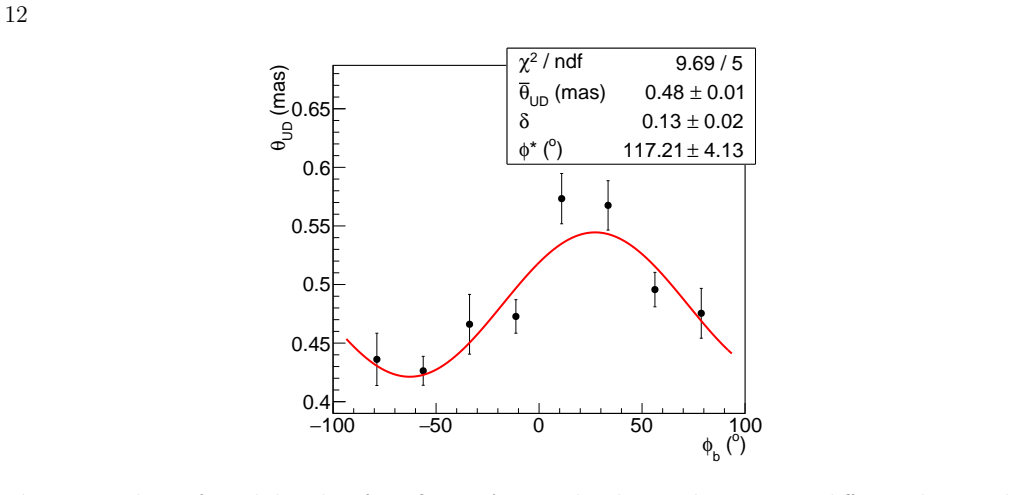
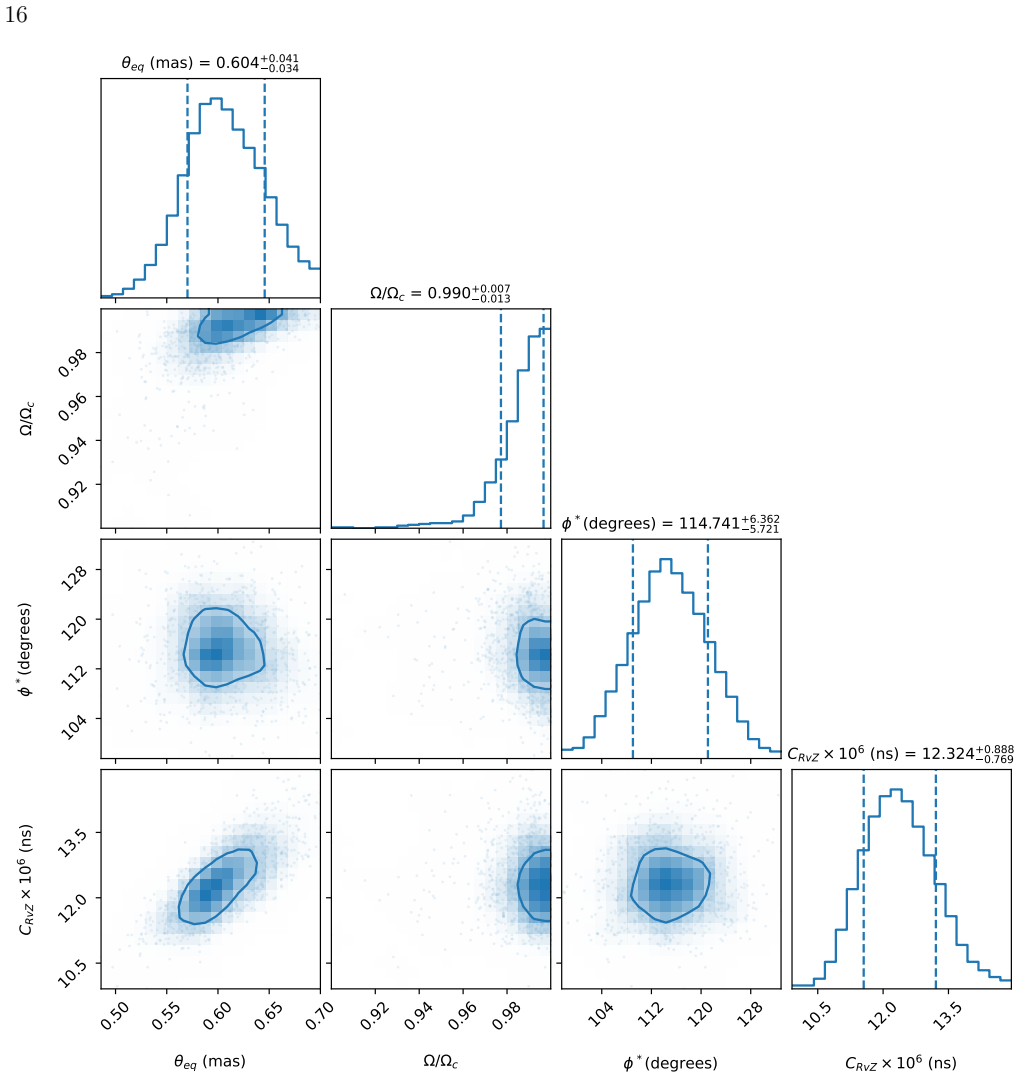
The central discovery, stated on the paper's own terms, is that intensity-interferometry visibilities taken over baselines of varied length and orientation resolve the equatorial bulge of a rapidly rotating star. Fitting the squared visibilities with a uniformly illuminated ellipse yields a minor-axis angular diameter of $0.43\pm0.02$ mas, a major-to-minor axis ratio of $1.28\pm0.04$, and a rotation-axis position angle of $116^\circ\pm5^\circ$ (statistical; comparable systematic uncertainties are reported). A Roche--von Zeipel rapid-rotator model with limb and gravity darkening describes the same data with an equatorial angular diameter of $0.604^{+0.041}_{-0.034}$ mas, an equatorial radius of $10.9^{+0.8}_{-0.6}\,R_\odot$, a 1 $\sigma$ lower limit of 97.7 percent of the breakup rotation rate, and a position angle of $114.7^{+6.4}_{-5.7}$ degrees. The paper states that this is the first measurement of an oblate photosphere using intensity interferometry.
Load-bearing premise
The load-bearing premise is that light from gamma Cas's decretion disk contributes negligibly to the correlated 416 nm signal, even though the 10 nm bandpass includes the H-delta line (which the disk fills with emission) and the model does not include the disk.
Editorial extensions
If this is right
- Rapid rotators among bright stars can now have their photospheric oblateness and spin-axis orientation measured at optical wavelengths, not just their disk geometry at infrared wavelengths.
- Agreement between photosphere and disk position angles becomes a direct test of whether decretion disks form in the equatorial plane.
- For rapid rotators, circular-disk fits are orientation-dependent, so previous single-orientation intensity-interferometry size measurements may need elliptical reanalysis.
- Near-critical stellar rotation models must now reproduce geometric constraints from intensity interferometry, not just spectra and spectral energy distributions.
- More hour-angle coverage and additional telescopes would sharpen the derived equatorial radius and rotation rate because the remaining uncertainty is statistical plus comparable systematic.
Reading between the lines
- A direct test of the disk-contamination assumption would be multi-band intensity interferometry across the Balmer jump; a stable fitted axis ratio would confirm the photospheric origin, while a wavelength-dependent ratio would map the disk contribution.
- The same u--v coverage could be turned on other bright Be stars, and because the visibility zeros depend on baseline orientation, shape extraction does not require full model-independent imaging.
- If disk emission does contaminate the 416 nm band, the method would still be useful, since the line-emitting disk itself could be mapped in H-alpha or H-delta light with the same correlator.
- With longer optical baselines, the visibility function's dependence on the intensity distribution could reveal latitude-dependent gravity darkening rather than only the outer ellipse.
Signed reviews
Editorial analysis
A structured set of objections, weighed in public.
Referee Report
Summary. The paper presents stellar intensity interferometry (SII) observations of the rapid rotator γ Cassiopeiae using the VERITAS telescopes, with a 416 nm narrow-band filter. From more than 160 pair-hours of data, the authors extract squared visibilities as a function of baseline length and orientation, then fit them with (i) a uniform ellipse model and (ii) a Roche–von Zeipel rapid-rotator model with PHOENIX atmospheres. The uniform ellipse fit yields a minor-axis angular diameter of 0.43±0.02 mas, an axis ratio of 1.28±0.04, and a rotation-axis position angle of 116°±5°. The Roche–von Zeipel model gives an equatorial angular diameter of 0.604+0.041−0.034 mas and a 1σ lower limit on the rotation rate of 97.7% of breakup. The authors conclude that this is the first measurement of a stellar photosphere's oblateness using intensity interferometry, and that the measured orientation is consistent with infrared interferometric measurements of the decretion disk.
Significance. If the central claim is secure, this is a milestone for intensity interferometry: it demonstrates that SII with IACT-class collectors can measure not only stellar angular sizes but also photospheric shapes and orientations at sub-milliarcsecond scales. The paper's strengths include the publication of the full visibility data table (Table B1), a transparent bootstrap-based fitting procedure, and the internal consistency between the simple geometric model and the more physical atmosphere model. The inferred rotation rate is consistent with independent spectroscopic and interferometric constraints on γ Cas. The result would open a new niche for SII in stellar astrophysics, complementing Michelson interferometry at longer wavelengths.
major comments (2)
- [§5, Figure 15] The 416 nm bandpass (10 nm wide) includes the Hδ line at 4101 Å. The paper itself notes in Section 5 and in the caption of Figure 15 that the Hδ core is filled in by emission from γ Cas's decretion disk, and that 'The disk is not included in our model.' Because the disk is geometrically thin and lies in the equatorial plane (position angle ≈116°, consistent with the fitted rotation axis), any non-negligible disk contribution in this band will add an orientation-dependent visibility term that can mimic or bias the measured oblateness. The paper does not estimate the disk flux fraction in the 416 nm band, the angular scale of the emitting region, or its complex visibility at the 50–150 m baselines. I request a quantitative assessment—either from the ELODIE spectrum convolved with the filter transmission or from a simple disk model—showing that the fitted ellipse parameters (θ_min, r, φ*) and the near-critical rotation solution are robust to the inclusion of a disk component. Without this, the central claim of a photospheric oblateness measurement is not fully supported.
- [§3.6, Figure 7] All squared-visibility measurements below a fixed signal-to-noise threshold are discarded and excluded from the fits. The excluded points are predominantly the longest-baseline, lowest-visibility measurements, which are precisely the data that most strongly constrain the angular diameter and shape. Discarding them rather than modeling them as censored data can bias the fitted parameters, especially if the noise distribution is asymmetric or if the exclusion correlates with baseline orientation. I recommend either performing a censored-likelihood fit that includes all measurements (treating sub-threshold points as upper limits) or demonstrating with simulations that the threshold cut—including the 3.0–4.1 fs variation—does not bias θ_min, r, and φ*. The current systematic uncertainty estimate varies the threshold value but does not test the effect of the selection itself.
minor comments (5)
- [Table 1] In the row for 2024-02-21, the telescope pairs are listed as '(1,3), 2,3)'; the second pair is missing its opening parenthesis and should read '(2,3)'.
- [§5, Table 3] The text states that T_pole = 26500 K provides a reasonable match to the spectrophotometry, but Table 3 reports '≃26500−28000'; the value and range should be made consistent.
- [§4, Table 2] The reduced χ² values for the uniform disk (213/114 ≈ 1.87) and uniform ellipse (170/112 ≈ 1.52) fits are notably larger than unity; the paper should discuss the likely sources of the excess scatter (e.g., residual correlated noise, unmodeled surface structure) and consider whether the quoted statistical uncertainties need to be rescaled.
- [§4, Figure 8] The caption states that the zero-baseline squared visibility is fixed to the value from the uniform ellipse fit when fitting the individual uv slices; this constraint can bias the recovered modulation in θ_UD(φ_b). I suggest checking whether freeing this parameter per slice changes the derived δ and φ*.
- [§6] The wording 'a lower limit on the angular velocity very near the critical value, Ω/Ωc = 0.977' is ambiguous: the best-fit value is 0.990 and 0.977 is the 1σ lower limit. Please clarify this phrasing in the text and abstract.
Circularity Check
No significant circularity: the visibility fits are self-contained, and the external consistency checks are not inputs to the fits.
full rationale
The central results are obtained by direct least-squares fits of measured squared visibilities to two independent models: a uniform-ellipse model (Eq. 6) and a Roche-von Zeipel stellar atmosphere model (Section 5). The uniform-ellipse parameters (θ_min, r, φ*) are fitted to the visibility data with no fitted quantity fed back as a prediction. The Roche-von Zeipel model is parameterized by θ_eq, Ω/Ω_c, φ*, and a normalization constant C_RvZ, all fitted to the same visibility data; fixed priors (parallax from van Leeuwen 2007, inclination i=60° from Lailey & Sigut 2024, gravity darkening β=0.20 from Che et al. 2011) come from external published work, not from the present measurement. The agreement with Hα spectroscopy, infrared disk position angle, and archival spectrophotometry is used only as an external consistency check, not as an input to the fits. Self-citations to prior VSII instrument papers (Abeysekara et al. 2020; Acharyya et al. 2024) describe data-processing methods and are not load-bearing for the oblateness claim; the cited Roche-von Zeipel modeling references (Aufdenberg et al. 2006; Sackrider & Aufdenberg 2023) provide a standard physical model, not a uniqueness theorem that forces the result. The only in-scope limitation passage is the Figure 15 caption, 'The disk is not included in our model,' together with the statement that Hδ is filled by disk emission. That is a possible systematic bias affecting interpretation of the fitted elongation, but it does not make the derivation circular: disk flux is not fitted, subtracted, or used as a model input. The threshold/cut variations and reanalysis of β UMa are robustness checks, not fitted-input predictions. Therefore no circular step is present; the derivation is self-contained against the new interferometric data.
Assumptions & free parameters
free parameters (11)
- Visibility normalization constant Cnorm =
12.4 ± 0.5 fs (ellipse); 12.324+0.888−0.769e6 ns (RvZ)
- Uniform disk angular radius theta_UD =
0.44 ± 0.01 ± 0.03 mas
- Ellipse minor-axis angular diameter theta_min =
0.43 ± 0.02 ± 0.02 mas
- Ellipse axis ratio r =
1.28 ± 0.04 ± 0.02
- Ellipse position angle phi* =
116 ± 5 ± 7 degrees
- RvZ equatorial angular diameter theta_eq =
0.604+0.041−0.034 mas
- RvZ rotation rate omega/omega_c =
0.990+0.007−0.013
- RvZ position angle phi* =
114.7+6.4−5.7 degrees
- Polar effective temperature T_pole =
26500 K
- Noise threshold for excluding sub-threshold peaks =
3.58 fs, varied 3.0 to 4.1 fs
- Polar gravity log(g)_pole =
3.82 dex
assumptions (7)
- domain assumption A uniformly illuminated circular or elliptical disk visibility model adequately describes the photosphere projection.
- domain assumption A Roche-von Zeipel model with uniform rotation and von Zeipel gravity-darkening parameter beta=0.20 applies to gamma Cassiopeiae.
- domain assumption The inclination of the rotation axis is i=60 degrees.
- domain assumption The parallax of gamma Cassiopeiae is 5.94±0.12 mas.
- domain assumption The 416 nm band, including the disk-filled Hδ line, is dominated by photospheric light, so the decretion disk can be omitted from the model.
- domain assumption PHOENIX model atmosphere intensities interpolated from a 106-point effective-temperature and gravity grid are accurate for these stellar parameters.
- domain assumption The threshold cut on sub-threshold peaks and the linear stray-light interpolation do not introduce baseline-dependent bias.
Cite this review
Pith. "Pith review of Measurement of the photosphere oblateness of $\gamma$ Cassiopeiae via Stellar Intensity Interferometry with the VERITAS Observatory." pith.science (2026). https://pith.science/paper/LV6SB3XP
@misc{pith2026250615027,
  author       = {Pith},
  title        = {Pith review of: Measurement of the photosphere oblateness of $\gamma$ Cassiopeiae via Stellar Intensity Interferometry with the VERITAS Observatory},
  year         = {2026},
  howpublished = {\url{https://pith.science/paper/LV6SB3XP}},
  note         = {Machine review of arXiv:2506.15027}
}
abstract
We use the stellar intensity interferometry system implemented with the Very Energetic Radiation Imaging Telescope Array System (VERITAS) at Fred Lawrence Whipple Observatory (FLWO) as a light collector to obtain measurements of the rapid rotator star $\gamma$ Cassiopeiae, at a wavelength of 416 nm. Using data from baselines sampling different position angles, we extract the size, oblateness, and projected orientation of the photosphere. Fitting the data with a uniform ellipse model yields a minor-axis angular diameter of $0.43\pm0.02$ mas, a major-to-minor-radius ratio of $1.28\pm0.04$, and a position angle of $116^\circ\pm5^\circ$ for the axis of rotation. A rapidly-rotating stellar atmosphere model that includes limb and gravity darkening describes the data well with a fitted angular diameter of $0.604^{+0.041}_{-0.034}$ mas corresponding to an equatorial radius of 10.9$^{+0.8}_{-0.6}~R_\odot$, a rotational velocity with a $1~\sigma$ lower limit at $97.7\%$ that of breakup velocity, and a position angle of $114.7^{+6.4}_{-5.7}$ degrees. These parameters are consistent with H$\alpha$ line spectroscopy and infrared-wavelength Michelson interferometric measurements of the star's decretion disk. This is the first measurement of an oblate photosphere using intensity interferometry.
Figures


Figures from the paper (12 more)






Forward citations
Cited by 1 Pith paper
-
Misaligned or chaotic? A strong break of axial symmetry in the local LRD J1025 revealed with VLT/FORS2 spectropolarimetry
The local Little Red Dot J1025 shows a 48° polarisation-angle offset between continuum and broad H-alpha, requiring broken axial symmetry.
Reference graph
Works this paper leans on
-
[1]
Abe, S., Abhir, J., Acciari, V. A., et al. 2024, Monthly Notices of the Royal Astronomical Society, 529, 4387, doi: 10.1093/mnras/stae697
-
[2]
U., Benbow, W., Brill, A., et al
Abeysekara, A. U., Benbow, W., Brill, A., et al. 2020, Nature Astronomy, 4, 1164–1169, doi: 10.1038/s41550-020-1143-y
-
[3]
Acharyya, A., et al. 2024, Astrophys. J., 966, 28, doi: 10.3847/1538-4357/ad2b68 Astropy Collaboration, Price-Whelan, A. M., Sip˝ ocz, B. M., et al. 2018, AJ, 156, 123, doi: 10.3847/1538-3881/aabc4f
-
[4]
P., M´ erand, A., Coud´ e du Foresto, V., et al
Aufdenberg, J. P., M´ erand, A., Coud´ e du Foresto, V., et al. 2006, ApJ, 645, 664, doi: 10.1086/504149
doi:10.1086/504149 2006
-
[5]
Brun, R., & Rademakers, F. 1997, Nucl. Instrum. Meth. A, 389, 81, doi: 10.1016/S0168-9002(97)00048-X
-
[6]
2001, A&A, 378, 861, doi: 10.1051/0004-6361:20011202
Chauville, J., Zorec, J., Ballereau, D., et al. 2001, A&A, 378, 861, doi: 10.1051/0004-6361:20011202
-
[7]
Che, X., Monnier, J. D., Zhao, M., et al. 2011, ApJ, 732, 68, doi: 10.1088/0004-637X/732/2/68
-
[8]
Dravins, D., LeBohec, S., Jensen, H., & Nu˜ nez, P. D. 2013, Astroparticle Physics, 43, 331, doi: https: //doi.org/10.1016/j.astropartphys.2012.04.017
Show all 32 references
-
[9]
2022, astropy/specutils: V1.7.0, v1.7.0, Zenodo, doi: 10.5281/zenodo.6207491
Earl, N., Tollerud, E., Jones, C., et al. 2022, astropy/specutils: V1.7.0, v1.7.0, Zenodo, doi: 10.5281/zenodo.6207491
2022 doi
-
[10]
2016, The Journal of Open Source Software, 1, 24, doi: 10.21105/joss.00024 Gonz´ alez-Riestra, R., Cassatella, A., Solano, E.,
Foreman-Mackey, D. 2016, The Journal of Open Source Software, 1, 24, doi: 10.21105/joss.00024 Gonz´ alez-Riestra, R., Cassatella, A., Solano, E.,
2016 doi
-
[11]
2000, A&AS, 141, 343, doi: 10.1051/aas:2000317 Hanbury Brown, R
Altamore, A., & Wamsteker, W. 2000, A&AS, 141, 343, doi: 10.1051/aas:2000317 Hanbury Brown, R. 1974, The intensity interferometer. Its applications to astronomy (London: Taylor & Francis Ltd.) Hanbury Brown, R., & Twiss, R. 1954, The
2000 doi
-
[12]
London, Edinburgh, and Dublin Philosophical Magazine and Journal of Science, 45, 663, doi: 10.1080/14786440708520475
- [13]
-
[14]
2006, Astroparticle Physics, 25, 391, doi: https: //doi.org/10.1016/j.astropartphys.2006.04.002
Holder, J., Atkins, R., Badran, H., et al. 2006, Astroparticle Physics, 25, 391, doi: https: //doi.org/10.1016/j.astropartphys.2006.04.002
2006 doi
-
[15]
1975, Comput
James, F., & Roos, M. 1975, Comput. Phys. Commun., 10, 343, doi: 10.1016/0010-4655(75)90039-9
1975 doi
-
[16]
2021, PoS, ICRC2021, 803, doi: 10.22323/1.395.0803
Kieda, D., et al. 2021, PoS, ICRC2021, 803, doi: 10.22323/1.395.0803
2021 doi
-
[17]
D., & Sigut, T
Lailey, B. D., & Sigut, T. A. A. 2024, MNRAS, 527, 2585, doi: 10.1093/mnras/stad3321
2024 doi
-
[18]
2020, PhD thesis, University of Utah
Matthews, N. 2020, PhD thesis, University of Utah
2020
-
[19]
2023, AJ, 165, 117, doi: 10.3847/1538-3881/acb142
Matthews, N., Rivet, J.-P., Vernet, D., et al. 2023, AJ, 165, 117, doi: 10.3847/1538-3881/acb142
2023 doi
-
[20]
2004, PASP, 116, 693, doi: 10.1086/422177
Soubiran, C. 2004, PASP, 116, 693, doi: 10.1086/422177
2004 doi
-
[21]
2025, Bachelor’s honors thesis, The Ohio State University
Rose, J. 2025, Bachelor’s honors thesis, The Ohio State University. https://kb.osu.edu/handle/1811/105962
2025
-
[22]
D., Kieda, D., & LeBohec, S
Rou, J., Nu˜ nez, P. D., Kieda, D., & LeBohec, S. 2013, Monthly Notices of the Royal Astronomical Society, 430, 3187, doi: 10.1093/mnras/stt123
2013 doi
-
[23]
L., & Aufdenberg, J
Sackrider, J. L., & Aufdenberg, J. P. 2023, Research Notes of the American Astronomical Society, 7, 216, doi: 10.3847/2515-5172/ad023b
2023 doi
-
[24]
2023, Bachelor’s honors thesis, The Ohio State University
Scott, M. 2023, Bachelor’s honors thesis, The Ohio State University. http://hdl.handle.net/1811/102963
2023
-
[25]
Sigut, T. A. A., Mahjour, A. K., & Tycner, C. 2020, ApJ, 894, 18, doi: 10.3847/1538-4357/ab8386
2020 doi
-
[26]
Smith, M. A. 2019, PASP, 131, 044201, doi: 10.1088/1538-3873/aaf70b
2019 doi
-
[27]
D., et al
Stee, Ph., Delaa, O., Monnier, J. D., et al. 2012, A&A, 545, A59, doi: 10.1051/0004-6361/201219234
2012 doi
-
[28]
R., Moran, J
Thompson, A. R., Moran, J. M., & Swenson Jr., G. W. 2001, Interferometry and Synthesis in Radio Astronomy (WILEY-VCH Verlag GmbH & Co. KGaA)
2001
-
[29]
2021, JCAP, 2021, 057, doi: 10.1088/1475-7516/2021/05/057
Torrado, J., & Lewis, A. 2021, JCAP, 2021, 057, doi: 10.1088/1475-7516/2021/05/057
2021 doi
-
[30]
C., Zavala, R
Tycner, C., Gilbreath, G. C., Zavala, R. T., et al. 2006, Astron. J., 131, 2710, doi: 10.1086/502679 van Leeuwen, F. 2007, A&A, 474, 653, doi: 10.1051/0004-6361:20078357
2006 doi
-
[31]
E., et al
Virtanen, P., Gommers, R., Oliphant, T. E., et al. 2020, Nature Methods, 17, 261, doi: 10.1038/s41592-019-0686-2 28
2020 doi
-
[32]
2023, Monthly Notices of the Royal Astronomical Society, 527, 12243, doi: 10.1093/mnras/stad3676
Zmija, A., Vogel, N., Wohlleben, F., et al. 2023, Monthly Notices of the Royal Astronomical Society, 527, 12243, doi: 10.1093/mnras/stad3676
2023 doi
Reviewed August 15, 2026 · model on record in the stance chip above.
Discussion (0). Continue with ORCID to comment.