REVIEW 3 major objections 5 minor 75 references
Constraining Nonthermal Dark Matter's Impact on the Matter Power Spectrum
T0 review · 3 major / 5 minor · reviewed 2026-08-14 · deepseek-v4-flash
Pith's one-line read Dark matter produced during an early matter-dominated era is still relativistic at reheating, so free streaming erases the era's boost to small-scale structure, and observed structures bound the birth velocity ($\gamma_D \lesssim 550$ at…
desk verdict The paper convincingly shows that nonthermal dark matter produced during an EMDE remains relativistic at reheating, wiping out the EMDE perturbation enhancement; the Lyman-alpha-derived exclusion limits are real but less certain than they look because of the transfer-function shape extrapolation. read the letter →
The pith
A machine-rendered reading of the paper's core claim, the machinery that carries it, and where it could break.
The reading
What carries the argument
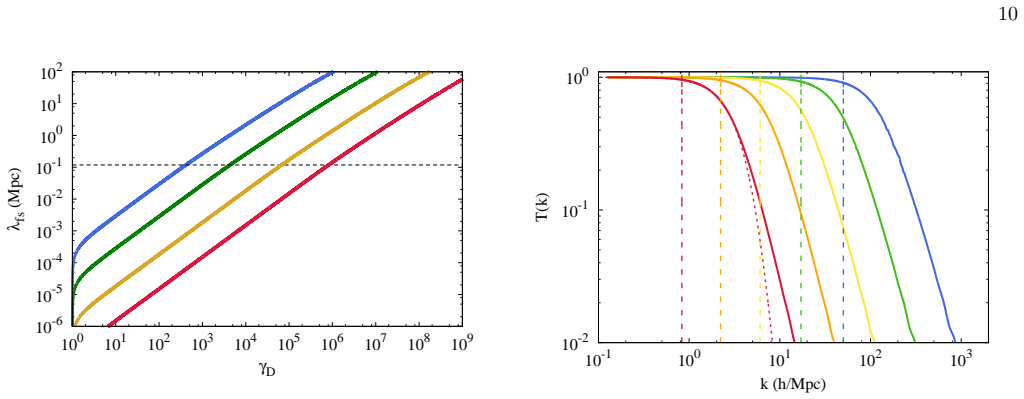
The load-bearing object is the birth-time distribution $f(a_D)$ of dark-matter particles, obtained from the comoving production rate $d\hat{n}_\chi/da_D \propto \rho_\phi \sqrt{a_D}/H_D$ during the EMDE. This distribution determines the average velocity $\langle v^2\rangle(a)$, the fraction of particles born early enough to be cold at reheating, and—after scaling by the combination $\mu = \gamma_D v_D a_{RH}/a_0$—the present-day momentum distribution that enters the transfer function. The transfer function itself is fitted with the ansatz $T(k) = [1 + (\alpha k)^\beta]^\gamma$, with $\beta$ and $\gamma$ given as analytic functions of $\alpha$, so the whole cosmological constraint reduces to a single cutoff scale $\alpha$. A separate piece of machinery is the analytic free-streaming integral, expressed in terms of $\mu$, which connects $\alpha$ to the physical free-streaming length by a simple power law.
What would settle it
Detect structure on scales the EMDE is supposed to enhance—for instance a population of microhalos corresponding to comoving scales $\lambda \lesssim 30$ pc, or a matter power spectrum at $k \gtrsim 10\,h/\mathrm{Mpc}$ that shows no suppression below the cold-dark-matter prediction—and the central claim that free streaming erases those perturbations is contradicted.
Extended reading notes
Core claim
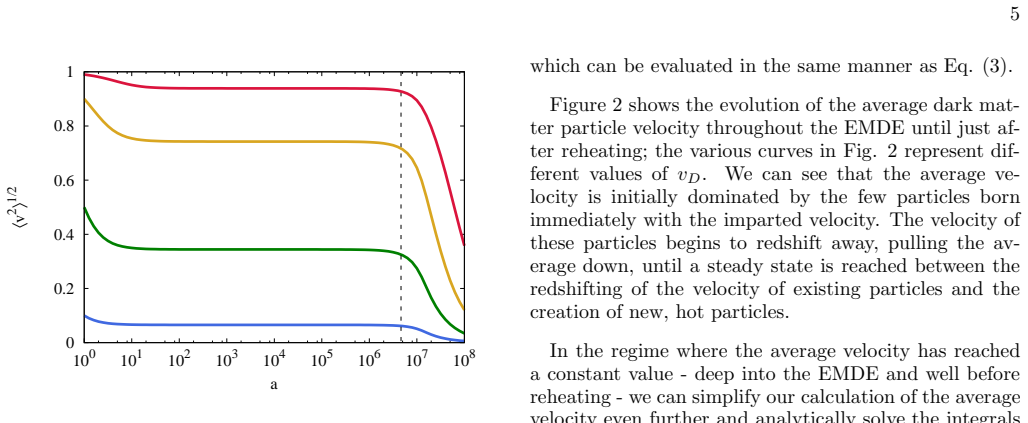
The central discovery is that adiabatic cooling cannot rescue nonthermal dark matter in an EMDE. The average dark-matter velocity at reheating stays close to the velocity imparted at decay—for $v_D=0.99$, the rms velocity is still about 0.93—because the continuous creation of fresh relativistic particles offsets the redshift of older ones. Consequently, only a tiny fraction of the dark matter (about 0.15% for $v_D=0.5$) is slow enough at reheating to preserve the factor-of-ten perturbation enhancement that modes entering the horizon at $0.1 a_{RH}$ would otherwise enjoy, and mixed-dark-matter studies imply even that fraction is far too small to matter. On observed scales, the same free streaming suppresses power in the Lyman-$\alpha$ forest and reduces the predicted number of Milky Way satellites. The resulting constraints are phrased in terms of the parameter combination $\mu = \gamma_D v_D a_{RH}/a_0$, which sets both the free-streaming length and the momentum distribution; for a reheat temperature of 10 MeV they require $\gamma_D \lesssim 550$.
Load-bearing premise
The load-bearing assumption is that the model's transfer function is faithfully represented by the fitting form $T(k) = [1 + (\alpha k)^\beta]^\gamma$ with $\beta$ and $\gamma$ fixed as functions of $\alpha$, and that the Lyman-$\alpha$ likelihood computed from precomputed hydrodynamic simulations remains valid when extrapolated to this shape; if the true shape differs where $T(k)$ is small, the quoted $\alpha$ and $\gamma_D$ limits would shift.
Editorial extensions
If this is right
- The EMDE enhancement to small-scale structure is preserved only for dark matter born with very low velocity; for a particle born at half the speed of light only about 0.15% of the population is slow enough at reheating ($v_{RH} < 0.01$), so the enhancement is effectively erased.
- Lyman-alpha forest data bound the transfer-function cutoff to $\alpha < 0.011\,\mathrm{Mpc}/h$ (68% C.L.) and $\alpha < 0.026\,\mathrm{Mpc}/h$ (95% C.L.), which for a given reheat temperature translates into an upper limit on $\gamma_D$; for $T_{RH}=10$ MeV, $\gamma_D \lesssim 550$.
- Milky Way satellite counts give essentially the same 95% cutoff, $\alpha < 0.026\,\mathrm{Mpc}/h$ (equivalently a half-mode scale $k_{hm} > 36\,h/\mathrm{Mpc}$), so the two independent small-scale probes agree.
- In the absence of annihilations, matching the observed relic abundance requires the branching fraction $f$ of the decaying scalar into dark matter to be below about $10^{-4}$ in the allowed region, meaning annihilations or another depletion mechanism are needed to avoid fine-tuning.
- The constraints can be recast as limits on the scalar decay rate $\Gamma_\phi$ and on the parent-daughter mass hierarchy ($m_\phi = 2\gamma_D m_\chi$), connecting the cosmological bound to particle-physics parameters.
Reading between the lines
- Because the cutoff depends on the single combination $\mu = \gamma_D v_D a_{RH}/a_0$, any nonthermal production mechanism with the same birth-time distribution and the same $\mu$ should show the same cutoff scale, so the bounds are transferable beyond the specific two-body decay considered.
- If future Lyman-alpha measurements or satellite catalogs push the cutoff below $\alpha \approx 0.011\,\mathrm{Mpc}/h$, the allowed region would contract toward lower $\gamma_D$; if they relax it, higher birth velocities would open up.
- A broader, non-monoenergetic distribution of birth velocities could change the shape of the transfer function and shift the limits, depending on the high-velocity tail; this is a natural next step left by the paper.
- If dark matter can exchange momentum with Standard Model particles after production, the velocity distribution would cool more efficiently, potentially reviving the EMDE microhalo signature; searches for microhalos at pc scales would then discriminate between this minimal model and models with interactions.
Editorial analysis
A structured set of objections, weighed in public.
Referee Report
Summary. The paper studies nonthermal dark matter production during an early matter-dominated era (EMDE) preceding reheating. The authors model a decaying scalar field that produces both Standard Model radiation and dark matter particles with a common initial velocity v_D, and they derive the resulting dark matter velocity distribution and its evolution. Their central finding is that adiabatic cooling during the EMDE is inefficient: most dark matter particles are still relativistic at reheating, so their free streaming erases the perturbation growth that would otherwise occur during the EMDE. They also compute the matter power spectrum suppression using CLASS and fit the resulting transfer function to the form T(k)=[1+(alpha k)^beta]^gamma, with beta and gamma fixed as functions of alpha. Using a Lyman-alpha forest likelihood from Ref. [67], they derive bounds on alpha, translate them into constraints on the production Lorentz factor gamma_D as a function of reheat temperature T_RH, and find a comparable bound from Milky Way satellite abundances. The headline result is that for T_RH=10 MeV, dark matter must be produced with gamma_D lesssim 550.
Significance. If the quantitative bounds hold, the paper closes an important loophole in the EMDE-enhanced structure formation scenario: it shows that the most natural, non-fine-tuned production of dark matter during an EMDE yields relativistic particles whose free streaming destroys the linear-growth enhancement. The analytic derivation of the birth-time distribution and average velocity in Sections II and III is clean, self-contained, and robust, and it requires no external data. The Milky Way satellite bound is independent of the Lyman-alpha likelihood and depends mainly on the half-mode scale, making it a relatively robust quantitative result. The main weakness is that the headline Lyman-alpha exclusion relies on extrapolating a WDM-calibrated likelihood to a transfer-function shape very different from thermal WDM, so the precise excluded region in Fig. 12 is less certain than the central qualitative claim.
major comments (3)
- [Section IV.B, Eq. (34) and Fig. 11] The quantitative Lyman-alpha bounds on alpha, and hence the headline constraint gamma_D lesssim 550 for T_RH = 10 MeV, depend on evaluating the Ref. [67] likelihood for transfer-function shape parameters that are far outside the WDM-like simulation grid. The paper itself states that parameter values outside the template are linearly extrapolated, and the fitted gamma values are approximately -1.1 to -1.35, whereas thermal WDM has gamma = -4.46. This is roughly a factor of three difference in the high-k slope of T(k), and Lyman-alpha flux power is sensitive to the shape of the suppression, not just the half-mode scale. The derived alpha bounds and the corresponding exclusion region in Fig. 12 therefore inherit an unvalidated extrapolation. The authors should either validate the likelihood for this shape with dedicated hydrodynamic simulations, or explicitly present the Lyman-alpha bounds as approximate and make the MW satellite bound the primary quantitative result.
- [Section IV.B, Figs. 9-10] The claim that the nonthermal transfer function is 'quite similar' to thermal WDM is based on matching the half-mode scale, but the two shapes differ substantially at T(k) lesssim 0.1 because of the different gamma. Since the Lyman-alpha likelihood is mapped through the full fitting form, the alpha approximately 2 alpha_WDM relation cannot by itself justify using the WDM-calibrated simulation grid. The MW satellite constraint in Section IV.C, which uses only khm through Eq. (38), is less sensitive to this shape difference and should be presented as the more robust channel; the paper's current emphasis on the Lyman-alpha bound gives a false impression of equal robustness for the two constraints.
- [Section IV.B, paragraph on 'Whenever some of the parameters assume values not enclosed by the template'] The manuscript reports the Lyman-alpha bound as a firm result, but the reliance on linear extrapolation is disclosed only in a single sentence. No code or simulation products are released, so the likelihood evaluation for the extrapolated region cannot be independently checked. This is not a critique of the analytic derivation, but it is a load-bearing issue for the quantitative exclusion region: a reader cannot distinguish which part of Fig. 12 is anchored by actual simulations and which part is extrapolation. At minimum, the figures should mark the extrapolated region of parameter space, and the text should state how much of the reported bound lies outside the simulation grid.
minor comments (5)
- [Section IV.B] There is a typo in 'Markov hain Monte Carlo' that should read 'Markov chain Monte Carlo.'
- [Section III, Eq. (26)] The integral expression contains an unexplained factor 'sqrt(i)' in the elliptic-integral term; this may be a typographical artifact, but it should be clarified or corrected.
- [Section III, Fig. 3 caption] The caption reads '1 > a_D > a_D,2', which appears to be a typo; it should presumably be 'a_D,1 < a_D < a_D,2'.
- [Section II.A] The sentence 'We will see in Section IV that restrictions from small-scale structure on the parameter space of gamma_D and T_RH provide much stronger bounds' is followed by a period missing after 'relic abundance'; the text should be punctuated consistently.
- [Section IV.B, Eq. (35)] Equation (35) gives alpha in units of Mpc/h but the numerical coefficient is written as 0.177 (lambda_fs/Mpc)^0.908 Mpc/h; it would be clearer to state explicitly that lambda_fs is in Mpc and alpha in Mpc/h.
Circularity Check
No circularity found: the velocity-distribution and free-streaming calculations are self-contained, and the external Lyman-alpha and Milky Way satellite constraints are independent of the paper's assumptions.
full rationale
The paper's central derivation in Sections II and III computes the dark matter birth-time distribution from the scalar decay equations and then obtains the resulting velocity distribution and free-streaming lengths. This is a self-contained differential calculation with no input from the data it eventually constrains. The transfer functions are generated with CLASS from the model's own distribution function, and the fitting form Eq. (34) with beta and gamma as functions of alpha is a descriptive parametrization of the model's own transfer functions, not a parameter fitted to external data. The Lyman-alpha bounds alpha < 0.011 Mpc/h and alpha < 0.026 Mpc/h are obtained by inserting this model's transfer-function family into a pre-existing MCMC likelihood from Ref. [67], which is based on independent MIKE/HIRES quasar data and precomputed hydrodynamic simulations; the Milky Way satellite bound is imported from Ref. [58]'s independent analysis. Although Refs. [66] and [67] include coauthor Murgia, they are published, externally calibrated analyses using independent data sets and simulation grids, so they count as real evidence rather than circular self-citation under the review rules. The main legitimate concern is that the Ref. [67] likelihood template is linearly extrapolated to beta and gamma values far from thermal WDM (gamma approximately -1.1 versus -4.46), and the paper explicitly acknowledges this extrapolation. That is a validation and correctness risk, not circularity by construction, because the resulting bounds are not algebraic functions of the paper's own fitted parameters. No step in the derivation reduces to its inputs, so the circularity score is 0.
Assumptions & free parameters
free parameters (2)
- alpha (transfer function cutoff) =
alpha < 0.011 Mpc/h (68% C.L.), < 0.026 Mpc/h (95% C.L.)
- beta and gamma (shape parameters) =
beta = 0.0029 ln(alpha)^2 + 0.039 ln(alpha) + 2.51; gamma = -(0.0055 ln(alpha)^2 + 0.083 ln(alpha) + 1.35)
assumptions (5)
- standard math Friedmann equations with an oscillating scalar field behaving as pressureless matter during the EMDE.
- domain assumption Dark matter is produced by two-body scalar decay with one common birth velocity vD and no scattering or annihilations after production.
- domain assumption Entropy is conserved after a = 3aRH, so g*S and temperature relations determine aRH/a0 and the relation between TRH and the scale factor.
- domain assumption The WDM fitting form T(k) = [1 + (alpha k)^beta]^gamma, with beta and gamma fixed as functions of alpha, captures the nonthermal transfer function at all scales relevant to Lyman-alpha constraints.
- domain assumption The WDM subhalo mass function suppression from Ref. [72] and the Milky Way satellite bound from Ref. [58] apply to this nonthermal model because its transfer function matches WDM near the half-mode scale.
Cite this review
Pith. "Pith review of Constraining Nonthermal Dark Matter's Impact on the Matter Power Spectrum." pith.science (2026). https://pith.science/paper/LWJAD7UQ
@misc{pith2026190810369,
  author       = {Pith},
  title        = {Pith review of: Constraining Nonthermal Dark Matter's Impact on the Matter Power Spectrum},
  year         = {2026},
  howpublished = {\url{https://pith.science/paper/LWJAD7UQ}},
  note         = {Machine review of arXiv:1908.10369}
}
abstract
The inclusion of a period of (effective) matter domination following inflation and prior to the onset of radiation domination has interesting and observable consequences for structure growth. During this early matter-dominated era (EMDE), the Universe was dominated by massive particles, or an oscillating scalar field, that decayed into Standard Model particles, thus reheating the Universe. This decay process could also be the primary source of dark matter. In the absence of fine-tuning between the masses of the parent and daughter particles, both dark matter particles and Standard Model particles would be produced with relativistic velocities. We investigate the effects of the nonthermal production of dark matter particles with relativistic velocities on the matter power spectrum by determining the resulting velocity distribution function for the dark matter. We find that the vast majority of dark matter particles produced during the EMDE are still relativistic at reheating, so their free streaming erases the perturbations that grow during the EMDE. The free streaming of the dark matter particles can also prevent the formation of satellite galaxies around the Milky Way and the structures observed in the Lyman-$\alpha$ forest. For a given reheat temperature, these observations put an upper limit on the velocity of the dark matter particles at their creation. For example, for a reheat temperature of 10 MeV, dark matter must be produced with a Lorentz factor $\gamma \lesssim 550$.
Figures


Figures from the paper (7 more)




Reference graph
Works this paper leans on
-
[51]
A. Di Marco, G. Pradisi, and P. Cabella, Phys. Rev. D98, 123511 (2018), 1807.05916
arXiv 2018
- [67]
- [1]
-
[2]
D. S. Akerib et al. (LUX), Phys. Rev. Lett. 122, 131301 (2019), 1811.11241
arXiv 2019
-
[3]
66 × 105Mpc ) µ ln ( 2 T∗ Teq ) − ln 1 + √ µ 2 ( T∗ T0 ) 2 + 1 + (
-
[4]
66 × 1011pc ) γDvD aRH a0 ln ( 2 T∗ Teq ) − ln 1 + √ ( γDvD aRH a0 ) 2( T∗ T0 ) 2 + 1 , (27) where we have used the fact that g∗ remains constant after T∗ = 2 × 10⁻⁵ GeV to set a∗T∗ = aeqTeq = a0T0. An important feature of this calculation is that the parameters of our model, the dark matter velocity at its production and the reheat temperat...
-
[5]
The integral in Eq. (24) can be broken into three separate contributing integrals, representing the scalar- , radiation-, and matter-dominated eras (because the dark matter free-streaming length does not change signif- icantly after matter-radiation equality, we neglect dark 10-5 10-4 10-3 10-2 10-1 100 0 0.2 0.4 0.6 0.8 1 ε (λfs < λhor (aRH/10) ) vD FIG....
-
[6]
66 × 105Mpc ) √ T0 Teq √ 2iµ [ F ( i sinh−1√ iµ ) − F ( i sinh−1 √ iµ Teq T0 )] . (29) The above equation gives the scale at which the power spectrum of our model begins to differ from that of the standard ΛCDM power spectrum. Figure 7 shows the free-streaming length calculated by Eq. (29) as a func- tion of the Lorentz factor at decay, γD, for different va...
Show all 75 references
- [7]
- [8]
-
[9]
Ibarra, A
A. Ibarra, A. S. Lamperstorfer, and J. Silk, Phys. Rev. D89, 063539 (2014), 1309.2570
2014 arXiv
- [10]
-
[11]
Ackermann et al
M. Ackermann et al. (Fermi-LAT), Phys. Rev. Lett. 115, 231301 (2015), 1503.02641
2015 arXiv
-
[12]
Liu, X.-J
W. Liu, X.-J. Bi, S.-J. Lin, and P.-F. Yin, Chin. Phys. C41, 045104 (2017), 1602.01012
2017 arXiv
-
[13]
Albert et al
A. Albert et al. (Fermi-LAT, DES), Astrophys. J. 834, 110 (2017), 1611.03184
2017 arXiv
-
[14]
Ackermann et al
M. Ackermann et al. (Fermi-LAT), Astrophys. J. 840, 43 (2017), 1704.03910
2017 arXiv
-
[15]
Hannestad, Phys
S. Hannestad, Phys. Rev. D70, 043506 (2004), astro- ph/0403291
2004
-
[16]
Kawasaki, K
M. Kawasaki, K. Kohri, and N. Sugiyama, Phys. Rev. D62, 023506 (2000), astro-ph/0002127
2000 arXiv
-
[17]
Ichikawa, M
K. Ichikawa, M. Kawasaki, and F. Takahashi, JCAP 0705, 007 (2007), astro-ph/0611784
2007 arXiv
-
[18]
Kofman, A
L. Kofman, A. D. Linde, and A. A. Starobinsky, Phys. Rev. D56, 3258 (1997), hep-ph/9704452
1997 arXiv
-
[19]
Allahverdi, R
R. Allahverdi, R. Brandenberger, F.-Y. Cyr-Racine, an d A. Mazumdar, Ann. Rev. Nucl. Part. Sci. 60, 27 (2010), 1001.2600
2010 arXiv
-
[20]
M. S. Turner, Phys. Rev. D28, 1243 (1983)
1983
-
[21]
Coughlan, W
G. Coughlan, W. Fischler, E. W. Kolb, S. Raby, and G. Ross, Physics Letters B 131, 59 (1983), ISSN 0370-2693, URL http://www.sciencedirect.com/science/article/pii/0370269383910912
1983
-
[22]
de Carlos, J
B. de Carlos, J. A. Casas, F. Quevedo, and E. Roulet, Phys. Lett. B318, 447 (1993), hep-ph/9308325
1993 arXiv
-
[23]
Banks, D
T. Banks, D. B. Kaplan, and A. E. Nelson, Phys. Rev. D49, 779 (1994), hep-ph/9308292
1994 arXiv
-
[24]
Banks, M
T. Banks, M. Berkooz, and P. J. Steinhardt, Phys. Rev. D52, 705 (1995), hep-th/9501053
1995 arXiv
-
[25]
Banks, M
T. Banks, M. Berkooz, S. H. Shenker, G. W. Moore, and P. J. Steinhardt, Phys. Rev. D52, 3548 (1995), hep- th/9503114
1995
-
[26]
B. S. Acharya, G. Kane, and E. Kuflik, Int. J. Mod. Phys. A29, 1450073 (2014), 1006.3272
2014 arXiv
-
[27]
J. T. Giblin, G. Kane, E. Nesbit, S. Watson, and Y. Zhao, Phys. Rev. D96, 043525 (2017), 1706.08536
2017 arXiv
-
[28]
G. Kane, K. Sinha, and S. Watson, Int. J. Mod. Phys. D24, 1530022 (2015), 1502.07746
2015 arXiv
- [29]
- [30]
-
[31]
Berlin, D
A. Berlin, D. Hooper, and G. Krnjaic, Phys. Rev. D94, 095019 (2016), 1609.02555
2016 arXiv
-
[32]
J. A. Dror, E. Kuflik, B. Melcher, and S. Watson, Phys. Rev. D97, 063524 (2018), 1711.04773
2018 arXiv
- [33]
- [34]
-
[35]
D. J. H. Chung, E. W. Kolb, and A. Riotto, Phys. Rev. D60, 063504 (1999), hep-ph/9809453
1999 arXiv
-
[36]
G. F. Giudice, E. W. Kolb, and A. Riotto, Phys. Rev. D64, 023508 (2001), hep-ph/0005123
2001 arXiv
-
[37]
Fornengo, A
N. Fornengo, A. Riotto, and S. Scopel, Phys. Rev. D67, 023514 (2003), hep-ph/0208072
2003 arXiv
-
[38]
Pallis, Astropart
C. Pallis, Astropart. Phys. 21, 689 (2004), hep- ph/0402033
2004
-
[39]
Gelmini, P
G. Gelmini, P. Gondolo, A. Soldatenko, and C. E. Ya- guna, Phys. Rev. D74, 083514 (2006), hep-ph/0605016
2006 arXiv
-
[40]
G. B. Gelmini and P. Gondolo, Phys. Rev. D74, 023510 (2006), hep-ph/0602230
2006 arXiv
-
[41]
Roszkowski, S
L. Roszkowski, S. Trojanowski, and K. Turzy´ nski, JHEP 11, 146 (2014), 1406.0012
2014 arXiv
- [42]
-
[43]
G. L. Kane, P. Kumar, B. D. Nelson, and B. Zheng, Phys. Rev. D93, 063527 (2016), 1502.05406
2016 arXiv
- [44]
- [45]
-
[46]
Maity and P
D. Maity and P. Saha, Phys. Dark Univ. p. 100317 (2018), [Phys. Dark Univ.25,100317(2019)], 1804.10115
2018 arXiv
- [47]
-
[48]
Bernal, C
N. Bernal, C. Cosme, T. Tenkanen, and V. Vaskonen, Eur. Phys. J. C79, 30 (2019), 1806.11122
2019 arXiv
- [49]
-
[50]
Chowdhury, E
D. Chowdhury, E. Dudas, M. Dutra, and Y. Mambrini, Phys. Rev. D99, 095028 (2019), 1811.01947
2019 arXiv
- [52]
-
[53]
Cohen, M
T. Cohen, M. Lisanti, A. Pierce, and T. R. Slatyer, JCAP 1310, 061 (2013), 1307.4082
2013 arXiv
-
[54]
A. L. Erickcek and K. Sigurdson, Phys. Rev. D84, 083503 (2011), 1106.0536
2011 arXiv
-
[55]
J. Fan, O. ¨Ozsoy, and S. Watson, Phys. Rev. D90, 043536 (2014), 1405.7373
2014 arXiv
-
[56]
A. L. Erickcek, Phys. Rev. D92, 103505 (2015), 1504.03335
2015 arXiv
-
[57]
A. L. Erickcek, K. Sinha, and S. Watson, Phys. Rev. D94, 063502 (2016), 1510.04291
2016 arXiv
- [58]
-
[60]
J. Baur, N. Palanque-Delabrouille, C. Y` eche, C. Mag- neville, and M. Viel, JCAP 1608, 012 (2016), 1512.01981
2016 arXiv
- [61]
-
[62]
E. O. Nadler, V. Gluscevic, K. K. Boddy, and R. H. Wechsler, Astrophys. J. 878, L32 (2019), [Astrophys. J. Lett.878,32(2019)], 1904.10000
2019 arXiv
- [63]
- [64]
-
[65]
Blackadder and S
G. Blackadder and S. M. Koushiappas, Phys. Rev. D90, 103527 (2014), 1410.0683
2014 arXiv
- [66]
-
[68]
Boyarsky, J
A. Boyarsky, J. Lesgourgues, O. Ruchayskiy, and M. Viel , JCAP 0905, 012 (2009), 0812.0010
2009 arXiv
- [69]
-
[70]
Murgia, A
R. Murgia, A. Merle, M. Viel, M. Totzauer, and A. Schneider, JCAP 1711, 046 (2017), 1704.07838
2017 arXiv
- [71]
-
[72]
Schneider, R
A. Schneider, R. E. Smith, A. V. Macci` o, and B. Moore, MNRAS 424, 684 (2012), 1112.0330
2012 arXiv
-
[73]
M. Viel, G. D. Becker, J. S. Bolton, and M. G. Haehnelt, Phys. Rev. D88, 043502 (2013), 1306.2314
2013 arXiv
-
[74]
Archidiacono, D
M. Archidiacono, D. C. Hooper, R. Murgia, S. Bohr, J. Lesgourgues, and M. Viel (2019), 1907.01496
2019 arXiv
-
[75]
Murgia, G
R. Murgia, G. Scelfo, M. Viel, and A. Raccanelli, Phys. Rev. Lett. 123, 071102 (2019), 1903.10509
2019 arXiv
-
[76]
M. R. Lovell, C. S. Frenk, V. R. Eke, A. Jenkins, L. Gao, and T. Theuns, Mon. Not. Roy. Astron. Soc. 439, 300 (2014), 1308.1399
2014 arXiv
Reviewed August 14, 2026 · model on record in the stance chip above.
Discussion (0). Continue with ORCID to comment.