REVIEW 4 major objections 4 minor 107 references
Evidence for a Catastrophically Disrupted Open Cluster
T0 review · 4 major / 4 minor · reviewed 2026-08-16 · deepseek-v4-flash
Pith's one-line read This paper claims that OCSN-49 is the first known remnant of a catastrophically disrupted open cluster.
desk verdict Solid stellar-age package plus a suggestive but model-dependent dynamical age; the disruption claim is reasonable but the 83 Myr number is only as strong as the isotropic-unbound initial condition. read the letter →
The pith
A machine-rendered reading of the paper's core claim, the machinery that carries it, and where it could break.
The reading
What carries the argument
The argument runs on two machines. On the stellar side, a Bayesian fit of theoretical isochrones to the stream's color-magnitude diagram fixes the age near 600 Myr, lithium abundances are compared against benchmark open clusters to prefer roughly 420 Myr, and the color-period diagram is matched to benchmark clusters to prefer roughly 500 Myr. On the dynamical side, the cluster's birth state is modeled as an unbound, isotropic Gaussian sphere of tracer particles with an initial radius R = 7.6 pc and velocity dispersion σv = 0.20 km/s, integrated forward under a smooth model of the Milky Way potential; comparing the end state to the observed phase-space positions of 257 members yields the dynamical age t = 83 ± 1 Myr. The discrepancy between the two sides is the evidence for a disruptive encounter.
What would settle it
Measure radial velocities across the full extent of the stream and look for non-Gaussian, anisotropic expansion patterns, or find a surviving bound core of OCSN-49 stars; either would break the single isotropic-expansion model that yields the 83 Myr age. Alternatively, demonstrate that no giant molecular cloud of roughly $10^{5}$ solar masses crossed the cluster's orbit within the past 80 million years.
Extended reading notes
Core claim
OCSN-49 is a coeval stellar population with a stellar age of roughly 400–600 Myr, established by isochrone fitting, lithium abundances, and rotation-period gyrochronology, and a dynamical age of 83 ± 1 Myr, established by integrating an unbound, isotropic Gaussian sphere of tracer particles forward in a model Milky Way potential and matching the structure observed today in six-dimensional phase space. The paper claims these ages can only be reconciled if OCSN-49 formed as a bound open cluster and was catastrophically disrupted roughly 500 Myr after birth, with a single near-head-on encounter with a giant molecular cloud of about $10^{5}$ solar masses being the most probable culprit. This would make OCSN-49 the first known remnant of a catastrophically disrupted open cluster and therefore a benchmark for investigating cluster disruption in the Milky Way.
Load-bearing premise
The 83-million-year dynamical age assumes the disruptive encounter left OCSN-49 as an unbound, isotropic, Gaussian ball of stars; if the real encounter produced anisotropic motions or a partially bound remnant, the fitted age could be biased and the claimed discrepancy could shrink.
Editorial extensions
If this is right
- OCSN-49 remained a bound open cluster for roughly 500 Myr before a disruptive encounter—most plausibly a giant molecular cloud—tore it apart.
- The 83 Myr expansion time implies the structure is still dispersing, and within a few hundred million years its stars will be indistinguishable from the Milky Way field.
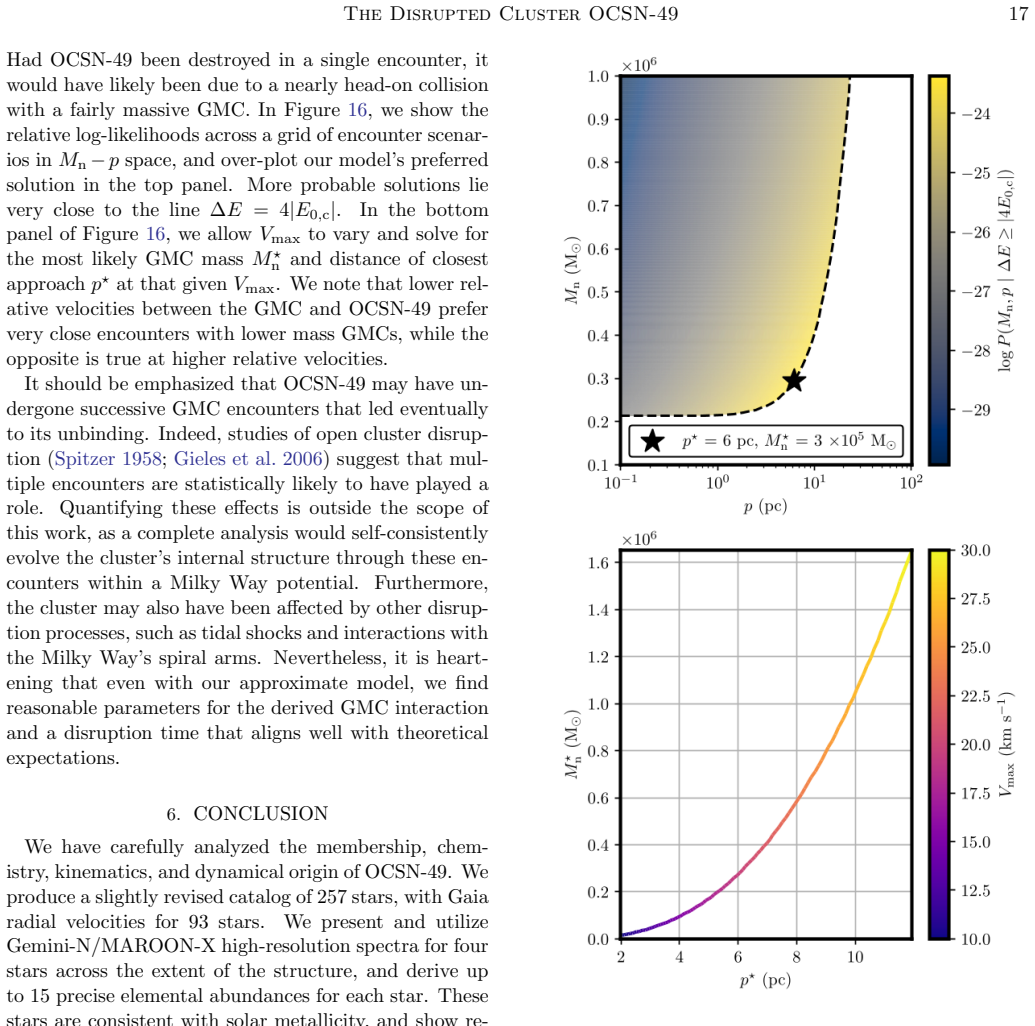
- Under the single-encounter assumption, the preferred culprit is a near head-on collision with a giant molecular cloud of about 10^5 solar masses at a closest approach near 6 pc; multiple weaker encounters remain possible.
- The forward-modeling method can be applied to other comoving streams to reveal hidden disruption events rather than only quiet tidal dispersal.
- The model predicts an extended tail of undiscovered members at low right ascension, so the current 257-member catalog is likely incomplete.
Reading between the lines
- If the disruptive encounter left the stars in an anisotropic or non-Gaussian configuration, the quoted 83 ± 1 Myr could be a biased lower limit; a real GMC shock would plausibly imprint velocity correlations along the stream that the current model cannot represent.
- A dedicated search for a surviving bound core, or for a massive molecular cloud along the stream's past orbit, would distinguish a single catastrophic encounter from gradual tidal stripping.
- Other machine-discovered comoving streams showing the same pattern—a young dynamical age alongside an older stellar age—could turn the GMC disruption rate from a theoretical estimate into a measured population statistic.
- An N-body simulation of the cluster-GMC encounter, matching the present six-dimensional phase space, could recover the encounter direction and impact angle and test the Gaussian assumption directly.
Signed reviews
Editorial analysis
A structured set of objections, weighed in public.
Referee Report
Summary. The paper analyzes OCSN-49, a comoving stellar stream with 257 members, using Gaia astrometry, new high-resolution MAROON-X spectroscopy of four stars, and TESS/ZTF rotation periods for 110 members. It derives a stellar age of roughly 400--600 Myr from isochrone fitting, lithium depletion, and gyrochronology, and a dynamical age of 83 +/- 1 Myr from forward integration of an unbound, isotropic Gaussian model cluster in a smooth Milky Way potential. The authors interpret the discrepancy between these ages as evidence that OCSN-49 was catastrophically disrupted by a giant molecular cloud roughly 500 Myr into its lifetime and claim that OCSN-49 is the first known remnant of such a disrupted open cluster.
Significance. The paper is clearly written and benefits from an unusually rich set of independent age diagnostics: precise multi-element abundances for four members, rotation periods for more than 100 members, isochrone fits across the stream, and a forward-model dynamical age with posterior predictive checks. If the interpretation is correct, OCSN-49 would be a valuable observational benchmark for cluster disruption theories. However, the central claim rests on the assumption that a disruptive encounter leaves the system in the specific unbound, isotropic Gaussian state assumed in the dynamical model. Realistic GMC encounters are expected to produce anisotropic, non-Gaussian, and possibly partially bound remnants, and the paper explicitly defers the decisive N-body test to future work. The stellar-age evidence is solid, but the dynamical-age interpretation is not yet secure enough to support the strong 'first known remnant' claim.
major comments (4)
- [Section 4.2 (Eq. 2, Fig. 13)] The quoted dynamical age t = 83 +/- 1 Myr is the expansion time of a model that starts as an unbound, isotropic Gaussian sphere with R = 7.6 +/- 0.4 pc and sigma_v = 0.20 +/- 0.01 km/s. Because the model family contains no anisotropic states, no non-Gaussian density profiles, and no bound remnant, the fit only demonstrates that some unbound isotropic Gaussian expanding for 83 Myr matches the present-day phase space. A real GMC shock deposits a spatially coherent, direction-dependent impulse; if the true post-encounter state is anisotropic or partially bound, the fitted t is a biased effective expansion time and the claimed discrepancy with the stellar age could be an artifact. The paper's own Section 6 acknowledges that N-body modeling is future work, but that is exactly the test needed to validate the paper's central interpretation. I request either such simulations or a sensitivity analysis with a parameterized anisotropic/non-Gaussian family of initial conditions, showing that t remains near 80 Myr and not, say, several hundred Myr, before the catastrophic-disruption scenario can be supported.
- [Section 4.2 (Fig. 12)] The augmented error kernels (1 deg in position, 0.1 mas in parallax, 0.2 mas/yr in proper motion, 1 km/s in radial velocity) are hand-set and enter the likelihood directly, shaping the posterior and the quoted statistical precision. The formal +/- 1 Myr error is therefore conditional on these choices. The paper should include a sensitivity analysis in which the kernel sizes are varied by, for example, factors of 1.5 and 2, and demonstrate that the inferred t, R, and sigma_v remain stable. Without this, the precision of the dynamical age, and more importantly the existence of the age gap itself, is not robust.
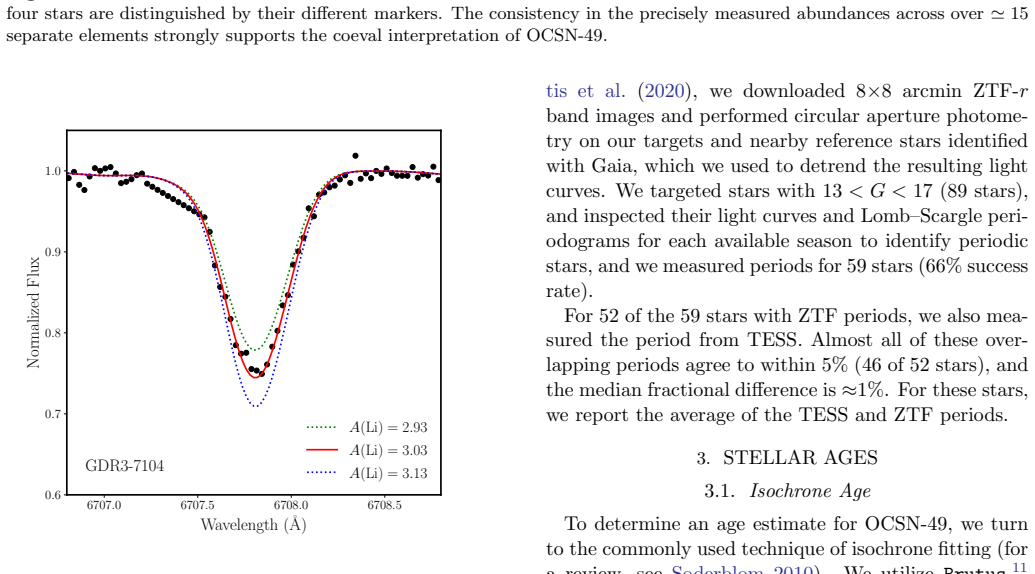
- [Section 3.2 (Table 3, Eq. 1)] The A(Li) values are quoted without uncertainties, and the best-fit lithium abundance is described as determined by eye from synthetic spectra. Since the lithium comparison is one of the three independent stellar-age indicators, the lack of any uncertainty estimate makes the strength of this pillar difficult to assess. The authors should provide at least a conservative uncertainty, for example 0.1 dex motivated by the synthetic spectra shown in Figure 6, and propagate it into the likelihood comparison defined by Equation (1).
- [Section 5.2 (Eqs. 4--6)] The inferred GMC mass and impact parameter (M_n = 3 x 10^5 M_sun, p = 6 pc) are dominated by the assumed priors P(M_n) proportional to M_n^-2 and P(p) proportional to p, together with the fiducial Vmax = 20 km/s. The authors present this as a consistency check, but the manuscript wording, for example 'find that a nearly head-on collision with a fairly massive GMC ... was necessary,' reads as a constraint rather than an illustration. Please clarify in the text that these values are prior-dominated and illustrative, not derived from the phase-space structure of OCSN-49.
minor comments (4)
- [Abstract and Section 4.1 (Fig. 11)] The abstract says the orbits 'converged to a single point,' but Figure 11 shows the mean positions of the northern and southern subgroups approaching within about 10 pc about 130 Myr ago, not converging to a point; please soften the abstract wording to match the actual metric D used in the analysis.
- [Section 2.2.3] The statement that the A(Li) uncertainty is 'significantly smaller than 0.1 dex' based on inspection of Figure 6 should be justified quantitatively or replaced with a conservative adopted value.
- [Figure 12 caption] The phrase 'Error bars are chosen to apply to all stars' could be misunderstood as measurement uncertainties; clarify that these are Gaussian kernel widths used in the likelihood, not the Gaia measurement errors.
- [Section 6] Given the dependence of the dynamical age on the untested initial-condition assumption, the claim that OCSN-49 is 'the first known remnant of a catastrophically disrupted open cluster' should be softened to 'candidate' or accompanied by a clear caveat.
Circularity Check
No significant circularity: stellar ages and dynamical age are independently inferred; the GMC disruption estimate is a consistency check, not an input to the fits.
full rationale
The paper's central result is a discrepancy between two age estimates that are inferred from disjoint datasets. The stellar age (400-600 Myr) comes from MIST isochrone fitting (Section 3.1), lithium abundances compared to benchmark clusters (Section 3.2), and gyrochronology from TESS/ZTF rotation periods (Section 3.3); none of these inputs enters the dynamical model. The dynamical age t = 83 +/- 1 Myr is a free parameter of the forward model in Section 4.2, fit to Gaia astrometry and radial velocities under explicit assumptions (unbound 3D Gaussian, isotropic sigma_v, flat priors). The GMC mass and impact parameter in Section 5.2 are posterior consistency estimates computed from the fitted cluster mass (225 Msun) and the analytic Gieles et al. (2006) energy-injection formula; they are not used to fit or redefine the stellar or dynamical ages. The only self-citation is the methodological transfer from Tregoning et al. (2024); that work was applied to a different cluster (Theia 456) and is described in sufficient detail here, so the cited result does not itself carry the OCSN-49 conclusion. The paper explicitly defers self-consistent N-body modeling of the disruption, which is a limitation on robustness of the inferred encounter scenario, not a circular step. No equation in the paper reduces a predicted quantity to the data used to fit it.
Assumptions & free parameters
free parameters (11)
- Dynamical model age t =
83 ± 1 Myr
- Initial velocity dispersion σv =
0.20 ± 0.01 km/s
- Initial scale R =
7.6 ± 0.4 pc
- Initial orbital actions and angles =
JR = 3.92, Jφ = -2007.4, JZ = 0.15 (kpc km/s); ωR = 2.71, ωφ = 5.34, ωZ = 2.10 (rad)
- Augmented error kernel sizes =
1 deg (position), 0.1 mas (parallax), 0.2 mas/yr (proper motion), 1 km/s (RV)
- Isochrone age =
≈600 Myr
- Outlier fraction (Brutus) =
10%
- GMC encounter relative velocity Vmax =
20 km/s
- GMC mass function and impact parameter priors =
P(Mn) ∝ Mn^-2 and P(p) ∝ p
- Destructive encounter threshold =
ΔE = 4|E0,c|
- Initial cluster mass =
225 M_sun
assumptions (7)
- domain assumption The adopted Milky Way potential (gala MilkyWayPotential) is an accurate representation of the Galaxy for orbit integration.
- ad hoc to paper The progenitor can be modeled as an unbound, isotropic Gaussian sphere of tracer particles with no self-gravity.
- domain assumption The Gieles et al. (2006) analytic formulas for the disruption timescale (Eq. 4) and energy injection (Eq. 5) apply to OCSN-49.
- domain assumption The Chen et al. (2020) GMC mass-size relation Mn = 156.6 (Rn/pc)^1.96 M_sun is applicable to the disrupting cloud.
- domain assumption Gaia is complete for G < 17 and the Hunt & Reffert (2023) member list is representative for the mass estimate.
- domain assumption Benchmark cluster ages used for lithium and gyrochronology comparisons are accurate (Pleiades 125 Myr, M48 420 Myr, Praesepe 700 Myr, Hyades 680 Myr, NGC 3532 400 Myr, NGC 2281 500 Myr).
- domain assumption MIST isochrones and Kurucz model atmospheres are reliable for solar-type dwarf stars.
Cite this review
Pith. "Pith review of Evidence for a Catastrophically Disrupted Open Cluster." pith.science (2026). https://pith.science/paper/LXPDHX5Y
@misc{pith2026250419343,
  author       = {Pith},
  title        = {Pith review of: Evidence for a Catastrophically Disrupted Open Cluster},
  year         = {2026},
  howpublished = {\url{https://pith.science/paper/LXPDHX5Y}},
  note         = {Machine review of arXiv:2504.19343}
}
abstract
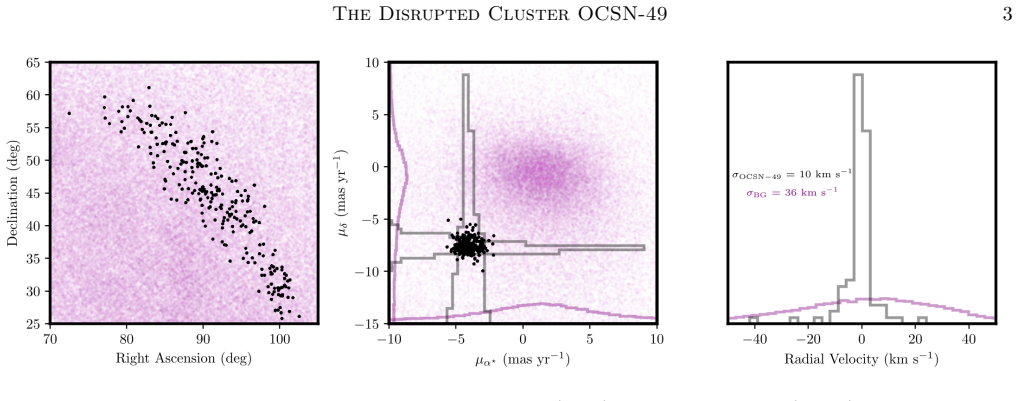
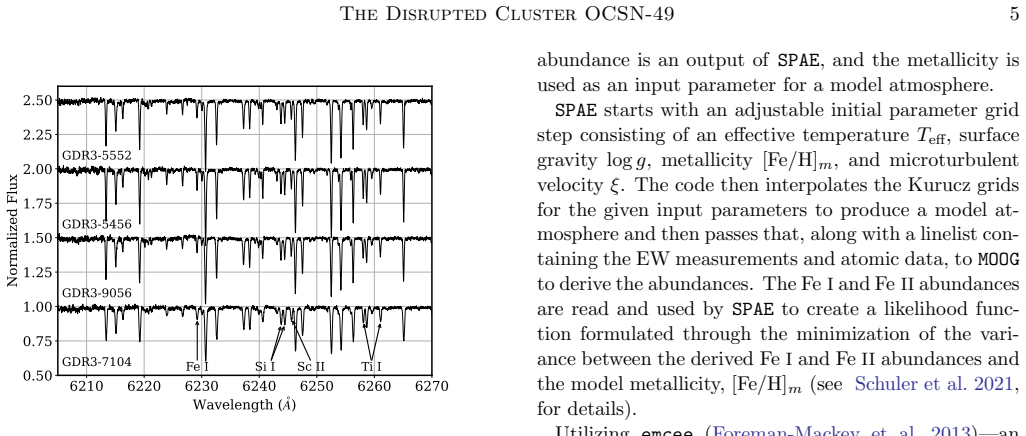
Of the many discoveries uncovered by the Gaia astrometric mission, some of the most exciting are related to nearby dispersed stellar structures. We analyze one such structure in the Milky Way disk, OCSN-49, a coeval stellar stream with 257 identified members spanning approximately 30$^\circ$ across the sky. We obtained high-resolution spectroscopic data for four members that span the stream's extent, finding these four stars to have solar metallicities and remarkably homogeneous chemistry. Through a combination of isochrone fitting, lithium abundance analysis, and gyrochronology, we find a consistent stellar age of 400--600 Myr. Integrating stellar orbits backwards reveals that OCSN-49 converged to a single point at a much younger age. By integrating unbound model stars forward and comparing them to the current phase-space distribution of OCSN-49, we derive a dynamical age of 83$\pm$1 Myr, inconsistent with the age of the stellar population. The discrepancy between the kinematic and stellar age indicators is naturally explained by a disruptive event that unbound OCSN-49 roughly 500 Myr into its lifetime. Based on rate estimates, disruption due to a passing giant molecular cloud (GMC) is the most likely culprit. Assuming a single encounter, we find that a nearly head-on collision with a fairly massive GMC ($\sim$10$^5$ M$_\odot$) was necessary to unbind the cluster, although encounters with multiple GMCs may be responsible. To our knowledge, OCSN-49 serves as the first known remnant of a catastrophically disrupted open cluster and therefore serves as a benchmark for further investigating cluster disruption in the Milky Way.
Figures

Figures from the paper (12 more)



Reference graph
Works this paper leans on
-
[1]
, " * write output.state after.block = add.period write newline
ENTRY address archivePrefix author booktitle chapter doi edition editor eprint howpublished institution journal key month number organization pages publisher school series title misctitle type volume year version url label extra.label sort.label short.list INTEGERS output.state before.all mid.sentence after.sentence after.block FUNCTION init.state.consts ...
-
[2]
write newline
" write newline "" before.all 'output.state := FUNCTION format.url url empty "" new.block "" url * "" * if FUNCTION format.eprint eprint empty "" archivePrefix empty "" archivePrefix "arXiv" = new.block " " eprint * " " * new.block " " eprint * " " * if if if FUNCTION format.doi doi empty "" " " doi * " " * if FUNCTION format.pid doi empty eprint empty ur...
-
[3]
4000 \@twopowertwo=
thebibliography [1] 20pt to REFERENCES 6pt =0pt -12pt 10pt plus 3pt =0pt =0pt =1pt plus 1pt =0pt =0pt -12pt =13pt plus 1pt =20pt =13pt plus 1pt \@M =10000 =-1.0em =0pt =0pt 0pt =0pt =1.0em @enumiv\@empty 10000 10000 `\.\@m \@noitemerr \@latex@warning Empty `thebibliography' environment \@ifnextchar \@reference \@latexerr Missing key on reference command E...
2021
-
[4]
,߯ǁDQ&3r]W;Oϟ :| o`7@3 uxdǀ\ < ȿ مl6. ٛ thLaÌ<hH 87& PVȅr0.[n R \>0 \ ŧ ,PJ& O2Dk
thebibliography [1] 20pt to REFERENCES 6pt =0pt \@twocolumntrue 12pt -12pt 10pt plus 3pt =0pt =0pt =1pt plus 1pt =0pt =0pt -12pt =13pt plus 1pt =20pt =13pt plus 1pt \@M =10000 =-1.0em =0pt =0pt 0pt =0pt =1.0em @enumiv\@empty 10000 10000 `\.\@m \@noitemerr \@latex@warning Empty `thebibliography' environment \@ifnextchar \@reference \@latexerr Missing key o...
arXiv 2017
-
[5]
2025, , 693, A305, 10.1051/0004-6361/202451853
Almeida , D., Moitinho , A., & Moreira , S. 2025, , 693, A305, 10.1051/0004-6361/202451853
-
[6]
Andrews , J. J., Curtis , J. L., Chanam \'e , J., et al. 2022, , 163, 275, 10.3847/1538-3881/ac6952
-
[7]
Bailer-Jones, C. A. L. , Andrae, R. , Arcay, B. , et al. 2013, A&A, 559, A74, 10.1051/0004-6361/201322344
-
[8]
Barnes , S. A. 2003, , 586, 464, 10.1086/367639
doi:10.1086/367639 2003
Show all 107 references
-
[9]
2007, Proceedings of the International Astronomical Union, 3, 32–35, 10.1017/s1743921308015226
Bastian, N. 2007, Proceedings of the International Astronomical Union, 3, 32–35, 10.1017/s1743921308015226
2007 doi
-
[10]
2003, , 340, 227, 10.1046/j.1365-8711.2003.06286.x
Baumgardt , H., & Makino , J. 2003, , 340, 227, 10.1046/j.1365-8711.2003.06286.x
2003
-
[11]
2001, , 377, 462, 10.1051/0004-6361:20011043
Bergond , G., Leon , S., & Guibert , J. 2001, , 377, 462, 10.1051/0004-6361:20011043
2001 doi
-
[12]
F., Matzner , C
Bildsten , L., Brown , E. F., Matzner , C. D., & Ushomirsky , G. 1997, , 482, 442, 10.1086/304151
1997 doi
-
[13]
2018, , 613, A63, 10.1051/0004-6361/201731881
Bouvier , J., Barrado , D., Moraux , E., et al. 2018, , 613, A63, 10.1051/0004-6361/201731881
2018 doi
-
[14]
2015, , 216, 29, 10.1088/0067-0049/216/2/29
Bovy , J. 2015, , 216, 29, 10.1088/0067-0049/216/2/29
2015 doi
-
[15]
E., Phillip , C., Fleming , S
Brasseur , C. E., Phillip , C., Fleming , S. W., Mullally , S. E., & White , R. L. 2019, Astrocut: Tools for creating cutouts of TESS images , Astrophysics Source Code Library, record ascl:1905.007
2019
-
[16]
Campello, R. J. G. B., Moulavi, D., & Sander, J. 2013, in Advances in Knowledge Discovery and Data Mining, ed. J. Pei, V. S. Tseng, L. Cao, H. Motoda, & G. Xu (Berlin, Heidelberg: Springer Berlin Heidelberg), 160--172
2013
-
[17]
2024, , 99, 101696, 10.1016/j.newar.2024.101696
Cantat-Gaudin , T., & Casamiquela , L. 2024, , 99, 101696, 10.1016/j.newar.2024.101696
2024
-
[18]
2019, , 624, A126, 10.1051/0004-6361/201834453
Cantat-Gaudin , T., Krone-Martins , A., Sedaghat , N., et al. 2019, , 624, A126, 10.1051/0004-6361/201834453
2019 doi
-
[19]
2020, , 635, A45, 10.1051/0004-6361/201937386
Castro-Ginard , A., Jordi , C., Luri , X., et al. 2020, , 635, A45, 10.1051/0004-6361/201937386
2020 doi
-
[20]
Q., Li , G
Chen , B. Q., Li , G. X., Yuan , H. B., et al. 2020, , 493, 351, 10.1093/mnras/staa235
2020 doi
- [21]
-
[22]
2016, , 823, 102, 10.3847/0004-637X/823/2/102
Choi , J., Dotter , A., Conroy , C., et al. 2016, , 823, 102, 10.3847/0004-637X/823/2/102
2016 doi
-
[23]
H., et al
Coronado, J., Rix, H.-W., Trick, W. H., et al. 2020, Monthly Notices of the Royal Astronomical Society, 495, 4098, 10.1093/mnras/staa1358
2020 doi
-
[24]
L., Ag \"u eros , M
Curtis , J. L., Ag \"u eros , M. A., Mamajek , E. E., Wright , J. T., & Cummings , J. D. 2019, , 158, 77, 10.3847/1538-3881/ab2899
2019 doi
-
[25]
L., Ag \"u eros , M
Curtis , J. L., Ag \"u eros , M. A., Matt , S. P., et al. 2020, , 904, 140, 10.3847/1538-4357/abbf58
2020 doi
-
[26]
2015, , 449, 1811, 10.1093/mnras/stv395
Dalessandro , E., Miocchi , P., Carraro , G., J \' lkov \'a , L., & Moitinho , A. 2015, , 449, 1811, 10.1093/mnras/stv395
2015 doi
-
[27]
2016, , 222, 8, 10.3847/0067-0049/222/1/8
Dotter , A. 2016, , 222, 8, 10.3847/0067-0049/222/1/8
2016 doi
-
[28]
T., Curtis , J
Douglas , S. T., Curtis , J. L., Ag \"u eros , M. A., et al. 2019, , 879, 100, 10.3847/1538-4357/ab2468
2019 doi
-
[29]
A., Corradi , W
Ferreira , F. A., Corradi , W. J. B., Maia , F. F. S., Angelo , M. S., & Santos , J. F. C., J. 2021, , 502, L90, 10.1093/mnrasl/slab011
2021 doi
- [30]
-
[31]
2016, Journal of Open Source Software, 1, 24, 10.21105/joss.00024
Foreman-Mackey, D. 2016, Journal of Open Source Software, 1, 24, 10.21105/joss.00024
2016 doi
-
[32]
W., Lang, D., & Goodman, J
Foreman-Mackey, D., Hogg, D. W., Lang, D., & Goodman, J. 2013, Publications of the Astronomical Society of the Pacific, 125, 306, 10.1086/670067
2013 doi
-
[33]
, Frémat, Y
Fouesneau, M. , Frémat, Y. , Andrae, R. , et al. 2023, A&A, 674, A28, 10.1051/0004-6361/202243919
2023 doi
-
[34]
2002, , 40, 487, 10.1146/annurev.astro.40.060401.093840
Freeman , K., & Bland-Hawthorn , J. 2002, , 40, 487, 10.1146/annurev.astro.40.060401.093840
2002
-
[35]
J., Barnes , S
Fritzewski , D. J., Barnes , S. A., James , D. J., & Strassmeier , K. G. 2021, , 652, A60, 10.1051/0004-6361/202140894
2021 doi
-
[36]
J., Barnes , S
Fritzewski , D. J., Barnes , S. A., Weingrill , J., et al. 2023, , 674, A152, 10.1051/0004-6361/202346083
2023 doi
-
[37]
Gaia Collaboration , Vallenari , A., Brown , A. G. A., et al. 2023, , 674, A1, 10.1051/0004-6361/202243940
2023 doi
-
[38]
Galli , P. A. B., Miret-Roig , N., Bouy , H., Olivares , J., & Barrado , D. 2023, , 520, 6245, 10.1093/mnras/stad520
2023 doi
-
[39]
Gieles , M., Athanassoula , E., & Portegies Zwart , S. F. 2007, , 376, 809, 10.1111/j.1365-2966.2007.11477.x
2007
-
[41]
M., Brasseur , C
Ginsburg , A., Sip o cz , B. M., Brasseur , C. E., et al. 2019, , 157, 98, 10.3847/1538-3881/aafc33
2019 doi
-
[42]
P., & Bastian, N
Goodwin, S. P., & Bastian, N. 2006, Monthly Notices of the Royal Astronomical Society, 373, 752–758, 10.1111/j.1365-2966.2006.11078.x
2006
-
[43]
2018, , 863, 67, 10.3847/1538-4357/aad0a0
Gossage , S., Conroy , C., Dotter , A., et al. 2018, , 863, 67, 10.3847/1538-4357/aad0a0
2018 doi
-
[44]
R., Millman, K
Harris, C. R., Millman, K. J., van der Walt, S. J., et al. 2020, Nature, 585, 357–362, 10.1038/s41586-020-2649-2
2020 doi
-
[45]
W., et al
Hattori , S., Foreman-Mackey , D., Hogg , D. W., et al. 2022, , 163, 284, 10.3847/1538-3881/ac625a
2022 doi
-
[46]
2020, Annual Review of Astronomy and Astrophysics, 58, 205, https://doi.org/10.1146/annurev-astro-032620-021917
Helmi, A. 2020, Annual Review of Astronomy and Astrophysics, 58, 205, https://doi.org/10.1146/annurev-astro-032620-021917
2020 doi
-
[47]
L., & Reffert , S
Hunt , E. L., & Reffert , S. 2023, , 673, A114, 10.1051/0004-6361/202346285
2023 doi
-
[48]
Hunter, J. D. 2007, Computing in Science & Engineering, 9, 90, 10.1109/MCSE.2007.55
2007 doi
-
[49]
R., & Lindegren , L
J rgensen , B. R., & Lindegren , L. 2005, , 436, 127, 10.1051/0004-6361:20042185
2005 doi
-
[50]
2019, , 884, 173, 10.3847/1538-4357/ab44be
Kamdar , H., Conroy , C., Ting , Y.-S., et al. 2019, , 884, 173, 10.3847/1538-4357/ab44be
2019 doi
-
[51]
Kawaler , S. D. 1989, , 343, L65, 10.1086/185512
1989 doi
-
[52]
R., Deliyannis , C
King , J. R., Deliyannis , C. P., Hiltgen , D. D., et al. 1997, , 113, 1871, 10.1086/118399
1997 doi
-
[53]
Kokaia , G., & Davies , M. B. 2019, , 489, 5165, 10.1093/mnras/stz813
2019 doi
-
[54]
E., Belokurov , V., & Torrealba , G
Koposov , S. E., Belokurov , V., & Torrealba , G. 2017, , 470, 2702, 10.1093/mnras/stx1182
2017 doi
-
[55]
2019, , 158, 122, 10.3847/1538-3881/ab339a
Kounkel , M., & Covey , K. 2019, , 158, 122, 10.3847/1538-3881/ab339a
2019 doi
-
[56]
2001, Monthly Notices of the Royal Astronomical Society, 322, 231, 10.1046/j.1365-8711.2001.04022.x
Kroupa, P. 2001, Monthly Notices of the Royal Astronomical Society, 322, 231, 10.1046/j.1365-8711.2001.04022.x
2001
-
[57]
Kurucz, R. L. 2011, Canadian Journal of Physics, 89, 417, 10.1139/p10-104
2011 doi
- [58]
-
[59]
J., & Lada, E
Lada, C. J., & Lada, E. A. 2003, Annual Review of Astronomy and Astrophysics, 41, 57, https://doi.org/10.1146/annurev.astro.41.011802.094844
2003 arXiv
-
[60]
Lamers , H. J. G. L. M., & Gieles , M. 2006, , 455, L17, 10.1051/0004-6361:20065567
2006 doi
-
[61]
Lamers , H. J. G. L. M., Gieles , M., & Portegies Zwart , S. F. 2005, , 429, 173, 10.1051/0004-6361:20041476
2005 doi
-
[62]
Landsman , W. B. 1993, in Astronomical Society of the Pacific Conference Series, Vol. 52, Astronomical Data Analysis Software and Systems II, ed. R. J. Hanisch , R. J. V. Brissenden , & J. Barnes , 246
1993
-
[63]
Larsen , S. S. 2004, , 416, 537, 10.1051/0004-6361:20034533
2004 doi
-
[64]
Larson , R. B. 1981, , 194, 809, 10.1093/mnras/194.4.809
1981 doi
-
[65]
Lombardi , M., Alves , J., & Lada , C. J. 2010, , 519, L7, 10.1051/0004-6361/201015282
2010 doi
-
[66]
J., Laher, R
Masci, F. J., Laher, R. R., Rusholme, B., et al. 2018, , 131, 018003, 10.1088/1538-3873/aae8ac
2018 doi
-
[67]
2017, Journal of Open Source Software, 2, 205, 10.21105/joss.00205
McInnes, L., Healy, J., & Astels, S. 2017, Journal of Open Source Software, 2, 205, 10.21105/joss.00205
2017 doi
-
[68]
2019, , 622, L13, 10.1051/0004-6361/201834950
Meingast , S., Alves , J., & F \"u rnkranz , V. 2019, , 622, L13, 10.1051/0004-6361/201834950
2019 doi
-
[69]
Mok , A., Chandar , R., & Fall , S. M. 2020, , 893, 135, 10.3847/1538-4357/ab7a14
2020 doi
-
[70]
2025, , 694, A70, 10.1051/0004-6361/202450369
Moreira , S., Moitinho , A., Silva , A., & Almeida , D. 2025, , 694, A70, 10.1051/0004-6361/202450369
2025 doi
-
[71]
Oort , J. H. 1958, Ricerche Astronomiche, 5, 507
1958
-
[72]
2024, pandas-dev/pandas: Pandas, v2.2.2, Zenodo, 10.5281/zenodo.10957263
pandas development team, T. 2024, pandas-dev/pandas: Pandas, v2.2.2, Zenodo, 10.5281/zenodo.10957263
2024 doi
-
[73]
E., Kharchenko , N
Piskunov , A. E., Kharchenko , N. V., R \"o ser , S., Schilbach , E., & Scholz , R. D. 2006, , 445, 545, 10.1051/0004-6361:20053764
2006 doi
-
[74]
H., & Rybicki, G
Press, W. H., & Rybicki, G. B. 1989, Astrophysical Journal, 338, 277, 10.1086/167197
1989 doi
-
[75]
Price-Whelan, A. M. 2017, Journal of Open Source Software, 2, 388, 10.21105/joss.00388
2017 doi
-
[76]
M., Sip o cz , B
Price-Whelan , A. M., Sip o cz , B. M., G \"u nther , H. M., et al. 2018, , 156, 123, 10.3847/1538-3881/aabc4f
2018 doi
-
[77]
2023, , 265, 12, 10.3847/1538-4365/acadd6
Qin , S., Zhong , J., Tang , T., & Chen , L. 2023, , 265, 12, 10.3847/1538-4365/acadd6
2023 doi
-
[78]
A., Curtis , J
Rampalli , R., Ag \"u eros , M. A., Curtis , J. L., et al. 2021, , 921, 167, 10.3847/1538-4357/ac0c1e
2021 doi
- [79]
-
[80]
S., Goodman , A
Rice , T. S., Goodman , A. A., Bergin , E. A., Beaumont , C., & Dame , T. M. 2016, , 822, 52, 10.3847/0004-637X/822/1/52
2016 doi
-
[81]
R., Winn , J
Ricker , G. R., Winn , J. N., Vanderspek , R., et al. 2015, J. Astron. Telesc. Instrum. Syst., 1, 014003, 10.1117/1.JATIS.1.1.014003
2015 doi
-
[82]
C., Andrews , J
Schuler , S. C., Andrews , J. J., Clanzy , V. R., et al. 2021, , 162, 109, 10.3847/1538-3881/ac10c6
2021 doi
-
[83]
C., Flateau , D., Cunha , K., et al
Schuler , S. C., Flateau , D., Cunha , K., et al. 2011, , 732, 55, 10.1088/0004-637X/732/1/55
2011 doi
-
[84]
L., St \"u rmer , J., et al
Seifahrt , A., Bean , J. L., St \"u rmer , J., et al. 2016, in Society of Photo-Optical Instrumentation Engineers (SPIE) Conference Series, Vol. 9908, Ground-based and Airborne Instrumentation for Astronomy VI, ed. C. J. Evans , L. Simard , & H. Takami , 990818, 10.1117/12.2232069
2016 doi
-
[85]
L., & Schwab , C
Seifahrt , A., St \"u rmer , J., Bean , J. L., & Schwab , C. 2018, in Society of Photo-Optical Instrumentation Engineers (SPIE) Conference Series, Vol. 10702, Ground-based and Airborne Instrumentation for Astronomy VII, ed. C. J. Evans , L. Simard , & H. Takami , 107026D, 10.1...
2018 doi
-
[86]
L., St \"u rmer , J., et al
Seifahrt , A., Bean , J. L., St \"u rmer , J., et al. 2020, in Society of Photo-Optical Instrumentation Engineers (SPIE) Conference Series, Vol. 11447, Ground-based and Airborne Instrumentation for Astronomy VIII, ed. C. J. Evans , J. J. Bryant , & K. Motohara , 114471F, 10.11...
2020 doi
- [87]
- [88]
-
[89]
Soderblom, D. R. 2010, Annual Review of Astronomy and Astrophysics, 48, 581, https://doi.org/10.1146/annurev-astro-081309-130806
2010 doi
-
[90]
R., Jones , B
Soderblom , D. R., Jones , B. F., Balachandran , S., et al. 1993, , 106, 1059, 10.1086/116704
1993 doi
-
[91]
M., Rivolo , A
Solomon , P. M., Rivolo , A. R., Barrett , J., & Yahil , A. 1987, , 319, 730, 10.1086/165493
1987 doi
- [92]
-
[93]
Stark , A. A. 1984, , 281, 624, 10.1086/162137
1984 doi
-
[94]
P., Steinhauer , A., Anthony-Twarog , B
Sun , Q., Deliyannis , C. P., Steinhauer , A., Anthony-Twarog , B. J., & Twarog , B. A. 2023, , 952, 71, 10.3847/1538-4357/acc5e3
2023 doi
-
[95]
P., Twarog , B
Sun , Q., Deliyannis , C. P., Twarog , B. A., et al. 2022, , 513, 5387, 10.1093/mnras/stac1251
2022 doi
-
[96]
2019, , 877, 12, 10.3847/1538-4357/ab13b0
Tang , S.-Y., Pang , X., Yuan , Z., et al. 2019, , 877, 12, 10.3847/1538-4357/ab13b0
2019 doi
-
[97]
2015, , 807, 104, 10.1088/0004-637X/807/1/104
Ting , Y.-S., Conroy , C., & Goodman , A. 2015, , 807, 104, 10.1088/0004-637X/807/1/104
2015 doi
-
[98]
R., Andrews, J
Tregoning, K. R., Andrews, J. J., Agüeros, M. A., et al. 2024, Theia 456: Tidally Shredding an Open Cluster. 2405.13133
2024 arXiv
-
[99]
2010, , 708, 1598, 10.1088/0004-637X/708/2/1598
Trenti , M., Vesperini , E., & Pasquato , M. 2010, , 708, 1598, 10.1088/0004-637X/708/2/1598
2010 doi
-
[100]
2022, Gaia DR3 documentation , Gaia DR3 documentation, European Space Agency; Gaia Data Processing and Analysis Consortium
van Leeuwen , F., de Bruijne , J., Babusiaux , C., et al. 2022, Gaia DR3 documentation , Gaia DR3 documentation, European Space Agency; Gaia Data Processing and Analysis Consortium. Online at https://gea.esac.esa.int/archive/documentation/GDR3/index.html
2022
-
[101]
C., & Stassun , K
Vejar , G., Schuler , S. C., & Stassun , K. G. 2021, , 919, 100, 10.3847/1538-4357/ac10c3
2021 doi
-
[102]
E., et al
Virtanen, P., Gommers, R., Oliphant, T. E., et al. 2020, Nature Methods, 17, 261, 10.1038/s41592-019-0686-2
2020 doi
-
[103]
D., Farr , W
Vousden , W. D., Farr , W. M., & Mandel , I. 2016, , 455, 1919, 10.1093/mnras/stv2422
2016 doi
-
[104]
2000, , 540, 797, 10.1086/309347
Wada , K., Spaans , M., & Kim , S. 2000, , 540, 797, 10.1086/309347
2000 doi
-
[105]
Waskom, M. L. 2021, Journal of Open Source Software, 6, 3021, 10.21105/joss.03021
2021 doi
-
[106]
1971, , 13, 309
Wielen , R. 1971, , 13, 309
1971
-
[107]
1985, in IAU Symposium, Vol
Wielen , R. 1985, in IAU Symposium, Vol. 113, Dynamics of Star Clusters, ed. J. Goodman & P. Hut , 449--460
1985
- [108]
Reviewed August 16, 2026 · model on record in the stance chip above.
Discussion (0). Continue with ORCID to comment.