REVIEW 3 major objections 6 minor 64 references
Gridless Parameter Estimation for One-Bit MIMO Radar with Time-Varying Thresholds
T0 review · 3 major / 6 minor · reviewed 2026-08-14 · deepseek-v4-flash
Pith's one-line read The paper claims one-bit MIMO radar can jointly estimate target angles and Doppler frequencies off the grid, with mean-squared errors down to 10^-9 in simulations while storing about 3% of the data of a 16-bit system.
desk verdict Solid engineering with a genuine new formulation and careful CRB analysis, but the central sparse-perturbation argument fails exactly in the RGT regime where the paper's best numbers are produced. read the letter →
The pith
A machine-rendered reading of the paper's core claim, the machinery that carries it, and where it could break.
The reading
What carries the argument
The load-bearing mechanism is the 1b-ANM-L1 formulation (problem (19)), which pairs the atomic norm of the two-dimensional sinusoidal data matrix with $\ell^1$ regularization on the perturbation vectors $p_q$. The atomic norm is the trace-minimization surrogate for the sparsest decomposition of $X$ into atoms $w(\phi_1) v^H(\phi_2)$, realized through a positive-semidefinite block matrix $[T(u_1) \, X; \, X^H \, T(u_2)] \succeq 0$; the $\ell^1$ term is justified by Theorem 1, which says a sparse $p_q$ exists whenever the noisy signed data are consistent with some signal. The same machinery also produces the parameter estimates: the Toeplitz factors $T(u_1)$ and $T(u_2)$ carry the angle and Doppler frequencies, and their Vandermonde decompositions yield the gridless angle-Doppler pairs.
What would settle it
Simulate the paper's 1b-MIMO setup at, say, SNR = -20 dB with a time-varying threshold whose mean equals the true signal level, so many samples sit near the comparator, and count how often entries of the perturbation $p_q$ from Theorem 1 are nonzero. If that fraction is high, above roughly 40-50%, at the same time that the 1b-ANM-L1 mean-squared error stops tracking the derived Cramér-Rao bound as the sample length $L$ grows, then the sparse-perturbation premise is what breaks.
Extended reading notes
Core claim
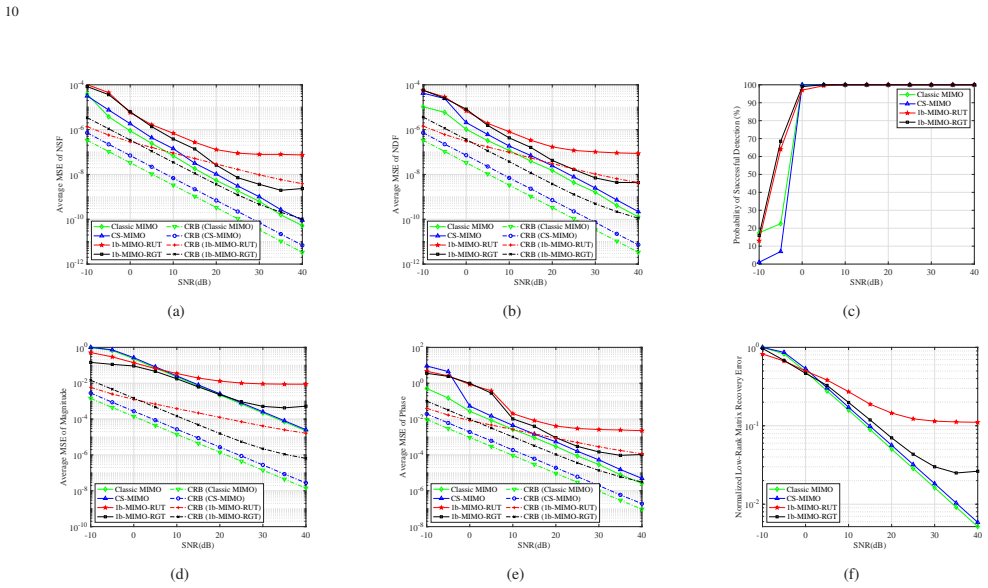
At the center of the paper is the claim that a one-bit MIMO radar, where each receive antenna keeps only the sign of the real and imaginary parts of the received waveform relative to a known, time-varying threshold, can estimate target angles and Doppler frequencies without any discretization grid. The enabling observation is Theorem 1: for each transmitted pulse, the effect of the unknown noise on the sign measurements can be replaced by a perturbation vector $p_q$ with no more nonzero entries than the noise itself, so the one-bit consistency constraint can always be met. This leads to the 1b-ANM-L1 program (problem (19)): minimize the trace of two Toeplitz matrices, the atomic norm of the low-rank data matrix $X = \sum_{k=1}^K \beta_k c(\theta_k) d^H(\nu_k)$, plus an $\ell^1$ penalty on the perturbing vectors, subject to a positive-semidefinite block-Toeplitz constraint and the sign constraints. Angle and Doppler frequencies are then obtained by Vandermonde decomposition of the two Toeplitz factors. The paper also shows that the Fisher information matrix of the one-bit data is a weighted version of the unquantized Fisher information, with weights bounded by $2/\pi$, and reports simulations in which the one-bit radar approaches the accuracy of 16-bit systems at low SNR and reaches $10^{-9}$ normalized-frequency errors at high SNR.
Load-bearing premise
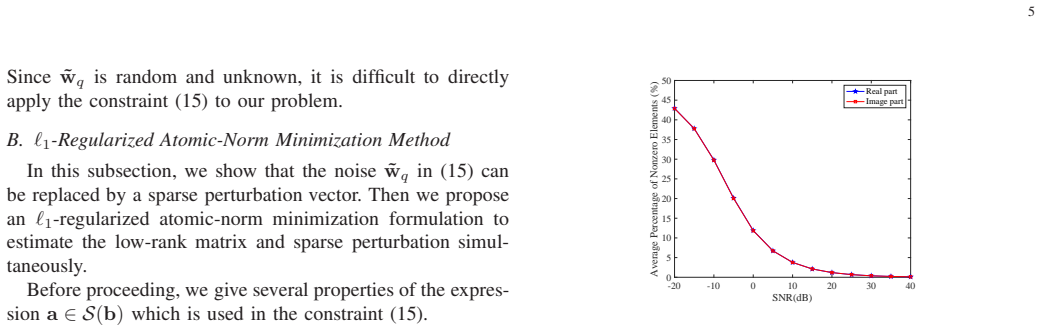
The whole method rests on the premise that the perturbation $p_q$ that repairs the one-bit sign flips is sparse; the paper proves only that $p_q$ is no denser than the noise, and the actual sparsity is observed empirically, so if sign flips become dense, for instance a threshold centered on the signal at low SNR, the $\ell^1$ penalty stops matching the noise and the estimator loses its justification.
Editorial extensions
If this is right
- A MIMO radar can be built around one-bit comparators and still resolve targets: in the paper's configuration it stores only about 3% of the data of a classic 16-bit MIMO radar while keeping angle-Doppler estimates accurate.
- In the low-SNR regime the one-bit radar matches or beats its 16-bit counterparts in probability of successful detection; the high-SNR gap is narrowed by using random Gaussian thresholds that center on the signal.
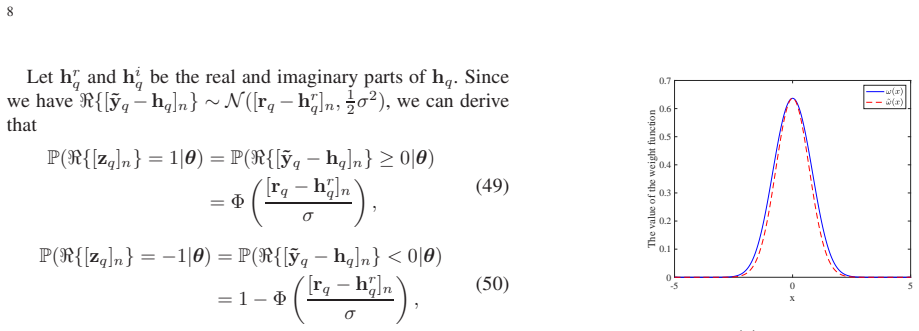
- The Cramér-Rao bound analysis implies a constant information loss from one-bit sampling: the one-bit Fisher information matrix is at most $2/\pi$ times the unquantized one, so roughly 2 dB of information is gone regardless of the threshold choice.
- Increasing the temporal sampling rate $L$ is a practical lever for the one-bit radar: the simulations show its MSE falls steadily as $L$ grows even though the bit budget stays far below the high-bit rivals, because one-bit ADCs are cheap at high rates.
- The ADMM-based solver keeps the 1b-ANM-L1 program tractable as the array and CPI dimensions grow, where a generic interior-point solver becomes slow or runs out of memory.
Reading between the lines
- The paper does not explore this, but the sparse-perturbation equivalence suggests the same 1b-ANM-L1 template transfers to any one-bit low-rank recovery problem, such as massive MIMO channel estimation or passive radar, wherever the matrix to recover is a sum of a few 2D sinusoids.
- The random-Gaussian-threshold results imply an adaptive-threshold design that the paper only sketches: use a first coarse one-bit pass to center later thresholds on the signal, then shrink the threshold variance as the estimate improves; the paper fixes the variance at five times the noise variance rather than optimizing it.
- A testable extension would be to replace the fixed $\ell^1$ penalty with a weighted or reweighted $\ell^1$ scheme that exploits knowledge of where sign flips are more likely, near threshold crossings, potentially improving low-SNR performance beyond the reported results.
- Because the CRB weight function $\omega(x)$ is largest when the threshold sits exactly on the signal, threshold placement and signal distribution interact; one could design time-varying thresholds to match the expected signal histogram and approach the $2/\pi$ Fisher-information cap more closely.
Signed reviews
Editorial analysis
A structured set of objections, weighed in public.
Referee Report
Summary. The paper studies a one-bit MIMO radar (1b-MIMO) that combines temporal one-bit sampling with time-varying thresholds, random antenna selection (SAA) in the spatial domain, and reduced time-on-target (RTT) in the Doppler domain. The observation model is given by (5)-(9), and the goal is to estimate K angle-Doppler pairs from sign measurements. The authors prove an atomic-norm/rank equivalence (Appendix A), introduce a perturbation vector p_q, and, based on the claimed sparsity of p_q, formulate the convex 1b-ANM-L1 problem (19). They derive an ADMM algorithm with closed-form updates (34)-(40), compute the CRB for one-bit data as a weighted version of the unquantized FIM (Section VI), and compare random uniform thresholds (RUT) with random Gaussian thresholds (RGT). Numerical experiments show that, after successful detection, the 1b-MIMO radar can achieve MSEs as low as 10^-7 to 10^-9 for normalized spatial and Doppler frequencies at high SNR, with a data volume about 3% of a classic 16-bit MIMO radar.
Significance. If the central claims hold, the paper provides a practical architecture and algorithm for reducing ADC cost, energy, and data volume in MIMO radar while retaining high-resolution angle-Doppler estimation. The strength of the manuscript is its explicit convex formulation, the closed-form ADMM updates (34)-(40), and the CRB analysis (51)-(54) that correctly exhibits the weighted-FIM structure known from [24]; Appendix A gives a proof of the atomic-norm/rank equivalence used in (12). The numerical study is broad, covering SNR sweeps, threshold bit depth, number of samples, number of targets, and runtime comparisons with CVX solvers. The main weakness is that the theoretical justification of the sparse perturbation is not established for the RGT strategy that underlies several of the headline results, so the current version is better viewed as a heuristic validated by simulation than as a fully guaranteed estimator.
major comments (3)
- [Section IV.B, Fig. 1, Eq. (19)] The sparse-perturbation justification for the ℓ1 term in (19) is not valid for the random Gaussian threshold (RGT) strategy that yields the best results in Figs. 3 and 6. In the RGT simulation, the threshold mean equals the signal and σ_r² = σ_i² = 5σ², so d_n = ([r_q]_n - [h_q^r]_n)/σ ∼ N(0,5) independently of SNR, while the real-part noise has variance 1/2 on the same scale. Consequently P(sign(d_n + w_n) ≠ sign(d_n)) is an SNR-independent constant (about 0.10 per real component, hence about 0.19 per complex sample), and the expected support of the perturbation p_q constructed in Theorem 1 does not tend to zero as SNR→∞. Theorem 1 only establishes existence with ‖p_q‖₀ ≤ ‖w_q‖₀, which is trivial for dense Gaussian noise; the actual sparsity of p_q is therefore an additional empirical assumption, and Figure 1 does not document the threshold strategy used. Since no recovery guarantee is supplied for (19) even under genuine sparsity, the theoretical bridge is weakest exactly in the high-SNR RGT regime where the paper reports MSEs of 10⁻⁷ to 10⁻⁹. Please prove a sign-flip sparsity bound for RGT, restrict the sparse-perturbation claim to strategies such as RUT where flips vanish asymptotically, or explicitly reposition (19) as a heuristic and add experiments showing robustness to roughly 10-20% randomized sign flips.
- [Section VII.A and footnote 1] The RGT implementation uses threshold means equal to estimates of r_q and i_q provided by the RUT-based 1b-MIMO algorithm on the same data. As the footnote acknowledges, this demonstrates the best achievable performance of RGT rather than a standalone implementable strategy. The conclusion that the RGT strategy can improve performance in the high SNR regime by utilizing a priori information should be qualified accordingly, and the sensitivity of the RGT curves to the quality of the prior estimates should be quantified, for example by using only a fraction of the data or a lower-fidelity prior.
- [Section VII.B, Fig. 3] The MSE curves are averaged only over trials in which detection is successful, while the CRB curves are unconditional lower bounds. A conditional MSE can fall below the unconditional CRB, so the closeness of the MSE and CRB curves in Fig. 3 may be partly an artifact of the conditioning. Please either compute the CRB under the same conditioning, report unconditional MSE as well, or state explicitly that the CRB overlay is only indicative.
minor comments (6)
- [Section III, after Eq. (5)] The phrase 'during the the q-th pulse' contains a duplicated 'the'.
- [Section II] The quantities a(θ) and b(θ) are vectors, not matrices; the text should say 'steering vectors' rather than 'steering matrices'.
- [Section V, Algorithm 1] Algorithm 1 updates X, then u1 and u2, then p and b, whereas Eqs. (23)-(26) present a joint X, P update followed by b and H; please state that the algorithm is a Gauss-Seidel variant of (23)-(26).
- [Section VI.C] The bound I(θ) ≼ (2/π) Ĩ(θ) is stated without proof; a one-line argument that the weight function ω(x) is bounded above by 2/π would make the section self-contained.
- [Appendix A] The step from (A9) to the conclusion 'K = K*' is terse; a sentence justifying that the matrices Z1 and Z2 can be chosen with the stated factorization would help the reader.
- [Fig. 1] Figure 1 should state the threshold strategy and all simulation parameters; as written, the empirical sparsity claim used to motivate (19) cannot be reproduced or checked.
Circularity Check
No significant circularity: the atomic-norm/rank equivalence is proven in-house, the CRB uses an independent standard result, and the noise-to-sparse-perturbation step is a constructive theorem plus an empirical sparsity observation.
full rationale
The derivation chain is self-contained and externally anchored. The rank/atomic-norm equivalence (12) is not assumed from a self-citation: although [57] is cited, Appendix A supplies the full Vandermonde-decomposition proof, so the cited prior work is not load-bearing. The one-bit FIM formula (52)-(53) is imported from [24], an independent source, and is then used only to compute threshold-averaged weights with the stated approximation w_tilde(x) = (2/pi) exp(-x^2); no parameter is fitted to the reported CRB curves. The core claim that noise acts as a sparse perturbation is Theorem 1, an exact constructive statement (||p_q||_0 <= ||w_q||_0); the additional sparsity needed for the l1 term is an empirical observation (Fig. 1) about the noise model, not an input that already contains the estimation result. The RGT strategy used for the best numerical results is transparently an oracle-style benchmark: the footnote 'Here is to show the best achievable performance of the RGT strategy' discloses that the threshold mean uses RUT-based estimates of r_q and i_q. This is a benchmarking limitation, and the skeptic's point that RGT sign flips are not SNR-sparse is a correctness risk, but it is not circularity: the final angle/Doppler estimates are produced by a new optimization problem (19), not read out from the RUT estimates. Hence no step reduces by construction to its own input.
Assumptions & free parameters
free parameters (4)
- regularization parameter λ =
50
- ADMM penalty parameter ρ =
0.5
- data fidelity weight μ =
2/(1+e^{-0.25*SNR})
- RGT threshold variance scaling κ =
5
assumptions (5)
- standard math Vandermonde decomposition of positive semidefinite Toeplitz matrices (Lemma A1)
- ad hoc to paper Sparsity of the perturbation vector p_q in (18) at operational SNR
- domain assumption i.i.d. complex Gaussian noise with known variance σ²
- domain assumption Ideal orthogonality of transmitted waveforms, S S^H = I_M
- domain assumption Stop-and-hop point-target model with all targets in the same range bin
Cite this review
Pith. "Pith review of Gridless Parameter Estimation for One-Bit MIMO Radar with Time-Varying Thresholds." pith.science (2026). https://pith.science/paper/LXWEWFE5
@misc{pith2026190810487,
  author       = {Pith},
  title        = {Pith review of: Gridless Parameter Estimation for One-Bit MIMO Radar with Time-Varying Thresholds},
  year         = {2026},
  howpublished = {\url{https://pith.science/paper/LXWEWFE5}},
  note         = {Machine review of arXiv:1908.10487}
}
abstract
We investigate the one-bit MIMO (1b-MIMO) radar that performs one-bit sampling with a time-varying threshold in the temporal domain and employs compressive sensing in the spatial and Doppler domains. The goals are to significantly reduce the hardware cost, energy consumption, and amount of stored data. The joint angle and Doppler frequency estimations from noisy one-bit data are studied. By showing that the effect of noise on one-bit sampling is equivalent to that of sparse impulsive perturbations, we formulate the one-bit $\ell_1$-regularized atomic-norm minimization (1b-ANM-L1) problem to achieve gridless parameter estimation with high accuracy. We also develop an iterative method for solving the 1b-ANM-L1 problem via the alternating direction method of multipliers. The Cram$\acute{\text{e}}$r-Rao bound (CRB) of the 1b-MIMO radar is analyzed, and the analytical performance of one-bit sampling with two different threshold strategies is discussed. Numerical experiments are presented to show that the 1b-MIMO radar can achieve high-resolution parameter estimation with a largely reduced amount of data.
Figures
Figures from the paper (4 more)


Reference graph
Works this paper leans on
-
[24]
Quantized spectral compressed sens- ing: CramerRao bounds and recovery algorithms,
H. Fu and Y . Chi, “Quantized spectral compressed sens- ing: CramerRao bounds and recovery algorithms,” IEEE Transactions on Signal Processing , vol. 66, no. 12, pp. 3268–3279, June 2018
work page 2018
-
[1]
MIMO radar: an idea whose time has come,
E. Fishler, A. Haimovich, R. Blum, D. Chizhik, L. Ci- mini, and R. V alenzuela, “MIMO radar: an idea whose time has come,” in Proceedings of the 2004 IEEE Radar Conference, April 2004, pp. 71–78
work page 2004
-
[2]
MIMO radar with colocated anten- nas,
J. Li and P . Stoica, “MIMO radar with colocated anten- nas,” IEEE Signal Processing Magazine , vol. 24, no. 5, pp. 106–114, Sept 2007
work page 2007
-
[3]
MIMO radar with widely separated antennas,
A. M. Haimovich, R. S. Blum, and L. J. Cimini, “MIMO radar with widely separated antennas,” IEEE Signal Pro- cessing Magazine, vol. 25, no. 1, pp. 116–129, Jan 2008
work page 2008
-
[4]
Xampling: Analog to digital at sub-Nyquist rates,
M. Mishali, Y . C. Eldar, O. Dounaevsky, and E. Shoshan, “Xampling: Analog to digital at sub-Nyquist rates,” IET Circuits, Devices Systems, vol. 5, no. 1, pp. 8–20, January 2011
work page 2011
-
[5]
Practical compressed sensing: modern data acquisition and signal processing,
S. Becker, “Practical compressed sensing: modern data acquisition and signal processing,” Ph.D. dissertation, California Institute of Technology, 2011
work page 2011
-
[6]
Quadrature compressive sampling for radar signals,
F. Xi, S. Chen, and Z. Liu, “Quadrature compressive sampling for radar signals,” IEEE Trans. Signal Process., vol. 62, no. 11, pp. 2787–2802, June 2014
work page 2014
-
[7]
Sub-Nyquist radar via Doppler focusing,
O. Bar-Ilan and Y . C. Eldar, “Sub-Nyquist radar via Doppler focusing,” IEEE Trans. Signal Process. , vol. 62, no. 7, pp. 1796–1811, April 2014
work page 2014
Show all 64 references
-
[8]
A compressed sensing parameter extraction platform for radar pulse sig- nal acquisition,
J. Y oo, C. Turnes, E. B. Nakamura, C. K. Le, S. Becker, E. A. Sovero, M. B. Wakin, M. C. Grant, J. Romberg, A. Emami-Neyestanak, and E. Candes, “A compressed sensing parameter extraction platform for radar pulse sig- nal acquisition,” IEEE Journal on Emerging and Selected T o...
2012
-
[9]
Pulse- Doppler signal processing with quadrature compressive sampling,
C. Liu, F. Xi, S. Chen, Y . D. Zhang, and Z. Liu, “Pulse- Doppler signal processing with quadrature compressive sampling,” IEEE Trans. Aerosp. Electron. Syst. , vol. 51, no. 2, pp. 1217–1230, April 2015
2015
-
[10]
MIMO radar using compressive sampling,
Y . Y u, A. P . Petropulu, and H. V . Poor, “MIMO radar using compressive sampling,” IEEE Journal of Selected T opics in Signal Processing , vol. 4, no. 1, pp. 146–163, Feb 2010
2010
-
[11]
MIMO-MC radar: A mimo radar approach based on matrix comple- tion,
S. Sun, W . U. Bajwa, and A. P . Petropulu, “MIMO-MC radar: A mimo radar approach based on matrix comple- tion,” IEEE Transactions on Aerospace and Electronic Systems, vol. 51, no. 3, pp. 1839–1852, July 2015
2015
-
[12]
Spatial compressive sensing for MIMO radar,
M. Rossi, A. M. Haimovich, and Y . C. Eldar, “Spatial compressive sensing for MIMO radar,” IEEE Transac- tions on Signal Processing , vol. 62, no. 2, pp. 419–430, Jan 2014
2014
-
[13]
SUMMeR: Sub-Nyquist MIMO Radar,
D. Cohen, D. Cohen, Y . C. Eldar, and A. M. Haimovich, “SUMMeR: Sub-Nyquist MIMO Radar,” IEEE Transac- tions on Signal Processing , vol. 66, no. 16, pp. 4315– 4330, 2018
2018
-
[14]
Reduced time-on-target in pulse doppler radar: Slow time domain compressed sensing,
D. Cohen and Y . C. Eldar, “Reduced time-on-target in pulse doppler radar: Slow time domain compressed sensing,” in 2016 IEEE Radar Conference (RadarConf) , May 2016, pp. 1–4
2016
-
[15]
TenDSuR: Tensor-based 4D sub-Nyquist radar,
S. Na, K. V . Mishra, Y . Liu, Y . C. Eldar, and X. Wang, “TenDSuR: Tensor-based 4D sub-Nyquist radar,” IEEE Signal Processing Letters , vol. 26, no. 2, pp. 237–241, Feb 2019
2019
-
[16]
Sub-Nyquist radar systems: Temporal, spectral, and spatial compression,
D. Cohen and Y . C. Eldar, “Sub-Nyquist radar systems: Temporal, spectral, and spatial compression,” IEEE Sig- nal Processing Magazine , vol. 35, no. 6, pp. 35–58, Nov 2018
2018
-
[17]
Analog-to-digital converter survey and analysis,
R. H. Walden, “Analog-to-digital converter survey and analysis,” IEEE Journal on Selected Areas in Communi- cations, vol. 17, no. 4, pp. 539–550, April 1999
1999
-
[18]
Analog- to-digital converters,
T. W . Rondeau, J. H. Reed, and C. W . Bostian, “Analog- to-digital converters,” IEEE Signal Processing Magazine , vol. 22, no. 6, pp. 69–77, Nov 2005. 15
2005
-
[19]
1-bit compressive sensing,
P . T. Boufounos and R. G. Baraniuk, “1-bit compressive sensing,” in 2008 42nd Annual Conference on Informa- tion Sciences and Systems , March 2008, pp. 16–21
2008
-
[20]
Trust, but verify: Fast and accurate signal recovery from 1- bit compressive measurements,
J. N. Laska, Z. Wen, W . Yin, and R. G. Baraniuk, “Trust, but verify: Fast and accurate signal recovery from 1- bit compressive measurements,” IEEE Transactions on Signal Processing , vol. 59, no. 11, pp. 5289–5301, Nov 2011
2011
-
[21]
Robust 1-bit compressive sensing via binary stable embeddings of sparse vectors,
L. Jacques, J. N. Laska, P . T. Boufounos, and R. G. Baraniuk, “Robust 1-bit compressive sensing via binary stable embeddings of sparse vectors,” IEEE Transactions on Information Theory , vol. 59, no. 4, pp. 2082–2102, April 2013
2013
-
[22]
One-bit compre s- sive sampling with time-varying thresholds for multiple sinusoids,
C. Gianelli, L. Xu, J. Li, and P . Stoica, “One-bit compre s- sive sampling with time-varying thresholds for multiple sinusoids,” in 2017 IEEE 7th International W orkshop on Computational Advances in Multi-Sensor Adaptive Processing (CAMSAP) , Dec 2017, pp. 1–5
2017
-
[23]
ADMM for harmonic retrieval from one-bit sampling with time-varying thresholds,
C. Qian and J. Li, “ADMM for harmonic retrieval from one-bit sampling with time-varying thresholds,” in 2017 IEEE International Conference on Acoustics, Speech and Signal Processing (ICASSP) , March 2017, pp. 3699– 3703
2017
-
[25]
DOA estimation using one-bit quantized measurements,
O. Bar-Shalom and A. J. Weiss, “DOA estimation using one-bit quantized measurements,” IEEE Transactions on Aerospace and Electronic Systems , vol. 38, no. 3, pp. 868–884, July 2002
2002
-
[26]
DOA estimation from one-bit compressed array data via joint sparse representation,
K. Y u, Y . D. Zhang, M. Bao, Y . H. Hu, and Z. Wang, “DOA estimation from one-bit compressed array data via joint sparse representation,” IEEE Signal Processing Letters, vol. 23, no. 9, pp. 1279–1283, Sept 2016
2016
-
[27]
Compressive radar sensing via one-bit sam- pling with time-varying thresholds,
J. Li, M. M. Naghsh, S. J. Zahabi, and M. Modarres- Hashemi, “Compressive radar sensing via one-bit sam- pling with time-varying thresholds,” in 2016 50th Asilo- mar Conference on Signals, Systems and Computers , Nov 2016, pp. 1164–1168
2016
-
[28]
Compressive pulse-Doppler radar sensing via 1-bit sampling with time-varying threshold,
S. J. Zahabi, M. M. Naghsh, M. Modarres-Hashemi, and J. Li, “Compressive pulse-Doppler radar sensing via 1-bit sampling with time-varying threshold,” in 2017 IEEE International Conference on Acoustics, Speech and Signal Processing (ICASSP) , March 2017, pp. 3419– 3423
2017
-
[29]
Super-resolution pulse-Doppler rad ar sensing via one-bit sampling,
F. Xi and S. Chen, “Super-resolution pulse-Doppler rad ar sensing via one-bit sampling,” in 2018 IEEE 10th Sensor Array and Multichannel Signal Processing W orkshop (SAM), July 2018, pp. 232–236
2018
-
[30]
Channel estimation and per- formance analysis of one-bit massive MIMO systems,
Y . Li, C. Tao, G. Seco-Granados, A. Mezghani, A. L. Swindlehurst, and L. Liu, “Channel estimation and per- formance analysis of one-bit massive MIMO systems,” IEEE Transactions on Signal Processing , vol. 65, no. 15, pp. 4075–4089, Aug 2017
2017
-
[31]
Performance analysis for channel estimation with 1- bit ADC and unknown quantization threshold,
M. S. Stein, S. Bar, J. A. Nossek, and J. Tabrikian, “Performance analysis for channel estimation with 1- bit ADC and unknown quantization threshold,” IEEE Transactions on Signal Processing , vol. 66, no. 10, pp. 2557–2571, May 2018
2018
-
[32]
One-bit quantization design and channel estimation for massive MIMO systems,
F. Wang, J. Fang, H. Li, Z. Chen, and S. Li, “One-bit quantization design and channel estimation for massive MIMO systems,” IEEE Transactions on V ehicular T ech- nology, vol. 67, no. 11, pp. 10 921–10 934, Nov 2018
2018
-
[33]
One-bit compressive sensing with norm estimation,
K. Knudson, R. Saab, and R. Ward, “One-bit compressive sensing with norm estimation,” IEEE Transactions on Information Theory , vol. 62, no. 5, pp. 2748–2758, May 2016
2016
-
[34]
Time for dithering: fast and quantized random embeddings via the restricted isometry property,
V . Cambareri and L. Jacques, “Time for dithering: fast and quantized random embeddings via the restricted isometry property,” Information and Inference: A Journal of the IMA , vol. 6, no. 4, pp. 441–476, 04 2017
2017
-
[35]
Small width, low distortions: Quantized r an- dom embeddings of low-complexity sets,
L. Jacques, “Small width, low distortions: Quantized r an- dom embeddings of low-complexity sets,” IEEE Trans- actions on Information Theory , vol. 63, no. 9, pp. 5477– 5495, Sep. 2017
2017
-
[36]
Quantized compressive sensing with RIP matrices: The benefit of dithering,
C. Xu and L. Jacques, “Quantized compressive sensing with RIP matrices: The benefit of dithering,” CoRR, vol. abs/1801.05870, 2018
2018 arXiv
-
[37]
Signal recovery from 1- bit quantized noisy samples via adaptive thresholding,
S. Khobahi and M. Soltanalian, “Signal recovery from 1- bit quantized noisy samples via adaptive thresholding,” in 2018 52nd Asilomar Conference on Signals, Systems, and Computers , Oct 2018, pp. 1757–1761
2018
-
[38]
Robust 1-bit compressed sensing and sparse logistic regression: A convex pro- gramming approach,
Y . Plan and R. V ershynin, “Robust 1-bit compressed sensing and sparse logistic regression: A convex pro- gramming approach,” IEEE Transactions on Information Theory, vol. 59, no. 1, pp. 482–494, Jan 2013
2013
-
[39]
Greedy sparse signal reconstruction from sign measurements,
P . T. Boufounos, “Greedy sparse signal reconstruction from sign measurements,” in 2009 Conference Record of the F orty-Third Asilomar Conference on Signals, Systems and Computers , Nov 2009, pp. 1305–1309
2009
-
[40]
Robust 1-bit com- pressive sensing using adaptive outlier pursuit,
M. Y an, Y . Y ang, and S. Osher, “Robust 1-bit com- pressive sensing using adaptive outlier pursuit,” IEEE Transactions on Signal Processing , vol. 60, no. 7, pp. 3868–3875, July 2012
2012
-
[41]
Sensitivity to basis mismatch in compressed sensing,
Y . Chi, L. L. Scharf, A. Pezeshki, and A. R. Calderbank, “Sensitivity to basis mismatch in compressed sensing,” IEEE Trans. Signal Process. , vol. 59, no. 5, pp. 2182– 2195, May 2011
2011
-
[42]
Sinusoidal parameter estimation from signed measurements via ma- jorizationminimization based relax,
J. Ren, T. Zhang, J. Li, and P . Stoica, “Sinusoidal parameter estimation from signed measurements via ma- jorizationminimization based relax,” IEEE Transactions on Signal Processing , vol. 67, no. 8, pp. 2173–2186, April 2019
2019
-
[43]
Towards a math- ematical theory of super-resolution,
E. J. Candes and C. Fernandez-Granda, “Towards a math- ematical theory of super-resolution,” Communications on Pure and Applied Mathematics , vol. 67, no. 6, pp. 906– 956, 2014
2014
-
[44]
Com- pressed sensing off the grid,
G. Tang, B. N. Bhaskar, P . Shah, and B. Recht, “Com- pressed sensing off the grid,” IEEE Trans. Inf. Theory , vol. 59, no. 11, pp. 7465–7490, Nov 2013
2013
-
[45]
Atomic norm denoising with applications to line spectral estimation,
B. N. Bhaskar, G. Tang, and B. Recht, “Atomic norm denoising with applications to line spectral estimation,” IEEE Transactions on Signal Processing , vol. 61, no. 23, pp. 5987–5999, Dec 2013
2013
-
[46]
On gridless sparse methods for 16 line spectral estimation from complete and incomplete data,
Z. Y ang and L. Xie, “On gridless sparse methods for 16 line spectral estimation from complete and incomplete data,” IEEE Trans. Signal Process. , vol. 63, no. 12, pp. 3139–3153, June 2015
2015
-
[47]
V andermonde decompo- sition of multilevel toeplitz matrices with application to multidimensional super-resolution,
Z. Y ang, L. Xie, and P . Stoica, “V andermonde decompo- sition of multilevel toeplitz matrices with application to multidimensional super-resolution,” IEEE Transactions on Information Theory , vol. 62, no. 6, pp. 3685–3701, June 2016
2016
-
[48]
Efficient two- dimensional line spectrum estimation based on decoupled atomic norm minimization,
Z. Zhang, Y . Wang, and Z. Tian, “Efficient two- dimensional line spectrum estimation based on decoupled atomic norm minimization,” Signal Processing, vol. 163, pp. 95 – 106, 2019
2019
-
[49]
Distributed optimization and statistical learning via the alternating direction method of multipliers,
S. Boyd, N. Parikh, E. Chu, B. Peleato, and J. Eckstein, “Distributed optimization and statistical learning via the alternating direction method of multipliers,” F ound. Trends Mach. Learn., vol. 3, no. 1, pp. 1–122, Jan. 2011
2011
-
[50]
Super-resolution delay-doppler estimation for ofdm passive radar,
L. Zheng and X. Wang, “Super-resolution delay-doppler estimation for ofdm passive radar,” IEEE Transactions on Signal Processing , vol. 65, no. 9, pp. 2197–2210, May 2017
2017
-
[51]
Richards, Fundamentals of Radar Signal Processing
M. Richards, Fundamentals of Radar Signal Processing . New Y ork, NY , USA: McGraw-Hill, 2005
2005
-
[52]
An efficient two-dimensional frequency estimator,
S. Kay and R. Nekovei, “An efficient two-dimensional frequency estimator,” IEEE Transactions on Acoustics, Speech, and Signal Processing , vol. 38, no. 10, pp. 1807– 1809, Oct 1990
1990
-
[53]
Estimating two-dimensional frequencies by ma - trix enhancement and matrix pencil,
Y . Hua, “Estimating two-dimensional frequencies by ma - trix enhancement and matrix pencil,” IEEE Transactions on Signal Processing, vol. 40, no. 9, pp. 2267–2280, Sep. 1992
1992
-
[54]
Reconfigurable adaptive array beamforming by antenna selection,
X. Wang, E. Aboutanios, M. Trinkle, and M. G. Amin, “Reconfigurable adaptive array beamforming by antenna selection,” IEEE Transactions on Signal Processing , vol. 62, no. 9, pp. 2385–2396, May 2014
2014
-
[55]
Joint transmit designs for coexistence of MIMO wireless communications and sparse sensing radars in clutter,
B. Li and A. P . Petropulu, “Joint transmit designs for coexistence of MIMO wireless communications and sparse sensing radars in clutter,” IEEE Transactions on Aerospace and Electronic Systems , vol. 53, no. 6, pp. 2846–2864, Dec 2017
2017
-
[56]
Joint system design for coexistence of MIMO radar and MIMO com- munication,
J. Qian, M. Lops, , X. Wang, and Z. He, “Joint system design for coexistence of MIMO radar and MIMO com- munication,” IEEE Transactions on Signal Processing , vol. 66, no. 13, pp. 3504–3519, July 2018
2018
-
[57]
Super-resolution delay- Doppler estimation for sub-Nyquist radar via atomic norm minimization,
F. Xi, S. Chen, and Z. Liu, “Super-resolution delay- Doppler estimation for sub-Nyquist radar via atomic norm minimization,” in 2017 IEEE International Con- ference on Acoustics, Speech and Signal Processing (ICASSP), March 2017, pp. 4326–4330
2017
-
[58]
Low-complexity opti- mization for two-dimensional direction-of-arrival estim a- tion via decoupled atomic norm minimization,
Z. Tian, Z. Zhang, and Y . Wang, “Low-complexity opti- mization for two-dimensional direction-of-arrival estim a- tion via decoupled atomic norm minimization,” in 2017 IEEE International Conference on Acoustics, Speech and Signal Processing (ICASSP) , March 2017, pp. 3071– 3075
2017
-
[59]
CVX: Matlab software for disciplined convex programming, version 2.1,
M. Grant and S. Boyd, “CVX: Matlab software for disciplined convex programming, version 2.1,” http://cvxr.com/cvx, Mar. 2014
2014
-
[60]
Asymptotic analysis of complex LASSO via complex approximate message passing (CAMP),
A. Maleki, L. Anitori, Z. Y ang, and R. G. Baraniuk, “Asymptotic analysis of complex LASSO via complex approximate message passing (CAMP),” IEEE Transac- tions on Information Theory , vol. 59, no. 7, pp. 4290– 4308, July 2013
2013
-
[61]
Sequential signal encoding from noisy measure- ments using quantizers with dynamic bias control,
H. C. Papadopoulos, G. W . Wornell, and A. V . Oppen- heim, “Sequential signal encoding from noisy measure- ments using quantizers with dynamic bias control,” IEEE Transactions on Information Theory , vol. 47, no. 3, pp. 978–1002, March 2001
2001
-
[62]
Music, maximum likelihood, and cramer-rao bound,
P . Stoica and A. Nehorai, “Music, maximum likelihood, and cramer-rao bound,” IEEE Transactions on Acoustics, Speech, and Signal Processing , vol. 37, no. 5, pp. 720– 741, May 1989
1989
-
[63]
¨Uber den zusammenhang der extremen von harmonischen funktionen mit ihren koefzienten und ¨ uber den picard-landauschen satz,
C. Carath´ eodory and L. Fej´ er, “¨Uber den zusammenhang der extremen von harmonischen funktionen mit ihren koefzienten und ¨ uber den picard-landauschen satz,” Ren- diconti del Circolo Matematico di Palermo (1884-1940) , vol. 32, no. 1, pp. 218–239, 1911
1940
-
[64]
Stoica and R
P . Stoica and R. L. Moses, Spectral analysis of signals . NJ, USA: Pearson/Prentice Hall Upper Saddle River, 2005
2005
Reviewed August 14, 2026 · model on record in the stance chip above.
Discussion (0). Continue with ORCID to comment.