REVIEW 3 major objections 5 minor 39 references
Point Cloud Super Resolution with Adversarial Residual Graph Networks
T0 review · 3 major / 5 minor · reviewed 2026-08-14 · deepseek-v4-flash
Pith's one-line read AR-GCN, a residual graph network trained with a graph adversarial loss, outperforms existing point cloud upsampling methods on seen and unseen benchmarks.
desk verdict Solid empirical point-cloud upsampling paper with a genuinely wrong justification for its one-sided loss; worth reviewing, but the loss rationale needs a fix. read the letter →
The pith
A machine-rendered reading of the paper's core claim, the machinery that carries it, and where it could break.
The reading
What carries the argument
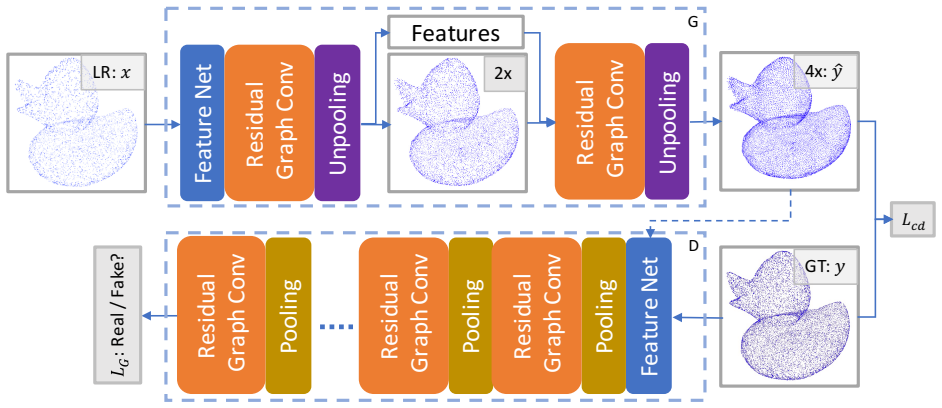
The load-bearing object is the residual graph convolution block built on G-conv, where each vertex feature is updated as $f_{l+1}^p = w_0 f_l^p + w_1 \sum_{q \in N(p)} f_l^q$, with neighbors defined by k-nearest neighbors in Euclidean space ($k=8$). Around this, the unpooling block reshapes a G-conv output into $\hat{n} \times 2 \times 3$ displacements $\delta x$ and adds them to the input to double the point count, so the generator predicts residuals rather than absolute coordinates, aided by a skip connection between input and output. The graph discriminator downsamples via farthest point sampling and max-pooling to output 64 patch scores, enabling a graph patch GAN. The training signal is carried by the loss $L = \lambda L_{\mathrm{cd}} + L_G$, with $L_{\mathrm{cd}}$ the one-sided Chamfer distance and $L_G = \|1 - D(\hat{y})\|^2$.
What would settle it
Train AR-GCN on the PU-Net data with the full symmetric Chamfer distance, keeping $\hat{L}_{\mathrm{cd}}$ alongside $L_{\mathrm{cd}}$ and the adversarial term, and evaluate F-score and Chamfer distance on the same test split. If the full-loss model matches or exceeds AR-GCN, the paper's stated reason for dropping the symmetric term is falsified; a second check is counting near-coincident output points in AR-GCN's predictions, since the dropped term was claimed to prevent duplication.
Extended reading notes
Core claim
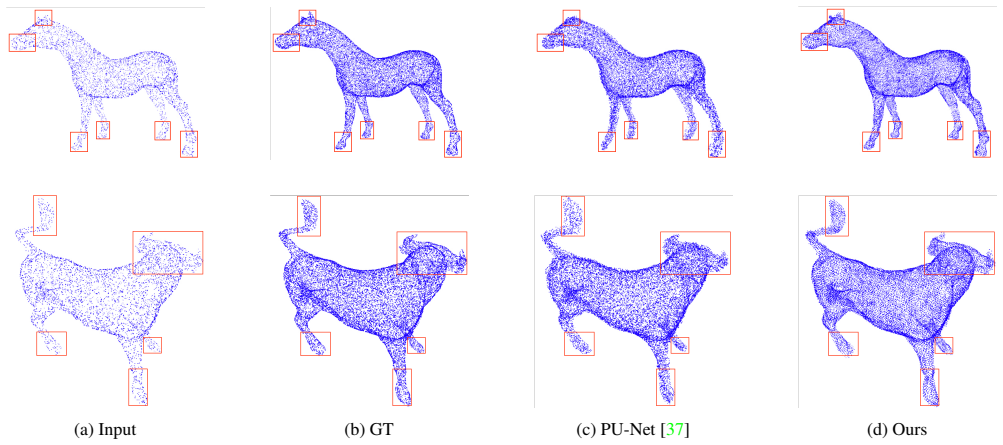
The central claim is that AR-GCN achieves state-of-the-art point cloud super-resolution by combining three components: a residual graph convolution generator that upsamples progressively by 2x and predicts per-point offset displacements through unpooling blocks, a graph patch discriminator that classifies local patches of point clouds as real or fake, and a training loss that keeps only the one-sided Chamfer term $L_{\mathrm{cd}}$ plus an LS-GAN adversarial loss $L_G$. The authors hold that the symmetric Chamfer term $\hat{L}_{\mathrm{cd}}$ encourages output points to coincide with the sparse input, causing duplication, so it is removed. Under this design, the reported tables show consistent gains over PU-Net and MLS in Chamfer distance, Earth Mover's distance, F-score, normalized uniformity coefficient, and deviation on both the test split and SHREC15, with roughly equal parameter count.
Load-bearing premise
The paper's results depend on the claim that discarding the symmetric half of the Chamfer distance, keeping only the distance from ground-truth points to output points, gives a sound training signal, because the dropped half is said to cause duplicate points.
Editorial extensions
If this is right
- If AR-GCN's reported numbers hold, learning-based point cloud upsampling can beat classical MLS on fidelity and uniformity simultaneously, something PU-Net did not achieve.
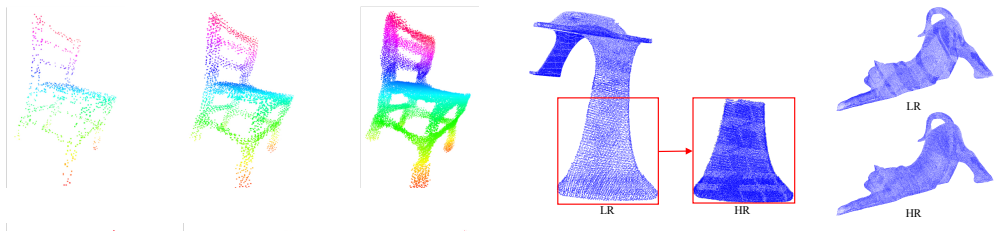
- The same architecture upsamples iteratively: applying the 4x model twice turns 1,024 points into roughly 16,384 points while retaining shape details, so fixed-ratio training transfers to larger ratios.
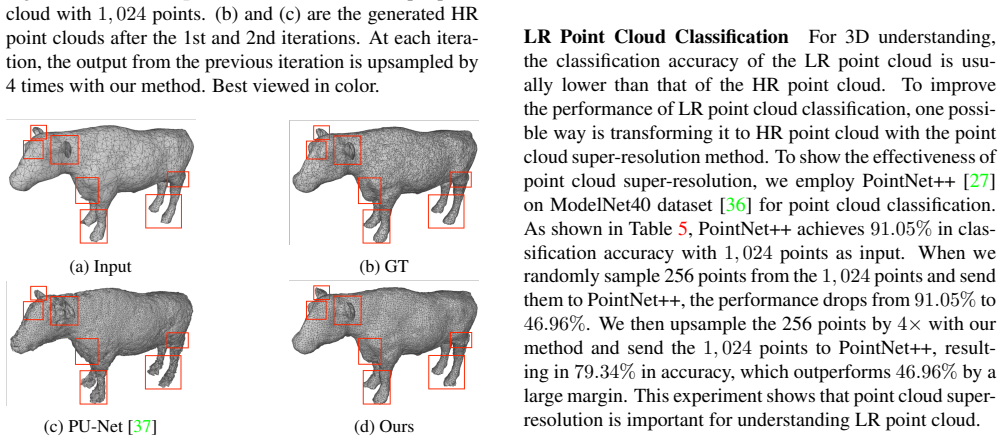
- Upsampling sparse inputs with AR-GCN recovers classification accuracy: PointNet++ on 1,024 upsampled-from-256 points reaches 79.34% versus 46.96% on the raw 256 points.
- The graph adversarial loss appears to enforce uniformity without an explicit repulsion term, since normalized uniformity improves despite no hand-designed uniformity loss.
- AR-GCN degrades gracefully under Gaussian noise and non-uniform sampling, still beating clean-input PU-Net on several metrics.
Reading between the lines
- If the one-sided Chamfer term is the active ingredient, its removal may trade completeness for fidelity; a direct test would measure precision and recall separately on the output points, since the dropped term is what penalizes output points far from any ground-truth point.
- The residual displacement formulation transfers naturally to point cloud completion and denoising, where input and output share a surface but differ in density and noise; the paper does not claim this extension.
- The graph patch discriminator could be paired with other generators or used as a trainable loss for mesh or occupancy upsampling, but that is an extension beyond the paper.
- A practical variant would retain a down-weighted symmetric Chamfer term and check whether F-score changes; the paper's ablation only removes it entirely.
Signed reviews
Editorial analysis
A structured set of objections, weighed in public.
Referee Report
Summary. The paper proposes AR-GCN, a learning-based point cloud super-resolution method combining a residual graph convolutional generator, a graph-based LS-GAN discriminator, and a loss that weighs a one-sided Chamfer distance term against a graph adversarial term. The generator upsamples progressively by a factor of two using graph convolution blocks, unpooling blocks that predict coordinate residuals, and a skip connection from input to output. The method is trained on the PU-Net dataset and evaluated on both the PU-Net test split and the unseen SHREC15 dataset, reporting improvements over PU-Net and MLS on CD, EMD, F-score, NUC, and Deviation. Additional experiments demonstrate robustness to noisy and uneven inputs, iterative upsampling, mesh reconstruction, and a classification application on ModelNet40.
Significance. If the empirical claims hold, AR-GCN is a practical contribution to point cloud upsampling: it combines residual graph convolutions with an adversarial loss, and the held-out SHREC15 results support a generalization claim. The paper ships a public code repository, provides architecture ablations, and reports downstream applications. However, the central empirical claim rests on a training objective whose geometric rationale is stated incorrectly in Section 3.2, and the loss-balance hyperparameter lambda is never reported. These issues are fixable but require additional experiments and reporting before the benchmark conclusions can be accepted as stated.
major comments (3)
- [Section 3.2, Eq. (3)] The statement that L_hat_cd 'encourages y_hat to be identical to the LR input, which leads to duplication points' is incorrect. Eq. (3) sums over output points q the squared distance to the nearest point of the ground truth y, so it penalizes output points that are far from the GT surface; it does not pull output points toward the sparse LR input, and duplicates lying on the GT surface would not be penalized. Because the one-sided term Lcd in Eq. (2) only requires every GT point to have a nearby output point, output points that are not the nearest neighbor of any GT point receive no geometric gradient from Lcd. The paper provides no ablation comparing the proposed one-sided objective with the full symmetric Chamfer distance, so it is not possible to tell whether the gains in Tables 1 and 2 come from the residual graph architecture and adversarial loss or from an under-constrained geometric loss. Please correct the justification and add such an ablation with lambda reported.
- [Section 4.2, Eq. (1)] Equation (1) defines L(x,y) = lambda Lcd + LG, but the value of lambda is never reported anywhere in Section 4.2 or in the ablation study. Since the two-step training procedure (80 epochs with Lcd, then 40 epochs with the full loss) interacts with this weighting, the loss-balance hyperparameter is essential for reproducibility and for interpreting the relative contribution of the adversarial term. Please report the value and, ideally, a small sensitivity study.
- [Tables 1 and 2] The headline comparisons are reported from a single run without error bars or significance tests. While the F-score margins are large (70.28% vs. 43.24% on the train-test split and 93.07% vs. 56.39% on SHREC15), some of the claimed advantages, such as EMD on SHREC15 (0.0031 vs. 0.0032 for MLS) and several NUC entries, are small. Please report mean and standard deviation over multiple training runs, or provide a significance test for the close comparisons, to support the state-of-the-art claim.
minor comments (5)
- [Section 3.2, Eq. (2)] Calling Lcd a 'point-wise distance' is misleading: Eq. (2) is a one-sided coverage term from the ground truth to the output, not a per-point correspondence distance. Please rephrase to avoid confusion with the later claim that Lcd measures point-wise distance.
- [Section 4.3] The metric column 'NUC with different p' is not explained in the text; please define p, state the range used, and clarify that smaller values are better for both NUC and Deviation.
- [Table 3] The row label 'GCN4×points' is visually ambiguous; consider writing 'GCN-4x (points)' or adding a footnote that clarifies the subscript.
- [Introduction and Related Work] The abstract claims state-of-the-art performance, but the comparison set contains only PU-Net and MLS. Please either broaden the comparison or explicitly narrow the claim to these baselines.
- [Section 4.5] The sentence 'the F-score decreases by about 8% as shown by ResGCN + Lpu and ResGCN' should state whether the change is relative or in percentage points, since the table shows a drop from 68.75% to 60.71%.
Circularity Check
No significant circularity: the state-of-the-art claim is an empirical benchmark result trained and evaluated on external data.
full rationale
The paper's central claim is an empirical performance claim evaluated on external benchmarks (the PU-Net train-test split and the unseen SHREC15 dataset) with metrics that are not defined in terms of the trained parameters or the training objective. The training loss in Eq. 1, L(x,y) = lambda * Lcd(G(x),y) + LG(G(x)), is used to fit the generator and discriminator, but the reported CD, EMD, F-score, NUC, and Deviation values are measured after training on held-out or unseen point clouds, so the predictions do not reduce by construction to the fitted loss. The ablation study in Table 3 provides an internal comparison of architecture variants and training strategies, and the comparisons against MLS and PU-Net are external baselines. The paper's justification for dropping the symmetric Chamfer term L_hat_cd is questionable: Eq. 3 sums over output points the squared distance to the nearest ground-truth point, which penalizes output points far from the ground truth rather than encouraging identity with the LR input. However, an incorrect or weakly supported design justification is not circular reasoning, because the benchmark results remain externally falsifiable and the model is not defined in terms of its reported metrics. The unreported value of lambda and the hand-selected two-stage training schedule are reproducibility concerns, not circular dependency. There are no load-bearing self-citations by the present authors; the cited works on PU-Net, LS-GAN, GCN, and patch-GAN are prior external references used for comparison or building blocks, not as evidence that reduces the central claim to its own inputs. Overall, no equation or experimental result in the paper is equivalent to its own input by definition, and no fitted parameter is renamed as a prediction.
Assumptions & free parameters
free parameters (5)
- lambda (loss balance) =
not reported
- k (nearest neighbors) =
8
- channels and depth =
128 channels and 12 residual layers in the generator; 64 channels and 4 layers in the discriminator
- training schedule =
80 epochs with Lcd, then 40 epochs with joint loss; Adam at learning rate 0.001, batch size 28
- discriminator output patch size =
64 points
assumptions (5)
- domain assumption A k-NN graph in Euclidean space is an adequate local structure representation for point cloud generation.
- domain assumption The PU-Net dataset and evaluation protocol provide a valid measure of point cloud super-resolution quality.
- domain assumption Adversarial training with LS-GAN converges to useful local realism without destabilizing coordinate regression.
- domain assumption One-sided Chamfer distance is a valid training objective for point cloud super-resolution.
- domain assumption Uniformly sampled ground-truth points from meshes represent ideal high-resolution point clouds.
Cite this review
Pith. "Pith review of Point Cloud Super Resolution with Adversarial Residual Graph Networks." pith.science (2026). https://pith.science/paper/M23ZTONW
@misc{pith2026190802111,
  author       = {Pith},
  title        = {Pith review of: Point Cloud Super Resolution with Adversarial Residual Graph Networks},
  year         = {2026},
  howpublished = {\url{https://pith.science/paper/M23ZTONW}},
  note         = {Machine review of arXiv:1908.02111}
}
read the original abstract
Point cloud super-resolution is a fundamental problem for 3D reconstruction and 3D data understanding. It takes a low-resolution (LR) point cloud as input and generates a high-resolution (HR) point cloud with rich details. In this paper, we present a data-driven method for point cloud super-resolution based on graph networks and adversarial losses. The key idea of the proposed network is to exploit the local similarity of point cloud and the analogy between LR input and HR output. For the former, we design a deep network with graph convolution. For the latter, we propose to add residual connections into graph convolution and introduce a skip connection between input and output. The proposed network is trained with a novel loss function, which combines Chamfer Distance (CD) and graph adversarial loss. Such a loss function captures the characteristics of HR point cloud automatically without manual design. We conduct a series of experiments to evaluate our method and validate the superiority over other methods. Results show that the proposed method achieves the state-of-the-art performance and have a good generalization ability to unseen data.
Figures


Figures from the paper (3 more)
Reference graph
Works this paper leans on
- [1]
- [2]
-
[3]
F. Bernardini, J. Mittleman, H. Rushmeier, C. Silva, and G. Taubin. The ball-pivoting algorithm for surface recon- struction. IEEE transactions on visualization and computer graphics, 1999. 1, 8
work page 1999
-
[4]
M. M. Bronstein, J. Bruna, Y . LeCun, A. Szlam, and P. Van- dergheynst. Geometric deep learning: going beyond eu- clidean data. IEEE Signal Processing Magazine, 2017. 3
work page 2017
-
[5]
M. Defferrard, X. Bresson, and P. Vandergheynst. Convolu- tional neural networks on graphs with fast localized spectral filtering. In NIPS, 2016. 2
work page 2016
-
[6]
C. Dong, C. C. Loy, K. He, and X. Tang. Learning a deep convolutional network for image super-resolution. InECCV,
-
[7]
H. Fan, H. Su, and L. J. Guibas. A point set generation net- work for 3d object reconstruction from a single image. In CVPR, 2017. 1, 2
work page 2017
-
[8]
I. Goodfellow, J. Pouget-Abadie, M. Mirza, B. Xu, D. Warde-Farley, S. Ozair, A. Courville, and Y . Bengio. Gen- erative adversarial nets. In NIPS, 2014. 3
work page 2014
Show all 39 references
-
[9]
W. Han, S. Chang, D. Liu, M. Yu, M. Witbrock, and T. S. Huang. Image super-resolution via dual-state recurrent net- works. In CVPR, 2018. 2
2018
-
[10]
Haris, G
M. Haris, G. Shakhnarovich, and N. Ukita. Deep backpro- jection networks for super-resolution. In CVPR, 2018. 2
2018
-
[11]
Hartley and A
R. Hartley and A. Zisserman. Multiple view geometry in computer vision. Cambridge university press, 2003. 1
2003
-
[12]
Huang, D
H. Huang, D. Li, H. Zhang, U. Ascher, and D. Cohen-Or. Consolidation of unorganized point clouds for surface recon- struction. TOG, 2009. 1
2009
-
[13]
Huang, S
H. Huang, S. Wu, M. Gong, D. Cohen-Or, U. Ascher, and H. R. Zhang. Edge-aware point set resampling. TOG, 2013. 1, 2
2013
-
[14]
Jiang, Y
M. Jiang, Y . Wu, and C. Lu. Pointsift: A sift-like net- work module for 3d point cloud semantic segmentation. arXiv:1807.00652, 2018. 2
2018 arXiv
-
[15]
H. Kato, Y . Ushiku, and T. Harada. Neural 3d mesh renderer. In CVPR, 2018. 2
2018
-
[16]
J. Kim, J. Kwon Lee, and K. Mu Lee. Deeply-recursive convolutional network for image super-resolution. In CVPR,
-
[17]
D. P. Kingma and J. Ba. Adam: A method for stochastic optimization. arXiv:1412.6980, 2014. 5
2014 arXiv
-
[18]
Ledig, L
C. Ledig, L. Theis, F. Husz ´ar, J. Caballero, A. Cunningham, A. Acosta, A. P. Aitken, A. Tejani, J. Totz, Z. Wang, et al. Photo-realistic single image super-resolution using a genera- tive adversarial network. In CVPR, 2017. 2
2017
-
[19]
J. Li, B. M. Chen, and G. H. Lee. So-net: Self-organizing network for point cloud analysis. In CVPR, 2018. 2
2018
-
[20]
Y . Li, R. Bu, M. Sun, and B. Chen. Pointcnn. arXiv:1801.07791, 2018. 2
2018 arXiv
-
[21]
Z. Lian, J. Zhang, S. Choi, H. ElNaghy, J. El-Sana, T. Fu- ruya, A. Giachetti, R. A. Guler, L. Lai, C. Li, H. Li, F. A. Limberger, R. Martin, R. U. Nakanishi, A. P. Neto, L. G. Nonato, R. Ohbuchi, K. Pevzner, D. Pickup, P. Rosin, A. Sharf, L. Sun, X. Sun, S. Tari, G. Unal, and...
2015
-
[22]
Lipman, D
Y . Lipman, D. Cohen-Or, D. Levin, and H. Tal-Ezer. Parameterization-free projection for geometry reconstruc- tion. TOG, 2007. 2
2007
-
[23]
X. Mao, Q. Li, H. Xie, R. Y . Lau, Z. Wang, and S. P. Smol- ley. Least squares generative adversarial networks. In ICCV,
-
[24]
Maturana and S
D. Maturana and S. Scherer. V oxnet: A 3d convolutional neural network for real-time object recognition. In IROS,
-
[25]
Pan and etc
S. Pan and etc. Adversarially regularized graph autoencoder for graph embedding. In IJCAI, 2018. 2
2018
-
[26]
C. R. Qi, H. Su, K. Mo, and L. J. Guibas. Pointnet: Deep learning on point sets for 3d classification and segmentation. arXiv:1612.00593, 2016. 2
2016 arXiv
-
[27]
C. R. Qi, L. Yi, H. Su, and L. J. Guibas. Pointnet++: Deep hierarchical feature learning on point sets in a metric space. In NIPS, 2017. 2, 8
2017
-
[28]
Riegler, A
G. Riegler, A. O. Ulusoy, and A. Geiger. Octnet: Learning deep 3d representations at high resolutions. In CVPR, 2017. 2
2017
-
[29]
Shrivastava, T
A. Shrivastava, T. Pfister, O. Tuzel, J. Susskind, W. Wang, and R. Webb. Learning from simulated and unsupervised images through adversarial training. In CVPR, 2017. 4
2017
-
[30]
Smith, S
E. Smith, S. Fujimoto, and D. Meger. 3d object super- resolution. arXiv:1802.09987, 2018. 2
2018 arXiv
-
[31]
Sokolova, N
M. Sokolova, N. Japkowicz, and S. Szpakowicz. Beyond accuracy, f-score and roc: a family of discriminant measures for performance evaluation. In Australasian joint conference on artificial intelligence, 2006. 5
2006
-
[32]
H. Su, V . Jampani, D. Sun, S. Maji, E. Kalogerakis, M.-H. Yang, and J. Kautz. Splatnet: Sparse lattice networks for point cloud processing. In CVPR, 2018. 2
2018
-
[33]
X. Sun, J. Wu, X. Zhang, Z. Zhang, C. Zhang, T. Xue, J. B. Tenenbaum, and W. T. Freeman. Pix3d: Dataset and methods for single-image 3d shape modeling. In CVPR, 2018. 2
2018
-
[34]
N. Wang, Y . Zhang, Z. Li, Y . Fu, W. Liu, and Y .-G. Jiang. Pixel2mesh: Generating 3d mesh models from single rgb im- ages. arXiv:1804.01654, 2018. 2
2018 arXiv
-
[35]
Y . Wang, L. Wang, H. Wang, and P. Li. End-to-end im- age super-resolution via deep and shallow convolutional net- works. arXiv:1607.07680, 2016. 2
2016 arXiv
-
[36]
Z. Wu, S. Song, A. Khosla, F. Yu, L. Zhang, X. Tang, and J. Xiao. 3d shapenets: A deep representation for volumetric shapes. In CVPR, 2015. 2, 8
2015
-
[37]
L. Yu, X. Li, C.-W. Fu, D. Cohen-Or, and P.-A. Heng. Pu- net: Point cloud upsampling network. In CVPR, 2018. 1, 2, 5, 6, 7, 8
2018
-
[38]
Zhang and M
Y . Zhang and M. Rabbat. A graph-cnn for 3d point cloud classification. In ICASSP, 2018. 2
2018
-
[39]
Zhang, Y
Y . Zhang, Y . Tian, Y . Kong, B. Zhong, and Y . Fu. Residual dense network for image super-resolution. In CVPR, 2018. 2
2018
Reviewed August 14, 2026 · model on record in the stance chip above.
Discussion (0). Continue with ORCID to comment.