Vanishing cross-diffusion limit in a Keller-Segel system with additional cross-diffusion
Pith reviewed 2026-05-24 15:51 UTC · model grok-4.3
The pith
The vanishing limit of an added cross-diffusion term is proved for Keller-Segel systems, with convergence to the classical model when signal production is sublinear.
A machine-rendered reading of the paper's core claim, the machinery that carries it, and where it could break.
Core claim
The limit of vanishing cross-diffusion parameter is proved rigorously in the parabolic-elliptic and parabolic-parabolic cases. When the signal production is sublinear, the existence of global-in-time weak solutions as well as the convergence of the solutions to those of the classical parabolic-elliptic Keller-Segel equations are proved. The proof is based on a reformulation of the equations eliminating the additional cross-diffusion term but making the equation for the cell density quasilinear. For superlinear signal production terms, convergence rates in the cross-diffusion parameter are proved for local-in-time smooth solutions using H^s estimates and a variant of the Gronwall lemma. Two-1
What carries the argument
Reformulation of the equations that eliminates the additional cross-diffusion term while turning the cell-density equation into a quasilinear parabolic system.
If this is right
- Global weak solutions exist for the system with the extra cross-diffusion term.
- Solutions converge to those of the classical Keller-Segel system as the parameter vanishes when production is sublinear.
- Convergence rates hold for local smooth solutions in the superlinear case.
- The shape of cell aggregation bumps varies continuously with the value of the cross-diffusion parameter.
Where Pith is reading between the lines
- The same reformulation technique could be tested on other chemotaxis systems that include small stabilizing cross terms.
- Numerical schemes might deliberately insert a small cross-diffusion term for regularization and then remove it by taking the limit.
- The result supplies a justification for using the classical Keller-Segel model as an approximation whenever any weak stabilization mechanism is present but not dominant.
Load-bearing premise
The reformulation that eliminates the additional cross-diffusion term while turning the cell-density equation into a quasilinear parabolic system remains valid and permits direct application of standard existence theory.
What would settle it
A concrete counter-example of sublinear signal production in which the augmented system lacks global weak solutions or the vanishing-parameter limit fails to recover the classical Keller-Segel equations.
Figures
read the original abstract
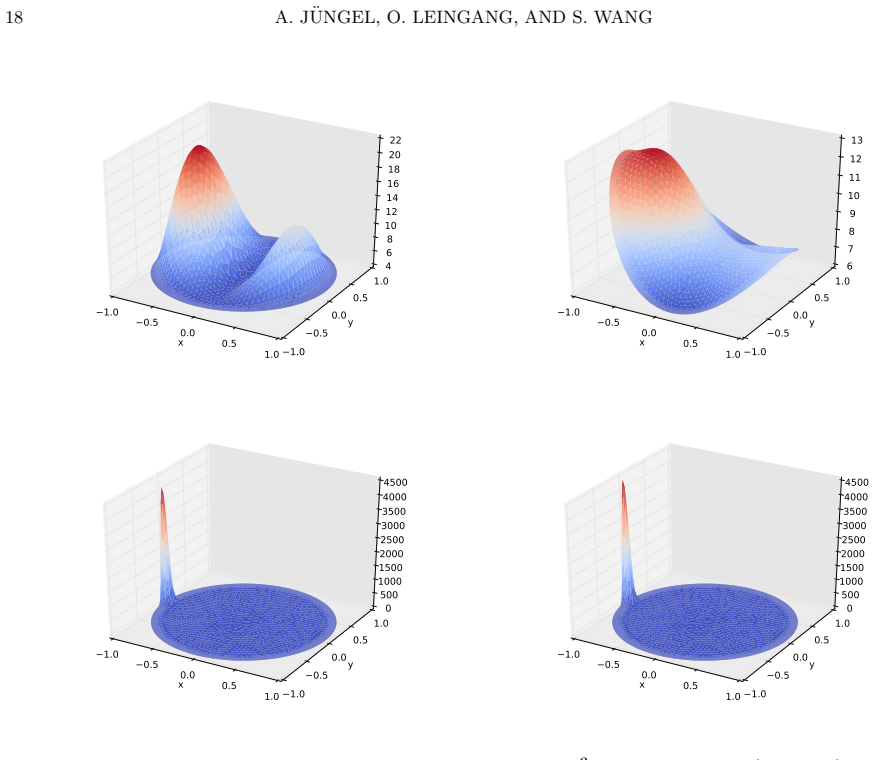
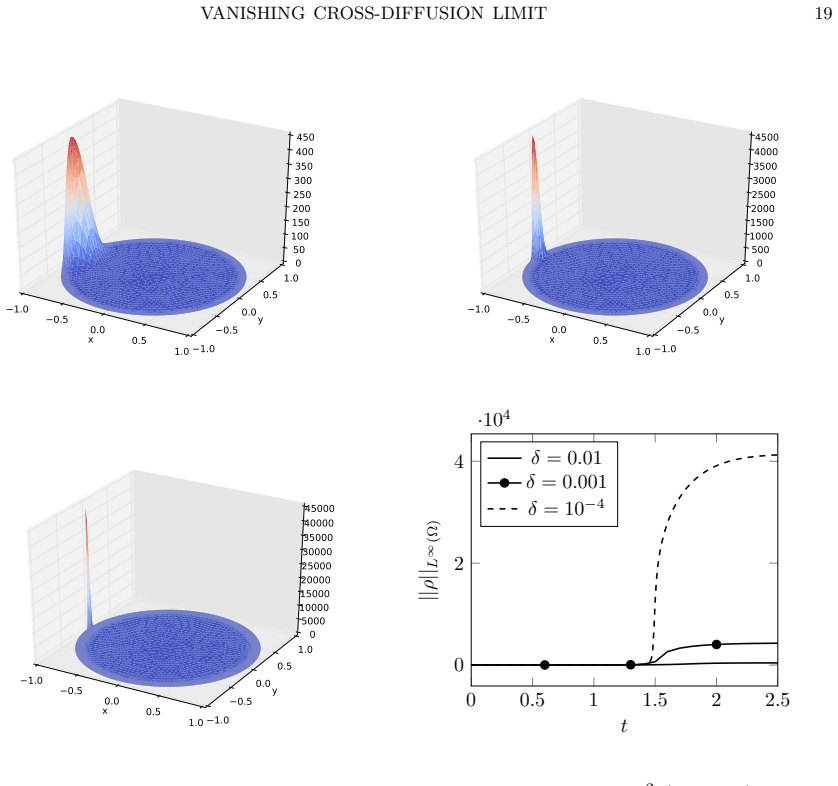
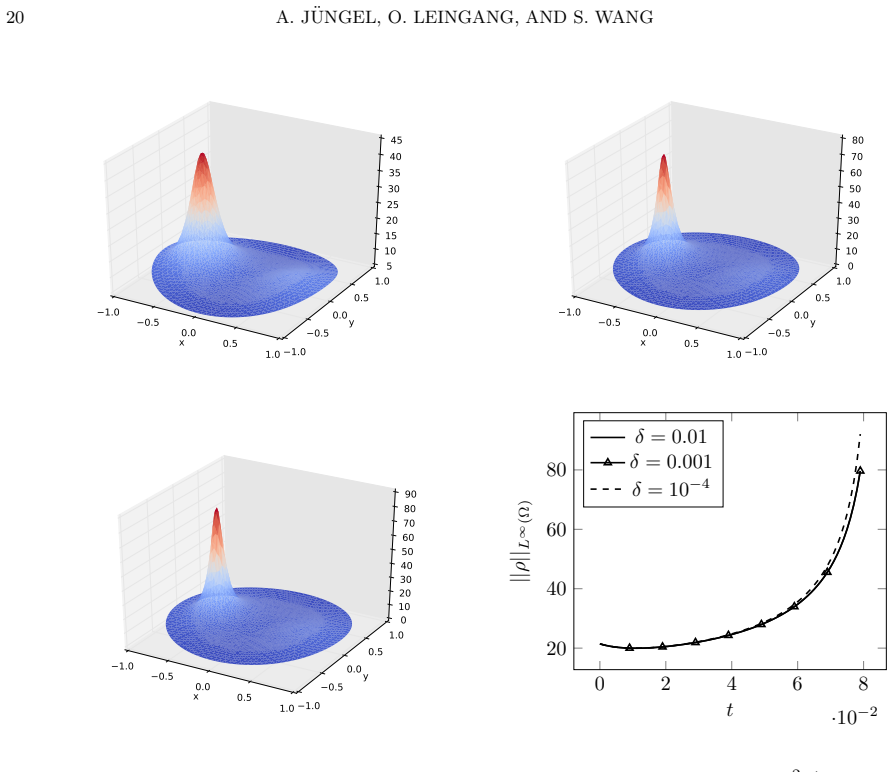
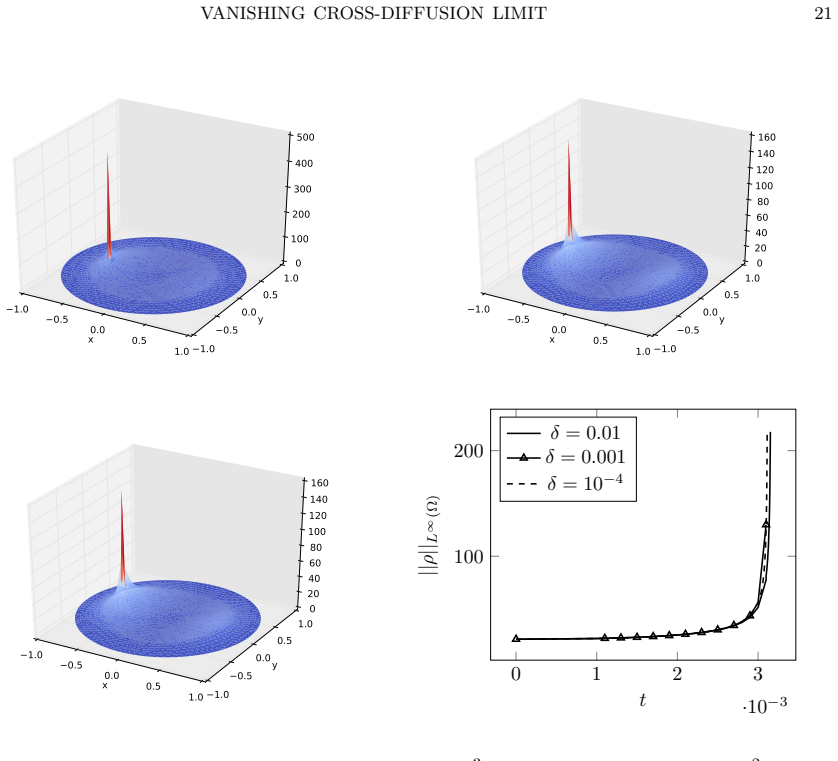
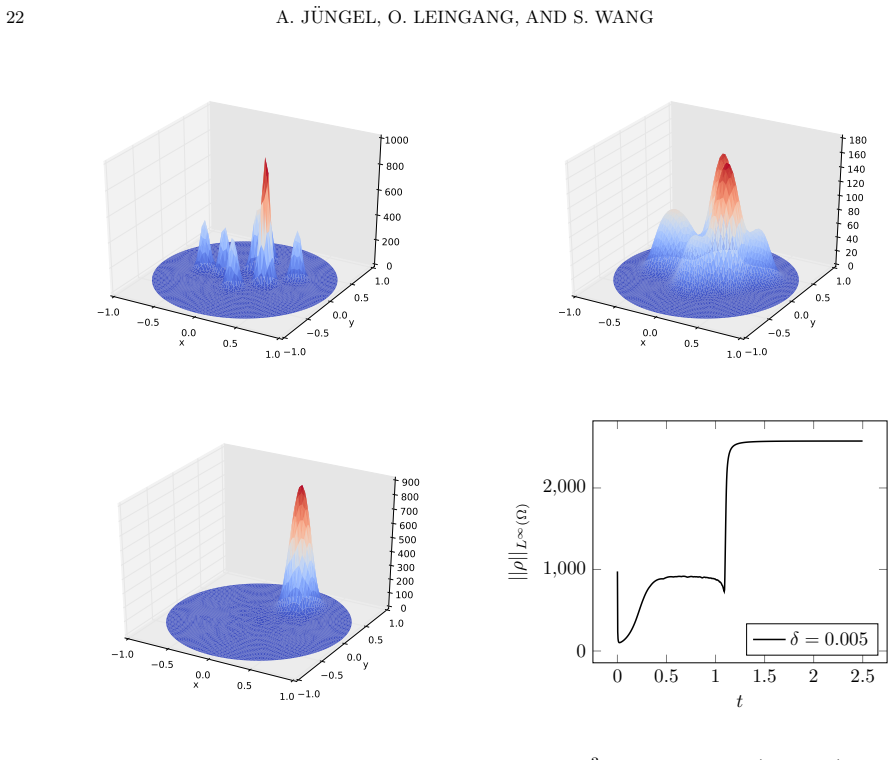
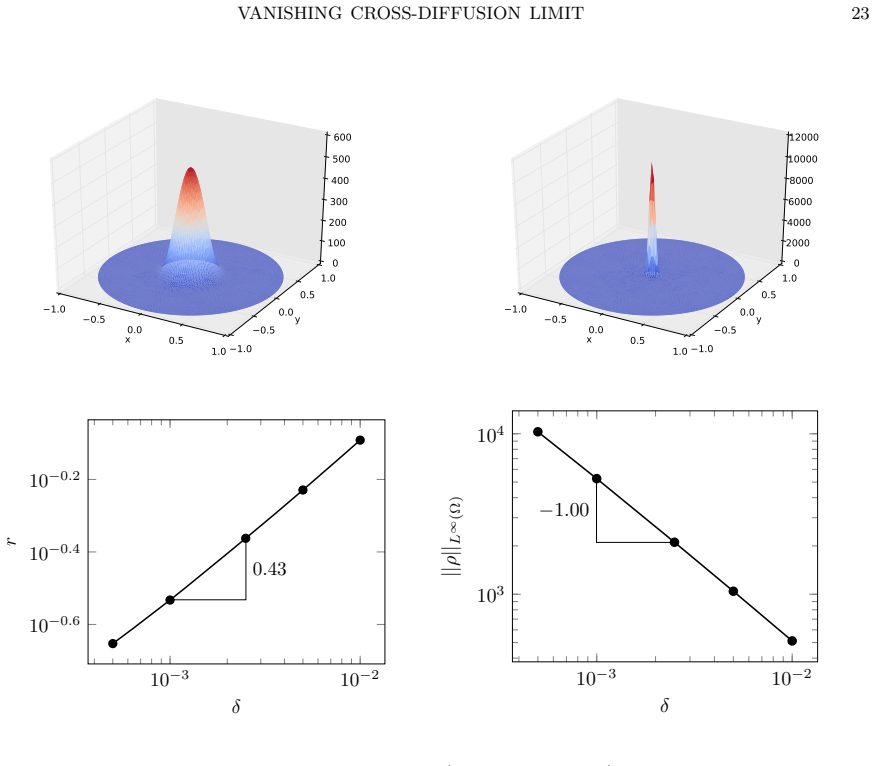
Keller-Segel systems in two and three space dimensions with an additional cross-diffusion term in the equation for the chemical concentration are analyzed. The cross-diffusion term has a stabilizing effect and leads to the global-in-time existence of weak solutions. The limit of vanishing cross-diffusion parameter is proved rigorously in the parabolic-elliptic and parabolic-parabolic cases. When the signal production is sublinear, the existence of global-in-time weak solutions as well as the convergence of the solutions to those of the classical parabolic-elliptic Keller--Segel equations are proved. The proof is based on a reformulation of the equations eliminating the additional cross-diffusion term but making the equation for the cell density quasilinear. For superlinear signal production terms, convergence rates in the cross-diffusion parameter are proved for local-in-time smooth solutions (since finite-time blow up is possible). The proof is based on careful $H^s(\Omega)$ estimates and a variant of the Gronwall lemma. Numerical experiments in two space dimensions illustrate the theoretical results and quantify the shape of the cell aggregation bumps as a function of the cross-diffusion parameter.
Editorial analysis
A structured set of objections, weighed in public.
Referee Report
Summary. The paper analyzes a variant of the Keller-Segel chemotaxis system in two and three space dimensions that includes an additional cross-diffusion term in the equation for the chemical signal. It establishes global-in-time existence of weak solutions, proves that the solutions converge to those of the classical parabolic-elliptic Keller-Segel system as the cross-diffusion parameter vanishes (under a sublinear signal-production assumption), and derives convergence rates for local smooth solutions in the superlinear case. The proofs proceed via a reformulation that removes the extra cross-diffusion term while rendering the cell-density equation quasilinear, followed by standard a-priori estimates, Gronwall arguments, and quasilinear parabolic existence theory; numerical experiments in 2D are included to illustrate aggregation behavior.
Significance. If the central claims hold, the manuscript supplies a rigorous justification for the stabilizing role of the additional cross-diffusion and for the vanishing-parameter limit, thereby connecting a regularized model to the classical Keller-Segel system. The explicit restriction to sublinear production, the use of a reformulation that permits direct application of quasilinear theory, and the accompanying numerical quantification of bump shapes constitute concrete strengths. The results are of interest to the analysis of quasilinear parabolic systems and chemotaxis models.
minor comments (3)
- [§2] The abstract states that the reformulation 'eliminates the additional cross-diffusion term but making the equation for the cell density quasilinear'; a brief remark in §2 clarifying whether the transformed system remains uniformly parabolic for all admissible parameter values would help readers verify applicability of the cited existence theory.
- [Theorem 1.3] In the statement of the main convergence theorem for the sublinear case, the precise function space in which the limit is taken (e.g., weak-* in L^∞ or strong in L^p) should be stated explicitly rather than left implicit from the preceding a-priori bounds.
- [§5] Figure 1 caption refers to 'cell aggregation bumps'; adding a short sentence on how the plotted quantity is extracted from the discrete scheme would improve reproducibility of the numerical section.
Simulated Author's Rebuttal
We thank the referee for the careful reading, positive assessment of the manuscript, and recommendation for minor revision. No major comments appear in the report.
Circularity Check
No significant circularity
full rationale
The derivation relies on an explicit reformulation of the system to a quasilinear parabolic form, followed by application of standard existence theory for quasilinear PDEs, energy estimates, and Gronwall's lemma. These steps are independent of the target limit result and do not reduce by construction to fitted parameters or self-referential definitions. No load-bearing self-citations or uniqueness theorems imported from prior author work are invoked in the provided outline. The sublinear-production restriction is stated explicitly as a hypothesis, not derived from the result itself.
Axiom & Free-Parameter Ledger
axioms (2)
- domain assumption Existence theory for quasilinear parabolic systems applies after the reformulation step.
- standard math Standard Sobolev embeddings and Gronwall-type inequalities hold for the resulting quasilinear system.
Reference graph
Works this paper leans on
-
[1]
H. Amann. Nonhomogeneous linear and quasilinear elliptic and parabolic boundary value problems. In: H. J. Schmeisser and H. Triebel (eds), Function Spaces, Differential Operators and Nonlinear Analysis, pp. 9–126. Teubner, Stuttgart, 1993
work page 1993
-
[2]
D. Bartolucci and D. Castorina. A global existence result for a Keller–Segel type system with super- critical initial data. J. Ellipt. Parabol. Eqs. 1 (2015), 243–262
work page 2015
-
[3]
N. Bellomo, A. Bellouquid, Y. Tao, and M. Winkler. Toward a mathematical theory of Keller–Segel models of pattern formation in biological tissues. Math. Models Meth. Appl. Sci. 25 (2015), 1663–1763
work page 2015
-
[4]
M. Bessemoulin-Chatard and A. J¨ ungel. A finite volume scheme for a Keller–Segel model with addi- tional cross-diffusion. IMA J. Numer. Anal. 34 (2013), 96–122
work page 2013
- [5]
- [6]
- [7]
-
[8]
V. Calvez and J. A. Carrillo. Volume effects in the Keller–Segel model: energy estimates preventing blow-up. J. Math. Pure Appl. 86 (2006), 155–175
work page 2006
-
[9]
V. Calvez and L. Corrias. The parabolic-parabolic Keller–Segel model in R2. Commun. Math. Sci. 6 (1008), 417–447
-
[10]
J. A. Carrillo, S. Hittmeir, and A. J¨ ungel. Cross diffusion and nonlinear diffusion preventing blow up in the Keller–Segel model. Math. Models Meth. Appl. Sci. 22, (2012), 1250041, 35 pages
work page 2012
-
[11]
L. Corrias, B. Perthame, and H. Zaag. Global solutions of some chemotaxis and angiogenesis systems in high space dimensions. Milan J. Math. 72 (2004), 1–28
work page 2004
-
[12]
M. Di Francesco and J. Rosado. Fully parabolic Keller–Segel model for chemotaxis with prevention of overcrowding. Nonlinearity 21 (2008), 2715–2730
work page 2008
-
[13]
M. Dreher and A. J¨ ungel. Compact families of piecewise constant functions in Lp(0, T; B). Nonlin. Anal. 75 (2012), 3072–3077
work page 2012
- [14]
- [15]
-
[16]
T. Hillen and K. Painter. A user’s guide to PDE models for chemotaxis. J. Math. Biol. 58 (2009), 183–217
work page 2009
- [17]
-
[18]
S. Hittmeir and A. J¨ ungel. Cross diffusion preventing blow up in the two-dimensional Keller–Segel model. SIAM J. Math. Anal. 43 (2011), 997–1022
work page 2011
-
[19]
L. Hsiao and S. Wang. Quasineutral limit of a time-dependent drift-diffusion-Poisson model for p-n junction semiconductor devices. J. Diff. Eqs. 225 (2006), 411–439
work page 2006
-
[20]
J. Hunter. Matplotlib: A 2D graphics environment. Comput. Sci. Engin. 9 (2007), 90–95
work page 2007
- [21]
-
[22]
J¨ ungel.Entropy Methods for Diffusive Partial Differential Equations
A. J¨ ungel.Entropy Methods for Diffusive Partial Differential Equations . SpringerBriefs in Mathemat- ics, Springer, 2016
work page 2016
- [23]
-
[24]
E. Keller and L. Segel. Initiation of slime mold aggregation viewed as an instability. J. Theor. Biol. 26 (1970), 399–415
work page 1970
- [25]
-
[26]
R. Kowalczyk and Z. Szyma´ nska. On the global existence of solutions to an aggregation model. J. Math. Anal. Appl. 343 (2008), 379–398
work page 2008
-
[27]
J. Lankeit. Locally bounded global solutions to a chemotaxis consumption model with singular sensi- tivity and nonlinear diffusion. J. Diff. Eqs. 262 (2017), 4052–4084
work page 2017
-
[28]
A. Lunardi. Analytic Semigroups and Optimal Regularity in Parabolic Problems. Springer, Basel, 1995
work page 1995
-
[29]
C. Patlak. Random walk with persistence and external bias. Bull. Math. Biophys. 15 (1953), 311–338
work page 1953
-
[30]
J. Simon. Compact sets in the space Lp(0, T; B). Ann. Math. Pura. Appl. 146 (1987), 65–96
work page 1987
-
[31]
G. M. Troianiello. Elliptic Differential Equations and Obstacle Problems . Plenum Press, New York, 1987
work page 1987
-
[32]
M. Winkler. Chemotaxis with logistic source: Very weak solutions and their boundedness properties. J. Math. Anal. Appl. 348 (2008), 708–729. V ANISHING CROSS-DIFFUSION LIMIT 25
work page 2008
-
[33]
M. Winkler. A critical blow-up exponent in a chemotaxis system with nonlinear signal production. Nonlinearity 31 (2018), 2031–2056. Institute for Analysis and Scientific Computing, Vienna University of Technology, Wiedner Hauptstraße 8–10, 1040 Wien, Austria E-mail address : juengel@tuwien.ac.at Institute for Analysis and Scientific Computing, Vienna Univ...
work page 2018
discussion (0)
Sign in with ORCID, Apple, or X to comment. Anyone can read and Pith papers without signing in.