REVIEW 3 major objections 5 minor 15 references
Tenant-Aware Slice Admission Control using Neural Networks-Based Policy Agent
T0 review · 3 major / 5 minor · reviewed 2026-08-14 · deepseek-v4-flash
Pith's one-line read Giving a slice admission agent the tenant ID improves infrastructure revenue in simulated 5G networks.
desk verdict A plausible but under-evidenced claim that tenant identity improves RL slice admission; the 9-unit loss gap is likely within sampling noise. read the letter →
The pith
A machine-rendered reading of the paper's core claim, the machinery that carries it, and where it could break.
The reading
What carries the argument
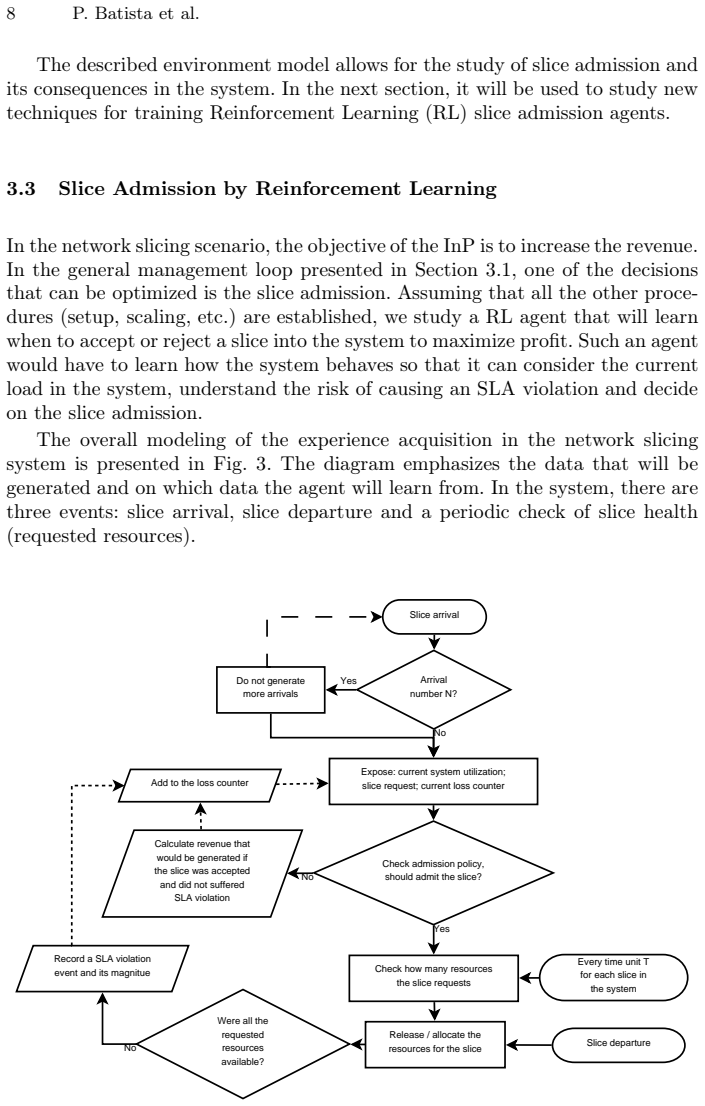
The load-bearing mechanism is a policy network whose state vector $s$ concatenates binary fields $A_b(x)$ encoding current system utilization, requested GPP resources at each central office and regional data center, requested link connectivity, slice duration, priority, and the tenant ID. The network has four hidden layers of 40 ReLU neurons and two outputs giving accept and reject probabilities, trained by reinforcement learning over episodes of 600 slice arrivals at 80 Erlangs load. Periodic scaling events check whether each deployed slice can get its requested resources, and violations are recorded as loss, so the agent must balance rejection loss against scaling loss. The tenant ID is the only input that differs from the baseline.
What would settle it
Re-run the comparison with tenant labels randomly shuffled between requests while keeping resource profiles fixed; if the tenant-aware agent no longer beats the baseline, the gain truly came from the tenant ID. As a statistical check, compute a confidence interval for the mean loss difference across many independently seeded 25-episode test sets and see whether it excludes zero.
Extended reading notes
Core claim
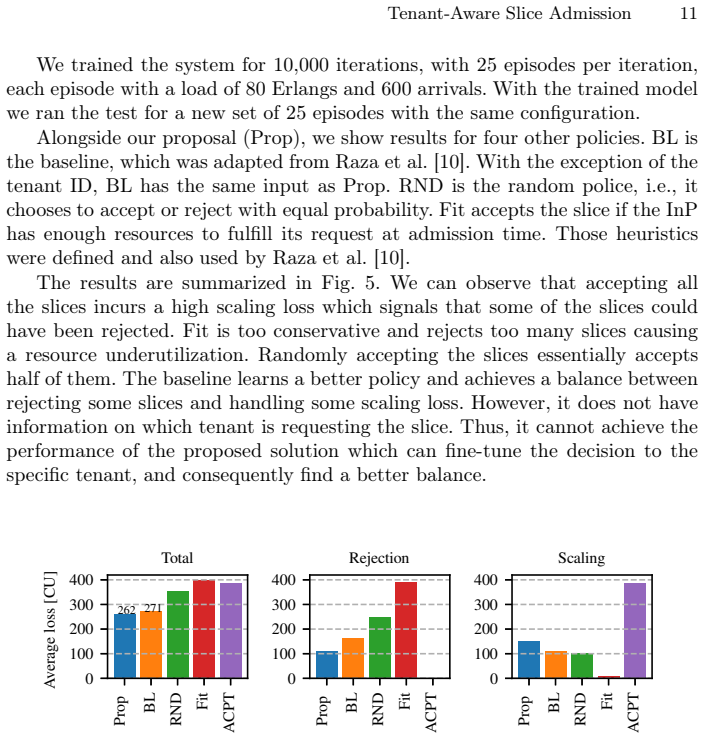
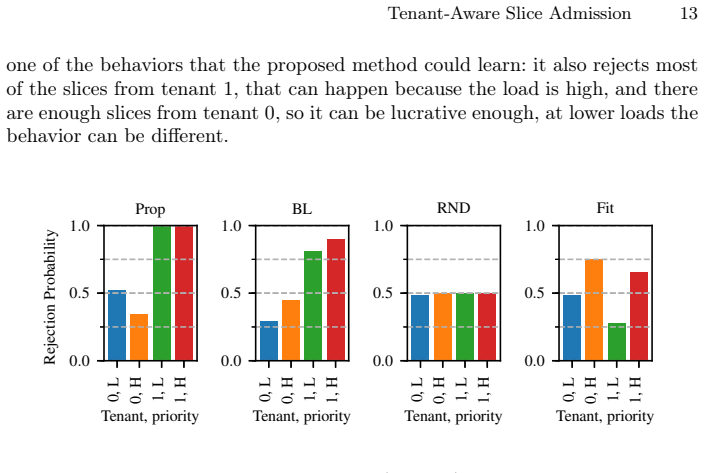
On the paper's own terms, the central discovery is that tenant awareness is a usable and profitable input for learned slice admission. In an episodic simulation with two tenants ($u_0=0.1$, $u_1=0.9$, $v_0=1$, $v_1=0.1$), where tenant 0 uses more resources and carries a higher penalty weight, the proposed policy network takes the tenant ID as an extra input and learns to reject almost all tenant 1 slices while accepting tenant 0 slices, and to accept high-priority slices more often than low-priority ones. Over 25 test episodes it reaches an average loss of 262 cost units, compared with 271 for the tenant-unaware baseline, and worse for the random, fit, and accept-all heuristics. The authors interpret this as the agent fine-tuning admission to the tenant-specific balance of revenue and SLA-violation cost.
Load-bearing premise
The claimed advantage rests on tenant identity being a stable predictor of slice resource usage and penalty in the simulation, and on the 9-unit loss gap over 25 episodes being larger than sampling noise; neither condition is tested outside this setup.
Editorial extensions
If this is right
- If the result holds, infrastructure providers can increase revenue by adding tenant identity to the admission state without changing the underlying network or orchestration.
- The learned policy effectively prioritizes tenants by expected penalty and resource profile, rejecting nearly all low-penalty, low-usage tenant 1 slices under high load.
- The closed-loop control design, with arrival, scaling checks, and departure feedback, gives the agent the SLA-violation history it needs to learn the cost of each admission choice.
- The same policy-network architecture can be applied to other management decisions in the loop, such as service setup and resource-pool selection.
Reading between the lines
- Editorial inference: the reported 9-cost-unit gap between Prop and BL is small, and the paper does not report variance or significance; replicating with many independent episode seeds is needed to confirm the gap is not noise.
- Editorial inference: the strategy of rejecting almost all tenant 1 slices would concentrate service on one tenant; in a real multi-tenant market this could raise fairness, regulatory, or long-term revenue concerns that the loss metric does not capture.
- Editorial inference: the same mechanism suggests that any stable behavioral covariate, such as tenant class, service type, or geographic region, should be fed to learned admission controllers, not only raw resource usage.
- Editorial inference: if tenant behavior drifts over time, the tenant ID may stop being predictive, so online retraining or periodic re-evaluation would be needed to keep the advantage.
Signed reviews
Editorial analysis
A structured set of objections, weighed in public.
Referee Report
Summary. The paper proposes a reinforcement-learning-based policy agent for network slice admission control in a virtualized 5G multi-tenant infrastructure. The agent uses a neural policy network whose state representation includes system utilization, the requested slice profile, duration, priority, and the identity of the tenant making the request. The admission decision is binary (accept/reject), and the objective is to maximize infrastructure-provider revenue, modeled as a loss composed of rejection losses and SLA scaling-violation penalties. The authors extend prior work by making resource requests stochastic: a binomial noise term with a tenant-dependent success probability is subtracted from each reference profile. They simulate two tenants with different resource-usage noise and penalty weights and compare the proposed tenant-aware policy against a tenant-unaware baseline and three heuristics (random, fit-if-possible, accept-all). The main reported result is an average total loss of 262 for the proposed policy versus 271 for the baseline over a test set of 25 episodes. The paper concludes that tenant awareness contributes to a better admission policy and increased InP revenue.
Significance. If the reported 9-unit loss improvement over the baseline were statistically robust, the paper would provide a useful, incremental demonstration that tenant identity is a valuable input feature for learning-based slice admission control. The problem formulation is clearly presented, the extension to stochastic, tenant-dependent resource requests is natural, and the comparison against multiple baselines is appropriate. The main limitation is empirical: the central claim rests on a single training run and a single test batch of 25 episodes, with no confidence intervals, repeated seeds, or paired tests. The qualitative interpretation of rejection behavior in Figs. 6 and 7 is also unsupported by numeric uncertainties. The paper does not provide code or a data release, which further limits reproducibility. These issues are fixable with additional experiments rather than being fundamental modeling flaws; the work is not circular, since tenant ID is an extra input feature and the baseline is independently defined.
major comments (3)
- [Section 4, Fig. 5] The central claim that tenant-aware admission improves revenue rests on a single pair of test-loss numbers: Prop=262 vs BL=271, from one trained model and one batch of 25 test episodes. The manuscript reports no variance, confidence intervals, or repeated training runs. Since each episode contains 600 stochastic arrivals with binomial resource-request noise, episode-level loss can plausibly vary by tens of units, making a 9-unit difference (about 3.3% of the total) possibly within one standard error of the mean. Please report results over multiple independent training seeds and use paired tests (e.g., bootstrap on per-episode losses with identical arrival streams for both policies) or otherwise provide a distributional comparison. The absence of code or data compounds this issue, as the result cannot be independently rechecked.
- [Section 4, tenant configuration] The claimed advantage is obtained for a single, hand-chosen tenant configuration (u0=0.1, u1=0.9, v0=1, v1=0.1) in which the tenant ID directly indexes the two parameters that determine profitability (resource-usage noise and penalty weight). The paper does not test whether the tenant-aware advantage persists when tenant parameters are less separated, swapped, or varied. Without such sensitivity analysis, the general conclusion that tenant-awareness contributes to a better admission policy is not established beyond this particular configuration.
- [Section 4, Figs. 6 and 7] The qualitative statements about rejection probabilities (e.g., 'the proposed strategy seems to reject almost all the tenant 1 slices') are not supported by numeric estimates or confidence intervals. These probabilities are computed from a single set of 25 test episodes, so the observed class-level behavior may not be stable. Please report the exact rejection counts or probabilities with uncertainties, or soften the qualitative claims accordingly.
minor comments (5)
- [Title and abstract] The PDF text shows 'T enant-Aware' with an erroneous space in the title; please fix this typographical error.
- [Section 3.2] The sentence 'a couple of Regional Data Centers (RDC), a few dozes of Central Offices' contains a typo: 'dozes' should be 'dozens'.
- [Section 4] The unit 'CU' in Figure 5 is not defined at first use; please define it (e.g., currency units or cost units).
- [Section 4] The simulation parameter set is incomplete: the arrival process behind 'load of 80 Erlangs and 600 arrivals' is not fully specified. Please provide the complete set of simulation parameters or cite the exact simulator version used.
- [General] The paper does not include a data/code availability statement; please add one or explain why the simulator is not released.
Circularity Check
No circularity: the tenant-aware policy is evaluated empirically against an independently defined baseline, and no fitted parameter is later reported as a prediction.
full rationale
The paper's central claim is an empirical reinforcement-learning comparison: the proposed policy (Prop) adds a tenant-ID input to the state vector, while the baseline (BL) uses the same policy-network architecture and inputs except for that ID. The result that Prop achieves an average loss of 262 versus BL's 271 is a measured outcome of a simulation, not a quantity derived from the inputs by construction. The tenant-dependent parameters u_t and v_t define the simulated environment and the tenant-ID feature, but the policy must learn to exploit that feature; the claim is not equivalent to the simulator configuration. The baseline and heuristics (RND, Fit, ACPT) are independently specified, partly after Raza et al., and that prior work is used only to provide a comparison point and simulation ingredients, not to assert the paper's conclusion. No equation in the paper reduces the claimed tenant-awareness advantage to its own inputs, no fitted constant is renamed as a prediction, and no load-bearing argument depends on an unverified self-citation. Concerns about the 9-unit gap being within sampling noise, the absence of confidence intervals, and the lack of code or data are evidence-quality and correctness issues, not circularity.
Assumptions & free parameters
free parameters (5)
- Tenant resource-usage noise probabilities u0, u1 =
u0=0.1, u1=0.9
- Tenant penalty weights v0, v1 =
v0=1, v1=0.1
- Resource capacities and network load =
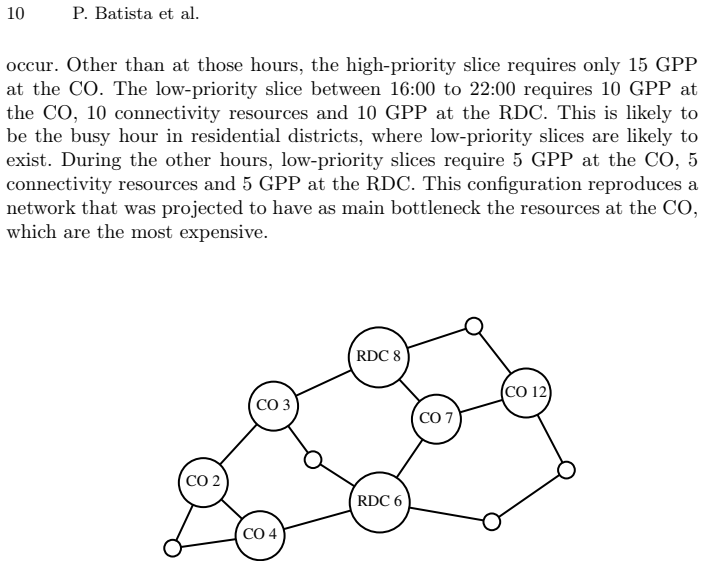
gr=80, gc=50, dl=50, 80 Erlangs, 600 arrivals
- Binomial noise trial count =
5 trials
- Policy network architecture and training budget =
4 hidden layers x 40 neurons, ReLU, 10,000 iterations, 25 episodes per iteration
assumptions (5)
- domain assumption The network model, topology, and slice reference profiles are taken from Raza et al. [10, 11, 12] and treated as valid without revalidation.
- ad hoc to paper Resource request noise is modeled as a Binomial(5, u_t) draw subtracted from each reference profile, with tenant-dependent u_t.
- domain assumption SLA violation penalties scale linearly with tenant penalty weight v_t and with the magnitude of the resource shortfall.
- domain assumption The revenue for a slice is a fixed amount agreed at admission based on slice parameters, and revenue loss from rejection equals the revenue that would have been generated.
- domain assumption The RL training schedule (10,000 iterations, 25 episodes per iteration, 80 Erlangs, 600 arrivals per episode) is assumed adequate for convergence.
Cite this review
Pith. "Pith review of Tenant-Aware Slice Admission Control using Neural Networks-Based Policy Agent." pith.science (2026). https://pith.science/paper/M32GSEX4
@misc{pith2026190807494,
  author       = {Pith},
  title        = {Pith review of: Tenant-Aware Slice Admission Control using Neural Networks-Based Policy Agent},
  year         = {2026},
  howpublished = {\url{https://pith.science/paper/M32GSEX4}},
  note         = {Machine review of arXiv:1908.07494}
}
read the original abstract
5G networks will provide the platform for deploying large number of tenant-associated management, control and end-user applications having different resource requirements at the infrastructure level. In this context, the 5G infrastructure provider must optimize the infrastructure resource utilization and increase its revenue by intelligently admitting network slices that bring the most revenue to the system. In addition, it must ensure that resources can be scaled dynamically for the deployed slices when there is a demand for them from the deployed slices. In this paper, we present a neural networks-driven policy agent for network slice admission that learns the characteristics of the slices deployed by the network tenants from their resource requirements profile and balances the costs and benefits of slice admission against resource management and orchestration costs. The policy agent learns to admit the most profitable slices in the network while ensuring their resource demands can be scaled elastically. We present the system model, the policy agent architecture and results from simulation study showing an increased revenue for infra-structure provider compared to other relevant slice admission strategies.
Figures


Figures from the paper (4 more)

Reference graph
Works this paper leans on
-
[1]
An Introduction, Benefits, Enablers, Challen ges & Call for 14 P
AT&T, BT, CenturyLink, Mobile, C., Colt, Telekom, D., KDD I, NTT, Orange, Italia, T., Telefonica, Telstra, Verizon: Network Functions Vir- tualisation. An Introduction, Benefits, Enablers, Challen ges & Call for 14 P. Batista et al. Action. Tech. rep., SDN and OpenFlow World Congress (Oct 201 2), https://portal.etsi.org/nfv/nfv_white_paper.pdf
-
[2]
In: IEEE INFOCOM 2017 - IEEE Conference on Computer Comm unications
Bega, D., Gramaglia, M., Banchs, A., Sciancalepore, V., S amdanis, K., Costa- Perez, X.: Optimising 5G infrastructure markets: The busin ess of network slic- ing. In: IEEE INFOCOM 2017 - IEEE Conference on Computer Comm unications. pp. 1–9 (May 2017). https://doi.org/10.1109/INFOCOM.201 7.8057045
-
[3]
IEEE Transactions on Wireless Communications 17(10), 6419–6432 (Oct 2018)
Caballero, P., Banchs, A., de Veciana, G., Costa-Perez, X ., Azcorra, A.: Network Slicing for Guaranteed Rate Services: Admission Control an d Resource Allocation Games. IEEE Transactions on Wireless Communications 17(10), 6419–6432 (Oct 2018). https://doi.org/10.1109/TWC.2018.2859918
-
[4]
Dahmen-Lhuissier, S.: Open Source MANO (Dec 2018), https://www.etsi.org/technologies-clusters/technologies/nfv/open-source-mano
work page 2018
-
[5]
Gomes, P., Vidal, A., Lins, S.: Next stop: Zero- touch automation standardization (Nov 2018), https://www.ericsson.com/research-blog/next-stop-zero-touch-automation-standardization/
work page 2018
-
[6]
Han, B., Feng, D., Schotten, H.D.: A Markov Model of Slice Admission Control. IEEE Networking Letters pp. 1–1 (2018). https://doi.org/10.1109/LNET.2018.2873978
arXiv 2018
-
[7]
Mao, H., Alizadeh, M., Menache, I., Kandula, S.: Resource Manage- ment with Deep Reinforcement Learning. pp. 50–56. ACM Press (2016). https://doi.org/10.1145/3005745.3005750
arXiv 2016
-
[8]
IEEE Communications Magazine 56(8), 78–84 (Aug 2018)
Oliva, A., Li, X., Costa-Perez, X., Bernardos, C.J., Bert in, P., Iovanna, P., Deiss, T., Mangues, J., Mourad, A., Casetti, C., Gonzalez, J .E., Azcorra, A.: 5G-TRANSFORMER: Slicing and Orchestrating Transport Netw orks for In- dustry Verticals. IEEE Communications Magazine 56(8), 78–84 (Aug 2018). https://doi.org/10.1109/MCOM.2018.1700990
Show all 15 references
-
[9]
ONAP: ONAP Architecture Overview. Tech. rep. (Dec 2018), https://www.onap.org/wp-content/uploads/sites/20/2018/06/ONAP_CaseSolution_Architecture_0618FNL.pdf
2018
-
[10]
In: 2018 European Conference on Optical Communication (ECOC)
Raza, M.R., Natalino, C., Öhlen, P., Wosinska, L., Monti , P.: A Slice Admis- sion Policy Based on Reinforcement Learning for a 5G Flexibl e RAN. In: 2018 European Conference on Optical Communication (ECOC). pp. 1 –3 (Sep 2018). https://doi.org/10.1109/ECOC.2018.8535483
2018
-
[11]
In: 2017 European Conference o n Optical Communi- cation (ECOC)
Raza, M.R., Rostami, A., Vidal, A., Santos, M.A.S., Wosi nska, L., Monti, P.: Priority-Aware Service Orchestration Using Big Data Analy tics for Dynamic Slic- ing in 5G Transport Networks. In: 2017 European Conference o n Optical Communi- cation (ECOC). pp. 1–3 (Sep 2017). htt...
2017
-
[12]
In: 2018 Eu ropean Con- ference on Optical Communication (ECOC)
Raza, M.R., Rostami, A., Wosinska, L., Monti, P.: Resour ce Orchestration Meets Big Data Analytics: The Dynamic Slicing Use Case. In: 2018 Eu ropean Con- ference on Optical Communication (ECOC). pp. 1–3. IEEE, Rom e (Sep 2018). https://doi.org/10.1109/ECOC.2018.8535581
2018
-
[13]
IEEE Communications M agazine 54(7), 32–39 (Jul 2016)
Samdanis, K., Costa-Perez, X., Sciancalepore, V.: From network sharing to multi- tenancy: The 5G network slice broker. IEEE Communications M agazine 54(7), 32–39 (Jul 2016). https://doi.org/10.1109/MCOM.2016.75 14161
2016 doi
-
[14]
In: IEEE INFOCOM 2017 - IEEE Conference on Comp uter Commu- nications
Sciancalepore, V., Samdanis, K., Costa-Perez, X., Bega , D., Gramaglia, M., Banchs, A.: Mobile traffic forecasting for maximizing 5G netw ork slicing resource utilization. In: IEEE INFOCOM 2017 - IEEE Conference on Comp uter Commu- nications. pp. 1–9 (May 2017). https://doi.org/...
2017
-
[15]
IEEE/A CM Transactions on Networking pp
Zheng, J., Caballero, P., de Veciana, G., Baek, S.J., Ban chs, A.: Statistical Multi- plexing and Traffic Shaping Games for Network Slicing. IEEE/A CM Transactions on Networking pp. 1–14 (2018). https://doi.org/10.1109/T NET.2018.2870184
2018
Reviewed August 14, 2026 · model on record in the stance chip above.
Discussion (0). Continue with ORCID to comment.