Dynamic multi-focus laser writing with acousto-optofluidics
Pith reviewed 2026-05-24 18:53 UTC · model grok-4.3
The pith
Ultrasound waves in a liquid diffract a laser beam into multiple tunable foci with sub-microsecond control.
A machine-rendered reading of the paper's core claim, the machinery that carries it, and where it could break.
Core claim
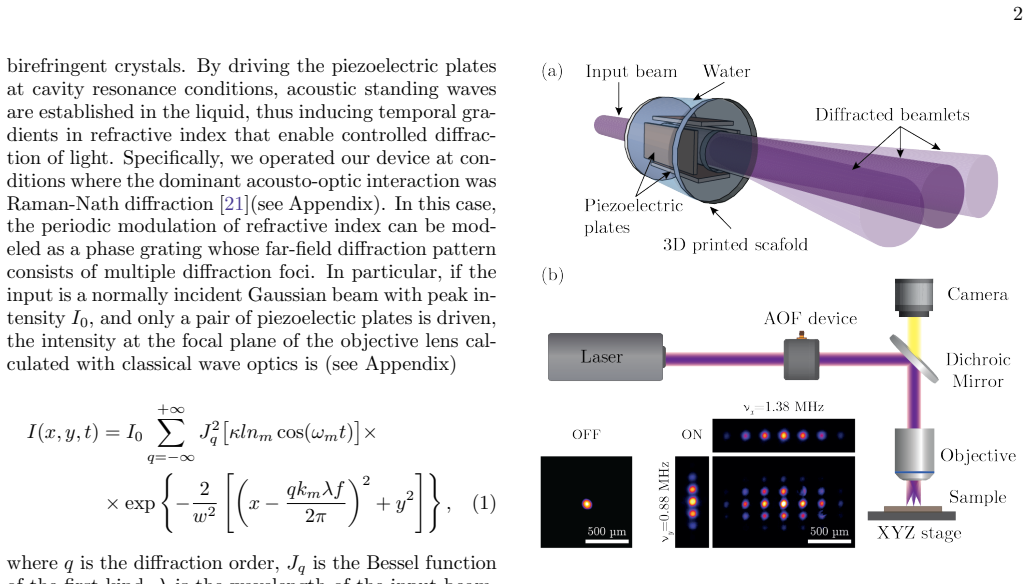
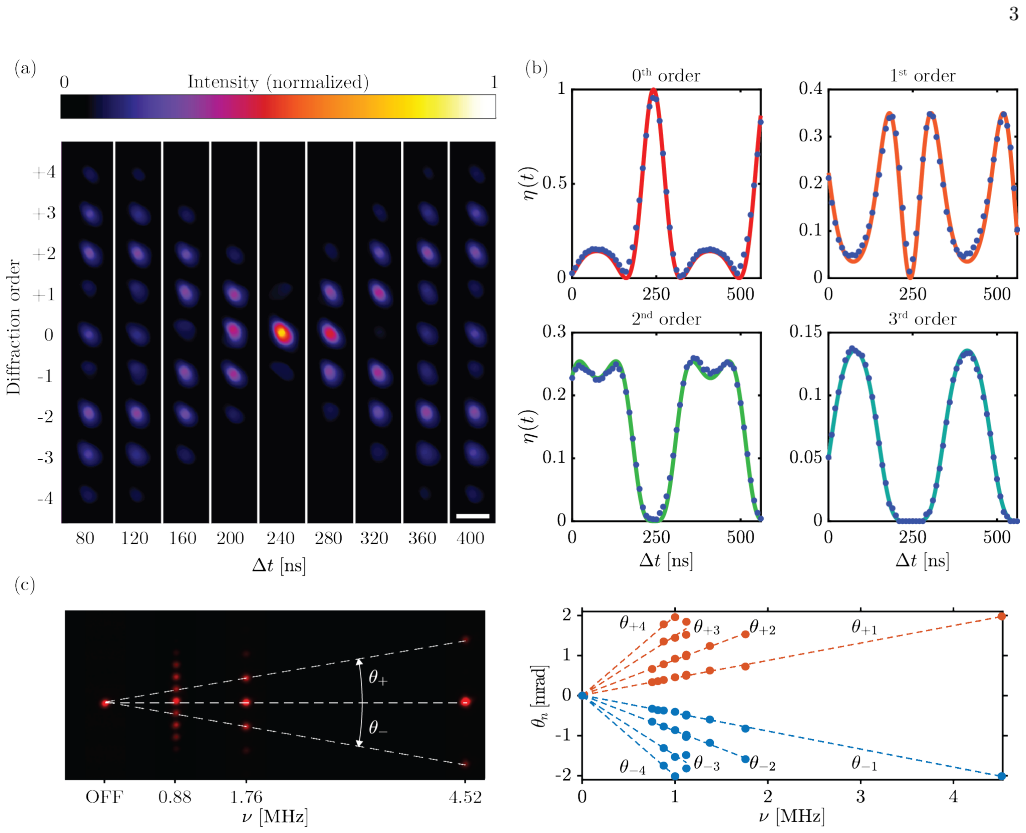
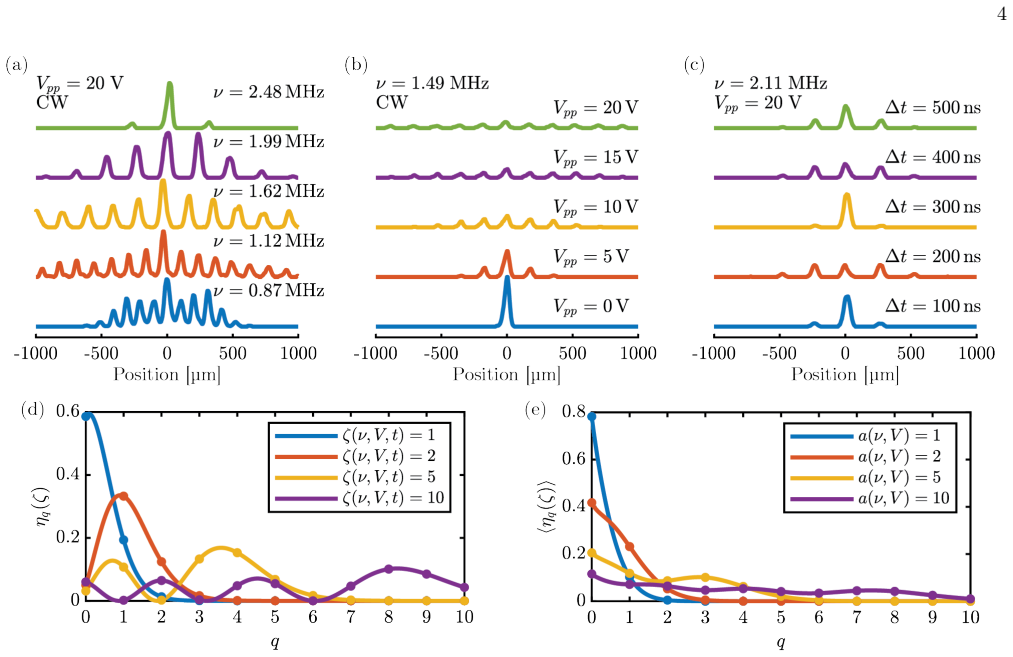
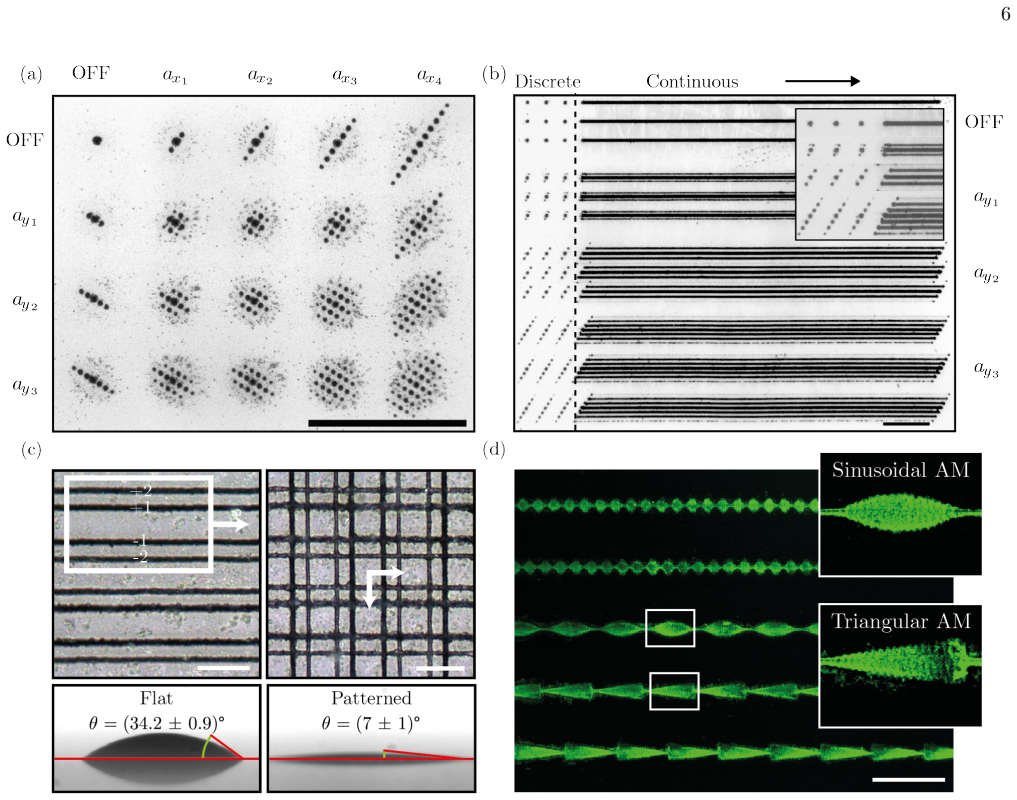
Ultrasound waves propagating in a liquid diffract an incoming laser into multiple beamlets whose distribution can be tuned by changing the amplitude, frequency, or phase of the ultrasound, achieving control times below one microsecond; when the sample is translated, this dynamic splitting enables high-throughput laser processing as shown by local modification of morphology and wettability on metals, polymers, and ceramics.
What carries the argument
Acousto-optofluidic diffraction, where ultrasound in a liquid acts as a tunable grating to split the laser light into multiple foci.
If this is right
- Sequential single-beam scanning can be replaced by parallel multi-focus writing.
- Multi-focus distributions can be adjusted in sub-microsecond times.
- High-throughput processing is possible across metals, polymers, and ceramics.
- Local changes to morphology and wettability can be achieved at higher speeds.
Where Pith is reading between the lines
- Similar acousto-optofluidic splitting could be applied to imaging systems for faster scanning.
- Optical trapping setups might benefit from rapid multi-particle manipulation using the same principle.
- Integration challenges with translation stages may limit applicability to certain high-precision tasks.
Load-bearing premise
The liquid and transducer can be combined with moving the sample without losing enough beam quality or focus stability to still produce the desired material changes.
What would settle it
A direct measurement showing that the laser spots lose focus or intensity too much during sample translation to achieve consistent morphological changes on the tested materials.
Figures
read the original abstract
Laser writing of materials is normally performed by the sequential scanning of a single focused beam across a sample. This process is time-consuming and it can severely limit the throughput of laser systems in key applications such as surgery, microelectronics, or manufacturing. Here we report a parallelization strategy based on ultrasound waves in a liquid to diffract light into multiple beamlets. Adjusting amplitude, frequency, or phase of ultrasound allows tunable multi-focus distributions with sub-microsecond control. When combined with sample translation, the dynamic splitting of light leads to high-throughput laser processing, as demonstrated by locally modifying the morphological and wettability properties of metals, polymers, and ceramics. The results illustrate how acousto-optofluidic systems are universal tools for fast multi-focus generation, with potential impact in fields such as imaging or optical trapping.
Editorial analysis
A structured set of objections, weighed in public.
Referee Report
Summary. The manuscript describes an acousto-optofluidic technique in which ultrasound waves in a liquid cell diffract an incident laser beam into multiple tunable foci. Control of ultrasound amplitude, frequency, or phase enables sub-microsecond reconfiguration of the multi-focus pattern. When this dynamic splitting is combined with sample translation, the approach is claimed to enable high-throughput laser processing, demonstrated by morphological and wettability modifications on metals, polymers, and ceramics via SEM, AFM, and contact-angle measurements.
Significance. If validated, the method provides a compact, electronically tunable route to parallel laser writing that avoids fixed diffractive optics or mechanical scanners. The experimental demonstrations across three material classes support versatility, and the sub-microsecond response follows directly from acoustic timescales. The work supplies concrete optical and material data, but the absence of quantitative throughput metrics (processing rate, area coverage, or benchmark comparisons) limits evaluation of the claimed high-throughput advantage.
major comments (1)
- [Results] Results section on translated exposures: the central high-throughput claim is supported only by qualitative SEM/AFM images and contact-angle data showing local modifications; no measured processing speeds (e.g., mm²/s), error bars on coverage rates, or direct comparison to single-beam scanning are reported. This quantitative gap is load-bearing for the assertion that dynamic splitting plus translation yields high throughput.
minor comments (2)
- [Experimental Setup] Experimental Setup: transducer driving electronics and liquid-cell alignment tolerances are described at a high level; additional parameters (e.g., acoustic power calibration, beam quality after cell traversal) would aid reproducibility.
- [Figures] Figure captions: several multi-focus pattern images lack intensity scale bars or quantitative line profiles, making it difficult to assess focus uniformity and contrast.
Simulated Author's Rebuttal
We thank the referee for their review and constructive feedback. We address the single major comment below.
read point-by-point responses
-
Referee: [Results] Results section on translated exposures: the central high-throughput claim is supported only by qualitative SEM/AFM images and contact-angle data showing local modifications; no measured processing speeds (e.g., mm²/s), error bars on coverage rates, or direct comparison to single-beam scanning are reported. This quantitative gap is load-bearing for the assertion that dynamic splitting plus translation yields high throughput.
Authors: We agree that the high-throughput assertion would be strengthened by quantitative metrics. The manuscript emphasizes the acousto-optofluidic mechanism and sub-microsecond tunability, with the translated-exposure results serving as proof-of-principle demonstrations across materials. In revision we will add explicit calculations of areal processing rate (using the reported translation speeds and number of foci), error bars on coverage estimates, and a direct comparison to equivalent single-beam scanning under the same laser parameters. revision: yes
Circularity Check
No significant circularity; purely experimental demonstration
full rationale
The manuscript is an experimental report on acousto-optofluidic multi-focus generation and material processing. No equations, derivations, fitted parameters, or predictive models appear in the abstract or described sections. All claims (tunable beamlets via ultrasound amplitude/frequency/phase, sub-microsecond control, high-throughput processing via translation, and morphological/wettability changes) rest on direct experimental observations (SEM/AFM/contact-angle data across metals/polymers/ceramics) rather than any reduction to self-defined inputs or self-citations. The acoustic response time provides an independent physical basis for the timing claim, with no load-bearing self-referential steps.
Axiom & Free-Parameter Ledger
Reference graph
Works this paper leans on
-
[1]
Solution of the wave equation in the acoustic cavity Propagation of acoustic waves in a viscous medium, water in our case, is governed by the damped acoustic wave equation [20, 31], which for a single axis can be written as ∂2ρ ∂t2− ∂2 ∂x2 ( ν ∂ρ ∂t + c2 sρ ) = 0, (A1) where ν is the kinematic viscosity of water,cs is the speed of sound in water and ρ is ...
-
[2]
to convert the variations of density into variations of refractive index: n(ρm) = n0 + ∂n ∂ρ ⏐⏐⏐⏐ ρ0 ρm = n0 + n4 0 + n2 0− 2 6n0 ρm ρ0 , (A4) where n0 and ρ0 are, respectively, the static refractive index and density of water. Combining equations A3 and A4 it is possible to obtain an analytic expression for the instantaneous refractive index in the cavit...
-
[3]
Acousto-optic interaction regime To determine the type of diffraction that occurs when a beam passes through the AOF device, we can use the Klein-Cook parameter defined as [32]: Q = 2πλl n0Λ2 (A6) being λ the wavelength of the laser beam, l the length of the piezoelectric plate (≈ 2 cm in current design), and Λ the wavelength of the acoustic wave. Consideri...
-
[4]
Calculation of the diffraction intensity The equation of a Gaussian beam traveling along the z-axis is given by E(r, z) = E0 w0 w(z) exp [−(r− r0)2 w2(z) ] × × exp [ −i ( κz + κ r2 2R(z)− ψ(z) )] (A7) where w0 is the beam waist, w the beam width, κ is the wave number, R is the radius of curvature, and ψ is the Guoy phase factor. The optical path length tra...
-
[5]
Measurement of the change in refractive index The good agreement between experimental results and model allowed us to calculate the change in refractive in- dex induced in the cavity. From the temporal character- ization of the AOF device, we obtained the intensity of each diffracted order as a function of time (Figure 2b) in the main text). By using equat...
-
[6]
T. C. Chong, M. H. Hong, and L. P. Shi, Laser precision engineering: From microfabrication to nanoprocessing, Laser & Photonics Reviews 4, 123 (2010)
work page 2010
-
[7]
M. Duocastella and C. B. Arnold, Bessel and annular beams for materials processing, Laser & Photonics Re- views 6, 607 (2012)
work page 2012
-
[8]
R. Osellame, H. J. Hoekstra, G. Cerullo, and M. Pollnau, Femtosecond laser microstructuring: An enabling tool for optofluidic lab-on-chips, Laser & Photonics Reviews 5, 442 (2011)
work page 2011
-
[9]
A. Piqu´ e, R. C. Auyeung, H. Kim, N. A. Charipar, and S. A. Mathews, Laser 3D micro-manufacturing, Journal of Physics D: Applied Physics 49, 223001 (2016)
work page 2016
- [10]
-
[11]
C. Eggeling, A. Chmyrov, S. W. Hell, T. Grotjohann, M. Ratz, S. Jakobs, J. Keller, and E. d’Este, Nanoscopy with more than 100,000 ’doughnuts’, Nature Methods10, 737 (2013)
work page 2013
-
[12]
Y. Kuroiwa, N. Takeshima, Y. Narita, S. Tanaka, and K. Hirao, Arbitrary micropatterning method in femtosec- ond laser microprocessing using diffractive optical ele- ments, Optics Express 12, 1908 (2004)
work page 1908
- [13]
- [14]
-
[15]
M. A. Dugan, J. X. Tull, and W. S. Warren, High- resolution acousto-optic shaping of unamplified and am- plified femtosecond laser pulses, Journal of the Optical Society of America B 14, 2348 (1997)
work page 1997
-
[16]
T. H¨ afner, J. Strauß, C. Roider, J. Heberle, and M. Schmidt, Tailored laser beam shaping for efficient and accurate microstructuring, Applied Physics A: Materials Science and Processing 124, 10.1007/s00339-017-1530-0 (2018)
- [17]
-
[18]
B. Sun, P. S. Salter, C. Roider, A. Jesacher, J. Strauss, J. Heberle, M. Schmidt, and M. J. Booth, Four- dimensional light shaping: Manipulating ultrafast spa- tiotemporal foci in space and time, Light: Science and Applications 7, 17117 (2018)
work page 2018
-
[19]
K. An, S. Hong, S. Han, H. Lee, J. Yeo, and S. H. Ko, Selective sintering of metal nanoparticle ink for maskless fabrication of an electrode micropattern using a spatially modulated laser beam by a digital micromirror device, ACS Applied Materials and Interfaces 6, 2786 (2014)
work page 2014
-
[20]
Q. Geng, D. Wang, P. Chen, and S. C. Chen, Ultrafast multi-focus 3-D nano-fabrication based on two-photon polymerization, Nature Communications 10, 1 (2019)
work page 2019
- [21]
-
[22]
L. Kong, J. Tang, J. P. Little, Y. Yu, T. L¨ ammermann, C. P. Lin, R. N. Germain, and M. Cui, Continuous vol- umetric imaging via an optical phase-locked ultrasound lens, Nature Methods 12, 759 (2015)
work page 2015
-
[23]
M. Duocastella and C. B. Arnold, Enhanced depth of field laser processing using an ultra-high-speed axial scanner, Applied Physics Letters 102, 061113 (2013)
work page 2013
-
[24]
T.-H. Chen, R. Fardel, and C. B. Arnold, Ultrafast z- scanning for high-efficiency laser micro-machining, Light: Science & Applications 7, 17181 (2018)
work page 2018
-
[25]
S. Surdo and M. Duocastella, Fast Acoustic Light Sculpt- ing for On-demand Maskless Lithography, Advanced Sci- ence , 1900304 (2019)
work page 2019
-
[26]
Y. Ohtsuka, Y. Arima, and Y. Imai, Acoustooptic 2-D profile shaping of a Gaussian laser beam, Applied Optics 24, 2813 (1985)
work page 1985
-
[27]
Maydan, Acoustooptical pulse modulators, IEEE Journal of Quantum Electronics 6, 15 (1970)
D. Maydan, Acoustooptical pulse modulators, IEEE Journal of Quantum Electronics 6, 15 (1970)
work page 1970
-
[28]
R. V. Johnson, Temporal response of the acoustooptic modulator in the high scattering efficiency regime, Ap- plied Optics 18, 903 (1979)
work page 1979
-
[29]
R. N. Wenzel, Resistance of solid surfaces to wetting by water, Industrial & Engineering Chemistry 28, 988 (1936)
work page 1936
- [30]
- [31]
-
[32]
S. Hong, J. Yeo, G. Kim, D. Kim, H. Lee, J. Kwon, H. Lee, P. Lee, and S. H. Ko, Nonvacuum , Maskless Fabrication of a Flexible Metal Grid Transparent Con- ductor by Low-Temperature Selective Laser Sintering of Nanoparticle Ink, ACS Nano 7, 5024 (2013)
work page 2013
-
[33]
J. Fischer and M. Wegener, Three-dimensional optical laser lithography beyond the diffraction limit, Laser & Photonics Reviews 7, 22 (2013)
work page 2013
-
[34]
D. Trypogeorgos, T. Harte, A. Bonnin, and C. Foot, Pre- cise shaping of laser light by an acousto-optic deflector, Optics Express 21, 8619 (2013)
work page 2013
-
[35]
J. H. Cantrell, L. Adler, and W. T. Yost, Subharmonic generation, chaos, and subharmonic resurrection in an acoustically driven fluid-filled cavity, Chaos 25, 023115 (2015)
work page 2015
-
[36]
E. McLeod and C. B. Arnold, Mechanics and refractive power optimization of tunable acoustic gradient lenses, Journal of Applied Physics 102, 1 (2007)
work page 2007
-
[37]
W. R. Klein and B. D. Cook, Unified Approach to Ul- trasonic Light Diffraction, IEEE Transactions on Sonics and Ultrasonics 14, 123 (1967)
work page 1967
-
[38]
C. V. Raman and N. S. Nagendra Nath, The diffraction of light by high frequency sound waves: Part I, Proceedings of the Indian Academy of Sciences - Section A 2, 406 (1935)
work page 1935
-
[39]
Svelto, Principles of Lasers , 5th ed
O. Svelto, Principles of Lasers , 5th ed. (Springer Verlag, 2009)
work page 2009
-
[40]
Goodman, Introduction To Fourier Optics , 4th ed
J. Goodman, Introduction To Fourier Optics , 4th ed. (W.H. Freeman, 2017)
work page 2017
discussion (0)
Sign in with ORCID, Apple, or X to comment. Anyone can read and Pith papers without signing in.