REVIEW 3 major objections 6 minor 45 references
A Geometry-based Stochastic Wireless Channel Model using Generative Neural Networks
T0 review · 3 major / 6 minor · reviewed 2026-08-04 · deepseek-v4-flash
Pith's one-line read A conditional WGAN-GP trained on channel parameters rendered as images can reproduce the joint statistics of ray-traced multipath channels, including path correlations, and interpolate to unseen distances, offering a data-efficient substitu
desk verdict Useful data-to-image trick for generative channel modeling, but the headline fidelity and interpolation claims rest on EM distances computed on synthetic padding. read the letter →
The pith
A machine-rendered reading of the paper's core claim, the machinery that carries it, and where it could break.
The reading
What carries the argument
The central mechanism is the data-to-image mapping. Each normalized 8x25 channel parameter matrix is enlarged by duplicating every element twice horizontally and eight times vertically, with three image channels, yielding a 64x50 image in which early convolutional kernels operate on homogeneous blocks of a single physical parameter; this exploits the texture bias of convolutional networks to learn correlations among paths. Links with fewer than 25 paths are padded with virtual paths, whose pathloss values are drawn from U(180,200) as a removable marker, and after generation virtual paths are dropped by thresholding pathloss at 180 dB. The stochastic engine is a conditional WGAN-GP—a Wasserst
What would settle it
Take a ray-tracing database from a scenario where some links have more than 25 paths or some real paths exceed 180 dB pathloss, train the same channel-image WGAN-GP on it, and compare EM distances, CDFs, and correlation matrices against the raw data; if the mismatch concentrates in those links, the fixed matrix size and threshold assumption is the cause. A simpler check is to count, in the original ray-tracing output, how often the 180 dB cutoff removes a real path or a link has more than 25 paths.
Extended reading notes
Core claim
The paper claims that representing each link's channel parameters as an image lets a conditional Wasserstein generative adversarial network with gradient penalty learn the full joint distribution of multipath components. Each link's parameters are arranged in an 8x25 matrix—pathloss, delay, departure and arrival angles, phase, and link state—and each entry is duplicated into a homogeneous block to form a 64x50 image, so convolutional kernels first see one physical parameter at a time. Trained on 602,770 ray-traced links in a dense urban area at 12 GHz, conditioned on 2D distance and receiver height, the generator's outputs match the original data in EM distance, CDFs, link-state probabilitie
Load-bearing premise
The method assumes every link in the target scenario has at most 25 resolvable paths and no real path has pathloss above 180 dB, so the virtual padding and the 180 dB removal rule cleanly separate synthetic entries from real multipath components.
Editorial extensions
If this is right
- The trained generator can produce stochastic channel realizations for any link in the studied area without re-running the ray tracer, enabling fast site-specific link- and system-level simulations.
- The model reproduces correlations among multipath components, something fully connected generative baselines fail to do, so coverage and interference studies that depend on those correlations should be more accurate.
- The model synthesizes statistically faithful channels for held-out 2D distance conditions, and finer partitioning of the condition range improves interpolation even when the training budget is held fixed.
- The data-to-image mapping is independent of propagation environment, so the same recipe can be combined with other generative model families, such as conditional variational autoencoders or diffusion models, to build GBSMs from other geometry-specific channel databases.
Reading between the lines
- The interpolation result suggests that, for a fixed ray-tracing budget, how densely the condition space is sampled may matter more than how many links are collected per condition; this could be tested by deliberately thinning a dataset along one condition axis.
- Because the whole pipeline depends on the 25-path cap and the 180 dB pathloss threshold, applying it to very reflective indoor environments, extreme near-field links, or higher frequencies would require re-checking whether real paths are being discarded or synthetic padding is leaking into the statistics.
- The texture-bias explanation predicts that the duplication factors and the spatial layout of parameters in the image are not arbitrary; ablating the duplication ratio or reordering rows should measurably change correlation fidelity, which would provide a direct test of the proposed mechanism.
Signed reviews
Editorial analysis
A structured set of objections, weighed in public.
Referee Report
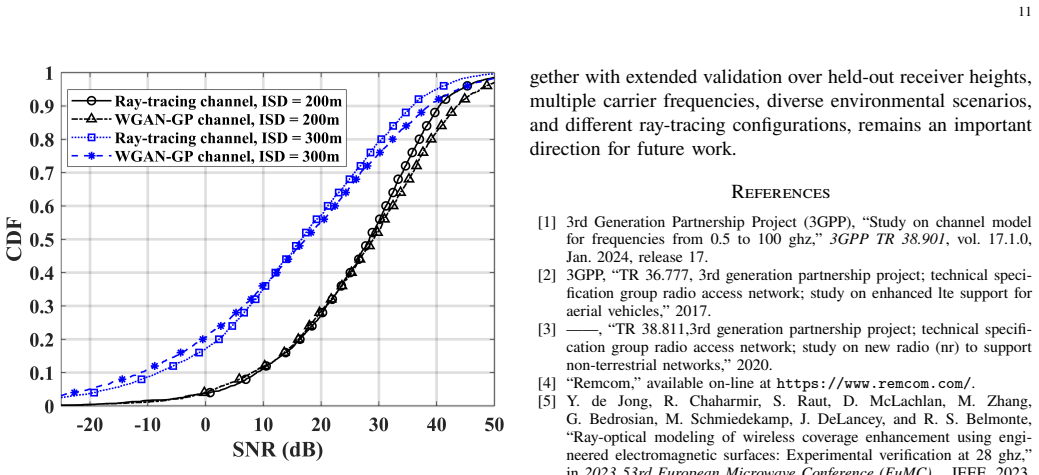
Summary. The manuscript proposes a geometry-based stochastic channel model (GBSM) built on a conditional WGAN-GP. Ray-tracing channel parameters per link (pathloss, delay, departure/arrival angles, phase, link state) are arranged into an 8×25 matrix, padded with "virtual paths" (pathloss sampled from U(180,200), other features from U(min,max)), normalized, and expanded into 3×64×50 images by duplication. A conditional WGAN-GP with convolutional generator and critic is trained on these images conditioned on 2D distance and RX height. After generation, images are downsampled, inverse-transformed, the LOS first column is replaced deterministically, and virtual paths are removed using a 180 dB pathloss threshold. The paper evaluates the model with EM distance, CDFs, link-state probabilities, angular PDFs, RMS spreads, correlation matrices (CMD), a distance-based held-out interpolation experiment, and system-level SNR simulations in Herald Square, claiming that the model faithfully represents joint distributions and reliably interpolates across held-out conditions.
Significance. If the central claims held, the contribution would be practically useful: a data-to-image mapping that lets CNN-based GANs capture multipath correlations, demonstrated on a realistic 602,770-link ray-tracing case study and compared against FC WGAN-GP and CVAE baselines. Strengths include the reproducible code link, detailed architecture and hyperparameter reporting, the equal-mass binning protocol for the interpolation study, and the system-level drop-based evaluation. However, the main quantitative evidence for distributional fidelity is compromised by the inclusion of synthetic virtual padding in the EM-distance computation, and the threshold-based path-removal rule rests on unverified assumptions. These issues are fixable but currently leave the paper's headline claims unsupported.
major comments (3)
- [Section VII.A, Table III] The EM distance is computed "between the model outputs before the data reconstruction process and the original data after normalization." The normalized original data still contain the virtual paths introduced in Section III.B (pathloss drawn from U(180,200), other features from U(min,max), padded to 8×25). For a link with 13 paths, 12 of 25 columns are synthetic; averaging over links, the EM distance is dominated by the model's ability to imitate independent uniform padding rather than by its fidelity on real multipath components. The statement that the measured values are "negligible" is therefore not evidence that the real channel distributions are captured. Please recompute the metric after masking/removing virtual paths (using the known path count) and report EM distances on real paths only, together with the fraction of virtual entries.
- [Sections III.B and VI] The reconstruction removes "virtual paths ... when the pathloss values exceed the outage pathloss threshold (180 dB)." This rule is valid only if no real path has pathloss >180 dB and no link has more than 25 resolvable paths. The paper does not verify either condition from the ray-tracing output. If the assumptions fail, real paths are silently discarded and every subsequent comparison (CDFs, RMS spreads, correlation matrices, SNR) is biased. Report the empirical maximum number of paths per link and the empirical pathloss distribution near 180 dB, and justify the threshold from data rather than treating it as an axiom.
- [Section VII.G and Fig. 14] The interpolation evaluation reports only the normalized ratio EM(p)/EM(p=1). This is not interpretable without absolute EM distances on held-out conditions; a ratio of 1.4 may correspond to a small or large absolute error, and because the EM metric is the same padded-data metric as in Table III, the interpolation claim inherits the virtual-path contamination. In addition, while the held-out experiment varies 2D distance, Section VII.C claims "statistical interpolation with respect to RX heights" from a model trained on five discrete heights; no held-out height evaluation is provided, so that claim is unsupported. Please report absolute EM distances on real-path-only held-out samples and add a genuine held-out height experiment if the height-interpolation claim is retained.
minor comments (6)
- [Section III.B] The phrase "virtual values of the feature data d_i are sampled from U(min d_i, max d_i)" is ambiguous. Please clarify whether min/max are computed per link, per feature across the whole dataset, or per feature per height; this affects reproducibility.
- [Section VI] Using "negative critic loss close to 0" as the only training stopping criterion is not a reliable convergence diagnostic for GANs. Consider reporting a quantitative validation metric (e.g., real-path EM distance) or fixed epochs with early stopping on held-out data.
- [Figs. 5 and 6] The captions state "on all paths over all links" without specifying whether the CDF is over all individual paths or averaged per link, and whether virtual paths have been removed before plotting. Please clarify.
- [Section VII.F] The correlation analysis is restricted to the second-strongest path. This supports the baseline comparison but does not by itself substantiate "capturing the correlations among multipath components" across all paths. A multi-path correlation metric or additional path indices would strengthen the claim.
- [Section VIII] The explanation that "small gaps ... are due to the lack of randomization of the ray-tracing channel" is vague. Please state how many random BS/UE drops are used and report confidence intervals or error bars for the SNR CDFs.
- [General] There are numerous typographical artifacts (e.g., "difficulty", "V ary", "efficient") and inconsistent citation formatting. A careful proofread is needed before resubmission.
Circularity Check
No significant circularity: the paper reports an empirical generative-model validation, and the claimed results do not reduce to the model's inputs by construction.
full rationale
The paper's central claim is that a WGAN-GP trained on channel images reproduces the joint statistics of ray-tracing data and interpolates across held-out 2D distance conditions. This is an empirical claim supported by comparisons against the original data: per-parameter EM distances (Table III), CDFs, link-state probabilities, angular PDFs, RMS spreads, correlation-matrix distances, and system-level SNR CDFs. None of these metrics is defined in terms of the model's own outputs; they compare trained-model outputs to held-out or reference data. The data-to-image mapping and duplication preprocessing are design choices, not equations that presuppose the conclusion. The virtual-path padding with pathloss values in U(180,200) and the later removal threshold of 180 dB are an internal labeling convention; they could contaminate or bias fidelity estimates if real paths exceed 180 dB or links have more than 25 paths, but that is a correctness/robustness concern, not circular reasoning. The WGAN-GP training objective is the Wasserstein distance, and the reported EM distances are evaluated in the normalized domain between generated and original distributions; this is a legitimate external comparison rather than a tautology. The self-citations ([36], [41], [42]) provide context, a standard CMD definition, and simulation settings, respectively, and are not load-bearing for the central derivation. The conclusion openly states that validation is limited to a single scenario and carrier frequency, which is a stated limitation rather than an appeal to the paper's own prior results. Accordingly, no circular step can be exhibited, and the appropriate score is 0.
Assumptions & free parameters
free parameters (6)
- Maximum paths per link =
25
- Virtual pathloss sampling range and outage threshold =
U(180,200) / 180 dB
- Duplication factors =
8x vertical, 2x horizontal, 3 channels
- Delay scaling multiplier =
1e7
- Link state label epsilon =
small epsilon (not specified)
- Training hyperparameters =
lr=1e-4, Adam beta=(0.5,0.9), epochs=20, batch=256, latent dim=25
assumptions (9)
- standard math Wasserstein GAN theory: Kantorovich-Rubinstein duality and gradient penalty ensure the critic approximates EM distance.
- standard math Pearson correlation and correlation matrix distance are valid measures of joint distribution fidelity.
- domain assumption Ray-tracing simulation (Wireless Insite) provides accurate ground-truth channel parameters.
- domain assumption The MIMO channel matrix in Eq. 1 fully describes the channel when mutual coupling is ignored.
- domain assumption ITU material electrical properties at 12 GHz are correct for the Herald Square scene.
- ad hoc to paper Virtual paths sampled from per-feature uniform distributions preserve trainability and do not distort learned statistics.
- ad hoc to paper A pathloss threshold of 180 dB uniquely identifies virtual paths, i.e., no real path exceeds 180 dB.
- ad hoc to paper Every link has no more than 25 resolvable paths.
- ad hoc to paper Duplication-based images exploit CNN texture bias to capture multipath correlations.
invented entities (2)
-
Virtual paths
-
Channel images
Cite this review
Pith. "Pith review of A Geometry-based Stochastic Wireless Channel Model using Generative Neural Networks." pith.science (2026). https://pith.science/paper/M3VKLXJD
@misc{pith2026260801840,
  author       = {Pith},
  title        = {Pith review of: A Geometry-based Stochastic Wireless Channel Model using Generative Neural Networks},
  year         = {2026},
  howpublished = {\url{https://pith.science/paper/M3VKLXJD}},
  note         = {Machine review of arXiv:2608.01840}
}
read the original abstract
Due to the high complexity of geometry-deterministic wireless channel modeling and the difficulty in its implementation, geometry-based stochastic channel modeling (GBSM) approaches have been used to evaluate system performance of wireless communications. This paper introduces a new method to model a GBSM by training a generative neural network using images formed by channel parameters. Toward this end, we process the data of channel parameters in the form of images and train the generative neural networks where the convolutional layers are mainly employed to capture correlation among multipath components. Through a case study, we demonstrate that the use of channel images facilitates the training of the generative model and ensures that the model learns the correlations among multipath components. We show that the outputs of the generative model faithfully represent the joint distributions of the original data, and that the trained model reliably interpolates across held-out conditions not used during training, demonstrating its practical value as a data-efficient alternative to directly resampling the ray-tracing database. Furthermore, to corroborate applicability of the trained model, we run simple system-level simulations and show the results obtained from the trained model closely match those from the ray-tracing data. Therefore, the proposed model is expected to ease the burden of GBSM implementations with general wireless conditions and capture the statistical joint distributions of the original channel data.
Figures


Figures from the paper (11 more)


Reference graph
Works this paper leans on
-
[20]
Generative neural network channel modeling for millimeter-wave uav communication,
W. Xia, S. Rangan, M. Mezzavilla, A. Lozano, G. Geraci, V . Semkin, and G. Loianno, “Generative neural network channel modeling for millimeter-wave uav communication,” IEEE Transactions on Wireless Communications, 2022. 12
2022
-
[1]
Study on channel model for frequencies from 0.5 to 100 ghz,
3rd Generation Partnership Project (3GPP), “Study on channel model for frequencies from 0.5 to 100 ghz,” 3GPP TR 38.901 , vol. 17.1.0, Jan. 2024, release 17
2024
-
[2]
TR 36.777, 3rd generation partnership project; technical speci- fication group radio access network; study on enhanced lte support for aerial vehicles,
3GPP, “TR 36.777, 3rd generation partnership project; technical speci- fication group radio access network; study on enhanced lte support for aerial vehicles,” 2017
2017
-
[3]
TR 38.811,3rd generation partnership project; technical specifi- cation group radio access network; study on new radio (nr) to support non-terrestrial networks,
——, “TR 38.811,3rd generation partnership project; technical specifi- cation group radio access network; study on new radio (nr) to support non-terrestrial networks,” 2020
2020
-
[4]
“Remcom,” available on-line at https://www.remcom.com/
-
[5]
Ray-optical modeling of wireless coverage enhancement using engi- neered electromagnetic surfaces: Experimental verification at 28 ghz,
Y . de Jong, R. Chaharmir, S. Raut, D. McLachlan, M. Zhang, G. Bedrosian, M. Schmiedekamp, J. DeLancey, and R. S. Belmonte, “Ray-optical modeling of wireless coverage enhancement using engi- neered electromagnetic surfaces: Experimental verification at 28 ghz,” in 2023 53rd European Microwave Conference (EuMC) . IEEE, 2023, pp. 702–705
2023
-
[6]
Millimetre Waves:Modelling and Simulation to Engineer for Coverage,
Phil Vigneron, “Millimetre Waves:Modelling and Simulation to Engineer for Coverage,” August 2017. [Online]. Available: https: //its.ntia.gov/media/66446/vigneron_isart2017.pdf
2017
-
[7]
Yin and X
X. Yin and X. Cheng, Propagation channel characterization, parameter estimation, and modeling for wireless communications . John Wiley & Sons, 2016
2016
Show all 45 references
-
[8]
A statistical model of mobile-to-mobile land communication channel,
A. S. Akki and F. Haber, “A statistical model of mobile-to-mobile land communication channel,” IEEE transactions on vehicular technology , vol. 35, no. 1, pp. 2–7, 1986
1986
-
[9]
Modeling, analysis, and simulation of mimo mobile-to-mobile fading channels,
M. Patzold, B. O. Hogstad, and N. Y oussef, “Modeling, analysis, and simulation of mimo mobile-to-mobile fading channels,” IEEE Transac- tions on Wireless Communications , vol. 7, no. 2, pp. 510–520, 2008
2008
-
[10]
An adaptive geometry-based stochastic model for non-isotropic mimo mobile-to-mobile channels,
X. Cheng, C.-X. Wang, D. I. Laurenson, S. Salous, and A. V . Vasilakos, “An adaptive geometry-based stochastic model for non-isotropic mimo mobile-to-mobile channels,” IEEE transactions on wireless communica- tions, vol. 8, no. 9, pp. 4824–4835, 2009
2009
-
[11]
Space-time correlated mobile-to-mobile channels: Modelling and simulation,
A. G. Zajic and G. L. Stuber, “Space-time correlated mobile-to-mobile channels: Modelling and simulation,” IEEE Transactions on Vehicular Technology, vol. 57, no. 2, pp. 715–726, 2008
2008
-
[12]
Statistical characteristics of measured mimo wireless channel data and comparison to conventional models,
J. W. Wallace and M. A. Jensen, “Statistical characteristics of measured mimo wireless channel data and comparison to conventional models,” in IEEE 54th Vehicular Technology Conference. VTC Fall 2001. Pro- ceedings (Cat. No. 01CH37211) , vol. 2. IEEE, 2001, pp. 1078–1082
2001
-
[13]
Impact of clustering in statistical indoor propagation models on link capacity,
K.-H. Li, M. A. Ingram, and A. Van Nguyen, “Impact of clustering in statistical indoor propagation models on link capacity,” IEEE Transac- tions on Communications , vol. 50, no. 4, pp. 521–523, 2002
2002
-
[14]
Geometry- based stochastic channel model for high-speed railway communications,
L. Zhou, F. Luan, S. Zhou, A. F. Molisch, and F. Tufvesson, “Geometry- based stochastic channel model for high-speed railway communications,” IEEE Transactions on Vehicular Technology , vol. 68, no. 5, pp. 4353– 4366, 2019
2019
-
[15]
A geometry-based stochastic mimo model for vehicle-to-vehicle communications,
J. Karedal, F. Tufvesson, N. Czink, A. Paier, C. Dumard, T. Zemen, C. F. Mecklenbrauker, and A. F. Molisch, “A geometry-based stochastic mimo model for vehicle-to-vehicle communications,” IEEE transactions on wireless communications , vol. 8, no. 7, pp. 3646–3657, 2009
2009
-
[16]
Geometry-based stochastic channel model for two-story lobby environment at 10 ghz,
A. Roivainen, C. F. Dias, N. Tervo, V . Hovinen, M. Sonkki, and M. Latva-aho, “Geometry-based stochastic channel model for two-story lobby environment at 10 ghz,” IEEE transactions on antennas and propagation, vol. 64, no. 9, pp. 3990–4003, 2016
2016
-
[17]
A geometry-based stochastic channel model for the millimeter-wave band in a 3gpp high-speed train scenario,
J. Y ang, B. Ai, K. Guan, D. He, X. Lin, B. Hui, J. Kim, and A. Hrovat, “A geometry-based stochastic channel model for the millimeter-wave band in a 3gpp high-speed train scenario,” IEEE Transactions on Vehicular Technology, vol. 67, no. 5, pp. 3853–3865, 2018
2018
-
[18]
Generative- adversarial-network-based wireless channel modeling: Challenges and opportunities,
Y . Y ang, Y . Li, W. Zhang, F. Qin, P . Zhu, and C.-X. Wang, “Generative- adversarial-network-based wireless channel modeling: Challenges and opportunities,” IEEE Communications Magazine , vol. 57, no. 3, pp. 22– 27, 2019
2019
-
[19]
Mimo-gan: Generative mimo channel modeling,
T. Orekondy, A. Behboodi, and J. B. Soriaga, “Mimo-gan: Generative mimo channel modeling,” in ICC 2022-IEEE International Conference on Communications . IEEE, 2022, pp. 5322–5328
2022
-
[21]
Multi-frequency channel modeling for millimeter wave and thz wireless communication via generative adversarial networks,
Y . Hu, M. Yin, W. Xia, S. Rangan, and M. Mezzavilla, “Multi-frequency channel modeling for millimeter wave and thz wireless communication via generative adversarial networks,” in 2022 56th Asilomar Conference on Signals, Systems, and Computers . IEEE, 2022, pp. 670–676
2022
-
[22]
Channelgan: Deep learning- based channel modeling and generating,
H. Xiao, W. Tian, W. Liu, and J. Shen, “Channelgan: Deep learning- based channel modeling and generating,” IEEE Wireless Communica- tions Letters , vol. 11, no. 3, pp. 650–654, 2022
2022
-
[23]
Propagation channel modeling by deep learning techniques,
S. Seyedsalehi, V . Pourahmadi, H. Sheikhzadeh, and A. H. G. Foumani, “Propagation channel modeling by deep learning techniques,” arXiv preprint arXiv:1908.06767, 2019
1908 arXiv
-
[24]
Addressing posterior collapse with mutual information for improved variational neural ma- chine translation,
A. D. McCarthy, X. Li, J. Gu, and N. Dong, “Addressing posterior collapse with mutual information for improved variational neural ma- chine translation,” in Proceedings of the 58th Annual Meeting of the Association for Computational Linguistics , 2020, pp. 8512–8525
2020
-
[25]
Tse and P
D. Tse and P . Viswanath, Fundamentals of wireless communication . Cambridge university press, 2005
2005
-
[26]
R. W. Heath Jr. and A. Lozano, Foundations of MIMO Communication . Cambridge University Press, 2018
2018
-
[27]
Remcomm [online],
“Remcomm [online],” https://www.remcom.com, online; accessed 28 November 2022
2022
-
[28]
Imagenet-trained cnns are biased towards texture; in- creasing shape bias improves accuracy and robustness,
R. Geirhos, P . Rubisch, C. Michaelis, M. Bethge, F. A. Wichmann, and W. Brendel, “Imagenet-trained cnns are biased towards texture; in- creasing shape bias improves accuracy and robustness,” in International conference on learning representations , 2018
2018
-
[29]
Wasserstein generative ad- versarial networks,
M. Arjovsky, S. Chintala, and L. Bottou, “Wasserstein generative ad- versarial networks,” in International conference on machine learning . PMLR, 2017, pp. 214–223
2017
-
[30]
Generative adversarial nets,
I. Goodfellow, J. Pouget-Abadie, M. Mirza, B. Xu, D. Warde-Farley, S. Ozair, A. Courville, and Y . Bengio, “Generative adversarial nets,” Advances in neural information processing systems , vol. 27, 2014
2014
-
[31]
Villani et al
C. Villani et al. , Optimal transport: old and new . Springer, 2009, vol. 338
2009
-
[32]
Improved training of wasserstein gans,
I. Gulrajani, F. Ahmed, M. Arjovsky, V . Dumoulin, and A. C. Courville, “Improved training of wasserstein gans,” Advances in neural information processing systems, vol. 30, 2017
2017
-
[33]
Geometry-based stochastic wireless channel mod- eling GitHub repository,
“Geometry-based stochastic wireless channel mod- eling GitHub repository,” available on-line at https://github.com/sk8053/GeoStochasticChanModel
-
[34]
FCC seeks comment on maximizing efficient use of 12 GHz band,
FCC Technical Advisory Council, “FCC seeks comment on maximizing efficient use of 12 GHz band,” January
-
[35]
6G working group position paper,
——, “6G working group position paper,” August
-
[36]
Cellular wireless networks in the upper mid-band,
S. Kang, M. Mezzavilla, S. Rangan, A. Madanayake, S. B. Venkatakrish- nan, G. Hellbourg, M. Ghosh, H. Rahmani, and A. Dhananjay, “Cellular wireless networks in the upper mid-band,” IEEE Open Journal of the Communications Society , 2024
2024
-
[37]
Electrical characteristics of the surface of the earth,
ITU-R, “Electrical characteristics of the surface of the earth,” Geneva, Sep. 2021
2021
-
[38]
Effects of building materials and structures on radiowave prop- agation above about 100 mhz,
——, “Effects of building materials and structures on radiowave prop- agation above about 100 mhz,” Geneva, Sep. 2021
2021
-
[39]
Multipath propagation and parameterization of its characteristics,
ITU-R P .1407-6, “Multipath propagation and parameterization of its characteristics,” Jun 2017
2017
-
[40]
Correlation matrix distance, a meaningful measure for evaluation of non-stationary mimo channels,
M. Herdin, N. Czink, H. Ozcelik, and E. Bonek, “Correlation matrix distance, a meaningful measure for evaluation of non-stationary mimo channels,” in 2005 IEEE 61st Vehicular Technology Conference , vol. 1. IEEE, 2005, pp. 136–140
2005
-
[41]
Spatially consistent air-to-ground channel modeling via generative neural networks,
A. Giuliani, R. Nikbakht, G. Geraci, S. Kang, A. Lozano, and S. Rangan, “Spatially consistent air-to-ground channel modeling via generative neural networks,” IEEE Wireless Communications Letters , 2024
2024
-
[42]
Millimeter-wave uav coverage in ur- ban environments,
S. Kang, M. Mezzavilla, A. Lozano, G. Geraci, W. Xia, S. Rangan, V . Semkin, and G. Loianno, “Millimeter-wave uav coverage in ur- ban environments,” in 2021 IEEE Global Communications Conference (GLOBECOM). IEEE, 2021, pp. 1–6
2021
-
[43]
Study of Radio Frequency (RF) and Electromagnetic Compati- bility (EMC) requirements for Active Antenna Array System (AAS) base station,
3GPP, “Study of Radio Frequency (RF) and Electromagnetic Compati- bility (EMC) requirements for Active Antenna Array System (AAS) base station,” TS 37.840
-
[2021]
Available: https://www.fcc.gov/document/fcc-seeks- comment-maximizing-efficient-use-12-ghz-band
[Online]. Available: https://www.fcc.gov/document/fcc-seeks- comment-maximizing-efficient-use-12-ghz-band
-
[2023]
Available: https://www.fcc.gov/sites/default/files/ Consolidated_6G_Paper_FCCTAC23_Final_for_Web.pdf
[Online]. Available: https://www.fcc.gov/sites/default/files/ Consolidated_6G_Paper_FCCTAC23_Final_for_Web.pdf
Reviewed August 4, 2026 · model on record in the stance chip above.
Discussion (0). Continue with ORCID to comment.