REVIEW 2 major objections 3 minor 18 references
The ${\rm BMO}\to{\rm BLO}$ action of the maximal operator on $\alpha$-trees
T0 review · 2 major / 3 minor · reviewed 2026-08-14 · deepseek-v4-flash
Pith's one-line read The paper proves that the BMO-to-BLO norm of the dyadic maximal operator is 1 in every dimension, via an explicit Bellman function and an optimizing sequence.
desk verdict A serious paper with a real upper-bound result and a load-bearing gap in the sharpness proof: Lemma 3.4's pasting argument does not preserve the BMO bound. read the letter →
The pith
A machine-rendered reading of the paper's core claim, the machinery that carries it, and where it could break.
The reading
What carries the argument
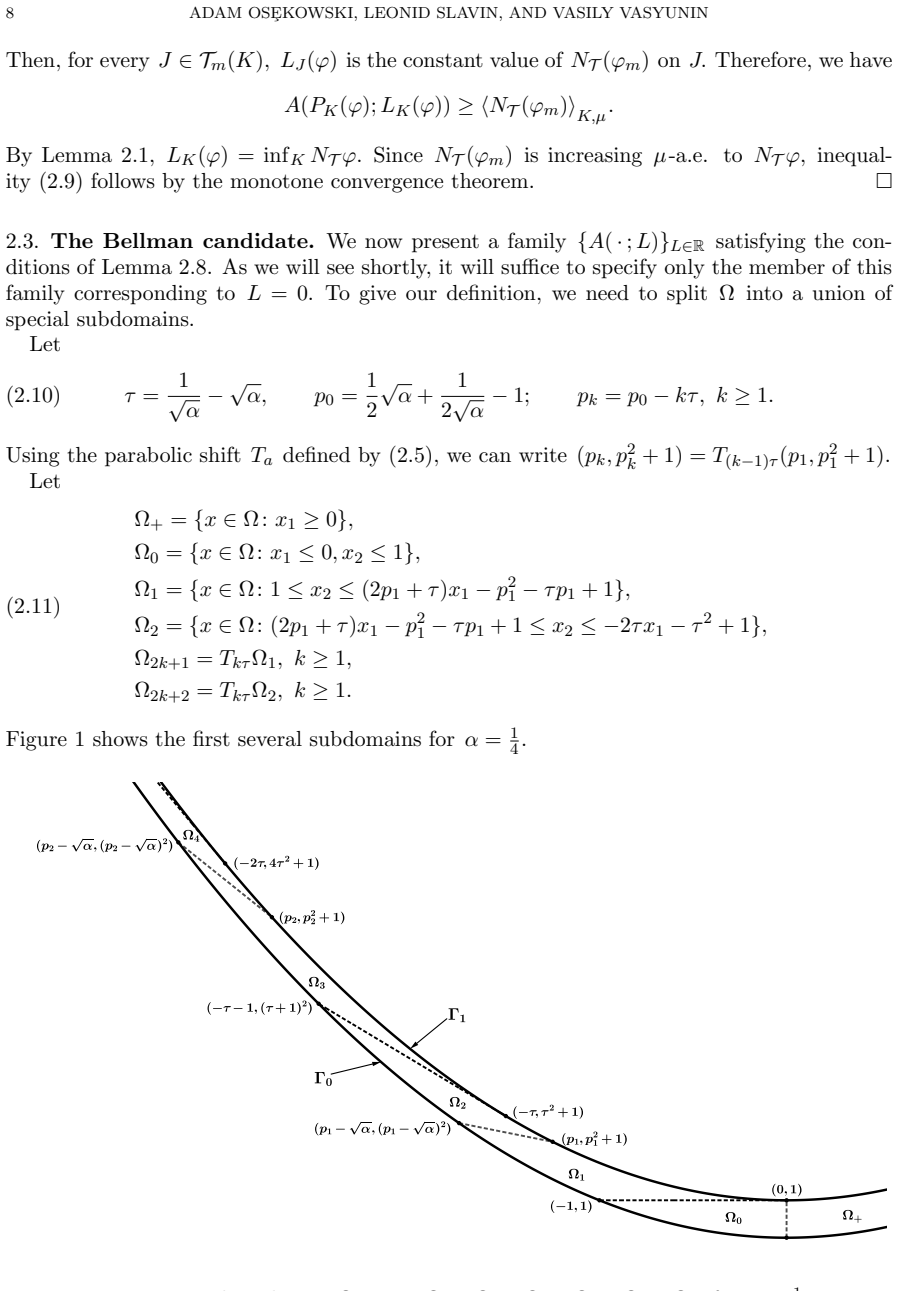
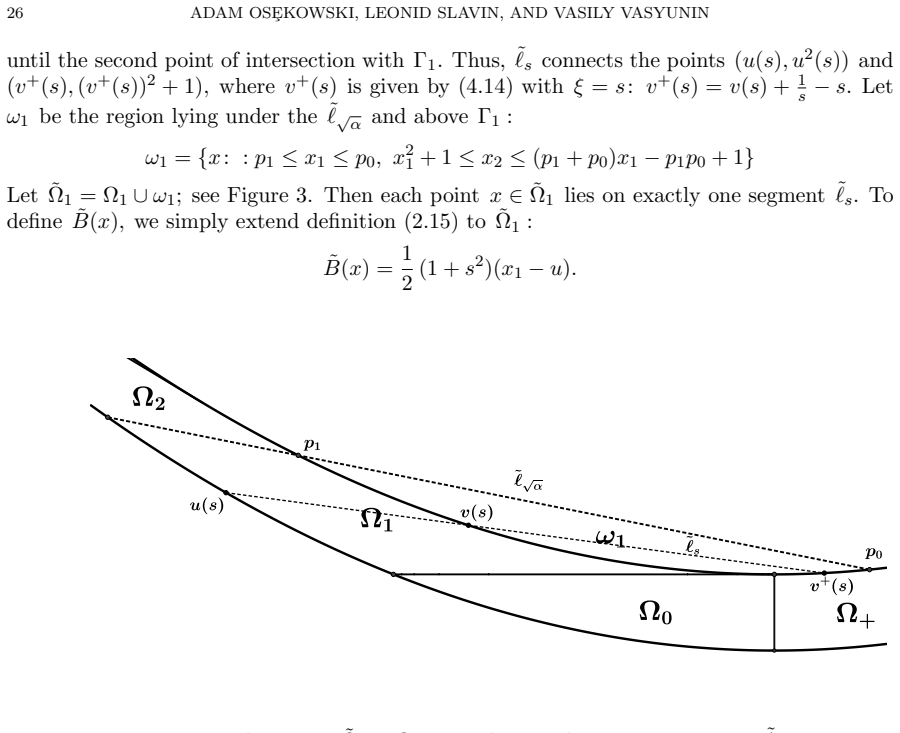
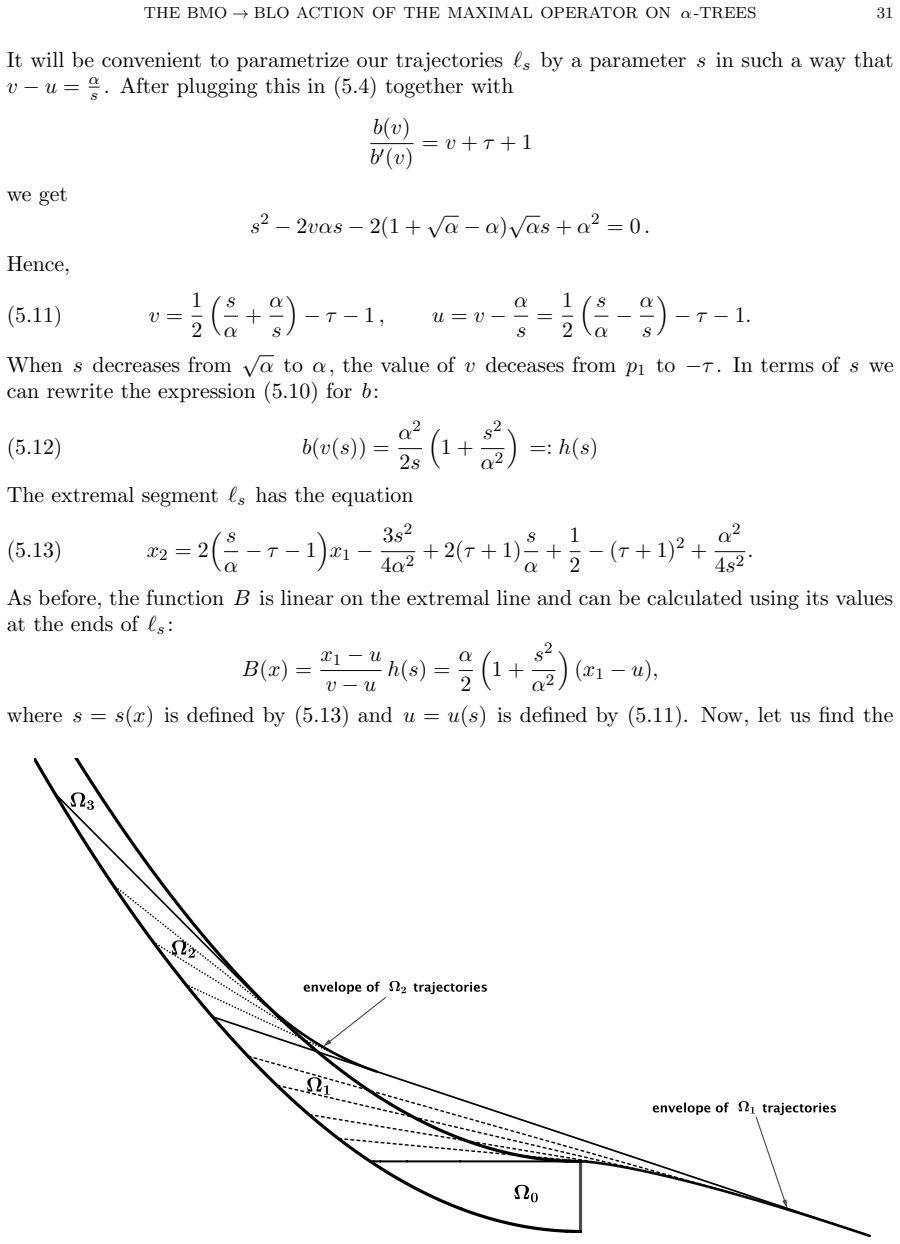
The machinery is the Bellman function $\mathcal{B}_n(x,L)=\sup\{\langle N\varphi\rangle_Q : \varphi\in E_{x,L,Q}\}$, together with a family of auxiliary functions $A(\,\cdot\,;L)$ built from a single candidate $B$ on the parabolic domain $\Omega=\{(x_1,x_2): x_1^2\le x_2\le x_1^2+1\}$. The candidate $B$ is defined piecewise on subdomains $\Omega_k$: it is linear on a foliation of line segments (the 'extremals'), and in the left part of the domain it repeats under the parabolic shift $T_a(x_1,x_2)=(x_1-a,x_2-2ax_1+a^2)$ with a scaling factor $\alpha^k$, giving the quasi-periodic structure. Lemma 2.8 (Bellman induction) converts $\alpha$-concavity of $A(\,\cdot\,;L)$ into the upper bound on $\langle N_T\varphi\rangle_K$, Lemma 2.12 packages $B$ into the required family, and the converse inequality $\mathcal{B}_n\ge\mathcal{A}_n$ is proved from local concavity and boundary comparisons on the upper parabola $\Gamma_1$.
What would settle it
Evaluate the $\alpha$-concavity inequality (2.7) numerically for the candidate $B$ on a dense grid of pairs $(x^-,x^+)$ and weights $\beta\in[\alpha,1/2]$, taking $\alpha=2^{-n}$ for small $n$ and refining near the boundaries between the domains $\Omega_k$ and near $\Gamma_1$. The inequality should be tight at the known equality configurations, for instance $\beta=\alpha$ with $x^-$ on $\Gamma_0$ and $x^+$ on $\Gamma_1$; a negative margin anywhere would disprove Lemma 2.11 and with it the upper bound in Theorem 1.1. Separately, compute $\langle N\varphi_j\rangle_Q$ for the paper's explicit sequence and compare its limit with $L+\Phi_n(t)$ to test the sharpness claim.
Extended reading notes
Core claim
The core discovery is an exact bound for the natural dyadic maximal operator $N\varphi(x)=\sup_{J\ni x}\langle\varphi\rangle_J$: for any dyadic cube $Q$, with $L=\inf_Q N\varphi$ and $t=L-\langle\varphi\rangle_Q$, one has $\langle N\varphi\rangle_Q \le L + \Phi_n(t)\|\varphi\|_{\mathrm{BMO}_d(Q)}$, where $\Phi_n$ is decreasing and convex and satisfies $\Phi_n(k(2^{n/2}-2^{-n/2}))=2^{-nk}$ for nonnegative integers $k$. Setting $t=0$ and taking suprema gives $\|N\varphi\|_{\mathrm{BLO}_d}\le\|\varphi\|_{\mathrm{BMO}_d}$, and the same inequality holds for the classical dyadic maximal operator $M$; both inequalities are sharp, so the norm is exactly 1 in every dimension. The proof identifies the Bellman function $\mathcal{B}_n$ of the extremal problem with an explicit candidate $\mathcal{A}_n$, and establishes the identification by proving the candidate is $\alpha$-concave and by matching it on the boundary of the domain.
Load-bearing premise
The upper bound depends on the claim that the specially constructed auxiliary function satisfies the required concavity inequality at every point of its domain; if that single condition fails, the norm-1 conclusion is not established.
Editorial extensions
If this is right
- - For every $\varphi\in\mathrm{BMO}_d(\mathbb{R}^n)$, both the natural and the classical dyadic maximal operators satisfy $\|N\varphi\|_{\mathrm{BLO}_d}\le\|\varphi\|_{\mathrm{BMO}_d}$, and the constant 1 is sharp for both.
- - The refined inequality (1.3) holds with the explicit function $\Phi_n$; at $t=k(2^{n/2}-2^{-n/2})$ the upper bound decays as $2^{-nk}$, so large gaps between the infimum and the cube average force the maximal-function average close to $L$.
- - For any $\alpha$-tree, the same Bellman induction yields $\langle N_T\varphi\rangle_K \le L+F_\alpha(t)\|\varphi\|_{\mathrm{BMO}(T(K))}$ with $F_\alpha(k(\alpha^{-1/2}-\alpha^{1/2}))=\alpha^k$, and $N_T:\mathrm{BMO}(T)\to\mathrm{BLO}(T)$ has norm at most 1.
- - The Bellman identity $\mathcal{B}_n=\mathcal{A}_n$ solves the extremal problem for every admissible triple of average, square average, and external maximal level, not just for the norm constant.
- - A simpler majorant $\mathcal{A}_0$ already yields the norm constant 1 directly, while the full candidate is needed to capture the sharp decay of $\Phi_n$.
Reading between the lines
- - The paper leaves open whether the same quasi-periodic Bellman candidate gives the exact norm on non-atomic $\alpha$-trees with a guaranteed child of measure $\alpha\mu(K)$; the paper notes such trees admit optimizing sequences, so the missing piece is a matching upper-bound verification.
- - Because the authors record an equivalence between $N:\mathrm{BMO}\to\mathrm{BLO}$ and $M:\mathcal{A}_\infty\to\mathcal{A}_1$, the explicit candidate here may serve as a template for the sharp $\mathcal{A}_\infty\to\mathcal{A}_1$ constant, though sharpness does not transfer automatically.
- - The norm-optimizing sequence is a one-dimensional construction extended by tensorization; one could test numerically whether genuinely $n$-dimensional rearrangements change the rate of approach to 1 for finite $n$, which would indicate whether the dimension-free constant is part of a stronger finite-dimensional phenomenon.
Signed reviews
Editorial analysis
A structured set of objections, weighed in public.
Referee Report
Summary. The paper studies the action of the natural dyadic maximal operator N (and the classical maximal operator M) from dyadic BMO into dyadic BLO, on general α-trees. The authors construct an explicit Bellman function for the corresponding extremal problem and prove an upper bound: for a function φ with BMO norm at most 1, ⟨Nφ⟩_Q ≤ L + Φ_n(t)‖φ‖_{BMO}, where L = inf_Q Nφ and t = L − ⟨φ⟩_Q. They show that Φ_n(k(2^{n/2}−2^{−n/2})) = 2^{−nk}, which implies that the BMO→BLO norm of N (and M) is at most 1. They also claim sharpness of the constants and provide an explicit norm-optimizing sequence.
Significance. If the claims are fully established, the paper would provide the first exact BMO→BLO norm for a maximal operator, equal to 1 in all dimensions, together with an explicit Bellman function and an explicit optimizer. The upper-bound portion is carefully developed: the α-concavity of the candidate B is verified in Section 4, and the Bellman induction in Section 2 is well motivated. The construction of an explicit norm-optimizing sequence in Section 3.1 is also a valuable contribution. However, the lower-bound/sharpness argument currently contains a gap that must be repaired before the main conclusions can be accepted.
major comments (2)
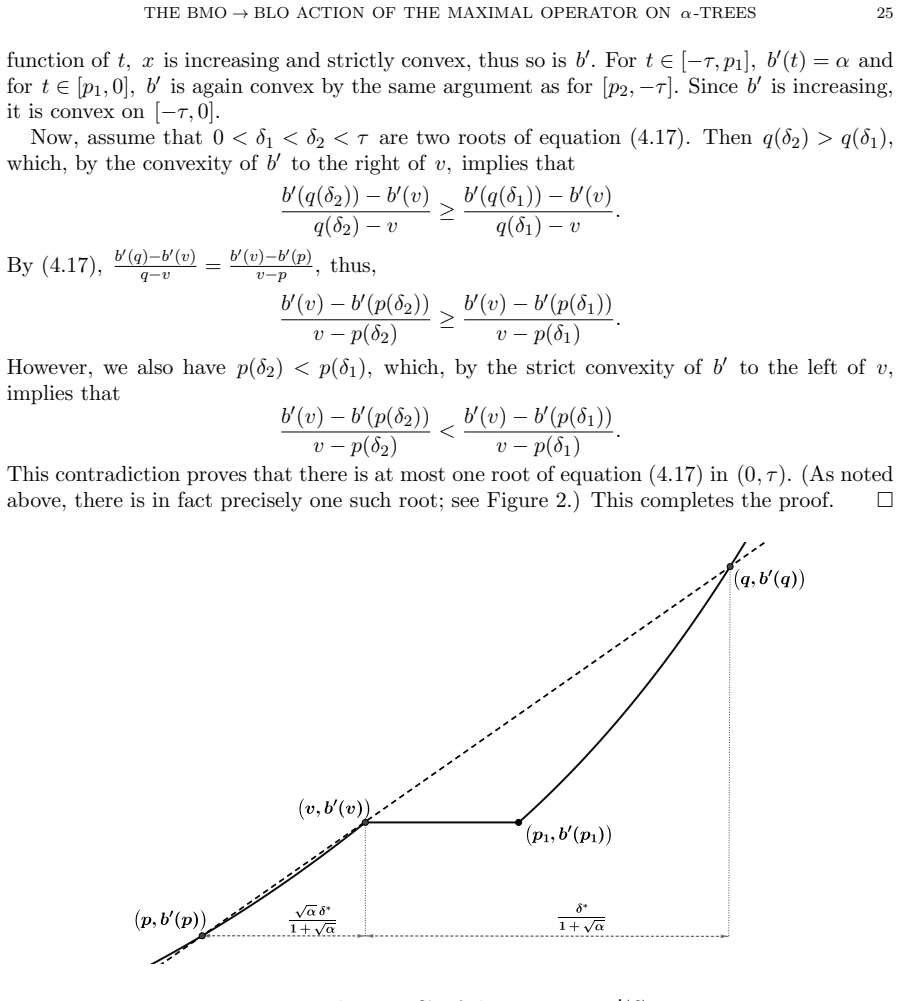
- [Section 3, Lemma 3.4] The proof of Lemma 3.4 asserts that the pasted function φ_j belongs to F_{(1−γ)x−+γx+}; this is not generally true, because dyadic subcubes that contain pieces of both types can have variance exceeding 1. For example, in dimension n=1, take γ=1/5, φ−=−5/2 on Q0, φ+=0, and partition Q0 as in the stress-test: the left half is of type −, and in the right half a greedy dyadic partition is used to realize measure 2/5 of type +. On the dyadic subcube R=(1/2,1), the proportion of + pieces is 2/5, giving ⟨φ²⟩_R−⟨φ⟩_R² = (2/5)(3/5)(5/2)² = 3/2 > 1. Thus φ_j ∉ F_{(1−γ)x−+γx+} in general. Since Lemma 3.4 is used in the proofs of Lemmas 3.5, 3.6, and 3.1, the lower bound B_n ≥ B and hence Theorem 2.13 and the sharpness claims of Theorem 1.1 that depend on it are not established by the given argument.
- [Section 3.1, Lemma 3.7] Lemma 3.7, which establishes the properties of the norm-optimizing sequence {ψ_j}, is stated with its proof left as an exercise. This lemma is used immediately afterwards to conclude that the sequence {φ_j} is optimizing and that ‖M‖_{BMO→BLO} ≥ 1. For a central claim of sharpness, the proof should be included in the manuscript or a reference with a complete proof should be provided; delegating a load-bearing computational verification to the reader is not acceptable.
minor comments (3)
- [Section 2.3, after (2.20)–(2.21)] The monotonicity and convexity of b on [0,∞) are left as an exercise; these properties are asserted in the proof of Theorem 1.4 and stated in Theorem 1.1 for Φ_n. Please include the verification or a citation.
- [Section 3, Lemma 3.4] There is a typo: 'both really heavily on' should be 'both rely heavily on'.
- [Section 2.1, Lemma 2.1] The proof of Lemma 2.1 is concise but the notation 'maximal subset' could be clarified; this is a presentation issue only.
Circularity Check
No significant circularity: the Bellman candidate is verified independently, and cited same-author results are general tools rather than conclusions built into the theorem.
full rationale
The paper's derivation chain is not circular. The Bellman function B_n is defined as a genuine supremum in (2.1)-(2.2), and the candidate B is introduced explicitly in (2.11)-(2.18). Its key property, α-concavity, is not assumed from the desired norm constant: Lemma 2.11 is proved in Section 4 using the general sufficient criterion from Lemma 4.1, followed by a detailed case analysis (Lemmas 4.4-4.11 and the W(ξ,θ) argument). The upper bound in Theorem 1.4 is obtained by Bellman induction in Lemma 2.8, and the lower bound/sharpness for the dyadic case is proved separately in Section 3 through the concavity lemmas Lemmas 3.4-3.6 and Lemma 3.1, with an explicit norm-optimizing sequence in Section 3.1 that is not used to create the upper bound. The main same-author input is Lemma 4.1 from [17] and the α-tree framework; this is a general, parameter-free theorem whose assumptions do not include the target BMO-to-BLO norm, so under the stated rules it counts as independent support rather than circularity. Some verifications are acknowledged as exercises or deferred, and the membership assertion in Lemma 3.4 ('Clearly, each φj∈F(1−γ)x−+γx+') is not fully justified in the text; these are potential correctness risks in the sharpness proof, not reductions of the theorem to its own inputs, and therefore they do not raise the circularity score.
Assumptions & free parameters
assumptions (3)
- domain assumption The α-tree differentiates L1(X,µ): for µ-almost every x and every f∈L1(X,µ), lim_k ⟨f⟩_{J_x^k,µ} = f(x) (Definition 1.3(4)).
- standard math Lemma 4.1 from [17] gives sufficient conditions (local concavity, derivative monotonicity on Γ1, and inequality (3)) for α-concavity.
- standard math Standard dyadic BMO/BLO facts and the John-Nirenberg and A1/A-infinity correspondences are taken as background.
Cite this review
Pith. "Pith review of The ${\rm BMO}\to{\rm BLO}$ action of the maximal operator on $\alpha$-trees." pith.science (2026). https://pith.science/paper/M4CEXNIJ
@misc{pith2026190804028,
  author       = {Pith},
  title        = {Pith review of: The $\rm BMO\to\rm BLO$ action of the maximal operator on $\alpha$-trees},
  year         = {2026},
  howpublished = {\url{https://pith.science/paper/M4CEXNIJ}},
  note         = {Machine review of arXiv:1908.04028}
}
abstract
We obtain the explicit upper Bellman function for the natural dyadic maximal operator acting from ${\rm BMO}(\mathbb{R}^n)$ into ${\rm BLO}(\mathbb{R}^n).$ As a consequence, we show that the ${\rm BMO}\to{\rm BLO}$ norm of the natural operator equals 1 for all $n,$ and so does the norm of the classical dyadic maximal operator. The main result is a partial corollary of a theorem for the so-called $\alpha$-trees, which generalize dyadic lattices. The Bellman function in this setting exhibits an interesting quasi-periodic structure depending on $\alpha,$ but also allows a majorant independent of $\alpha,$ hence the dimension-free norm constant. We also describe the decay of the norm with respect to the difference between the average of a function on a cube and the infimum of its maximal function on that cube. An explicit norm-optimizing sequence is constructed.
Figures
Figures from the paper (1 more)
Reference graph
Works this paper leans on
-
[1]
R. Ba˜ nuelos, A. Os¸ ekowski. Sharp weak type inequalities for fractional integral operators.Potential Anal- ysis 47 (2017), 103-121
work page 2017
-
[2]
C. Bennett. Another characterization of BLO. Proc. Amer. Math. Soc. 85 (1982), no. 4, 552-556
work page 1982
-
[3]
C. Bennett, R. A. DeVore, Ronald, R. Sharpley. Weak- L∞ and BMO. Ann. of Math. (2) 113 (1981), no. 3, 601-611
work page 1981
-
[4]
R. Coifman, R. Rochberg. Another characterization of BMO. Proc. Amer. Math. Soc. 79 (1980), no. 2, 249-254
work page 1980
-
[5]
P. Ivanishvili, N. Osipov, D. Stolyarov, V.Vasyunin, P. Zatitskiy. Bellman function for extremal problems in BMO. Trans. Amer. Math. Soc. 368 (2016), no. 5, 3415-3468
work page 2016
-
[6]
A. Melas. The Bellman functions of dyadic-like maximal operators and related inequalities. Advances in Mathematics, Vol. 192 (2005), No. 2, pp. 310-340
work page 2005
-
[7]
A. Melas. Sharp general local estimates for dyadic-like maximal operators and related Bellman functions. Adv. Math., Vol. 220 (2009), No. 2, pp. 367–426
work page 2009
- [8]
Show all 18 references
-
[9]
Melas, E
A. Melas, E. Nikolidakis, T. Stavropoulos. Sharp local lower Lp -bounds for dyadic-like maximal operators. Proc. Amer. Math. Soc., Vol. 141 (2013), No. 9, pp. 3171-3181
2013
-
[10]
Nazarov, S
F. Nazarov, S. Treil. The hunt for Bellman function: applications to estimates of singular integral operators and to other classical problems in harmonic analysis. (Russian) Algebra i Analiz , Vol. 8 (1996), No. 5, pp. 32-162; English translation in St. Petersburg Math. J. , V...
1996
-
[11]
Os¸ ekowski
A. Os¸ ekowski. Sharp inequalities for dyadicA1 weights. Arch. Math. (Basel) 101 (2013), no. 2, 181-190
2013
-
[12]
Os¸ ekowski
A. Os¸ ekowski. Sharp Weak-Type Inequality for Fractional Integral Operators Associated with d- Dimensional Walsh-Fourier Series. Integral Equations and Operator Theory 78 (2014), 589-600
2014
-
[13]
W. Ou. The natural maximal operator on BMO. Proc. Amer. Math. Soc. 129 (2001), no. 10, 2919-2921
2001
-
[14]
W. Ou. Near-symmetry in A∞ and refined Jones factorization. Proc. Amer. Math. Soc. 136 (2008), no. 9, 3239-3245
2008
-
[15]
Slavin, V
L. Slavin, V. Vasyunin. Sharp Lp estimates on BMO. Indiana Univ. Math. J. , Vol. 61 (2012), No. 3, pp. 1051-1110
2012
-
[16]
Slavin, A
L. Slavin, A. Stokolos, V. Vasyunin. Monge–Amp´ ere equations and Bellman functions: the dyadic maximal operator. C. R. Math. Acad. Sci. Paris 346 (9-10) (2008) 585-588
2008
-
[17]
Slavin, V
L. Slavin, V. Vasyunin. Inequalities for BMO on α-trees. Int. Math. Res. Not. IMRN 2016, no. 13, 4078- 4102
2016
-
[18]
Vasyunin
V. Vasyunin. Cincinnati lectures on Bellman functions, 2011, edited by L. Slavin. Available at arXiv: 1508.07668. F aculty of Mathematics, Informatics and Mechanics, University of W arsaw, Banacha 2, 02-097 W arsaw, Poland E-mail address: ados@mimuw.edu.pl University of Cincin...
2011 arXiv
Reviewed August 14, 2026 · model on record in the stance chip above.
Discussion (0). Continue with ORCID to comment.