REVIEW 4 major objections 5 minor 1 cited by
NEXUS: Spectral Variability of Little Red Dots and Blue Active Galactic Nuclei at $2 \lesssim z \lesssim 6$
T0 review · 4 major / 5 minor · reviewed 2026-08-04 · deepseek-v4-flash
Pith's one-line read Little Red Dots show H-alpha variability of at most about 4 percent on monthly timescales—far below the ~6 percent red-noise flicker of normal quasars—suggesting their broad-line light is produced differently.
desk verdict First systematic NIRSpec multi-epoch H-alpha variability sample for LRDs gives a plausible 4% upper limit, but the local-continuum normalization can suppress exactly the variability it measures, so the white-noise conclusion is not yet solid. read the letter →
The pith
A machine-rendered reading of the paper's core claim, the machinery that carries it, and where it could break.
The reading
What carries the argument
The load-bearing tool is the maximum-likelihood intrinsic rms variability estimator sigma_0, applied to pairwise fractional H-alpha flux differences between epochs: the paper symmetrizes the difference distribution with negative duplicates and divides the resulting scatter by the square root of two to obtain a sample-wide light-curve rms, sigma_0,lc. This estimator separates true source variability from per-epoch measurement noise, allowing 12 LRDs to be compared statistically with 56 low-redshift SDSS-RM AGNs. The secondary machinery is the ensemble structure function built from SDSS-RM H-alpha light curves, which supplies the red-noise baseline, together with a local-continuum normalizatio
What would settle it
Take the same or a larger LRD sample and normalize every NIRSpec epoch using independent difference-imaging photometry for all epochs rather than the spectral continuum. If the resulting H-alpha rms variability exceeds about 6 percent on rest-frame timescales below 100 days, or if the structure function rises with timescale instead of staying flat, the white-noise, weak-variability conclusion fails.
Extended reading notes
Core claim
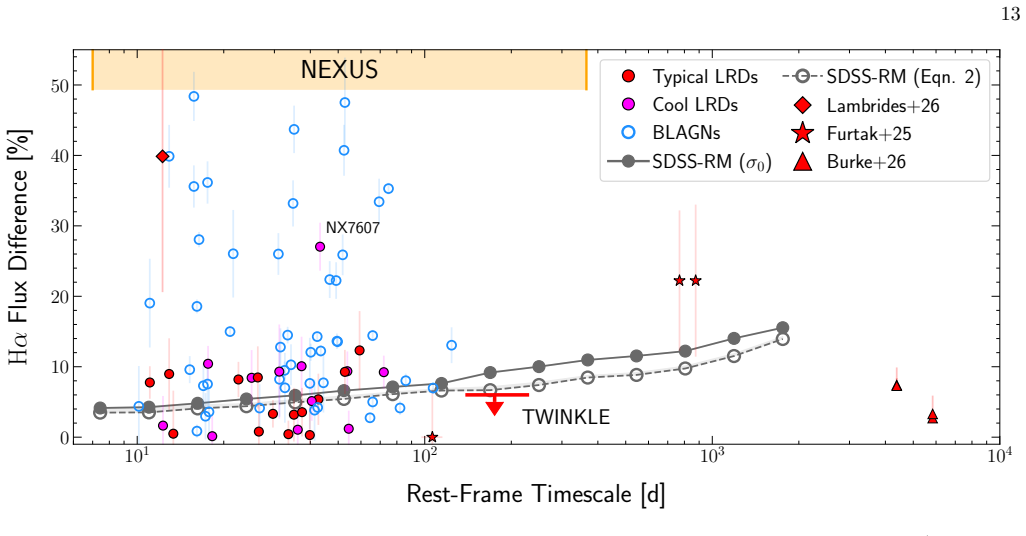
The central claim is that, as a population, LRDs have intrinsic H-alpha flux variability of about 4 percent rms or less on rest-frame timescales under roughly 100 days, with rest-optical continuum variability below about 3 percent, while luminosity-matched low-redshift AGNs show about 6 percent monthly H-alpha variability with a red-noise structure function that grows with timescale. Combining the present multi-epoch NIRSpec measurements with published LRD variability measurements on roughly six-month to decade timescales, the paper argues that LRD variability is flat—white-noise-like—across all sampled timescales, in both H-alpha and continuum. The authors present this as evidence that the
Load-bearing premise
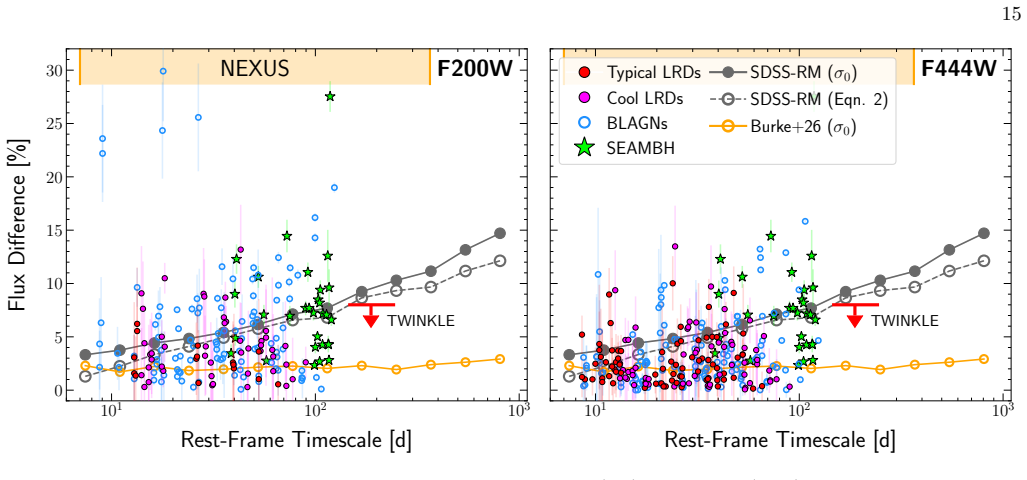
The load-bearing premise is that the LRD continuum is steady over the observed months, so dividing each epoch spectrum by its local continuum only corrects slit losses—an assumption supported by difference-imaging photometry from the first three epochs, since if the continuum actually varies the normalization would cancel the associated line variability and could create the flat low-amplitude pattern the paper reports.
Editorial extensions
If this is right
- If LRDs genuinely vary as white noise, standard reverberation-mapping campaigns will not detect correlated H-alpha responses on monthly cadences, and black-hole masses for LRDs cannot be derived the usual way.
- The flat structure function means longer baselines do not accumulate variability signal the way they do for normal AGNs; detecting real LRD variability will require much larger samples or rare individual objects, not simply longer monitoring.
- Models that predict normal AGN-like ionizing-flux flicker, and hence roughly 6 percent monthly broad-line variability, are disfavored for the bulk of the LRD population, while dense-envelope or super-Eddington models that damp short-term variability are favored.
- The enhanced Balmer decrement combined with weak variability points to collisional excitation or radiative transfer in dense gas, rather than dust reddening, as the origin of LRD line ratios.
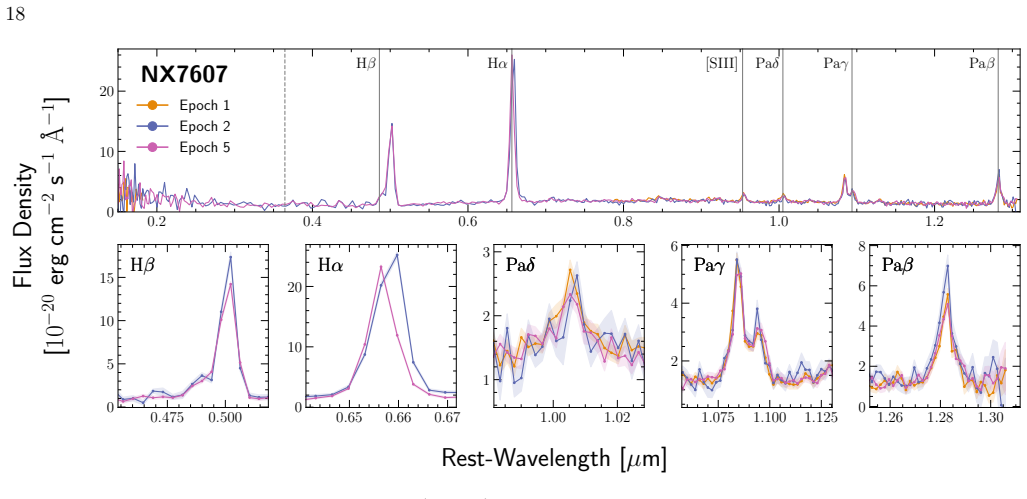
- Rare variable LRDs such as NX7607 may be transitional objects or misclassified reddened AGNs, and identifying such objects is a path toward understanding diversity within the population.
Reading between the lines
- If the flat variability pattern is real, the reported 4 percent H-alpha upper limit may itself be optimistic: normalizing each epoch to a constant local continuum would erase any line variability that tracks the continuum, so the true line variability could be even lower than measured.
- The comparison sample is luminosity-matched but not matched in Eddington ratio or black-hole mass; if LRD variability follows the same anti-correlation with accretion rate seen in local AGNs, the observed suppression might reflect extreme super-Eddington accretion rather than a fundamentally different emission mechanism—an alternative the current data may not fully exclude.
- A direct test would be to obtain difference-imaging photometry for every spectroscopic epoch and normalize each spectrum independently; if the LRD continuum does vary at the roughly 2 percent level, the white-noise conclusion would need revision.
- The same multi-epoch NIRSpec data could be searched for correlated narrow-line variability, for example in [OIII], which would discriminate between scattered or reprocessed emission and collisionally excited line origins in the dense-gas picture.
Signed reviews
Editorial analysis
A structured set of objections, weighed in public.
Referee Report
Summary. The paper presents multi-epoch JWST/NIRSpec MSA spectroscopy from the first six NEXUS Deep epochs for 17 Little Red Dots and 14 blue broad-line AGNs at 2 ≲ z ≲ 6. After fitting the Hα complex and normalizing each epoch spectrum (local-continuum normalization for LRDs, aperture-photometric normalization for BLAGNs), the authors measure Balmer decrements, line ratios, and Hα and continuum variability. They report that LRDs have enhanced Balmer decrements, low continuum variability (σ0,lc ≈ 2–3%), and low Hα variability (σ0,lc = 4.02%) on rest-frame ~1–3 month timescales, compared with 6.29% for an Hα-luminosity-matched SDSS-RM sample, a difference they quote as 3.8σ. Combining this with literature results at longer timescales, they argue that LRD broad-line variability follows a white-noise pattern, in contrast to the red-noise behavior of normal AGNs, suggesting different broad-line production mechanisms in LRDs.
Significance. If the central result holds, it is valuable: it provides one of the first spectroscopic, ensemble constraints on high-redshift LRD broad-line variability and connects to a growing body of photometric non-detections. The use of an external SDSS-RM comparison sample, the explicit treatment of flux uncertainties via the σ0 maximum-likelihood estimator, and the authors' repeated caution that their estimates are upper limits are strengths. The sample is small (12 LRDs, 26 Hα flux pairs), however, and the headline 4% constraint is conditional on a local-continuum normalization that assumes a non-varying LRD continuum. That assumption, plus the exclusion of the most variable LRD (NX7607), means the population-level claim and the white-noise interpretation are not yet fully secured. With additional robustness tests and more careful reporting of the NX7607 exclusion, the paper would provide a solid upper-limit benchmark for LRD variability models.
major comments (4)
- [§3.1, normalization scheme] The LRD normalization divides each epoch's Hα profile by the fitted local continuum and rescales to the epoch with the largest continuum. This removes any fractional flux change that is common to Hα and the adjacent continuum. In the standard AGN reverberation picture the paper contrasts with, a few-percent ionizing-continuum change over 1–3 months would induce a proportional Hα response, so the normalization would suppress exactly the signal the paper aims to measure. The only direct evidence that the LRD continuum is constant comes from difference-image photometry of the first three Deep imaging epochs (§4.3), whereas the spectroscopic variability uses up to six MSA epochs; raw F200W aperture photometry shows ~6% scatter, comparable to the quoted 4% Hα rms. Thus σ0,lc = 4.02% (Table 3) is an upper limit only under the assumption of a non-varying LRD rest-optical continuum. Please quant
- [§3.3 and Table 3] The text says 'We exclude NX7607 when obtaining σ0,lc, as its ∼30% variability significantly inflates the estimated intrinsic variability,' yet Table 3 lists 'All LRDs' with N_obj = 12, N_pair = 26, and σ0,lc = 4.02%, which appears to include NX7607 (which has 2 reliable epochs in Table 1). No row is given for the sample excluding NX7607, and §4.2 quotes 4.02% as the main LRD result. Please clarify which sample produced the headline value and report both with and without NX7607. Because NX7607 is the single most variable LRD, its inclusion/exclusion is pivotal to the claimed 3.8σ suppression; this must be transparent and not confined to a single sentence.
- [§3.3, σ0 estimator] The σ0 estimate is obtained by duplicating all |ΔF| values with negative signs, thereby doubling the number of data points without adding independent information. The quoted uncertainty (e.g., 4.02+0.59, Table 3) is therefore likely optimistic. With only 26 independent flux pairs from 12 LRDs, the 3.8σ excess over SDSS-RM is fragile. Please validate with bootstrap resampling of the 26 pairs and with one-object-out/jackknife tests, and state the number of independent (non-duplicated) pairs when quoting significances. The SDSS-RM uncertainty is tiny because of its large pair count; the comparison error is dominated by the LRD side, so a proper small-sample treatment is essential.
- [§4.2 and §5.1, white-noise claim] The conclusion of a 'white-noise pattern across all timescales' is derived by combining the NEXUS 4% upper limit with literature points on yearly-to-decade timescales, several of which are themselves upper limits or marginal detections (TWINKLE; Burke et al. 2026; Furtak et al. 2025). Upper limits cannot demonstrate a flat structure function; they only place an envelope. Moreover, the combined data are heterogeneous (different objects, different normalizations, some photometric, some spectroscopic). Please fit a power-law structure function to the upper limits or provide a statistical test that the ensemble is inconsistent with a red-noise model; otherwise soften the conclusion to 'consistent with low-level variability bounded by current upper limits.'
minor comments (5)
- [§3.2, Eq. (1)] The extinction coefficient κ(λ) is used in Eq. (1) before being defined; define R_V and κ in the text immediately before the equation.
- [§4.3/Table 3] The F200W 'Typical LRDs' row contains only 1 object and 15 pairs. This is too little to support an ensemble claim; the text should explicitly caution that the F200W typical-LRD constraint is dominated by a single source.
- [§6] Typo: 'inclde' should be 'include' in the final paragraph.
- [References] A few references are arXiv-only or lack full bibliographic details (e.g., Naidu et al. 2025, Chen et al. 2026, Sneppen et al. 2026). Please ensure all cited works have complete journal/volume/page information where available.
- [§3.1, cool LRDs] The cool LRDs are normalized with aperture photometry while typical LRDs use local continuum, yet both are combined in Table 3's 'All LRDs' row. The text should remind the reader of this methodological difference when interpreting the combined σ0,lc.
Circularity Check
No circular derivation: the Hα variability constraint is an upper limit with a continuum-normalization caveat, and the SDSS-RM comparison is externally grounded.
full rationale
The paper's central derivation (Hα rms variability of LRDs vs SDSS-RM) is self-contained: the same σ0,lc maximum-likelihood estimator is applied to both NEXUS and SDSS-RM light curves, and the comparison sample is drawn from the public SDSS-RM program. The only quasi-circular element is the local-continuum normalization in Section 3.1, which divides each epoch's line profile by the fitted local continuum. This removes any common-mode line+continuum variability and would bias the measured Hα rms low if LRD continua vary at the few-percent level. However, the paper explicitly justifies this choice with difference-image photometry (Section 4.3, quoting Z. Stone et al. 2025) showing ≲2-3% continuum rms, and labels the derived estimates as upper limits due to systematics. That is an explicit assumption with external empirical support, not a mathematical reduction of the conclusion to the inputs. Self-citations to NEXUS survey papers and the σ0 estimator (Y. Shen et al. 2019) are standard method/data references, not circular premises. No fitted parameter is renamed as a prediction. The white-noise interpretation is a synthesis of several independent upper limits, not a derivation from a self-citation chain. The normalization caveat is a correctness risk, not circularity, so the score is low.
Assumptions & free parameters
free parameters (2)
- 5% flux uncertainty cut =
5%
- Line-spread-function resolution increase factor =
60%
assumptions (4)
- domain assumption LRDs are compact, so slit losses affect continuum and emission lines identically
- ad hoc to paper The rest-optical continuum of LRDs is not intrinsically variable over ~1-3 month timescales
- domain assumption Intrinsic population variability is Gaussian distributed around zero mean
- domain assumption SMC extinction curve and Case B recombination intrinsic Balmer ratio for A_V estimates
Cite this review
Pith. "Pith review of NEXUS: Spectral Variability of Little Red Dots and Blue Active Galactic Nuclei at $2 \lesssim z \lesssim 6$." pith.science (2026). https://pith.science/paper/M4ERO5Y7
@misc{pith2026260801647,
  author       = {Pith},
  title        = {Pith review of: NEXUS: Spectral Variability of Little Red Dots and Blue Active Galactic Nuclei at $2 \lesssim z \lesssim 6$},
  year         = {2026},
  howpublished = {\url{https://pith.science/paper/M4ERO5Y7}},
  note         = {Machine review of arXiv:2608.01647}
}
abstract
We present spectral measurements for 17 Little Red Dots (LRDs) and 14 blue broad-line active galactic nuclei (AGNs) at $2\lesssim z \lesssim 6$ using multi-epoch JWST NIRSpec MSA spectra from the NEXUS program, sampling rest-frame timescales of $\sim 1-3$ months. Overall, the LRD population shows significantly enhanced Balmer decrement compared with both blue JWST AGNs at similar redshifts and 56 low-redshift broad-line AGNs matched in H$\rm\alpha$ luminosity. The rest-optical continua of LRDs show little ensemble variability (rms $\lesssim 3\%$), and the total H$\rm\alpha$ emission also shows weaker ensemble variability compared with low-redshift AGNs matched in H$\rm\alpha$ luminosity and rest-frame timescales. Based on the flux uncertainties, we constrain the intrinsic H$\rm\alpha$ rms variability to be $\lesssim 4\%$ for the LRD population over these timescales. Combining our results with recent broad-line variability measurements of LRDs over yearly to decade timescales reveals a low-level white-noise pattern across all timescales, in stark contrast to the variability amplitude ($\sim 6\%$ over monthly timescales) and red-noise pattern observed in normal AGNs. These results add to the growing observational studies that suggest population-wise, LRDs have weak variability both in optical continuum and broad-line emission. Furthermore, the distinct white-noise broad-line variability pattern suggests different production mechanisms of broad-line emission in LRDs as opposed to normal AGNs, and/or different properties of the driving ionizing flux from the central engine.
Figures


Figures from the paper (7 more)


Forward citations
Cited by 1 Pith paper
-
Ripples in the OCEANS: Broad Line Variability of Little Red Dots
Two of six Little Red Dots show marginal broad Halpha variability between JWST epochs, weakly supporting an AGN origin for those sources.
Reference graph
Works this paper leans on
-
[1]
Ai, Y. L., Yuan, W., Zhou, H. Y., et al. 2010, ApJL, 716, L31, doi: 10.1088/2041-8205/716/1/L31
-
[2]
Akins, H. B., Casey, C. M., Lambrides, E., et al. 2025, The Astrophysical Journal, 991, 37, doi: 10.3847/1538-4357/ade984
-
[3]
Ananna, T. T., Bogd´ an,´A., Kov´ acs, O. E., Natarajan, P., & Hickox, R. C. 2024, The Astrophysical Journal Letters, 969, L18, doi: 10.3847/2041-8213/ad5669
-
[4]
Asada, Y., Inayoshi, K., Fei, Q., Fujimoto, S., & Willott, C. 2026, Origins of the UV Continuum and Balmer Emission Lines in Little Red Dots: Observational Validation of Dense Gas Envelope Models Enshrouding the AGN, arXiv Astropy Collaboration, Robitaille, T. P., Tollerud, E. J., et al. 2013, A&A, 558, A33, doi: 10.1051/0004-6361/201322068 Astropy Collab...
-
[5]
Barro, G., P´ erez-Gonz´ alez, P. G., Kocevski, D. D., et al. 2024, The Astrophysical Journal, 963, 128, doi: 10.3847/1538-4357/ad167e
-
[6]
Begelman, M. C., & Dexter, J. 2026, The Astrophysical Journal, 996, 48, doi: 10.3847/1538-4357/ae274a
-
[7]
Bellm, E. C., Kulkarni, S. R., Graham, M. J., et al. 2019, PASP, 131, 018002, doi: 10.1088/1538-3873/aaecbe
-
[8]
Bentz, M. C., Denney, K. D., Grier, C. J., et al. 2013, ApJ, 767, 149, doi: 10.1088/0004-637X/767/2/149
Show all 146 references
-
[9]
D., & McKee, C
Blandford, R. D., & McKee, C. F. 1982, The Astrophysical Journal, 255, 419, doi: 10.1086/159843
1982 doi
-
[10]
2023, msaexp: NIRSpec analyis tools, 0.6.17 Zenodo, doi: 10.5281/zenodo.8319596
Brammer, G. 2023, msaexp: NIRSpec analyis tools, 0.6.17 Zenodo, doi: 10.5281/zenodo.8319596
2023 doi
-
[11]
2026, arXiv e-prints, arXiv:2601.22214, doi: 10.48550/arXiv.2601.22214
Brazzini, M., D’Eugenio, F., Maiolino, R., et al. 2026, arXiv e-prints, arXiv:2601.22214, doi: 10.48550/arXiv.2601.22214
2026 doi
- [12]
-
[13]
R., Simons, R
Brooks, M., Trump, J. R., Simons, R. C., et al. 2025, Beyond the Monsters: A More Complete Census of Black Hole Activity at Cosmic Dawn, arXiv, doi: 10.48550/arXiv.2511.19609
2025 doi
-
[14]
J., Shen, Y., Liu, X., et al
Burke, C. J., Shen, Y., Liu, X., et al. 2023, Monthly Notices of the Royal Astronomical Society, 518, 1880, doi: 10.1093/mnras/stac2478
2023 doi
-
[15]
J., Stone, Z., Shen, Y., & Jiang, Y.-F
Burke, C. J., Stone, Z., Shen, Y., & Jiang, Y.-F. 2026, ApJ, 1004, 16, doi: 10.3847/1538-4357/ae6b89
2026 doi
-
[16]
J., Shen, Y., Blaes, O., et al
Burke, C. J., Shen, Y., Blaes, O., et al. 2021, Science, 373, 789, doi: 10.1126/science.abg9933
2021 doi
-
[17]
C., et al
Calzetti, D., Armus, L., Bohlin, R. C., et al. 2000, ApJ, 533, 682, doi: 10.1086/308692
2000 doi
-
[18]
B., Perna, R., et al
Cantiello, M., Hassan, J. B., Perna, R., et al. 2025, Pulsational Instability of Quasi-Stars: Interpreting the Variability of Little Red Dots, arXiv, doi: 10.48550/arXiv.2512.17997
2025 doi
-
[19]
C., Begley, R., McLeod, D
Carnall, A. C., Begley, R., McLeod, D. J., et al. 2023, Monthly Notices of the Royal Astronomical Society: Letters, 518, L45, doi: 10.1093/mnrasl/slac136
2023 doi
-
[20]
M., Akins, H
Casey, C. M., Akins, H. B., Finkelstein, S. L., et al. 2025, The Astrophysical Journal, 990, L61, doi: 10.3847/2041-8213/adfa91
2025 doi
- [21]
-
[22]
2025, Monthly Notices of the Royal Astronomical Society, doi: 10.1093/mnras/staf2131
Chang, S.-J., Gronke, M., Matthee, J., & Mason, C. 2025, Monthly Notices of the Royal Astronomical Society, doi: 10.1093/mnras/staf2131
2025 doi
-
[23]
C., Li, R., & Zhuang, M.-Y
Chen, C.-H., Ho, L. C., Li, R., & Zhuang, M.-Y. 2025, The Astrophysical Journal, 983, 60, doi: 10.3847/1538-4357/ada93a
2025 doi
- [24]
-
[25]
Chen, K., Li, Z., Inayoshi, K., & Ho, L. C. 2025, ApJL, 994, L42, doi: 10.3847/2041-8213/ae1955 de Graaff, A., Rix, H.-W., Carniani, S., et al. 2024, A&A, 684, A87, doi: 10.1051/0004-6361/202347755 de Graaff, A., Rix, H.-W., Naidu, R. P., et al. 2025, Astronomy & Astrophysics,...
2025 doi
-
[26]
2025, A&A, 704, A313, doi: 10.1051/0004-6361/202557164 DESI Collaboration, Abdul Karim, M., Adame, A
Delvecchio, I., Daddi, E., Magnelli, B., et al. 2025, A&A, 704, A313, doi: 10.1051/0004-6361/202557164 DESI Collaboration, Abdul Karim, M., Adame, A. G., et al. 2026, AJ, 171, 285, doi: 10.3847/1538-3881/ae4c43 D’Eugenio, F., Nelson, E., Ji, X., et al. 2025, arXiv e-prints, ar...
2025 doi
-
[27]
2016, ApJ, 825, 126, doi: 10.3847/0004-637X/825/2/126
Du, P., Lu, K.-X., Zhang, Z.-X., et al. 2016, ApJ, 825, 126, doi: 10.3847/0004-637X/825/2/126
2016 doi
-
[28]
2018, ApJ, 856, 6, doi: 10.3847/1538-4357/aaae6b
Du, P., Zhang, Z.-X., Wang, K., et al. 2018, ApJ, 856, 6, doi: 10.3847/1538-4357/aaae6b
2018 doi
-
[29]
W., Lang, D., & Goodman, J
Foreman-Mackey, D., Hogg, D. W., Lang, D., & Goodman, J. 2013, PASP, 125, 306, doi: 10.1086/670067
2013 doi
-
[30]
B., Trump, J
Fries, L. B., Trump, J. R., Davis, M. C., et al. 2023, ApJ, 948, 5, doi: 10.3847/1538-4357/acbfb7
2023 doi
-
[31]
R., et al
Fujimoto, S., Wang, B., Weaver, J. R., et al. 2024, The Astrophysical Journal, 977, 250, doi: 10.3847/1538-4357/ad9027
2024 doi
-
[32]
J., Zitrin, A., Plat, A., et al
Furtak, L. J., Zitrin, A., Plat, A., et al. 2023, The Astrophysical Journal, 952, 142, doi: 10.3847/1538-4357/acdc9d
2023 doi
-
[33]
J., Labb´ e, I., Zitrin, A., et al
Furtak, L. J., Labb´ e, I., Zitrin, A., et al. 2024, Nature, 628, 57, doi: 10.1038/s41586-024-07184-8
2024 doi
-
[34]
J., Secunda, A
Furtak, L. J., Secunda, A. R., Greene, J. E., et al. 2025, Astronomy and Astrophysics, 698, A227, doi: 10.1051/0004-6361/202554110
2025 doi
- [35]
-
[36]
Gordon, K. D. 2024, Journal of Open Source Software, 9, 7023, doi: 10.21105/joss.07023
2024 doi
-
[37]
D., Clayton, G
Gordon, K. D., Clayton, G. C., Decleir, M., et al. 2023, The Astrophysical Journal, 950, 86, doi: 10.3847/1538-4357/accb59
2023 doi
-
[38]
D., Clayton, G
Gordon, K. D., Clayton, G. C., Misselt, K. A., Landolt, A. U., & Wolff, M. J. 2003, The Astrophysical Journal, 594, 279, doi: 10.1086/376774
2003 doi
-
[39]
D., Fitzpatrick, E
Gordon, K. D., Fitzpatrick, E. L., Massa, D., et al. 2024, The Astrophysical Journal, 970, 51, doi: 10.3847/1538-4357/ad4be1
2024 doi
-
[40]
E., Labbe, I., Goulding, A
Greene, J. E., Labbe, I., Goulding, A. D., et al. 2024, The Astrophysical Journal, 964, 39, doi: 10.3847/1538-4357/ad1e5f
2024 doi
-
[41]
J., Pancoast, A., Barth, A
Grier, C. J., Pancoast, A., Barth, A. J., et al. 2017, ApJ, 849, 146, doi: 10.3847/1538-4357/aa901b
2017 doi
-
[42]
2023, The Astrophysical Journal, 959, 39, doi: 10.3847/1538-4357/ad029e
Harikane, Y., Zhang, Y., Nakajima, K., et al. 2023, The Astrophysical Journal, 959, 39, doi: 10.3847/1538-4357/ad029e
2023 doi
-
[43]
R., Millman, K
Harris, C. R., Millman, K. J., van der Walt, S. J., et al. 2020, Nature, 585, 357, doi: 10.1038/s41586-020-2649-2
2020 doi
-
[44]
2021, ApJS, 253, 20, doi: 10.3847/1538-4365/abd774
Hu, C., Li, S.-S., Yang, S., et al. 2021, ApJS, 253, 20, doi: 10.3847/1538-4365/abd774
2021 doi
-
[45]
2022, ApJ, 934, 132, doi: 10.3847/1538-4357/ac75d8
Hu, H., Inayoshi, K., Haiman, Z., Quataert, E., & Kuiper, R. 2022, ApJ, 934, 132, doi: 10.3847/1538-4357/ac75d8
2022 doi
-
[46]
Hunter, J. D. 2007, Computing in Science & Engineering, 9, 90, doi: 10.1109/MCSE.2007.55
2007 doi
-
[47]
B., Crenshaw, D
Hutchings, J. B., Crenshaw, D. M., Kraemer, S. B., et al. 2002, AJ, 124, 2543, doi: 10.1086/344080
2002 doi
-
[48]
2024, ApJL, 973, L49, doi: 10.3847/2041-8213/ad74e2
Inayoshi, K., & Ichikawa, K. 2024, ApJL, 973, L49, doi: 10.3847/2041-8213/ad74e2
2024 doi
-
[49]
S., & Noda, H
Inayoshi, K., Kimura, S. S., & Noda, H. 2025, Publications of the Astronomical Society of Japan, 77, 811, doi: 10.1093/pasj/psaf050
2025 doi
-
[50]
2025, Monthly Notices of the Royal Astronomical Society, 544, 3900, doi: 10.1093/mnras/staf1867
Ji, X., Maiolino, R., ¨Ubler, H., et al. 2025, Monthly Notices of the Royal Astronomical Society, 544, 3900, doi: 10.1093/mnras/staf1867
2025 doi
-
[51]
2026, Monthly Notices of the Royal Astronomical Society, 545, staf2235, doi: 10.1093/mnras/staf2235
Ji, X., D’Eugenio, F., Juodˇ zbalis, I., et al. 2026, Monthly Notices of the Royal Astronomical Society, 545, staf2235, doi: 10.1093/mnras/staf2235
2026 doi
-
[52]
M., & Davis, S
Jiang, Y.-F., Stone, J. M., & Davis, S. W. 2014, ApJ, 796, 106, doi: 10.1088/0004-637X/796/2/106 Juodˇ zbalis, I., Maiolino, R., Baker, W. M., et al. 2026, MNRAS, 546, stag086, doi: 10.1093/mnras/stag086 Juodˇ zbalis, I., Ji, X., Maiolino, R., et al. 2024, Monthly Notices of t...
2014 doi
-
[53]
C., Bechtold, J., & Siemiginowska, A
Kelly, B. C., Bechtold, J., & Siemiginowska, A. 2009, ApJ, 698, 895, doi: 10.1088/0004-637X/698/1/895
2009 doi
-
[54]
C., Becker, A
Kelly, B. C., Becker, A. C., Sobolewska, M., Siemiginowska, A., & Uttley, P. 2014, ApJ, 788, 33, doi: 10.1088/0004-637X/788/1/33
2014 doi
-
[55]
Kido, D., Ioka, K., Hotokezaka, K., Inayoshi, K., & Irwin, C. M. 2025, Monthly Notices of the Royal Astronomical Society, 544, 3407, doi: 10.1093/mnras/staf1898
2025 doi
-
[56]
2010, ApJ, 724, 386, doi: 10.1088/0004-637X/724/1/386
Kim, D., Im, M., & Kim, M. 2010, ApJ, 724, 386, doi: 10.1088/0004-637X/724/1/386
2010 doi
-
[57]
D., Onoue, M., Inayoshi, K., et al
Kocevski, D. D., Onoue, M., Inayoshi, K., et al. 2023, The Astrophysical Journal, 954, L4, doi: 10.3847/2041-8213/ace5a0
2023 doi
-
[58]
D., Finkelstein, S
Kocevski, D. D., Finkelstein, S. L., Barro, G., et al. 2025, The Astrophysical Journal, 986, 126, doi: 10.3847/1538-4357/adbc7d
2025 doi
-
[59]
2023, The Astrophysical Journal, 957, L7, doi: 10.3847/2041-8213/ad037a
Kokorev, V., Fujimoto, S., Labbe, I., et al. 2023, The Astrophysical Journal, 957, L7, doi: 10.3847/2041-8213/ad037a
2023 doi
-
[60]
I., Greene, J
Kokorev, V., Caputi, K. I., Greene, J. E., et al. 2024, The Astrophysical Journal, 968, 38, doi: 10.3847/1538-4357/ad4265
2024 doi
-
[61]
P., et al
Kokorev, V., Chisholm, J., Naidu, R. P., et al. 2025, The Deepest GLIMPSE of a Dense Gas Cocoon Enshrouding a Little Red Dot, arXiv, doi: 10.48550/arXiv.2511.07515
2025 doi
-
[62]
2024, MNRAS, 529, 2131, doi: 10.1093/mnras/stae515
Kokubo, M. 2024, MNRAS, 529, 2131, doi: 10.1093/mnras/stae515
2024 doi
-
[63]
2025, The Astrophysical Journal, 995, 24, doi: 10.3847/1538-4357/ae119e Koz lowski, S
Kokubo, M., & Harikane, Y. 2025, The Astrophysical Journal, 995, 24, doi: 10.3847/1538-4357/ae119e Koz lowski, S. 2016, ApJ, 826, 118, doi: 10.3847/0004-637X/826/2/118
2025 doi
-
[64]
Kwan, J., & Krolik, J. H. 1981, ApJ, 250, 478, doi: 10.1086/159395 Labb´ e, I., van Dokkum, P., Nelson, E., et al. 2023, Nature, 616, 266, doi: 10.1038/s41586-023-05786-2
1981 doi
- [65]
-
[66]
E., Bezanson, R., et al
Labbe, I., Greene, J. E., Bezanson, R., et al. 2025, The Astrophysical Journal, 978, 92, doi: 10.3847/1538-4357/ad3551
2025 doi
-
[67]
K., Pitrou, A., & Seibert, S
Lam, S. K., Pitrou, A., & Seibert, S. 2015, in Proceedings of the Second Workshop on the LL VM Compiler Infrastructure in HPC, LL VM ’15 (New York, NY, USA: Association for Computing Machinery), 1–6, doi: 10.1145/2833157.2833162
2015
- [68]
- [69]
-
[70]
2017, MNRAS, 467, 540, doi: 10.1093/mnras/stx055
Lamperti, I., Koss, M., Trakhtenbrot, B., et al. 2017, MNRAS, 467, 540, doi: 10.1093/mnras/stx055
2017 doi
-
[71]
C., Ward, M
Landt, H., Bentz, M. C., Ward, M. J., et al. 2008, ApJS, 174, 282, doi: 10.1086/522373
2008 doi
-
[72]
L., Finkelstein, S
Larson, R. L., Finkelstein, S. L., Kocevski, D. D., et al. 2023, The Astrophysical Journal, 953, L29, doi: 10.3847/2041-8213/ace619
2023 doi
-
[73]
2026, ApJ, 1005, 150, doi: 10.3847/1538-4357/ae74c6
Lin, R., Zheng, Z.-Y., Wang, J., et al. 2026, ApJ, 1005, 150, doi: 10.3847/1538-4357/ae74c6
2026 doi
-
[74]
2026, The Astrophysical Journal, 996, 93, doi: 10.3847/1538-4357/ae1b9b
Lin, X., Fan, X., Wang, F., et al. 2026, The Astrophysical Journal, 996, 93, doi: 10.3847/1538-4357/ae1b9b
2026 doi
- [75]
-
[76]
E., & Ma, Y
Liu, H., Jiang, Y.-F., Quataert, E., Greene, J. E., & Ma, Y. 2025, The Astrophysical Journal, 994, 113, doi: 10.3847/1538-4357/ae0c19
2025 doi
-
[77]
Liu, J.-R., Feng, H., & Ho, L. C. 2026, arXiv e-prints, arXiv:2607.17448. https://arxiv.org/abs/2607.17448
2026 arXiv
- [78]
-
[79]
2019, ApJ, 877, 23, doi: 10.3847/1538-4357/ab16e8
Lu, K.-X., Huang, Y.-K., Zhang, Z.-X., et al. 2019, ApJ, 877, 23, doi: 10.3847/1538-4357/ab16e8
2019 doi
-
[80]
E., Setton, D
Ma, Y., Greene, J. E., Setton, D. J., et al. 2025, ApJ, 981, 191, doi: 10.3847/1538-4357/ada613
2025 doi
-
[81]
L., Ivezi´ c,ˇZ., Kochanek, C
MacLeod, C. L., Ivezi´ c,ˇZ., Kochanek, C. S., et al. 2010, ApJ, 721, 1014, doi: 10.1088/0004-637X/721/2/1014
2010 doi
-
[82]
L., Ivezi´ c,ˇZ., Sesar, B., et al
MacLeod, C. L., Ivezi´ c,ˇZ., Sesar, B., et al. 2012, ApJ, 753, 106, doi: 10.1088/0004-637X/753/2/106
2012 doi
-
[83]
2024, The Astrophysical Journal Letters, 976, L24, doi: 10.3847/2041-8213/ad90e1
Madau, P., & Haardt, F. 2024, The Astrophysical Journal Letters, 976, L24, doi: 10.3847/2041-8213/ad90e1
2024 doi
- [84]
- [85]
-
[86]
2024, Astronomy and Astrophysics, 691, A145, doi: 10.1051/0004-6361/202347640
Maiolino, R., Scholtz, J., Curtis-Lake, E., et al. 2024, Astronomy and Astrophysics, 691, A145, doi: 10.1051/0004-6361/202347640
2024 doi
-
[87]
2025, Monthly Notices of the Royal Astronomical Society, 538, 1921, doi: 10.1093/mnras/staf359 23
Maiolino, R., Risaliti, G., Signorini, M., et al. 2025, Monthly Notices of the Royal Astronomical Society, 538, 1921, doi: 10.1093/mnras/staf359 23
2025 doi
-
[88]
P., Brammer, G., et al
Matthee, J., Naidu, R. P., Brammer, G., et al. 2024, The Astrophysical Journal, 963, 129, doi: 10.3847/1538-4357/ad2345
2024 doi
-
[89]
2026, arXiv e-prints, arXiv:2603.17667, doi: 10.48550/arXiv.2603.17667 M´ erida, R
Matthee, J., Torralba, A., Pezzulli, G., et al. 2026, arXiv e-prints, arXiv:2603.17667, doi: 10.48550/arXiv.2603.17667 M´ erida, R. M., Sawicki, M., Willott, C. J., Gaspar, G., &
2026 doi
- [90]
- [91]
- [92]
-
[93]
2019, MNRAS, 488, 5185, doi: 10.1093/mnras/stz2016
Netzer, H. 2019, MNRAS, 488, 5185, doi: 10.1093/mnras/stz2016
2019 doi
-
[94]
2025, LMFIT: Non-Linear Least-Squares Minimization and Curve-Fitting for Python, doi: 10.5281/zenodo.16175987
Newville, M., Otten, R., Nelson, A., et al. 2025, LMFIT: Non-Linear Least-Squares Minimization and Curve-Fitting for Python, doi: 10.5281/zenodo.16175987
2025 doi
- [95]
-
[96]
Pacucci, F., Ferrara, A., & Kocevski, D. D. 2026, The Little Red Dots Are Direct Collapse Black Holes, arXiv, doi: 10.48550/arXiv.2601.14368
2026 doi
-
[97]
2024, The Astrophysical Journal, 976, 96, doi: 10.3847/1538-4357/ad84f7
Pacucci, F., & Narayan, R. 2024, The Astrophysical Journal, 976, 96, doi: 10.3847/1538-4357/ad84f7
2024 doi
-
[98]
2026, arXiv e-prints, arXiv:2606.09721
Pan, Z., Zhuang, M.-Y., Shen, Y., et al. 2026, arXiv e-prints, arXiv:2606.09721. https://arxiv.org/abs/2606.09721
2026 arXiv
-
[99]
2026, ApJ, 1004, 185, doi: 10.3847/1538-4357/ae6e3f
Pang, Y., Wang, X., Cheng, C., et al. 2026, ApJ, 1004, 185, doi: 10.3847/1538-4357/ae6e3f
2026 doi
- [100]
-
[101]
Peterson, B. M. 2001, Variability of Active Galactic Nuclei (eprint: arXiv:astro-ph/0109495), 3, doi: 10.1142/9789812811318 0002
2001 arXiv
-
[102]
Rakshit, S., & Stalin, C. S. 2017, ApJ, 842, 96, doi: 10.3847/1538-4357/aa72f4
2017 doi
-
[103]
H., et al
Rinaldi, P., Bonaventura, N., Rieke, G. H., et al. 2025, The Astrophysical Journal, 992, 71, doi: 10.3847/1538-4357/adfa10
2025 doi
-
[104]
2015, MNRAS, 447, 49, doi: 10.1093/mnras/stu2387 S´ anchez-S´ aez, P., Lira, P., Mej ´ ıa-Restrepo, J., et al
Sadowski, A., Narayan, R., Tchekhovskoy, A., et al. 2015, MNRAS, 447, 49, doi: 10.1093/mnras/stu2387 S´ anchez-S´ aez, P., Lira, P., Mej ´ ıa-Restrepo, J., et al. 2018, ApJ, 864, 87, doi: 10.3847/1538-4357/aad7f9
2015 doi
-
[105]
2026, arXiv e-prints, arXiv:2603.22277, doi: 10.48550/arXiv.2603.22277
Scholtz, J., D’Eugenio, F., Maiolino, R., et al. 2026, arXiv e-prints, arXiv:2603.22277, doi: 10.48550/arXiv.2603.22277
2026 doi
-
[106]
S., Jiang, Y.-F., et al
Secunda, A., Somerville, R. S., Jiang, Y.-F., et al. 2025, The Astrophysical Journal, 996, 6, doi: 10.3847/1538-4357/ae1f08
2025 doi
-
[107]
J., Greene, J
Setton, D. J., Greene, J. E., Spilker, J. S., et al. 2025, The Astrophysical Journal Letters, 991, L10, doi: 10.3847/2041-8213/ade78b
2025 doi
-
[108]
J., Treu, T., Melo, A., et al
Shajib, A. J., Treu, T., Melo, A., et al. 2025, A&A, 702, L12, doi: 10.1051/0004-6361/202556281
2025 doi
-
[109]
N., Dawson, K
Shen, Y., Brandt, W. N., Dawson, K. S., et al. 2015, The Astrophysical Journal Supplement Series, 216, 4, doi: 10.1088/0067-0049/216/1/4
2015 doi
-
[110]
B., Horne, K., et al
Shen, Y., Hall, P. B., Horne, K., et al. 2019, The Astrophysical Journal Supplement Series, 241, 34, doi: 10.3847/1538-4365/ab074f
2019 doi
-
[111]
J., Horne, K., et al
Shen, Y., Grier, C. J., Horne, K., et al. 2024, ApJS, 272, 26, doi: 10.3847/1538-4365/ad3936
2024 doi
- [112]
-
[113]
2016, A&A, 585, A129, doi: 10.1051/0004-6361/201527353
Simm, T., Salvato, M., Saglia, R., et al. 2016, A&A, 585, A129, doi: 10.1051/0004-6361/201527353
2016 doi
-
[114]
2013, MNRAS, 429, 2366, doi: 10.1093/mnras/sts508
Smith, N. 2013, MNRAS, 429, 2366, doi: 10.1093/mnras/sts508
2013 doi
-
[115]
2026, in Encyclopedia of Astrophysics, Volume 2, Vol
Smith, N. 2026, in Encyclopedia of Astrophysics, Volume 2, Vol. 2, 508–532, doi: 10.1016/B978-0-443-21439-4.00147-4
2026 doi
-
[116]
H., & Nikopoulos, G
Sneppen, A., Watson, D., Matthews, J. H., & Nikopoulos, G. 2026, arXiv e-prints, arXiv:2606.12509. https://arxiv.org/abs/2606.12509
2026 arXiv
-
[117]
H., et al
Sneppen, A., Watson, D., Matthews, J. H., et al. 2026, Inside the Cocoon: A Comprehensive Explanation of the Spectra of Little Red Dots, arXiv
2026
-
[118]
Hewett, P. C. 2026, MNRAS, 546, stag191, doi: 10.1093/mnras/stag191
2026 doi
-
[119]
2012, MNRAS, 426, 2703, doi: 10.1111/j.1365-2966.2012.21772.x
Stern, J., & Laor, A. 2012, MNRAS, 426, 2703, doi: 10.1111/j.1365-2966.2012.21772.x
2012
-
[120]
J., et al
Stone, Z., Shen, Y., Burke, C. J., et al. 2022, Monthly Notices of the Royal Astronomical Society, 514, 164, doi: 10.1093/mnras/stac1259
2022 doi
-
[121]
2025, NEXUS: A Search for Nuclear Variability with the First Two JWST NIRCam Epochs, arXiv, doi: 10.48550/arXiv.2509.19585
Stone, Z., Shen, Y., Zhuang, M.-Y., et al. 2025, NEXUS: A Search for Nuclear Variability with the First Two JWST NIRCam Epochs, arXiv, doi: 10.48550/arXiv.2509.19585
-
[122]
F., et al
Stone, Z., Shen, Y., Anderson, S. F., et al. 2025, ApJ, 991, 218, doi: 10.3847/1538-4357/adfd4c 24
2025 doi
-
[123]
J., Kokorev, V., Kocevski, D
Taylor, A. J., Kokorev, V., Kocevski, D. D., et al. 2025a, The Astrophysical Journal Letters, 989, L7, doi: 10.3847/2041-8213/ade789
-
[124]
J., Finkelstein, S
Taylor, A. J., Finkelstein, S. L., Kocevski, D. D., et al. 2025b, The Astrophysical Journal, 986, 165, doi: 10.3847/1538-4357/add15b
-
[125]
L., Fan, X., Wang, F., & Yang, J
Tee, W. L., Fan, X., Wang, F., & Yang, J. 2025, The Astrophysical Journal Letters, 983, L26, doi: 10.3847/2041-8213/adc5e3
2025 doi
-
[126]
2025, The Warm Outer Layer of a Little Red Dot as the Source of [Fe II] and Collisional Balmer Lines with Scattering Wings, arXiv, doi: 10.48550/arXiv.2510.00103
Torralba, A., Matthee, J., Pezzulli, G., et al. 2025, The Warm Outer Layer of a Little Red Dot as the Source of [Fe II] and Collisional Balmer Lines with Scattering Wings, arXiv, doi: 10.48550/arXiv.2510.00103
2025 doi
- [127]
-
[128]
E., et al
Virtanen, P., Gommers, R., Oliphant, T. E., et al. 2020, Nature Methods, 17, 261, doi: 10.1038/s41592-019-0686-2
2020 doi
-
[129]
2024, ApJL, 969, L13, doi: 10.3847/2041-8213/ad55f7
Wang, B., Leja, J., de Graaff, A., et al. 2024, ApJL, 969, L13, doi: 10.3847/2041-8213/ad55f7
2024 doi
-
[130]
L., et al
Wang, B., de Graaff, A., Davies, R. L., et al. 2025, The Astrophysical Journal, 984, 121, doi: 10.3847/1538-4357/adc1ca
2025 doi
-
[131]
Wang, J., & Xu, D. W. 2015, A&A, 573, A15, doi: 10.1051/0004-6361/201424848
2015 doi
-
[132]
D., et al
Wang, W., Wylezalek, D., Breuck, C. D., et al. 2024, Astronomy & Astrophysics, 683, A169, doi: 10.1051/0004-6361/202348531
2024 doi
-
[133]
Waskom, M. L. 2021, Journal of Open Source Software, 6, 3021, doi: 10.21105/joss.03021
2021 doi
-
[134]
C., Alberts, S., Ji, Z., et al
Williams, C. C., Alberts, S., Ji, Z., et al. 2024, The Astrophysical Journal, 968, 34, doi: 10.3847/1538-4357/ad3f17
2024 doi
-
[135]
2022, The Astrophysical Journal Supplement Series, 263, 42, doi: 10.3847/1538-4365/ac9ead
Wu, Q., & Shen, Y. 2022, The Astrophysical Journal Supplement Series, 263, 42, doi: 10.3847/1538-4365/ac9ead
2022 doi
-
[136]
A., Bing, L., et al
Xiao, M., Oesch, P. A., Bing, L., et al. 2025, Astronomy and Astrophysics, 700, A231, doi: 10.1051/0004-6361/202554361
2025 doi
-
[137]
T., Ruan, J
Yu, W., Richards, G. T., Ruan, J. J., et al. 2025, ApJ, 992, 130, doi: 10.3847/1538-4357/adfdd2
2025 doi
-
[138]
T., et al
Yue, M., Eilers, A.-C., Ananna, T. T., et al. 2024, The Astrophysical Journal Letters, 974, L26, doi: 10.3847/2041-8213/ad7eba
2024 doi
- [139]
-
[140]
Zhang, Z., Jiang, L., Liu, W., & Ho, L. C. 2025a, The Astrophysical Journal, 985, 119, doi: 10.3847/1538-4357/adcb3e
-
[141]
C., & Inayoshi, K
Zhang, Z., Jiang, L., Liu, W., Ho, L. C., & Inayoshi, K. 2025b, JWST Insights into Narrow-line Little Red Dots, arXiv, doi: 10.48550/arXiv.2506.04350
-
[142]
2025c, Little Red Dot Variability over a Century Reveals Black Hole Envelope via a Giant Einstein Cross, arXiv, doi: 10.48550/arXiv.2512.05180
Zhang, Z., Li, M., Oguri, M., et al. 2025c, Little Red Dot Variability over a Century Reveals Black Hole Envelope via a Giant Einstein Cross, arXiv, doi: 10.48550/arXiv.2512.05180
-
[143]
Zhou, S., Sun, M., Zhang, Z., Chen, J., & Ho, L. C. 2025, The Astrophysical Journal, 991, 137, doi: 10.3847/1538-4357/adfd5f
2025 doi
-
[144]
2025, NEXUS: A Spectroscopic Census of Broad-line AGNs and Little Red Dots at$3\lesssim Z\lesssim 6$, arXiv, doi: 10.48550/arXiv.2505.20393
Zhuang, M.-Y., Li, J., Shen, Y., et al. 2025, NEXUS: A Spectroscopic Census of Broad-line AGNs and Little Red Dots at$3\lesssim Z\lesssim 6$, arXiv, doi: 10.48550/arXiv.2505.20393
-
[145]
2026a, ApJS, 282, 54, doi: 10.3847/1538-4365/ae2d05
Zhuang, M.-Y., Wang, F., Sun, F., et al. 2026a, ApJS, 282, 54, doi: 10.3847/1538-4365/ae2d05
- [146]
Reviewed August 4, 2026 · model on record in the stance chip above.
Discussion (0). Continue with ORCID to comment.