REVIEW 3 major objections 6 minor 30 references
Risk-Control Strategies
T0 review · 3 major / 6 minor · reviewed 2026-08-14 · deepseek-v4-flash
Pith's one-line read This paper claims that risk-controlled hedging of multi-period contracts such as GICs and point-to-point EIAs can be computed by a single parametric-linear-programming backward induction with convex piecewise-linear value functions.
desk verdict A useful LP-based dynamic programming template for pricing GICs and EIAs under risk-measure constraints, but the exactness claim rests on unhandled degeneracy and the numerical tuning is in-sample. read the letter →
The pith
A machine-rendered reading of the paper's core claim, the machinery that carries it, and where it could break.
The reading
What carries the argument
The central object is the cost-to-go function $V_t(z_t)$, where $z_t$ is the state variable, typically the capital needed to finance the hedge portfolio at node $i_t$. The paper proves that $V_t(z_t)$ is convex piecewise linear because $z_t$ appears only on the right-hand side of the local linear program; convexity follows from perturbation of the right-hand side and piecewise linearity from the simplex feasibility regions of the parametric program. The supporting hyperplanes of $V_t(z_t)$ are passed to the previous node as linear constraints, preserving the LP structure. This machinery carries the argument: every algorithm in Section 4 is the same backward LP template with different CVaR linearizations and constraints.
What would settle it
Run the backward induction on a two-period binomial tree where the state variable is the previously held stock position (as the paper suggests for transaction costs) and where a degenerate vertex occurs in the dual LP; if the computed cost-to-go is not convex piecewise linear, or if the multi-parametric pivoting cannot cover the whole range of starting capitals, the central claim fails. This is testable because the paper specifies the binomial setting and the local LP structure.
Extended reading notes
Core claim
The central discovery is that risk-control hedging strategies for multi-period derivatives can be computed by solving, node by node, a local optimization problem whose value function is a convex piecewise-linear function of a single state variable, namely the capital needed to finance the next period's investment strategy. The structural result behind this is that when the state variable enters the linear program only through the right-hand side, the optimal value as a function of that parameter is convex piecewise linear. The paper therefore replaces the usual stochastic dynamic programming update with multi-parametric linear programming: each local step produces the supporting hyperplanes that encode the next value function, and those hyperplanes become linear constraints in the preceding step. This allows several competing risk-control criteria—CVaR as a constraint, CVaR in the objective, a weighted average of current and future risk, future-risk barriers, and coherent dynamic risk measures—to be implemented in one framework. The numerical sections apply the framework to GICs and point-to-point EIAs and report that including a European call option in the hedge portfolio lowers the required initial capital and the conditional tail criterion.
Load-bearing premise
The whole scheme rests on the assumption that increasing the capital available at a node changes the minimal hedging cost along a kinked but convex curve that can be stored by finitely many tangent lines; if a local linear program becomes degenerate or the curve develops a non-convex bend, the backward induction loses exactness.
Editorial extensions
If this is right
- The same backward LP template prices GICs, point-to-point EIAs, and other intermediate-payment derivatives by changing only the payoff function, transition probabilities, and state equations.
- Adding a one-month at-the-money European call option to the hedge portfolio lowers the required initial capital and the tail criterion for both GICs and point-to-point EIAs.
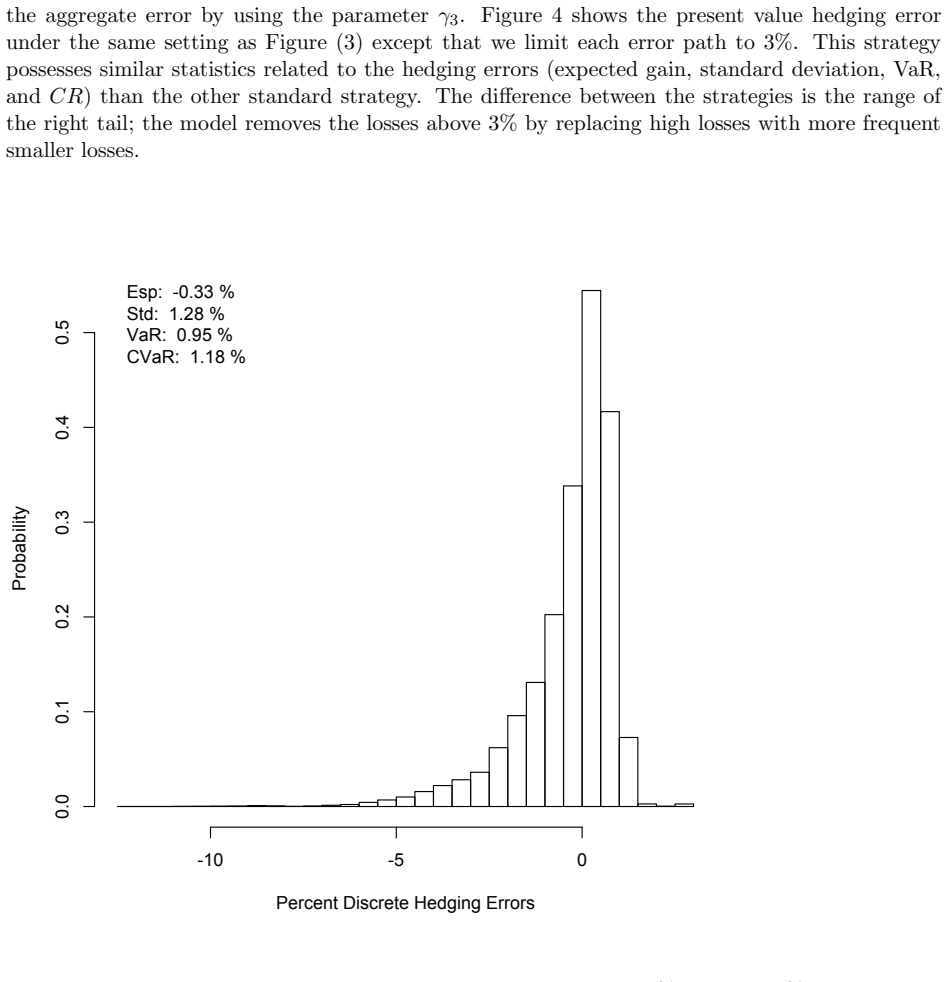
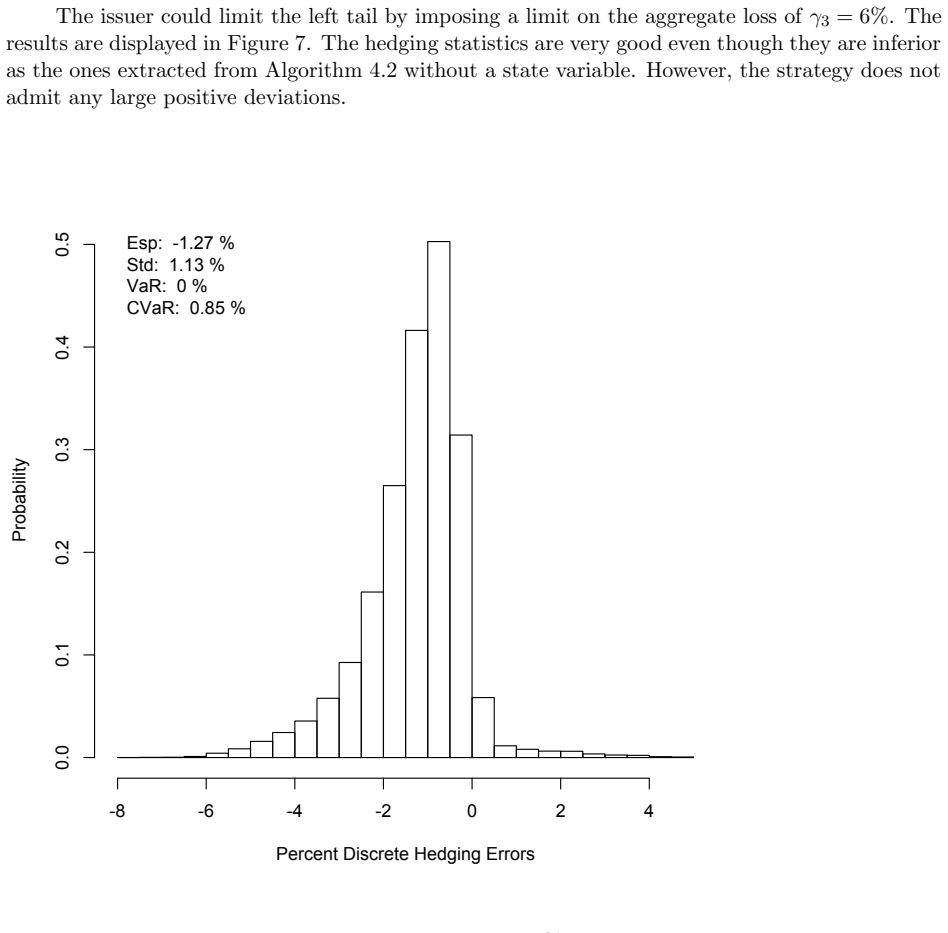
- Imposing a cap on accumulated pathwise losses removes large positive hedging errors, replacing them with more frequent smaller losses while leaving the expected gain nearly unchanged.
- The framework covers CVaR-as-constraint, CVaR-as-objective with expected future costs, future-risk barriers, and coherent dynamic risk measures as variations of one parametric LP scheme.
- As the number of rebalancing dates grows, the optimized tail criterion decreases once the tree is sufficiently dense, while increasing the number of nodes per period widens the index tail and raises the criterion.
Reading between the lines
- The same template could price American and barrier options by adding an early-exercise decision variable; the paper notes this as future work but does not implement it.
- Because multi-parametric linear programming requires a degeneracy-resolution rule, the practical bottleneck in reproducing the tables is the choice of that rule; the paper mentions degeneracy but gives no explicit construction.
- The calibration loop—scanning the CVaR retention level and the loss threshold to minimize a simulated tail statistic—could be automated; the paper reports only grid-search results.
- The pathwise-accumulated-loss state variable opens a route to constraints on cumulative shortfall over the whole contract, not just per-transition losses; the paper demonstrates the per-path cap but not this extension.
Signed reviews
Editorial analysis
A structured set of objections, weighed in public.
Referee Report
Summary. The paper proposes a discrete-time, tree-based dynamic programming framework for pricing equity-linked products (GICs and point-to-point EIAs) with partial hedging. The issuer's hedging portfolio is selected backward in time by solving local optimization problems: under a probabilistic or CVaR constraint on the transition loss (Algorithm 4.2), or with the local risk measure in the objective, either averaged with future cost-to-go (Algorithm 4.5), constrained by a barrier on future risk (Algorithm 4.7), or embedded in a coherent dynamic risk measure recursion (Algorithm 4.8). The authors argue that when the state appears only in the right-hand side of a linear program, the cost-to-go function is convex piecewise linear and can be represented by supporting hyperplanes via multi-parametric LP. Numerical examples for GICs and EIAs on a binomial tree with one-month rebalancing and a European call option illustrate the method; a statistic CR (initial hedge cost plus 95% CVaR of the discounted mismatch minus the premium) is introduced to calibrate the risk parameters.
Significance. If the central claim holds, the paper gives a single LP-based template for comparing several risk-control objectives in equity-linked insurance, with multiple assets and pathwise loss constraints. The CVaR and expected-downside LP reformulations are standard and correctly stated, and the convexity propositions are conventional. The explicit focus on the supporting-hyperplane representation of the value function is a useful contribution, as is the pathwise loss cap. The paper, however, supplies no code or solver details, the numerical evaluation is in-sample (parameters are chosen by minimizing CR on the same simulated paths used to report it), and the EIA transition probabilities in Eq. (5.45) contain a likely error. These issues do not invalidate the framework, but they reduce the force of the numerical claims and of the claim that the algorithms are exact in the presence of degeneracy.
major comments (3)
- [Section 4.3.1, Proposition 4.4 and Algorithms 4.5/4.7/4.8] The exactness of the backward induction in Algorithms 4.5, 4.7 and 4.8 relies on representing each V_t as the set of its supporting hyperplanes, constructed by the multi-parametric LP pivot procedure described after Proposition 4.4. The paper states there that the procedure is 'fully true if the dual LP is not degenerate', but no degeneracy resolution is proposed for the GIC/EIA instances. Those instances contain natural degeneracy sources: with c=59% and γ0=0 some risk constraints are non-binding, and in the EIA model each index outcome is paired with a death and a survival successor, producing structurally redundant constraints. At a degenerate vertex the single-pivot neighbouring-basis argument need not enumerate all optimal bases, so the stored hyperplane set for V_t may be incomplete; constraints (4.25) and (4.35) would then understate θ and the backward induction would solve a looser problem than the stated dynamic program. Since no solver details or code are given, the numerical section cannot rule this out. This is the load-bearing point for the paper's central algorithmic claim and should be fixed by a degeneracy-robust mpLP implementation (e.g., lexicographic perturbation, as in Jones et al. 2007) or by an explicit argument excluding degeneracy in these models.
- [Section 5.3, Eq. (5.45)] In Eq. (5.45) the survival-branch probabilities do not match the N-subperiod binomial index model. For a survival node with k=j-N-1 up moves, the index value is S u^k d^{N-k}, so the binomial coefficient should be C(N,k), not C(2N+1,k). As written, the conditional probabilities for the survival branch are not normalized, and the EIA numerical results in Section 5.3 are not generated by the model described in (5.43)-(5.44). The authors should correct this coefficient and regenerate the affected EIA results (Figures 6-8 and the related CR values).
- [Section 5.1] Section 5.1 explicitly says CR is used 'as a guideline to fine tune' c and γ0, and that 'different sets of these parameters are tested and the optimal values are compared'. The reported CR values in Tables 2-5 and Figures 2-8 are therefore minima over c (and in Figure 2, over γ0) selected on the same 50,000 simulated paths used to evaluate CR. This is in-sample calibration; it likely makes the reported CR values optimistic and makes the selected c values unstable (e.g., Table 3, where the 'optimal' c jumps from 40 to 90 when N increases from 2 to 4). An out-of-sample or cross-validated evaluation, pre-specified parameters, or a CR curve with uncertainty bands is needed before the comparative numerical claims can be assessed.
minor comments (6)
- [Section 5.2.1, Figure 2] The text says the figure is based on Algorithm 4.7, although the surrounding paragraph describes Algorithm 4.2; the algorithm label should be corrected.
- [Sections 1 and 2] There are typos: 'un function' should be 'a function', and 'The nuclear of our backward stochastic dynamic models' should be 'The core of our...'.
- [Algorithm 4.5] The weight λ in (4.22)/(4.24) is never given a value in Section 5, and no sensitivity analysis is reported; if Algorithm 4.5 results are not shown, the omission should be stated.
- [Abstract] The abstract lists American and Barrier options as typical products, but the paper only treats GICs and point-to-point EIAs; the conclusion says American options are 'being tested'. The abstract should be aligned with the content.
- [Section 5.2.1 and Table 5] No standard errors or confidence intervals are reported for the simulation-based CR estimates, and the claimed comparison with Gaillardetz and Moghtadai (2017) is not documented with a numerical benchmark in the tables.
- [Sections 5.2-5.3] The claim that the algorithms work for unfolded trees is not demonstrated by any unfolded-tree numerical example; all optimization examples use a recombining binomial tree, with the unfolded tree used only for simulation of error paths.
Circularity Check
The reported CR values are in-sample minima obtained by tuning the risk-measure retention level on the same simulated paths used to compute CR, so the headline numerical performance is fitted rather than independently predicted; the LP dynamic-programming derivation itself is not circular.
-
fitted input called prediction
[Section 5.1 and Section 5.2.1, Tables 2–5]
"The table provides optimized results for the risk measure threshold. The mismatches are generated for different c (5%, 10%,,··· , 95%) and the lowest CR obtained from the simulations is presented as well as the risk level that provided this result."
The paper first defines CR as the evaluation statistic, then states that 'CR is used as a guideline to fine tune the risk measure parameters' and that 'different sets of these parameters are tested and the "optimal" values are compared.' The reported headline values, such as GIC CR = 1.14% at c = 59% and EIA CR = 0.24% at c = 50%, are therefore the minimum of CR(c) evaluated on the same 50,000 simulated paths that are used to estimate CR. The retention level c is fitted to the performance measure, so the reported CR is a fitted in-sample minimum rather than an independent prediction.
full rationale
The central mathematical derivation in Sections 3 and 4 is self-contained and does not reduce to its inputs. The cost-to-go functions are constructed by backward parametric linear programming, with convex piecewise linearity justified by standard external results (Rockafellar 1970; Bereanu 1964; Dempster 1980; Gal and Nedoma 1972). The CVaR formulations are taken from Rockafellar and Uryasev 2000, and the coherent dynamic recursion from Riedel 2004; these are external, not self-citations, and none of them is used to forbid alternatives. The citation to Gaillardetz and Moghtadai 2017 is a comparison benchmark and is not load-bearing for the framework's correctness. The degeneracy caveat after Proposition 4.4 is an acknowledged correctness gap or unproven assumption, not a circular step: it weakens the claim that the supporting-hyperplane representation is always complete, but it does not make the derivation equivalent to its inputs. The one genuine circularity is in the numerical evaluation: the same CR statistic is used both to calibrate the risk-measure parameters and to report the strategy's performance, and the tables explicitly present the lowest CR obtained from the simulations. This makes the headline numerical values fitted statistics rather than independent predictions. Accordingly, the score reflects partial circularity in the reported numerical performance, while the paper's algorithmic framework itself remains largely self-contained.
Assumptions & free parameters
free parameters (4)
- CVaR retention level c =
Varies by table; e.g., 59% for default GIC, 50% for EIA, and 45-95% across Tables 2-5
- Loss threshold gamma0 =
0
- Pathwise loss cap gamma3 =
3% for GIC, 6% for EIA
- Weight lambda in Algorithm 4.5 =
Not reported
assumptions (5)
- domain assumption The random process is a finite discrete tree and the portfolio is rebalanced only at tree nodes.
- domain assumption Interest rates are deterministic.
- ad hoc to paper Cost-to-go functions are convex piecewise linear and can be represented by their supporting hyperplanes.
- domain assumption The binomial tree probabilities under the physical measure are given by pi=(e^{mu/12}-d)/(u-d), while options are priced with Black-Scholes.
- ad hoc to paper The risk measure CR is an appropriate criterion for calibrating risk parameters.
Cite this review
Pith. "Pith review of Risk-Control Strategies." pith.science (2026). https://pith.science/paper/M4LPTMSF
@misc{pith2026190802228,
  author       = {Pith},
  title        = {Pith review of: Risk-Control Strategies},
  year         = {2026},
  howpublished = {\url{https://pith.science/paper/M4LPTMSF}},
  note         = {Machine review of arXiv:1908.02228}
}
read the original abstract
In this paper, we consider the pricing of derivative products that involve dynamic hedging strategies and payments within the planning horizon. Equity-indexed annuities (EIAs), Guaranteed investment certificate (GIC), American and Barrier options are typical examples of these products. Our exploration involves evaluation under different assumptions related to the way the risk is tailored by the issuer. The unified constrained discrete stochastic dynamic programming framework presented in this paper makes use of sequential local minimizing strategies related to stochastic transitions. This sequential minimizations takes into account all intermediate requirements and involves several dynamic risk measures modelling. To demonstrate the flexibility of this framework we present numerical examples featuring GICs and point-to-point EIAs.
Figures


Figures from the paper (5 more)



Reference graph
Works this paper leans on
-
[1]
F. Abergel and N. Millot. Nonquadratic local risk-minimization for hedging contingent claims in incomplete markets. SIAM Journal on Financial Mathematics, 2 0 (1): 0 342--356, 2011
work page 2011
-
[2]
Artzner, F
P. Artzner, F. Delbaen, J.-M. Eber, and D. Heath. Coherent measures of risk. Mathematical Finance, 9 0 (3): 0 203--228, 1999
1999
-
[3]
A. Ben-Tal, L. El Ghaoui, and A. Nemirovski. Robust optimization. Princeton University Press, 2009
work page 2009
-
[4]
B. Bereanu. Regions de decision et repartitionde l'optimum dans la programmation lineaire. C. R. Acad. Sci. Paris, 1383-1386, 1964
work page 1964
-
[5]
F. Black and M. Scholes. The pricing of options and corporate liabilities. The Journal of Political Economy, 81 0 (3): 0 637--654, 1973
work page 1973
-
[6]
F. Borrelli, A. Bemporad, and M. Morari. A geometric algorithm to multi-parametric linear programming. Journal of Optimization Theory and Applications, 118 0 (3): 0 515--540, 2003
work page 2003
-
[7]
N.L. Bowers. Actuarial Mathematics. Society of Actuaries, 1997. ISBN 9780938959465
work page 1997
-
[8]
A. Charnes, W.W. Cooper, and G.H. Symonds. Cost horizons and certainty equivalents: an approach to stochastic programming of heating oil production. Management science, 4: 0 236--263, 1958
work page 1958
Show all 30 references
-
[9]
Coleman, Y
T.F. Coleman, Y. Li, and M.-C. Patron. Hedging guarantees in variable annuities under both equity and interest rate risks. Insurance: Mathematics and Economics, 38 0 (2): 0 215--228, 2006
2006
-
[10]
Cox, S.A
J.C. Cox, S.A. Ross, and M. Rubinstein. Option pricing: A simplified approach. Journal of financial Economics, 7 0 (3): 0 229--263, 1979
1979
-
[11]
Dempster, editor
M.A.H. Dempster, editor. A Discussion of the Properties of a Basic Simplex Algorithm for Generating the Decision Regions of Bereanu., 1980. Academic Press
1980
-
[12]
F\"ollmer and P
H. F\"ollmer and P. Leukert. Efficient hedging: Cost versus shortfall risk. Finance and Stochastics, 4 0 (2): 0 117--146, 2000
2000
-
[13]
F\"ollmer and M
H. F\"ollmer and M. Schweizer. Hedging by sequential regression: An in- troduction to the mathematics of option trading. Astin Bulletin, 2 0 (147-160), 1988
1988
-
[14]
F\"ollmer and D
H. F\"ollmer and D. Sondermann. Hedging of non-redundant contingent claims. Contributions to Mathematical Economics, 1986
1986
-
[15]
Quantile hedging
Hans F\"ollmer and Peter Leukert. Quantile hedging. Finance and Stochastics, 3 0 (3): 0 251--273, 1999
1999
-
[16]
Gaillardetz and M
P. Gaillardetz and M. Moghtadai. Partial hedging for equity-linked products using risk-minimizing strategies. North American Actuarial Journal, 21 0 (4): 0 580--593, 2017
2017
-
[17]
Gal and J
T. Gal and J. Nedoma. Multiparametric linear programming. Management Science, 18 0 (406-442), 1972
1972
-
[18]
M. Hardy. Investment guarantees: modeling and risk management for equity-linked life insurance. John Wiley & Sons, 2003
2003
-
[19]
Jonesa, E.C
C.N. Jonesa, E.C. Kerriganb, and J.M. Maciejowskic. Lexicographic perturbation for multiparametric linear programming with applications to control. Automatica, 43: 0 1808--1816, 2007
2007
-
[20]
Kucukyavuz
S. Kucukyavuz. On mixing sets arising in chance-constrained programming. Mathematical Programming, 132: 0 31--56, 2012
2012
-
[21]
Luedtke, S
J. Luedtke, S. Ahmed, and G. Nemhauser. An integer programming approach for linear programs with probabilistic constraints. Mathematical Programming, 122 0 (2): 0 247--272, 2010
2010
-
[22]
Markowitz
H. Markowitz. Portfolio Selection: Efficient Diversification of Investmen. New York: John Wiley, 1959
1959
-
[23]
Miller and H.M
B.L. Miller and H.M. Wagner. Chance constrained programming with joint constraints. Operations Research, 13: 0 930--965, 1965
1965
-
[24]
A. Prekopa. Contributions to the theory of stochastic programming. Mathematical Programming, 4: 0 201--221, 1973
1973
-
[25]
A. Prekopa. Dual method for the solution of a one-stage stochastic programming problem with random rhs obeying a discrete probability distribution. ZOR Methods Models Operations Research, 34: 0 441--461, 1990
1990
-
[26]
F. Riedel. Dynamic coherent risk measures. Stochastic Processes and their Applications, 112: 0 185--200, 2004
2004
-
[27]
Rockafellar
R.T. Rockafellar. Convex Analysis. Princeton University Press, 1970
1970
-
[28]
Rockafellar and S
R.T. Rockafellar and S. Uryasev. Optimization of conditional value-at-risk. Journal of Risk, 2: 0 21--41, 2000
2000
-
[29]
Ruszczynski
A. Ruszczynski. Probabilistic programming with discrete distributions and precedence constrained knapsack polyhedra. Mathematical Programming, 93: 0 195--215, 2002
2002
-
[30]
Schweizer
M. Schweizer. Hedging of options in a general semimartingale model. PhD thesis, ETH Zurich, 1988
1988
Reviewed August 14, 2026 · model on record in the stance chip above.
Discussion (0). Continue with ORCID to comment.