REVIEW 1 major objections 4 minor 35 references
An existence theory for small-amplitude doubly periodic water waves with vorticity
T0 review · 1 major / 4 minor · reviewed 2026-08-14 · deepseek-v4-flash
Pith's one-line read This paper proves the existence of small-amplitude, doubly periodic, three-dimensional gravity-capillary water waves with vorticity, bifurcating from a Beltrami laminar flow.
desk verdict First genuinely three-dimensional steady water waves with Beltrami vorticity, proved by a clean reduction and multi-parameter bifurcation; conditions are explicit and satisfiable. read the letter →
The pith
A machine-rendered reading of the paper's core claim, the machinery that carries it, and where it could break.
The reading
What carries the argument
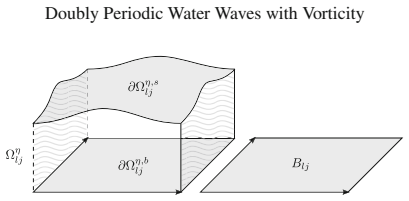
The argument is carried by a reduction of the free-boundary problem to one nonlinear equation for the surface. After a flattening change of variables and a shift of the velocity field, the system becomes (2.5), and the operator $C_\alpha: v \mapsto (\nabla\times v - \alpha v,\, v_3|_{\text{surface}})$ is shown to be an isomorphism under the non-resonance condition (2.7); this lets the velocity be eliminated, leaving the single pseudodifferential surface equation (2.6). The linearisation of this surface equation has Fourier symbol $\rho(c,k)$, and the assumptions of Theorem 4.1 make its kernel two-dimensional, spanned by $\cos(k_1\cdot x')$ and $\cos(k_2\cdot x')$. A Lyapunov–Schmidt reduction then splits the surface into the two kernel modes plus an orthogonal correction, producing a $2\times 2$ system of bifurcation equations whose coefficient matrix has determinant equal to the transversality expression from (3.12); the implicit function theorem solves it for $c$ as a function of $t$. The geometric heart of the parameter search is the observation that, for fixed $k$, the equation $\rho(c,k)=0$ defines a hyperbola $C(k)$ in the $(c_1,c_2)$-plane, and the angle between the asymptotes of two such hyperbolas controls whether the two curves intersect in a non-tangential point—condition (3.8) guarantees both a common root $c^\star$ and transversality.
What would settle it
Take a concrete parameter set satisfying all hypotheses—say $\alpha=1$, $d=1$, a symmetric lattice with $|k_1|=|k_2|$ and angle $\theta$ obeying (3.8), and $\sigma$ outside the countable exceptional set—and solve the reduced surface equation (2.6) numerically near the bifurcation point. If any nontrivial small solution exists that is not captured by the leading-order formula $\eta=t_1\cos(k_1\cdot x')+t_2\cos(k_2\cdot x')+O(|t|^2)$ with $c-c^\star=O(|t|^2)$, or if the predicted two-parameter family fails to appear, the central claim would be contradicted. A cheaper check: search the dual lattice for all roots of $\rho(c^\star,k)=0$; a third pair of roots for every $\sigma$ would refute the genericity statement in Remark 4.2.
Extended reading notes
Core claim
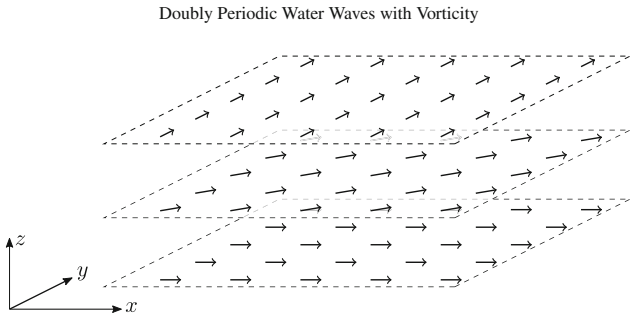
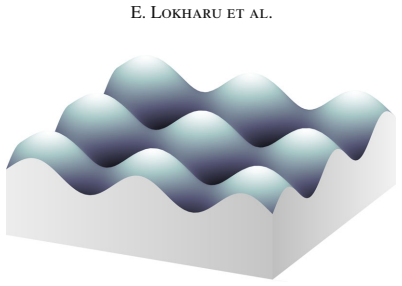
The central result, Theorem 4.1, is an existence theorem: given depth $d>0$, vorticity parameter $\alpha$, surface tension $\sigma>0$, and a laminar Beltrami flow $U[c^\star_1,c^\star_2]$, suppose the dual lattice is generated by independent vectors $k_1,k_2$ and that (i) the non-resonance condition (2.7) holds, (ii) at $c=c^\star$ the dispersion relation $\rho(c,k)=g+\sigma|k|^2-\frac{(c\cdot k)^2}{|k|^2}\kappa(|k|)+\alpha\frac{(c\cdot k)(c\cdot k^\perp)}{|k|^2}=0$ has exactly the four roots $\pm k_1,\pm k_2$ in the lattice, and (iii) the transversality condition (3.12) holds. Then there is a neighbourhood of zero in the $(t_1,t_2)$-plane and analytic corrections $\delta_1,\delta_2=O(|t|^2)$ such that for each $t$ there is a doubly periodic solution $(v,\eta)$ of the Beltrami–Euler system (2.5) with $c_1=c^\star_1+\delta_1(t)$, $c_2=c^\star_2+\delta_2(t)$ and $\eta(x')=t_1\cos(k_1\cdot x')+t_2\cos(k_2\cdot x')+O(|t|^2)$. The solution depends analytically on $t$, and locally these are the only nontrivial solutions except for two families of two-and-a-half-dimensional waves. The paper also shows the hypotheses can be satisfied: for any $\alpha>0$ and $d>0$ one can choose lattice lengths and angle so that a suitable $c^\star$ exists, and in the symmetric-lattice case the 'exactly four roots' condition holds for all surface-tension values outside a countable exceptional set.
Load-bearing premise
The construction depends on avoiding a resonance: for every lattice wave number $k$ shorter than $|\alpha|$, the quantity $\sqrt{\alpha^2-|k|^2}$ must not be an integer multiple of $\pi/d$; at such a resonance extra internal modes appear and the proof's reduction to a single surface equation no longer works.
Editorial extensions
If this is right
- For any $\alpha>0$ and $d>0$, parameters can be chosen—lattice lengths, angle, and a generic surface tension—so that the theorem applies, yielding genuinely three-dimensional doubly periodic waves with nonzero Beltrami vorticity.
- The theorem also covers $\alpha=0$, giving another proof of existence of doubly periodic irrotational gravity-capillary waves, now obtained alongside the vortical case.
- Along the curves $t_1=0$ and $t_2=0$ the two-parameter family degenerates into two families of two-and-a-half-dimensional waves, so the genuinely three-dimensional waves appear through dimension-breaking bifurcations and connect two different two-and-a-half-dimensional states.
- Near the bifurcation point the family is exhaustive: the only small-amplitude solutions are the two-parameter genuinely three-dimensional family and the two two-and-a-half-dimensional families.
Reading between the lines
- Editorial extension: because the theorem excludes resonant vertical modes by (2.7), resonant lattices form the natural next target; Cases III and IV in Section 3.1 already show what new linear modes appear there, suggesting coupled-mode or constant-mode bifurcations the present theory does not reach.
- Editorial extension: the explicit leading-order formula $\eta\approx t_1\cos(k_1\cdot x')+t_2\cos(k_2\cdot x')$ makes the family directly accessible to numerical continuation and to a linear stability analysis of the bifurcating waves, neither of which the paper undertakes.
- Editorial extension: the same reduction machinery, with a different dispersion relation, might transfer to other elliptic free-boundary problems with Beltrami or force-free fields, such as magnetohydrostatic free surfaces, though the hyperbola-intersection argument would have to be reworked.
Signed reviews
Editorial analysis
A structured set of objections, weighed in public.
Referee Report
Summary. The paper proves an existence theorem for small-amplitude three-dimensional steady gravity-capillary water waves with vorticity, periodic with respect to a given two-dimensional lattice, under the assumption that the relative velocity field is a Beltrami field (curl u = αu). The authors reduce the free-boundary problem to a single nonlinear pseudodifferential equation for the surface elevation by analytically eliminating the velocity field (Theorem 2.1, condition (2.7)), analyze the linearized problem via Fourier modes to derive the dispersion relation (3.3), and establish the needed transversality condition (Proposition 3.3). The main result, Theorem 4.1, uses Lyapunov-Schmidt reduction to construct a two-parameter family of solutions near a laminar flow, with surface elevation η = t1 cos(k1·x') + t2 cos(k2·x') + O(|t|^2), analytic in the parameters t = (t1,t2). The theorem is explicitly conditional on three assumptions: the non-resonance condition (2.7), the exact-four-roots condition for the dispersion equation, and the transversality condition (3.12). Propositions 3.1 and 3.3 and Remark 4.2 show that these assumptions can be satisfied, in particular for symmetric lattices with generic surface-tension values.
Significance. If the result is correct, it provides the first existence theory for genuinely three-dimensional doubly periodic water waves with vorticity in the Beltrami class, going beyond the irrotational theory developed by Reeder-Shinbrot, Sun, Craig-Nicholls, and Groves-Mielke. The proof is rigorous and self-contained: it is based on classical elliptic theory, Fourier-multiplier estimates, and a multi-parameter bifurcation argument, with no fitted parameters or external numerical input. The paper also recovers 2.5-dimensional waves and describes dimension-breaking connections between the genuinely three-dimensional family and the 2.5-dimensional families, which is a notable structural insight. The conditional hypotheses are clearly stated, and the authors explicitly show that the non-resonance and transversality conditions are open or generic, so the theorem is not vacuous. The main limitation, the exclusion of resonant cases (Cases III and IV in Section 3.1), is acknowledged and does not undermine the stated conditional result.
major comments (1)
- [Section 3.1, Cases III and IV; Remark 4.3] The non-resonance condition (2.7) excludes a genuine set of parameter values for which additional linearized modes appear, as shown by the paper's own analysis in Cases III and IV of Section 3.1. This is an explicit limitation that the authors acknowledge in Remark 4.3. Remark 4.2 demonstrates that (2.7) can be satisfied together with κ(|k_j|) > 0 by choosing |k_j| close to |α| and avoiding finitely many angles, so the conditional theorem has nonempty scope. I do not regard this as a defect, but the exclusion should be kept in mind when citing the theorem.
minor comments (4)
- [Section 3.1, near equation (3.8)] There is a duplicated word in the sentence 'if α ≠ 0 we we can always assume that it is positive'; 'we we' should be 'we'.
- [Section 1.3] The word 'elluded' should be 'eluded'.
- [Remark 4.2] In the displayed condition for (2.7), the indices n1 and n2 are said to range over Z; it would be clearer to state explicitly that n1 and n2 are not both zero, although the surrounding text implies this.
- [Lemma 4.4] The claim that the Fourier multiplier operator L is Fredholm of index 0 and invertible on the complement is justified by a citation to [3, Prop. 2.78]; a one-sentence explanation of why the symbol's zeros at ±k1, ±k2 are isolated would improve readability, but the cited theory is appropriate.
Circularity Check
No significant circularity: the bifurcation proof is self-contained and its restrictive assumptions are explicit and satisfiable.
full rationale
This paper's derivation chain is self-contained. The central claim, Theorem 4.1, is a conditional multi-parameter bifurcation result: under the explicit non-resonance condition (2.7), the exact-four-roots dispersion condition, and the transversality condition (3.12), the Lyapunov-Schmidt reduction produces a two-parameter family of solutions with c adjusted as O(|t|^2). The dispersion relation (3.3) is derived from the linearized problem (3.1) by direct Fourier analysis, not imported from a fit or from the conclusion. The reduced equation (2.6) is obtained by eliminating the velocity field through Theorem 2.1, whose key step (Lemma 2.2) is proved using classical elliptic theory and Fourier eigenvalue arguments. The bifurcation equations (4.8) are solved by the implicit function theorem, with the coefficient matrix being the transversality condition; the amplitudes t1,t2 are free parameters in a neighbourhood of zero, and c1,c2 are then determined, so no quantity is fitted to data and then renamed a prediction. The self-citations, such as the variational principle of Lokharu and Wahlén [27], appear only in the introduction and remarks and are not used in the proof of Theorem 4.1; they are therefore not load-bearing. Assumptions (2.7) and the exact-four-roots condition are genuine hypotheses, explicitly shown in Remark 4.2 to be satisfiable by avoiding finitely many angles and a countable set of surface-tension values, so they do not hide the conclusion. When (2.7) fails, Cases III and IV produce extra linearized modes, but the paper explicitly excludes those cases; this is a stated limitation rather than a circular step. No equation in the paper reduces by definition to its own input.
Assumptions & free parameters
assumptions (8)
- standard math Classical elliptic regularity and Schauder estimates (Agmon-Douglis-Nirenberg Theorem 6.30)
- standard math Analytic implicit function theorem
- standard math Fourier multiplier estimates on Hölder spaces (Bahouri-Chemin-Danchin Prop. 2.78)
- domain assumption The relative velocity field is a strong Beltrami field with constant α (equation 1.1a)
- domain assumption Inviscid, incompressible, constant density fluid with gravity and surface tension
- domain assumption Non-resonance condition (2.7)
- domain assumption Lattice periodicity and symmetry conditions (1.4)-(1.5)
- domain assumption αd not in 2πZ\{0}
Cite this review
Pith. "Pith review of An existence theory for small-amplitude doubly periodic water waves with vorticity." pith.science (2026). https://pith.science/paper/M5LBBWL2
@misc{pith2026190802655,
  author       = {Pith},
  title        = {Pith review of: An existence theory for small-amplitude doubly periodic water waves with vorticity},
  year         = {2026},
  howpublished = {\url{https://pith.science/paper/M5LBBWL2}},
  note         = {Machine review of arXiv:1908.02655}
}
read the original abstract
We prove the existence of three-dimensional steady gravity-capillary waves with vorticity on water of finite depth. The waves are periodic with respect to a given two-dimensional lattice and the relative velocity field is a Beltrami field, meaning that the vorticity is collinear to the velocity. The existence theory is based on multi-parameter bifurcation theory.
Figures
Figures from the paper (2 more)


Reference graph
Works this paper leans on
-
[1]
, Va r h o l m, K.: Traveling gravity water waves with critical layers
Aasen,A . , Va r h o l m, K.: Traveling gravity water waves with critical layers. J. Math. Fluid Mech. 20, 161–187, 2018
work page 2018
-
[2]
Agmon,S . ,Douglis,A . ,Nirenberg, L.: Estimates near the boundary for solutions of elliptic partial differential equations satisfying general boundary conditions I. Comm. Pure Appl. Math. 12, 623–727, 1959
work page 1959
-
[3]
Bahouri,H . , Chemin,J . - Y . ,Danchin,R . : Fourier analysis and nonlinear partial differential equations , vol. 343. Grundlehren der Mathematischen Wissenschaften. Springer, Heidelberg 2011
work page 2011
-
[4]
Boulmezaoud, T.Z., Amari, T.: On the existence of non-linear force-free fields in three-dimensional domains. Z. Angew. Math. Phys. 51, 942–967, 2000
work page 2000
-
[5]
Boulmezaoud,T . - Z . ,Maday,Y . ,Amari, T.: On the linear force-free fields in bounded and unbounded three-dimensional domains.M2AN Math. Model. Numer. Anal.33, 359– 393, 1999
work page 1999
-
[6]
Buffoni,B . ,Groves, M.D., Sun, S.M., Wahlén, E.: Existence and conditional ener- getic stability of three-dimensional fully localised solitary gravity-capillary water waves. J. Differ. Equ. 254, 1006–1096, 2013
work page 2013
-
[7]
Buffoni,B . ,Groves, M.D., Wahlén, E.: A variational reduction and the existence of a fully localised solitary wave for the three-dimensional water-wave problem with weak surface tension. Arch. Ration. Mech. Anal. 228, 773–820, 2018
work page 2018
-
[8]
Constantin, A.: Edge waves along a sloping beach. J. Phys. A 34, 9723–9731, 2001
work page 2001
Show all 35 references
-
[9]
:Nonlinear water waves with applications to wave-current interactions and tsunamis, vol
Constantin,A . :Nonlinear water waves with applications to wave-current interactions and tsunamis, vol. 81. CBMS-NSF Regional Conference Series in Applied Mathematics, Society for Industrial and Applied Mathematics (SIAM), Philadelphia PA 2011
2011
-
[10]
Constantin, A.: An exact solution for equatorially trapped waves. J. Geophys. Res. Oceans, 117, 2012 11. Craig,W . , Nicholls, D.P .: Travelling two and three dimensional capillary gravity water waves. SIAM J. Math. Anal. 32, 323–359, 2000
2012
-
[12]
, Escher,J
Ehrnström,M . , Escher,J . , Villari, G.: Steady water waves with multiple critical layers: interior dynamics. J. Math. Fluid Mech. 14, 407–419, 2012
2012
-
[13]
, Escher,J
Ehrnström,M . , Escher,J . , Wahlén, E.: Steady water waves with multiple critical layers. SIAM J. Math. Anal. 43, 1436–1456, 2011
2011
-
[14]
,Wahlén, E.: Trimodal steady water waves.Arch
Ehrnström,M . ,Wahlén, E.: Trimodal steady water waves.Arch. Ration. Mech. Anal. 216, 449–471, 2015 E. Lokharu et al
2015
-
[15]
, Peralta-Salas, D.: Beltrami fields with a nonconstant proportionality factor are rare
Enciso,A . , Peralta-Salas, D.: Beltrami fields with a nonconstant proportionality factor are rare. Arch. Ration. Mech. Anal. 220, 243–260, 2016
2016
-
[16]
Cambridge University Press, Cambridge 2014
Freidberg, J.P .:Ideal MHD. Cambridge University Press, Cambridge 2014
2014
-
[17]
GAMM- Mitt
Groves, M.D.: Three-dimensional travelling gravity-capillary water waves. GAMM- Mitt. 30, 8–43, 2007
2007
-
[18]
Groves, M.D., Haragus, M.: A bifurcation theory for three-dimensional oblique trav- elling gravity-capillary water waves. J. Nonlinear Sci. 13, 397–447, 2003
2003
-
[19]
, Sun, S.M.: A dimension-breaking phenomenon in the theory of steady gravity-capillary water waves.R
Groves, M.D., Haragus,M . , Sun, S.M.: A dimension-breaking phenomenon in the theory of steady gravity-capillary water waves.R. Soc. Lond. Philos. Trans. Ser. A Math. P h y s .E n g .S c i ., 360, 2189–2243 2002. Recent developments in the mathematical theory of water waves (O...
2002
-
[20]
Groves, M.D., Mielke, A.: A spatial dynamics approach to three-dimensional gravity- capillary steady water waves. Proc. R. Soc. Edinburgh Sect. A 131, 83–136, 2001
2001
-
[21]
Groves, M.D., Sun, S.-M.: Fully localised solitary-wave solutions of the three- dimensional gravity-capillary water-wave problem. Arch. Ration. Mech. Anal. 188,1 – 91, 2008
2008
-
[22]
Groves, M.D., Sun, S.M., Wahlén, E.: A dimension-breaking phenomenon for water waves with weak surface tension. Arch. Ration. Mech. Anal. 220, 747–807, 2016
2016
-
[23]
Henry, D.: On three-dimensional Gerstner-like equatorial water waves. Philos. Trans. R. Soc. A 376, 20170088, 2018
2018
-
[24]
, Plotnikov, P .: Asymmetrical three-dimensional travelling gravity waves
Iooss,G . , Plotnikov, P .: Asymmetrical three-dimensional travelling gravity waves. Arch. Ration. Mech. Anal. 200, 789–880, 2011
2011
-
[25]
, Plotnikov, P .I.: Small divisor problem in the theory of three-dimensional water gravity waves
Iooss,G . , Plotnikov, P .I.: Small divisor problem in the theory of three-dimensional water gravity waves. Mem. Am. Math. Soc. 200, viii+128, 2009
2009
-
[26]
, Neudert,M
Kaiser,R . , Neudert,M . ,v o n Wahl, W.: On the existence of force-free magnetic fields with small nonconstant α in exterior domains. Commun. Math. Phys. 211, 111– 136, 2000
2000
-
[27]
, Wahlén, E.: A variational principle for three-dimensional water waves over Beltrami flows
Lokharu,E . , Wahlén, E.: A variational principle for three-dimensional water waves over Beltrami flows. Nonlinear Anal. 184, 193–209, 2019
2019
-
[28]
Majda, A.J., Bertozzi, A.L.: Vorticity and Incompressible Flow, vol. 27. Cambridge Texts in Applied Mathematics, Cambridge University Press, Cambridge 2002
2002
-
[29]
Nilsson, D.: Three-dimensional internal gravity-capillary waves in finite depth. Math. Methods Appl. Sci. 42, 4113–4145, 2019
2019
-
[30]
:Magnetohydrodynamics of the Sun
Priest,E . :Magnetohydrodynamics of the Sun. Cambridge University Press, Cambridge 2014
2014
-
[31]
, Shinbrot, M.: Three-dimensional, nonlinear wave interaction in water of constant depth
Reeder,J . , Shinbrot, M.: Three-dimensional, nonlinear wave interaction in water of constant depth. Nonlinear Anal. 5, 303–323, 1981
1981
-
[32]
Sun, T.: Three-dimensional steady water waves generated by partially localized pressure disturbances. SIAM J. Math. Anal. 24, 1153–1178, 1993
1993
-
[33]
Wahlén, E.: Steady periodic capillary-gravity waves with vorticity. SIAM J. Math. Anal. 38, 921–943, 2006
2006
-
[34]
Wahlén, E.: Non-existence of three-dimensional travelling water waves with constant non-zero vorticity. J. Fluid Mech. 746, 2014
2014
-
[35]
Discrete Contin
Walsh, S.: Steady stratified periodic gravity waves with surface tension I: local bifur- cation. Discrete Contin. Dyn. Syst. 34, 3241–3285, 2014
2014
-
[36]
Discrete Contin
Walsh, S.: Steady stratified periodic gravity waves with surface tension II: global bi- furcation. Discrete Contin. Dyn. Syst. 34, 3287–3315, 2014 Doubly Periodic Water Waves with V orticity E. Lokharu Department of Mathematics, Linköping University, 581 83 Linköping Sweden. an...
2020
Reviewed August 14, 2026 · model on record in the stance chip above.
Discussion (0). Continue with ORCID to comment.