REVIEW 3 major objections 3 minor 1 cited by
The DESI-Lensing Mock Challenge: large-scale cosmological analysis of 3x2-pt statistics
T0 review · 3 major / 3 minor · reviewed 2026-08-11 · deepseek-v4-flash
Pith's one-line read This paper shows that a full mock-based analysis pipeline for DESI Year 1 lensing and clustering data recovers the input cosmology within the statistical error margins.
desk verdict Solid mock challenge for the DESI-Y1 3x2-pt pipeline; the new wp covariance is the key ingredient and the one part not directly mock-validated. read the letter →
The pith
A machine-rendered reading of the paper's core claim, the machinery that carries it, and where it could break.
The reading
What carries the argument
The central object is the analytical covariance matrix of the combined 3x2-pt data vector. It is built from Gaussian, noise, and super-sample contributions following the formulations of Krause & Eifler and Joachimi et al., with a new extension: the covariances between the projected correlation function $w_p(R)$ and the angular shear statistics $\xi_\pm(\theta)$ and $\gamma_t(\theta)$, derived in the Limber approximation in Appendix D. This machinery sets the error bars in the parameter fits; the validation of the shear and galaxy-galaxy lensing diagonal errors against the mock ensemble, agreeing to a few percent, is what gives the parameter-recovery claim its weight.
What would settle it
A direct check would be to compare the analytical $w_p(R)$ covariance to the scatter of $w_p$ measurements across a suite of mock catalogues built without the domain-decomposition artefact or with that effect corrected; if the analytical errors deviate from the mock scatter by more than the few-percent level seen for $\xi_\pm$ and $\gamma_t$, the parameter-recovery claim would be undermined. A cheaper test is to check whether $w_p$-only fits across many realisations produce a $\chi^2$ distribution consistent with the assumed number of degrees of freedom.
Extended reading notes
Core claim
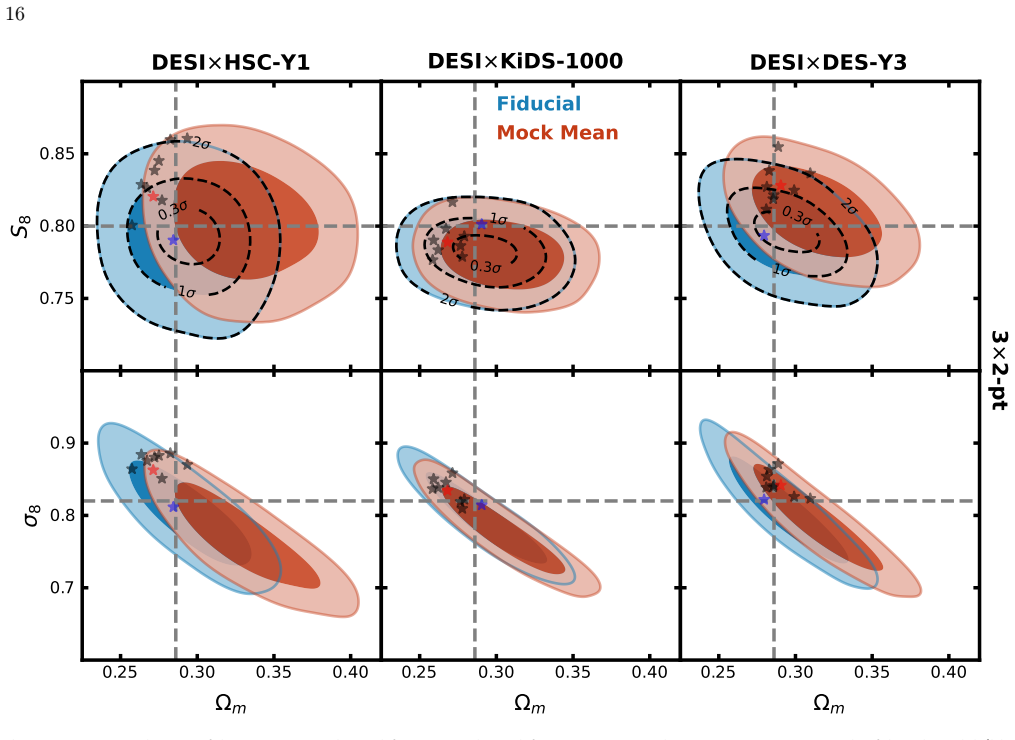
On the paper's own terms, the discovery is that the 3x2-pt pipeline for DESI-Y1, combining cosmic shear $\xi_\pm$, galaxy-galaxy lensing $\gamma_t$, and projected clustering $w_p$, is ready for real data: fits to simulated data vectors return the input values of $\Omega_m$ and $S_8$ within roughly half a $\sigma$ to one $\sigma$, with probability-to-exceed statistics comparable to earlier DES-Y3 validation. The parameter biases in the fitted data are consistent with the noise expected from eight mock realizations plus prior volume effects. The paper therefore concludes that the fiducial fitting configuration produces an acceptable recovery of the underlying cosmology at DESI-Y1 precision.
Load-bearing premise
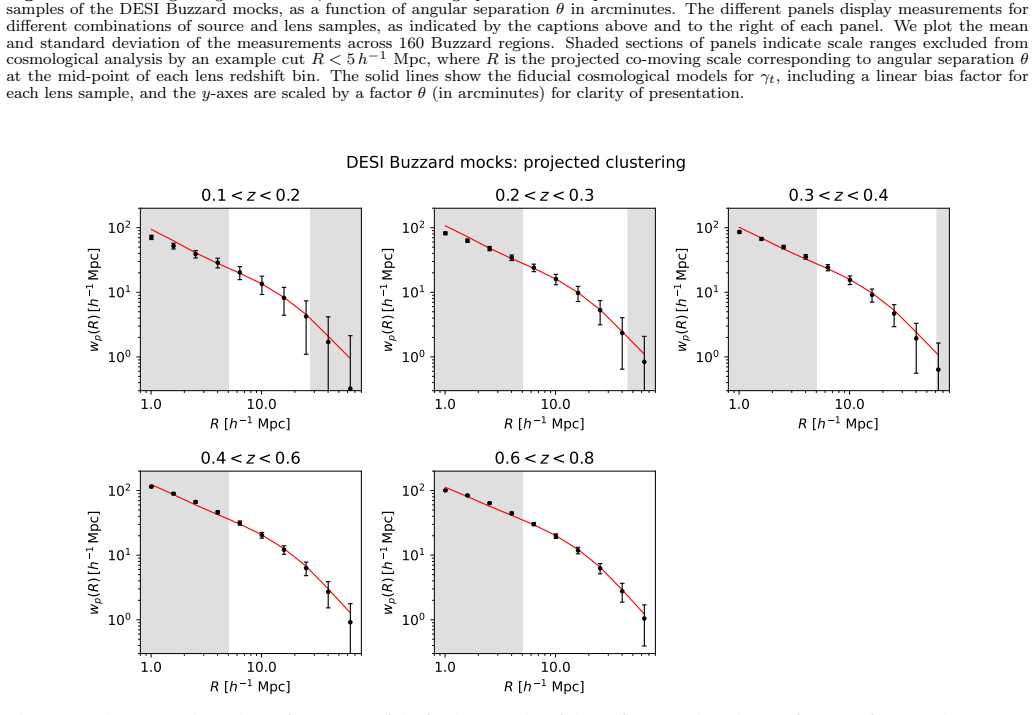
The analytical error model for the projected clustering measurement and its correlation with the shear measurements is assumed to be correct, but it could not be checked directly against the simulated data because the simulations' domain decomposition spoils the numerical covariance estimate for $w_p$.
Editorial extensions
If this is right
- The DESI-Y1 3x2-pt analysis can proceed using the analytical covariance, including the new $w_p$ cross-terms, without needing a large mock ensemble to calibrate the error matrix.
- Cosmic shear alone recovers the fiducial parameters with the smallest bias, while the galaxy-galaxy lensing plus clustering combination shows somewhat larger, though still acceptable, biases, meaning the choice of small-scale cuts matters.
- Including the projected correlation function of the spectroscopic lenses adds clustering signal-to-noise without degrading the cosmological parameter recovery.
- The validated framework directly supports the upcoming joint DESI-Y1, KiDS, DES and HSC cosmology analysis.
Reading between the lines
- The $w_p$ covariance, being the one part of the error model not directly checked against the mock ensemble, carries residual risk: if the true noise or super-sample terms for projected clustering are misestimated, the reported parameter errors on the clustering component would be off by that amount.
- Because the mocks omit intrinsic alignments and other astrophysical effects, this validation establishes a floor on pipeline performance rather than a guarantee that real-data fits will be unbiased at the same level.
- The same analytic covariance machinery is the natural foundation for the paper's stated next step, a joint analysis with full 3D clustering including redshift-space distortions, where the added growth-rate information would enter through new cross-covariance terms.
Signed reviews
Editorial analysis
A structured set of objections, weighed in public.
Referee Report
Summary. This paper presents an end-to-end validation of the DESI-Y1 3x2-pt cosmological analysis pipeline using the Buzzard N-body simulation suite. The authors construct mock galaxy and weak lensing catalogs matching DESI BGS/LRG lenses and KiDS-1000, DES-Y3, and HSC-Y1 sources, measure cosmic shear xi±(theta), galaxy-galaxy lensing gamma_t(theta), and projected clustering wp(R), and compute an analytic covariance including Gaussian, super-sample, and noise terms, with new cross-covariance terms involving wp(R) derived in Appendix D. The covariance is tested against the mock ensemble for xi± and gamma_t and against two external codes for xi± and gamma_t; cosmological parameter recovery is then tested with CosmoMC using fiducial scale cuts Rclus=7 h^-1 Mpc and Rggl=10 h^-1 Mpc, with the third lens bin excluded. The paper reports parameter biases in the Omega_m-S8 plane below about 1 sigma and concludes that the fiducial 3x2-pt configuration recovers the underlying cosmology within the statistical error appropriate for DESI-Y1.
Significance. If correct, the paper would provide a valuable end-to-end validation of a key analysis pipeline and introduces a new analytic ingredient—the cross-covariance between the projected correlation function and angular shear/GGL statistics—that will be used in the DESI-Y1 analysis. The strengths include the realistic mock construction, the detailed analytic covariance formalism, the public data release for the figures, and the explicit comparison to external covariance codes at the 1% level for the angular statistics. However, the central validation claim is weakened by the admitted lack of a direct mock-based test of the wp covariance block, which is a principal new ingredient and an input to the parameter-recovery likelihood. The paper is therefore a solid methodological contribution whose headline claim requires an additional validation step before it can be taken as fully demonstrated.
major comments (3)
- [Sec. 3.2, Apps. D-E] The analytic covariance for wp(R) and its cross-covariances is not directly validated against the Buzzard ensemble; Sec. 3.2 states this explicitly, and the external-code comparisons in Appendix E cover only the xi± and gamma_t configurations, not the wp block or its cross-terms. The global chi^2 and PTE statistics used in Secs. 5.5-5.6 are integrated quantities that cannot localize a block-specific error in the wp covariance, and because the same covariance enters both the data and fiducial-model fits in Eq. (21), a block-specific miscalibration would directly affect the reported 'within statistical error margin' statement. Since the headline claim rests on this likelihood ingredient, a direct validation of the wp covariance (e.g., against an alternative simulation without the domain-decomposition issue, or against an independent analytic code including the wp block) is needed.
- [Sec. 5, Sec. 5.6] The third lens redshift bin (0.3<z<0.4) is excluded from all fits because of the Buzzard light-cone transition, as stated in Sec. 5, but the abstract and Sec. 5.6 present the recovery claim without this qualification. The validation is therefore performed on four lens bins rather than the five-bin DESI-Y1 configuration, so the headline claim is stronger than the test actually performed. The paper should state this exclusion explicitly wherever the 'within statistical error' claim is made and, ideally, quantify the impact of the excluded bin on the reported biases.
- [Sec. 2.1 and Sec. 3.1] The analytic covariance is computed using fiducial linear bias factors b=(1.35,1.51,1.65,2.21,2.44) that are fitted to the mock projected correlation functions, while the same wp data are later analyzed in the likelihood with galaxy bias parameters that are free. This partial dependence of the covariance on the analyzed data introduces a potential circularity that is not quantified; the paper should test the sensitivity of the parameter-recovery conclusions to the bias values assumed in the covariance, for example by repeating the fiducial fit with bias parameters shifted by their fitted uncertainties.
minor comments (3)
- [Sec. 5.1] The maximum wp scale cut is set to half the projected separation of the average nside=8 pixel size; this is an ad hoc choice and a sensitivity test varying this cut (e.g., to one-third or two-thirds of the pixel scale) would strengthen the scale-cut validation.
- [Eq. (21)] The PTE definition invokes a rescaling of the covariance by the number of mock realizations M, but the exact form of the rescaled covariance C^M is not written out; specifying this rescaling explicitly would improve reproducibility.
- [Fig. 17] The individual lens redshift bins are not labeled directly in the panels of Fig. 17; adding the redshift ranges to each panel would improve readability.
Circularity Check
No significant circularity: the parameter-recovery claim is an empirical end-to-end test, and the covariance derivation is independent of the claimed result.
full rationale
The central claim, recovery of the Buzzard fiducial cosmology within statistical errors, is tested by fitting mock data vectors with a likelihood whose covariance is derived analytically from standard power-spectrum covariance formulas (Krause & Eifler 2017; Joachimi et al. 2021) and presented in Appendices A–D. The galaxy bias values used in the covariance are fitted from the mock projected correlation functions (Sec. 2.1), but they enter only the error normalization; the cosmological parameters are free, and the recovery of Omega_m and S8 is not statistically forced by these inputs. The analytical covariance is checked against external codes for the xi+/- and gamma_t blocks (Appendix E) and against mock dispersion for xi+/- and gamma_t (Sec. 3.2); the admitted lack of a direct mock comparison for the wp block (Sec. 3.2) is a validation gap, not a circular reduction. The PTE statistic compares mock-mean fits to fiducial-model fits using the same covariance, which is an internal consistency test rather than a construction of the result. The fiducial scale cuts were chosen after inspecting mock fits (Secs. 5.1 and 5.5), which introduces some selection, but the paper also reports results for alternative cuts, so the recovery statement is not a tautology. Self-citations (e.g., DeRose et al. 2019, 2022) are used as prior validation or comparison, not as the load-bearing justification for the recovery claim.
Assumptions & free parameters
free parameters (4)
- Galaxy bias factors b_i in covariance =
(1.35, 1.51, 1.65, 2.21, 2.44)
- Lens magnification coefficients alpha_i =
(0.91, 1.58, 2.02, 2.58, 2.26)
- Fiducial scale cuts Rggl, Rclus =
Rggl = 10, Rclus = 7 h^-1 Mpc
- Large-scale wp cut (domain decomposition bound) =
half the projected separation of the average angular size of nside=8 pixels
assumptions (7)
- domain assumption The Buzzard mocks faithfully reproduce the lens and source redshift distributions, weights, photo-z errors, shear calibration and magnification of the real surveys (Sec 2.1).
- domain assumption Intrinsic alignments are absent from the mocks and therefore from the validation (Sec 2.1).
- domain assumption The non-Gaussian (connected) covariance is negligible for this 3x2-pt data vector (Sec 3.1, 'We do not include the non-Gaussian contribution ... (Joachimi et al. 2021)').
- domain assumption The linear Kaiser bias model with a constant bias per bin is adequate at the chosen scale cuts (Sec 4.2.3).
- domain assumption Buzzard's matter power spectrum and halo model reproduce the true lensing and clustering signals (halofit shown to reproduce Buzzard cosmic shear in DeRose et al. 2019).
- ad hoc to paper The third lens redshift bin (0.3 < z < 0.4) is excluded from all fits because of the Buzzard light-cone transition (Sec 5).
- ad hoc to paper The maximum wp scale cut, set to half the projected separation of the mean nside=8 pixel size, removes domain decomposition effects (Sec 5.1).
Cite this review
Pith. "Pith review of The DESI-Lensing Mock Challenge: large-scale cosmological analysis of 3x2-pt statistics." pith.science (2026). https://pith.science/paper/M5RZ3ANY
@misc{pith2026241212548,
  author       = {Pith},
  title        = {Pith review of: The DESI-Lensing Mock Challenge: large-scale cosmological analysis of 3x2-pt statistics},
  year         = {2026},
  howpublished = {\url{https://pith.science/paper/M5RZ3ANY}},
  note         = {Machine review of arXiv:2412.12548}
}
read the original abstract
The current generation of large galaxy surveys will test the cosmological model by combining multiple types of observational probes. Realising the statistical promise of these new datasets requires rigorous attention to all aspects of analysis including cosmological measurements, modelling, covariance and parameter likelihood. In this paper we present the results of an end-to-end simulation study designed to test the analysis pipeline for the combination of the Dark Energy Spectroscopic Instrument (DESI) Year 1 galaxy redshift dataset and separate weak gravitational lensing information from the Kilo-Degree Survey, Dark Energy Survey and Hyper-Suprime-Cam Survey. Our analysis employs the 3x2-pt correlation functions including cosmic shear and galaxy-galaxy lensing, together with the projected correlation function of the spectroscopic DESI lenses. We build realistic simulations of these datasets including galaxy halo occupation distributions, photometric redshift errors, weights, multiplicative shear calibration biases and magnification. We calculate the analytical covariance of these correlation functions including the Gaussian, noise and super-sample contributions, and show that our covariance determination agrees with estimates based on the ensemble of simulations. We use a Bayesian inference platform to demonstrate that we can recover the fiducial cosmological parameters of the simulation within the statistical error margin of the experiment, investigating the sensitivity to scale cuts. This study is the first in a sequence of papers in which we present and validate the large-scale 3x2-pt cosmological analysis of DESI-Y1.
Figures


Figures from the paper (14 more)






Forward citations
Cited by 1 Pith paper
-
Artifacts in Halo Shapes: Imprints of the Initial Condition
Grid-based initial conditions imprint roughly one-percent alignment artifacts on simulated halo shapes, with a redshift-dependent sign flip whose origin is not yet pinned down.
Reference graph
Works this paper leans on
-
[1]
Abdalla E., et al., 2022, @doi [Journal of High Energy Astrophysics] 10.1016/j.jheap.2022.04.002 , https://ui.adsabs.harvard.edu/abs/2022JHEAp..34...49A 34, 49
-
[2]
Alcock C., Paczynski B., 1979, @doi [ ] 10.1038/281358a0 , https://ui.adsabs.harvard.edu/abs/1979Natur.281..358A 281, 358
doi:10.1038/281358a0 1979
-
[3]
Amon A., et al., 2022, @doi [ ] 10.1103/PhysRevD.105.023514 , https://ui.adsabs.harvard.edu/abs/2022PhRvD.105b3514A 105, 023514
-
[4]
Asgari M., et al., 2021, @doi [ ] 10.1051/0004-6361/202039070 , https://ui.adsabs.harvard.edu/abs/2021A&A...645A.104A 645, A104
-
[5]
Baldauf T., Smith R. E., Seljak U., Mandelbaum R., 2010, @doi [ ] 10.1103/PhysRevD.81.063531 , https://ui.adsabs.harvard.edu/abs/2010PhRvD..81f3531B 81, 063531
-
[6]
Barreira A., Krause E., Schmidt F., 2018, @doi [ ] 10.1088/1475-7516/2018/06/015 , https://ui.adsabs.harvard.edu/abs/2018JCAP...06..015B 2018, 015
-
[7]
Bartelmann M., Schneider P., 2001, @doi [ ] 10.1016/S0370-1573(00)00082-X , https://ui.adsabs.harvard.edu/abs/2001PhR...340..291B 340, 291
-
[8]
Bianchi D., et al., 2018, @doi [ ] 10.1093/mnras/sty2377 , https://ui.adsabs.harvard.edu/abs/2018MNRAS.481.2338B 481, 2338
Show all 92 references
-
[9]
L., 2020, @doi [ ] 10.1088/1475-7516/2020/09/052 , https://ui.adsabs.harvard.edu/abs/2020JCAP...09..052B 2020, 052
Brieden S., Gil-Mar \' n H., Verde L., Bernal J. L., 2020, @doi [ ] 10.1088/1475-7516/2020/09/052 , https://ui.adsabs.harvard.edu/abs/2020JCAP...09..052B 2020, 052
2020 doi
-
[10]
E., Contreras S., 2023, @doi [ ] 10.1093/mnras/stad243 , https://ui.adsabs.harvard.edu/abs/2023MNRAS.521..937C 521, 937
Chaves-Montero J., Angulo R. E., Contreras S., 2023, @doi [ ] 10.1093/mnras/stad243 , https://ui.adsabs.harvard.edu/abs/2023MNRAS.521..937C 521, 937
2023 doi
- [11]
-
[12]
E., 2023, @doi [ ] 10.1093/mnras/stad2434 , https://ui.adsabs.harvard.edu/abs/2023MNRAS.525.3149C 525, 3149
Contreras S., Chaves-Montero J., Angulo R. E., 2023, @doi [ ] 10.1093/mnras/stad2434 , https://ui.adsabs.harvard.edu/abs/2023MNRAS.525.3149C 525, 3149
2023 doi
-
[13]
DES Collaboration et al., 2018, @doi [ ] 10.1103/PhysRevD.98.043526 , https://ui.adsabs.harvard.edu/abs/2018PhRvD..98d3526A 98, 043526
2018 doi
-
[14]
DES Collaboration et al., 2022, @doi [ ] 10.1103/PhysRevD.105.023520 , https://ui.adsabs.harvard.edu/abs/2022PhRvD.105b3520A 105, 023520
2022 doi
-
[15]
DES and KiDS Collaboration et al., 2023, @doi [The Open Journal of Astrophysics] 10.21105/astro.2305.17173 , https://ui.adsabs.harvard.edu/abs/2023OJAp....6E..36D 6, 36
2023 arXiv
- [16]
-
[17]
DESI Collaboration et al., 2024, @doi [ ] 10.3847/1538-3881/ad3217 , https://ui.adsabs.harvard.edu/abs/2024AJ....168...58D 168, 58
2024 doi
- [18]
-
[19]
DeRose J., et al., 2022, @doi [ ] 10.1103/PhysRevD.105.123520 , https://ui.adsabs.harvard.edu/abs/2022PhRvD.105l3520D 105, 123520
2022 doi
-
[20]
DeRose J., et al., 2023, @doi [ ] 10.1088/1475-7516/2023/07/054 , https://ui.adsabs.harvard.edu/abs/2023JCAP...07..054D 2023, 054
2023 doi
-
[21]
Di Valentino E., et al., 2021, @doi [Astroparticle Physics] 10.1016/j.astropartphys.2021.102605 , https://ui.adsabs.harvard.edu/abs/2021APh...13102605D 131, 102605
2021
-
[22]
R., Schaye J., Kay S
Duffy A. R., Schaye J., Kay S. T., Dalla Vecchia C., 2008, @doi [ ] 10.1111/j.1745-3933.2008.00537.x , https://ui.adsabs.harvard.edu/abs/2008MNRAS.390L..64D 390, L64
2008
-
[23]
Eifler T., et al., 2021, @doi [ ] 10.1093/mnras/stab1762 , https://ui.adsabs.harvard.edu/abs/2021MNRAS.507.1746E 507, 1746
2021 doi
-
[24]
Elvin-Poole J., et al., 2023, @doi [ ] 10.1093/mnras/stad1594 , https://ui.adsabs.harvard.edu/abs/2023MNRAS.523.3649E 523, 3649
2023 doi
-
[25]
Emas et al.\ in prep. 2025, ,
2025
-
[26]
arXiv:2405.13491
Euclid Collaboration et al., 2024, @doi [arXiv e-prints] 10.48550/arXiv.2405.13491 , https://ui.adsabs.harvard.edu/abs/2024arXiv240513491E p. arXiv:2405.13491
2024 doi
-
[27]
Fang X., Eifler T., Krause E., 2020a, @doi [ ] 10.1093/mnras/staa1726 , https://ui.adsabs.harvard.edu/abs/2020MNRAS.497.2699F 497, 2699
-
[28]
Fang X., Krause E., Eifler T., MacCrann N., 2020b, @doi [ ] 10.1088/1475-7516/2020/05/010 , https://ui.adsabs.harvard.edu/abs/2020JCAP...05..010F 2020, 010
2020 doi
-
[29]
J., Crocce M., 2015, @doi [ ] 10.1093/mnras/stu2464 , https://ui.adsabs.harvard.edu/abs/2015MNRAS.447.1319F 447, 1319
Fosalba P., Gazta \ n aga E., Castander F. J., Crocce M., 2015, @doi [ ] 10.1093/mnras/stu2464 , https://ui.adsabs.harvard.edu/abs/2015MNRAS.447.1319F 447, 1319
2015 doi
-
[30]
L., 2021, @doi [ ] 10.3847/1538-4357/ac0e95 , https://ui.adsabs.harvard.edu/abs/2021ApJ...919...16F 919, 16
Freedman W. L., 2021, @doi [ ] 10.3847/1538-4357/ac0e95 , https://ui.adsabs.harvard.edu/abs/2021ApJ...919...16F 919, 16
2021 doi
-
[31]
Gatti M., et al., 2021, @doi [ ] 10.1093/mnras/stab918 , https://ui.adsabs.harvard.edu/abs/2021MNRAS.504.4312G 504, 4312
2021 doi
-
[32]
Giblin B., et al., 2021, @doi [ ] 10.1051/0004-6361/202038850 , https://ui.adsabs.harvard.edu/abs/2021A&A...645A.105G 645, A105
2021 doi
-
[33]
Guzik J., Seljak U., 2001, @doi [ ] 10.1046/j.1365-8711.2001.04081.x , https://ui.adsabs.harvard.edu/abs/2001MNRAS.321..439G 321, 439
2001
-
[34]
Hahn C., et al., 2023, @doi [ ] 10.3847/1538-3881/accff8 , https://ui.adsabs.harvard.edu/abs/2023AJ....165..253H 165, 253
2023 doi
-
[35]
Hamana T., et al., 2020, @doi [ ] 10.1093/pasj/psz138 , https://ui.adsabs.harvard.edu/abs/2020PASJ...72...16H 72, 16
2020 doi
-
[36]
Harnois-D \'e raps J., et al., 2018, @doi [ ] 10.1093/mnras/sty2319 , https://ui.adsabs.harvard.edu/abs/2018MNRAS.481.1337H 481, 1337
2018 doi
-
[37]
Heymans C., et al., 2021, @doi [ ] 10.1051/0004-6361/202039063 , https://ui.adsabs.harvard.edu/abs/2021A&A...646A.140H 646, A140
2021 doi
-
[38]
Hildebrandt H., et al., 2017, @doi [ ] 10.1093/mnras/stw2805 , https://ui.adsabs.harvard.edu/abs/2017MNRAS.465.1454H 465, 1454
2017 doi
-
[39]
Hildebrandt H., et al., 2021, @doi [ ] 10.1051/0004-6361/202039018 , https://ui.adsabs.harvard.edu/abs/2021A&A...647A.124H 647, A124
2021 doi
-
[40]
Hu W., Jain B., 2004, @doi [ ] 10.1103/PhysRevD.70.043009 , https://ui.adsabs.harvard.edu/abs/2004PhRvD..70d3009H 70, 043009
2004 doi
-
[41]
Huterer D., 2023, @doi [ ] 10.1007/s00159-023-00147-4 , https://ui.adsabs.harvard.edu/abs/2023A&ARv..31....2H 31, 2
2023 doi
-
[42]
Ivezi \'c Z ., et al., 2019, @doi [ ] 10.3847/1538-4357/ab042c , https://ui.adsabs.harvard.edu/abs/2019ApJ...873..111I 873, 111
2019 doi
-
[43]
Jarvis M., Bernstein G., Jain B., 2004, @doi [ ] 10.1111/j.1365-2966.2004.07926.x , https://ui.adsabs.harvard.edu/abs/2004MNRAS.352..338J 352, 338
2004
-
[44]
L., 2010, @doi [ ] 10.1051/0004-6361/200913657 , https://ui.adsabs.harvard.edu/abs/2010A&A...523A...1J 523, A1
Joachimi B., Bridle S. L., 2010, @doi [ ] 10.1051/0004-6361/200913657 , https://ui.adsabs.harvard.edu/abs/2010A&A...523A...1J 523, A1
2010 doi
-
[45]
Joachimi B., Schneider P., Eifler T., 2008, @doi [ ] 10.1051/0004-6361:20078400 , https://ui.adsabs.harvard.edu/abs/2008A&A...477...43J 477, 43
2008 doi
-
[46]
Joachimi B., et al., 2021, @doi [ ] 10.1051/0004-6361/202038831 , https://ui.adsabs.harvard.edu/abs/2021A&A...646A.129J 646, A129
2021 doi
-
[47]
Joudaki S., et al., 2018, @doi [ ] 10.1093/mnras/stx2820 , https://ui.adsabs.harvard.edu/abs/2018MNRAS.474.4894J 474, 4894
2018 doi
-
[48]
Kaiser N., 1987, @doi [ ] 10.1093/mnras/227.1.1 , https://ui.adsabs.harvard.edu/abs/1987MNRAS.227....1K 227, 1
1987 doi
-
[49]
Kilbinger M., 2015, @doi [Reports on Progress in Physics] 10.1088/0034-4885/78/8/086901 , https://ui.adsabs.harvard.edu/abs/2015RPPh...78h6901K 78, 086901
2015 doi
-
[50]
Krause E., Eifler T., 2017, @doi [ ] 10.1093/mnras/stx1261 , https://ui.adsabs.harvard.edu/abs/2017MNRAS.470.2100K 470, 2100
2017 doi
- [51]
- [52]
-
[53]
U., et al., 2024, @doi [The Open Journal of Astrophysics] 10.33232/001c.121260 , https://ui.adsabs.harvard.edu/abs/2024OJAp....7E..57L 7, 57
Lange J. U., et al., 2024, @doi [The Open Journal of Astrophysics] 10.33232/001c.121260 , https://ui.adsabs.harvard.edu/abs/2024OJAp....7E..57L 7, 57
2024 doi
-
[54]
Leauthaud A., et al., 2017, @doi [ ] 10.1093/mnras/stx258 , https://ui.adsabs.harvard.edu/abs/2017MNRAS.467.3024L 467, 3024
2017 doi
-
[55]
Lewis A., 2013, @doi [ ] 10.1103/PhysRevD.87.103529 , https://ui.adsabs.harvard.edu/abs/2013PhRvD..87j3529L 87, 103529
2013 doi
-
[56]
Lewis A., Challinor A., Lasenby A., 2000, @doi [ ] 10.1086/309179 , https://ui.adsabs.harvard.edu/abs/2000ApJ...538..473L 538, 473
2000 doi
-
[57]
Li Y., Hu W., Takada M., 2014, @doi [ ] 10.1103/PhysRevD.90.103530 , https://ui.adsabs.harvard.edu/abs/2014PhRvD..90j3530L 90, 103530
2014 doi
-
[58]
Li X., et al., 2022, @doi [ ] 10.1093/pasj/psac006 , https://ui.adsabs.harvard.edu/abs/2022PASJ...74..421L 74, 421
2022 doi
-
[59]
MacCrann N., Blazek J., Jain B., Krause E., 2020, @doi [ ] 10.1093/mnras/stz2761 , https://ui.adsabs.harvard.edu/abs/2020MNRAS.491.5498M 491, 5498
2020 doi
-
[60]
MacCrann N., et al., 2022, @doi [ ] 10.1093/mnras/stab2870 , https://ui.adsabs.harvard.edu/abs/2022MNRAS.509.3371M 509, 3371
2022 doi
-
[61]
Mandelbaum R., 2018, @doi [ ] 10.1146/annurev-astro-081817-051928 , https://ui.adsabs.harvard.edu/abs/2018ARA&A..56..393M 56, 393
2018 doi
-
[62]
Mandelbaum R., et al., 2018, @doi [ ] 10.1093/pasj/psx130 , https://ui.adsabs.harvard.edu/abs/2018PASJ...70S..25M 70, S25
2018 doi
-
[63]
J., Brieden S., Tr \"o ster T., Heymans C., 2021, @doi [ ] 10.1093/mnras/stab082 , https://ui.adsabs.harvard.edu/abs/2021MNRAS.502.1401M 502, 1401
Mead A. J., Brieden S., Tr \"o ster T., Heymans C., 2021, @doi [ ] 10.1093/mnras/stab082 , https://ui.adsabs.harvard.edu/abs/2021MNRAS.502.1401M 502, 1401
2021 doi
-
[64]
Miyatake H., et al., 2023, @doi [ ] 10.1103/PhysRevD.108.123517 , https://ui.adsabs.harvard.edu/abs/2023PhRvD.108l3517M 108, 123517
2023 doi
-
[65]
Moresco M., et al., 2022, @doi [Living Reviews in Relativity] 10.1007/s41114-022-00040-z , https://ui.adsabs.harvard.edu/abs/2022LRR....25....6M 25, 6
2022 doi
-
[66]
Muir J., et al., 2020, @doi [ ] 10.1093/mnras/staa965 , https://ui.adsabs.harvard.edu/abs/2020MNRAS.494.4454M 494, 4454
2020 doi
-
[67]
Myles J., et al., 2021, @doi [ ] 10.1093/mnras/stab1515 , https://ui.adsabs.harvard.edu/abs/2021MNRAS.505.4249M 505, 4249
2021 doi
-
[68]
Pandey S., et al., 2020, @doi [ ] 10.1103/PhysRevD.102.123522 , https://ui.adsabs.harvard.edu/abs/2020PhRvD.102l3522P 102, 123522
2020 doi
-
[69]
Porredon et al.\ in prep. 2025, ,
2025
-
[70]
Prat J., et al., 2022, @doi [ ] 10.1103/PhysRevD.105.083528 , https://ui.adsabs.harvard.edu/abs/2022PhRvD.105h3528P 105, 083528
2022 doi
-
[71]
Raichoor A., et al., 2023, @doi [ ] 10.3847/1538-3881/acb213 , https://ui.adsabs.harvard.edu/abs/2023AJ....165..126R 165, 126
2023 doi
-
[72]
Raveri M., Zacharegkas G., Hu W., 2020, @doi [ ] 10.1103/PhysRevD.101.103527 , https://ui.adsabs.harvard.edu/abs/2020PhRvD.101j3527R 101, 103527
2020 doi
-
[73]
arXiv:2410.06962
Reischke R., et al., 2024, @doi [arXiv e-prints] 10.48550/arXiv.2410.06962 , https://ui.adsabs.harvard.edu/abs/2024arXiv241006962R p. arXiv:2410.06962
2024 doi
-
[74]
G., et al., 2016, @doi [ ] 10.3847/0004-637X/826/1/56 , https://ui.adsabs.harvard.edu/abs/2016ApJ...826...56R 826, 56
Riess A. G., et al., 2016, @doi [ ] 10.3847/0004-637X/826/1/56 , https://ui.adsabs.harvard.edu/abs/2016ApJ...826...56R 826, 56
2016 doi
-
[75]
Schneider P., van Waerbeke L., Kilbinger M., Mellier Y., 2002, @doi [ ] 10.1051/0004-6361:20021341 , https://ui.adsabs.harvard.edu/abs/2002A&A...396....1S 396, 1
2002 doi
-
[76]
F., et al., 2022, @doi [ ] 10.1103/PhysRevD.105.023515 , https://ui.adsabs.harvard.edu/abs/2022PhRvD.105b3515S 105, 023515
Secco L. F., et al., 2022, @doi [ ] 10.1103/PhysRevD.105.023515 , https://ui.adsabs.harvard.edu/abs/2022PhRvD.105b3515S 105, 023515
2022 doi
-
[77]
Shirasaki M., Takada M., 2018, @doi [ ] 10.1093/mnras/sty1327 , https://ui.adsabs.harvard.edu/abs/2018MNRAS.478.4277S 478, 4277
2018 doi
-
[78]
Singh S., Yu B., Seljak U., 2021, @doi [ ] 10.1093/mnras/staa3263 , https://ui.adsabs.harvard.edu/abs/2021MNRAS.501.4167S 501, 4167
2021 doi
-
[79]
H., 2020, @doi [ ] 10.1093/mnras/stz3157 , https://ui.adsabs.harvard.edu/abs/2020MNRAS.491.3022S 491, 3022
Sinha M., Garrison L. H., 2020, @doi [ ] 10.1093/mnras/stz3157 , https://ui.adsabs.harvard.edu/abs/2020MNRAS.491.3022S 491, 3022
2020 doi
-
[80]
Sugiyama S., Takada M., Kobayashi Y., Miyatake H., Shirasaki M., Nishimichi T., Park Y., 2020, @doi [ ] 10.1103/PhysRevD.102.083520 , https://ui.adsabs.harvard.edu/abs/2020PhRvD.102h3520S 102, 083520
2020 doi
-
[81]
Sugiyama S., et al., 2023, @doi [ ] 10.1103/PhysRevD.108.123521 , https://ui.adsabs.harvard.edu/abs/2023PhRvD.108l3521S 108, 123521
2023 doi
-
[82]
Takada M., Hu W., 2013, @doi [ ] 10.1103/PhysRevD.87.123504 , https://ui.adsabs.harvard.edu/abs/2013PhRvD..87l3504T 87, 123504
2013 doi
-
[83]
Takahashi R., Sato M., Nishimichi T., Taruya A., Oguri M., 2012, @doi [ ] 10.1088/0004-637X/761/2/152 , https://ui.adsabs.harvard.edu/abs/2012ApJ...761..152T 761, 152
2012 doi
-
[84]
Takahashi R., Hamana T., Shirasaki M., Namikawa T., Nishimichi T., Osato K., Shiroyama K., 2017, @doi [ ] 10.3847/1538-4357/aa943d , https://ui.adsabs.harvard.edu/abs/2017ApJ...850...24T 850, 24
2017 doi
-
[85]
L., Robertson B
Tinker J. L., Robertson B. E., Kravtsov A. V., Klypin A., Warren M. S., Yepes G., Gottl \"o ber S., 2010, @doi [ ] 10.1088/0004-637X/724/2/878 , https://ui.adsabs.harvard.edu/abs/2010ApJ...724..878T 724, 878
2010 doi
-
[86]
A., et al., 2018, @doi [ ] 10.1093/mnras/sty1889 , https://ui.adsabs.harvard.edu/abs/2018MNRAS.479.4998T 479, 4998
Troxel M. A., et al., 2018, @doi [ ] 10.1093/mnras/sty1889 , https://ui.adsabs.harvard.edu/abs/2018MNRAS.479.4998T 479, 4998
2018 doi
-
[87]
H., DeRose J., Busha M
Wechsler R. H., DeRose J., Busha M. T., Becker M. R., Rykoff E., Evrard A., 2022, @doi [ ] 10.3847/1538-4357/ac5b0a , https://ui.adsabs.harvard.edu/abs/2022ApJ...931..145W 931, 145
2022 doi
-
[88]
H., Mortonson M
Weinberg D. H., Mortonson M. J., Eisenstein D. J., Hirata C., Riess A. G., Rozo E., 2013, @doi [ ] 10.1016/j.physrep.2013.05.001 , https://ui.adsabs.harvard.edu/abs/2013PhR...530...87W 530, 87
2013 doi
-
[89]
Wenzl L., Chen S.-F., Bean R., 2024, @doi [ ] 10.1093/mnras/stad3314 , https://ui.adsabs.harvard.edu/abs/2024MNRAS.527.1760W 527, 1760
2024 doi
-
[90]
Yuan S., et al., 2024, @doi [ ] 10.1093/mnras/stae1792 , https://ui.adsabs.harvard.edu/abs/2024MNRAS.533..589Y 533, 589
2024 doi
-
[91]
Zhou R., et al., 2023, @doi [ ] 10.3847/1538-3881/aca5fb , https://ui.adsabs.harvard.edu/abs/2023AJ....165...58Z 165, 58
2023 doi
-
[92]
de la Torre S., et al., 2017, @doi [ ] 10.1051/0004-6361/201630276 , https://ui.adsabs.harvard.edu/abs/2017A&A...608A..44D 608, A44
2017 doi
Reviewed August 11, 2026 · model on record in the stance chip above.
Discussion (0). Continue with ORCID to comment.