REVIEW 1 cited by
Learning from the Past: Adaptive Parallelism Tuning for Stream Processing Systems
T0 review · reviewed 2026-08-16 · deepseek-v4-flash
Pith's one-line read StreamTune learns from historical streaming-job DAGs to recommend operator parallelism by predicting operator-level bottlenecks with a monotonic constraint.
The pith
A machine-rendered reading of the paper's core claim, the machinery that carries it, and where it could break.
The reading
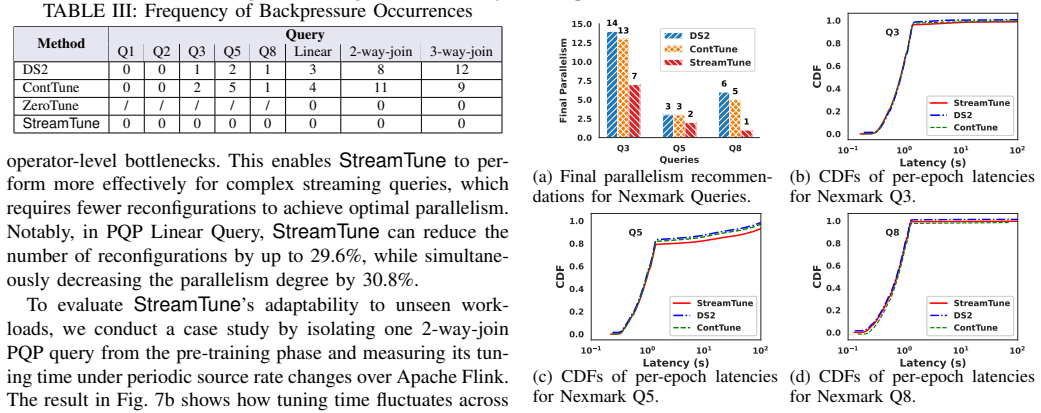
The evaluation was run on Apache Flink and Timely Dataflow using the Nexmark benchmark and PQP synthetic queries. StreamTune reports lower total parallelism than DS2, ContTune, and ZeroTune in most experiments, with zero backpressure occurrences in the tested runs, and latency distributions comparable to the baselines in Timely Dataflow. The largest headline reduction is 83.3% less parallelism than DS2 on Nexmark Q8.
The main caveat is that the pre-training data appears to include the same queries that are later tuned, so the reported gains may partly come from seeing those jobs before. Only one held-out 2-way join job is tested for adaptation time, not for the headline resource savings. No code or data is provided.
Extended reading notes
Core claim
StreamTune reduces reconfigurations by up to 29.6% and parallelism degrees by up to 30.8% in Apache Flink, and achieves up to an 83.3% reduction in parallelism degrees while maintaining comparable processing performance in Timely Dataflow, when compared to state-of-the-art methods. This is the load-bearing empirical assertion: the method is better than DS2, ContTune, and ZeroTune at finding resource-efficient parallelism without causing backpressure.
Load-bearing premise
The monotonic constraint: for every operator and every workload, increasing an operator's parallelism monotonically decreases the probability that it becomes a bottleneck, so a binary search can find the minimal safe parallelism. Section IV-B (Monotonic Constraint of Mf) grounds this in one Flink job with a filter and a window operator, shown in Fig. 4. If parallelism can hurt performance through partitioning, state shuffling, or communication overhead, the recommended parallelism may be wrong.
Signed reviews
Editorial analysis
A structured set of objections, weighed in public.
Assumptions & free parameters
free parameters (5)
- Bottleneck CPU threshold T =
unspecified (e.g., 60%)
- Flink backpressure ratio =
10% of cumulative busy/idle/backpressured time
- Timely input-rate ratio =
85%
- GED similarity-search threshold tau =
5
- Cluster count k =
determined by elbow method
assumptions (4)
- domain assumption Bottleneck probability decreases monotonically with operator parallelism.
- domain assumption Backpressure propagates upstream and bottleneck operators can be identified by checking only the downstream operators of backpressured operators.
- standard math Graph Edit Distance with the two added edit operations satisfies the triangle inequality and is a valid clustering distance.
- ad hoc to paper The similarity center, the most frequent DAG within threshold, approximates the true cluster centroid.
Cite this review
Pith. "Pith review of Learning from the Past: Adaptive Parallelism Tuning for Stream Processing Systems." pith.science (2026). https://pith.science/paper/M6NGARUM
@misc{pith2026250412074,
  author       = {Pith},
  title        = {Pith review of: Learning from the Past: Adaptive Parallelism Tuning for Stream Processing Systems},
  year         = {2026},
  howpublished = {\url{https://pith.science/paper/M6NGARUM}},
  note         = {Machine review of arXiv:2504.12074}
}
read the original abstract
Distributed stream processing systems rely on the dataflow model to define and execute streaming jobs, organizing computations as Directed Acyclic Graphs (DAGs) of operators. Adjusting the parallelism of these operators is crucial to handling fluctuating workloads efficiently while balancing resource usage and processing performance. However, existing methods often fail to effectively utilize execution histories or fully exploit DAG structures, limiting their ability to identity bottlenecks and determine the optimal parallelism. In this paper, we propose StreamTune, a novel approach for adaptive paralelism tuning in stream processing systems. StreamTune incorporates a pre-training and fine-tuning framework that leverages global knowledge from historical execution data for job-specific parallelism tuning. In the pre-training phase, Stream Tune clusters the historical data with Graph Edit Distance and pre-trains a Graph Neural Networkbased encoder per cluster to capture the correlation between the operator parallelism, DAG structures, and the identified operator-level bottlenecks. In the online tuning phase, StreamTune iteratively refines operator parallelism recommendations using an operator-level bottleneck prediction model enforced with a monotonic constraint, which aligns with the observed system performance behavior. Evaluation results demonstrate that StreamTune reduces reconfigurations by up to 29.6% and parallelism degrees by up to 30.8% in Apache Flink under a synthetic workload. In Timely Dataflow, StreamTune achieves up to an 83.3% reduction in parallelism degrees while maintaining comparable processing performance under the Nexmark benchmark, when compared to the state-of-the-art methods.
Figures


Figures from the paper (6 more)



Forward citations
Cited by 1 Pith paper
-
Towards a Proactive Autoscaling Framework for Data Stream Processing at the Edge using GRU and Transfer Learning
A GRU forecaster beats CNN, ARIMA, and Prophet on simulated and rescaled load data for edge stream processing, but the transfer-learning and autoscaling stages that complete the proposed framework are not implemented.
Reference graph
Works this paper leans on
- [1]
-
[2]
A Modular Implementation of Timely Dataflow in Rust,
F. McSherry, “A Modular Implementation of Timely Dataflow in Rust,” https://github.com/frankmcsherry/timely-dataflow/, [Accessed 2024/10/28]
work page 2024
- [3]
-
[4]
“Amazon Kinesis,” https://aws.amazon.com/kinesis/, [Accessed 2024/10/28]
work page 2024
- [5]
- [6]
- [7]
-
[8]
StreamOps: Cloud-native runtime management for streaming services in bytedance,
Y . Mao, Z. Chen, Y . Zhang, M. Wang, Y . Fang, G. Zhang, R. Shi, and R. T. Ma, “StreamOps: Cloud-native runtime management for streaming services in bytedance,” Proceedings of the VLDB Endowment , vol. 16, no. 12, pp. 3501–3514, 2023
work page 2023
Show all 60 references
-
[9]
The dataflow model: a practical approach to balancing correctness, latency, and cost in massive-scale, unbounded, out-of-order data pro- cessing,
T. Akidau, R. Bradshaw, C. Chambers, S. Chernyak, R. J. Fern ´andez- Moctezuma, R. Lax, S. McVeety, D. Mills, F. Perry, E. Schmidt et al., “The dataflow model: a practical approach to balancing correctness, latency, and cost in massive-scale, unbounded, out-of-order data pro- ...
2015
-
[10]
Naiad: a timely dataflow system,
D. G. Murray, F. McSherry, R. Isaacs, M. Isard, P. Barham, and M. Abadi, “Naiad: a timely dataflow system,” in Proceedings of the Twenty-Fourth ACM Symposium on Operating Systems Principles, 2013, pp. 439–455
2013
-
[11]
Lightweight asynchronous snapshots for distributed dataflows,
P. Carbone, G. F ´ora, S. Ewen, S. Haridi, and K. Tzoumas, “Lightweight asynchronous snapshots for distributed dataflows,” arXiv preprint arXiv:1506.08603, 2015
2015 arXiv
-
[12]
Turbine: Facebook’s service management platform for stream processing,
Y . Mei, L. Cheng, V . Talwar, M. Y . Levin, G. Jacques-Silva, N. Simha, A. Banerjee, B. Smith, T. Williamson, S. Yilmaz et al. , “Turbine: Facebook’s service management platform for stream processing,” in ICDE, 2020, pp. 1591–1602
2020
-
[13]
Dhalion: self-regulating stream processing in heron,
A. Floratou, A. Agrawal, B. Graham, S. Rao, and K. Ramasamy, “Dhalion: self-regulating stream processing in heron,” Proceedings of the VLDB Endowment , vol. 10, no. 12, pp. 1825–1836, 2017
2017
-
[14]
Three steps is all you need: fast, accurate, automatic scaling decisions for distributed streaming dataflows,
V . Kalavri, J. Liagouris, M. Hoffmann, D. Dimitrova, M. Forshaw, and T. Roscoe, “Three steps is all you need: fast, accurate, automatic scaling decisions for distributed streaming dataflows,” in OSDI, 2018, pp. 783– 798
2018
-
[15]
DRS: Auto-scaling for real-time stream analytics,
T. Z. Fu, J. Ding, R. T. Ma, M. Winslett, Y . Yang, and Z. Zhang, “DRS: Auto-scaling for real-time stream analytics,” IEEE/ACM Transactions on networking, vol. 25, no. 6, pp. 3338–3352, 2017
2017
-
[16]
Elastic stream processing with latency guarantees,
B. Lohrmann, P. Janacik, and O. Kao, “Elastic stream processing with latency guarantees,” in 2015 IEEE 35th International Conference on Distributed Computing Systems . IEEE, 2015, pp. 399–410
2015
-
[17]
Integrating scale out and fault tolerance in stream processing using operator state management,
R. Castro Fernandez, M. Migliavacca, E. Kalyvianaki, and P. Pietzuch, “Integrating scale out and fault tolerance in stream processing using operator state management,” in SIGMOD, 2013, pp. 725–736
2013
-
[18]
Stela: Enabling stream processing systems to scale-in and scale-out on-demand,
L. Xu, B. Peng, and I. Gupta, “Stela: Enabling stream processing systems to scale-in and scale-out on-demand,” in 2016 IEEE International Conference on Cloud Engineering (IC2E) . IEEE, 2016, pp. 22–31
2016
-
[19]
ContTune: Continuous tuning by conservative bayesian optimization for distributed stream data processing systems,
J. Lian, X. Zhang, Y . Shao, Z. Pu, Q. Xiang, Y . Li, and B. Cui, “ContTune: Continuous tuning by conservative bayesian optimization for distributed stream data processing systems,” Proceedings of the VLDB Endowment, vol. 16, no. 13, pp. 4282–4295, 2023
2023
-
[20]
ZeroTune: Learned zero-shot cost models for parallelism tuning in stream processing,
P. Agnihotri, B. Koldehofe, P. Stiegele, R. Heinrich, C. Binnig, and M. Luthra, “ZeroTune: Learned zero-shot cost models for parallelism tuning in stream processing,” in ICDE, 2024, pp. 2040–2053
2024
-
[21]
A review of generalized zero-shot learning meth- ods,
F. Pourpanah, M. Abdar, Y . Luo, X. Zhou, R. Wang, C. P. Lim, X.-Z. Wang, and Q. J. Wu, “A review of generalized zero-shot learning meth- ods,” IEEE transactions on pattern analysis and machine intelligence , vol. 45, no. 4, pp. 4051–4070, 2022
2022
-
[22]
CSI GED: An efficient approach for graph edit similarity computation,
K. Gouda and M. Hassaan, “CSI GED: An efficient approach for graph edit similarity computation,” in 2016 IEEE 32nd International Conference on Data Engineering (ICDE) . IEEE, 2016, pp. 265–276
2016
-
[23]
Efficient graph similarity search over large graph databases,
W. Zheng, L. Zou, X. Lian, D. Wang, and D. Zhao, “Efficient graph similarity search over large graph databases,” IEEE Transactions on Knowledge and Data Engineering , vol. 27, no. 4, pp. 964–978, 2014
2014
-
[24]
A partition-based approach to structure similarity search,
X. Zhao, C. Xiao, X. Lin, Q. Liu, and W. Zhang, “A partition-based approach to structure similarity search,” PVLDB, vol. 7, no. 3, pp. 169– 180, 2013
2013
-
[25]
How powerful are graph neural networks?
K. Xu, W. Hu, J. Leskovec, and S. Jegelka, “How powerful are graph neural networks?” in ICLR 2019,. OpenReview.net, 2019
2019
-
[26]
Inductive representation learning on large graphs,
W. L. Hamilton, Z. Ying, and J. Leskovec, “Inductive representation learning on large graphs,” in NIPS 2017 , I. Guyon, U. von Luxburg, S. Bengio, H. M. Wallach, R. Fergus, S. V . N. Vishwanathan, and R. Garnett, Eds., 2017, pp. 1024–1034
2017
-
[27]
Representation learning on graphs with jumping knowledge networks,
K. Xu, C. Li, Y . Tian, T. Sonobe, K.-i. Kawarabayashi, and S. Jegelka, “Representation learning on graphs with jumping knowledge networks,” in ICML, 2018, pp. 5453–5462
2018
-
[28]
Neural message passing for quantum chemistry,
J. Gilmer, S. S. Schoenholz, P. F. Riley, O. Vinyals, and G. E. Dahl, “Neural message passing for quantum chemistry,” in ICML. PMLR, 2017, pp. 1263–1272
2017
-
[29]
Meta-gnn: On few-shot node classification in graph meta-learning,
F. Zhou, C. Cao, K. Zhang, G. Trajcevski, T. Zhong, and J. Geng, “Meta-gnn: On few-shot node classification in graph meta-learning,” in Proceedings of the 28th ACM International Conference on Information and Knowledge Management , 2019, pp. 2357–2360
2019
-
[30]
N-gcn: Multi- scale graph convolution for semi-supervised node classification,
S. Abu-El-Haija, A. Kapoor, B. Perozzi, and J. Lee, “N-gcn: Multi- scale graph convolution for semi-supervised node classification,” in uncertainty in artificial intelligence . PMLR, 2020, pp. 841–851
2020
-
[31]
Evolvegcn: Evolving graph convolutional networks for dynamic graphs,
A. Pareja, G. Domeniconi, J. Chen, T. Ma, T. Suzumura, H. Kanezashi, T. Kaler, T. Schardl, and C. Leiserson, “Evolvegcn: Evolving graph convolutional networks for dynamic graphs,” in Proceedings of the AAAI conference on artificial intelligence , vol. 34, no. 04, 2020, pp. 5363– 5370
2020
-
[32]
Link prediction based on graph neural net- works,
M. Zhang and Y . Chen, “Link prediction based on graph neural net- works,” Advances in neural information processing systems , vol. 31, 2018
2018
-
[33]
Learning to rep- resent programs with graphs,
M. Allamanis, M. Brockschmidt, and M. Khademi, “Learning to rep- resent programs with graphs,” in International Conference on Learning Representations, 2018
2018
-
[34]
Text level graph neural network for text classification,
L. Huang, D. Ma, S. Li, X. Zhang, and H. Wang, “Text level graph neural network for text classification,” in Proceedings of the 2019 Conference on Empirical Methods in Natural Language Processing and the 9th International Joint Conference on Natural Language Processing (EMNLP-...
2019
-
[35]
One model to rule them all: Towards zero- shot learning for databases,
B. Hilprecht and C. Binnig, “One model to rule them all: Towards zero- shot learning for databases,” in CIDR, 2022
2022
-
[36]
A unified transferable model for ml-enhanced dbms,
Z. Wu, P. Yang, P. Yu, R. Zhu, Y . Han, Y . Li, D. Lian, K. Zeng, and J. Zhou, “A unified transferable model for ml-enhanced dbms,” CIDR, 2022
2022
-
[37]
LlamaTune: sample-efficient dbms configuration tuning,
K. Kanellis, C. Ding, B. Kroth, A. M ¨uller, C. Curino, and S. Venkatara- man, “LlamaTune: sample-efficient dbms configuration tuning,” vol. 15, no. 11, p. 2953–2965, 2022
2022
-
[38]
The cross entropy method for classification,
S. Mannor, D. Peleg, and R. Rubinstein, “The cross entropy method for classification,” in Proceedings of the 22nd international conference on Machine learning, 2005, pp. 561–568
2005
-
[39]
Certified monotonic neural networks,
X. Liu, X. Han, N. Zhang, and Q. Liu, “Certified monotonic neural networks,” in NIPS, 2020
2020
-
[40]
Constrained monotonic neural networks,
D. Runje and S. M. Shankaranarayana, “Constrained monotonic neural networks,” in ICML, A. Krause, E. Brunskill, K. Cho, B. Engelhardt, S. Sabato, and J. Scarlett, Eds., vol. 202. PMLR, 2023, pp. 29 338– 29 353
2023
-
[41]
Support-vector networks,
C. Cortes, “Support-vector networks,” Machine Learning, 1995
1995
-
[42]
A training algorithm for optimal margin classifiers,
B. E. Boser, I. M. Guyon, and V . N. Vapnik, “A training algorithm for optimal margin classifiers,” in Proceedings of the fifth annual workshop on Computational learning theory , 1992, pp. 144–152
1992
-
[43]
Xgboost: A scalable tree boosting system,
T. Chen and C. Guestrin, “Xgboost: A scalable tree boosting system,” in Proceedings of the 22nd acm sigkdd international conference on knowledge discovery and data mining , 2016, pp. 785–794
2016
-
[44]
Lightgbm: A highly efficient gradient boosting decision tree,
G. Ke, Q. Meng, T. Finley, T. Wang, W. Chen, W. Ma, Q. Ye, and T.- Y . Liu, “Lightgbm: A highly efficient gradient boosting decision tree,” NIPS, vol. 30, 2017
2017
-
[45]
A distance measure between attributed relational graphs for pattern recognition,
A. Sanfeliu and K.-S. Fu, “A distance measure between attributed relational graphs for pattern recognition,” IEEE transactions on systems, man, and cybernetics , no. 3, pp. 353–362, 1983
1983
-
[46]
Boosting graph similarity search through pre-computation,
J. Kim, “Boosting graph similarity search through pre-computation,” in SIGMOD, 2021, pp. 951–963
2021
-
[47]
Comparing stars: On approximating graph edit distance,
Z. Zeng, A. K. Tung, J. Wang, J. Feng, and L. Zhou, “Comparing stars: On approximating graph edit distance,” VLDB, vol. 2, no. 1, pp. 25–36, 2009
2009
-
[48]
Computing similarity between rna structures,
B. Ma, L. Wang, and K. Zhang, “Computing similarity between rna structures,” Theoretical Computer Science , vol. 276, no. 1-2, pp. 111– 132, 2002
2002
-
[49]
The k-means algorithm: A comprehensive survey and performance evaluation,
M. Ahmed, R. Seraj, and S. M. S. Islam, “The k-means algorithm: A comprehensive survey and performance evaluation,” Electronics, vol. 9, no. 8, p. 1295, 2020
2020
-
[50]
An median graphs: properties, algorithms, and applications,
X. Jiang, A. Munger, and H. Bunke, “An median graphs: properties, algorithms, and applications,” IEEE Transactions on pattern analysis and machine intelligence , vol. 23, no. 10, pp. 1144–1151, 2001
2001
-
[51]
Speeding up GED verification for graph similarity search,
L. Chang, X. Feng, X. Lin, L. Qin, W. Zhang, and D. Ouyang, “Speeding up GED verification for graph similarity search,” in 2020 IEEE 36th International Conference on Data Engineering (ICDE) . IEEE, 2020, pp. 793–804
2020
-
[52]
Inves: Incremental partitioning-based verification for graph similarity search
J. Kim, D.-H. Choi, and C. Li, “Inves: Incremental partitioning-based verification for graph similarity search.” in EDBT, 2019, pp. 229–240
2019
-
[53]
An exact graph edit distance algorithm for solving pattern recognition problems,
Z. Abu-Aisheh, R. Raveaux, J.-Y . Ramel, and P. Martineau, “An exact graph edit distance algorithm for solving pattern recognition problems,” in 4th International Conference on Pattern Recognition Applications and Methods 2015, 2015
2015
-
[54]
Nexmark benchmark,
“Nexmark benchmark,” https://beam.apache.org/documentation/sdks/ java/testing/nexmark/, 2024, [Accessed 2024/10/28]
2024
-
[55]
The application of cluster analysis in strategic management research: an analysis and critique,
D. J. Ketchen and C. L. Shook, “The application of cluster analysis in strategic management research: an analysis and critique,” Strategic management journal, vol. 17, no. 6, pp. 441–458, 1996
1996
-
[56]
DS2 github repository,
“DS2 github repository,” https://github.com/strymon-system/ds2, 2024, [Accessed 2024/10/28]
2024
-
[57]
Gml: effi- ciently auto-tuning flink’s configurations via guided machine learning,
Y . Guo, H. Shan, S. Huang, K. Hwang, J. Fan, and Z. Yu, “Gml: effi- ciently auto-tuning flink’s configurations via guided machine learning,” IEEE Transactions on Parallel and Distributed Systems, vol. 32, no. 12, pp. 2921–2935, 2021
2021
-
[58]
Automatic database management system tuning through large-scale machine learn- ing,
D. Van Aken, A. Pavlo, G. J. Gordon, and B. Zhang, “Automatic database management system tuning through large-scale machine learn- ing,” in Proceedings of the 2017 ACM international conference on management of data , 2017, pp. 1009–1024
2017
-
[59]
Restune: Resource oriented tuning boosted by meta-learning for cloud databases,
X. Zhang, H. Wu, Z. Chang, S. Jin, J. Tan, F. Li, T. Zhang, and B. Cui, “Restune: Resource oriented tuning boosted by meta-learning for cloud databases,” in SIGMOD, 2021, pp. 2102–2114
2021
-
[60]
An end-to-end automatic cloud database tuning system using deep reinforcement learning,
J. Zhang, Y . Liu, K. Zhou, G. Li, Z. Xiao, B. Cheng, J. Xing, Y . Wang, T. Cheng, L. Liu et al., “An end-to-end automatic cloud database tuning system using deep reinforcement learning,” in SIGMOD, 2019, pp. 415– 432
2019
Reviewed August 16, 2026 · model on record in the stance chip above.
Discussion (0). Continue with ORCID to comment.