REVIEW 3 major objections 6 minor 13 references
IceTop as veto for IceCube: results
T0 review · 3 major / 6 minor · reviewed 2026-08-14 · deepseek-v4-flash
Pith's one-line read IceTop, the surface array above a deep neutrino detector, can cut the atmospheric cosmic-ray background for down-going muon neutrinos to a passing fraction between $2\times 10^{-5}$ and $5\times 10^{-6}$ at a minimum neutrino energy near…
desk verdict The paper reports a plausible but not yet validated veto passing fraction of 2e-5 to 5e-6, resting on an untested forced-trigger template. read the letter →
The pith
A machine-rendered reading of the paper's core claim, the machinery that carries it, and where it could break.
The reading
What carries the argument
The load-bearing object is the IceTop log-likelihood ratio $\Lambda_{\nu,\mathrm{CR}}$. For each of the 162 surface tanks, the charge $Q$ in vertical-equivalent muons, the residual time $t_{\mathrm{res}}$ relative to the expected shower front, and the perpendicular distance $d$ from the shower axis are transformed into the coordinates $\rho = \log_{10}(Q/[\mathrm{VEM}])$, $\tau = \mathrm{sign}(t_{\mathrm{res}}/[\mathrm{ns}])\,\log_{10}(|t_{\mathrm{res}}/[\mathrm{ns}]|+1)$, and $\delta = \log_{10}(d/[\mathrm{m}]+1)$. Three-dimensional PDFs $H_{\mathrm{CR}}$ and $H_{\nu}$ are built from data in bins of muon energy proxy and zenith angle, with $H_{\nu}$ constructed by replacing observed IceTop hits with forced-trigger background hits. The ratio of per-tank probabilities multiplied over all tanks gives the per-event score; the event's own contribution is removed from the PDF before scoring to avoid overfitting in low-statistics bins.
What would settle it
Generate a simulated sample of neutrino-induced muon tracks with a complete detector response, build the neutrino-like PDF from forced-trigger background hits exactly as in the paper, apply the same log-likelihood cut, and measure the passing fraction; if that fraction disagrees with the data-derived $2\times 10^{-5}$ to $5\times 10^{-6}$ beyond systematic uncertainty, the forced-trigger replacement is not representative and the measured veto efficiency is biased.
Extended reading notes
Core claim
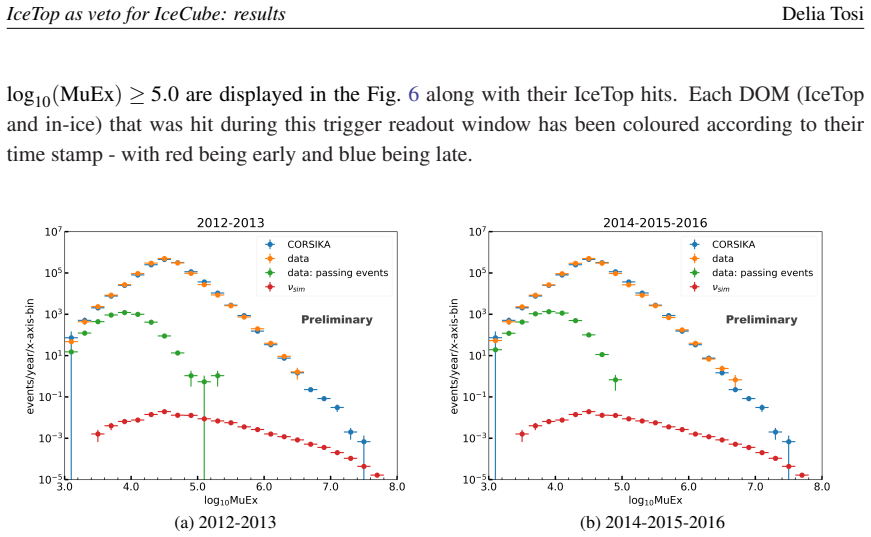
The central claim is that IceTop achieves a reduction of $2\times 10^{-5}$ to $5\times 10^{-6}$ in the atmospheric background for a down-going muon neutrino sample at a minimum neutrino energy of about 100 TeV. The number is obtained from five years of data by comparing, tank by tank, the observed IceTop hit pattern with two three-dimensional probability distributions: one for cosmic-ray events and one for neutrino-like events in which recorded surface hits have been replaced by forced-trigger background hits. A log-likelihood ratio between the two hypotheses, with a cut chosen to retain 80% of neutrino-like events (99.9% in the highest-energy bins), defines which tracks are vetoed. Counting the surviving events, and conservatively assuming that all of them are cosmic rays that slipped through, gives the passing fraction. Seven events with $\log_{10}(\mathrm{MuEx}) \geq 5.0$ survive across the two data samples and are highlighted as candidate astrophysical neutrinos.
Load-bearing premise
The neutrino-like surface pattern is built by replacing the IceTop hits on real muon tracks with background hits from forced triggers, so the whole veto calibration rests on those forced-trigger hits being a faithful sample of the accidental surface noise that would accompany a neutrino-induced muon.
Editorial extensions
If this is right
- At roughly 100 TeV the atmospheric cosmic-ray background for down-going muon neutrino tracks is suppressed to a passing fraction between $2\times 10^{-5}$ and $5\times 10^{-6}$, opening a data-driven route to Southern-Hemisphere neutrino searches.
- The high-energy tracks that survive the veto are, under the conservative assumption that everything passing is a cosmic ray, candidate astrophysical neutrinos; detailed simulation is required before any one event can be claimed as astrophysical.
- The cut can be tuned to retain a target number of events per year, so the method is positioned to feed a real-time neutrino alert stream.
- Atmospheric muon neutrinos whose accompanying shower reaches the surface are also vetoed by the same footprint comparison; quantifying that rejection efficiency is identified as a follow-up requiring detailed simulations.
- Because the veto logic is data-driven, it can be applied to simulated layouts of a larger surface array, giving future detector designs a realistic veto-efficiency benchmark.
Reading between the lines
- Inference: If forced-trigger hits faithfully represent accidental surface noise, the same passing-fraction curve can be extended below 100 TeV by adding exposure, giving an empirical veto calibration in an energy range where simulations are least trusted.
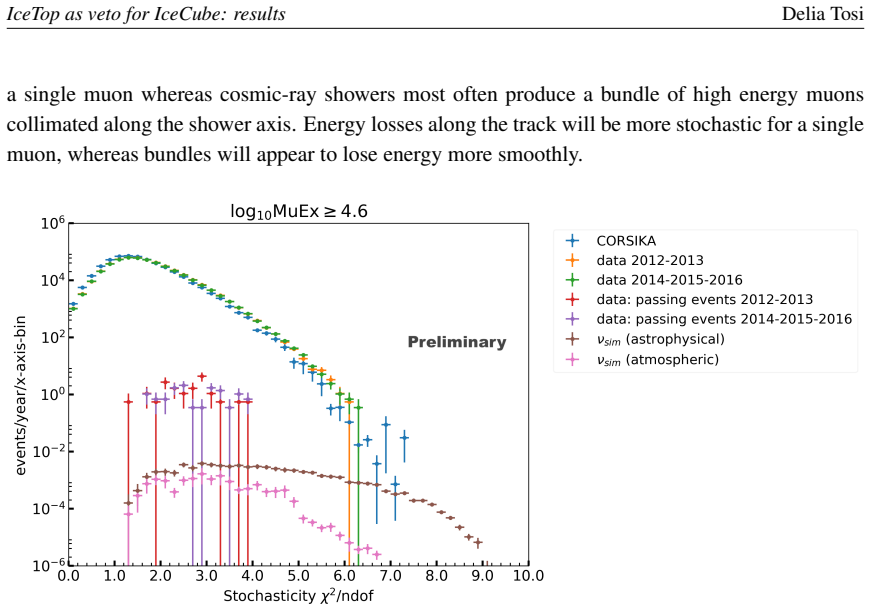
- Inference: The paper's veto score and its stochasticity parameter could be combined into a two-dimensional classifier; the seven surviving events are too few to validate it, but the distribution shapes suggest it could separate neutrino-induced single muons from surviving muon bundles.
- Inference: The measured passing fraction at the current partial surface coverage is a benchmark for scaling to larger arrays: a denser surface detector should lower the passing fraction roughly in proportion to added solid-angle coverage, a scaling that simulation can test before construction.
Signed reviews
Editorial analysis
A structured set of objections, weighed in public.
Referee Report
Summary. This proceedings paper reports a data-driven veto of cosmic-ray muons in IceCube using IceTop surface hits. The authors construct cosmic-ray and neutrino-like probability density functions from data, define an IceTop log-likelihood ratio (Eq. 3.2), and set a per-bin cut that retains 80% of the neutrino-like sample (99.9% for log10(MuEx) >= 5.2). Applying the cut to five years of data split into two samples, they find 5 and 2 events passing at log10(MuEx) >= 4.8, and quote a background reduction of ~2e-5 to 5e-6 for a minimum neutrino energy of ~100 TeV. They explicitly note that thorough simulations are necessary to establish whether the passing events are astrophysical neutrinos or rare cosmic rays.
Significance. If established, the result would demonstrate that IceTop can veto down-going cosmic-ray muon background at the 10^-5 level, which is valuable for southern-sky neutrino searches and for designing future surface veto arrays. The analysis is commendably data-driven, uses leave-one-out subtraction to avoid overfitting, and checks consistency across two independent data samples. However, the headline reduction is based on only five and two passing events, and its validity rests on an unvalidated assumption about how the neutrino-like PDF is constructed. The paper's own call for simulations limits the interpretation of the candidate events, but the background-reduction claim itself also depends on that same unvalidated template. The quantitative result therefore needs further support before being taken at face value.
major comments (3)
- [Section 2 (final paragraph) and Section 3, Eq. (3.1)] The neutrino-like PDF H_nu is generated by replacing observed IceTop hits on muon tracks with background hits from unbiased periodic forced triggers, but the manuscript does not describe how these forced-trigger hits are assigned residual times tau relative to the expected shower front of the reconstructed in-ice track. If the forced-trigger hits have a different tau distribution than the accidental IceTop noise accompanying a true neutrino-induced muon in an in-ice trigger window, H_nu is biased. Because Lambda_cut is chosen to retain a fixed fraction of H_nu, a biased H_nu changes the actual neutrino retention efficiency and therefore the measured passing fraction. The authors should either specify the overlay procedure in detail or validate the representativeness of forced-trigger hits, for example by comparing accidental-hit rates and timing distributions in in-ice triggered events with those in forced-trigger data.
- [Section 4, Fig. 8 and last paragraph] The passing fraction is reported as '2e-5 to 5e-6' without statistical uncertainties. The underlying counts are 5 events out of 249,694 and 2 events out of 387,576; the Poisson uncertainties are on the order of ±50-100% of the central values at 68% confidence, and the two measurements are statistically consistent with a common value. The quoted range may therefore reflect Poisson fluctuation rather than a true energy-dependent variation. The paper should present the passing fraction with confidence intervals (e.g., Clopper-Pearson or Feldman-Cousins intervals) and should not claim a reduction range without these uncertainties.
- [Section 4, paragraph beginning 'Assuming that all the passing events...'] The calculation of the passing fraction assumes 'all the passing events are cosmic rays that sneak through the veto,' while the same passing events are described elsewhere as 'candidate astrophysical neutrinos.' These statements are in tension: if the passing sample contains neutrinos, the cosmic-ray passing fraction is lower than the quoted value, and the quoted reduction is an upper limit rather than a measured value. The manuscript should explicitly distinguish between an upper limit on the cosmic-ray background and a measured reduction, and should state the assumption clearly in the abstract and conclusions.
minor comments (6)
- [Section 2, near Fig. 3] The phrase 'the PDFs are shown in the Figs. 3a and 3b' should be written as 'Fig. 3(a) and 3(b)' for consistency with journal style.
- [Section 3, below Eq. (3.2)] There is a missing space in 'eventx j'; it should read 'event x_j'.
- [Section 4, first paragraph] The sentence '5 events out of 249694 pass the cuts for log10(MuEx)>=4.8 out of which 3 passing events have log10(MuEx)>=5.0' is a run-on; it should be split into two sentences.
- [Section 4, second paragraph] The phrase 'in absence of' should be 'in the absence of'.
- [Section 4, figure descriptions] The spelling 'coloured' should be made consistent with the rest of the text (either American or British spelling throughout).
- [Section 4, sample labels] The labels '2012-2013' and '2014-2015-2016' are slightly misleading given that the first sample extends to May 2014 and the second begins in April 2014; consider renaming them '2012-2014' and '2014-2017'.
Circularity Check
No significant circularity: the reported veto passing fraction is a measured efficiency on data, and the data-driven neutrino-like PDF is an input assumption rather than a quantity obtained from the result.
full rationale
The analysis is a standard efficiency measurement. The cosmic-ray PDF H_CR is built from observed muon tracks, and the neutrino-like PDF H_nu is built from the same tracks after replacing their IceTop hits with forced-trigger background hits. The cut Lambda_cut is then fixed to retain 80% (or 99.9% at high log10(MuEx)) of the constructed H_nu sample, and the reported background reduction is the fraction of passing events in the full data sample under the stated assumption that all passing events are cosmic rays. That passing fraction is not forced by the retention percentage, because the 80% retention applies only to the constructed H_nu sample, not to the data. The paper explicitly subtracts each event's own contribution before computing its likelihood ratio, mitigating overfitting from using the same events for template construction and counting. The citations to prior IceCube work for the log-likelihood ratio method are provenance for a standard technique, not a load-bearing self-citation or a uniqueness theorem. The main limitation is the untested assumption that forced-trigger hits accurately represent accidental IceTop noise; this affects the external validity of the efficiency and is acknowledged by the paper's call for thorough simulations, but it is a correctness risk, not a circular reduction. No equation in the paper reduces an output to an input by construction, and no fitted parameter is renamed as a prediction.
Assumptions & free parameters
free parameters (2)
- log10(MuEx) threshold =
3.0
- Retention fraction for the veto cut (Lambda_cut) =
80% for most energy bins; 99.9% for log10(MuEx) >= 5.2
assumptions (4)
- domain assumption Muon track reconstruction and the surface extension of the track accurately determine the IceTop tanks and expected arrival times.
- ad hoc to paper Force-trigger background IceTop hits are representative of the accidental IceTop noise that would accompany a neutrino-induced muon track.
- domain assumption The contamination of the observed muon track dataset by neutrino events is negligible.
- domain assumption Standard flux models (astrophysical neutrino flux with index -2.13 and H3a cosmic-ray model) are used for weighting the simulated comparison samples.
Cite this review
Pith. "Pith review of IceTop as veto for IceCube: results." pith.science (2026). https://pith.science/paper/MA5UXM6G
@misc{pith2026190807008,
  author       = {Pith},
  title        = {Pith review of: IceTop as veto for IceCube: results},
  year         = {2026},
  howpublished = {\url{https://pith.science/paper/MA5UXM6G}},
  note         = {Machine review of arXiv:1908.07008}
}
read the original abstract
The IceCube Neutrino Observatory features both a kilometer-cubed detector between 1.45 and 2.45 km depth and an array of ice-filled tanks, called IceTop, located at the surface. The presence of both detectors at the same location allows for detailed studies of cosmic rays and their muon content in ice, while the lack of signals in the surface detectors can be used to identify muon tracks in the deep detector as neutrino candidates and to determine the veto efficiency of IceTop. While the solid angle coverage of the current detectors is limited, this has interesting implications for the design of a larger surface array. In this contribution, we present the results from this study applied to 5 years of data. We find a few interesting neutrino candidate events that pass the cuts designed to veto cosmic rays. Thorough simulations are necessary to establish the likelihood for these events to be astrophysical neutrinos or rare cosmic rays.
Figures


Figures from the paper (5 more)



Reference graph
Works this paper leans on
-
[1]
IceCube Coll., M. G. Aartsen et al., J. Inst. 12 P03012 (2017)
work page 2017
-
[2]
IceCube Coll., R. Abbasi et al., Nucl. Instrum. Meth. A700 188 (2013)
work page 2013
-
[3]
IceCube Collaboration, PoS(ICRC2015)022 (2015)
work page 2015
-
[4]
IceCube Coll., PoS(ICRC2019)1010 (these proceedings)
-
[5]
IceCube Coll., PoS(ICRC2015)1086 (2015)
work page 2015
-
[6]
IceCube Coll., PoS(ICRC2017)967 (2017)
work page 2017
-
[7]
AMANDA Coll., J. Ahrens et al., Nucl. Instrum. Meth. A524 169-194 (2004)
work page 2004
-
[8]
A. Gazizov and M. P. Kowalski, Comput. Phys. Commun. 172 203-213 (2005)
work page 2005
Show all 13 references
-
[9]
IceCube Coll., M. G. Aartsen et al., J. Inst. 9 P03009 (2014)
2014
-
[10]
IceCube Coll., M. G. Aartsen et al., Astrophys. J. 833 3 (2016)
2016
-
[11]
IceCube Coll., PoS(ICRC2017)514 (2017)
2017
-
[12]
T. K. Gaisser, Astropart. Phys. 35 801-806 (2012)
2012
-
[13]
IceCube Collaboration, PoS(ICRC2015)1156 (2015). 8
2015
Reviewed August 14, 2026 · model on record in the stance chip above.
Discussion (0). Continue with ORCID to comment.