A spectral-subspace-augmented POD-Galerkin method for parametrized PDEs with limited snapshot data
Pith reviewed 2026-07-03 18:55 UTC · model grok-4.3
The pith
SS-POD augments POD-Galerkin with partitioned spectral subspaces to achieve high accuracy from limited snapshots.
A machine-rendered reading of the paper's core claim, the machinery that carries it, and where it could break.
Core claim
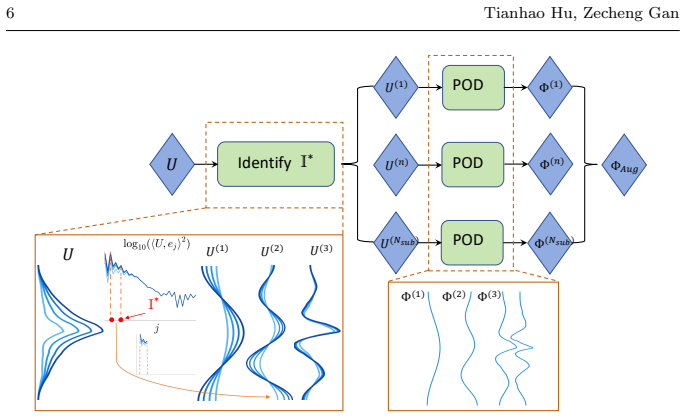
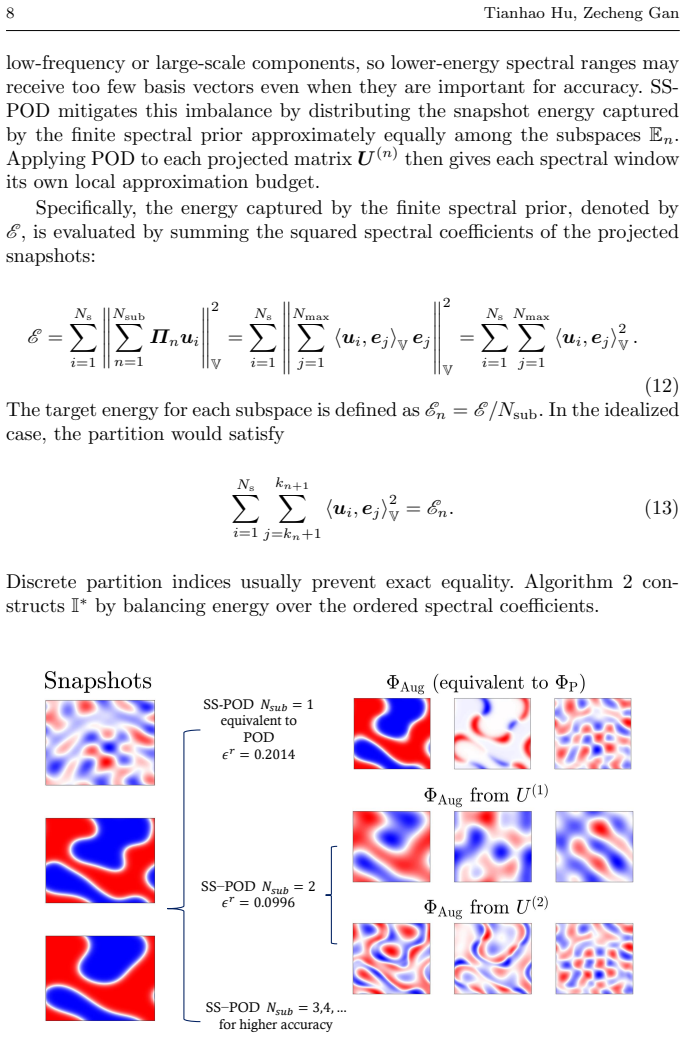
By partitioning a spectral approximation space into orthogonal subspaces and performing local POD on the projected snapshot matrices, with partitions chosen so that each subspace receives comparable snapshot energy, SS-POD produces reduced bases that maintain high out-of-sample accuracy for parametrized PDEs even when snapshot data is severely limited.
What carries the argument
The energy-balancing partition of a spectral approximation space into orthogonal subspaces for local POD application.
If this is right
- SS-POD yields compact reduced bases that generalize better than standard POD when snapshots are few.
- Accuracy gains appear in both linear and nonlinear parametrized PDEs when paired with DEIM.
- Computational cost for many-query tasks decreases because fewer high-fidelity solves are needed.
- The approach suits multiscale problems in energy science where generating many snapshots is impractical.
Where Pith is reading between the lines
- If the spectral space is chosen from a standard basis like spherical harmonics, the method might extend to other geometries with known eigenfunction bases.
- Energy balancing could be replaced by other criteria such as variance or residual norms in future variants.
- The local POD problems might be solved in parallel to further speed up basis construction.
Load-bearing premise
The initial spectral approximation space must be problem-adapted enough that its orthogonal subspaces can be ranked by the energy content of the available snapshots.
What would settle it
Running the method on a problem where the chosen spectral space does not align with the solution manifold, then checking if the error improvement over standard POD vanishes.
Figures
read the original abstract
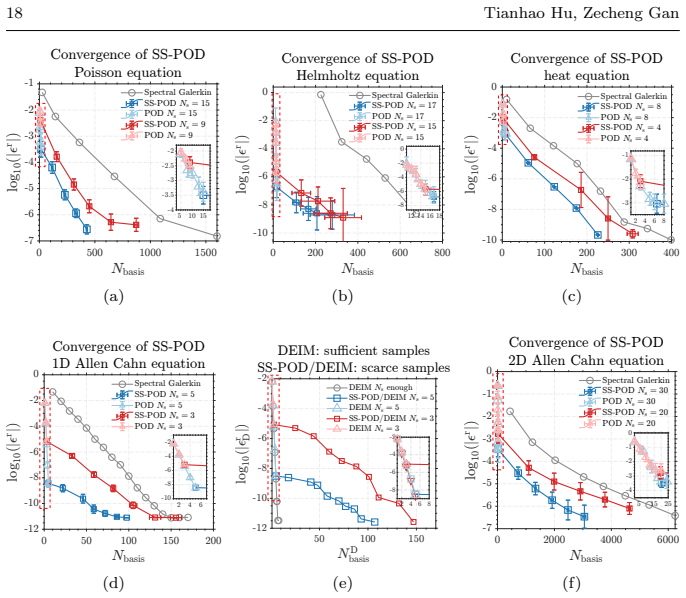
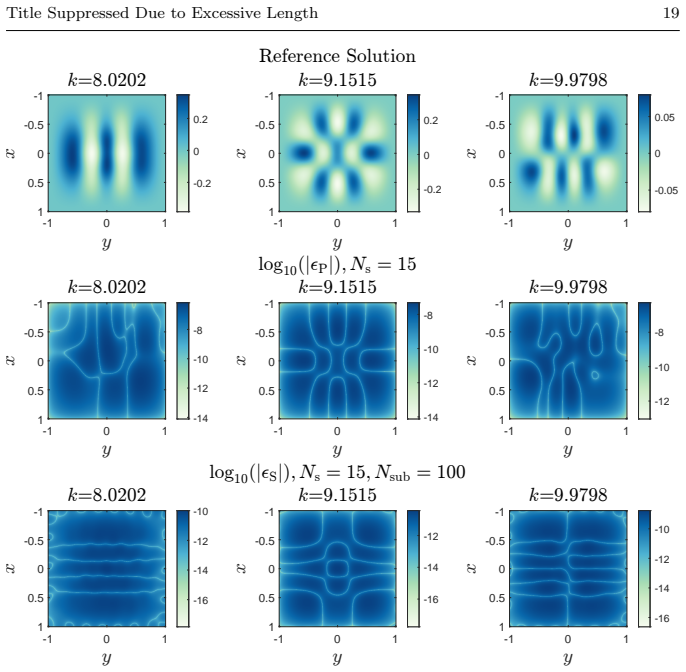
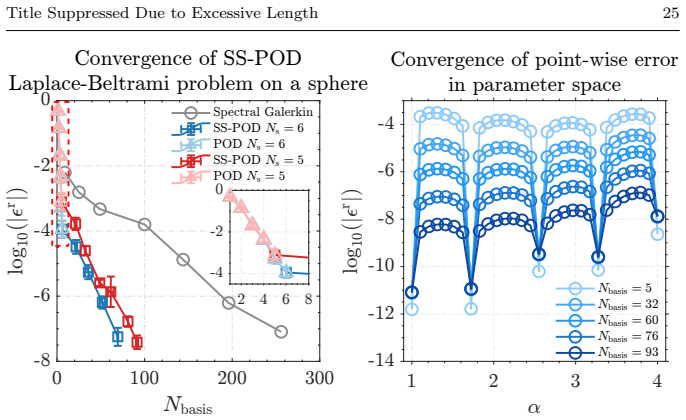
Parametrized partial differential equations (PDEs) arise in many-query simulation, optimization, control, and uncertainty quantification, where repeated full-order solves restrict the number of high-fidelity snapshots that can be generated. This limitation is particularly pronounced in computational energy science, where multiscale models of porous-media flow, transport, and energy materials often make large snapshot datasets impractical. Proper orthogonal decomposition (POD) constructs compact reduced bases from solution snapshots, but it may exhibit limited out-of-sample predictive capability when the snapshots insufficiently sample the solution manifold. To address this limitation, we propose a spectral-subspace-augmented POD-Galerkin method (SS-POD) tailored to limited-data regimes. SS-POD starts from a problem-adapted spectral approximation space, partitions it into orthogonal subspaces, and performs POD locally on the projected snapshot matrices. An energy-balancing rule determines the spectral partition so that the resulting local POD problems are assigned comparable amounts of snapshot energy. For nonlinear parametrized PDEs, SS-POD is coupled with the discrete empirical interpolation method (DEIM). Numerical experiments show that SS-POD improves out-of-sample accuracy over standard POD-Galerkin while retaining compact reduced bases in limited-snapshot regimes. In particular, for a Laplace-Beltrami problem on the unit sphere with only 5 snapshots, SS-POD achieves a relative error of $3.9*10^{-8}$ using 91 basis functions, whereas the standard POD error saturates at $7.8*10^{-4}$ and the spectral-Galerkin method requires 256 basis functions for comparable accuracy. These results indicate that SS-POD provides an effective strategy for high-fidelity reduced-order modeling from limited snapshot data.
Editorial analysis
A structured set of objections, weighed in public.
Referee Report
Summary. The manuscript proposes a spectral-subspace-augmented POD-Galerkin (SS-POD) method for reduced-order modeling of parametrized PDEs under limited snapshot data. SS-POD starts from a problem-adapted spectral approximation space, partitions it into orthogonal subspaces using an energy-balancing rule so that local POD problems receive comparable snapshot energy, and applies POD locally on the projected snapshot matrices; for nonlinear problems it is coupled with DEIM. Numerical results on a Laplace-Beltrami problem on the unit sphere with only 5 snapshots report that SS-POD attains a relative error of 3.9×10^{-8} with 91 basis functions, while standard POD saturates at 7.8×10^{-4} and a pure spectral-Galerkin method requires 256 functions for comparable accuracy.
Significance. If the central numerical gains hold under the stated assumptions, the method offers a concrete strategy for improving out-of-sample accuracy in data-scarce regimes that arise in energy-science applications. The explicit comparison against both POD and spectral-Galerkin on the sphere problem, together with the use of an energy-balancing partition, supplies a reproducible demonstration that the augmentation can be effective when a high-quality spectral basis is already available. The absence of an error analysis or a general procedure for constructing the initial spectral space, however, restricts the assessed significance to the specific test case shown.
major comments (3)
- [Abstract, §3] Abstract and §3 (method description): the claim that SS-POD is applicable to general parametrized PDEs rests on the existence of a 'problem-adapted spectral approximation space' whose orthogonal subspaces admit meaningful energy ranking. No procedure is given for constructing or selecting this space when the operator lacks an obvious eigenbasis (unlike the spherical-harmonics case for the Laplace-Beltrami operator), so the reported accuracy gain cannot be assumed to transfer.
- [Abstract] Abstract: the energy-balancing rule that determines the spectral partition is presented without derivation or convergence analysis. Because the partition directly controls the local POD problems and the final basis size (91 functions in the reported experiment), the lack of justification for the rule is load-bearing for the central accuracy claim.
- [Numerical experiments] Numerical experiments (sphere Laplace-Beltrami): while the 3.9×10^{-8} error with 5 snapshots is striking, the manuscript provides no comparison against other limited-data techniques (e.g., sparse POD, dictionary learning, or physics-informed ROMs) that also aim to mitigate snapshot scarcity, leaving open whether the gain is specific to the spectral-augmentation strategy.
minor comments (2)
- [§3] Notation for the projected snapshot matrices and the energy measure used in the balancing rule should be introduced with explicit definitions before the algorithm is stated.
- [Numerical experiments] The manuscript should clarify whether the reported basis-function counts (91 vs. 256) are chosen by the same tolerance or by a fixed dimension; this affects the fairness of the comparison.
Simulated Author's Rebuttal
We thank the referee for the thoughtful review and constructive comments on our manuscript. We address each major comment below and indicate where revisions will be made.
read point-by-point responses
-
Referee: [Abstract, §3] Abstract and §3 (method description): the claim that SS-POD is applicable to general parametrized PDEs rests on the existence of a 'problem-adapted spectral approximation space' whose orthogonal subspaces admit meaningful energy ranking. No procedure is given for constructing or selecting this space when the operator lacks an obvious eigenbasis (unlike the spherical-harmonics case for the Laplace-Beltrami operator), so the reported accuracy gain cannot be assumed to transfer.
Authors: We agree that the method presupposes the availability of a suitable problem-adapted spectral space. The manuscript demonstrates the augmentation strategy in cases where such a space exists (e.g., spherical harmonics for the Laplace-Beltrami operator), without providing a general construction procedure for arbitrary operators. We will revise the abstract and §3 to clarify the scope and assumptions regarding the initial spectral space. revision: partial
-
Referee: [Abstract] Abstract: the energy-balancing rule that determines the spectral partition is presented without derivation or convergence analysis. Because the partition directly controls the local POD problems and the final basis size (91 functions in the reported experiment), the lack of justification for the rule is load-bearing for the central accuracy claim.
Authors: The energy-balancing rule is a practical heuristic intended to assign comparable snapshot energy to each local POD subproblem. While we do not supply a formal derivation or convergence analysis, the rule is motivated by numerical stability considerations and is supported by the reported experiments. We will expand the motivation and description of the rule in the revised method section. revision: partial
-
Referee: [Numerical experiments] Numerical experiments (sphere Laplace-Beltrami): while the 3.9×10^{-8} error with 5 snapshots is striking, the manuscript provides no comparison against other limited-data techniques (e.g., sparse POD, dictionary learning, or physics-informed ROMs) that also aim to mitigate snapshot scarcity, leaving open whether the gain is specific to the spectral-augmentation strategy.
Authors: The experiments compare SS-POD directly to standard POD-Galerkin and pure spectral-Galerkin to isolate the contribution of the spectral-subspace augmentation. Broader comparisons to other limited-data methods lie outside the intended scope of the paper. The existing results suffice to support the claims regarding improvement over the two baseline approaches in the tested regime. revision: no
- A general procedure for constructing the problem-adapted spectral approximation space for arbitrary parametrized PDEs
- An error analysis or convergence theory for the SS-POD method
Circularity Check
No circularity; constructive procedure validated on external benchmarks
full rationale
The paper defines SS-POD as an explicit algorithmic procedure (start from a stated problem-adapted spectral space, apply an energy-balancing partition rule, perform local POD on projected snapshots, couple with DEIM for nonlinear cases). The headline numerical claim is an empirical measurement on the unit-sphere Laplace-Beltrami problem (5 snapshots, 91 basis functions, 3.9e-8 error) compared against standard POD and full spectral-Galerkin on the same external test case. No equation reduces a claimed prediction to a fitted input by construction, no load-bearing step rests on a self-citation, and the precondition of a suitable initial spectral space is declared up-front rather than derived from the method itself. The derivation chain is therefore self-contained against the reported benchmarks.
Axiom & Free-Parameter Ledger
axioms (1)
- domain assumption A problem-adapted spectral approximation space exists whose orthogonal subspaces can be ranked by the amount of snapshot energy they carry.
Reference graph
Works this paper leans on
-
[1]
Abdi, H., Williams, L.: Principal component analysis. WIREs Comput. Stat.2(4), 433–459 (2010). DOI https://doi.org/10.1002/wics.101
-
[2]
Barrault, M., Maday, Y., Nguyen, N., Patera, A.: An ‘empirical interpolation’ method: Application to efficient reduced-basis discretization of partial differential equations. C. R. Math.339(9), 667–672 (2004). DOI https://doi.org/10.1016/j.crma.2004.08.006
-
[3]
Binev, P., Cohen, A., Dahmen, W., DeVore, R., Petrova, G., Wojtaszczyk, P.: Con- vergence rates for greedy algorithms in reduced basis methods. SIAM J. Math. Anal. 43(3), 1457–1472 (2011). DOI https://doi.org/10.1137/100795772
-
[4]
ESAIM: M2AN 46(3), 595–603 (2012)
Buffa, A., Maday, Y., Patera, A., Prud’homme, C., Turinici, G.: A priori convergence of the greedy algorithm for the parametrized reduced basis method. ESAIM: M2AN 46(3), 595–603 (2012). DOI https://doi.org/10.1051/m2an/2011056
-
[5]
Springer Science & Business Media, Berlin (2007)
Canuto, C., Hussaini, M., Quarteroni, A., Zang, T.: Spectral Methods: Evolution to Complex Geometries and Applications to Fluid Dynamics. Springer Science & Business Media, Berlin (2007). DOI https://doi.org/10.1007/978-3-540-30728-0
-
[6]
Chaturantabut, S., Sorensen, D.: Discrete empirical interpolation for nonlinear model reduction. In: Proc. 48th IEEE Conf. Decis. Control (CDC), pp. 4316–4321 (2009). DOI https://doi.org/10.1109/CDC.2009.5400045
-
[7]
Chaturantabut, S., Sorensen, D.: Nonlinear model reduction via discrete empirical in- terpolation. SIAM J. Sci. Comput.32(5), 2737–2764 (2010). DOI https://doi.org/10. 1137/090766498
2010
-
[8]
Chaturantabut, S., Sorensen, D.: A state space error estimate for POD-DEIM nonlinear model reduction. SIAM J. Numer. Anal.50(1), 46–63 (2012). DOI https://doi.org/10. 1137/110822724
2012
-
[9]
Chen, J., Chi, X., E, W., Yang, Z.: Bridging traditional and machine learning-based algorithms for solving PDEs: The random feature method. J. Mach. Learn.1, 268–298 (2022). DOI https://doi.org/10.4208/jml.220726
-
[10]
Chen, Y., Ji, L., Narayan, A., Xu, Z.: L1-based reduced over collocation and hyper reduction for steady state and time-dependent nonlinear equations. J. Sci. Comput.87, 10 (2021). DOI https://doi.org/10.1007/s10915-021-01416-z
-
[11]
Chen, Y., Ji, Y., Narayan, A., Xu, Z.: TGPT-PINN: Nonlinear model reduction with transformed GPT-PINNs. Comput. Methods Appl. Mech. Eng.430, 117198 (2024). DOI https://doi.org/10.1016/j.cma.2024.117198
-
[12]
Chen, Y., Koohy, S.: GPT-PINN: Generative pre-trained physics-informed neural net- works toward non-intrusive meta-learning of parametric PDEs. Fin. Elem. Anal. Des. 228, 104047 (2024). DOI https://doi.org/10.1016/j.finel.2023.104047
-
[13]
Deparis, S.: Reduced basis error bound computation of parameter-dependent Navier– Stokes equations by the natural norm approach. SIAM J. Numer. Anal.46(4), 2039– 2067 (2008). DOI https://doi.org/10.1137/060674181
-
[14]
Nonlinearity35(1), 278–310 (2021)
E, W., Han, J., Jentzen, A.: Algorithms for solving high dimensional PDEs: From nonlinear Monte Carlo to machine learning. Nonlinearity35(1), 278–310 (2021). DOI https://doi.org/10.1088/1361-6544/ac337f
-
[15]
E, W., Yu, B.: The Deep Ritz method: A deep learning-based numerical algorithm for solving variational problems. Commun. Math. Stat.6(1), 1–12 (2018). DOI https: //doi.org/10.1007/s40304-018-0127-z
-
[16]
Flyer, N., Wright, G.: Transport schemes on a sphere using radial basis functions. J. Comput. Phys.226(1), 1059–1084 (2007). DOI https://doi.org/10.1016/j.jcp.2007.05. 009
-
[17]
Fox, R., Miura, H.: An approximate analysis technique for design calculations. AIAA J.9(1), 177–179 (1971). DOI https://doi.org/10.2514/3.49225
-
[18]
Fresca, S., Manzoni, A.: POD-DL-ROM: Enhancing deep learning-based reduced order models for nonlinear parametrized PDEs by proper orthogonal decomposition. Comput. Methods Appl. Mech. Eng.388, 114181 (2022). DOI https://doi.org/10.1016/j.cma. 2021.114181
-
[19]
Part I—open-loop model development
Graham, W., Peraire, J., Tang, K.: Optimal control of vortex shedding using low- order models. Part I—open-loop model development. Int. J. Numer. Methods Eng. 44(7), 945–972 (1999). DOI https://doi.org/10.1002/(SICI)1097-0207(19990310)44: 7⟨945::AID-NME537⟩3.0.CO;2-F Title Suppressed Due to Excessive Length 27
-
[20]
ESAIM: M2AN41(3), 575–605 (2007)
Grepl, M., Maday, Y., Nguyen, N., Patera, A.: Efficient reduced-basis treatment of nonaffine and nonlinear partial differential equations. ESAIM: M2AN41(3), 575–605 (2007). DOI https://doi.org/10.1051/m2an:2007031
-
[21]
In: Real-Time PDE-Constrained Optimization, pp
Grepl, M., Nguyen, N., Veroy, K., Patera, A., Liu, G.: Certified Rapid Solution of Partial Differential Equations for Real-Time Parameter Estimation and Optimization. In: Real-Time PDE-Constrained Optimization, pp. 199–216. SIAM, Philadelphia (2007). DOI https://doi.org/10.1137/1.9780898718935.ch10
-
[22]
Gudmundsson, K., Colonius, T.: Instability wave models for the near-field fluctuations of turbulent jets. J. Fluid Mech.689, 97–128 (2011). DOI https://doi.org/10.1017/jfm. 2011.401
work page doi:10.1017/jfm 2011
-
[23]
Elsevier, Amsterdam (2012)
Gunzburger, M.: Finite Element Methods for Viscous Incompressible Flows: A Guide to Theory, Practice, and Algorithms. Elsevier, Amsterdam (2012)
2012
-
[24]
Gunzburger, M., Peterson, J., Shadid, J.: Reduced-order modeling of time-dependent PDEs with multiple parameters in the boundary data. Comput. Methods Appl. Mech. Eng.196(4-6), 1030–1047 (2007). DOI https://doi.org/10.1016/j.cma.2006.08.004
-
[25]
Model Reduction and Approximation: Theory and Algorithms15, 65 (2017)
Haasdonk, B.: Reduced basis methods for parametrized PDEs—a tutorial introduction for stationary and instationary problems. Model Reduction and Approximation: Theory and Algorithms15, 65 (2017)
2017
-
[26]
Han, J., Jentzen, A., E, W.: Deep learning-based numerical methods for high- dimensional parabolic partial differential equations and backward stochastic differential equations. Commun. Math. Stat.5(4), 349–380 (2017). DOI https://doi.org/10.1007/ s40304-017-0117-6
2017
-
[27]
Han, J., Jentzen, A., E, W.: Solving high-dimensional partial differential equations using deep learning. Proc. Natl. Acad. Sci. USA115(34), 8505–8510 (2018). DOI https: //doi.org/10.1073/pnas.1718942115
-
[28]
Hannachi, A., Jolliffe, I., Stephenson, D.: Empirical orthogonal functions and related techniques in atmospheric science: A review. Int. J. Climatol.27(9), 1119–1152 (2007). DOI https://doi.org/10.1002/joc.1499
-
[29]
Heinrichs, W.: A stabilized treatment of the biharmonic operator with spectral methods. SIAM J. Sci. Stat. Comput.12(5), 1162–1172 (1991). DOI https://doi.org/10.1137/ 0912061
1991
-
[30]
Springer, Cham (2016)
Hesthaven, J., Rozza, G., Stamm, B.: Certified Reduced Basis Methods for Parametrized Partial Differential Equations. Springer, Cham (2016). DOI https://doi.org/10.1007/ 978-3-319-22470-1
2016
-
[31]
Iapichino, L., Rozza, G., Quarteroni, A.: Reduced basis method and domain decom- position for elliptic problems in multi-parameter domains. In: Numerical Mathematics and Advanced Applications 2011, pp. 367–374 (2013). DOI https://doi.org/10.1016/j. camwa.2015.12.001
work page doi:10.1016/j 2011
-
[32]
Ito, K., Ravindran, S.: A reduced-order method for simulation and control of fluid flows. J. Comput. Phys.143(2), 403–425 (1998). DOI https://doi.org/10.1006/jcph.1998.5943
-
[33]
Ito, K., Ravindran, S.: Reduced basis method for optimal control of unsteady viscous flows. Int. J. Comput. Fluid Dyn.15(2), 97–113 (2001). DOI https://doi.org/10.1080/ 10618560108970021
2001
-
[34]
Ito, K., Schroeter, J.: Reduced order feedback synthesis for viscous incompressible flows. Math. Comput. Model.33(1-3), 173–192 (2001). DOI https://doi.org/10.1016/ S0895-7177(00)00237-5
2001
-
[35]
arXiv preprint arXiv:2505.08214 (2025)
Jin, T., Peng, Z., Xiang, Y.: Adaptive and hybrid reduced order models to miti- gate Kolmogorov barrier in a multiscale kinetic transport equation. arXiv preprint arXiv:2505.08214 (2025). DOI https://doi.org/10.48550/arXiv.2505.08214
-
[36]
NSPOD: Accelerating Krylov solvers via DeepONet-learned POD subspaces
Levrero-Florencio, F., Lee, Y., Pathak, J., Karniadakis, G.: NSPOD: Neural Subspace Proper Orthogonal Decomposition for dynamical systems on complex geometries. arXiv preprint arXiv:2605.07828 (2026). DOI https://doi.org/10.48550/arXiv.2605.07828
work page internal anchor Pith review Pith/arXiv arXiv doi:10.48550/arxiv.2605.07828 2026
-
[37]
arXiv preprint arXiv:2511.07684 (2025)
Li, J., Bespalov, A., Li, J.: Nemytskii neural operator: A nonlinear model reduction method for parametrized partial differential equations. arXiv preprint arXiv:2511.07684 (2025). DOI https://doi.org/10.48550/arXiv.2511.07684
-
[38]
Li, X., Fan, Y., Wang, C., Yu, X., Sun, S., Sun, D.: A POD-DEIM reduced model for compressible gas reservoir flow based on the Peng–Robinson equation of state. J. Nat. Gas Sci. Eng.79, 103367 (2020). DOI https://doi.org/10.1016/j.jngse.2020.103367 28 Tianhao Hu, Zecheng Gan
-
[39]
Fourier Neural Operator for Parametric Partial Differential Equations
Li, Z., Kovachki, N., Azizzadenesheli, K., Liu, B., Bhattacharya, K., Stuart, A., Anand- kumar, A.: Fourier neural operator for parametric partial differential equations. arXiv preprint arXiv:2010.08895 (2020). DOI https://doi.org/10.48550/arXiv.2010.08895
work page internal anchor Pith review Pith/arXiv arXiv doi:10.48550/arxiv.2010.08895 2010
-
[40]
Springer, New York (1977)
Lo` eve, M.: Probability Theory I. Springer, New York (1977). DOI https://doi.org/10. 1007/978-1-4684-9464-8
1977
-
[41]
Lu, L., Jin, P., Pang, G., Zhang, Z., Karniadakis, G.: Learning nonlinear operators via DeepONet based on the universal approximation theorem of operators. Nat. Mach. Intell.3(3), 218–229 (2021). DOI https://doi.org/10.1038/s42256-021-00302-5
-
[42]
Lumley, J.: The structure of inhomogeneous turbulent flows. Atmos. Turbul. Radio Propag. pp. 166–178 (1967)
1967
-
[43]
Elsevier, New York (2012)
Lumley, J.: Stochastic Tools in Turbulence. Elsevier, New York (2012)
2012
-
[44]
arXiv preprint arXiv:2208.12630 (2022)
Mendez, M.: Generalized and multiscale modal analysis. arXiv preprint arXiv:2208.12630 (2022). DOI https://doi.org/10.48550/arXiv.2208.12630
-
[45]
Mendez, M., Balabane, M., Buchlin, J.M.: Multi-scale proper orthogonal decomposition of complex fluid flows. J. Fluid Mech.870, 988–1036 (2019). DOI https://doi.org/10. 1017/jfm.2019.212
2019
-
[46]
Mendez, M., Hess, D., Watz, B., Buchlin, J.M.: Multiscale proper orthogonal decom- position (mPOD) of TR-PIV data—a case study on stationary and transient cylinder wake flows. Meas. Sci. Technol.31(9), 094014 (2020). DOI https://doi.org/10.1088/ 1361-6501/ab82be
2020
-
[47]
Mendez, M., Scelzo, M., Buchlin, J.M.: Multiscale modal analysis of an oscillating im- pinging gas jet. Exp. Therm. Fluid Sci.91, 256–276 (2018). DOI https://doi.org/10. 1016/j.expthermflusci.2017.10.032
2018
-
[48]
Oliveira, I., Patera, A.: Reduced-basis techniques for rapid reliable optimization of sys- tems described by affinely parametrized coercive elliptic partial differential equations. Optim. Eng.8(1), 43–65 (2007). DOI https://doi.org/10.1007/s11081-007-9002-6
-
[49]
Patera, A.: A spectral element method for fluid dynamics: Laminar flow in a channel expansion. J. Comput. Phys.54(3), 468–488 (1984). DOI https://doi.org/10.1016/ 0021-9991(84)90128-1
1984
-
[50]
MIT, Cambridge (2007)
Patera, A., Rozza, G.: Reduced Basis Approximation and A Posteriori Error Estimation for Parametrized Partial Differential Equations. MIT, Cambridge (2007). Lecture Notes
2007
-
[51]
Springer Science & Business Media, New York (2012)
Pinkus, A.: n-Widths in Approximation Theory. Springer Science & Business Media, New York (2012)
2012
-
[52]
Politis, A.: Microphone array processing for parametric spatial audio techniques. Ph.D. thesis, Aalto University (2016)
2016
-
[53]
Prud’homme, C., Rovas, D., Veroy, K., Machiels, L., Maday, Y., Patera, A., Turinici, G.: Reliable real-time solution of parametrized partial differential equations: Reduced-basis output bound methods. J. Fluids Eng.124(1), 70–80 (2002). DOI https://doi.org/10. 1115/1.1448332
2002
-
[54]
Quarteroni, A., Manzoni, A., Negri, F.: Reduced Basis Methods for Partial Differential Equations: An Introduction, vol. 92. Springer, Cham (2015). DOI doi.org/10.1007/ 978-3-319-15431-2
2015
-
[55]
Raissi, M., Perdikaris, P., Karniadakis, G.: Physics-informed neural networks: A deep learning framework for solving forward and inverse problems involving nonlinear partial differential equations. J. Comput. Phys.378, 686–707 (2019). DOI https://doi.org/10. 1016/j.jcp.2018.10.045
2019
-
[56]
Rozza, G., Huynh, D., Patera, A.: Reduced basis approximation and a posteriori error estimation for affinely parametrized elliptic coercive partial differential equations: Ap- plication to transport and continuum mechanics. Arch. Comput. Methods Eng.15(3), 229–275 (2008). DOI https://doi.org/10.1007/s11831-008-9019-9
-
[57]
San, O., Borggaard, J.: Principal interval decomposition framework for POD reduced- order modeling of convective Boussinesq flows. Int. J. Numer. Methods Fluids78(1), 37–62 (2015). DOI https://doi.org/10.1002/fld.4006
-
[58]
Schmidt, O., Towne, A., Colonius, T., Cavalieri, A., Jordan, P., Br` es, G.: Wavepackets and trapped acoustic modes in a turbulent jet: Coherent structure eduction and global stability. J. Fluid Mech.825, 1153–1181 (2017). DOI https://doi.org/10.1017/jfm.2017. 407 Title Suppressed Due to Excessive Length 29
-
[59]
Direct solvers of second- and fourth- order equations using Chebyshev polynomials
Shen, J.: Efficient spectral-Galerkin method II. Direct solvers of second- and fourth- order equations using Chebyshev polynomials. SIAM J. Sci. Comput.16(1), 74–87 (1995). DOI https://doi.org/10.1137/0916006
-
[60]
Sieber, M., Paschereit, C., Oberleithner, K.: Spectral proper orthogonal decomposition. J. Fluid Mech.792, 798–828 (2016). DOI https://doi.org/10.1017/jfm.2016.103
-
[61]
Sinha, A., Rodr´ ıguez, D., Br` es, G., Colonius, T.: Wavepacket models for supersonic jet noise. J. Fluid Mech.742, 71–95 (2014). DOI https://doi.org/10.1017/jfm.2013.660
-
[62]
Strang, G.: On the construction and comparison of difference schemes. SIAM J. Numer. Anal.5(3), 506–517 (1968). DOI https://doi.org/10.1137/0705041
-
[63]
AIAA J.55(12), 4013–4041 (2017)
Taira, K., Brunton, S., Dawson, S., Rowley, C., Colonius, T., McKeon, B., Schmidt, O., Gordeyev, S., Theofilis, V., Ukeiley, L.: Modal analysis of fluid flows: An overview. AIAA J.55(12), 4013–4041 (2017). DOI https://doi.org/10.2514/1.J056060
-
[64]
Towne, A., Schmidt, O., Colonius, T.: Spectral proper orthogonal decomposition and its relationship to dynamic mode decomposition and resolvent analysis. J. Fluid Mech. 847, 821–867 (2018). DOI https://doi.org/10.1017/jfm.2018.283
-
[65]
Trefethen, L.: Spectral Methods in MATLAB. SIAM, Philadelphia (2000). DOI https: //doi.org/10.1137/1.9780898719598
-
[66]
Veroy, K., Patera, A.: Certified real-time solution of the parametrized steady incom- pressible Navier–Stokes equations: Rigorous reduced-basis a posteriori error bounds. Int. J. Numer. Meth. Fluids47(8-9), 773–788 (2005). DOI https://doi.org/10.1002/fld.867
-
[67]
In: 16th AIAA Computational Fluid Dynamics Conference, p
Veroy, K., Prud’homme, C., Rovas, D., Patera, A.: A posteriori error bounds for reduced- basis approximation of parametrized noncoercive and nonlinear elliptic partial differ- ential equations. In: 16th AIAA Computational Fluid Dynamics Conference, p. 3847 (2003). DOI https://doi.org/10.2514/6.2003-3847
-
[68]
Lecture Notes, University of Konstanz4(4), 1–29 (2013)
Volkwein, S.: Proper orthogonal decomposition: Theory and reduced-order modelling. Lecture Notes, University of Konstanz4(4), 1–29 (2013)
2013
-
[69]
Wang, B., Xu, Y., Zhou, Y., Xue, D.: Multi-fidelity learning in materials informatics: Methodologies, applications, and outlook. J. Mater. Inform.6, 16 (2026). DOI https: //doi.org/10.20517/jmi.2025.85
-
[70]
Open Phys.14(1), 588–601 (2016)
Wang, Q., Yu, X., Sun, S.: POD-Galerkin model for incompressible single-phase flow in porous media. Open Phys.14(1), 588–601 (2016). DOI https://doi.org/10.1515/ phys-2016-0061
2016
-
[71]
Wang, Z., Xiao, D., Fang, F., Govindan, R., Pain, C., Guo, Y.: Model identification of reduced order fluid dynamics systems using deep learning. Int. J. Numer. Methods Fluids86(4), 255–268 (2018). DOI https://doi.org/10.1002/fld.4416
-
[72]
Xiao, D., Fang, F., Buchan, A., Pain, C., Navon, I., Muggeridge, A.: Non-intrusive reduced order modelling of the Navier–Stokes equations. Comput. Methods Appl. Mech. Eng.293, 522–541 (2015). DOI https://doi.org/10.1016/j.cma.2015.05.015
discussion (0)
Sign in with ORCID, Apple, or X to comment. Anyone can read and Pith papers without signing in.