AB-Sync: Attention-Based Slot-Level Clock Synchronization Method for UWB-TDOA Localization Networks
Pith reviewed 2026-06-29 02:18 UTC · model grok-4.3
The pith
AB-Sync models slot-specific clock ratios with attention to map timestamps more precisely in UWB-TDOA systems.
A machine-rendered reading of the paper's core claim, the machinery that carries it, and where it could break.
Core claim
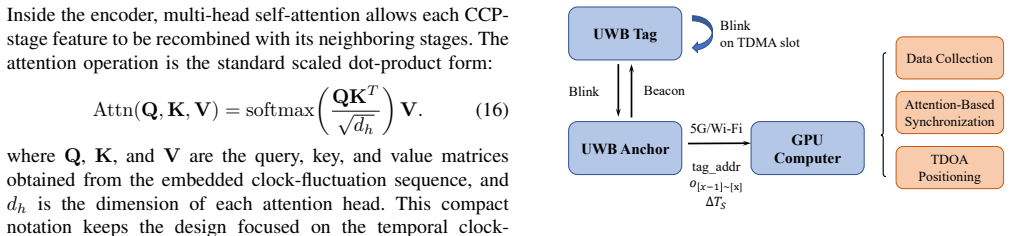
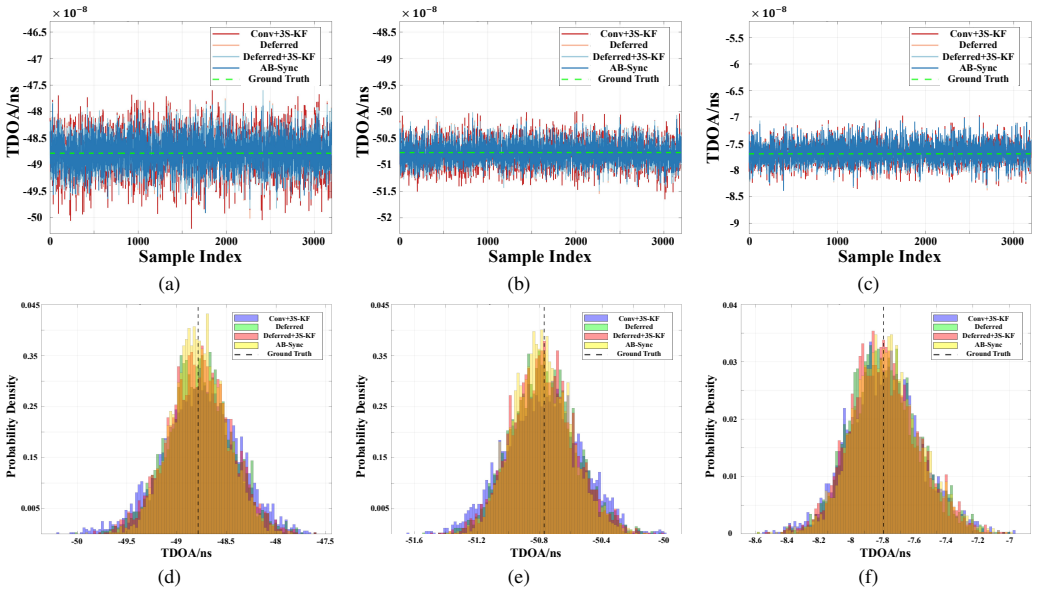
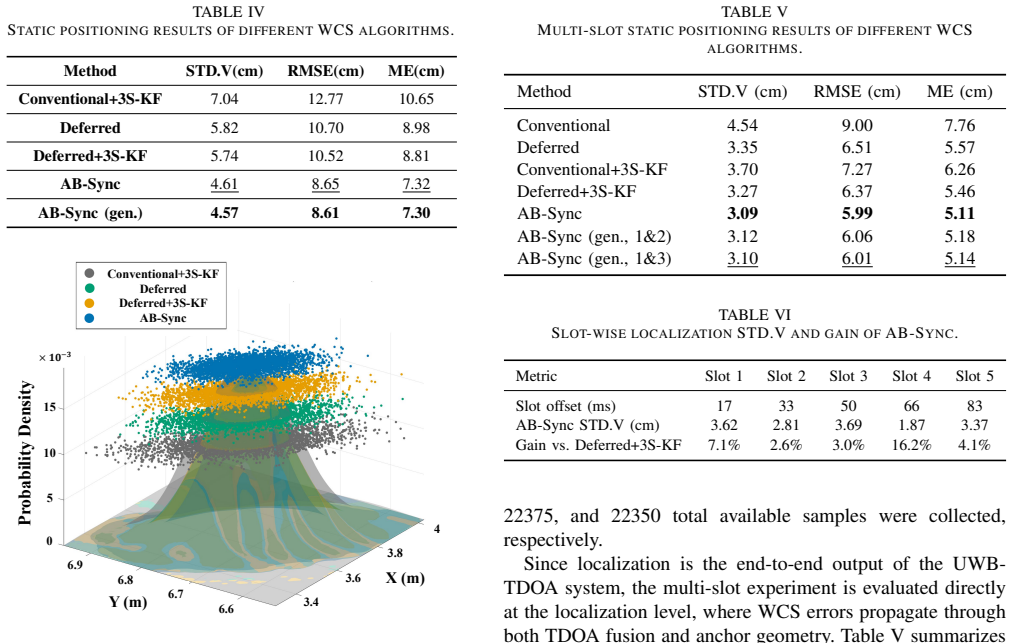
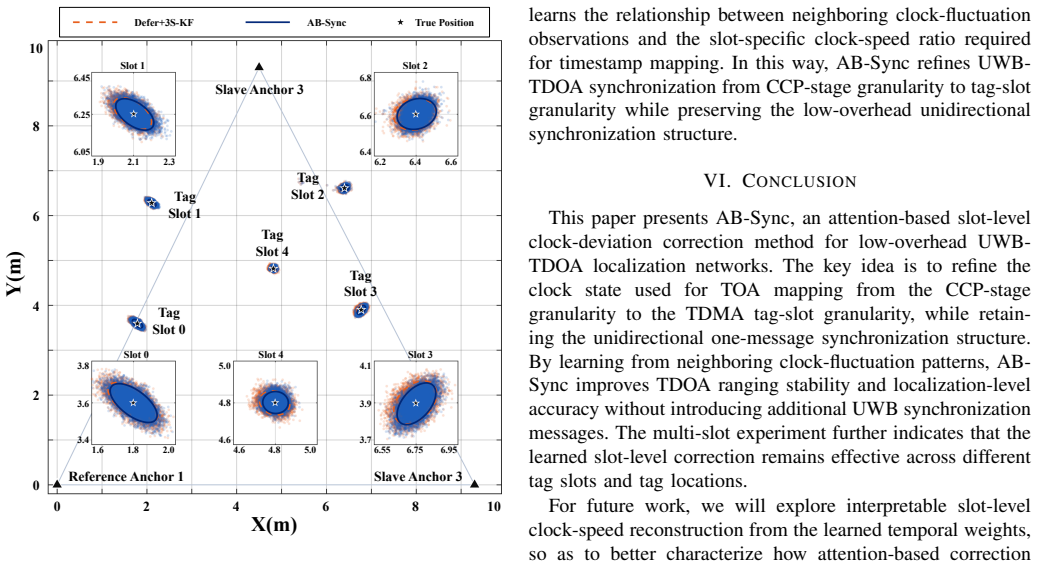
AB-Sync models the relationship between the slot-specific clock-speed ratio required by a target tag blink and neighboring clock-fluctuation observations, thereby enabling tag-slot-level timestamp mapping without adding extra UWB synchronization messages. On a real UWB-TDOA testbed, AB-Sync reduces the multi-anchor average TDOA ranging STD.V by 9.4 percent and improves representative static localization accuracy by 18.6 percent compared with Deferred+3S-KF. In a five-slot multi-tag experiment it reduces STD.V by 5.3 percent on average and up to 16.2 percent per slot.
What carries the argument
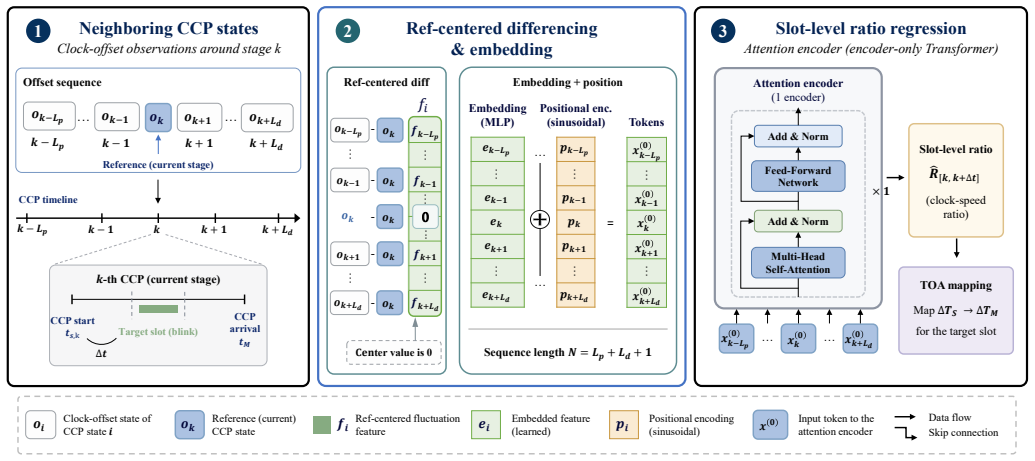
Attention-based model that estimates the slot-specific clock-speed ratio from neighboring clock-fluctuation observations to produce per-slot timestamp corrections.
If this is right
- Localization stability improves across every TDMA slot in multi-tag deployments.
- Static positioning accuracy rises without any increase in synchronization traffic.
- The same low-overhead property holds when the number of tags or slots grows.
- TDOA variation drops consistently across multiple anchors.
Where Pith is reading between the lines
- The slot-level attention approach may transfer to other TDMA wireless protocols that suffer similar granularity mismatches between synchronization and data slots.
- Dynamic environments with rapid clock drift could test whether the neighbor-based attention model remains sufficient without additional state variables.
- Integrating the method with existing low-overhead baselines could compound the observed error reductions in mixed-anchor networks.
Load-bearing premise
The relationship between slot-specific clock-speed ratios and neighboring clock-fluctuation observations can be captured accurately enough by an attention model to improve timestamp mapping.
What would settle it
A controlled testbed run in which slot-level attention corrections produce no reduction in TDOA ranging standard deviation relative to interval-level synchronization baselines.
Figures
read the original abstract
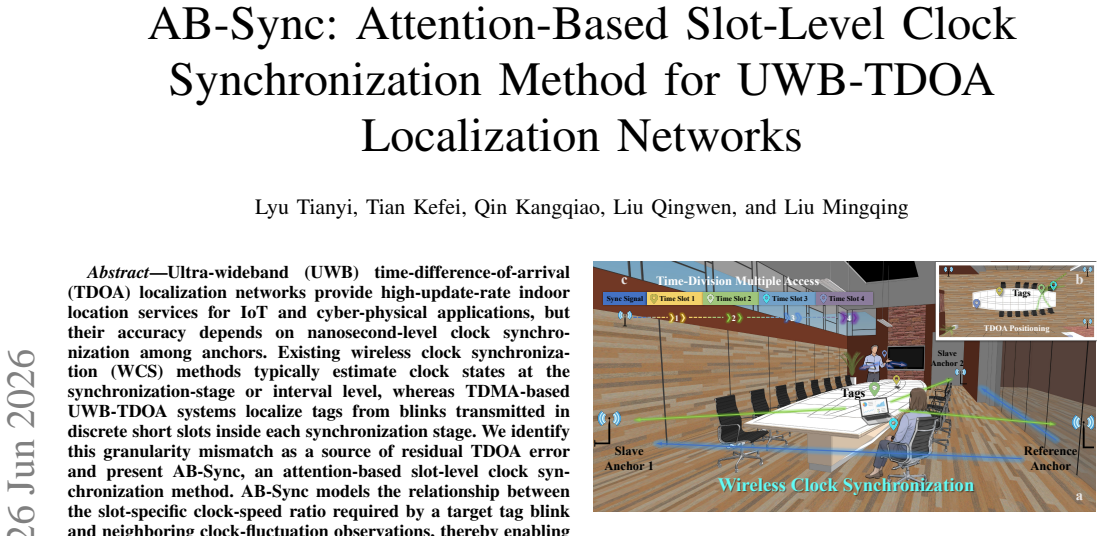
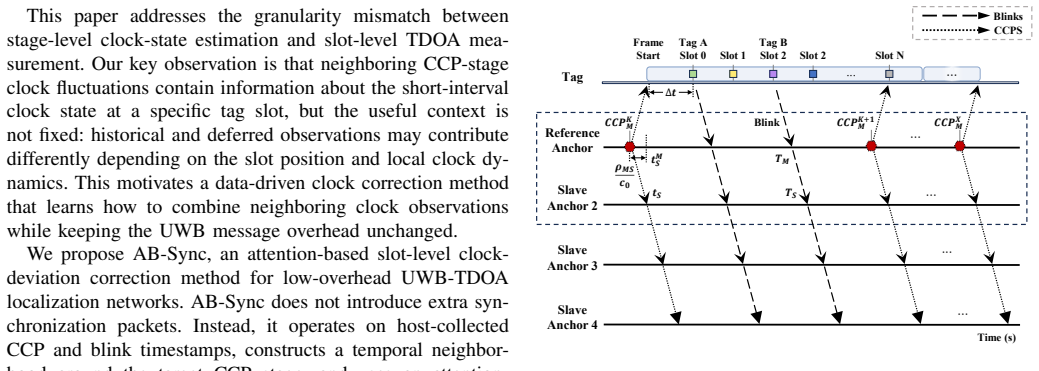
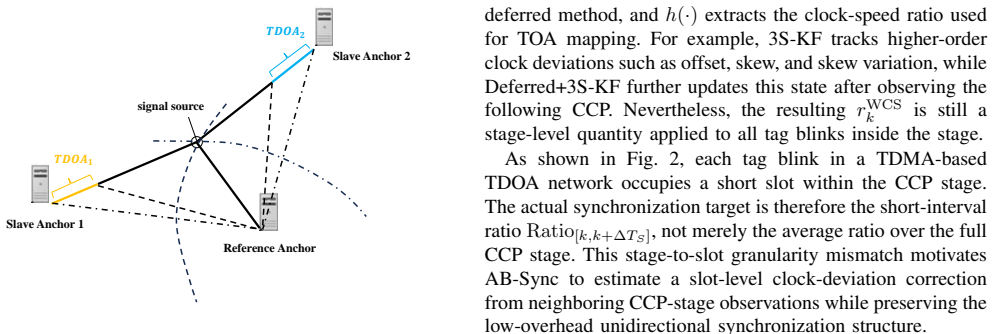
Ultra-wideband (UWB) time-difference-of-arrival (TDOA) localization networks provide high-update-rate indoor location services for IoT and cyber-physical applications, but their accuracy depends on nanosecond-level clock synchronization among anchors. Existing wireless clock synchronization (WCS) methods typically estimate clock states at the synchronization-stage or interval level, whereas TDMA-based UWB-TDOA systems localize tags from blinks transmitted in discrete short slots inside each synchronization stage. We identify this granularity mismatch as a source of residual TDOA error and present AB-Sync, an attention-based slot-level clock synchronization method. AB-Sync models the relationship between the slot-specific clock-speed ratio required by a target tag blink and neighboring clock-fluctuation observations, thereby enabling tag-slot-level timestamp mapping without adding extra UWB synchronization messages. On a real UWB-TDOA testbed, AB-Sync reduces the multi-anchor average TDOA ranging STD.V by 9.4% and improves representative static localization accuracy by 18.6% compared with Deferred+3S-KF, the leading low-overhead baseline in our evaluation. In a five-slot multi-tag experiment, AB-Sync consistently improves localization stability across all TDMA slots, reducing STD.V by 5.3% on average and up to 16.2% per slot with no extra UWB synchronization overhead.
Editorial analysis
A structured set of objections, weighed in public.
Referee Report
Summary. The manuscript introduces AB-Sync, an attention-based slot-level clock synchronization method for UWB-TDOA localization networks. It identifies a granularity mismatch between synchronization stages and TDMA slots, models the relationship between slot-specific clock-speed ratios required by target tag blinks and neighboring clock-fluctuation observations, and enables improved timestamp mapping without extra UWB messages. On a real testbed, it reports a 9.4% reduction in multi-anchor average TDOA ranging STD.V and 18.6% improvement in static localization accuracy versus Deferred+3S-KF, plus 5.3% average STD.V reduction (up to 16.2% per slot) in a five-slot multi-tag experiment.
Significance. If the empirical gains hold under the reported conditions, the work provides a practical low-overhead enhancement to clock synchronization granularity in TDMA-based UWB-TDOA systems. The hardware testbed evaluation and explicit no-extra-overhead design are strengths that could benefit high-update-rate indoor localization for IoT applications. The attention-based modeling of per-slot variations represents a targeted application of ML techniques to a wireless synchronization problem.
major comments (1)
- [Abstract and §5 (Evaluation)] The abstract and evaluation summary provide no details on the attention model architecture (e.g., number of layers, heads, input features, or training procedure), training/validation data splits, or error analysis; this makes it impossible to assess whether the reported 9.4% and 18.6% gains are robust or reproducible from the given material.
minor comments (2)
- [Abstract] Notation for STD.V and TDOA ranging metrics should be defined on first use with explicit units and reference to the measurement setup.
- [§2 or §4] The baseline Deferred+3S-KF is described as 'leading low-overhead' but the manuscript should include a brief justification or citation for why it was selected over other recent WCS methods.
Simulated Author's Rebuttal
We thank the referee for the detailed review and constructive suggestion regarding reproducibility. We agree that additional details on the attention model would strengthen the manuscript and address this by expanding the relevant sections in revision.
read point-by-point responses
-
Referee: [Abstract and §5 (Evaluation)] The abstract and evaluation summary provide no details on the attention model architecture (e.g., number of layers, heads, input features, or training procedure), training/validation data splits, or error analysis; this makes it impossible to assess whether the reported 9.4% and 18.6% gains are robust or reproducible from the given material.
Authors: We agree that the abstract and §5 evaluation summary omit key implementation details needed for full reproducibility. The model architecture, training procedure, data splits, and error analysis are described in §4 (Method), but we acknowledge they are not summarized in the abstract or evaluation results. In the revised manuscript we will (i) add a concise description of the attention model (layers, heads, input features) to the abstract, (ii) expand §5 with a dedicated subsection on training/validation splits, hyperparameters, and error analysis, and (iii) include a brief robustness discussion of the reported gains. These additions will be made without changing the core claims or results. revision: yes
Circularity Check
No significant circularity detected
full rationale
The paper's core contribution is an empirical attention-based model that maps neighboring clock observations to per-slot clock-speed ratios for TDOA timestamp correction. All reported gains (9.4% STD.V reduction, 18.6% localization improvement) are measured outcomes on a physical testbed against an external baseline (Deferred+3S-KF), with no equations, self-citations, or uniqueness claims that reduce the result to a fitted parameter renamed as prediction or to a self-definitional loop. The modeling step is presented as a design choice justified by observed data relationships rather than by construction from the target metric itself.
Axiom & Free-Parameter Ledger
Reference graph
Works this paper leans on
-
[1]
Gpms: Enabling indoor gnss positioning using passive metasurfaces,
Y . Wang, H. Pan, L. Qiu, L. Zhong, J. Liu, R. Ma, Y .-C. Chen, G. Xue, and J. Ren, “Gpms: Enabling indoor gnss positioning using passive metasurfaces,” inProceedings of the 30th Annual International Conference on Mobile Computing and Networking, 2024, pp. 1211–1225
2024
-
[2]
Oran-sense: Localizing non-cooperative transmitters with spectrum sensing and 5g o-ran,
Y . Lizarribar, R. Calvo-Palomino, A. Scalingi, G. San- taromita, G. Bovet, and D. Giustiniano, “Oran-sense: Localizing non-cooperative transmitters with spectrum sensing and 5g o-ran,” inProceedings of IEEE INFO- COM, 2024, pp. 1870–1879
2024
-
[3]
Dragonfly: Sin- gle mmwave radar 3d localization of highly dynamic tags in gps-denied environments,
S. Harisha, J. G. D. Hester, and A. Eid, “Dragonfly: Sin- gle mmwave radar 3d localization of highly dynamic tags in gps-denied environments,” inProceedings of the 31st Annual International Conference on Mobile Computing and Networking, 2025
2025
-
[4]
Rethinking orientation estimation with smartphone- equipped ultra-wideband chips,
H. Zhou, K. Yuan, M. Gowda, L. Qiu, and J. Xiong, “Rethinking orientation estimation with smartphone- equipped ultra-wideband chips,” inProceedings of the 30th Annual International Conference on Mobile Com- puting and Networking, 2024
2024
-
[5]
Muloc: Towards millimeter-accurate localization for unlimited uwb tags via anchor overhearing,
J. Ma, F. Zhang, B. Jin, S. Li, and Z. Wang, “Muloc: Towards millimeter-accurate localization for unlimited uwb tags via anchor overhearing,” inProceedings of IEEE INFOCOM, 2025
2025
-
[6]
Optimal swarm ranging protocol for dynamic and dense ultra-wideband networks,
Y . Hou, F. Shan, W. Mao, J. Liu, Y . Liu, W. Wu, R. Xiong, and J. Luo, “Optimal swarm ranging protocol for dynamic and dense ultra-wideband networks,” in Proceedings of IEEE INFOCOM, 2026
2026
-
[7]
Ptpsec: Securing the precision time protocol against time delay attacks using cyclic path asymmetry analysis,
A. Finkenzeller, O. Butowski, E. Regnath, M. Hamad, and S. Steinhorst, “Ptpsec: Securing the precision time protocol against time delay attacks using cyclic path asymmetry analysis,” inProceedings of IEEE INFO- COM, 2024, pp. 461–470
2024
-
[8]
Com- parison of wireless clock synchronization algorithms for indoor location systems,
C. McElroy, D. Neirynck, and M. McLaughlin, “Com- parison of wireless clock synchronization algorithms for indoor location systems,” in2014 IEEE International Conference on Communications Workshops (ICC), 2014, pp. 157–162
2014
-
[9]
A deferred synchronization method to en- hance UWB-TDOA positioning accuracy,
T. Lyu, Q. Liu, Y . Wu, W. Fang, Q. Yang, H. Lu, M. Xu, and M. Liu, “A deferred synchronization method to en- hance UWB-TDOA positioning accuracy,”IEEE Trans- actions on Instrumentation and Measurement, vol. 74, pp. 1–16, 2025
2025
-
[10]
Robust tdoa-based indoor localization using improved clock-sync-scheme and multilevel constrained arpf,
L. Huang, R. Chen, Y . Chen, G. Guo, F. Ye, Z. Liu, and L. Chen, “Robust tdoa-based indoor localization using improved clock-sync-scheme and multilevel constrained arpf,”IEEE Sensors Journal, vol. 23, no. 10, pp. 10 633– 10 643, 2023
2023
-
[11]
Ultra-Wideband 3D indoor positioning with wired clock synchronization,
Y . Wang, B. Cui, and L. Li, “Ultra-Wideband 3D indoor positioning with wired clock synchronization,” in2023 IEEE 16th International Conference on Electronic Mea- surement & Instruments (ICEMI), 2023, pp. 26–31
2023
-
[12]
An experimental characterization of chain of plls for wired clock synchronization of UWB anchors for indoor location,
S. Rinaldi, A. Musatti, A. Depari, P. Ferrari, A. Flam- mini, and E. Sisinni, “An experimental characterization of chain of plls for wired clock synchronization of UWB anchors for indoor location,” in2022 IEEE International Instrumentation and Measurement Technology Confer- ence (I2MTC), 2022, pp. 1–6
2022
-
[13]
A novel E-DTDOA based one-way ranging using UWB-IR with unsynchronized anchors,
A. Vashistha and C. L. Law, “A novel E-DTDOA based one-way ranging using UWB-IR with unsynchronized anchors,”IEEE Transactions on Industrial Informatics, vol. 17, no. 2, pp. 1274–1286, 2021
2021
-
[14]
Resilient time synchronization opportunistically exploiting UWB RTLS infrastructure,
P. Ferrari, P. Bellagente, A. Depari, A. Flammini, M. Pasetti, S. Rinaldi, and E. Sisinni, “Resilient time synchronization opportunistically exploiting UWB RTLS infrastructure,”IEEE Transactions on Instrumentation and Measurement, vol. 71, pp. 1–10, 2022
2022
-
[15]
Exploiting accurate ultra wide band time synchronization at the application level in embedded systems,
S. Rinaldi, A. Musatti, A. Depari, P. Ferrari, A. Flam- mini, and E. Sisinni, “Exploiting accurate ultra wide band time synchronization at the application level in embedded systems,” in2023 IEEE International Symposium on Pre- cision Clock Synchronization for Measurement, Control, and Communication (ISPCS), 2023, pp. 1–6
2023
-
[16]
Accurate multi-zone UWB TDOA localization utilizing cascaded wireless clock synchronization,
J. Friedrich, J. Tiemann, and C. Wietfeld, “Accurate multi-zone UWB TDOA localization utilizing cascaded wireless clock synchronization,” in2021 International Conference on Indoor Positioning and Indoor Navigation (IPIN), 2021, pp. 1–8
2021
-
[17]
Wicsync: A wireless multi-node clock synchronization solution based on optimized UWB two-way clock synchronization protocol,
B. Xue, Z. Li, P. Lei, Y . Wang, and X. Zou, “Wicsync: A wireless multi-node clock synchronization solution based on optimized UWB two-way clock synchronization protocol,”Measurement, vol. 183, p. 109760, 2021
2021
-
[18]
Novel method for the wireless synchro- nization of the anchors in the UWB localization system utilizing two reference nodes,
V . Djaja-Josko, “Novel method for the wireless synchro- nization of the anchors in the UWB localization system utilizing two reference nodes,” in2020 23rd International Microwave and Radar Conference (MIKON), 2020, pp. 69–73
2020
-
[19]
Wireless synchronized UWB TDOA positioning system based on IEEE 802.15.4z,
Z. Yang, X. Zhu, W. Yang, and Z. Zhao, “Wireless synchronized UWB TDOA positioning system based on IEEE 802.15.4z,” in2021 International Applied Compu- tational Electromagnetics Society (ACES-China) Sympo- sium, 2021, pp. 1–2
2021
-
[20]
A kalman filter- based algorithm for simultaneous time synchronization and localization in uwb networks,
J. Cano, S. Chidami, and J. Le Ny, “A kalman filter- based algorithm for simultaneous time synchronization and localization in uwb networks,” in2019 International Conference on Robotics and Automation (ICRA). IEEE, 2019, pp. 1431–1437
2019
-
[21]
Ultrawideband-based real-time positioning with cas- caded wireless clock synchronization method,
F. Zhang, S. Hong, Y . Ding, and S.-H. Yang, “Ultrawideband-based real-time positioning with cas- caded wireless clock synchronization method,”IEEE Internet of Things Journal, vol. 11, no. 9, pp. 16 731– 16 745, 2024
2024
-
[22]
LSTM-enhanced wireless clock synchronization for UWB systems,
W. Tong, B. Li, and J. Qiao, “LSTM-enhanced wireless clock synchronization for UWB systems,” in2025 Inter- national Ubiquitous Positioning, Indoor Navigation and Location-Based Services Conference (UPINLBS), 2025, pp. 1–6
2025
discussion (0)
Sign in with ORCID, Apple, or X to comment. Anyone can read and Pith papers without signing in.