REVIEW 3 major objections 3 minor 81 references
An integrated multi-size collision model for flotation
T0 review · 3 major / 3 minor · reviewed 2026-08-07 · deepseek-v4-flash
Pith's one-line read The paper proposes the Integrated Multi-Size Collision model (IMSC), which combines turbulent shear, inertial drift, gravity, swarm corrections, and bubble flow-distortion into a single collision-kernel formula, and reports that it…
desk verdict Substantial integrated model, but the validation is partly circular because key constants are fitted to the same DNS data used to claim superiority; still deserves peer review. read the letter →
The pith
A machine-rendered reading of the paper's core claim, the machinery that carries it, and where it could break.
The reading
What carries the argument
The load-bearing object is the radial relative velocity $w_{r,\mathrm{rms}}$ inside the spherical collision kernel. The model writes $w_{r,\mathrm{rms}} = \sqrt{(2/\pi)\sigma_I^2 + \langle w_{II,G}^2 \rangle (w_r/w_\infty)^2}$, where $\sigma_I^2$ comes from the turbulent shear mechanism and $\langle w_{II,G}^2 \rangle$ from the combined inertia-gravity mechanism. Mechanism I uses a parabolic-exponential fluid autocorrelation function for the energy spectrum and a piecewise longitudinal fluid structure function $S_{\ell\ell}^{(\mathrm{IMSC})}$ that equals the Borgas-Yeung form below $r_\eta = 1.5\eta$, blends smoothly to zero between $r_\eta$ and $r_\lambda = 0.6\lambda + 0.1L$, and is zero beyond. Mechanism II and gravity are combined through the Dodin-Elperin integral over the collision sphere, after adding swarm corrections from Garnier et al. and Richardson-Zaki and drag corrections from Schiller-Naumann and Karamanev-Nikolov. A size-ratio correction factor $(w_r/w_\infty)^2$ is applied when the radius ratio is below 0.3, using Nguyen's flow field around a bubble for ratios below 0.1 and a linear transition in between.
What would settle it
A decisive check is to run the IMSC on collision-rate data that were not used to tune the constants — for example, bubbles larger than 2.4 mm, Taylor Reynolds numbers well above 175, or non-spherical deformable bubbles — and compare the predicted particle-bubble kernel with new DNS or experiments. If the fixed thresholds $r_\lambda = 0.6\lambda + 0.1L$ and the 0.1/0.3 size-ratio boundaries systematically miss the data while existing models do not, the central claim of full parameter-range coverage is refuted.
Extended reading notes
Core claim
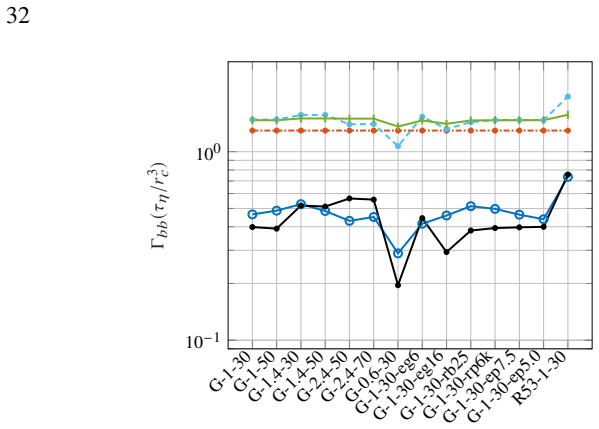
The paper's central claim is that the collision kernel for particle-bubble, particle-particle, and bubble-bubble encounters in flotation can be captured by a single model that reduces to the classical Saffman-Turner limit for inertialess particles and otherwise adds contributions from finite-inertia drift, gravity, and the wake-like distortion of the flow by the larger collision partner. The IMSC is built on the spherical collision kernel $\Gamma = 2\pi r_c^2 w_{r,\mathrm{rms}}$, with all modelling effort going into the radial relative velocity $w_{r,\mathrm{rms}}$. That velocity is decomposed into a shear-driven part (Mechanism I) and a combined part from inertia and gravity (Mechanism II + gravity). New elements include a piecewise longitudinal fluid structure function that blends the Borgas-Yeung form at small separations to zero at large separations, a consistent Eulerian treatment of the inertia term, and a size-ratio-dependent correction factor for a large bubble's disturbance of the local flow. Across the DNS cases, the authors report that the IMSC gives the best overall agreement for the particle-bubble collision kernel and, unlike other tested models, also captures the particle-particle and bubble-bubble kernels without retuning.
Load-bearing premise
The load-bearing premise is that the constants fitted to the DNS calibration set — the structure-function cutoffs $r_\eta = 1.5\eta$ and $r_\lambda = 0.6\lambda + 0.1L$ and the size-ratio thresholds 0.1 and 0.3 — are universal across all flotation conditions; if they are not, the claimed predictive superiority over other models would not transfer outside the tested range.
Editorial extensions
If this is right
- Euler-Euler flotation simulations can use a single collision kernel for all collision pair types, removing the need to select a different model for fine versus coarse particles.
- The IMSC reproduces the classical Saffman-Turner limit for zero-inertia particles, so it is consistent with established theory at one end of the parameter range.
- The model accepts standard simulation inputs ($k$, $\varepsilon$, volume fractions, phase Reynolds numbers), so it can be inserted into existing CFD frameworks without new state variables.
- In the high-turbulence validation case, the remaining gap between model and DNS is attributed to preferential concentration, and the paper shows that multiplying by the radial distribution function $g(r_c)$ recovers the trend, giving a ready extension for clustering-prone conditions.
- Because the model is modular, individual submodels (drag, swarm correction, structure function) can be improved or replaced as better two-phase turbulence data become available.
Reading between the lines
- Editorial inference: the threshold constants $r_\eta = 1.5\eta$ and $r_\lambda = 0.6\lambda + 0.1L$ are expressed in viscosity-based scales, so they may transfer to other Reynolds numbers even though they were calibrated on a narrow DNS set; computing $S_{\ell\ell}$ from the existing DNS database at different $\mathrm{Re}_\lambda$ would test this directly.
- Editorial inference: the size-ratio correction is formulated with the larger partner as a bubble with an immobile surface, but the same piecewise structure could be applied to strongly unequal particle pairs; the paper does not test this, so it is an open extension.
- Editorial inference: a two-phase longitudinal structure function extracted from a richer DNS database could replace the single-phase $S_{\ell\ell}$ and would likely improve the gravity-driven cases, where the paper reports the largest deviations.
- Editorial inference: the model's input requirements are all local cell quantities, so its computational cost is low enough to make cell-local evaluation in full-cell Euler-Euler simulations practical; this is the natural next deployment step.
Editorial analysis
A structured set of objections, weighed in public.
Referee Report
Summary. The manuscript proposes the Integrated Multi-Size Collision (IMSC) model for predicting collision kernels between particles and bubbles, and also between pairs of particles and pairs of bubbles, in turbulent flotation flows. The model is assembled from existing stochastic collision-kernel concepts with new elements: a blended longitudinal fluid structure function with fitted length constants, drag and swarm corrections, a combined Mechanism-II/gravity contribution, and a piecewise flow-modulation correction for strong size disparity. Validation is performed against the authors' own DNS for fine and coarse particles and against one literature DNS set (Chan et al. 2023). The paper claims that IMSC provides better predictions than current collision models and covers the full flotation parameter range.
Significance. If the claimed predictive accuracy were independent of the calibration data, IMSC would be a practically valuable engineering correlation for Euler-Euler flotation simulations. The paper's strengths include a thorough critical review of existing collision models, a clear modular model structure, explicit documentation of all sub-models, and an implementation summary in Appendix A. The careful reporting of the DNS data and the explicit admission that some prefactors were chosen to match these data are also commendable. The central limitation is that the model is calibrated on the same DNS data that are later presented as validation; the one external case does not exercise the flotation-specific regime or the flow-modulation correction. Thus the abstract's predictive-superiority claim is not yet established.
major comments (3)
- [Sections 3.4.3 and 3.7, Eqs. (3.33) and (3.50), Figures 9-13] The length constants r_eta=1.5 eta and r_lambda=0.6 lambda+0.1 L in the blended structure function, and the size-ratio thresholds 0.1 and 0.3 in the flow-modulation correction, are, by the authors' own statement, chosen to best match the DNS collision kernels presented in Sections 4 and 5. Those same DNS results are then used as the primary evidence that IMSC outperforms earlier models, which makes the reported agreement partly a fitting result rather than an independent test. The external Chan et al. case in Section 5.2 has no gravity, no size-ratio contrast, and point particles, and the agreement requires multiplying by a radial distribution function g(r_c) taken from that same DNS via Eq. (3.1). Consequently, the abstract's claim that IMSC provides better predictions and covers the entire parameter range is not supported by an out-of-sample test. I request either a genuine out-of-sample validation (for example, calibrating on a subset of DNS cases and validating on the remaining cases) or a substantial weakening of the predictive claim.
- [Eq. (3.34) and Table A.1] The Mechanism I variance in the main text is sigma_I^2 = S_ll(r_i)<v_i^2>/u_rms^2 + S_ll(r_j)<v_j^2>/u_rms^2 + S_ll(r_c) f(r_c)<v_i v_j>/u_rms^2, but Table A.1 lists sigma_I^2 with 2 sqrt(S_ll(r_i) S_ll(r_j))<v_i v_j>/u_rms^2, without f(r_c). These are different expressions, so a reader implementing the model from the summary table will obtain a different collision kernel than from the derivation. Appendix A is explicitly offered as the implementation reference, so this inconsistency must be resolved.
- [Section 3.7, Eq. (3.51) and Table A.1] The text defines Z = ((r_i/r_j)_m)^2 * 1/(4Y) = 0.0025 Y, whereas Table A.1 gives Z = 0.01/(4Y). Since (r_i/r_j)_m = 0.1, the expression in Eq. (3.51) equals 0.0025/Y, not 0.0025Y. Continuity of the piecewise correction at r_i/r_j = 0.1 requires Z = 0.01/(4Y). The resulting factor-Y^2 discrepancy makes the interpolation branch of Eq. (3.50) ambiguous and must be corrected.
minor comments (3)
- [Figure 13 caption] The caption uses 'ISMC' where 'IMSC' is meant; this should be corrected.
- [Section 3.4.1, after Eq. (3.18)] The sentence says 'a bubble volume fraction of eps_p = 8.8%'; this should read eps_b = 8.8%.
- [Table 2] The reference case G-0.6-240 is listed twice, the second time without parameter values; the duplicate row should be removed.
Circularity Check
Validation is in-sample for the fitted constants: r_eta, r_lambda and the size-ratio thresholds are calibrated on the same DNS cases later used to claim superiority.
-
fitted input called prediction
[Section 3.4.3, Eq. (3.33)]
"The prefactors were chosen to best match the collision kernels in the available DNS data presented in Sections 4 and 5 below."
The constants r_eta = 1.5 eta and r_lambda = 0.6 lambda + 0.1 L define the longitudinal structure function S_l l, which directly enters the Mechanism I contribution in Eq. (3.34) and hence the collision kernel through Eq. (2.5). Section 4 then uses exactly these DNS collision kernels (Figures 9-11) as the validation evidence for the IMSC. The agreement with DNS is therefore not an independent confirmation of these constants: they were fitted to minimize error on the same data, whereas the comparison models (Saffman-Turner, Abrahamson, Zaichik, etc.) do not have such calibrated degrees of freedom. This makes the abstract's claim of 'better predictions' partly in-sample.
-
fitted input called prediction
[Section 3.7, Eq. (3.50)]
"The DNS data utilized for subsequent validation suggest that the assumption regarding the independence of collision partners on their relative velocity, due to their coupling with the fluid, holds true for the condition r_i/r_j > (r_i/r_j)_n = 0.3 (cf. sections 4.4.1 and 5.1 below)."
The size-ratio thresholds (r_i/r_j)_m = 0.1 and (r_i/r_j)_n = 0.3 define where the flow-modulation correction is active, transitional, or absent. They are justified by the same DNS cases used in Sections 4.4.1 and 5.1 to validate the model. In particular, the coarse-particle cases in Table 2 have d_p/d_b between 0.3 and 0.5, so Eq. (3.50) returns (w_r/w_infty)^2 = 1 because the threshold was set on those very cases. The agreement shown in Figure 13 is therefore partly encoded in the threshold choice, not an independent test.
full rationale
Section 3.4.3 states outright that the cut-off parameters r_eta = 1.5 eta and r_lambda = 0.6 lambda + 0.1 L were 'chosen to best match the collision kernels in the available DNS data presented in Sections 4 and 5 below.' Section 3.7 similarly derives the size-ratio thresholds 0.1 and 0.3 from the DNS cases listed in those same validation sections. The central validation plots (Figures 9 and 13) then compare IMSC against those same DNS collision kernels and claim the IMSC 'provides better predictions.' Since the comparison models do not have these calibration constants, part of the observed agreement is structurally built into IMSC; the comparison is not an out-of-sample test. The only independent benchmark, Chan et al. (2023) in Section 5.2, does not exercise the flotation-specific regime: it has no gravity, no size-ratio contrast, uses point particles with equal Stokes numbers, and the IMSC curve is accepted only after multiplication by an externally supplied radial distribution function g(r_c) via Eq. (3.1). That benchmark therefore cannot validate the fitted r_eta/r_lambda thresholds or the flow-modulation correction. There is no self-citation chain or definitional equivalence here; the rest of the model is assembled from external literature and documented derivations, and the paper discloses its fitting, so the appropriate verdict is partial circularity rather than complete reduction. A separate consistency issue: Eq. (3.51) gives Z = 0.0025Y while Table A.1 lists Z = 0.01/(4Y), which differ by a factor Y^2; this does not affect the circularity score but makes the piecewise correction ambiguous.
Assumptions & free parameters
free parameters (4)
- r_eta prefactor =
1.5 (r_eta = 1.5 eta)
- r_lambda coefficients =
0.6 and 0.1 (r_lambda = 0.6*lambda + 0.1*L)
- Lower size-ratio threshold (r_i/r_j)_m =
0.1
- Upper size-ratio threshold (r_i/r_j)_n =
0.3
assumptions (6)
- domain assumption Homogeneous and isotropic fluid turbulence (Section 3.2(i)).
- domain assumption The dispersed elements do not affect the fluid (one-way coupling), except for the separately modeled flow distortion around the large bubble (Section 3.2(iv)).
- domain assumption The velocity distributions of particles and bubbles are Gaussian (Section 3.3).
- domain assumption Mechanism I and Mechanism II are independent and uncorrelated (Section 3.3).
- domain assumption The Basset history force is neglected in the particle equation of motion (Section 3.4.1).
- domain assumption The longitudinal fluid structure function and the velocity autocorrelation of single-phase isotropic turbulence apply unchanged to the dense three-phase flow (Sections 3.4.2 and 3.4.3).
Cite this review
Pith. "Pith review of An integrated multi-size collision model for flotation." pith.science (2026). https://pith.science/paper/MDHBP7UK
@misc{pith2026250603881,
  author       = {Pith},
  title        = {Pith review of: An integrated multi-size collision model for flotation},
  year         = {2026},
  howpublished = {\url{https://pith.science/paper/MDHBP7UK}},
  note         = {Machine review of arXiv:2506.03881}
}
read the original abstract
The accuracy obtained with CFD and process simulations of flotation critically depends on the quality and robustness of the underlying models for the non-resolved sub-processes. An important issue in flotation is the collision between particles and air bubbles. Many models have been developed, but their accuracy for applications in flotation is limited. In particular, the significant size difference between particles and bubbles and their intricate coupling to the turbulent flow field pose severe challenges. The present paper first reviews presently employed collision models, highlighting their advantages and disadvantages when applied to flotation. On this basis, the "Integrated Multi-Size Collision model" (IMSC) is proposed. After a detailed evaluation, it combines existing approaches from various sources and introduces new developments designed to address present shortcomings. The model is validated by own DNS data as well as data from the literature. It is shown that, overall, the IMSC provides better predictions for the collision rate in typical flotation conditions than presently employed collision models and covers the entire parameter range of the flotation process very well. Using the available data, some of the underlying modelling assumptions are validated. Finally, a comprehensive overview of the model is provided for further use in Euler-Euler frameworks or process simulations.
Figures


Figures from the paper (12 more)




Reference graph
Works this paper leans on
-
[1]
, " * write output.state after.block = add.period write newline
ENTRY address author booktitle chapter edition editor howpublished institution journal key month note number organization pages publisher school series title type volume year eprint label extra.label sort.label short.list INTEGERS output.state before.all mid.sentence after.sentence after.block FUNCTION init.state.consts #0 'before.all := #1 'mid.sentence ...
-
[2]
write newline
" write newline "" before.all 'output.state := FUNCTION n.dashify 't := "" t empty not t #1 #1 substring "-" = t #1 #2 substring "--" = not "--" * t #2 global.max substring 't := t #1 #1 substring "-" = "-" * t #2 global.max substring 't := while if t #1 #1 substring * t #2 global.max substring 't := if while FUNCTION word.in bbl.in capitalize " " * FUNCT...
-
[3]
1975 Collision rates of small particles in a vigorously turbulent fluid
Abrahamson, J. 1975 Collision rates of small particles in a vigorously turbulent fluid . Chem. Eng. Sci. 30 , 1371--1379
work page 1975
-
[4]
Angriman, S. , Mininni, P. D. & Cobelli, P. J. 2020 Velocity and acceleration statistics in particle-laden turbulent swirling flows . Phys. Rev. Fluids 5 , 64605
work page 2020
-
[5]
Bloom, F. & Heindel, T. J. 2002 On the structure of collision and detachment frequencies in flotation models . Chem. Eng. Sci. 57 , 2467--2473
work page 2002
-
[6]
Borgas, M. S. & Yeung, P. K. 2004 Relative dispersion in isotropic turbulence. Part 2. A new stochastic model with reynolds-number dependence . J. Fluid Mech. 503 , 125--160
work page 2004
- [7]
-
[8]
Chan, T. T. K. , Ng, C. S. & Krug, D. 2023 Bubble-particle collisions in turbulence: insights from point-particle simulations . J. Fluid Mech. 959 , A6
work page 2023
Show all 81 references
-
[9]
& Uhlmann, M
Chouippe, A. & Uhlmann, M. 2015 Forcing homogeneous turbulence in direct numerical simulation of particulate flow with interface resolution and gravity . Phys. Fluids 27 , 123301
2015
-
[10]
, Grace, J
Clift, R. , Grace, J. R. & Weber, M. E. 1978 Bubbles, drops, and particles\/ . Academic Press
1978
-
[11]
2012 Some observations on copper yields and ore grades
Crowson, P. 2012 Some observations on copper yields and ore grades . Resour. Policy 37 , 59--72
2012
-
[12]
, Fornasiero, D
Dai, Z. , Fornasiero, D. & Ralston, J. 2000 Particle-bubble collision models - a review . Adv. Colloid Interface Sci. 85 , 231--256
2000
-
[13]
Deglon, D. A. , Egya-mensah, D. & Franzidis, J. P. 2000 Review of hydrodynamics and gas dispersion in flotation cells on south african platinum concentrators . Miner. Eng. 13 , 235--244
2000
-
[14]
& Elperin, T
Dodin, Z. & Elperin, T. 2002 On the collision rate of particles in turbulent flow with gravity . Phys. Fluids 14 , 2921--2924
2002
-
[15]
& Rzehak, R
Draw, M. & Rzehak, R. 2025 A flotation framework for E ulerian multiphase CFD : Integrating bubble-particle aggregates and flotation kinetics . Miner. Eng. 228 , 109258
2025
-
[16]
, Fornasiero, D
Duan, J. , Fornasiero, D. & Ralston, J. 2003 Calculation of the flotation rate constant of chalcopyrite particles in an ore . Int. J. Miner. Process. 72 , 227--237
2003
-
[17]
& Pope, S
Eswaran, V. & Pope, S. B. 1988 An examination of forcing in direct numerical simulations of turbulence . Comput. Fluids 16 , 257--278
1988
-
[18]
& Ragab, S
Fayed, H. & Ragab, S. 2015 Numerical simulations of two-phase flow in a self-aerated flotation machine and kinetics modeling . Miner. 5 , 164--188
2015
-
[19]
Fuerstenau, M. C. , Jameson, G. J. & Yoon, R.-H. , ed. 2007 Froth flotation: a century of innovation\/ . Society for Mining, Metallurgy, and Exploration
2007
-
[20]
, Lance, M
Garnier, C. , Lance, M. & Marié, J. L. 2002 Measurement of local flow characteristics in buoyancy-driven bubbly flow at high void fraction . Exp. Therm. Fluid Sci. 26 , 811--815
2002
-
[21]
, Sinojmeri, A
Grieco, G. , Sinojmeri, A. , Bussolesi, M. , Cocomazzi, G. & Cavallo, A. 2021 Environmental impact variability of copper tailing dumps in fushe arrez ( Northern Albania ): The role of pyrite separation during flotation . Sustainability 13 , 9643
2021
-
[22]
Hadler, K & Cilliers, J J 2019 The effect of particles on surface tension and flotation froth stability . Min. Metall. Explor. 36 , 63--69
2019
-
[23]
, Firouzi, M
Hassanzadeh, A. , Firouzi, M. , Albijanic, B. & Celik, M. S. 2018 A review on determination of particle–bubble encounter using analytical, experimental and numerical methods . Miner. Eng. 122 , 296--311
2018
-
[24]
Hinze, J. O. 1975 Turbulence\/ , 2nd edn. McGraw-Hill
1975
-
[25]
, L a P orta, D
Hund, K. , L a P orta, D. , Fabregas, T. P. , Laing, T. & Drexhage, J. 2020 Minerals for climate action: T he mineral intensity of the clean energy transition (english) . W orld B ank G roup
2020
-
[26]
Ireland, P. J. , Bragg, A. D. & Collins, L. R. 2016 The effect of R eynolds number on inertial particle dynamics in isotropic turbulence. Part 1 . S imulations without gravitational effects . J. Fluid Mech. 796 , 617--658
2016
-
[27]
Karamanev, D. G. & Nikolov, L. N. 1992 Free rising spheres do not obey N ewton's law for free settling . AIChE J. 38 , 1843--1846
1992
-
[28]
Koh, P. T. L. & Schwarz, M. P. 2003 CFD modelling of bubble-particle collision rates and efficiencies in a flotation cell . Miner. Eng. 16 , 1055--1059
2003
-
[29]
Koh, P. T. L. & Schwarz, M. P. 2006 CFD modelling of bubble–particle attachments in flotation cells . Miner. Eng. 19 , 619--626
2006
-
[30]
Koh, P. T. L. & Schwarz, M. P. 2007 CFD model of a self-aerating flotation cell . I. J. Miner. Proc. 85 , 16--24
2007
-
[31]
, Karapantsios, T
Kostoglou, M. , Karapantsios, T. D. & Evgenidis, S. 2020 a\/ On a generalized framework for turbulent collision frequency models in flotation: The road from past inconsistencies to a concise algebraic expression for fine particles . Adv. Colloid Interface Sci. 284 , 102270
2020
-
[32]
, Karapantsios, T
Kostoglou, M. , Karapantsios, T. D. & Matis, K. A. 2006 Modeling local flotation frequency in a turbulent flow field . Adv. Colloid Interface Sci. 122 , 79--91
2006
-
[33]
, Karapantsios, T
Kostoglou, M. , Karapantsios, T. D. & Oikonomidou, O. 2020 b\/ A critical review on turbulent collision frequency/efficiency models in flotation: Unravelling the path from general coagulation to flotation . Adv. Colloid Interface Sci. 279 , 102158
2020
-
[34]
Kruis, F. E. & Kusters, K. A. 1997 The collision rate of particles in turbulent flow . Chem. Eng. Commun. 158 , 201--230
1997
-
[35]
, Govender, D
Lelinski, D. , Govender, D. , Dabrowski, B. , Traczy, F. & Mulligan, M. 2011 Effective use of energy in the flotation process . The Southern African Institute of Mining and Metallurgy
2011
-
[36]
Maxey, M. R. & Riley, J. J. 1983 Equation of motion for a small rigid sphere in a nonuniform flow . Phys. Fluids 26 , 883--889 , doi: 10.1063/1.864230
1983 doi
-
[37]
Mesa, Diego , Morrison, Angus J & Brito-Parada, Pablo R 2020 The effect of impeller-stator design on bubble size: Implications for froth stability and flotation performance . Miner. Eng. 157 , 106533
2020
-
[38]
Meyer, C. J. & Deglon, D. A. 2011 Particle collision modeling – a review . Miner. Eng. 24 , 719--730
2011
-
[39]
, Nguyen, A
Ngo-Cong, D. , Nguyen, A. V & Tran-Cong, T. 2018 Isotropic turbulence surpasses gravity in affecting bubble-particle collision interaction in flotation . Miner. Eng. 122 , 165--175
2018
-
[40]
Nguyen, A. V. 1999 Hydrodynamics of liquid flows around air bubbles in flotation: a review . Int. J. Miner. Process. 56 , 165--205
1999
-
[41]
Nguyen, A. V. , An-Vo, D.-A. , Tran-Cong, T. & Evans, G. M. 2016 A review of stochastic description of the turbulence effect on bubble-particle interactions in flotation . Int. J. Miner. Process. 156 , 75--86
2016
-
[42]
Nguyen, A. V. & Schulze, H. J. 2004 Colloidal Science of Flotation\/ , Surfactant Science Series , vol. 118 . Marcel Dekker
2004
-
[43]
, Brito-Parada, P
Norori-McCormac, A. , Brito-Parada, P. R. , Hadler, K. , Cole, K. & Cilliers, J. J. 2017 The effect of particle size distribution on froth stability in flotation . Sep. Purif. Technol. 184 , 240--247
2017
-
[44]
, Farrokhpay, S
Ostadrahimi, M. , Farrokhpay, S. , Gharibi, K. & Dehghani, A. 2020 A new empirical model to calculate bubble size in froth flotation columns . Coll. Surfaces A 594 , 124672
2020
-
[45]
Phiri, T. C. , Singh, P. & Nikoloski, A. N. 2021 The potential for copper slag waste as a resource for a circular economy: A review – Part II . Miner. Eng. 172 , 107150
2021
-
[46]
Pope, S. B. 2000 Turbulent Flows\/ . Cambridge University Press
2000
-
[47]
, Qiu, X.-Y
Ran, J.-C. , Qiu, X.-Y. , Hu, Z. , Liu, Q.-J. , Song, B.-X. & Yao, Y.-Q. 2019 Effects of particle size on flotation performance in the separation of copper, gold and lead . Powder Technol. 344 , 654--664
2019
-
[48]
& Zaki, W.N
Richardson, J.F. & Zaki, W.N. 1954 Sedimentation and fluidisation: P art I . Trans. Inst. Chem. Eng. 32 , 35--53
1954
-
[49]
2001 Generalized correlation for bubble motion
Rodrigue, D. 2001 Generalized correlation for bubble motion . AIChE J. 47 , 39--44
2001
-
[50]
Saffman, P. G. & Turner, J. S. 1956 On the collision of drops in turbulent clouds . J. Fluid Mech. 1 , 16--30
1956
-
[51]
& Fröhlich, J
Santarelli, C. & Fröhlich, J. 2015 Direct numerical simulations of spherical bubbles in vertical turbulent channel flow . Int. J. Multiph. Flow 75 , 174--193
2015
-
[52]
Sawford, B. L. 1991 Reynolds number effects in lagrangian stochastic models of turbulent dispersion . Phys. Fluids A: Fluid Dyn. 3 , 1577--1586
1991
-
[53]
& Naumann, A
Schiller, L. & Naumann, A. 1935 A drag coefficient correlation . Z. VDI 77 , 318--320
1935
-
[54]
, Sommer, A.-E
Shi, P. , Sommer, A.-E. , Rox, H. , Eckert, K. & Rzehak, R. 2022 Euler-Euler/RANS modeling of solid-liquid flow in stirred tanks: A comprehensive model validation . Miner. Eng. 185 , 107679
2022
-
[55]
1917 Versuch einer mathematischen Theorie der Koagulationskinetik kolloider Lösungen
von Smoluchowski, M. 1917 Versuch einer mathematischen Theorie der Koagulationskinetik kolloider Lösungen . Zeitung für Physikalische Chemie 92 , 129--168
1917
-
[56]
& Collins, L
Sundaram, S. & Collins, L. R. 1997 Collision statistics in an isotropic particle-laden turbulent suspension. part 1. direct numerical simulations . J. Fluid Mech. 335 , 75--109
1997
-
[57]
Sutherland, K. L. 1948 Physical chemistry of flotation. XI . K inetics of the flotation process . J. Phys. Colloid Chem. 52 , 394--425
1948
-
[58]
Tabelin, C. B. , Park, I. , Phengsaart, T. , Jeon, S. , Villacorte-Tabelin, M. , Alonzo, D. , Yoo, K. , Ito, M. & Hiroyoshi, N. 2021 Copper and critical metals production from porphyry ores and e-wastes: A review of resource availability, processing/recycling challenges, socio...
2021
-
[59]
, Runge, K
Tabosa, E. , Runge, K. & Holtham, P. 2016 The effect of cell hydrodynamics on flotation performance . Int. J. Miner. Process. 156 , 99--107
2016
-
[60]
Taylor, G. I. 1935 Distribution of velocity and temperature between concentric rotating cylinders . Proc. R. Soc. Lond. A 151 , 494--512
1935
-
[61]
Tchen, C. M. 1947 Mean value and correlation problems connected with the motion of small particles suspended in a turbulent fluid . PhD thesis, TU Delft, Hydraulic Engineering
1947
-
[62]
In Proceedings of the International Minerals Processing Congress\/ , pp
Tiedemann, Benedikt & Fröhlich, Jochen 2024 A first DNS investigation of turbulent collisions in flotation. In Proceedings of the International Minerals Processing Congress\/ , pp. 2739--2748
2024
-
[63]
& Fröhlich, J
Tiedemann, B. & Fröhlich, J. 2025 Direct numerical simulation of collision events in flotation under the influence of gravity . Int J. Multiph. Flow 188 , 105204
2025
-
[64]
, Kempe, T
Tschisgale, S. , Kempe, T. & Fröhlich, J. 2018 A general implicit direct forcing immersed boundary method for rigid particles . Comput. Fluids 170 , 285--298
2018
-
[65]
Uhlmann, Markus & Doychev, Todor 2014 Sedimentation of a dilute suspension of rigid spheres at intermediate galileo numbers: the effect of clustering upon the particle motion . J. Fluid Mech. 752 , 310--348
2014
-
[66]
, Goffé, B
Vidal, O. , Goffé, B. & Arndt, N. 2013 Metals for a low-carbon society . Nat. Geosci. 6 , 894--896
2013
-
[67]
, Pumir, A
Voßkuhle, M. , Pumir, A. , Lévêque, E. & Wilkinson, M. 2014 Prevalence of the sling effect for enhancing collision rates in turbulent suspensions . J. Fluid Mech. 749 , 841--852
2014
-
[68]
Wang, G. , Ge, L. , Mitra, S. , Evans, G. M. , Joshi, J. B. & Chen, S. 2018 A review of CFD modelling studies on the flotation process . Miner. Eng. 127 , 153--177
2018
-
[69]
, Ayala, O
Wang, L.-P. , Ayala, O. , Kasprzak, S. E. & Grabowski, W. W. 2005 Theoretical formulation of collision rate and collision efficiency of hydrodynamically interacting cloud droplets in turbulent atmosphere . J. Atmos. Sci. 62 , 2433--2450
2005
-
[70]
, Chen, S
Wang, L.-P. , Chen, S. , Brasseur, J. G. & Wyngaard, J. C. 1996 Examination of hypotheses in the K olmogorov refined turbulence theory through high-resolution simulations. Part 1 . Velocity field . J. Fluid Mech. 309 , 113--156
1996
-
[71]
, Wexler, A
Wang, L.-P. , Wexler, A. S. & Zhou, Y. 1998 Statistical mechanical descriptions of turbulent coagulation . Phys. Fluids 10 , 2647--2651
1998
-
[72]
Williams, J. J. E. 1980 Droplet coagulation in two-phase turbulent pipe flows . PhD thesis
1980
-
[73]
Williams, J. J. E. & Crane, R. I. 1983 Particle collision rate in turbulent flow . Int. J. Multiph. Flow 9 , 421--435
1983
-
[74]
World Bank Group 2017 The growing role of minerals and metals for a low carbon future
2017
-
[75]
2000 Flotation\/
Yarar, B. 2000 Flotation\/ . John Wiley & Sons, Ltd
2000
-
[76]
Yeung, P. K. & Pope, S. B. 1989 Lagrangian statistics from direct numerical simulations of isotropic turbulence . J. Fluid Mech. 207 , 531--586
1989
-
[77]
You, X. , Li, L. , Liu, J. , Wu, L. , He, M. & Lyu, X. 2017 Investigation of particle collection and flotation kinetics within the J ameson cell downcomer . Powder Technol. 310 , 221--227
2017
-
[78]
1984 Collision rate of small particles in a homogeneous and isotropic turbulence
Yuu, S. 1984 Collision rate of small particles in a homogeneous and isotropic turbulence . AICHE J. 30 , 802--807
1984
-
[79]
Zaichik, L. I. , Simonin, O. & Alipchenkov, V. M. 2006 Collision rates of bidisperse inertial particles in isotropic turbulence . Phys. Fluids 18 , 035110
2006
-
[80]
Zaichik, L. I. , Simonin, O. & Alipchenkov, V. M. 2010 Turbulent collision rates of arbitrary-density particles . Int. J. Heat Mass Transf. 53 , 1613--1620
2010
-
[81]
, Kamble, V
Zürner, T. , Kamble, V. , Rzehak, R. & Eckert, K. 2024 Experimental and numerical investigation of turbulent multiphase jets . Miner. Eng. 211 , 108699
2024
Reviewed August 7, 2026 · model on record in the stance chip above.
Discussion (0). Continue with ORCID to comment.