REVIEW 3 major objections 5 minor 1 cited by
DNS Study of the Global Heat Release Rate During Early Flame Kernel Development under Engine Conditions
T0 review · 3 major / 5 minor · reviewed 2026-08-14 · deepseek-v4-flash
Pith's one-line read Early flame-kernel burn-rate swings come from flame shape, not strain
desk verdict Careful, useful DNS with a clean mechanism for kernel heat-release variability, but the curvature-over-strain claim rests on two realizations and is stated too strongly. read the letter →
The pith
A machine-rendered reading of the paper's core claim, the machinery that carries it, and where it could break.
The reading
What carries the argument
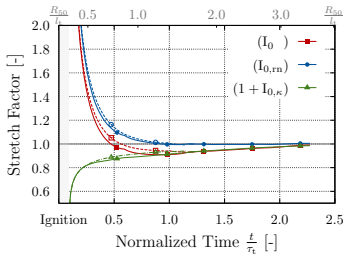
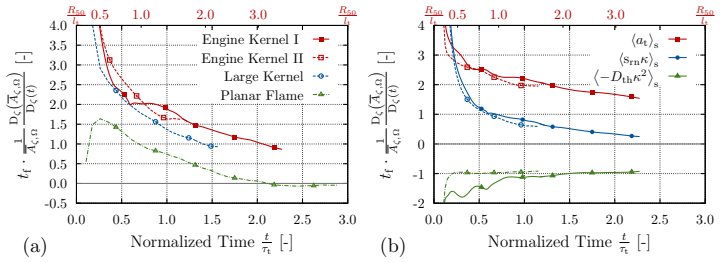
The load-bearing object is the decomposition of the global heat-release rate into a flame-structure factor and a flame-geometry factor, joined to the flame area balance. A progress variable $\zeta$ is defined by a modeled transport equation, so that the global reaction-progress rate equals $(\rho_u s_{l,u}^0/V_{\Omega})\, I_0\, A_{c,\Omega}$: the laminar reference burning rate times a global stretch factor $I_0$ times total flame surface area. The paper splits $I_0$ into a normal-propagation part $I_{0,rn}$ and a curvature/tangential-diffusion part $I_{0,\kappa}$, and splits the per-area flame area rate of change into tangential strain $a_t$, kinematic restoration $s_{rn}\kappa$, and scalar dissipation $-D_{th}\kappa^2$. The central work of this machinery is to show that run-to-run area differences follow the curvature-dependent terms, not $a_t$, and that kernel-sized planar subregions reproduce the same curvature-driven fluctuations.
What would settle it
Run additional engine-kernel DNS realizations with the same nominal conditions but different turbulent flow fields, and test whether the dominant term in the kernel area balance remains the curvature-dependent dissipation and restoration terms rather than tangential strain; if in some realizations strain-production excursions match or exceed the curvature terms, the causal claim would be false. A cheaper check is to compare the area-balance term histories across many planar-flame subregions and ask whether strain-driven subsets occur.
Extended reading notes
Core claim
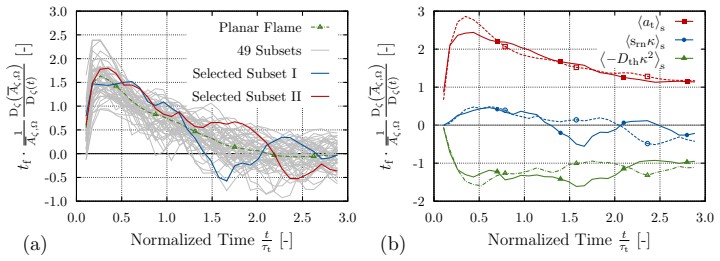
The central discovery is that in these engine-relevant unity-Lewis-number kernel simulations, the global burning rate splits cleanly into a laminar-like flame response and a geometry problem. The stretch factor $I_0$, which measures the deviation of the mean displacement speed from an unstretched laminar flame, returns to $I_{0,rn}=1$ after ignition artifacts decay, and conditional temperature profiles show no thickening of the averaged flame structure despite Karlovitz numbers up to about 13. Meanwhile, two kernel realizations with identical nominal conditions differ by up to 25% in integrated heat release, and the difference is traced to total flame area. Analysis of the flame area balance equation shows that the run-to-run variations in area growth come from the curvature-dependent terms, especially scalar dissipation, not from tangential strain production. Local planar-flame segments with kernel-sized areas also show temporal area-rate fluctuations, but there the variations are tied to negatively curved regions alone.
Load-bearing premise
The load-bearing premise is that two engine-kernel realizations are enough to say which term in the flame area balance controls run-to-run variations; a different pair of turbulent flow fields could in principle show strain-driven variations, and the present data cannot rule that out.
Editorial extensions
If this is right
- For Karlovitz numbers up to about 13 at unity Lewis number, the averaged flame structure in an engine kernel is not thickened by turbulence, so flamelet-based models can describe the mean burning rate without an extra turbulent-thickening term.
- Once ignition effects decay, the mean normal displacement speed equals the unstretched laminar burning velocity, so early-kernel propagation can be modeled as laminar propagation plus a separate curvature correction.
- Run-to-run heat-release variation in these conditions is a flame-area effect dominated by curvature evolution, implying that ignition-kernel models must represent curvature history rather than just strain statistics.
- The same curvature-driven area fluctuations appear in local kernel-sized segments of a fully developed planar flame, so the mechanism is not an artifact of small kernel size.
- Because the conditions sit in the thin-reaction-zones regime with Karlovitz numbers at the upper engine range, the authors expect the conclusions to carry over to more realistic Reynolds numbers with similar Karlovitz and higher Damköhler numbers.
Reading between the lines
- A testable extension would be to run several additional kernel realizations with the same nominal conditions and check whether the curvature-dependent terms always dominate the kernel area balance; the current attribution uses only two realizations.
- Because Lewis number is artificially unity, an immediate next step is to repeat the area-balance decomposition under differential diffusion and EGR dilution, where stretch directly modifies flame structure and may shift the curvature-versus-strain balance.
- The results suggest that combustion models predicting cycle-to-cycle variation should couple the resolved flow to a curvature-tracking quantity, such as a level-set field or the kernel radius, rather than relying solely on strain-based flame surface density closures.
- One could test the mechanism experimentally by measuring kernel boundary curvature over many cycles with high-speed imaging and correlating curvature evolution with heat-release-derived burning rates.
Signed reviews
Editorial analysis
A structured set of objections, weighed in public.
Referee Report
Summary. This paper presents a three-dimensional DNS database of early flame kernel development under engine-relevant, unity-Lewis-number, stoichiometric iso-octane/air conditions at 6 bar and 600 K. The analysis is built on a flame-integrated balance equation that decomposes the global reaction-progress rate into a stretch factor I0 and the global flame surface density. The authors conclude that, despite Karlovitz numbers up to about 13, small-scale turbulence does not thicken the averaged flame structure, that the mean normal displacement speed returns to the laminar unstretched value after ignition transients decay, and that run-to-run variations in global heat release are primarily caused by flame area dynamics, specifically by curvature evolution rather than by tangential strain production. Complementary local analyses of a planar flame are used to test the generality of the curvature effect.
Significance. If the main causal claim holds, the paper provides useful evidence for flamelet-type modeling of early kernel growth and for understanding cycle-to-cycle variability in spark-ignition engines. The strength of the paper is that the DNS conditions are carefully chosen and well documented, the mathematical formulation in Sections 2 and 4.2 is clear and closed, and the central conclusions are direct measurements compared with laminar reference flames rather than outcomes of fitted models. The analysis using a defined progress variable and the explicit area balance equation is conceptually clean. The main weakness is statistical: the curvature-over-strain attribution rests on only two kernel realizations, with no uncertainty quantification, and the planar-subset evidence has a different geometry and different dominant terms.
major comments (3)
- [Sec. 4.2.1, Figs. 3 and 6; abstract and Conclusions] The central causal claim—that run-to-run heat-release variations are caused by curvature evolution rather than by strain production—is based on exactly two engine-kernel realizations (Engine Kernel I and II). With n=2, the visible difference in the ⟨−Dthκ²⟩ term and the small difference in ⟨at⟩ in Fig. 6(b) cannot distinguish a systematic mechanism from a realization-specific fluctuation. No error bars, confidence intervals, or sensitivity analysis are provided. The planar-subset analysis gives better local statistics but is not a direct test of the kernel attribution because its geometry differs and its normal-propagation term behaves differently. To support the stated conclusion, the authors should either add more kernel realizations, provide an uncertainty estimate based on the existing subsets or on bootstrap-type resampling, or explicitly reframe the claim as an observation on these two DNS runs rather than a general mechanism.
- [Sec. 3.1, Eq. (18)] All flame-surface and curvature statistics are computed from the progress variable ζ defined by Eq. (18), whose source is the sum of product-species source terms. The text correctly notes that Eq. (18) follows from the sum of major-species transport equations only if the Soret effect is neglected and constant molecular weight is assumed. These neglected terms are not quantified, and no validation is shown that ζ-based iso-surface statistics are representative of a physically defined progress variable (for example, a product mass fraction or normalized temperature). Since the geometric and displacement-speed conclusions are all conditioned on ζ iso-surfaces, this is a load-bearing assumption that should be supported by a short quantitative check for at least one kernel realization.
- [Sec. 4.2.2, Figs. 7 and 8; Conclusions] The planar-subset analysis provides good evidence that local area fluctuations in a developed planar flame are dominated by curvature-dependent terms, but it does not test the specific mechanism claimed for kernels. The authors themselves note that in planar subsets the normal-propagation term s_rn κ shows pronounced variations, whereas in the kernels the net s_rn κ contribution cancels and the differences appear in both positive- and negative-curvature regions. Therefore the conclusion bullet that 'in both flame configurations, the variations are mainly caused by the curvature-dependent terms' is too strong; the planar data support the importance of curvature, but not the quantitative or mechanistic transfer of the kernel result. This distinction should be stated clearly and the kernel-level attribution should be supported by additional realizations or a more direct uncertainty analysis.
minor comments (5)
- [Fig. 5(b)] The temperature-standard-deviation profile is computed from only one kernel realization, as noted in the caption, but the accompanying text does not acknowledge that the standard deviation itself is therefore a single-sample estimate; this should be stated explicitly to avoid overinterpretation.
- [Abstract and Conclusions] The Karlovitz-number range is reported as 'up to 13' in the abstract and 'Ka ≈ 10' in the Conclusions; please harmonize these numbers with Table 2 and the regime diagram in Fig. 2.
- [Sec. 4.1, Conclusions] The sentence 'These observations are equally valid for more realistic Reynolds numbers' is an extrapolation beyond the simulated parameter range (Ret up to about 385, lt/lf about 10–12). It should be softened or supported by an argument from the regime diagram rather than stated as a DNS-based result.
- [Sec. 3.1, Eq. (7)] The paper uses 'global heat release rate' throughout, but Eq. (7) is strictly the rate of change of the integral of the progress-variable source term; since Eq. (19) sums product-species source terms, the relationship to the enthalpy-based heat release rate should be justified or the terminology should be qualified.
- [Sec. 4, paragraph after Fig. 3] There is a typo: 'exhibts' should be 'exhibits'.
Circularity Check
No significant circularity: central claims are direct DNS measurements compared with independent laminar references; no fitted input is renamed as a prediction.
full rationale
The paper's central findings are direct measurements from DNS: the mean flame structure and displacement speed are compared against separately computed laminar reference flames (unstretched and spherically expanding), and the flame area balance is evaluated from the DNS fields via Eq. (28). The decomposition of the global burning rate into a stretch factor I0 and a flame surface area Ac,Omega in Eq. (7) is an exact kinematic identity, not an ansatz that encodes the conclusions. The progress variable zeta is defined diagnostically through Eq. (18) as the solution of a transported scalar whose source is the sum of major product species source terms; this is a bookkeeping construct, not a fit to the target results. The claim that run-to-run heat-release variations are driven by curvature evolution rather than strain is obtained by comparing the computed terms <a_t>, <s_rn*kappa>, and <-D_th*kappa^2> in the area balance (Fig. 6b and 7b); no parameter is fitted to produce this ranking. The planar-flame subset analysis provides an independent, complementary dataset, and the differences between kernel and planar behavior are explicitly discussed rather than assumed away. The self-citations [18,19] concern differential-diffusion studies and are not load-bearing for the unity-Lewis-number conclusions presented here; the chemistry mechanism is calibrated to external experimental data, not to the DNS outcomes. The limitation that only two engine-kernel realizations are used is a statistical robustness concern about how strongly the curvature-versus-strain attribution is supported, not a circularity: it does not show that the conclusion is equivalent to the inputs by construction. Accordingly, no circular step satisfying the required evidence standard is present, and the appropriate score is 0.
Assumptions & free parameters
free parameters (3)
- Ignition energy Eign =
0.32 mJ
- Ignition duration tau_ign =
0.16 tf = 15 microseconds
- Ignition profile constant C =
0.603
assumptions (4)
- domain assumption Unity Lewis number for all species
- domain assumption Low-Mach-number, constant-volume, decaying isotropic turbulence box with no walls or spark plug
- domain assumption Curtiss-Hirschfelder diffusion plus Soret effect, ideal gas, skeletal iso-octane mechanism calibrated in prior work
- ad hoc to paper Progress variable zeta defined by Eq. (18) with source term equal to the sum of product species source terms
invented entities (1)
-
Reaction progress variable zeta
Cite this review
Pith. "Pith review of DNS Study of the Global Heat Release Rate During Early Flame Kernel Development under Engine Conditions." pith.science (2026). https://pith.science/paper/MDICOTTS
@misc{pith2026190807556,
  author       = {Pith},
  title        = {Pith review of: DNS Study of the Global Heat Release Rate During Early Flame Kernel Development under Engine Conditions},
  year         = {2026},
  howpublished = {\url{https://pith.science/paper/MDICOTTS}},
  note         = {Machine review of arXiv:1908.07556}
}
read the original abstract
Despite the high technical relevance of early flame kernel development for the reduction of cycle-to-cycle variations in spark ignition engines, there is still a need for a better fundamental understanding of the governing in-cylinder phenomena in order to enable resilient early flame growth. To isolate the effects of small- and large-scale turbulent flow motion on the young flame kernel, a three-dimensional DNS database has been designed to be representative for engine part load conditions. The analysis is focussed on flame displacement speed and flame area in order to investigate effects of flame structure and flame geometry on the global burning rate evolution. It is shown that despite a Karlovitz number of up to 13, which is at the upper range of conventional engine operation, thickening of the averaged flame structure by small-scale turbulent mixing is not observed. After ignition effects have decayed, the flame normal displacement speed recovers the behavior of a laminar unstretched premixed flame under the considered unity-Lewis-number conditions. Run-to-run variations in the global heat release rate are shown to be primarily caused by flame kernel area dynamics. The analysis of the flame area balance equation shows that turbulence causes stochastic flame kernel area growth by affecting the curvature evolution, rather than by inducing variations in total flame area production by strain. Further, it is shown that in local segments of a fully-developed planar flame with similar surface area as the investigated flame kernels, temporal variations in flame area rate-of-change occur. Contrasting to early flame kernels, these effects can be exclusively attributed to curvature variations in negatively curved flame regions.
Figures


Figures from the paper (5 more)


Forward citations
Cited by 1 Pith paper
-
Analysis of Premixed Flame Kernel/Turbulence Interactions under Engine Conditions based on DNS Data
DNS analysis shows small flame kernels are distorted by large-scale turbulent strain, producing excess curvature and a positively skewed curvature distribution, unlike developed turbulent flames.
Reference graph
Works this paper leans on
-
[1]
P. Aleiferis, A. Taylor, K. Ishii, Y. Urata, The nature of early flame de- velopment in a lean-burn stratified-charge spark-ignition engine, Com- bustion and Flame 136 (3) (2004) 283–302
work page 2004
-
[2]
D. Jung, K. Sasaki, N. Iida, Effects of increased spark discharge energy and enhanced in-cylinder turbulence level on lean limits and cycle-to- cycle variations of combustion for SI engine operation, Applied Energy 205 (2017) 1467–1477
work page 2017
-
[3]
E. E. Milkins, H. C. Watson, L. C. Goldsworthy, R. J. Hallworth, Cy- cle by cycle variability in emissions of a spark ignition engine, in: In- ternational Automobile Engineering and Manufacturing Meeting, SAE International, 1974
work page 1974
-
[4]
A. Karvountzis-Kontakiotis, A. Dimaratos, L. Ntziachristos, Z. Samaras, Exploring the stochastic and deterministic aspects of cyclic emission variability on a high speed spark-ignition engine, Energy 118 (2017) 68–76
work page 2017
-
[5]
P. Schiffmann, D. L. Reuss, V. Sick, Empirical investigation of spark- ignited flame-initiation cycle-to-cycle variability in a homogeneous charge reciprocating engine, International Journal of Engine Research 19 (5) (2018) 491–508
work page 2018
-
[6]
B. Peterson, D. L. Reuss, V. Sick, High-speed imaging analysis of mis- fires in a spray-guided direct injection engine, Proceedings of the Com- bustion Institute 33 (2) (2011) 3089–3096. 39
work page 2011
-
[7]
B. Peterson, D. L. Reuss, V. Sick, On the ignition and flame development in a spray-guided direct-injection spark-ignition engine, Combustion and Flame 161 (1) (2014) 240–255
work page 2014
-
[8]
J. Bode, J. Schorr, C. Kr¨ uger, A. Dreizler, B. B¨ ohm, Influence of three- dimensional in-cylinder flows on cycle-to-cycle variations in a fired strati- fied DISI engine measured by time-resolved dual-plane PIV, Proceedings of the Combustion Institute 36 (3) (2017) 3477–3485
work page 2017
Show all 59 references
-
[9]
W. Zeng, S. Keum, T.-W. Kuo, V. Sick, Role of large scale flow fea- tures on cycle-to-cycle variations of spark-ignited flame-initiation and its transition to turbulent combustion, Proceedings of the Combustion Institute 37 (4) (2019) 4945–4953
2019
-
[10]
Buschbeck, N
M. Buschbeck, N. Bittner, T. Halfmann, S. Arndt, Dependence of com- bustion dynamics in a gasoline engine upon the in-cylinder flow field, determined by high-speed PIV, Experiments in Fluids 53 (6) (2012) 1701–1712
2012
-
[11]
Echekki, H
T. Echekki, H. Kolera-Gokula, A regime diagram for premixed flame kernel-vortex interactions, Physics of Fluids 19 (4) (2007) 043604
2007
-
[12]
Vasudeo, T
N. Vasudeo, T. Echekki, M. S. Day, J. B. Bell, The regime diagram for premixed flame kernel-vortex interactions – revisited, Physics of Fluids 22 (4) (2010) 043602
2010
-
[13]
Reddy, J
H. Reddy, J. Abraham, Influence of turbulence-kernel interactions on flame development in lean methane/air mixtures under natural gas- fueled engine conditions, Fuel 103 (2013) 1090–1105. 40
2013
-
[14]
Klein, N
M. Klein, N. Chakraborty, K. W. Jenkins, R. S. Cant, Effects of ini- tial radius on the propagation of premixed flame kernels in a turbulent environment, Physics of Fluids 18 (5) (2006) 055102
2006
-
[15]
Chakraborty, E
N. Chakraborty, E. Mastorakos, R. S. Cant, Effects of turbulence on spark ignition in inhomogeneous mixtures: A direct numerical simula- tion (DNS) study, Combustion Science and Technology 179 (1-2) (2007) 293–317
2007
-
[16]
G. Fru, D. Th´ evenin, G. Janiga, Impact of turbulence intensity and equivalence ratio on the burning rate of premixed methane-air flames, Energies 4 (6) (2011) 878–893
2011
-
[17]
H. A. Uranakara, S. Chaudhuri, K. Lakshmisha, On the extinction of igniting kernels in near-isotropic turbulence, Proceedings of the Com- bustion Institute 36 (2) (2017) 1793–1800
2017
-
[18]
Falkenstein, A
T. Falkenstein, A. Rezchikova, R. Langer, M. Bode, S. Kang, H. Pitsch, The role of differential diffusion during early flame kernel development under engine conditions - Part I: Analysis of the heat-release-rate re- sponse, Submitted to Combustion and Flame (2019)arXiv:1910.10149
2019 arXiv
-
[19]
Falkenstein, H
T. Falkenstein, H. Chu, M. Bode, S. Kang, H. Pitsch, The role of dif- ferential diffusion during early flame kernel development under engine conditions - Part II: The effect of flame geometry and structure, Sub- mitted to Combustion and Flame (2019) arXiv:1910.10150
2019 arXiv
-
[20]
Pitsch, Large-eddy simulation of turbulent combustion, Annual Re- view of Fluid Mechanics 38 (1) (2006) 453–482
H. Pitsch, Large-eddy simulation of turbulent combustion, Annual Re- view of Fluid Mechanics 38 (1) (2006) 453–482. 41
2006
-
[21]
Boger, D
M. Boger, D. Veynante, H. Boughanem, A. Trouv´ e, Direct numerical simulation analysis of flame surface density concept for large eddy sim- ulation of turbulent premixed combustion, Symposium (International) on Combustion 27 (1) (1998) 917–925
1998
-
[22]
Echekki, J
T. Echekki, J. Chen, Analysis of the contribution of curvature to pre- mixed flame propagation, Combustion and Flame 118 (1999) 308–311
1999
-
[23]
K. N. C. Bray, Studies of the turbulent burning velocity, Proceedings of the Royal Society of London A: Mathematical, Physical and Engineering Sciences 431 (1882) (1990) 315–335
1990
-
[24]
M¨ uller, Low-Mach-number asymptotics of the Navier-Stokes equa- tions, Journal of Engineering Mathematics 34 (1) (1998) 97–109
B. M¨ uller, Low-Mach-number asymptotics of the Navier-Stokes equa- tions, Journal of Engineering Mathematics 34 (1) (1998) 97–109
1998
-
[25]
J. O. Hirschfelder, C. F. Curtiss, R. B. Bird, Molecular theory of gases and liquids, John Wiley and Sons, New York, 1954
1954
-
[26]
Pitsch, N
H. Pitsch, N. Peters, Numerical and asymptotic studies of the structure of premixed iso-octane flames, Symposium (International) on Combus- tion 26 (1) (1996) 763–771
1996
-
[27]
L. Cai, H. Pitsch, Mechanism optimization based on reaction rate rules, Combustion and Flame 161 (2) (2014) 405–415
2014
-
[28]
Galmiche, F
B. Galmiche, F. Halter, F. Foucher, Effects of high pressure, high temperature and dilution on laminar burning velocities and Markstein lengths of iso-octane/air mixtures, Combustion and Flame 159 (11) (2012) 3286–3299. 42
2012
-
[29]
Vervisch, D
L. Vervisch, D. Veynante, Interlinks between approaches for modeling turbulent flames, Proceedings of the Combustion Institute 28 (1) (2000) 175–183
2000
-
[30]
S. Kang, M. Bode, T. Falkenstein, H. Pitsch, High-Q Club, http://www.fz-juelich.de/ias/jsc/EN/Expertise/High-Q- Club/CIAO/ node.html (2015)
2015
-
[31]
Desjardins, G
O. Desjardins, G. Blanquart, G. Balarac, H. Pitsch, High order con- servative finite difference scheme for variable density low Mach number turbulent flows, Journal of Computational Physics 227 (15) (2008) 7125– 7159
2008
-
[32]
Jiang, C.-W
G.-S. Jiang, C.-W. Shu, Efficient implementation of weighted ENO schemes, Journal of Computational Physics 126 (1) (1996) 202–228
1996
-
[33]
Trisjono, S
P. Trisjono, S. Kang, H. Pitsch, On a consistent high-order finite differ- ence scheme with kinetic energy conservation for simulating turbulent reacting flows, Journal of Computational Physics 327 (2016) 612–628
2016
-
[34]
Crank, P
J. Crank, P. Nicolson, A practical method for numerical evaluation of solutions of partial differential equations of the heat-conduction type, Mathematical Proceedings of the Cambridge Philosophical Society 43 (1) (1947) 50–67
1947
-
[35]
J. Kim, P. Moin, Application of a fractional-step method to incompress- ible Navier-Stokes equations, Journal of Computational Physics 59 (2) (1985) 308–323. 43
1985
-
[36]
C. D. Pierce, Progress-variable approach for large-eddy simulation of turbulent combustion, Ph.D. thesis, Stanford University (2001)
2001
-
[37]
R. D. Falgout, U. M. Yang, hypre: A library of high performance pre- conditioners, in: P. M. A. Sloot, A. G. Hoekstra, C. J. K. Tan, J. J. Dongarra (Eds.), Computational Science — ICCS 2002, Springer Berlin Heidelberg, 2002, pp. 632–641
2002
-
[38]
V. E. Henson, U. M. Yang, BoomerAMG: A parallel algebraic multigrid solver and preconditioner, Applied Numerical Mathematics 41 (1) (2002) 155–177
2002
-
[39]
Strang, On the construction and comparison of difference schemes, SIAM Journal on Numerical Analysis 5 (3) (1968) 506–517
G. Strang, On the construction and comparison of difference schemes, SIAM Journal on Numerical Analysis 5 (3) (1968) 506–517
1968
-
[40]
A. C. Hindmarsh, P. N. Brown, K. E. Grant, S. L. Lee, R. Serban, D. E. Shumaker, C. S. Woodward, SUNDIALS: Suite of nonlinear and differ- ential/algebraic equation solvers, ACM Transactions on Mathematical Software 31 (3) (2005) 363–396
2005
-
[41]
P. N. Brown, G. D. Byrne, A. C. Hindmarsh, VODE: A variable- coefficient ODE solver, SIAM Journal on Scientific and Statistical Com- puting 10 (5) (1989) 1038–1051
1989
-
[42]
J. Heywood, Combustion and its modeling in spark-ignition engines, in: Proceedings of the Third International Symposium on Diagnostics and Modeling of Combustion in Internal Combustion Engines (COMODIA), Yokohama, Japan, July 11–14, 1994, pp. 1–15. 44
1994
-
[43]
D. Heim, J. Ghandhi, A detailed study of in-cylinder flow and turbulence using PIV, SAE International Journal of Engines 4 (1) (2011) 1642–1668
2011
-
[44]
Peters, The turbulent burning velocity for large-scale and small-scale turbulence, Journal of Fluid Mechanics 384 (1999) 107–132
N. Peters, The turbulent burning velocity for large-scale and small-scale turbulence, Journal of Fluid Mechanics 384 (1999) 107–132
1999
-
[45]
Hesse, N
H. Hesse, N. Chakraborty, E. Mastorakos, The effects of the lewis num- ber of the fuel on the displacement speed of edge flames in igniting turbulent mixing layers, Proceedings of the Combustion Institute 32 (1) (2009) 1399–1407
2009
-
[46]
Subramanian, P
V. Subramanian, P. Domingo, L. Vervisch, Turbulent flame spreading mechanisms after spark ignition, AIP Conference Proceedings 1190 (1) (2009) 68–89
2009
-
[47]
S. S. Shy, M. T. Nguyen, S.-Y. Huang, C.-C. Liu, Is turbulent facili- tated ignition through differential diffusion independent of spark gap?, Combustion and Flame 185 (2017) 1–3
2017
-
[48]
Bor´ ee, S
J. Bor´ ee, S. Maurel, R. Bazile, Disruption of a compressed vortex, Physics of Fluids 14 (7) (2002) 2543–2556
2002
-
[49]
Voisine, L
M. Voisine, L. Thomas, J. Bor´ ee, P. Rey, Spatio-temporal structure and cycle to cycle variations of an in-cylinder tumbling flow, Experiments in Fluids 50 (5) (2011) 1393–1407
2011
-
[50]
Pischinger, J
S. Pischinger, J. B. Heywood, A model for flame kernel development in a spark-ignition engine, Symposium (International) on Combustion 23 (1) (1991) 1033 – 1040. 45
1991
-
[51]
R. N. Dahms, M. C. Drake, T. D. Fansler, T.-W. Kuo, N. Peters, Under- standing ignition processes in spray-guided gasoline engines using high- speed imaging and the extended spark-ignition model SparkCIMM. Part A: Spark channel processes and the turbulent flame front propagatio...
2011
-
[52]
G. K. Giannakopoulos, C. E. Frouzakis, M. Matalon, A. G. Tomboulides, The turbulent flame speed of premixed spherically expanding flames, in: D. G. E. Grigoriadis, B. J. Geurts, H. Kuerten, J. Fr¨ ohlich, V. Arme- nio (Eds.), Direct and Large-Eddy Simulation X, Springer Internat...
2018
-
[53]
Abraham, F
J. Abraham, F. A. Williams, F. V. Bracco, A discussion of turbulent flame structure in premixed charges, in: SAE International Congress and Exposition, SAE International, 1985
1985
-
[54]
Damk¨ ohler, Der Einfluss der Turbulenz auf die Flam- mengeschwindigkeit in Gasgemischen, Zeitschrift fr Elektrochemie und angewandte physikalische Chemie 46 (11) (1940) 601–626
G. Damk¨ ohler, Der Einfluss der Turbulenz auf die Flam- mengeschwindigkeit in Gasgemischen, Zeitschrift fr Elektrochemie und angewandte physikalische Chemie 46 (11) (1940) 601–626
1940
-
[55]
Herrmann, A domain decomposition parallelization of the fast march- ing method, Annual Research Briefs, Center for Turbulence Research, Stanford, CA, (2003) 213–226
M. Herrmann, A domain decomposition parallelization of the fast march- ing method, Annual Research Briefs, Center for Turbulence Research, Stanford, CA, (2003) 213–226
2003
-
[56]
Th´ evenin, O
D. Th´ evenin, O. Gicquel, J. D. Charentenay, R. Hilbert, D. Veynante, Two- versus three-dimensional direct simulations of turbulent methane flame kernels using realistic chemistry, Proceedings of the Combustion Institute 29 (2) (2002) 2031–2039. 46
2002
-
[57]
Th´ evenin, Three-dimensional direct simulations and structure of ex- panding turbulent methane flames, Proceedings of the Combustion In- stitute 30 (1) (2005) 629–637
D. Th´ evenin, Three-dimensional direct simulations and structure of ex- panding turbulent methane flames, Proceedings of the Combustion In- stitute 30 (1) (2005) 629–637
2005
-
[58]
S. M. Candel, T. J. Poinsot, Flame stretch and the balance equation for the flame area, Combustion Science and Technology 70 (1–3) (1990) 1–15
1990
-
[59]
Peters, Turbulent Combustion, Cambridge Monographs on Mechan- ics, Cambridge University Press, 2000
N. Peters, Turbulent Combustion, Cambridge Monographs on Mechan- ics, Cambridge University Press, 2000. 47
2000
Reviewed August 14, 2026 · model on record in the stance chip above.
Discussion (0). Continue with ORCID to comment.