Panel Flow Matching: A Generative Approach to Learning Distributions of Longitudinal Data
Pith reviewed 2026-06-30 08:17 UTC · model grok-4.3
The pith
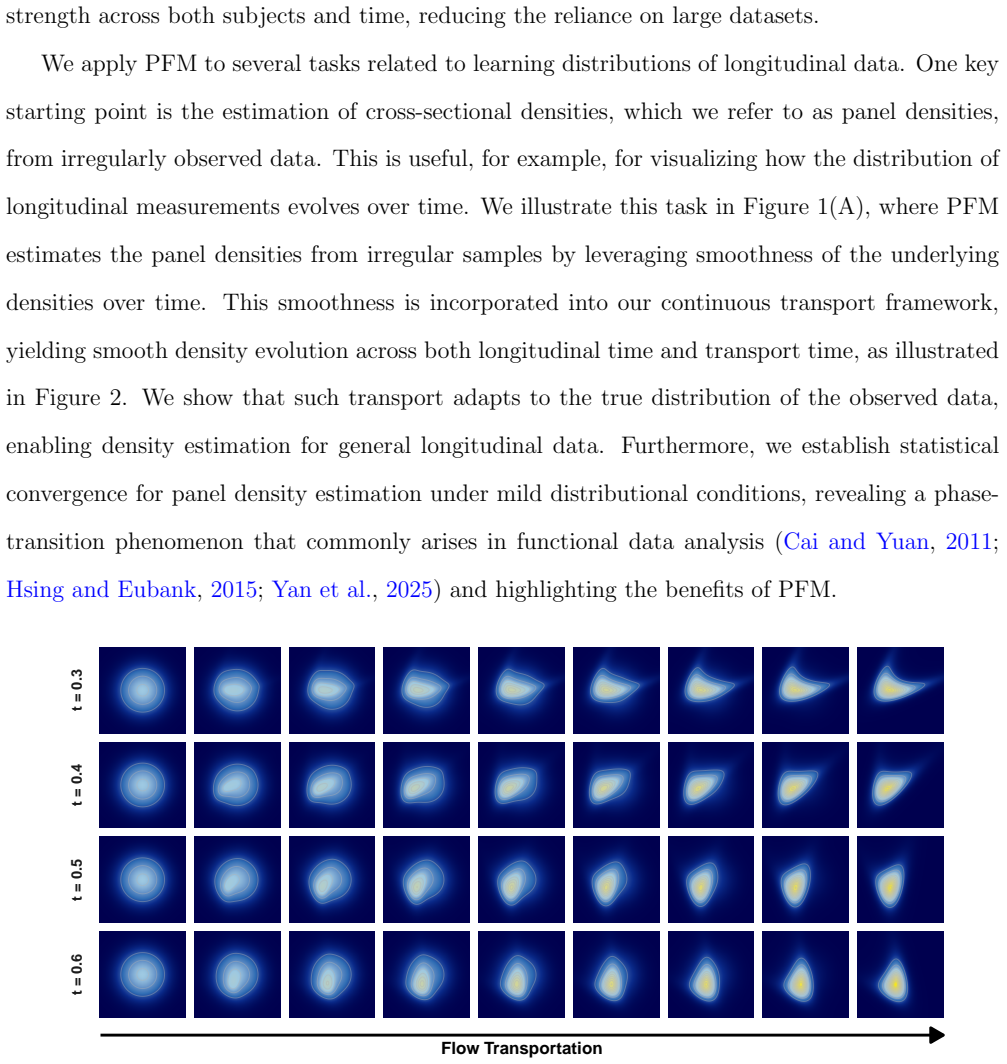
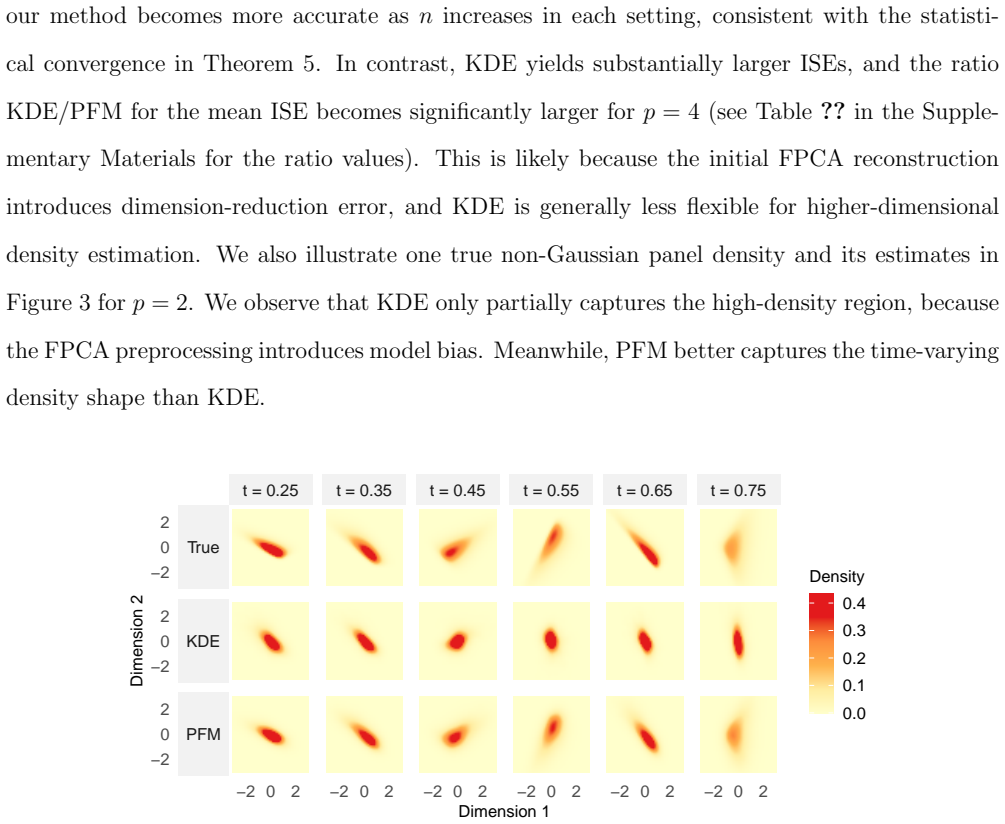
Panel flow matching estimates cross-sectional densities of longitudinal data by pooling across irregular time points with a continuous flow model.
A machine-rendered reading of the paper's core claim, the machinery that carries it, and where it could break.
Core claim
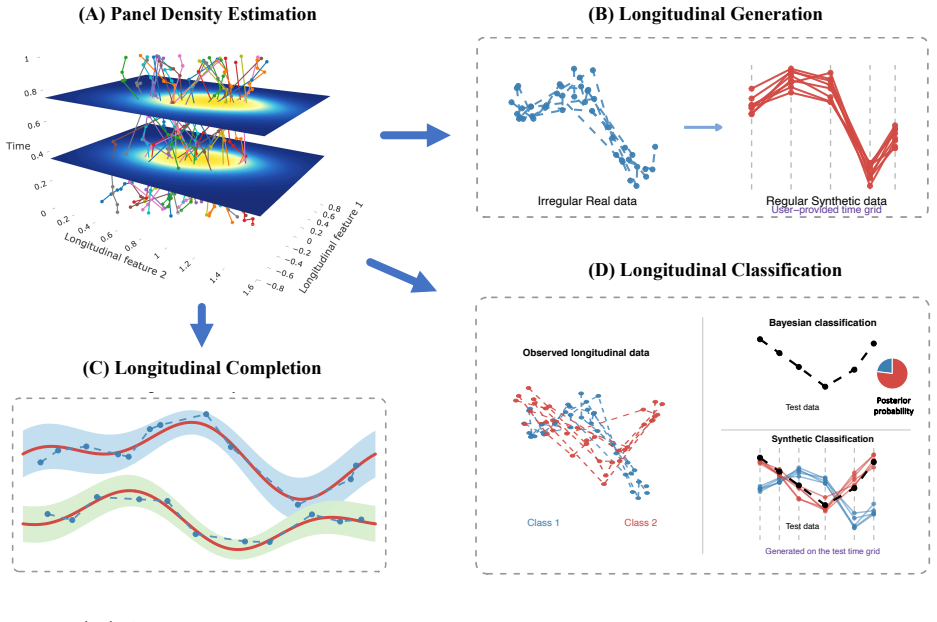
Panel flow matching (PFM) is a generative framework for learning longitudinal distributions by pooling information across time via a continuous panel flow model. PFM combines a forward flow-matching step with a backward kernel-fitting step, yielding a flexible and data-adaptive approach for capturing complex distributional structures. Applied to panel densities, it establishes statistical guarantees under irregular and sparse sampling designs and supports longitudinal completion, synthetic data generation, and classification.
What carries the argument
The continuous panel flow model that pools information across time points through the combination of forward flow-matching and backward kernel-fitting.
If this is right
- The method directly supports longitudinal data completion without a separate dimension-reduction stage.
- It enables synthetic data generation that respects the learned time-varying distributions.
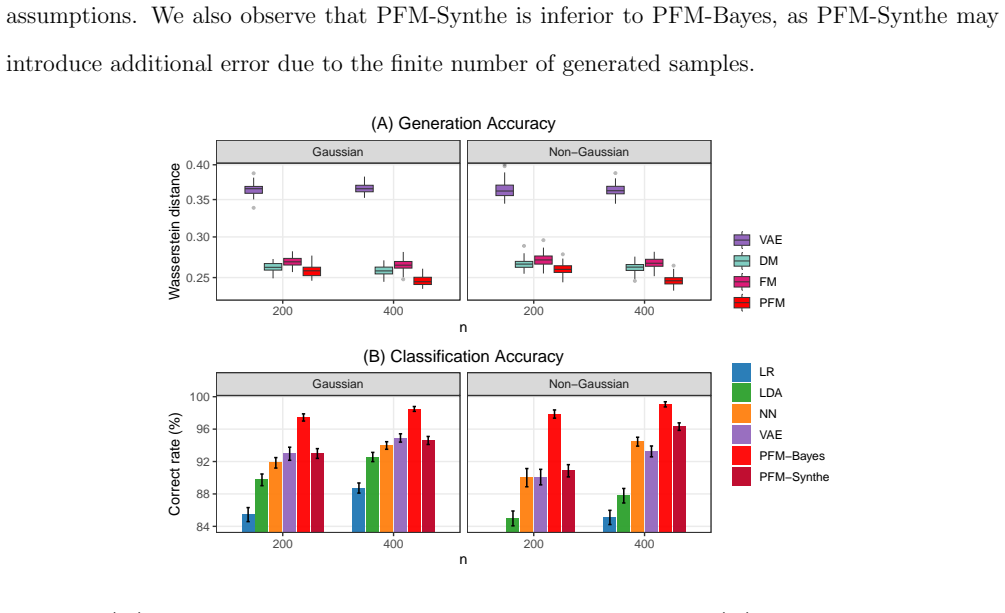
- It improves classification accuracy by capturing time-varying distributional differences between groups.
- Statistical guarantees hold for density estimation even when observations are sparse and irregularly timed.
- The same framework applies to visualization and other downstream tasks on panel data.
Where Pith is reading between the lines
- The flow-plus-kernel structure could be tested on other irregularly observed time series, such as patient monitoring records with missing visits.
- If the guarantees extend to higher dimensions, the approach might reduce reliance on dimension reduction in functional data analysis.
- A direct comparison on datasets with known ground-truth panel densities would quantify the gain from the continuous flow assumption.
- The method's flexibility suggests it could handle mixed data types, such as combining continuous and categorical longitudinal variables.
Load-bearing premise
A continuous panel flow model can effectively pool information across time points to capture distributions under irregular and sparse sampling from limited subjects.
What would settle it
A simulation or real dataset where panel flow matching fails to outperform standard density estimators on cross-sectional estimation error under controlled irregular sampling would falsify the claim of reliable pooling.
Figures
read the original abstract
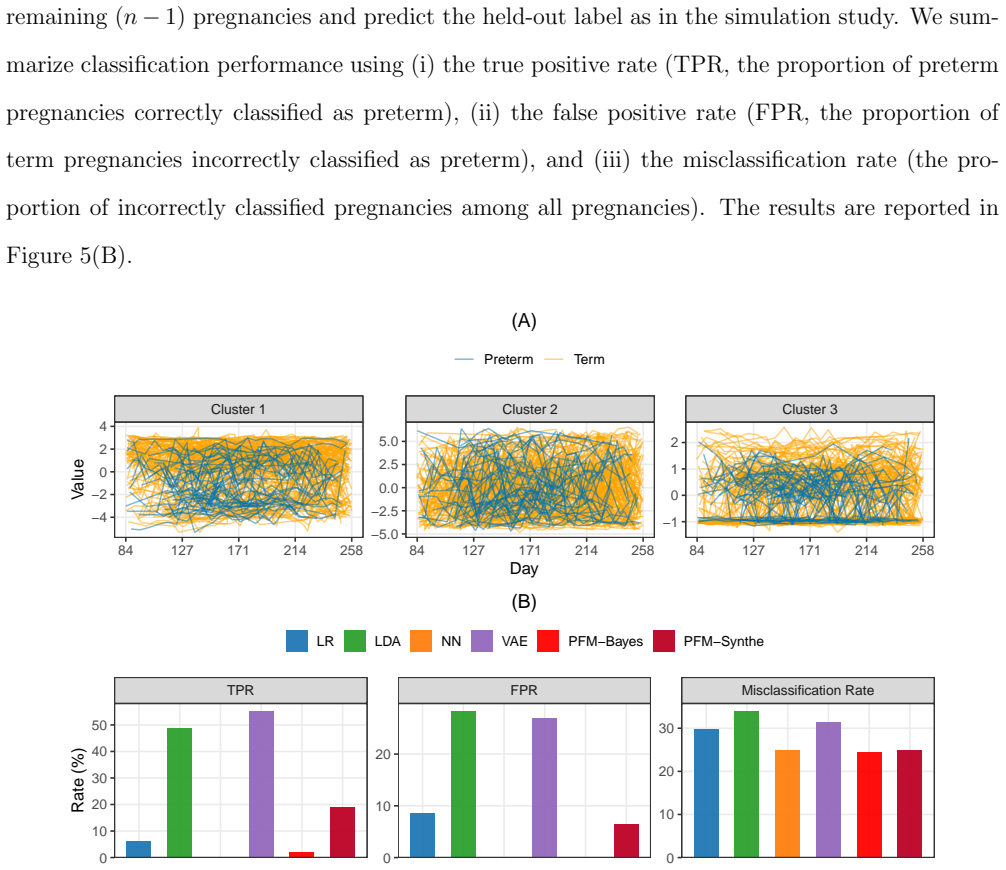
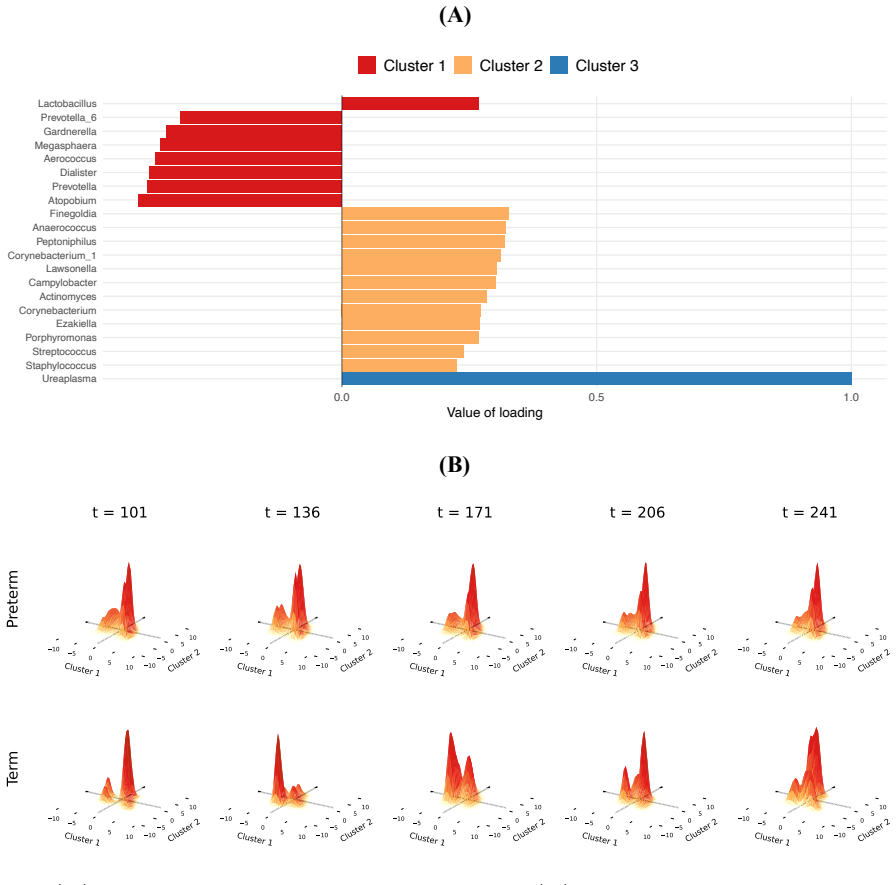
Learning distributions of longitudinal data is central to tasks such as visualization, completion, classification, and synthetic data generation, but it remains statistically challenging because longitudinal observations are often irregular, sparse, and collected from only a limited number of subjects. To address this, we develop a novel generative framework, termed panel flow matching (PFM), for learning longitudinal distributions by pooling information across time via a continuous panel flow model. PFM combines a forward flow-matching step with a backward kernel-fitting step, yielding a flexible and data-adaptive approach for capturing complex distributional structures. We apply PFM to estimate panel densities, namely the cross-sectional densities of longitudinal data, and establish statistical guarantees under irregular and sparse sampling designs. Under this, PFM naturally supports tasks including longitudinal completion, synthetic data generation, and classification, without requiring a preliminary dimension-reduction step to handle data irregularity. Extensive simulations demonstrate that PFM outperforms existing methods across these tasks. We further apply PFM to a vaginal microbiome longitudinal dataset from 188 pregnancies labeled as term or preterm, where it improves classification accuracy and reveals time-varying distributional differences between the two groups.
Editorial analysis
A structured set of objections, weighed in public.
Referee Report
Summary. The manuscript proposes Panel Flow Matching (PFM), a generative framework for learning distributions of longitudinal data under irregular and sparse sampling from limited subjects. PFM integrates a forward flow-matching step with a backward kernel-fitting step to pool information across time points via a continuous panel flow model. The method is applied to panel density estimation, with claimed statistical guarantees; it supports downstream tasks including longitudinal completion, synthetic data generation, and classification without preliminary dimension reduction. Simulations show outperformance relative to existing methods, and the approach is demonstrated on a vaginal microbiome dataset from 188 pregnancies, improving classification accuracy and revealing time-varying group differences.
Significance. If the statistical guarantees hold, PFM offers a flexible and data-adaptive alternative for modeling complex longitudinal structures, addressing a key challenge in the field without requiring dimension reduction. The combination of flow matching and kernel fitting enables information pooling across irregular time points, which is a modeling strength. Credit is due for the extensive simulation studies across multiple tasks and the real-data application to microbiome classification, which provide concrete empirical evidence of practical utility.
minor comments (3)
- [Methods] The description of the continuous panel flow model in the methods section would benefit from an explicit statement of how the forward and backward steps interact under sparsity to achieve the claimed pooling.
- [Simulations] In the simulation results, the performance metrics for baseline methods should include implementation details or references to ensure reproducibility of the outperformance claims.
- [Notation] Notation for the kernel-fitting step could be standardized to avoid ambiguity between the panel density estimator and the generative sampling procedure.
Simulated Author's Rebuttal
We thank the referee for the positive assessment of our work and the recommendation of minor revision. No specific major comments appear in the report, so we have no points to address point-by-point at this stage. We will incorporate any minor editorial or presentational suggestions in the revised manuscript.
Circularity Check
No significant circularity
full rationale
The provided abstract and context describe PFM as a novel generative framework that combines a forward flow-matching step with a backward kernel-fitting step to pool information across time points for panel density estimation. These are presented as distinct, independent methodological components, with statistical guarantees claimed under irregular sampling. No equations, self-citations, or derivations are shown that reduce a claimed prediction or result to a fitted input by construction, nor any self-definitional loops or ansatz smuggled via prior work. The approach is data-adaptive without evidence of renaming known results or load-bearing self-citation chains. This matches the reader's assessment of no circular reasoning, indicating a self-contained derivation against external benchmarks.
Axiom & Free-Parameter Ledger
Reference graph
Works this paper leans on
-
[1]
arXiv preprint arXiv:2601.16120 , year=
Synthetic Augmentation in Imbalanced Learning: When It Helps, When It Hurts, and How Much to Add , author=. arXiv preprint arXiv:2601.16120 , year=
-
[2]
Scandinavian Journal of Statistics , volume=
Functional modelling and classification of longitudinal data , author=. Scandinavian Journal of Statistics , volume=. 2005 , publisher=
2005
-
[3]
International Conference on Artificial Intelligence and Statistics , pages=
Longitudinal variational autoencoder , author=. International Conference on Artificial Intelligence and Statistics , pages=. 2021 , organization=
2021
-
[4]
arXiv preprint arXiv:2103.00569 , year=
Optimal classification for functional data , author=. arXiv preprint arXiv:2103.00569 , year=
-
[5]
Journal of the American Statistical Association , volume=
Optimal linear discriminant analysis for high-dimensional functional data , author=. Journal of the American Statistical Association , volume=. 2024 , publisher=
2024
-
[6]
Computational Statistics , volume=
PLS classification of functional data , author=. Computational Statistics , volume=. 2007 , publisher=
2007
-
[7]
Advances in Neural Information Processing Systems , volume=
Trajectory flow matching with applications to clinical time series modelling , author=. Advances in Neural Information Processing Systems , volume=
-
[8]
Annual Review of Statistics and its Application , volume=
Functional data analysis , author=. Annual Review of Statistics and its Application , volume=. 2016 , publisher=
2016
-
[9]
Stanford Digital Repository , year=
Vaginal microbiome before and after childbirth , author=. Stanford Digital Repository , year=
-
[10]
2015 , publisher=
Theoretical foundations of functional data analysis, with an introduction to linear operators , author=. 2015 , publisher=
2015
-
[11]
Advances in neural information processing systems , volume=
Denoising diffusion probabilistic models , author=. Advances in neural information processing systems , volume=
-
[12]
Biometrika , volume=
Optimal Bayes classifiers for functional data and density ratios , author=. Biometrika , volume=. 2017 , publisher=
2017
-
[13]
Statistica Sinica , volume=
Copula-based functional Bayes classification with principal components and partial least squares , author=. Statistica Sinica , volume=. 2023 , publisher=
2023
-
[14]
Journal of computational and graphical statistics , volume=
Penalized functional regression , author=. Journal of computational and graphical statistics , volume=. 2011 , publisher=
2011
-
[15]
Biometrics , volume=
A Bayesian hierarchical model for classification with selection of functional predictors , author=. Biometrics , volume=. 2010 , publisher=
2010
-
[16]
Journal of the Royal Statistical Society Series B: Statistical Methodology , volume=
Achieving near perfect classification for functional data , author=. Journal of the Royal Statistical Society Series B: Statistical Methodology , volume=. 2012 , publisher=
2012
-
[17]
Technometrics , volume=
The Mahalanobis distance for functional data with applications to classification , author=. Technometrics , volume=. 2015 , publisher=
2015
-
[18]
Journal of Data Science , volume=
A Copula-Based Supervised Learning Classification for Continuous and Discrete Data , author=. Journal of Data Science , volume=. 2022 , publisher=
2022
-
[19]
Smooth Flow Matching for Synthesizing Functional Data
Smooth Flow Matching for Synthesizing Functional Data , author=. arXiv preprint arXiv:2508.13831 , year=
work page internal anchor Pith review Pith/arXiv arXiv
-
[20]
The Journal of Machine Learning Research , volume=
CODA: High dimensional copula discriminant analysis , author=. The Journal of Machine Learning Research , volume=. 2013 , publisher=
2013
-
[21]
Journal of the American statistical association , volume=
Functional data analysis for sparse longitudinal data , author=. Journal of the American statistical association , volume=. 2005 , publisher=
2005
-
[22]
Hadjipantelis and Kyunghee Han and Hao Ji and Changbo Zhu and Hans-Georg Müller and Jane-Ling Wang , year =
Yidong Zhou and Han Chen and Su I Iao and Poorbita Kundu and Hang Zhou and Satarupa Bhattacharjee and Cody Carroll and Yaqing Chen and Xiongtao Dai and Jianing Fan and Alvaro Gajardo and Pantelis Z. Hadjipantelis and Kyunghee Han and Hao Ji and Changbo Zhu and Hans-Georg Müller and Jane-Ling Wang , year =
-
[23]
Journal of Applied Statistics , volume=
Bootstrap aggregated classification for sparse functional data , author=. Journal of Applied Statistics , volume=. 2022 , publisher=
2022
-
[24]
Journal of the Royal Statistical Society Series B: Statistical Methodology , volume=
Functional linear discriminant analysis for irregularly sampled curves , author=. Journal of the Royal Statistical Society Series B: Statistical Methodology , volume=. 2001 , publisher=
2001
-
[25]
Scandinavian Journal of Statistics , volume=
Deep neural network classifier for multidimensional functional data , author=. Scandinavian Journal of Statistics , volume=. 2023 , publisher=
2023
-
[26]
Journal of computational and Graphical Statistics , volume=
Functional robust support vector machines for sparse and irregular longitudinal data , author=. Journal of computational and Graphical Statistics , volume=. 2013 , publisher=
2013
-
[27]
Biostatistics & Epidemiology , volume=
A tutorial on kernel density estimation and recent advances , author=. Biostatistics & Epidemiology , volume=. 2017 , publisher=
2017
-
[28]
PloS One , volume=
The shortlist method for fast computation of the earth mover's distance and finding optimal solutions to transportation problems , author=. PloS One , volume=. 2014 , publisher=
2014
-
[29]
2013 , publisher=
Smoothing spline ANOVA models , author=. 2013 , publisher=
2013
-
[30]
Journal of the American Statistical Association , volume=
Deep regression for repeated measurements , author=. Journal of the American Statistical Association , volume=. 2025 , publisher=
2025
-
[31]
The Annals of Statistics , volume=
Deep nonparametric regression on approximate manifolds: Nonasymptotic error bounds with polynomial prefactors , author=. The Annals of Statistics , volume=. 2023 , publisher=
2023
-
[32]
1985 , publisher=
Nonlinear functional analysis and its applications: I: Fixed-Point Theorems , author=. 1985 , publisher=
1985
-
[33]
Journal of Mathematical Analysis and Applications , volume=
A three layer neural network can represent any multivariate function , author=. Journal of Mathematical Analysis and Applications , volume=. 2023 , publisher=
2023
-
[34]
International Conference on Machine Learning , pages=
Uniform convergence rates for kernel density estimation , author=. International Conference on Machine Learning , pages=. 2017 , organization=
2017
-
[35]
Journal of the American Statistical Association , number=
Subtype-Aware Registration of Longitudinal Electronic Health Records , author=. Journal of the American Statistical Association , number=. 2026 , publisher=
2026
-
[36]
2011 , journal=
Optimal estimation of the mean function based on discretely sampled functional data: Phase transition , author=. 2011 , journal=
2011
-
[37]
Journal of the American Statistical Association , volume=
Functional principal component analysis of spatiotemporal point processes with applications in disease surveillance , author=. Journal of the American Statistical Association , volume=. 2014 , publisher=
2014
-
[38]
Advances in Neural Information Processing Systems , volume=
Discrete flow matching , author=. Advances in Neural Information Processing Systems , volume=
-
[39]
arXiv preprint arXiv:2302.03660 , year=
Flow matching on general geometries , author=. arXiv preprint arXiv:2302.03660 , year=
-
[40]
Journal of Biomedical Informatics , pages=
Integrated analysis for electronic health records with structured and sporadic missingness , author=. Journal of Biomedical Informatics , pages=. 2025 , publisher=
2025
-
[41]
arXiv preprint arXiv:2310.17848 , year=
Boosting data analytics with synthetic volume expansion , author=. arXiv preprint arXiv:2310.17848 , year=
-
[42]
arXiv preprint arXiv:2510.03569 , year=
Longitudinal Flow Matching for Trajectory Modeling , author=. arXiv preprint arXiv:2510.03569 , year=
-
[43]
ACM computing surveys , volume=
Diffusion models: A comprehensive survey of methods and applications , author=. ACM computing surveys , volume=. 2023 , publisher=
2023
-
[44]
arXiv preprint arXiv:1606.05908 , year=
Tutorial on variational autoencoders , author=. arXiv preprint arXiv:1606.05908 , year=
-
[45]
Bernoulli , pages=
Dynamic density estimation with diffusive Dirichlet mixtures , author=. Bernoulli , pages=. 2016 , publisher=
2016
-
[46]
Journal of Machine Learning Research , volume=
Normalizing flows for probabilistic modeling and inference , author=. Journal of Machine Learning Research , volume=
-
[47]
Biometrika , volume=
Individualized dynamic latent factor model for multi-resolutional data with application to mobile health , author=. Biometrika , volume=. 2024 , publisher=
2024
-
[48]
The Annals of Applied Statistics , volume=
Regionalization of China’s PM 2.5: A robust functional spatial clustering with angular depth , author=. The Annals of Applied Statistics , volume=. 2026 , publisher=
2026
-
[49]
PhysioNet , year=
``MIMIC-IV" (version 3.0) , author=. PhysioNet , year=
-
[50]
Journal of the American Statistical Association , number=
Functional-SVD for Heterogeneous Trajectories: Case Studies in Health , author=. Journal of the American Statistical Association , number=. 2026 , publisher=
2026
-
[51]
Nature medicine , volume=
A longitudinal big data approach for precision health , author=. Nature medicine , volume=. 2019 , publisher=
2019
-
[52]
Functional clustering for longitudinal associations between social determinants of health and stroke mortality in the
Luo, Fangzhi and Tan, Jianbin and Zhang, Donglan and Huang, Hui and Shen, Ye , journal=. Functional clustering for longitudinal associations between social determinants of health and stroke mortality in the. 2025 , publisher=
2025
-
[53]
arXiv preprint arXiv:2601.13405 , year=
Associating High-Dimensional Longitudinal Datasets through an Efficient Cross-Covariance Decomposition , author=. arXiv preprint arXiv:2601.13405 , year=
-
[54]
2005 , publisher=
Introduction to nonparametric regression , author=. 2005 , publisher=
2005
-
[55]
arXiv preprint arXiv:2404.00551 , year=
Convergence of continuous normalizing flows for learning probability distributions , author=. arXiv preprint arXiv:2404.00551 , year=
-
[56]
Journal of the Royal Statistical Society Series B: Statistical Methodology , volume=
Components and completion of partially observed functional data , author=. Journal of the Royal Statistical Society Series B: Statistical Methodology , volume=. 2015 , publisher=
2015
-
[57]
Journal of the Royal Statistical Society Series B: Statistical Methodology , volume=
Modelling sparse generalized longitudinal observations with latent Gaussian processes , author=. Journal of the Royal Statistical Society Series B: Statistical Methodology , volume=. 2008 , publisher=
2008
-
[58]
Statistics and computing , volume=
Fast covariance estimation for sparse functional data , author=. Statistics and computing , volume=. 2018 , publisher=
2018
-
[59]
Adam: A Method for Stochastic Optimization
Adam: A method for stochastic optimization , author=. arXiv preprint arXiv:1412.6980 , year=
work page internal anchor Pith review Pith/arXiv arXiv
-
[60]
Transactions on Machine Learning Research , pages=
Improving and generalizing flow-based generative models with minibatch optimal transport , author=. Transactions on Machine Learning Research , pages=
-
[61]
Journal of the American Statistical Association , volume=
On the use of reproducing kernel Hilbert spaces in functional classification , author=. Journal of the American Statistical Association , volume=. 2018 , publisher=
2018
-
[62]
Test , volume=
Probability-enhanced effective dimension reduction for classifying sparse functional data , author=. Test , volume=. 2016 , publisher=
2016
-
[63]
International Conference on Artificial Intelligence and Statistics , pages=
Functional Flow Matching , author=. International Conference on Artificial Intelligence and Statistics , pages=. 2024 , organization=
2024
-
[64]
Flow Straight and Fast: Learning to Generate and Transfer Data with Rectified Flow
Flow straight and fast: Learning to generate and transfer data with rectified flow , author=. arXiv preprint arXiv:2209.03003 , year=
work page internal anchor Pith review Pith/arXiv arXiv
-
[65]
The Eleventh International Conference on Learning Representations , year=
Flow Matching for Generative Modeling , author=. The Eleventh International Conference on Learning Representations , year=
-
[66]
Advances in neural information processing systems , volume=
Neural ordinary differential equations , author=. Advances in neural information processing systems , volume=
-
[67]
2009 , publisher=
The elements of statistical learning: data mining, inference, and prediction , author=. 2009 , publisher=
2009
-
[68]
2010 , publisher=
Copula theory and its applications , author=. 2010 , publisher=
2010
-
[69]
Wiley Interdisciplinary Reviews: Computational Statistics , volume=
Review on functional data classification , author=. Wiley Interdisciplinary Reviews: Computational Statistics , volume=. 2024 , publisher=
2024
discussion (0)
Sign in with ORCID, Apple, or X to comment. Anyone can read and Pith papers without signing in.