REVIEW 3 major objections 4 minor 48 references
Community Detection in Energy Networks based on Energy Self-Sufficiency and Dynamic Flexibility Activation
T0 review · 3 major / 4 minor · reviewed 2026-08-15 · deepseek-v4-flash
Pith's one-line read An energy-aware modularity score partitions power grids into self-sufficient communities by measuring how much local demand is covered locally, and a Louvain-style algorithm maximizes it while accounting for storage and shiftable loads.
desk verdict A genuinely new energy modularity objective is hurt by a load-bearing bug in the scalable simulation variant, which does not compute the stated d(C). read the letter →
The pith
A machine-rendered reading of the paper's core claim, the machinery that carries it, and where it could break.
The reading
What carries the argument
The load-bearing object is energy modularity, a redefinition of Newman-Girvan modularity in which edge density is replaced by energy self-sufficiency. For a community $C$, $e(C)$ is the maximum share of total network demand that can be supplied from inside $C$ after optimally activating flexibility, and $a(C)$ is $C$'s share of total demand; the score of a partition is $\sum_C(e(C)-\gamma a(C)^2)$ with resolution parameter $\gamma$. Carrying the argument is the Louvain-style greedy search: starting from singleton communities, nodes are repeatedly moved to the neighboring community that most increases energy modularity, with moves that would disconnect a community forbidden, and communities are then aggregated into super-nodes. Because every move requires the self-sufficiency $d(C)$ of the affected communities, the authors couple this search with two flexibility-optimization methods, a linear program that respects efficiencies and flow limits, and a simulation-based method that aggregates all flexibility into one lossless virtual storage and updates its state of charge over time. The simulation is what delivers the claimed scalability, with per-community cost $O(|C||T|)$.
What would settle it
Take the same benchmark grid, compute $d(C)$ for many communities with both the simulation method and the constrained linear program, and measure the relative error as a function of community size, line congestion, and horizon length; if the approximation changes the ranking of candidate partitions so that the simulation-optimal partition no longer reaches the claimed self-sufficiency when rechecked with the LP, the central scalability claim is refuted.
Extended reading notes
Core claim
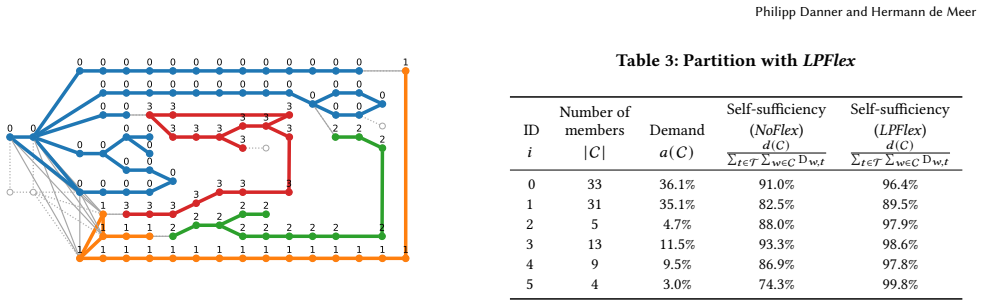
The central claim is that energy modularity $Q(P)=\sum_{C\in P}(e(C)-\gamma a(C)^2)$ is an effective objective for partitioning energy networks by self-sufficiency, where $e(C)$ is the fraction of total network demand supplied from inside community $C$ and $a(C)$ is community $C$'s share of total demand. Unlike standard modularity, which rewards dense internal edges and can therefore prefer artificial loops over useful direct supply, energy modularity rewards the covering of local demand by local supply and flexible assets. The proposed Louvain-based algorithm optimizes this objective by evaluating single-node moves through the gain in energy modularity, where each community's internally covered demand $d(C)$ is computed either by linear programming or by a fast simulation that aggregates the community's flexibility into one virtual battery. On a 99-bus medium-voltage benchmark grid, the paper reports that the resulting partitions reach per-community self-sufficiency between roughly 84 percent and 99.8 percent when flexibility is active, and that the simulation variant completes a full year at quarter-hour resolution in about 41 seconds, compared with roughly 2.5 hours for the LP variant. The paper concludes that energy modularity is a meaningful, operationally relevant metric and that the algorithm effectively leverages available flexibility to split networks into self-sufficient communities.
Load-bearing premise
The load-bearing premise is that aggregating a community's entire flexibility into one lossless virtual battery, with no line-flow limits and no efficiency losses, gives a faithful enough value of internal demand coverage to guide the search; if that approximation misrepresents $d(C)$, the near-real-time scalability on full-year data does not carry over to real grids.
Editorial extensions
If this is right
- Network operators can use energy modularity as a single objective to compare candidate microgrid partitions without pre-specifying the number of communities, using the gamma parameter to tune cluster granularity.
- Because the simulation-based method scales linearly in community size and time horizon, full-year, quarter-hourly community detection on medium-voltage grids becomes feasible on a single machine.
- Flexibility-aware partitions tend to contain more, smaller communities than flexibility-blind partitions, since storage allows undersupplied periods to be covered locally and therefore gives operators more local control islands.
- Communities with low no-flex self-sufficiency benefit most from the metric: on the test grid, one community rises from 74.3 percent self-sufficiency without flexibility to 99.8 percent with flexibility.
- The energy modularity of a partition lies in $[-1,1)$, with the all-in-one partition scoring zero at $\gamma=1$, so the score has a natural interpretation as a percentage-like quality measure.
Reading between the lines
- Because energy modularity is a well-defined global objective, it could be plugged into other modularity-maximizing schemes, such as spectral or mixed-integer methods, which may yield globally better partitions than the greedy Louvain search.
- The reported self-sufficiency figures are upper bounds under real losses, so a natural follow-up is to re-run the same partitions through AC power flow and quantify the gap between simulated and physically achievable self-sufficiency.
- The metric could extend to multi-energy cells covering gas, heat, and mobility by redefining internal supply and demand per energy carrier, since it only needs time series and flexibility constraints rather than a particular network physics model.
- A testable extension is to compare resilience during blackouts: partitions optimized for energy modularity may outperform topology-based islanding in served load, but that connection is not established in the paper.
Signed reviews
Editorial analysis
A structured set of objections, weighed in public.
Referee Report
Summary. The paper proposes a new quality metric, "energy modularity," for partitioning energy networks into self-sufficient communities. The metric evaluates a partition by the fraction of each community's demand that can be supplied internally over a time horizon, with flexibility resources (storage) modeled through state-of-charge and cyclic constraints. The authors integrate this metric into a Louvain-based greedy algorithm, computing community self-sufficiency via three routes: a no-flexibility baseline (NoFlex), a linear programming solver (LPFlex), and a simulation-based approximation (SimulateFlex). They validate the approach on a 99-bus SimBench rural medium-voltage grid, reporting community partitions, runtime scaling with time horizon, and the effect of a resolution parameter γ. The central claims are that energy modularity is an effective measure of self-sufficiency-based community quality and that the Louvain algorithm with SimulateFlex enables near-real-time, temporally high-resolution community detection on realistic grids.
Significance. If the results hold, the paper would contribute a principled, scalable tool for microgrid and energy-community formation that explicitly accounts for temporal supply/demand profiles and storage dynamics. This is a genuine gap in the existing community-detection literature for power grids, which largely relies on static topology or single-snapshot power flows. The strengths are the coherent LP formulation of community self-sufficiency with storage cycling constraints, the use of a public benchmark grid, and the explicit runtime comparison of the three d(C) computation methods. The novel metric itself, inspired by standard modularity but based on energy balancing rather than edge weights, is an original and reasonable conceptual step. However, the scalable simulation route contains a structural error that changes the optimized objective, and the empirical evaluation is limited to one grid without comparison to established partitioning methods.
major comments (3)
- [Section 3.3.4, Algorithm 2, line 9] The simulation-based method SimulateFlex does not compute d(C) as defined by Eq. (11). Under the algorithm's own assumptions (no losses, no flow limits), Section 3.3.4 states that the problem reduces to aggregating all community nodes into a single node. The correct per-time-step internal supply is then min(Σ_{w∈C} S_{w,t}, Σ_{w∈C} D_{w,t}), which permits cross-node balancing. Line 9 instead accumulates Σ_{w∈C} min(S_{w,t}, D_{w,t}), which only counts demand covered by the same node's supply. A two-node community with S_A=10, D_A=0, S_B=0, D_B=10 has LP value d(C)=10 but SimulateFlex returns 0. Since e(C) in Eq. (15) uses d(C), the SimulateFlex variant maximizes a different objective than Eq. (11). This undermines the relative-error comparison in Section 4.2.1, the full-year 41.4-second runtime claim in Section 4.2.2, the SimulateFlex partition in Section 4.4, and the "reasonable accuracy" statement in Section 4.5 for the scalable variant.
- [Section 3.2.2] The property that for γ=1 the trivial one-community partition has energy modularity zero is stated as "e(V)=a(V)=1", but e(V)=1 is not guaranteed by the model. e(V)=d(V)/Σ_{t,v}D_{v,t} equals 1 only when the entire network can satisfy all its demand from internal supply and flexibility; a net-importing network with external slack supply would have e(V)<1. This condition is not stated as an assumption, and the claimed value range [−1,1[ for energy modularity depends on it. The statement should be made conditional, or the model should fix the slack supply as part of V with a clear convention for d(V).
- [Section 4, Section 4.4] The empirical evaluation of the central effectiveness claim is based on a single benchmark grid with no comparison to existing community-detection approaches for power grids (e.g., standard modularity with power-flow-based weights, or spectral clustering on electrical distance). The only baselines are the three internal d(C) computation variants. Additionally, γ=0.25 is chosen in Section 4.4 after inspecting Figure 5, which is a post-hoc selection. Without a second grid or a comparison to alternative partitioning objectives, the claim that energy modularity is an "effective metric" for self-sufficient community detection is not yet fully supported.
minor comments (4)
- [Section 3.3.4, Algorithm 2] Algorithm 2 reuses the symbol Δ for two different quantities: line 6 defines Δ as the flexibility usage limit (Σ f_w), while line 10 assigns Δ to the net imbalance Σ(S−D), and line 11 then clamps that net imbalance using both meanings of Δ. This overloading makes the pseudocode ambiguous and should be fixed with distinct variable names.
- [Section 3.3.4, Algorithm 2, lines 19–21] The handling of cyclic state-of-charge in SimulateFlex (lines 19–20) is not derived or explained: the meaning of d_f, the role of σ_old, and the "compensate over-dispatch" step are unclear. A short derivation showing how these updates enforce the cyclic constraint (5) would improve reproducibility.
- [Section 4.1] The sentence reporting self-sufficiency percentages (82.1% with LPFlex, 84.3% with NoFlex, 88.3% with LPFlex, 90.9% with SimulateFlex) should clarify that these are d(V)/ΣD values for the whole network and state which method produced each number; the current ordering is easy to misread.
- [Figure 5 captions] The captions "NoFlex: Energy balance, ignoring flexibility" and "SimulateFlex: Energy balance, ignoring flexibility efficiencies" are confusing because both methods are energy balances; the intended distinction is that NoFlex omits flexibility while SimulateFlex includes it, and the captions should say so explicitly.
Circularity Check
No significant circularity: energy modularity is a defined objective, the Louvain algorithm optimizes it, and the evaluation uses external benchmark data; the identified Algorithm 2 issue is a correctness concern, not a circularity.
full rationale
After walking the derivation chain, I find no circular step that reduces a claimed prediction to its inputs. Energy modularity (Eq. 14-15) is defined from d(C) (Eq. 11), which is a linear program over nodal balances and flexibility constraints; the Louvain algorithm (Algorithm 1) optimizes this objective. This is an optimization of a stated objective, not a derivation of the objective from its own conclusions. The numerical evaluation compares NoFlex, SimulateFlex, and LPFlex on an external SimBench grid, and the Section 4.4.2 comparison of LPFlex and SimulateFlex partitions provides independent grounding for the claim that the simulation-based variant is reasonably accurate. Self-citations, such as [11] and [12], are used for background on flexibility disaggregation and blackout islanding; neither is load-bearing for the definition of energy modularity or for the claimed effectiveness. The skeptic's observation that Algorithm 2 line 9 sums per-node min(S,D) instead of min(sum S, sum D) after aggregation is a potential correctness flaw in the approximation, but it is not circularity: the algorithm is not defined in terms of the target result, nor is any fitted parameter renamed as a prediction. Accordingly the circularity score is 0.
Assumptions & free parameters
free parameters (1)
- gamma (resolution parameter) =
0.25
assumptions (5)
- domain assumption The transport/network flow model with linear loss approximation, allowing cyclic flows, adequately represents energy exchange for community detection.
- domain assumption All network demand must be supplied (nodal balance) and each community can be operated as an island.
- domain assumption Flexibility resources in a community can be aggregated into a single virtual storage without loss of accuracy.
- domain assumption The greedy Louvain heuristic returns a good approximation of the optimal partition for energy modularity.
- ad hoc to paper For gamma=1, the trivial partition has e(V)=a(V)=1, i.e., the whole network can meet all its demand internally.
Cite this review
Pith. "Pith review of Community Detection in Energy Networks based on Energy Self-Sufficiency and Dynamic Flexibility Activation." pith.science (2026). https://pith.science/paper/MGJOXZ2J
@misc{pith2026250619412,
  author       = {Pith},
  title        = {Pith review of: Community Detection in Energy Networks based on Energy Self-Sufficiency and Dynamic Flexibility Activation},
  year         = {2026},
  howpublished = {\url{https://pith.science/paper/MGJOXZ2J}},
  note         = {Machine review of arXiv:2506.19412}
}
read the original abstract
The global energy transition towards distributed, smaller-scale resources, such as decentralized generation and flexible assets like storage and shiftable loads, demands novel control structures aligned with the emerging network architectures. These architectures consist of interconnected, self-contained clusters, commonly called microgrids or energy communities. These clusters aim to optimize collective self-sufficiency by prioritizing local energy use or operating independently during wide-area blackouts. This study addresses the challenge of defining optimal clusters, framed as a community detection problem. A novel metric, termed energy modularity, is proposed to evaluate community partitions by quantifying energy self-sufficiency within clusters while incorporating the influence of flexible resources. Furthermore, a highly scalable community detection algorithm to maximize energy modularity based on the Louvain method is presented. Therefore, energy modularity is calculated using linear programming or a more efficient simulation-based approach. The algorithm is validated on an exemplary benchmark grid, demonstrating its effectiveness in identifying optimal energy clusters for modern decentralized energy systems.
Figures


Figures from the paper (5 more)




Reference graph
Works this paper leans on
-
[1]
Norah Alotaibi and Delel Rhouma. 2022. A review on community structures detection in time evolving social networks. Journal of King Saud University - Computer and Information Sciences 34, 8 (Sept. 2022), 5646–5662. https://doi.org/ 10.1016/j.jksuci.2021.08.016
-
[2]
Seyed Ali Arefifar, Yasser Abdel-Rady I. Mohamed, and Tarek H. M. El-Fouly
-
[3]
Mostafa Barani, Jamshid Aghaei, Mohammad Amin Akbari, Taher Niknam, Hos- sein Farahmand, and Magnus Korpås. 2019. Optimal Partitioning of Smart Distribution Systems Into Supply-Sufficient Microgrids. IEEE Transactions on Smart Grid 10, 3 (2019), 2523–2533. https://doi.org/10.1109/TSG.2018.2803215
arXiv 2019
-
[4]
Vincent D Blondel, Jean-Loup Guillaume, Renaud Lambiotte, and Etienne Lefebvre. 2008. Fast unfolding of communities in large networks. Journal of Statistical Mechanics: Theory and Experiment 2008, 10 (Oct. 2008), P10008. https://doi.org/10.1088/1742-5468/2008/10/P10008
-
[5]
Seth Blumsack, Pau Hines, Mahendra Patel, Clayton Barrows, and Eduardo Cotilla Sanchez. 2009. Defining power network zones from measures of electrical distance. In 2009 IEEE Power and Energy Society General Meeting, PES ’09 . IEEE, Calgary, AB, Canada, 1–8. https://doi.org/10.1109/PES.2009.5275353
-
[6]
Ulrik Brandes, Daniel Delling, Marco Gaertler, Robert Görke, Martin Hoefer, Zoran Nikoloski, and Dorothea Wagner. 2008. On Modularity Clustering. IEEE Transactions on Knowledge and Data Engineering 20, 2 (Feb. 2008), 172–188. https://doi.org/10.1109/TKDE.2007.190689
arXiv 2008
-
[7]
Tom Brown, David Schlachtberger, Alexander Kies, Stefan Schramm, and Martin Greiner. 2018. Synergies of sector coupling and transmission reinforcement in a cost-optimised, highly renewable European energy system. Energy 160 (2018), 720–739. https://doi.org/10.1016/j.energy.2018.06.222
-
[8]
Pak .K. Chan, Martine D.F. Schlag, and Jason Y. Zien. 1994. Spectral K-way Ratio-Cut Partitioning and Clustering. IEEE Transactions on Computer-Aided Design of Integrated Circuits and Systems 13, 9 (Sept. 1994), 1088–1096. https: //doi.org/10.1109/43.310898
Show all 48 references
-
[9]
Zengqiang Chen, Zheng Xie, and Qing Zhang. 2015. Community detection based on local topological information and its application in power grid. Neurocomput- ing 170 (Dec. 2015), 384–392. https://doi.org/10.1016/j.neucom.2015.04.093
2015 doi
-
[10]
Hines, Clayton Barrows, Seth Blumsack, and Mahendra Patel
Eduardo Cotilla-Sanchez, Paul D.H. Hines, Clayton Barrows, Seth Blumsack, and Mahendra Patel. 2013. Multi-attribute partitioning of power networks based on electrical distance. IEEE Transactions on Power Systems 28, 4 (2013), 4979–4987. https://doi.org/10.1109/TPWRS.2013.2263886
2013
-
[11]
Dominik Danner, Jan Seidemann, Michael Lechl, and Hermann de Meer. 2021. Flexibility Disaggregation under Forecast Conditions. In Proceedings of the Twelfth ACM International Conference on Future Energy Systems (Virtual Event, Italy) (e-Energy ’21). Association for Computing M...
2021
-
[12]
Philipp Danner, Anna Volkova, and Hermann De Meer. 2024. Two-Step Blackout Mitigation by Flexibility-Enabled Microgrid Islanding. In Workshop on Cyber- security and Privacy of Energy Systems (EnergySP), Proceedings of the 15th ACM International Conference on Future and Sustain...
2024
-
[13]
Gonzalez-Longatt, Peter Wall, and Vladimir Terzija
Lei Ding, Francisco M. Gonzalez-Longatt, Peter Wall, and Vladimir Terzija. 2013. Two-Step Spectral Clustering Controlled Islanding Algorithm. IEEE Transactions on Power Systems 28, 1 (2013), 75–84. https://doi.org/10.1109/TPWRS.2012. 2197640
2013 doi
-
[14]
Maymouna Ez Eddin, Mohamed Massaoudi, Haitham Abu-Rub, Mohammad Shadmand, and Mohamed Abdallah. 2023. Novel Functional Community Detec- tion in Networked Smart Grid Systems-Based Improved Louvain Algorithm. In 2023 IEEE Texas Power and Energy Conference (TPEC) . IEEE, College ...
2023
-
[15]
Fletcher and Kai Strunz
Robert H. Fletcher and Kai Strunz. 2007. Optimal Distribution System Horizon Planning–Part I: Formulation. IEEE Transactions on Power Systems 22, 2 (May 2007), 791–799. https://doi.org/10.1109/TPWRS.2007.895173
2007
-
[16]
Santo Fortunato. 2010. Community detection in graphs. Physics Reports 486, 3 (Feb. 2010), 75–174. https://doi.org/10.1016/j.physrep.2009.11.002
2010 doi
-
[17]
Montoya, and Alfredo Alcayde
Manuel Guerrero, Raul Baños, Consolación Gil, Francisco G. Montoya, and Alfredo Alcayde. 2019. Evolutionary Algorithms for Community Detection in Continental-Scale High-Voltage Transmission Grids. Symmetry 11, 12 (Dec. 2019), 1472. https://doi.org/10.3390/sym11121472
2019 doi
-
[18]
Montoya, Raúl Baños, Alfredo Alcayde, and Consolacíon Gil
Manuel Guerrero, Francisco G. Montoya, Raúl Baños, Alfredo Alcayde, and Consolacíon Gil. 2018. Community detection in national-scale high voltage transmission networks using genetic algorithms. Advanced Engineering Infor- matics 38 (Oct. 2018), 232–241. https://doi.org/10.1016...
2018 doi
-
[19]
Xu Han, Qizi Huangpeng, Xiaojun Duan, Qiannan Gao, and Yimin Yin. 2022. Intentional controlled islanding based on dynamic community detection for power grid. IET Generation, Transmission & Distribution 16, 21 (Nov. 2022), 4258–4272. https://doi.org/10.1049/gtd2.12591
2022 doi
-
[20]
Frank Harary and Gopal Gupta. 1997. Dynamic Graph Models. Mathematical and Computer Modelling 25, 7 (April 1997), 79–87. https://doi.org/10.1016/S0895- 7177(97)00050-2
1997 doi
-
[21]
Saeed Hasanvand, Majid Nayeripour, Seyed Ali Arefifar, and Hossein Fallahzadeh- Abarghouei. 2018. Spectral Clustering for Designing Robust and Reliable multi- MG Smart Distribution Systems. IET Generation, Transmission & Distribution 12, 6 (March 2018), 1359–1365. https://doi....
2018
-
[22]
Andreas Kießling and Mariam Khattabi. 2011. Cellular System Model for Smart Grids Combining Active Distribution Networks and Smart Buildings. In Energy- Efficient Computing and Networking , Nikos Hatziargyriou, Aris Dimeas, Thomai Tomtsi, and Anke Weidlich (Eds.). Springer Ber...
2011 doi
-
[23]
Lasseter
Robert H. Lasseter. 2002. MicroGrids. In 2002 IEEE Power Engineering Society Winter Meeting. Conference Proceedings (Cat. No.02CH37309) , Vol. 1. 305–308 vol.1. https://doi.org/10.1109/PESW.2002.985003
2002
-
[24]
Michael Lechl, Tim Fürmann, Hermann de Meer, and Anke Weidlich. 2023. A review of models for energy system flexibility requirements and potentials using the new FLEXBLOX taxonomy. Renewable and Sustainable Energy Reviews 184 (2023), 113570. https://doi.org/10.1016/j.rser.2023.113570
2023
-
[25]
Rosenwald, Juhwan Jung, and Chen-ching Liu
Hao Li, Gary W. Rosenwald, Juhwan Jung, and Chen-ching Liu. 2005. Strategic Power Infrastructure Defense. Proc. IEEE 93, 5 (May 2005), 918–933. https: //doi.org/10.1109/JPROC.2005.847260
2005
-
[26]
Hoicka, and Felicia J
Jens Lowitzsch, Christina E. Hoicka, and Felicia J. van Tulder. 2020. Renewable En- ergy Communities under the 2019 European Clean Energy Package – Governance Model for the Energy Clusters of the Future? Renewable and Sustainable Energy Reviews 122 (April 2020), 109489. https:...
2020
-
[27]
Steffen Meinecke, Džanan Sarajlić, Simon Ruben Drauz, Annika Klettke, Lars- Peter Lauven, Christian Rehtanz, Albert Moser, and Martin Braun. 2020. SimBench—A Benchmark Dataset of Electric Power Systems to Compare In- novative Solutions based on Power Flow Analysis. Energies 13...
2020
-
[28]
Atsushi Miyauchi, Tomohiro Sonobe, and Noriyoshi Sukegawa. 2018. Exact Clustering via Integer Programming and Maximum Satisfiability. Proceedings of the AAAI Conference on Artificial Intelligence 32, 1 (April 2018), 1367–1394. https://doi.org/10.1609/aaai.v32i1.11519
2018 doi
-
[29]
Nassar and M
Mohammed E. Nassar and M. M. A. Salama. 2016. Adaptive Self-Adequate Microgrids Using Dynamic Boundaries. IEEE Transactions on Smart Grid 7, 1 (2016), 105–113. https://doi.org/10.1109/TSG.2015.2420115
2016
-
[30]
Fabian Neumann, Veit Hagenmeyer, and Tom Brown. 2022. Assessments of Linear Power Flow and Transmission Loss Approximations in Coordinated Capacity Expansion Problems. Applied Energy 314 (May 2022), 118859. https: //doi.org/10.1016/j.apenergy.2022.118859
2022
-
[31]
Mark E. J. Newman and Michelle Girvan. 2004. Finding and Evaluating Com- munity Structure in Networks. Physical Review E 69, 2 (Feb. 2004), 026113. https://doi.org/10.1103/PhysRevE.69.026113 arXiv:cond-mat/0308217
2004 arXiv
-
[32]
Naoto Ozaki, Hiroshi Tezuka, and Mary Inaba. 2016. A simple acceleration method for the Louvain algorithm. International Journal of Computer and Electri- cal Engineering 8, 3 (2016), 207. https://doi.org/10.17706/ijcee.2016.8.3.207-218
2016 doi
-
[33]
Trakas, Pierluigi Mancarella, and Nikos D
Mathaios Panteli, Dimitris N. Trakas, Pierluigi Mancarella, and Nikos D. Hatziar- gyriou. 2016. Boosting the Power Grid Resilience to Extreme Weather Events Using Defensive Islanding. IEEE Transactions on Smart Grid 7, 6 (2016), 2913–2922. https://doi.org/10.1109/TSG.2016.2535228
2016
-
[34]
Jörg Reichardt and Stefan Bornholdt. 2007. Partitioning and Modularity of Graphs with Arbitrary Degree Distribution. Physical Review E 76, 1 (July 2007), 015102. https://doi.org/10.1103/PhysRevE.76.015102 arXiv:cond-mat/0606295
2007 arXiv
-
[35]
Giulio Rossetti and Rémy Cazabet. 2019. Community Discovery in Dynamic Networks: A Survey. Comput. Surveys 51, 2 (March 2019), 1–37. https://doi.org/ 10.1145/3172867
2019 doi
-
[36]
Sánchez-García, Max Fennelly, Seán Norris, Nick Wright, Graham Niblo, Jacek Brodzki, and Janusz W
Rubén J. Sánchez-García, Max Fennelly, Seán Norris, Nick Wright, Graham Niblo, Jacek Brodzki, and Janusz W. Bialek. 2014. Hierarchical Spectral Clustering of Power Grids. IEEE Transactions on Power Systems 29, 5 (Sept. 2014), 2229–2237. https://doi.org/10.1109/TPWRS.2014.2306756
2014
-
[37]
Merrill Smith and Dan Ton. 2013. Key Connections: The U.S. Department of Energy’s Microgrid Initiative. IEEE Power and Energy Magazine 11, 4 (2013), 22–27. https://doi.org/10.1109/MPE.2013.2258276
2013
-
[38]
Maurizio Titz, Sebastian Pütz, and Dirk Witthaut. 2024. Identifying drivers and mitigators for congestion and redispatch in the German electric power system with explainable AI. Applied Energy 356 (2024), 122351. https://doi.org/10.1016/ j.apenergy.2023.122351
2024
-
[39]
Traag, Paul Van Dooren, and Yurii Nesterov
Vincent A. Traag, Paul Van Dooren, and Yurii Nesterov. 2011. Narrow Scope for Resolution-Limit-Free Community Detection. Physical Review E 84, 1 (July 2011), 016114. https://doi.org/10.1103/PhysRevE.84.016114 arXiv:1104.3083 [physics]
2011 arXiv
-
[40]
Traag, Ludo Waltman, and Nees Jan van Eck
Vincent A. Traag, Ludo Waltman, and Nees Jan van Eck. 2019. From Louvain to Leiden: Guaranteeing Well-Connected Communities. Scientific Reports 9, 5233 (March 2019), 12. https://doi.org/10.1038/s41598-019-41695-z
2019 doi
-
[41]
Tim Tröndle, Stefan Pfenninger, and Johan Lilliestam. 2019. Home-made or imported: On the possibility for renewable electricity autarky on all scales in Europe. Energy Strategy Reviews 26 (Nov. 2019), 100388. https://doi.org/10.1016/ j.esr.2019.100388
2019
-
[42]
Rasti, Gerald Blumberg, and Aiko Schinke-Nendza
Björn Uhlemeyer, Joshua Jakob, Markus Zdrallek, Christoph Baumann, Wolfram Wellßow, Jörg Dickert, Sasan J. Rasti, Gerald Blumberg, and Aiko Schinke-Nendza
-
[43]
Xiaoliang Wang, Fei Xue, Shaofeng Lu, Lin Jiang, Ettore Bompard, and Marcelo Masera. 2022. Understanding Communities From a New Functional Perspective in Power Grids. IEEE Systems Journal 16, 2 (2022), 1–12. https://doi.org/10.1109/ JSYST.2022.3151388 © Philipp Danner 2025. Th...
2022
-
[44]
Yezhou Wang, Chen Chen, Jianhui Wang, and Ross Baldick. 2016. Research on Resilience of Power Systems under Natural Disasters - A Review. IEEE Transactions on Power Systems 31, 2 (2016), 1604–1613. https://doi.org/10.1109/ TPWRS.2015.2429656
2016
-
[45]
Chuanzhi Zhao, Jintang Zhao, Chunchao Wu, Xiaoliang Wang, Fei Xue, and Shaofeng Lu. 2019. Power Grid Partitioning Based on Functional Community Structure. IEEE Access 7 (2019), 152624–152634. https://doi.org/10.1109/ACCESS. 2019.2948606 © Philipp Danner 2025. This is the autho...
2019
-
[2012]
IEEE Transactions on Smart Grid 3, 3 (2012), 1491–1502
Supply-Adequacy-Based Optimal Construction of Microgrids in Smart Distribution Systems. IEEE Transactions on Smart Grid 3, 3 (2012), 1491–1502. https://doi.org/10.1109/TSG.2012.2198246 © Philipp Danner 2025. This is the author’s version of the work. It is posted here for your ...
2012
-
[2020]
CIRED - Open Access Proceedings Journal 2020, 1 (Jan
Cellular approach as a principle in integrated energy system planning and operation. CIRED - Open Access Proceedings Journal 2020, 1 (Jan. 2020), 58–61. https://doi.org/10.1049/oap-cired.2021.0021
2020
-
[3290]
https://doi.org/10.3390/en13123290
Reviewed August 15, 2026 · model on record in the stance chip above.
Discussion (0). Continue with ORCID to comment.