From local to global asymptotic behaviour of orthogonal polynomials
Pith reviewed 2026-06-28 03:59 UTC · model grok-4.3
The pith
For Szegő-class measures, the Cesàro means of |reflected orthogonal polynomial times Szegő function| squared converge uniformly to 1 inside almost every Stolz angle.
A machine-rendered reading of the paper's core claim, the machinery that carries it, and where it could break.
Core claim
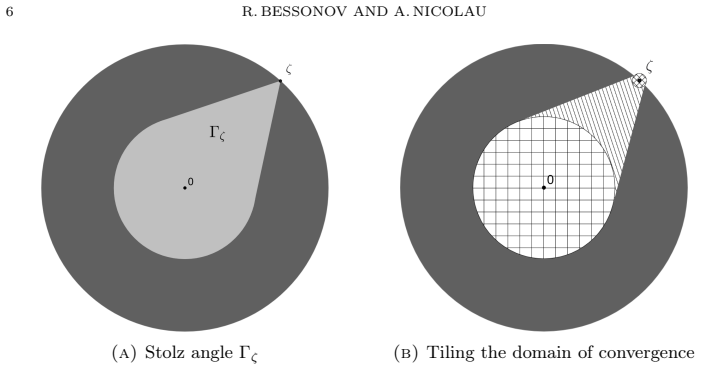
Let {ϕ_n^*} be the sequence of reflected orthogonal polynomials on the unit circle ∂D generated by a measure μ of Szegő class, and let D_μ be the Szegő function of μ. We prove the uniform Cesàro asymptotics sup_{z ∈ Γ_ζ} (1/n ∑_{k=0}^{n-1} |ϕ_k^*(z) D_μ(z)|^2 - 1|) → 0 as n→∞ for almost all Stolz angles Γ_ζ, ζ∈∂D. This extends a well-known asymptotic result of Máté, Nevai, and Totik (1991) from the local scale O(1/n) near ∂D to the global scale O(1). We also study asymptotic behavior of arguments of orthogonal polynomials and extend a classical theorem due to Grenander and Szegő using a new technique. As an application, we derive global asymptotic results for polynomial reproducing kernels u
What carries the argument
The uniform Cesàro mean (1/n)∑_{k=0}^{n-1} |ϕ_k^*(z) D_μ(z)|^2 taken inside Stolz angles Γ_ζ for almost every boundary point ζ, which upgrades local boundary control to global interior control.
If this is right
- The local Máté-Nevai-Totik asymptotics extend to uniform global convergence inside almost every Stolz angle.
- Asymptotic results on the arguments of the orthogonal polynomials extend the classical Grenander-Szegő theorem.
- Global asymptotic formulas hold for the polynomial reproducing kernels under varied assumptions on the measure μ.
Where Pith is reading between the lines
- The averaging technique may allow passage from local to global statements in related families of orthogonal polynomials on other contours.
- The result suggests that local boundary behavior of the measure controls averaged interior quantities for almost every approach direction.
Load-bearing premise
The orthogonality measure μ belongs to the Szegő class so that the Szegő function D_μ is well-defined and the local Máté-Nevai-Totik asymptotics apply.
What would settle it
A Szegő-class measure μ together with a positive-measure set of boundary points ζ where the Cesàro average of |ϕ_k^*(z) D_μ(z)|^2 stays bounded away from 1 uniformly inside the Stolz angle Γ_ζ for infinitely many n.
Figures
read the original abstract
Let $\{\phi^*_n\}$ be the sequence of reflected orthogonal polynomials on the unit circle $\partial \mathbb{D}$ generated by a measure $\mu$ of Szeg\H{o} class, and let $D_{\mu}$ be the Szeg\H{o} function of $\mu$. We prove the uniform Ces\`aro asymptotics $$ \sup_{z \in \Gamma_\zeta}\Biggl(\frac{1}{n}\sum_{k = 0}^{n-1}\Bigl||\phi_k^*(z) D_{\mu}(z)|^2 - 1\Bigr|\Biggr) \to 0, \qquad n \to \infty, $$ for almost all Stolz angles $\Gamma_{\zeta}$, $\zeta\in \partial \mathbb{D}$. This extends a well-known asymptotic result of M\'at\'e, Nevai, and Totik (1991) from the local scale $O(1/n)$ near $\partial \mathbb{D}$ to the global scale $O(1)$. We also study asymptotic behavior of arguments of orthogonal polynomials and extend a classical theorem due to Grenander and Szeg\H{o} using a new technique. As an application, we derive global asymptotic results for polynomial reproducing kernels under various assumptions on the orthogonality measure.
Editorial analysis
A structured set of objections, weighed in public.
Referee Report
Summary. The manuscript proves uniform Cesàro asymptotics sup_{z ∈ Γ_ζ} (1/n ∑_{k=0}^{n-1} ||ϕ_k^*(z) D_μ(z)|^2 - 1|) → 0 as n→∞ for almost all Stolz angles Γ_ζ with ζ∈∂D, where {ϕ_n^*} are the reflected orthogonal polynomials on the unit circle generated by a Szegő-class measure μ with Szegő function D_μ. This extends the local-scale Máté-Nevai-Totik asymptotics to the global O(1) scale. The paper also studies argument asymptotics of orthogonal polynomials (extending Grenander-Szegő via a new technique) and derives global asymptotics for polynomial reproducing kernels under various measure assumptions.
Significance. If the central extension holds, the result supplies a global counterpart to the well-known local MNT asymptotics in OPUC theory, which may streamline applications to reproducing kernels. The new technique for the argument asymptotics is a concrete technical contribution.
minor comments (3)
- [Introduction] Define the reflected polynomials ϕ_k^* and the Stolz angles Γ_ζ explicitly in the introduction (or §1) rather than assuming familiarity with the notation.
- [Applications section] In the application to reproducing kernels, state the precise assumptions on μ (beyond Szegő class) that are used for each global asymptotic statement.
- [Main theorem statement] Clarify whether the 'almost all' qualifier for ζ arises from the same null set as in the MNT local result or from an additional argument.
Simulated Author's Rebuttal
We thank the referee for the positive assessment of the manuscript, the accurate summary of its contributions, and the recommendation for minor revision. No specific major comments were raised in the report.
Circularity Check
No significant circularity identified
full rationale
The paper's central result extends the external Máté-Nevai-Totik (1991) local asymptotics to a uniform Cesàro mean over Stolz angles Γ_ζ for a.e. ζ, under the Szegő-class hypothesis that defines D_μ. This is a standard extension of an independent classical theorem rather than any reduction of the new global statement to a fitted quantity or self-defined input. No self-citation load-bearing steps, self-definitional relations, or ansatz smuggling appear in the provided abstract or description. The derivation chain is self-contained against external benchmarks.
Axiom & Free-Parameter Ledger
axioms (1)
- domain assumption μ is a Szegő-class measure on the unit circle
Reference graph
Works this paper leans on
-
[1]
Alexis, A
M. Alexis, A. Aptekarev, and S. Denisov. Continuity of weighted operators, Muckenhoupt Ap weights, and Steklov problem for orthogonal polynomials.Int. Math. Res. Not. IMRN, 8:5935–5972, 2022. 2
2022
-
[2]
M. U. Ambroladze. On the possible rate of growth of polynomials that are orthogonal with a continuous positive weight.Mat. Sb., 182(3):332–353, 1991. 2
1991
-
[3]
Aptekarev, S
A. Aptekarev, S. Denisov, and D. Tulyakov. On a problem by Steklov.J. Amer. Math. Soc., 29(4):1117–1165, 2016. 2
2016
-
[4]
V. M. Badkov. Asymptotic behavior of orthogonal polynomials.Mat. Sb. (N.S.), 109(151)(1):46–59, 165, 1979. 2
1979
-
[5]
Bessonov
R. Bessonov. On rate of convergence for universality limits.Integral Equations Operator Theory, 96(1):Paper No. 6, 20, 2024. 3, 8, 10, 11, 13, 28, 29, 31, 32, 33
2024
-
[6]
Bessonov and S
R. Bessonov and S. Denisov. Zero sets, entropy, and pointwise asymptotics of orthogonal polynomials.J. Funct. Anal., 280(12):Paper No. 109002, 38, 2021. 9, 10, 26, 27
2021
-
[7]
R. V. Bessonov. Entropy function and orthogonal polynomials.J. Approx. Theory, 272:Paper No. 105650, 16, 2021. 12, 17, 19
2021
-
[8]
S. Denisov. Pointwise behavior of SU(1,1) nonlinear Fourier transform.arXiv:2605.25108,
-
[9]
S. Denisov. The strong version of nonlinear carleson conjecture fails.arXiv:2605.01658, 2026. 5
Pith/arXiv arXiv 2026
-
[10]
Denisov and K
S. Denisov and K. Rush. Orthogonal polynomials on the circle for the weightwsatisfying conditionsw, w −1 ∈BMO.Constr. Approx., 46(2):285–303, 2017. 2
2017
-
[11]
S. A. Denisov. On the growth of polynomials orthogonal on the unit circle with a weightw that satisfiesw, w −1 ∈L ∞(T).Mat. Sb., 209(7):71–105, 2018. 2
2018
-
[12]
Eichinger, M
B. Eichinger, M. Lukić, and B. Simanek. An approach to universality using Weylm-functions. Ann. of Math. (2), 203(2):471–510, 2026. 3
2026
-
[13]
E. Findley. Universality for locally Szegő measures.J. Approx. Theory, 155(2):136–154, 2008. 2
2008
-
[14]
G. Freud. Über die starke (C, 1)-summierbarkeit von orthogonalen polynomreihen.Acta Math. Acad. Sci. Hungar., 3:83–88, 1952. 2
1952
-
[15]
J. B. Garnett.Bounded analytic functions, volume 96 ofPure and Applied Mathematics. Academic Press Inc., New York, 1981. 9, 16
1981
-
[16]
Ja. L. Geronimus and B. L. Golinskii. Asymptotic formulas for orthogonal polynomials.Teor. Funkci˘i Funkcional. Anal. i Priložen., 1:141–163, 1965. 2 36 R. BESSONOV AND A. NICOLAU
1965
-
[17]
B. L. Golinskii. Speed of convergence of a sequence of orthogonal polynomials to the limit function.Ukrain. Mat. Ž., 19(4):11–28, 1967. 2
1967
-
[18]
B. L. Golinskii. Two fundamental conditions for the asymptotic representation of polynomials that are orthogonal on the unit circle.Mat. Zametki, 15:847–855, 1974. 2
1974
-
[19]
Grenander and G
U. Grenander and G. Szegő.Toeplitz forms and their applications. California Monographs in Mathematical Sciences. University of California Press, Berkeley-Los Angeles, 1958. 2
1958
-
[20]
Khrushchev
S. Khrushchev. Schur’s algorithm, orthogonal polynomials, and convergence of Wall’s con- tinued fractions inL2(T).J. Approx. Theory, 108(2):161–248, 2001. 16
2001
-
[21]
Lubinsky
D. Lubinsky. A new approach to universality limits involving orthogonal polynomials.Ann. of Math. (2), 170(2):915–939, 2009. 3
2009
-
[22]
Mate and P
A. Mate and P. Nevai. Bernstein’s inequality inLp for0< p <1and (C, 1) bounds for orthogonal polynomials.Ann. of Math. (2), 111(1):145–154, 1980. 2, 12
1980
-
[23]
A. Máté, P. Nevai, and V. Totik. Szegő’s extremum problem on the unit circle.Ann. of Math. (2), 134(2):433–453, 1991. 2, 6
1991
-
[24]
Menchoff
D. Menchoff. Sur les séries de fonctions orthogonales.Fundamenta Mathematicae, 4(1):82– 105, 1923. 4
1923
-
[25]
Menchoff
D. Menchoff. Sur les séries de fonctions orthogonales.Fundamenta Mathematicae, 8(1):56– 108, 1926. 4
1926
-
[26]
Poltoratski
A. Poltoratski. Pointwise convergence of the non-linear Fourier transform.Ann. of Math. (2), 199(2):741–793, 2024. 4
2024
-
[27]
A. Poltoratski. Pointwise convergence of the non-linear Fourier transform. arXiv:2103.13349v13, 2025. 4
arXiv 2025
-
[28]
Rademacher
H. Rademacher. Einige Sätze über Reihen von allgemeinen Orthogonalfunktionen.Math. Ann., 87(1-2):112–138, 1922. 4
1922
-
[29]
E. A. Rahmanov. Estimates of the growth of orthogonal polynomials whose weight is bounded away from zero.Mat. Sb. (N.S.), 114(156)(2):269–298, 335, 1981. 2
1981
-
[30]
Simon.Orthogonal polynomials on the unit circle
B. Simon.Orthogonal polynomials on the unit circle. Part 1, volume 54, Part 1 ofAmerican Mathematical Society Colloquium Publications. American Mathematical Society, Providence, RI, 2005. Classical theory. 1, 3, 4, 9, 10, 16
2005
-
[31]
Simon.Szegő’s theorem and its descendants
B. Simon.Szegő’s theorem and its descendants. M. B. Porter Lectures. Princeton University Press, Princeton, NJ, 2011. Spectral theory forL2 perturbations of orthogonal polynomials. 1
2011
-
[32]
Szegő.Orthogonal polynomials, volume Vol
G. Szegő.Orthogonal polynomials, volume Vol. XXIII ofAmer. Math. Soc. Colloquium Pub- lications. Amer. Math. Soc., Providence, RI, fourth edition, 1975. 1
1975
-
[33]
V. Totik. Universality under Szegő’s condition.Canad. Math. Bull., 59(1):211–224, 2016. 3
2016
-
[34]
P. L. Ul’yanov. Development of D.E.Men’shov’s results on the theory of orthogonal series. Uspekhi Mat. Nauk, 47(5(287)):45–66, 207, 1992. 4, 35 R. Bessonov: F aculty of Mathematics and Physics, University of Ljubljana, and Institute of Mathematics, Physics and Mechanics, Jadranska ulica 19, 1000 Ljubljana Email address:roman.bessonov@fmf.uni-lj.si A. Nico...
1992
discussion (0)
Sign in with ORCID, Apple, or X to comment. Anyone can read and Pith papers without signing in.