Understanding Geopolitical Alignments Through Covariate Augmented Spectral Clustering of Heterogeneous UNGA Voting Data
Pith reviewed 2026-06-25 19:49 UTC · model grok-4.3
The pith
A covariate-assisted spectral clustering method for heterogeneous networks recovers communities by jointly using connectivity and node covariates, with explicit misclustering bounds.
A machine-rendered reading of the paper's core claim, the machinery that carries it, and where it could break.
Core claim
Under the heterogeneous node contextualized stochastic blockmodel, the proposed covariate assisted spectral clustering procedure for heterogeneous networks yields concentration results for the adjacency matrix, eigenspace perturbation bounds, and an explicit upper bound on the misclustering rate, while simulations and the UNGA application demonstrate practical improvements in community detection.
What carries the argument
Covariate augmented spectral clustering framework for heterogeneous networks that operates directly on the network structure and incorporates node covariates.
If this is right
- Incorporating covariates improves community recovery in heterogeneous networks compared with network-only methods.
- The procedure supplies an explicit upper bound on the misclustering rate.
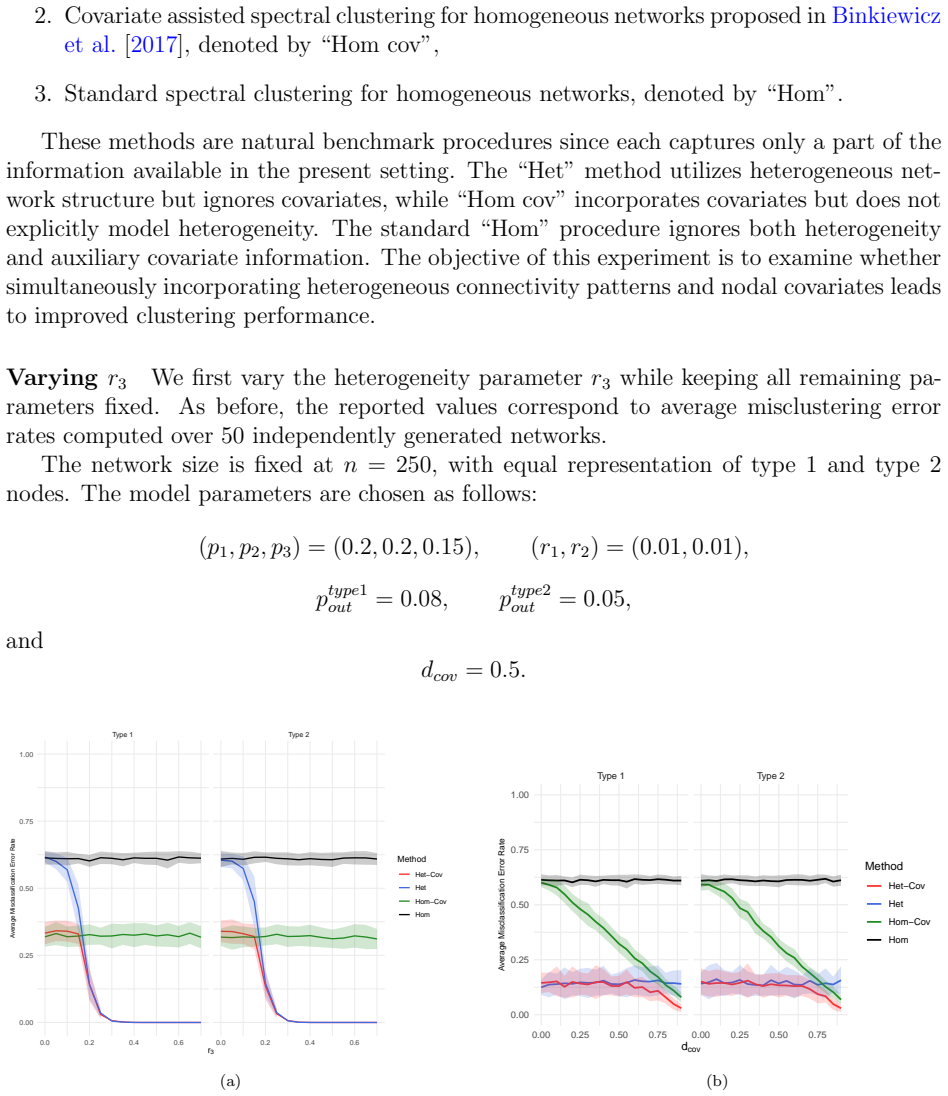
- The method outperforms several benchmark approaches in simulation studies.
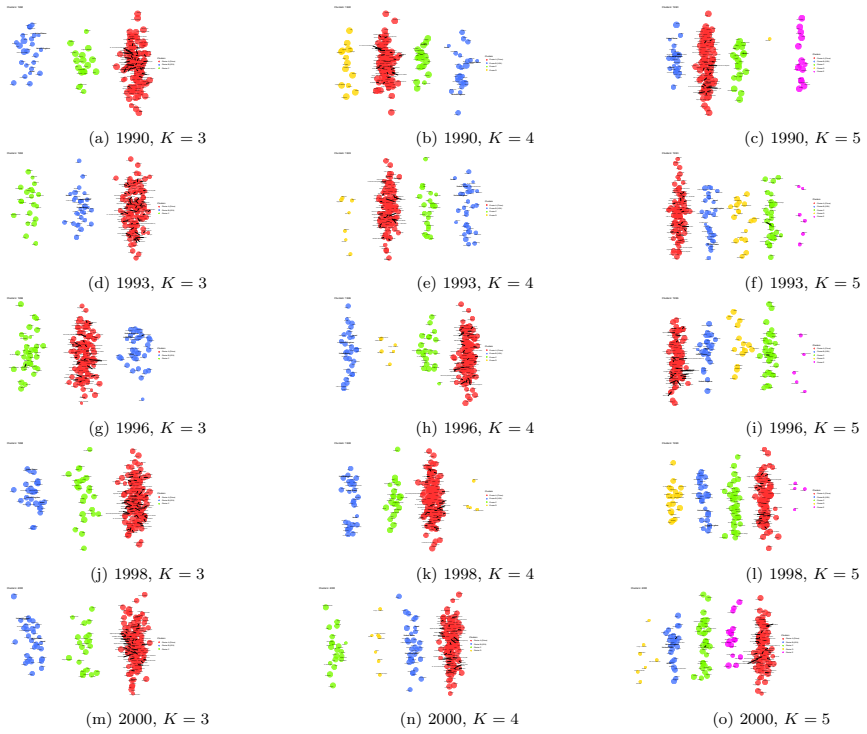
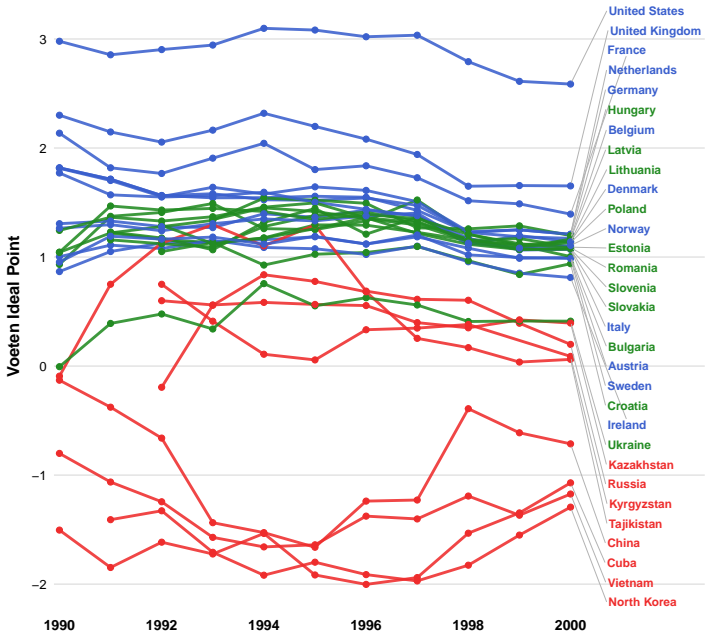
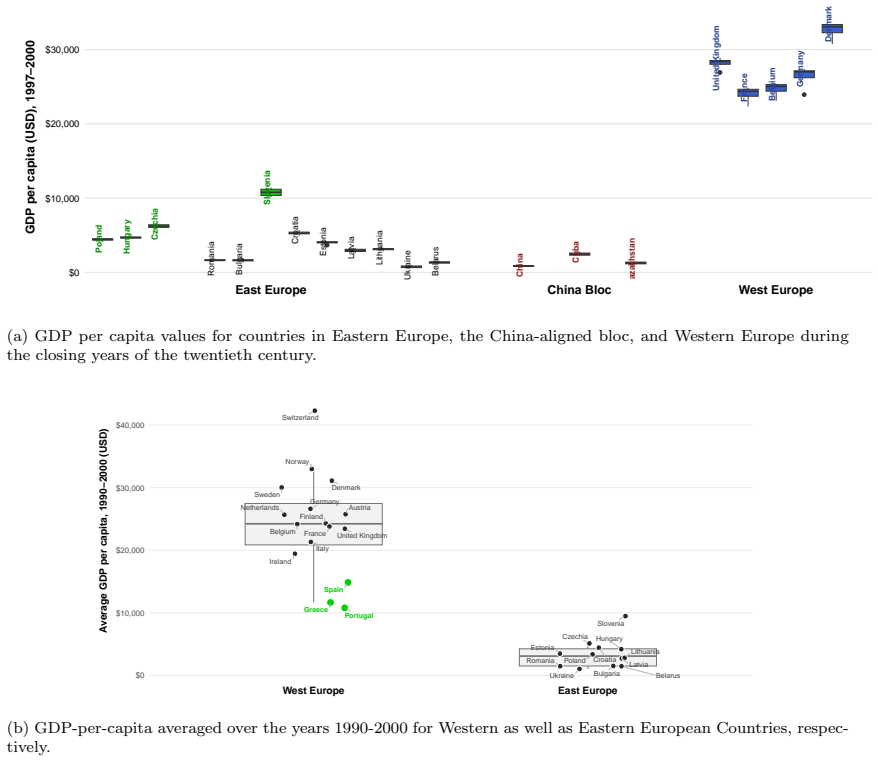
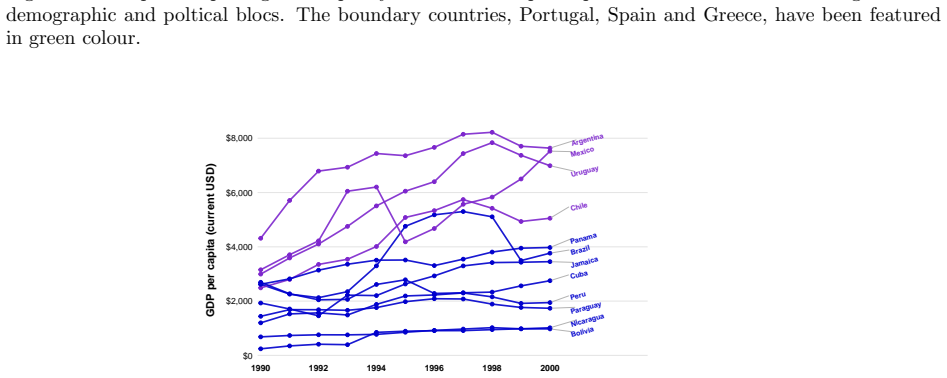
- Applied to UNGA voting data the framework reveals geopolitical structures by combining interactions with auxiliary covariates.
Where Pith is reading between the lines
- The same joint use of edges and covariates could be tested on other political or social networks that record both interactions and node attributes.
- Extensions to directed or time-varying heterogeneous graphs would be a natural next step if the current concentration arguments adapt.
- Checking whether the misclustering bound remains tight on larger real-world instances would test the practical reach of the theory.
Load-bearing premise
The observed network and covariates are generated from a heterogeneous node contextualized stochastic blockmodel.
What would settle it
A dataset generated from the heterogeneous node contextualized stochastic blockmodel where the observed misclustering rate exceeds the paper's explicit upper bound would falsify the guarantee.
Figures
read the original abstract
Community detection is a fundamental problem in network analysis. While many existing methods focus on homogeneous networks, real world networks are often heterogeneous, involving multiple node types and interaction mechanisms. In addition, node specific covariates frequently provide valuable information about the underlying community structure. Existing methodologies typically account for either network heterogeneity or covariate information, but seldom both simultaneously. In this paper, we propose a covariate assisted spectral clustering framework for heterogeneous networks that jointly utilizes network connectivity in a heterogeneous setting and node level covariates. The proposed method extends covariate assisted spectral clustering to heterogeneous settings and operates directly on the heterogeneous network without relying on projection based simplifications. Under a heterogeneous node contextualized stochastic blockmodel, we establish theoretical guarantees for the proposed procedure, including concentration results, eigenspace perturbation bounds, and an explicit upper bound on the misclustering rate. Simulation studies demonstrate that incorporating covariate information substantially improves community recovery and consistently outperforms several benchmark methods. We further apply the proposed framework to United Nations General Assembly voting data, where it reveals meaningful geopolitical structures by combining voting interactions with auxiliary covariate information.
Editorial analysis
A structured set of objections, weighed in public.
Referee Report
Summary. The paper proposes a covariate-assisted spectral clustering framework for heterogeneous networks, extending prior covariate-assisted methods to jointly incorporate network connectivity (without projection simplifications) and node covariates. Under the heterogeneous node contextualized stochastic blockmodel, it derives concentration results, eigenspace perturbation bounds, and an explicit upper bound on the misclustering rate. Simulations demonstrate improved community recovery over benchmarks when covariates are included, and the method is applied to UNGA voting data to identify geopolitical alignments.
Significance. If the stated theoretical guarantees hold, the work fills a recognized gap by simultaneously addressing network heterogeneity and covariate information in community detection. The explicit misclustering-rate bound and direct (non-projected) handling of heterogeneous networks are notable strengths. Simulation comparisons and the UNGA application provide concrete evidence of practical utility. These elements would make the contribution solid for the stat.AP community.
minor comments (2)
- [Abstract / §2] The heterogeneous node contextualized stochastic blockmodel is introduced as the setting for all theoretical results but is not given a compact formal definition in the abstract or early sections; adding a one-sentence statement of the generative assumptions would improve accessibility.
- [Simulation section] Simulation tables report performance gains but do not include standard errors or the number of Monte Carlo replications; adding these would strengthen the empirical claims.
Simulated Author's Rebuttal
We thank the referee for their positive summary, significance assessment, and recommendation of minor revision. The report accurately reflects the paper's contributions on covariate-assisted spectral clustering for heterogeneous networks with explicit misclustering bounds under the contextualized stochastic blockmodel, along with the simulation and UNGA voting application results.
Circularity Check
No significant circularity in derivation chain
full rationale
The paper posits the heterogeneous node contextualized stochastic blockmodel as the explicit data-generating assumption for all theoretical results and derives concentration inequalities, eigenspace perturbation bounds, and an explicit misclustering-rate upper bound from that model. This is a standard, non-circular modeling setup in which the generative process is stated up front and analytic properties are then established; no equation reduces a claimed bound to a fitted parameter by construction, no prediction is statistically forced by a prior fit, and no load-bearing premise rests solely on a self-citation chain. The provided abstract and reader summary contain no self-definitional steps or renamings of known results, confirming the derivation remains self-contained against external benchmarks.
Axiom & Free-Parameter Ledger
axioms (1)
- domain assumption Data generated under heterogeneous node contextualized stochastic blockmodel
Reference graph
Works this paper leans on
-
[1]
SPECTRAL CLUSTERING IN HETEROGENEOUS NETWORKS , urldate =
Srijan Sengupta and Yuguo Chen , journal =. SPECTRAL CLUSTERING IN HETEROGENEOUS NETWORKS , urldate =
-
[2]
Chandler Davis and W. M. Kahan , journal =. The Rotation of Eigenvectors by a Perturbation. III , urldate =
-
[3]
Proceedings of the 27th International Conference on Neural Information Processing Systems - Volume 2 , pages =
Qin, Tai and Rohe, Karl , title =. Proceedings of the 27th International Conference on Neural Information Processing Systems - Volume 2 , pages =. 2013 , publisher =
2013
-
[4]
Proceedings of the 25th Annual Conference on Learning Theory , pages =
Spectral Clustering of Graphs with General Degrees in the Extended Planted Partition Model , author =. Proceedings of the 25th Annual Conference on Learning Theory , pages =. 2012 , editor =
2012
-
[5]
Goldenberg, Anna and Zheng, Alice X. and Fienberg, Stephen E. and Airoldi, Edoardo M. , title =. Found. Trends Mach. Learn. , month = feb, pages =. 2010 , issue_date =. doi:10.1561/2200000005 , abstract =
-
[6]
Statistical Network Analysis: Past, Present, and Future
Sengupta, Srijan. Statistical Network Analysis: Past, Present, and Future. Frontiers of Statistics and Data Science. 2025. doi:10.1007/978-981-96-0742-6_7
-
[7]
BMC Bioinformatics , year=
Cluster analysis of networks generated through homology: automatic identification of important protein communities involved in cancer metastasis , author=. BMC Bioinformatics , year=
-
[8]
Handcock, Mark S. and Raftery, Adrian E. and Tantrum, Jeremy M. , title =. Journal of the Royal Statistical Society Series A: Statistics in Society , volume =. 2007 , month =. doi:10.1111/j.1467-985X.2007.00471.x , url =
-
[9]
Statistics and Computing , year=
A tutorial on spectral clustering , author=. Statistics and Computing , year=
-
[10]
On Spectral Clustering: Analysis and an algorithm , url =
Ng, Andrew and Jordan, Michael and Weiss, Yair , booktitle =. On Spectral Clustering: Analysis and an algorithm , url =
-
[11]
Journal of the American Statistical Association , volume =
Peter D Hoff and Adrian E Raftery and Mark S Handcock , title =. Journal of the American Statistical Association , volume =. 2002 , publisher =. doi:10.1198/016214502388618906 , URL =
-
[12]
Krzysztof Nowicki and Tom A. B Snijders , title =. Journal of the American Statistical Association , volume =. 2001 , publisher =. doi:10.1198/016214501753208735 , URL =
-
[13]
Holland and Kathryn Blackmond Laskey and Samuel Leinhardt , abstract =
Paul W. Holland and Kathryn Blackmond Laskey and Samuel Leinhardt , abstract =. Stochastic blockmodels: First steps , journal =. 1983 , issn =. doi:https://doi.org/10.1016/0378-8733(83)90021-7 , url =
-
[14]
, year =
Rohe, Karl and Chatterjee, Sourav and Yu, B. , year =. Spectral clustering and the high-dimensional stochastic blockmodel , volume =. Annals of Statistics - ANN STATIST , doi =
-
[15]
Stochastic blockmodels and community structure in networks , author =. Phys. Rev. E , volume =. 2011 , month =. doi:10.1103/PhysRevE.83.016107 , url =
-
[16]
A block model for node popularity in networks with community structure , urldate =
Srijan Sengupta and Yuguo Chen , journal =. A block model for node popularity in networks with community structure , urldate =
-
[17]
and Clauset, Aaron , year =
Newman, M. and Clauset, Aaron , year =. Structure and inference in annotated networks , volume =. Nature Communications , doi =
-
[18]
Journal of the American Statistical Association , volume =
Bowei Yan and Purnamrita Sarkar , title =. Journal of the American Statistical Association , volume =. 2021 , publisher =. doi:10.1080/01621459.2019.1706541 , URL =
-
[19]
Angelo Mele and Lingxin Hao and Joshua Cape and Carey E. Priebe , title =. Journal of Business & Economic Statistics , volume =. 2023 , publisher =. doi:10.1080/07350015.2022.2139709 , URL =
-
[20]
Binkiewicz, N. and Vogelstein, J. T. and Rohe, K. , title =. Biometrika , volume =. 2017 , month =. doi:10.1093/biomet/asx008 , url =
-
[21]
Community detection in networks with node features , volume =
Zhang, Yuan and Levina, Elizaveta , year =. Community detection in networks with node features , volume =. Electronic Journal of Statistics , doi =
-
[22]
Community detection with nodal information: Likelihood and its variational approximation , volume =
Weng, Haolei and Feng, Yang , year =. Community detection with nodal information: Likelihood and its variational approximation , volume =. Stat , doi =
-
[23]
Binkiewicz and J
N. Binkiewicz and J. T. Vogelstein and K. Rohe , journal =. Covariate-assisted spectral clustering , urldate =
-
[24]
Hu, Y and Wang, W , title =. Biometrika , volume =. 2024 , month =. doi:10.1093/biomet/asae011 , url =
-
[25]
Zhao, Junlong and Liu, Xiumin and Wang, Hansheng and Leng, Chenlei , title =. Biometrika , volume =. 2021 , month =. doi:10.1093/biomet/asab006 , url =
-
[26]
and Chatterjee, Snigdhansu , journal=
Chandna, Swati and Bagozzi, Benjamin E. and Chatterjee, Snigdhansu , journal=. Profile Least Squares Estimation in Networks With Covariates , year=
-
[27]
, journal=
Mu, Cong and Mele, Angelo and Hao, Lingxin and Cape, Joshua and Athreya, Avanti and Priebe, Carey E. , journal=. On Spectral Algorithms for Community Detection in Stochastic Blockmodel Graphs With Vertex Covariates , year=
-
[28]
IEEE Transactions on Network Science and Engineering , year=
Network Estimation via Graphon With Node Features , author=. IEEE Transactions on Network Science and Engineering , year=
-
[29]
Journal of the American Statistical Association , year=
PCABM: Pairwise Covariates-Adjusted Block Model for Community Detection , author=. Journal of the American Statistical Association , year=
-
[30]
Journal of Business & Economic Statistics , volume =
Shirong Xu and Yaoming Zhen and Junhui Wang , title =. Journal of Business & Economic Statistics , volume =. 2023 , publisher =. doi:10.1080/07350015.2022.2085726 , URL =
-
[31]
Statistics and Computing , month = jun, numpages =
Zhao, Da and Wang, Wanjie and Li, Jialiang , title =. Statistics and Computing , month = jun, numpages =. 2025 , issue_date =. doi:10.1007/s11222-025-10661-3 , abstract =
-
[32]
Harvard Dataverse , volume=
United Nations general assembly voting data , author=. Harvard Dataverse , volume=
-
[33]
Bailey and Anton Strezhnev and Erik Voeten , title =
Michael A. Bailey and Anton Strezhnev and Erik Voeten , title =. Journal of Conflict Resolution , volume =. 2017 , doi =. https://doi.org/10.1177/0022002715595700 , abstract =
-
[34]
A Two-Dimensional Analysis of Seventy Years of United Nations Voting , author=. 2018 , month=. doi:10.2139/ssrn.3166115 , journal=
-
[35]
Voeten, Erik , publisher =. 2009 , version =. doi:10.7910/DVN/LEJUQZ , url =
-
[36]
Journal of Applied Statistics , volume =
Qiushi Yu , title =. Journal of Applied Statistics , volume =. 2022 , publisher =. doi:10.1080/02664763.2021.1931820 , note =
-
[37]
Network Science , year=
A network approach to measuring state preferences , author=. Network Science , year=
-
[38]
, title =
McSherry, F. , title =. Proceedings of the 42nd IEEE Symposium on Foundations of Computer Science , pages =. 2001 , isbn =
2001
-
[39]
2021 , note =
unvotes: United Nations General Assembly Voting Data , author =. 2021 , note =
2021
-
[40]
2025 , note =
WDI: World Development Indicators and Other World Bank Data , author =. 2025 , note =
2025
-
[41]
SSRN Electronic Journal , year=
Spectral Inference for Large Stochastic Blockmodels With Nodal Covariates , author=. SSRN Electronic Journal , year=
-
[42]
Harris, Dan and Moore, Mick and Schmitz, Hubert , title =. IDS Working Papers , volume =. doi:https://doi.org/10.1111/j.2040-0209.2009.00326\_2.x , url =. https://onlinelibrary.wiley.com/doi/pdf/10.1111/j.2040-0209.2009.00326_2.x , abstract =
-
[43]
1999 , address =
Transition Report 1999: Ten Years of Transition -- Economic Transition in Central and Eastern Europe, the Baltic States and the CIS , institution =. 1999 , address =
1999
-
[44]
2002 , month=
Venla Sipilä , title=. 2002 , month=. doi:None , url=
2002
discussion (0)
Sign in with ORCID, Apple, or X to comment. Anyone can read and Pith papers without signing in.