REVIEW 4 major objections 5 minor 1 cited by
A self-consistent explanation of the MeV line in GRB 221009A unveils a dense circum-stellar medium
T0 review · 4 major / 5 minor · reviewed 2026-08-03 · deepseek-v4-flash
Pith's one-line read The paper argues that the ~10 MeV line in GRB 221009A is the high-latitude emission of a thin, pair-loaded blastwave, and that reproducing it requires a dense circum-stellar medium around the progenitor.
desk verdict A useful HLE correction and a creative pair-loading scenario, but the dense CSM is a fitted requirement, not a demonstrated consequence, and the line data are too contested for the title's claim. read the letter →
The pith
A machine-rendered reading of the paper's core claim, the machinery that carries it, and where it could break.
The reading
What carries the argument
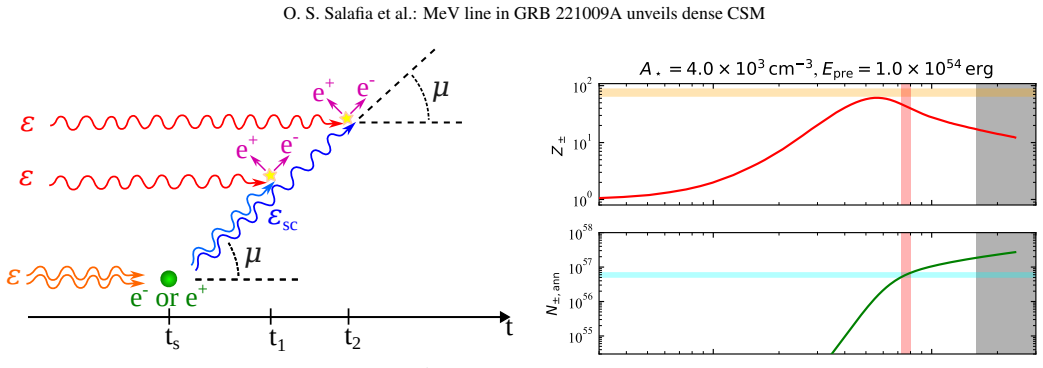
The key identity is the high-latitude emission formula for a thin relativistic shell: L∝[1+(t-t0)/t_ang]^-3 and hν∝[1+(t-t0)/t_ang]^-1, where t_ang=r/2Γ^2c is the angular time scale. Combined with the assumption that the line's rest-frame energy is mec^2, this formula converts the measured line evolution into constraints on r, Γ, N±, and t0. The companion mechanism is the pair-loading/radiative-acceleration cycle: hard incident photons are Compton-scattered by blastwave electrons, the upscattered photons pair-produce with other incident photons, the newly created pairs deposit momentum, and the shell accelerates. The paper models this with a coupled continuity and momentum equation system, i
What would settle it
Re-analyse the raw detector data across the saturated time window with an end-to-end response model and check whether the line's energy and luminosity follow clean (t-t0)^-1 and (t-t0)^-3 laws with a common t0 between 220 and 240 s. Alternatively, search the same epoch for the predicted inverse-Compton component at roughly 100–300 MeV with luminosity near 10^51 erg/s; its absence would contradict the pair-cooling scenario.
Extended reading notes
Core claim
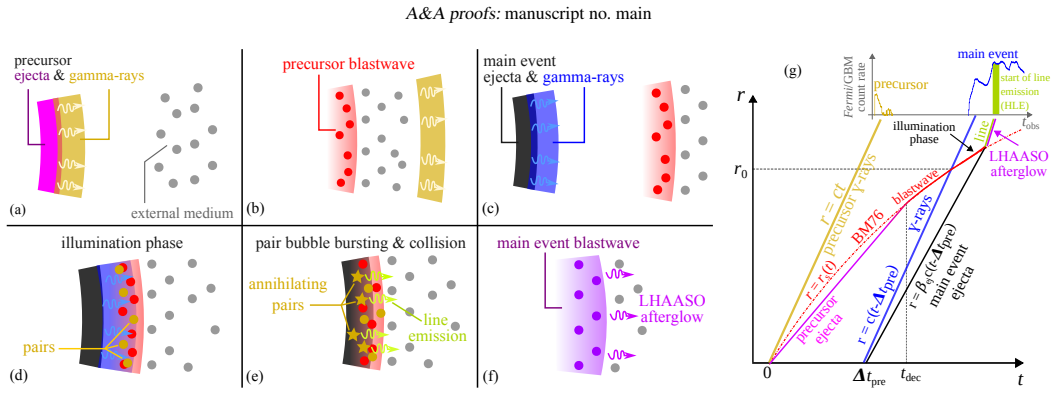
The central claim is that the observed t^-3 and t^-1 evolution of the line is quantitatively the high-latitude emission signature of an instantaneous flash from a thin spherical shell moving with Lorentz factor Γ≫1. If the line's rest-frame energy is mec^2 (electron-positron annihilation), the measured luminosity and photon energy fix the pair number and Lorentz factor for a given radius; a fit to the available data gives Γ≈(194±13)r16, N±≈(3.0±0.19)×10^57 r16, and t0≈234±17 s, with the radius between about 10^15 and 4×10^16 cm. The paper then shows that a blastwave driven by the GRB's precursor, decelerated in a dense external medium and illuminated by the main burst's hard radiation, can b
Load-bearing premise
The whole argument rests on the measured line being real and following a clean power-law decay in both brightness and energy; if the measurements from the saturated detector interval are unreliable or the independent analyses disagree, the derived shell parameters and the inferred dense stellar shell collapse.
Editorial extensions
If this is right
- If the high-latitude interpretation is right, the 10 MeV line directly measures a pair-loaded shell: Γ≈(194±13)r16, N±≈(3.0±0.19)×10^57 r16, with the first photons arriving at t0≈234±17 s, close to the TeV afterglow onset.
- The blastwave must be pair-enriched to a multiplicity of roughly 10^5–10^6 per swept-up electron, demanding external densities of 10^8–10^9 cm^-3 at radii of 10^15–4×10^16 cm.
- The required density and extent correspond to a progenitor mass-loss rate of about 10^-3 to 10^-1 solar masses per year in the last years before explosion, similar to Type IIn supernovae, and the dense medium could act as a Thomson screen hiding most of the precursor's gamma-ray emission.
- The same geometry explains the abrupt rise of the TeV afterglow: the main-event ejecta, moving through the cavity carved by the precursor, collide with the pair-loaded blastwave right after the pair bubble bursts.
- Analogous line emission should be searchable in other gamma-ray bursts that show a long quiescence followed by a luminous, hard emission episode, provided a dense circumstellar medium is present.
Reading between the lines
- Editorial inference: the radiative-acceleration phase also predicts an inverse-Compton component from the cooling pairs, peaking near roughly 100–300 MeV with luminosity around 10^51 erg/s at the same epoch as the line; this is a distinct, testable signature beyond the line itself, though the paper notes it will be difficult to separate from afterglow emission.
- Editorial inference: because the entire chain hinges on identifying the line's rest-frame energy with mec^2, an independent measurement of that rest-frame energy (rather than assuming it) could shift the derived radius and Lorentz factor; if the line is produced differently, the dense circum-stellar medium inference may not follow.
- Editorial inference: the paper's model stops when the blastwave becomes optically thick to Thomson scattering, arguing that multiple scatterings would enhance pair production; a fuller treatment could therefore shift the allowed density window, either relaxing or tightening the 10^8–10^9 cm^-3 requirement.
- Editorial inference: the progenitor scenario can be probed independently by searching for dense circum-stellar material in the associated supernova spectrum or in late-time radio emission; the paper notes the associated supernova appears ordinary, which may favor a smoothed, wind-like medium rather than a clumpy shell.
Editorial analysis
A structured set of objections, weighed in public.
Referee Report
Summary. The paper interprets the ~10 MeV emission line in GRB 221009A as high-latitude emission (HLE) from a geometrically thin, relativistically expanding shell in which e+e- pairs annihilate. From the observed L_line ∝ (t−t0)^−3 and hν_line ∝ (t−t0)^−1 evolution it derives constraints on Γ, N±, and r, summarized as Γ≈(194±13) r16 and N±≈(3.0±0.19)×10^57 r16 when BTI data are excluded. It then constructs a scenario in which this shell is the precursor blastwave, pair-loaded and radiatively accelerated by the main GRB emission; matching the HLE-inferred shell properties requires a very dense circum-stellar medium (n_ext∼10^8–10^9 cm^−3 or A⋆∼10^3–10^4 cm^−3) extending to a few×10^15 cm, reminiscent of Type IIn supernova progenitors. The paper is carefully argued, with an explicit HLE derivation (Appendix A), a detailed treatment of uncertainties in the line fits, and a numerical pair-loading model that is compared with Beloborodov (2002). However, the final claim that the GRB 'unveils a dense CSM' is not yet supported by any afterglow forward-modeling, and the entire chain depends on disputed line measurements.
Significance. If the scenario is correct, it would establish a novel link between a prompt-phase spectral feature and the progenitor's circum-stellar environment, with implications for GRB progenitor models and for searches for similar lines in other bursts. The paper's HLE formalism is clean and the pair-loading calculation is a substantial modeling effort; the authors also present a transparent discussion of the data-selection sensitivity. The main value today is as a self-consistency demonstration: it shows that a dense CSM can, within current uncertainties, explain the line if the line itself and the annihilation-line identification are accepted. Because the afterglow consequences of that same CSM are not yet computed, the paper's title and abstract overstate what has been established. The strongest contribution is the explicit, falsifiable prediction that the external shock afterglow must feel this dense CSM.
major comments (4)
- [Abstract, §5, §6] The central claim that the observation 'unveils a dense CSM' is not tested against the afterglow. The required n_ext∼10^8–10^9 cm^−3 (or A⋆∼10^3–10^4 cm^−3) is orders of magnitude above standard ISM/wind values and would dominate the external-shock dynamics and radiation. The paper explicitly defers this: Abstract says 'consequences ... are yet to be fully explored' and §6 repeats it. No calculation or comparison with the rich LHAASO, Fermi/LAT, XRT, optical, or radio afterglow data is presented. An incompatible afterglow would falsify the central claim even if the line data and HLE interpretation are accepted. This is load-bearing and should be addressed by forward-modeling the afterglow in this CSM, or by substantially weakening the 'unveils' claim.
- [§2.1.2, Fig. 1, Table 1] The entire HLE parameter extraction rests on a subjective selection of line measurements. Fig. 1 shows mutually incompatible error bars, and the line is partly inside the saturation BTI. Excluding versus including BTI data changes Γ/r16 from 194±13 to 215±3.4 and t0 from 234±17 to 238±10 (Table 1). The paper excludes Axelsson et al. (2025) and Konus-WIND data based on internal consistency, but does not quantify the effect of that exclusion on the final CSM density range. Because the allowed parameter box in Fig. 6 uses the union of 90% credible intervals (2.5<N±,ann,57/r0,16<3.3, 173<Γ1/r0,16<220), the claimed density interval is directly sensitive to this choice. An explicit marginalization over data-selection choices, or a conservative sensitivity study, is needed.
- [§2, §3, §4] The reasoning is partly circular: the HLE fit directly determines x1=Γ/r and x2=N±/r; the pair-loading model is then scanned over Epre, next/A⋆, and Ecut until it reproduces these same ratios (Fig. 6). Thus the CSM density is a requirement of the scenario, not an independent prediction. The authors are transparent about this, but the paper's framing ('unveils') should be corrected. The only quasi-independent link is the timing coincidence with the LHAASO rise, yet that same timing is used to set Eγf in §3.2. A concrete independent prediction—for example the early afterglow light-curve shape or the LAT IC component of §5.4—would break this circularity and significantly strengthen the paper.
- [§2.1.1, Eq. (3)-(5)] The derivation assumes hν'_line = m_e c^2, i.e. that the rest-frame line is e+e- annihilation, citing R24. This is not re-established here, and the alternative interpretation of Liu et al. (2025) is not quantitatively addressed. If the rest-frame line energy is not exactly mec², all derived quantities (N±, Γ, and the required pair multiplicity) scale accordingly. Since the whole scenario depends on this identification, it should be stated as a conditional assumption in the abstract and conclusions, or the authors should attempt an independent constraint on hν'_line from the data. At present the paper conflates 'the line is annihilation radiation' with the constraints that follow from it.
minor comments (5)
- [§2.1.1] Eq. (5) is introduced as a consequence of Eq. (4), but the reader must infer the numerical normalization. The text should state the reference values of Lline,50 and hνline explicitly at the point of use.
- [§2.1.2, Fig. 2] The posterior plots show only 100 samples and no convergence diagnostics. The use of log-uniform priors on x0...x3 is reasonable, but a brief statement on chain lengths, burn-in, and effective sample size would help reproducibility.
- [§4.2, Eq. (29)] The notation for the cut-off energy Ecut is introduced after Eq. (30), but Eq. (29) uses x_cut before defining it. Move the definition earlier.
- [Fig. 6] The grey dashed line is labeled 'T=1' in the axes but the text calls it 'Thomson scattering optical depth τ_T=1'. Please use consistent notation.
- [Abstract and §5.1] The phrase 'mass-annihilation' is used repeatedly; since it is not standard, define it at first use as 'pair annihilation' to avoid ambiguity with baryon annihilation.
Circularity Check
No structural circularity; the dense-CSM claim is an inferred requirement, not a tautological prediction.
full rationale
The derivation chain is not circular in the logical sense. The HLE constraints (Sec. 2, Eqs. 1-6) are obtained by fitting a physically motivated light-curve model to the published line measurements; hence Gamma/r16 and N±/r16 are fitted inputs, not predictions. The pair-loading scenario (Sects. 3-4, App. D) is a separate microphysical calculation: for given (n_ext or A*, E_pre, E_cut) it integrates the Be02 kinetic equations to predict Z±(E_gammaf), Gamma1(E_gammaf), and N±,ann(E_gammaf). The paper then scans this parameter space and retains the region where these predicted quantities fall inside the HLE-fitted intervals (Sec. 4.4). This is forward-model-to-data comparison/calibration, not a tautology: large regions of parameter space fail (Fig. 6), and the microphysics is independent of the line fit. The low precursor efficiency and high CSM density are therefore requirements of the scenario given the line, not independently validated predictions. The paper explicitly flags the missing external validation: the Abstract states "The consequences of such a CSM on the dynamics and emission of the external shock are yet to be fully explored", and Sec. 6 repeats "the consequences of which are yet to be fully explored". No afterglow forward model is presented, so the title's "unveils" outruns the available evidence; that is a correctness/falsifiability concern, not a circular step. The reliance on R24 for the line and its mec^2 rest-frame assignment involves overlapping authorship, but the feature is confirmed by other groups (Burns et al. 2024; Zhang et al. 2024a) and the HLE formalism is rederived in App. A; no load-bearing reduction to an unverified self-citation exists.
Assumptions & free parameters
free parameters (7)
- Shell radius r (x0 = r_16) =
mean 1.2, 90% CR [0.10, 4.2] (×10^16 cm, excluding BTI fit)
- Γ/r16 (x1) =
194±13 (excl. BTI); 215±3.4 (incl. BTI)
- N±,57/r16 (x2) =
3.0±0.19 (excl. BTI); 2.8±0.17 (incl. BTI)
- t0 (x3) =
234±17 s (excl. BTI); 238±10 s (incl. BTI)
- Epre (precursor ejecta energy) =
≈2×10^53-10^54 erg (k=0); 4×10^53-3×10^54 erg (k=2)
- External density next (k=0) or A⋆ (k=2) =
next ≈ 10^8-10^9 cm^-3; A⋆ ≈ 3×10^3-10^4 cm^-3
- Ecut (high-energy cutoff of main-event spectrum) =
100 MeV
assumptions (8)
- domain assumption Line rest-frame energy is mec² (pair annihilation) and pairs are cold
- domain assumption BM76 self-similar solution for a relativistic blastwave
- domain assumption Pair production and radiative acceleration follow the Be02 mechanism (Compton scattering + γγ pair creation with momentum deposition)
- domain assumption Blastwave is magnetized, keeping leptons tied to the plasma
- domain assumption Band-function spectrum with parameters from Frederiks+23 (α1=0.89, α2=2.21, Epeak=2660 keV) represents the main-event photon field
- domain assumption Electron injection index p=2.2 and microphysical fractions εe=0.1, εB=1e-3
- domain assumption Single-scattering approximation: incident photons undergo at most one Compton scattering before γγ annihilation
- domain assumption Main event ejecta travel in the cavity left by the precursor and lag the gamma-ray front by Δr ≈ r/2Γ²_ej
invented entities (1)
-
Dense circum-stellar medium (CSM) with n≈10^8-10^9 cm^-3 extending to a few×10^15 cm around the progenitor
independent evidence
Cite this review
Pith. "Pith review of A self-consistent explanation of the MeV line in GRB 221009A unveils a dense circum-stellar medium." pith.science (2026). https://pith.science/paper/MJ74CR7T
@misc{pith2026260114257,
  author       = {Pith},
  title        = {Pith review of: A self-consistent explanation of the MeV line in GRB 221009A unveils a dense circum-stellar medium},
  year         = {2026},
  howpublished = {\url{https://pith.science/paper/MJ74CR7T}},
  note         = {Machine review of arXiv:2601.14257}
}
read the original abstract
GRB~221009A has been the brightest gamma-ray burst (GRB) observed to date, and its afterglow has been characterized with unprecedented detail at TeV energies by LHAASO. Quite puzzlingly, it is also the most energetic GRB known. Among the riddles posed by this mysterious source, however, the sheer energetics are hardly the most intriguing: an unprecedented emission line at around 10 MeV has been uncovered by a detailed spectral analysis of Fermi/GBM data immediately following the brightest peak in the GRB prompt emission and the peak of the TeV afterglow. The temporal evolution of the line properties can be explained as high-latitude emission from a geometrically thin, relativistically expanding shell where annihilation of a large number of electron-positron pairs took place. We show that this interpretation yields stringent constraints on the properties of such shell, that point to a process that happens at radii typical of external shocks. We then demonstrate that the shell could have been the blastwave associated with the GRB precursor, with the line arising after pair loading of such blastwave as it was illuminated by the bright and hard radiation of the GRB. The scenario, which also explains the abrupt initial rise of the LHAASO afterglow, requires the progenitor of the GRB to have been surrounded by a circum-stellar medium (CSM) extending out to a few 10^15 cm, with a density 10^8-10^9 cm-3 reminiscent of those found in Type IIn supernovae. The consequences of such a CSM on the dynamics and emission of the external shock are yet to be fully explored. If future, more detailed work will confirm the compatibility of the GRB 221009A afterglow with our scenario, this will provide a precious clue to the nature of the progenitor of this peculiar GRB, which could also be present in other bursts that feature a long quiescence followed by a bright emission episode with a hard spectrum.
Figures


Figures from the paper (3 more)


Forward citations
Cited by 1 Pith paper
-
From Internal Collision to Photon Escape: First-Principles Modeling of Radiation-Mediated Shocks in Gamma-Ray Burst Photospheres
Self-consistent simulations reveal that reverse shocks in GRB photospheres stay radiation-mediated down to optical depths of a few tenths, with photons decoupling over a broad radial range and forming a quasi-thermal ...
Reference graph
Works this paper leans on
-
[1]
2025, ApJS, 277, 24 Band, D., Matteson, J., Ford, L., et al
Axelsson, M., Ajello, M., Arimoto, M., et al. 2025, ApJS, 277, 24 Band, D., Matteson, J., Ford, L., et al. 1993, ApJ, 413, 281 Beloborodov, A. M. 2002, ApJ, 565, 808 Blanchard, P. K., Villar, V . A., Chornock, R., et al. 2024, Nature Astronomy, 8, 774 Blandford, R. D. & McKee, C. F. 1976, Physics of Fluids, 19, 1130 Burns, E., Lesage, S., Goldstein, A., e...
arXiv 2025
-
[2]
⟨Lline⟩[ta,tb] (x)−L i δLi(x) #2 +
Assuming a power law spectrum,F ν(νobs,t 0)∝ν −β obs, and focussing ont obs≫t ang, we recover the original result of Kumar & Panaitescu (2000), namely Fν(νobs,t obs)∝ν −β obst−(2+β) obs . (A.13) Appendix B: HLE model fitting In this appendix we describe the technical details of our procedure for fitting the HLE model to the line properties inferred from t...
2000
-
[1967]
We note that our Eq
λ−1 γγ(εsc,µ)= Z +∞ εth (1−µ)σ γγ(εsc,ε,µ) dnγ dε dε,(D.10) whereεrepresents again the energy of an incident photon,ε th =2/(1−µ)ε sc is the threshold forγ−γabsorption, and σγγ(ε,ε sc,µ)= 3σT 8x2 h 2+2x −2−x−4 ln x+ √ x2−1 − 1+x −2 √ 1−x −2 i (D.11) is the Breit-Wheeler cross section (Jauch & Rohrlich 1976), withx= p εεsc(1−µ)/2. We note that our Eq. D.9 ...
1976
-
[1995]
Let us define the ratioℓof the gamma-ray luminosityLto the kinetic luminosityL ej of the main event ejecta (after the gamma-rays are released), so thatL=ℓL ej
to derive the bulk Lorentz factor of regions 2-3, as follows. Let us define the ratioℓof the gamma-ray luminosityLto the kinetic luminosityL ej of the main event ejecta (after the gamma-rays are released), so thatL=ℓL ej. This implies a main event gamma-ray efficiency ofη γ =L/(L+L ej)=ℓ/(1+ℓ). The comoving rest-mass density in region 4 is thenρ′ 4∼L ej/4...
2000
Reviewed August 3, 2026 · model on record in the stance chip above.
Discussion (0). Sign in to comment.