REVIEW 3 major objections 6 minor 95 references
Global solutions to cubic Dirac and Dirac-Klein-Gordon systems on spacetimes close to the Minkowski space
T0 review · 3 major / 6 minor · reviewed 2026-08-06 · deepseek-v4-flash
Pith's one-line read This paper claims that cubic Dirac and Dirac-Klein-Gordon systems admit global solutions with sharp $t^{-3/2}$ decay on stationary asymptotically flat spacetimes close to Minkowski space, for small compactly supported data with $N \geq…
desk verdict Genuine new DKG target, but the displayed bootstrap only yields growing bounds and the sharp decay rests on an unproved modified bootstrap; worth a serious referee, not acceptance as is. read the letter →
The pith
A machine-rendered reading of the paper's core claim, the machinery that carries it, and where it could break.
The reading
What carries the argument
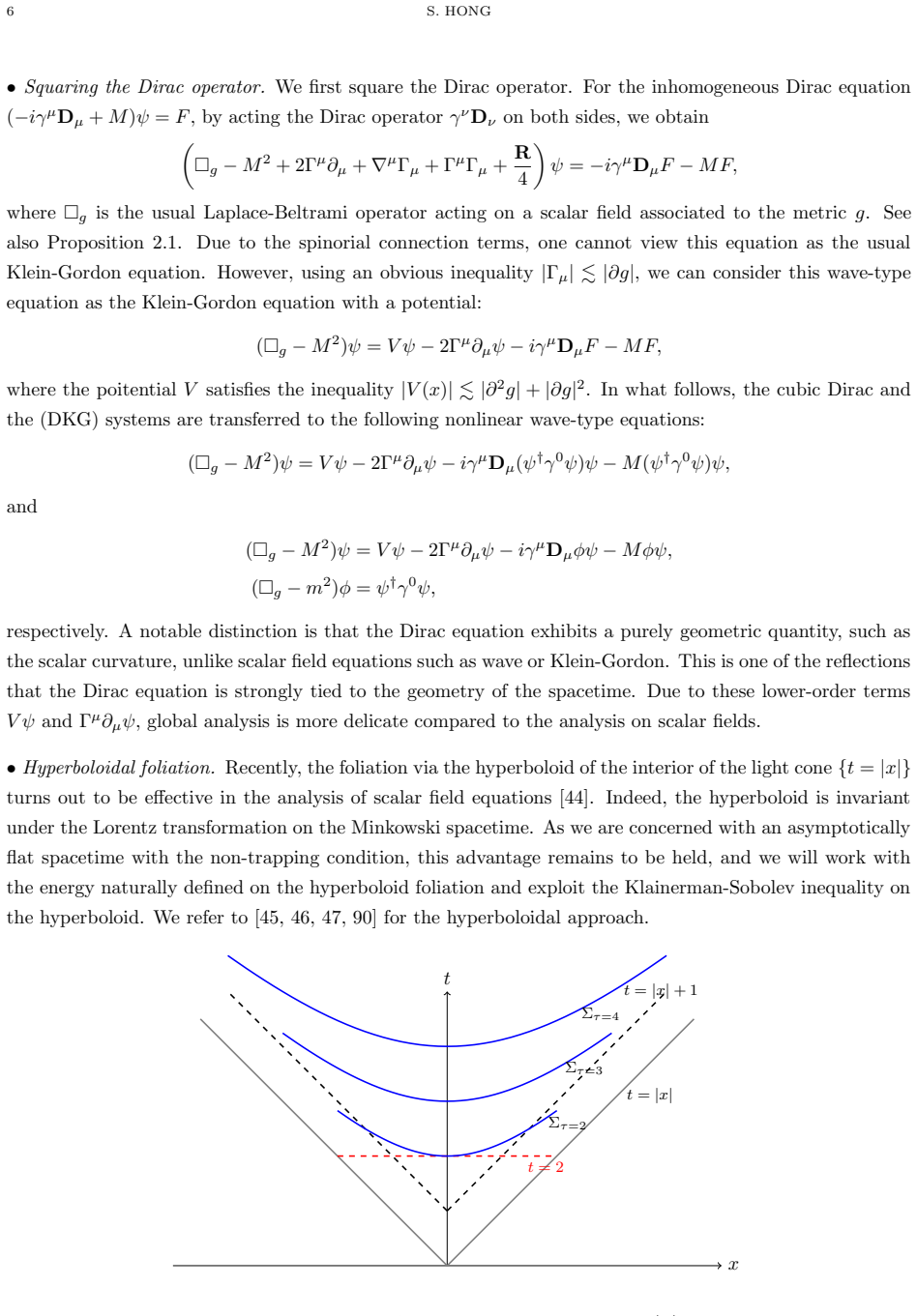
The load-bearing identity is the squared Dirac operator formula $(\square_g - M^2)\psi = -2\Gamma^\mu \partial_\mu \psi + V\psi - i\gamma^\mu D_\mu F - M F$ (Proposition 2.1), which turns the first-order Dirac equation into a wave-type equation whose extra terms are controlled by the smallness of the metric perturbation; here $\Gamma^\mu$ is the spinorial connection and $V$ satisfies $|V| \lesssim |\partial^2 g| + |\partial g|^2$. Around this identity the proof organizes three tools: hyperboloidal foliation energies $E_c[\psi]$, the modified Lorentz boost $L_i + \tfrac12 \gamma^0\gamma^i$ whose commutator with the Dirac operator is flat-friendly, and hyperboloidal Klainerman-Sobolev plus Hardy-type inequalities that convert energy bounds into pointwise decay and absorb dangerous $t$-factors from commutators. A key qualitative point is that the commutator $[\gamma^\mu D_\mu, L_i]$ does not vanish even in flat space, and the modified boost is needed to make the bracket acceptable.
What would settle it
Take a stationary asymptotically flat metric satisfying (1.4) with a small but nonzero short-range component $g_{sr}^{tj}$, and compute the energy of the spinor evolution under the squared equation $(\square_g - M^2)\psi = -2\Gamma^\mu\partial_\mu\psi + V\psi$ for small compactly supported data. If the local energy bound (1.8) on $\Sigma_{\tau_0}$ cannot be established for all $|I|+|J| \le N$, or if the bootstrap integrals in (1.12) grow like $\tau^{1/2 + (|I'|+|J|)\delta}$ with a constant that is not small relative to $\varepsilon$, then the closing argument in Section 5 fails; a concrete calculation of the $\Gamma^\mu\partial_\mu$ contribution would settle whether the footnote's assertion that the gap is 'not harmful' is correct.
Extended reading notes
Core claim
The paper's central claim, Theorem 1.2, is that for any smooth stationary asymptotically flat metric satisfying the decay and smallness conditions (1.4), every small compactly supported initial datum produces a global Dirac-Klein-Gordon solution obeying $\sup_{\Sigma_\tau} t^{3/2}|\psi| + \sup_{\Sigma_\tau} t^{3/2}|\phi| \lesssim \varepsilon$ and the energy bound $E_M[\partial^I L^J \psi](\tau) + E_m[\partial^I L^J \phi](\tau) \lesssim \varepsilon^2$ for all $\tau \ge 2$ and all $|I|+|J| \le N$. Theorem 1.1 gives the same conclusion for the cubic Dirac equation alone. The proof treats the gamma matrices as genuinely spacetime-dependent and shows that the spinorial connection terms they produce are acceptable error terms in the energy estimates, rather than obstructions to global existence.
Load-bearing premise
The starting local-in-time solution on the initial hyperboloid is obtained by citing a theorem that the paper's own footnote says applies to Klein-Gordon equations rather than to the squared Dirac equation with its extra spinor-dependent terms; the paper asserts this gap is harmless because the metric is close to Minkowski, but does not demonstrate it.
Editorial extensions
If this is right
- For every small compactly supported initial datum, the cubic Dirac equation admits a global solution with $\sup_{\Sigma_\tau} t^{3/2}|\psi| \lesssim \varepsilon$ (Theorem 1.1).
- For every such datum, the Dirac-Klein-Gordon system admits a global solution with both fields decaying at the sharp rate $t^{-3/2}$ and with controlled energy (Theorem 1.2).
- The same bootstrap closes when the metric is non-stationary but satisfies the time-decay assumption (1.15); the paper states the proof needs only straightforward modifications.
- The hyperboloidal energy method also yields global solutions for scalar Klein-Gordon equations with cubic or quadratic-with-derivative nonlinearities on the same backgrounds, as worked out in the appendix toy models.
Reading between the lines
- Editorial inference: the energy bounds proven for all $\partial^I L^J$ derivatives should give pointwise decay for derivative fields too, e.g. $t^{3/2}|L^J \psi| \lesssim \varepsilon$, by reapplying the Klainerman-Sobolev step; the paper states decay only for the undifferentiated fields.
- Editorial inference: the paper asserts, but does not prove, that the non-stationary case (1.15) works 'in essentially the same manner'; a direct check would need to show that commutators involving $\partial_t g_{sr}$ do not reintroduce a $t$-growth that the Hardy inequality cannot absorb.
- Editorial inference: the argument implicitly quantifies how small the metric perturbation must be: small enough that the connection term $\Gamma^\mu\partial_\mu\psi$ and potential $V\psi$ can be absorbed into the bootstrap margin. Extracting that quantitative threshold would indicate whether the result extends to slowly rotating black-hole metrics rather than merely perturbations of flat spacetime
- Editorial inference: the same commutator machinery should apply to any first-order hyperbolic system with nonconstant coefficients that can be squared into a wave-type equation; Maxwell-Dirac is the natural next test, but the gauge field's slower $t^{-1}$ decay would likely require modified scattering rather than the decay shown here.
Editorial analysis
A structured set of objections, weighed in public.
Referee Report
Summary. The paper claims global existence and sharp pointwise decay for the cubic Dirac equation and the Dirac-Klein-Gordon system on stationary asymptotically flat spacetimes close to Minkowski space. The proof squares the Dirac operator to obtain a nonlinear wave-type equation with spinorial lower-order terms, then applies hyperboloidal energy estimates, vector-field commutators, and a bootstrap argument. The main theorems (Theorems 1.1 and 1.2) assert uniform energy bounds and t^{-3/2} decay for small compactly supported data with N ≥ 11.
Significance. If established, the results would be a meaningful step for nonlinear Dirac systems on curved backgrounds, particularly the Dirac-Klein-Gordon system with its quadratic coupling. The paper's strategy—squaring the Dirac operator, using modified Lorentz boosts, and adapting the hyperboloidal foliation—is natural and the authors identify genuinely non-scalar difficulties. However, the manuscript as written does not supply complete proofs for several load-bearing steps, so the central claims are presently unsupported.
major comments (3)
- [Section 5, final paragraph] The claimed uniform energy bound sup_{τ0≤τ} (E_M[∂^I L^J ψ]^{1/2} + E_m[∂^I L^J ϕ]^{1/2}) ≤ 2C0ε, and the resulting sharp decay t^{3/2}|ψ|, t^{3/2}|ϕ| ≤ C0ε, are obtained by 'repeating the bootstrap argument with modified assumptions,' but this modified bootstrap is never displayed. The displayed bootstrap assumptions (5.1)-(5.2) allow high-derivative energies to grow like τ^{1/2+(|I'|+|J|)δ} with δ > 0, and Lemma 3.2 then gives only t^{3/2}|ψ| ≲ Cετ^{2δ}, which grows with τ. A uniform-in-τ bootstrap cannot be inferred from the preceding estimates; it would require new estimates reworking Propositions 4.1 and 5.1-5.3. This gap is load-bearing for both Theorem 1.1 and Theorem 1.2.
- [Section 1.2, footnote 1; Section 5.1] The local well-posedness statement used to start the bootstrap is cited from Theorem 11.2.1 of [44]. The footnote admits that this theorem concerns Klein-Gordon equations and does not cover the lower-order spinorial terms in the squared equation (2.8), and asserts that the gap is 'not harmful' because the background is close to Minkowski. No replacement argument or even a sketch is provided. Without a proof of (1.8)/(5.9) for the squared Dirac system, the bootstrap cannot be initialized.
- [Section 5.3, Proposition 5.3 (cf. Section 5.2, Proposition 5.2)] The proof concludes with bounds such as C'C^2ε^2M^{-1}τ^{(N+2)δ} and then states that choosing ε small completes the proof. The comparison with the bootstrap target (1/2)Cετ^{1/2+(|I'|+|J|)δ} is not made. Since (N+2)δ > 0, one must show that for all τ ≥ τ0 the left-hand side is bounded by the target; this requires an explicit exponent comparison and a choice of ε uniform in τ. The same omission occurs in Proposition 5.2. As written, the displayed estimates do not close the bootstrap.
minor comments (6)
- [Section 1.2, footnote 1] The phrase 'the lower-order terms can be absorbed somewhere' should be replaced by a precise statement or a proof; vague assertions of absorption are not verifiable.
- [Section 5, notation] The notation ∂^I = ∂_t^{I'} ∂_x^{I''} is introduced without defining I' and I'' in terms of the multi-index I; this should be clarified at first use.
- [Section 4.1, Proposition 4.1] The statement (4.1) uses t^{-1/2} while the later display (4.2) uses t^{-1}, and the powers of τ in the exponent differ ((N+2)δ versus (|I'|+|J|+2)δ); these inconsistencies should be reconciled and the integration in τ' made explicit.
- [Section 1.2, smallness condition] The quantity ε0 = ε0(N,g) is not quantified; the paper should indicate which constants in the metric control the smallness, even if the exact dependence is not computed.
- [Section 1.2, Theorem 1.1 and [57]] The paper states that Theorem 1.1 is a special case of the earlier work [57]; if so, the novelty rests on Theorem 1.2, and the introduction should position the contribution accordingly to avoid overclaiming.
- [Appendix, Proposition 5.4] Proposition 5.4 in the appendix duplicates Proposition 3.1; consolidating these statements would improve readability.
Circularity Check
No significant circularity: the proof is a forward bootstrap from metric and initial-data assumptions; the only self-citation is contextual and not load-bearing.
full rationale
The derivation chain is forward. Proposition 2.1 obtains the wave-type equation by squaring the Dirac operator; Propositions 4.1 and 4.2 estimate commutators under the bootstrap assumptions (5.1)-(5.2); Propositions 5.1-5.3 bound the linear and nonlinear error terms; the claimed closure is then a standard improved-bootstrap step. None of these equations is defined in terms of the quantity it is supposed to produce, and no fitted parameter is renamed as a prediction. The only self-citation, [57], is explicitly labelled as a previously established cubic result and is not used to justify the Dirac-Klein-Gordon theorem, so it is context rather than load-bearing evidence. The footnote admitting that Theorem 11.2.1 of [44] does not cover the lower-order spinorial terms is an explicit limitation, but it is a missing verification, not a circular reduction. Likewise, the closing sentence 'repeating the bootstrap argument with modified assumptions' is undisplayed and would need a separate check; an omitted proof is a completeness gap, not a construction in which the conclusion equals an input. Accordingly, there is no circular step to quote, and the paper is scored in the 0-2 non-circular range.
Assumptions & free parameters
free parameters (2)
- smallness threshold epsilon_0(N,g) =
not specified
- bootstrap constants C and delta =
C > 4C0; 1/(10N) <= delta <= 1/(5N)
assumptions (5)
- domain assumption The metric g satisfies the asymptotic flatness and smallness conditions (1.4), or (1.15) in the non-stationary case.
- standard math Hyperboloidal energy inequality, Klainerman-Sobolev inequality, and Hardy inequality hold on Sigma_tau for compactly supported functions in the forward cone.
- ad hoc to paper Local-in-time well-posedness from initial hyperboloid data with the energy bounds (1.8).
- standard math Spinorial curvature identities (2.9): [D_mu,D_nu] psi = (1/4) gamma^lambda gamma^sigma R_{mu nu lambda sigma} psi and gamma^mu gamma^nu gamma^lambda gamma^sigma R_{mu nu lambda sigma} = -2R.
- ad hoc to paper The bootstrap assumptions (5.1)-(5.2) can be closed, and a 'modified bootstrap' yields the uniform energy bound sup E^{1/2} <= 2C0 epsilon.
Cite this review
Pith. "Pith review of Global solutions to cubic Dirac and Dirac-Klein-Gordon systems on spacetimes close to the Minkowski space." pith.science (2026). https://pith.science/paper/MJXZCSDY
@misc{pith2026250800122,
  author       = {Pith},
  title        = {Pith review of: Global solutions to cubic Dirac and Dirac-Klein-Gordon systems on spacetimes close to the Minkowski space},
  year         = {2026},
  howpublished = {\url{https://pith.science/paper/MJXZCSDY}},
  note         = {Machine review of arXiv:2508.00122}
}
read the original abstract
We establish global existence and derive sharp pointwise decay estimates of solutions to cubic Dirac and Dirac-Klein-Gordon systems on a curved background, close to the Minkowski spacetime. By squaring the Dirac operator, we reduce the analysis to a nonlinear wave-type equation involving spinorial connections, and apply energy estimates based on vector field methods and the hyperboloidal foliation framework, introduced by LeFloch-Ma. A key difficulty arises from the commutator structure of the Dirac operator, which exhibits significantly different behaviour from that of scalar field equations and requires refined control throughout the analysis, particularly due to the spacetime-dependent gamma matrices, which reduce to constant matrices in the flat Minkowski spacetime.
Figures
Reference graph
Works this paper leans on
-
[57]
S. Herr, S. Hong, Strichartz estimates for the half Klein-Gordon equation on asymptotically flat backgrounds and applica- tions to cubic Dirac equations , available in arXiv:2502.13670
-
[44]
P.G. LeFloch, Y. Ma, The hyperboloidal foliation method , available in arXiv:1411.4910. NONLINEAR DIRAC EQUATIONS ON CUR VED SPACETIME 35
-
[1]
M. Alcubierre, The Dirac equation in general relativity and 3 + 1 formalism, available in arXiv:2503.03918
-
[2]
Alinhac, Geometric Analysis of Hyperbolic Differential Equations: An Introduction , London Mathematical Society Lecture Note Series: 374, (2010)
S. Alinhac, Geometric Analysis of Hyperbolic Differential Equations: An Introduction , London Mathematical Society Lecture Note Series: 374, (2010)
2010
-
[3]
Ben-Artzi, F
J. Ben-Artzi, F. Cacciafesta, A.S. de Suzzoni, J. Zhang, Global Strichartz estimates for the Dirac equation on symmetric spaces, Forum of Mathematics, Sigma, 10, E25, (2022)
2022
-
[4]
Batic, Scattering for massive Dirac fields on the Kerr metric , J
D. Batic, Scattering for massive Dirac fields on the Kerr metric , J. Math. Phys. 48, 022502, (2007)
2007
-
[5]
B¨ ar,The Dirac operator on hyperbolic manifolds of finite volume , J
C. B¨ ar,The Dirac operator on hyperbolic manifolds of finite volume , J. Diff. Geom. 53, (1999), 439–488
1999
-
[6]
Bejenaru and S
I. Bejenaru and S. Herr, The cubic Dirac equation: small initial data in H 1(R3), Comm. Math. Phys. 335(1), (2015), 43–83
2015
Show all 95 references
-
[7]
Bejenaru and S
I. Bejenaru and S. Herr, The cubic Dirac equation: small initial data in H 1/2(R2), Comm. Math. Phys. 343(2), (2016), 515–562
2016
-
[8]
Bejenaru and S
I. Bejenaru and S. Herr, On global well-posedness and scattering for the massive Dirac-Klein-Gordon system , J. Eur. Math. Soc. (JEMS), 19:8, (2017), 2445–2467
2017
-
[9]
Bournaveas and T
N. Bournaveas and T. Candy, Global well-posedness for the massless cubic Dirac equation , Int. Math. Res. Notices. No. 22, (2016), 6735–6828
2016
-
[10]
Bournaveas, T
N. Bournaveas, T. Candy, S. Machihara. A note on the Chern-Simons-Dirac equations in the Coulomb gauge , Discrete and Continuous Dynamical Systems, 34 No. 7, (2014), 2693–2701
2014
-
[11]
Brandling, K
V. Brandling, K. Kr¨ oncke,Global existence of Dirac-wave maps with curvature term on expanding spacetimes , Calc. Var. 57, No. 119, (2018)
2018
-
[12]
Cacciafesta and A
F. Cacciafesta and A. S. de Suzzoni, Weak dispersion for the Dirac equation on asymptotically flat and warped products spaces, Discrete Contin. Dyn. Syst., 39(8), (2019), 4359–4398
2019
-
[13]
Cacciafesta and A
F. Cacciafesta and A. S. de Suzzoni, Local in time Strichartz estimates for the Dirac equation on spherically symmetric spaces, Int. Math. Res. Not., Vol. 2022, Issue 4, (2022), 2729–2771
2022
-
[14]
Cacciafesta, A.S
F. Cacciafesta, A.S. de Suzzoni, and L. Meng, Strichartz estimates for the Dirac equations on asymptotically flat manifolds , available in doi.org/10.2422/2036-2145.202203-026
-
[15]
Cacciafesta, E
F. Cacciafesta, E. Danesi, L. Meng, Strichartz estimates for the half wave/Klein-Gordon and Dirac equations on compact manifolds without boundary , Mathe. Annal. doi.org/10.1007/s00208-023-02716-5
-
[16]
Candy, S
T. Candy, S. Herr, Transference of bilinear restriction estimates to quadratic variation norms and the Dirac-Klein-Gordon system, Annal. PDE., 11, No. 5, (2018), 1171–1240
2018
-
[17]
Candy, S
T. Candy, S. Herr, Conditional large initial data scattering results for the Dirac-Klein-Gordon system , Forum of Mathe- matics, Sigma, 6, (2018). 34 S. HONG
2018
-
[18]
Candy, S
T. Candy, S. Herr, On the Majorana condition for nonlinear Dirac systems, Ann. I. H. Poincar´ e, Vol. 35, (2018), 1707–1717
2018
-
[19]
J. M. Chadam, R. T. Glassey, On certain global solutions of the Cauchy problem for the (classical) coupled Klein-Gordon- Dirac equations in one and three space dimensions , Arch. Ration. Mech. Anal., 54, (1974), (223–237)
1974
-
[20]
J. M. Chadam, R. T. Glassey, On the Maxwell-Dirac equations with zero magnetic field and their solution in two space dimensions, J. Math. Anal. Appl., 53 (1976), 495–597
1976
-
[21]
Chen, Global stability of Minkowski spacetime for a spin-1/2 field , Advances in Theoretical and Mathematical Physics, 29, No
X. Chen, Global stability of Minkowski spacetime for a spin-1/2 field , Advances in Theoretical and Mathematical Physics, 29, No. 2, (2025), 485–556
2025
-
[22]
Y. Cho, S. Hong, K. Lee, Scattering and nonscattering of the Hartree-type nonlinear Dirac system at critical regularity , SIAM J. Math. Anal. 55, No. 4, (2023)
2023
-
[23]
Y. Cho, S. Hong, T. Ozawa, Charge conjugation approach to scattering for the Hartree type Dirac equations with chirality , J. Math. Phys. 64, 021508, (2023)
2023
-
[24]
Y. Cho, S. Kwon, K. Lee, C. Yang, The modified scattering for Dirac equations of scattering-critical nonlinearity , Adv. Diff. Equ., 29(3/4), (2024), 179–222
2024
-
[25]
Y. Cho, K. Lee, The global dynamics for the Maxwell-Dirac system , available in arXiv:2406.18887
-
[26]
Y. Cho, K. Lee, T. Ozawa, Small data scattering of 2D Hartree type Dirac equations , J. Math. Anal. Appl., 506, 125549, (2022)
2022
-
[27]
Christodoulou, Global solutions of nonlinear hyperbolic equations for small initial data , Comm
D. Christodoulou, Global solutions of nonlinear hyperbolic equations for small initial data , Comm. Pure Appl. Math. 39, No. 2, (1986), 267–282
1986
-
[28]
Christodoulou, S
D. Christodoulou, S. Klainerman, The Global Nonlinear Stability of the Minkowski Space Princeton University Press, Princeton, (1993)
1993
-
[29]
Cloos, On the long-time behavior of the three-dimensional dirac-maxwell equation with zero magnetic field , (2020)
C.C. Cloos, On the long-time behavior of the three-dimensional dirac-maxwell equation with zero magnetic field , (2020)
2020
-
[30]
Dafermos, I
M. Dafermos, I. Rodnianski, The redshift effect and radiation decay on black hole spacetimes , Comm. Pure Appl. Math., 52, (2009), 859–919
2009
-
[31]
Dafermos, I
M. Dafermos, I. Rodnianski, A proof of the uniform boundedness of solutions to the wave equation on slowly rotating Kerr backgrounds, Invent. Math., 185, (2011), 467–559
2011
-
[32]
Dafermos, G
M. Dafermos, G. Holzegel, I. Rodnianski, Boundedness and decay for the Teukolsky equation on Kerr spacetimes I: the case |a| ≪m, Annals of PDE, 5, No. 1, (2019)
2019
-
[33]
Dafermos, G
M. Dafermos, G. Holzegel, I. Rodnianski, The linear stability of the Schwarzschild solution to gravitational perturbations , Acta Math. 222, No. 1, (2019), 1–214
2019
-
[34]
D’ Ancona, D
P. D’ Ancona, D. Foschi, S. Selberg, Null structure and almost optimal local regularity for the Dirac-Klein-Gordon system , J. Eur. Math. Soc. 9, (2007), 877–899
2007
-
[35]
D’ Ancona, D
P. D’ Ancona, D. Foschi, S. Selberg, Null structure and almost optimal local regularity for the Maxwell-Dirac system , Amer. J. Math., 132, No. 3 (2010), 771–839
2010
-
[36]
D’ Ancona, S
P. D’ Ancona, S. Selberg, Global well-posedness of the Maxwell–Dirac system in two space dimensions , J. Func. Anal. 260, No. 8, (2011), 2300–2365
2011
-
[37]
P. A. M. Dirac The quantum theory of the electron , Proceedings of the Royal Society A: Mathematical, Physical and Engineering Sciences, 117, no. 778, (1928), 610–624
1928
-
[38]
Dong, P.G
S. Dong, P.G. LeFloch, Z. Wyatt, Global evolution of the U(1) Higgs Boson: nonlinear stability and uniform energy bounds, Ann. Henri Poincar´ e,22, (2021), 677–713
2021
-
[39]
S. Dong, K. Li, Global solution to the cubic Dirac equation in two space dimensions , J. Diff. Equ., 331, No. 15, (2022), 192–222
2022
-
[40]
S. Dong, K. Li, Y. Ma, X. Yuan, Global behavior of small data solutions for the 2D Dirac–Klein-Gordon system , Trans. Amer. Math. Soc. 377, (2024), 649–695
2024
-
[41]
Escobedo and L
M. Escobedo and L. Vega, A semilinear Dirac equation in H s(R3) for s >1, SIAM J. Math. Anal. Vol. 28, No. 2, (1997), 338–362
1997
-
[42]
Finster, N
F. Finster, N. Kamran, J. Smoller, S.-T. Yau, Decay rates and probability estimates for massive Dirac particles in the Kerr-Newman black hole Geometry , Commun. Math. Phys. 230, (2002), 201–244
2002
-
[43]
The long-time dynamics of Dirac particles in the Kerr-Newman black hole geometry , Adv. Theor. Math. Phys. 7, No. 1, (2003), 25–52
2003
-
[45]
LeFloch, Y
P.G. LeFloch, Y. Ma, The global nonlinear stability of Minkowski space for self-gravitating massive fields, the wave-Klein- Gordon model, Comm. Math. Phys., 346, (2016), 603–665
2016
-
[46]
LeFloch, Y
P.G. LeFloch, Y. Ma, The global nonlinear stability of Minkowski space for self-gravitating massive fields , World Scientific Press, (2018)
2018
-
[47]
LeFloch, Y
P.G. LeFloch, Y. Ma, Nonlinear stability of self-gravitating massive fields , Annals of PDE, 10:16, (2024)
2024
-
[48]
Galstian, K
A. Galstian, K. Yagdjian, Fundamental solutions for the Dirac equation in curved spacetime and generalized Euler-Poisson- Darboux equation, J. Diff. Equ., 300, (2021), 80–117
2021
-
[49]
Galstian, K
A. Galstian, K. Yagdjian, The self-interacting Dirac fields in FLR W spacetime, Nonlinear Differ. Equ. Appl. (2022) 29:62
2022
-
[50]
Gavrus, S.-J
C. Gavrus, S.-J. Oh, Global well-posedness of high dimensional Maxwell-Dirac for small critical data , Memoirs. Amer. Math. Soc., 264, No. 1279, (2020)
2020
-
[51]
Georgiev, B
V. Georgiev, B. Shakarov, Global large data solutions for 2D Dirac equation with Hartree type interaction , IMRN, Vol. 2022, Issue 17, (2022), 12803–12820
2022
-
[52]
Ginibre and G
J. Ginibre and G. Velo, Time decay of finite energy solutions of the nonlinear Klein-Gordon and Schr¨ odinger equations , Ann. Inst. H. Poincare Phys. Theo., 43(4), (1985), 399–442
1985
-
[53]
Ginoux, O
N. Ginoux, O. M¨ uller,Global solvability of massless Dirac–Maxwell systems , Ann. I. H. Poincar´ e – AN 35, (2018), 1645– 1654
2018
-
[54]
H¨ afner, J.-P
D. H¨ afner, J.-P. Nicolas. Scattering of massless Dirac fields by a Kerr black hole , Rev. Math. Phys. 16. No. 1, (2004), 29–123
2004
-
[55]
H¨ afner, J.-P
D. H¨ afner, J.-P. Nicolas, M. Mokdad,Scattering theory for Dirac fields inside a Reissner–Nordstr ¨ om-type black hole , J. Math. Phys. 62, 081503, (2021)
2021
-
[56]
S. Herr, M. Ifrim, M. Spitz, Modified scattering for the three dimensional Maxwell-Dirac system , available in arXiv:2406.02460
-
[58]
S. Herr, E. Lenzmann, The Boson star equation with initial data of low regularity , Nonlinear Anal., 97, (2014), 125–137
2014
-
[59]
S. Herr, C. Maul´ en, C. Mu˜noz Decay of solutions of nonlinear Dirac equations , available in arXiv:2503.05410
-
[60]
S. Herr, A. Tesfahun, Small data scattering for semi-relativistic equations with Hartree type nonlinearity, J. Differential Equations, 259 (2015), 5510–5532
2015
-
[61]
H¨ ormander,Lectures on nonlinear hyperbolic differential equations , 26, Springer Science & Business Media, (1997)
L. H¨ ormander,Lectures on nonlinear hyperbolic differential equations , 26, Springer Science & Business Media, (1997)
1997
-
[62]
Huh, S.-J
H. Huh, S.-J. Oh, Low regularity solutions to the Chern-Simons-Dirac and the Chern-Simons-Higgs equations in the Lorenz gauge, Comm. Partial Diff. Equ., 41, No. 3, (2016), 375–397
2016
-
[63]
W. M. Jin, Scattering of massive Dirac fields on the Schwarzschild black hole spacetime , Class. Quantum Grav. 15, 3163, (1998)
1998
-
[64]
Klainerman, The null condition and global existence to nonlinear wave equations, Nonlinear systems of partial differential equations in applied mathematics, (1986), 293–326
S. Klainerman, The null condition and global existence to nonlinear wave equations, Nonlinear systems of partial differential equations in applied mathematics, (1986), 293–326
1986
-
[65]
Klainerman, A commuting vectorfields approach to Strichartz-type inequalities and applications to quasi-linear wave equations, Int
S. Klainerman, A commuting vectorfields approach to Strichartz-type inequalities and applications to quasi-linear wave equations, Int. Math. Res. Not. IMRN 2001 (2001), 221–274
2001
-
[66]
M. Keel, T. Tao, Endpoint Strichartz estimates , Amer. J. Math. 120, (1998), 955–980
1998
-
[67]
S. Kwon, K. Lee, C. Yang, The modified scattering of two dimensional semi-relativistic Hartree equations , J. Evol. Equ. 24, No. 64, (2024)
2024
-
[68]
Lee, Local well-posedness of Dirac equations with nonlinearity derived from honeycomb structure in 2 dimensions , Bulletin of the Korean Mathematical Society, 58 No
K. Lee, Local well-posedness of Dirac equations with nonlinearity derived from honeycomb structure in 2 dimensions , Bulletin of the Korean Mathematical Society, 58 No. 6, (2021), 1445–1461
2021
-
[69]
Lee, Scattering results for the (1+4) dimensional massive Maxwell-Dirac system under Lorenz gauge condition, available in arXiv:2312.13621
K. Lee, Scattering results for the (1+4) dimensional massive Maxwell-Dirac system under Lorenz gauge condition, available in arXiv:2312.13621
-
[70]
Lenzmann, Well-posedness for semi-relativistic Hartree equations of critical type, Math
E. Lenzmann, Well-posedness for semi-relativistic Hartree equations of critical type, Math. Phys. Anal. Geom., 10, (2007), 43–64
2007
-
[71]
S. Ma, L. Zhang, Sharp decay estimates for massless Dirac fields on a Schwarzschild background , J. Func. Anal. 282, (2022), 109375
2022
-
[72]
Machihara, M
S. Machihara, M. Nakamura, K. Nakanishi, and T. Ozawa, Endpoint Strichartz estimates and global solutions for the nonlinear Dirac equations, J. Funct. Anal. 219(1), (2005), 1–20. 36 S. HONG
2005
-
[73]
Metcalfe and D
J. Metcalfe and D. Tataru, Global parametrices and dispersive estimates for variable coefficient wave equations , Mathe- matische Annalen, 353:1183–1237, (2012)
2012
-
[74]
Metcalfe, D
J. Metcalfe, D. Tataru, M. Tohaneanu, Price’s law on nonstationary space-times, Adv. Math. 230, No. 3, (2012), 995–1028
2012
-
[75]
Nicolas, Scattering of linear Dirac fields by a spherically symmetric Black- Hole , Ann
J.-P. Nicolas, Scattering of linear Dirac fields by a spherically symmetric Black- Hole , Ann. Inst. Henri Poincar´ e-Physique Th´ eorique,62 No. 2, (1995), 145–179
1995
-
[76]
Okamoto, Well-posedness of the Cauchy problem for the Chern-Simons-Dirac system in two dimensions , J
M. Okamoto, Well-posedness of the Cauchy problem for the Chern-Simons-Dirac system in two dimensions , J. Hyperbolic Differ. Equ., 10, No. 4, (2013), 735–771
2013
-
[77]
Parker and D
L.E. Parker and D. J. Toms, Quantum field theory in curved spacetime , Cambridge university press
-
[78]
Pasqualotto, Y
F. Pasqualotto, Y. Shlapentokh-Rothman, M. Van de Moortel, The asymptotics of massive fields on stationary spherically symmetric black holes for all angular momenta , available in arXiv:2303.17767
-
[79]
Pecher, Low regularity solutions for Chern-Simons-Dirac systems in the temporal and Coulomb gauge , Electron
H. Pecher, Low regularity solutions for Chern-Simons-Dirac systems in the temporal and Coulomb gauge , Electron. J. Differential Equations, No. 174, (2016)
2016
-
[80]
T. X. Pham, Conformal scattering theory for the Dirac equation on Kerr spacetime , Ann. Henri Poincar´ e,23, (2022), 3053–3091
2022
-
[81]
Pusateri, Modified scattering for the Boson star equation Comm
F. Pusateri, Modified scattering for the Boson star equation Comm. Math. Phys., 332, No. 3, (2014), 1203–1234
2014
-
[82]
Smoller, C
J. Smoller, C. Xie, Asymptotic behavior of massless Dirac waves in Schwarzschild geometry , Ann. Henri Poincar´ e,13, (2012), 943–989
2012
-
[83]
Soler, Classical, stable, nonlinear spinor fields with positive rest energy , Phys
M. Soler, Classical, stable, nonlinear spinor fields with positive rest energy , Phys. Rev. D. 1, no. 10, (1970), 2766–2769
1970
-
[84]
R. S. Strichartz, Restrictions of Fourier transforms to quadratic surfaces and decay of solutions of wave equations , Duke Math. J. 44(3), (1977), 705–714
1977
-
[85]
Tataru, Local decay of waves on asymptotically flat stationary space–times , Amer
D. Tataru, Local decay of waves on asymptotically flat stationary space–times , Amer. J. Mathe., Vol. 135, No. 2, (2013), 361–401
2013
-
[86]
Tataru, Parametrices and dispersive estimates for Schr¨ odinger operators with variable coefficients , Amer
D. Tataru, Parametrices and dispersive estimates for Schr¨ odinger operators with variable coefficients , Amer. J. Math. 130(3), (2008), 571–634
2008
-
[87]
Tesfahun, Long-time behavior of solutions to cubic Dirac equation with Hartree type nonlinearity in R1+2, Int
A. Tesfahun, Long-time behavior of solutions to cubic Dirac equation with Hartree type nonlinearity in R1+2, Int. Math. Res. Not., 2020, (2020), 6489–6538
2020
-
[88]
Tesfahun, Small data scattering for cubic dirac equation with hartree type nonlinearity in R1+3, SIAM J
A. Tesfahun, Small data scattering for cubic dirac equation with hartree type nonlinearity in R1+3, SIAM J. Math. Anal., 52 (2020), 2969–3003
2020
-
[89]
Thirring, A soluble relativistic field theory , Annals of Physics, 3, (1958), 91–112
W. Thirring, A soluble relativistic field theory , Annals of Physics, 3, (1958), 91–112
1958
-
[90]
Wang, An intrinsic hyperboloid approach for Einstein Klein-Gordon equations , J
Q. Wang, An intrinsic hyperboloid approach for Einstein Klein-Gordon equations , J. Differential Geom. 115, (2020), 27–109
2020
-
[91]
Wang, On global existence of 3D charge critical Dirac-Klein-Gordon system , Int
X. Wang, On global existence of 3D charge critical Dirac-Klein-Gordon system , Int. Math. Res. Notices, 2015, (2015), 10801–10846
2015
-
[92]
Yagdjian, Global in time self-interacting Dirac fields in the de Sitter space , J
K. Yagdjian, Global in time self-interacting Dirac fields in the de Sitter space , J. Evol. Equ. (2022) 22:22
2022
-
[93]
Yang, Scattering results for Dirac Hartree-type equations with small initial data , Commun
C. Yang, Scattering results for Dirac Hartree-type equations with small initial data , Commun. Pure Appl. Anal., 18, (2019), 1711–1734
2019
-
[94]
Zhang, Global stability of the Dirac–Klein–Gordon system in two and three space dimensions , Calc
Q. Zhang, Global stability of the Dirac–Klein–Gordon system in two and three space dimensions , Calc. Var. 63:198, (2024)
2024
-
[95]
Zhang, Global solutions of 2-D cubic Dirac equation with non-compactly supported data , J
Q. Zhang, Global solutions of 2-D cubic Dirac equation with non-compactly supported data , J. Geom. Anal. 34, No. 77, (2024). F akult¨at f¨ur Mathematik, Universit¨at Bielefeld, Bielefeld, Germany Email address : shong@math.uni-bielefeld.de
2024
Reviewed August 6, 2026 · model on record in the stance chip above.
Discussion (0). Sign in to comment.