REVIEW 1 major objections 5 minor 43 references
Inward and Outward Spillover Effects of One Unit's Treatment on Network Neighbors under Partial Interference
T0 review · 1 major / 5 minor · reviewed 2026-08-07 · deepseek-v4-flash
Pith's one-line read The paper proves that counting a neighbor's treatment effect from the treated sender's side (outward) and from the affected receiver's side (inward) generally gives different estimands, and characterizes exactly when they coincide.
desk verdict A clear, correct formalization of two averaging perspectives for spillover effects; the central theorem and equivalence conditions are new and should be refereed. read the letter →
The pith
A machine-rendered reading of the paper's core claim, the machinery that carries it, and where it could break.
The reading
What carries the argument
The load-bearing object is the pairwise spillover effect $\tau_{i_k j_k}(\alpha)=\bar Y_{i_k}(Z_{j_k}=1,\alpha)-\bar Y_{i_k}(Z_{j_k}=0,\alpha)$, where $\bar Y$ averages the receiver's potential outcome over a hypothetical treatment assignment $\alpha$ applied to all other units in the cluster. The argument turns on the contrast between the two averaging weights—$1/(N^{out}|N^{out}_{j_k}|)$ in the outward estimand versus $1/(N^{in}|N^{in}_{i_k}|)$ in the inward estimand—so the difference between the estimands is a weighted sum over ordered sender–receiver pairs. In inference, the same weights appear inside Horvitz-Thompson estimators via $W_{j_k}(Z_k)=P_\alpha(Z_{-j_k})/P_\beta(Z_k)$, which reweights the realized design $\beta$ to the hypothetical design $\alpha$.
What would settle it
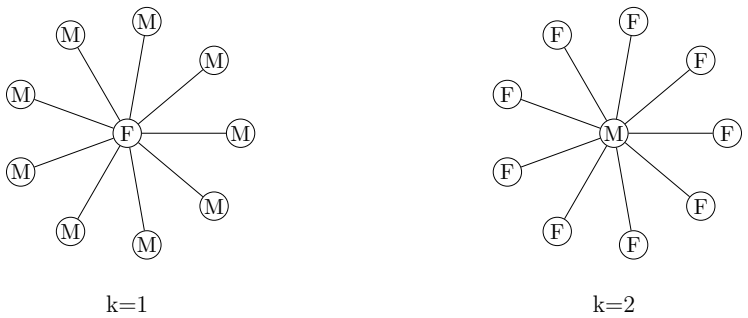
Take an undirected star graph with one center and four leaves, with pairwise spillover effects +1 from center to each leaf and −1 from each leaf to the center, and any assignment mechanism $\alpha$; the definitions give $\tau^{out}(\alpha)=-3/5$ and $\tau^{in}(\alpha)=3/5$, matching the nonzero status of equation (2). A single instance where the equality or difference of the two estimands disagreed with the zero or nonzero status of that weighted sum would refute Theorem 1.
Extended reading notes
Core claim
On the paper's own terms, the central discovery is a precise algebraic identity for the difference between the two spillover estimands. Let $\tau_{i_k j_k}(\alpha)$ be the pairwise spillover effect on unit $i$ when neighbor $j$ is treated, averaged over a hypothetical assignment $\alpha$ of the rest of the cluster. The outward effect weights each such pair by $1/(N^{out}|N^{out}_{j_k}|)$, averaging from the sender's perspective; the inward effect weights by $1/(N^{in}|N^{in}_{i_k}|)$, averaging from the receiver's perspective. Theorem 1 states that $\tau^{out}(\alpha)\neq\tau^{in}(\alpha)$ if and only if the degree-weighted sum over all sender–receiver pairs in equation (2) is nonzero. The paper further shows three sufficient conditions for equality: cluster-specific homogeneous pairwise effects on undirected graphs, globally homogeneous pairwise effects, or a constant degree-ratio condition; and it shows that even when the estimands coincide, the Horvitz-Thompson estimators can differ in variance.
Load-bearing premise
The comparison rests on the analyst's choice of the hypothetical assignment mechanism $\alpha$ that averages over the rest of each cluster; if that choice does not describe the policy scenario, the estimands and all equality conditions answer a different question.
Editorial extensions
If this is right
- Whenever the graph is non-regular and pairwise spillover effects are heterogeneous, estimates of outward and inward spillover effects will generally answer different questions, so studies should state which perspective they target.
- Under Conditions 1, 2, or 3 the two estimands coincide, so either Horvitz-Thompson estimator is unbiased for both; the variance formulas then determine which estimator is preferable for a given graph.
- The gap between the conservative variance bound and the true variance grows with the magnitude of pairwise spillover effects and with cluster size, and shrinks as the number of clusters grows, so confidence intervals may be needlessly wide in clustered designs with strong interference.
- For star graphs, the direction of the edges decides efficiency: outward-facing stars make the outward estimator less variable, while inward-facing stars make the inward estimator less variable.
- Asymptotic normality requires many clusters of bounded size; with a few large clusters the normal approximation and the associated confidence intervals are not justified.
Reading between the lines
- The degree-weight decomposition in the proof suggests a ready extension: cluster-weighted estimands, exposure-mapped variants, or conditional effects with continuous covariates should obey the same algebra as long as the averaging weights factor into sender and receiver components.
- In policy terms, the outward effect identifies whom to treat to generate benefits for others, whereas the inward effect identifies whom to protect; the paper does not tell the analyst which perspective a vaccination or information campaign should adopt, but it makes the consequences of that choice explicit.
- Because the estimands are indexed by the hypothetical assignment $\alpha$, the same experimental data can be used to evaluate several policy scenarios as long as each $\alpha$ is covered by the realized design; this decouples the scientific estimand from the actual randomization scheme.
- Condition 3 offers a purely graphical route to equivalence that does not require homogeneous effects, so it can be checked from degrees alone; in empirical networks this is the most practical sufficient condition.
Editorial analysis
A structured set of objections, weighed in public.
Referee Report
Summary. The manuscript defines two average spillover estimands under partial interference in clustered networks: the outward effect, which averages a sender's effect on its out-neighbors' outcomes, and the inward effect, which averages a receiver's outcome change caused by the treatment of one of its in-neighbors. Both estimands marginalize over a hypothetical assignment mechanism α within the rest of the cluster. The central result (Theorem 1) gives a necessary and sufficient condition for the two estimands to differ, expressed as a degree-weighted sum of pairwise spillover effects; Conditions 1–3 supply interpretable sufficient conditions for equality. The paper then proposes Horvitz-Thompson estimators for both estimands, proves unbiasedness, asymptotic normality, conservative variance bounds, and consistent variance estimators, and compares the conservative and true variances analytically and by simulation, including outward and inward star graphs. The theoretical development is carried out through direct algebra, with proofs in the appendix.
Significance. If the results hold, the paper provides a useful clarification of when sender- and receiver-perspective spillover effects coincide, which is directly relevant to choosing estimands in network experiments. Theorem 1 is a clean algebraic characterization, the sufficient conditions are interpretable (homogeneous pairwise effects or degree-ratio balance), and the worked examples make the distinction concrete. The inference section extends standard Horvitz-Thompson weighting to these estimands and gives explicit conservative variances, with simulations validating the analytical comparisons. A notable strength is that the central theorem is derived from definitions without fitting any parameter to data, and the proofs are checkable from the displayed algebra. The dependence of both estimands on the analyst-chosen α is a design choice rather than an internal inconsistency, though it is a limitation the authors could state more prominently. The main substantive gap is the absence of an explicit cross-cluster independence assumption for the design-based inference results.
major comments (1)
- [Section 4; proof of Proposition 3, around equation (27)] The proof of Proposition 3 uses cov(V_{j k_1}, V_{i k_2}) = 0 for k_1 ≠ k_2, and the proof of Proposition 2 requires each U_{j k} to be correlated with at most a constant number of units. These facts follow only if treatment assignment is independent (or at least uncorrelated) across clusters, an assumption that is never stated. Assumptions 3–6 do not imply it, and Section 4 explicitly allows assignment to be 'dependent' without restricting the dependence to within clusters. Without a cross-cluster independence assumption, V^c(τ̂_out) and V^c(τ̂_in) need not be conservative and the stated CLT in Proposition 2 may fail. Please add an explicit assumption that treatment vectors are independent across clusters (while allowing arbitrary within-cluster dependence), and propagate it to Propositions 6 and 7, which inherit this requirement.
minor comments (5)
- [Definition 5] In the display for τ̂_in(α), the second weight is written as \tilde W^0_{jk}(Z_k), but it should be \tilde W^0_{ik}(Z_k); the same subscript slip appears in equation (13) of Appendix E.
- [Definitions 2 and 3] The sets N_out_k and N_in_k are written as subsets of N (all units) rather than N_k (the k-th cluster). Taken literally, N_out and N_in would count each unit K times; these definitions should read N_out_k ⊆ N_k and N_in_k ⊆ N_k.
- [Table 1 and Appendix C.1] The quantity H_jk is defined as (N_out·|N_out_jk|)^{-1} − (N_in·|N_in_ik|)^{-1}, but the numerical values listed in Table 1 and the expressions in Appendix C.1 use the product (A−B)(A+B) = A^2 − B^2. Please align the label H_jk with the quantity actually used in the subsequent calculations.
- [Section 5, discussion after Proposition 5] The statement that the conservative-variance bias 'grows as |N_out_k| increases' should be qualified, because N_out and N_in also change with the graph size; as written, the sentence can be misread as a monotone claim independent of the denominators appearing in Proposition 5.
- [Section 2, Definitions 2–3] The dependence of both estimands on α is clear from the definitions, but the paper would benefit from an explicit sentence in the discussion advising that α should be chosen to match the policy scenario of interest, since otherwise the equality or inequality results may not answer the intended scientific question.
Circularity Check
No significant circularity: Theorem 1 and the estimator properties follow by direct algebra from the definitions and stated assumptions, with no fitted parameter presented as a prediction.
full rationale
The paper's central results are derived self-containedly. Theorem 1 follows from Definitions 2 and 3 by the summation reordering shown in equations (17) and (18), so it is a genuine algebraic characterization rather than a restatement of an input. Conditions 1, 2, and 3 are proven from the same definitions in Appendix F.1. The unbiasedness of the Horvitz-Thompson estimators in Proposition 1 is proven directly from the definition of the weight W_jk(Z_k) and Assumptions 1 and 3, and the CLT in Proposition 2 uses the boundedness and dependence conditions from Assumptions 4, 5, and 6. The variance propositions are analytical comparisons of the derived variance expressions. The paper does cite Wang et al. (2024) for the conservative variance construction and CLT lemma, but Wang et al. (2024) is not authored by any of the present authors, so this is external support rather than a self-citation chain. Moreover, the borrowings are methodological tools, not the central estimand comparison, which stands on its own algebra. No fitted input is renamed as a prediction, and no estimand is defined in terms of another estimand in a way that forces the stated equivalence. The only concerns visible in the manuscript are typographical: Table 1 labels H_jk as a first-order reciprocal difference while the calculations actually use the product of that difference and the corresponding sum, and Definition 5 has a subscripts slip in the notation for the control weight. These are correctness or presentation issues, not circularity, and they do not affect the theorem or the qualitative efficiency comparisons because the displayed numerical values are the ones used in the calculations.
Assumptions & free parameters
assumptions (7)
- domain assumption Assumption 1: Partial interference. Potential outcomes depend only on the treatment vector within the same cluster.
- domain assumption Assumption 2: No fully isolated clusters. Each cluster has at least one unit with an in-neighbor.
- domain assumption Assumption 3: Overlap between hypothetical and realized treatment assignments. Any treatment vector with positive hypothetical probability also has positive realized probability.
- domain assumption Assumption 4: Positivity of realized treatments. The probability of any feasible treatment vector is uniformly bounded below by a positive constant.
- domain assumption Assumption 5: Constant cluster size. n_k = O(1) for all clusters.
- domain assumption Assumption 6: Bounded potential outcomes. There exists a constant C such that |Y_ik(z_k)| <= C for all units and treatment vectors.
- standard math Standard probability and measure-theoretic background for design-based inference, including the CLT lemma from Ogburn et al. (2022) and Wang et al. (2024).
Cite this review
Pith. "Pith review of Inward and Outward Spillover Effects of One Unit's Treatment on Network Neighbors under Partial Interference." pith.science (2026). https://pith.science/paper/MKDR725U
@misc{pith2026250606615,
  author       = {Pith},
  title        = {Pith review of: Inward and Outward Spillover Effects of One Unit's Treatment on Network Neighbors under Partial Interference},
  year         = {2026},
  howpublished = {\url{https://pith.science/paper/MKDR725U}},
  note         = {Machine review of arXiv:2506.06615}
}
read the original abstract
In settings where interference is present, direct effects are commonly defined as the average effect of a unit's treatment on their own outcome while fixing the treatment status or probability among interfering units, and spillover effects measure the average effect of a change in the latter while the individual's treatment status is kept fixed. Here, we define the average causal effect of a unit's treatment status on the outcome of their network neighbors, while fixing the treatment probability in the remaining interference set. We propose two different weighting schemes defining two causal effects: i) the outward spillover effect, which represents the average effect of a unit's treatment on their neighbors' potential outcomes, and ii) the inward spillover effect, which represents the impact of each neighbor's treatment on an individual's own potential outcome. We prove that outward and inward spillover effects generally differ, even in an undirected network. However, under specific conditions these two causal estimands become equivalent. We provide numerous examples illustrating the conditions for equivalence or discrepancy of the two spillover effects. We then compare their Horvitz-Thompson estimators, examining their relative variance under various graph structures and structural assumptions on potential outcomes.
Figures


Figures from the paper (7 more)



Reference graph
Works this paper leans on
-
[1]
Allison E Aiello, Amanda M Simanek, Marisa C Eisenberg, Alison R Walsh, Brian Davis, Erik Volz, Caroline Cheng, Jeanette J Rainey, Amra Uzicanin, Hongjiang Gao, et al. Design and methods of a social network isolation study for reducing respiratory infection transmission: The ex-flu cluster randomized trial. Epidemics, 15: 0 38--55, 2016
work page 2016
-
[2]
Induction of social contagion for diverse outcomes in structured experiments in isolated villages
Edoardo M Airoldi and Nicholas A Christakis. Induction of social contagion for diverse outcomes in structured experiments in isolated villages. Science, 384 0 (6695): 0 eadi5147, 2024
work page 2024
-
[3]
Causal inference with networked treatment diffusion
Weihua An. Causal inference with networked treatment diffusion. Sociological Methodology, 48 0 (1): 0 152--181, 2018
work page 2018
-
[4]
A general method for detecting interference between units in randomized experiments
Peter M Aronow. A general method for detecting interference between units in randomized experiments. Sociological Methods & Research, 41 0 (1): 0 3--16, 2012
work page 2012
-
[5]
Peter M Aronow and Cyrus Samii. Estimating average causal effects under general interference, with application to a social network experiment. The Annals of Applied Statistics, 11 0 (4): 0 1912--1947, 2017
work page 1912
-
[6]
Exact p-values for network interference
Susan Athey, Dean Eckles, and Guido W Imbens. Exact p-values for network interference. Journal of the American Statistical Association, 113 0 (521): 0 230--240, 2018
work page 2018
-
[7]
Emergence of scaling in random networks
Albert-L \'a szl \'o Barab \'a si and R \'e ka Albert. Emergence of scaling in random networks. science, 286 0 (5439): 0 509--512, 1999
1999
-
[8]
Neighbors' effects on university enrollment
Andr \'e s Barrios-Fern \'a ndez. Neighbors' effects on university enrollment. American Economic Journal: Applied Economics, 14 0 (3): 0 30--60, 2022
work page 2022
Show all 43 references
-
[9]
Analyzing two-stage experiments in the presence of interference
Guillaume Basse and Avi Feller. Analyzing two-stage experiments in the presence of interference. Journal of the American Statistical Association, 113 0 (521): 0 41--55, 2018
2018
-
[10]
Randomization tests of causal effects under interference
Guillaume W Basse, Avi Feller, and Panos Toulis. Randomization tests of causal effects under interference. Biometrika, 106 0 (2): 0 487--494, 2019
2019
-
[11]
An essay on the logical foundations of survey sampling, part one
Debabrata Basu. An essay on the logical foundations of survey sampling, part one. Springer, 2011
2011
-
[12]
Spillover effects on health outcomes in low-and middle-income countries: a systematic review
Jade Benjamin-Chung, Jaynal Abedin, David Berger, Ashley Clark, Veronica Jimenez, Eugene Konagaya, Diana Tran, Benjamin F Arnold, Alan E Hubbard, Stephen P Luby, et al. Spillover effects on health outcomes in low-and middle-income countries: a systematic review. International ...
2017
-
[13]
Spillover effects in epidemiology: parameters, study designs and methodological considerations
Jade Benjamin-Chung, Benjamin F Arnold, David Berger, Stephen P Luby, Edward Miguel, John M Colford Jr, and Alan E Hubbard. Spillover effects in epidemiology: parameters, study designs and methodological considerations. International journal of epidemiology, 47 0 (1): 0 332--347, 2018
2018
-
[14]
Social networks and the decision to insure
Jing Cai, Alain De Janvry, and Elisabeth Sadoulet. Social networks and the decision to insure. American Economic Journal: Applied Economics, 7 0 (2): 0 81--108, 2015
2015
-
[15]
Direct and spillover effects of middle school vaccination requirements
Christopher S Carpenter and Emily C Lawler. Direct and spillover effects of middle school vaccination requirements. American Economic Journal: Economic Policy, 11 0 (1): 0 95--125, 2019
2019
-
[16]
Design and analysis of experiments in networks: Reducing bias from interference
Dean Eckles, Brian Karrer, and Johan Ugander. Design and analysis of experiments in networks: Reducing bias from interference. Journal of Causal Inference, 5 0 (1): 0 20150021, 2017
2017
-
[17]
On random graphs i
Paul Erd o s and Alfr\' e d R\' e ny. On random graphs i. Publ. math. debrecen, 6 0 (290-297): 0 18, 1959
1959
-
[18]
Targeted social distancing designs for pandemic influenza
Robert J Glass, Laura M Glass, Walter E Beyeler, and H Jason Min. Targeted social distancing designs for pandemic influenza. Emerging infectious diseases, 12 0 (11): 0 1671, 2006
2006
-
[19]
Estimating population effects of vaccination using large, routinely collected data
M Elizabeth Halloran and Michael G Hudgens. Estimating population effects of vaccination using large, routinely collected data. Statistics in medicine, 37 0 (2): 0 294--301, 2018
2018
-
[20]
Randomization test for the specification of interference structure, 2023
Tadao Hoshino and Takahide Yanagi. Randomization test for the specification of interference structure, 2023. URL https://arxiv.org/abs/2301.05580
2023 arXiv
-
[21]
Average direct and indirect causal effects under interference
Yuchen Hu, Shuangning Li, and Stefan Wager. Average direct and indirect causal effects under interference. Biometrika, 109 0 (4): 0 1165--1172, 2022
2022
-
[22]
Estimating effects of long-term treatments, 2023
Shan Huang, Chen Wang, Yuan Yuan, Jinglong Zhao, and Jingjing Zhang. Estimating effects of long-term treatments, 2023. URL https://arxiv.org/abs/2308.08152
2023
-
[23]
Toward causal inference with interference
Michael G Hudgens and M Elizabeth Halloran. Toward causal inference with interference. Journal of the American Statistical Association, 103 0 (482): 0 832--842, 2008
2008
-
[24]
Causal inference under approximate neighborhood interference
Michael P Leung. Causal inference under approximate neighborhood interference. Econometrica, 90 0 (1): 0 267--293, 2022
2022
-
[25]
Large sample randomization inference of causal effects in the presence of interference
Lan Liu and Michael G Hudgens. Large sample randomization inference of causal effects in the presence of interference. Journal of the american statistical association, 109 0 (505): 0 288--301, 2014
2014
-
[26]
On inverse probability-weighted estimators in the presence of interference
Lan Liu, Michael G Hudgens, and Sylvia Becker-Dreps. On inverse probability-weighted estimators in the presence of interference. Biometrika, 103 0 (4): 0 829--842, 2016
2016
-
[27]
Identification of endogenous social effects: The reflection problem
Charles F Manski. Identification of endogenous social effects: The reflection problem. The review of economic studies, 60 0 (3): 0 531--542, 1993
1993
-
[28]
Causal inference for social network data
Elizabeth L Ogburn, Oleg Sofrygin, Ivan Diaz, and Mark J Van der Laan. Causal inference for social network data. Journal of the American Statistical Association, pages 1--15, 2022
2022
-
[29]
Maternal and child health intervention to promote behaviour change: a population-level cluster-randomised controlled trial in honduras
William Oles, Marcus Alexander, Rennie Negron, Jennifer Nelson, Emma Iriarte, Edoardo M Airoldi, Nicholas A Christakis, and Laura Forastiere. Maternal and child health intervention to promote behaviour change: a population-level cluster-randomised controlled trial in honduras....
2024
-
[30]
Changing climates of conflict: A social network experiment in 56 schools
Elizabeth Levy Paluck, Hana Shepherd, and Peter M Aronow. Changing climates of conflict: A social network experiment in 56 schools. Proceedings of the National Academy of Sciences, 113 0 (3): 0 566--571, 2016
2016
-
[31]
Causal inference with interfering units for cluster and population level treatment allocation programs
Georgia Papadogeorgou, Fabrizia Mealli, and Corwin M Zigler. Causal inference with interfering units for cluster and population level treatment allocation programs. Biometrics, 75 0 (3): 0 778--787, 2019
2019
-
[32]
Efficient semiparametric estimation of network treatment effects under partial interference
Chan Park and Hyunseung Kang. Efficient semiparametric estimation of network treatment effects under partial interference. Biometrika, 109 0 (4): 0 1015--1031, 2022
2022
-
[33]
A graph-theoretic approach to randomization tests of causal effects under general interference
David Puelz, Guillaume Basse, Avi Feller, and Panos Toulis. A graph-theoretic approach to randomization tests of causal effects under general interference. Journal of the Royal Statistical Society Series B: Statistical Methodology, 84 0 (1): 0 174--204, 2022
2022
-
[34]
Herd immunity: understanding covid-19
Haley E Randolph and Luis B Barreiro. Herd immunity: understanding covid-19. Immunity, 52 0 (5): 0 737--741, 2020
2020
-
[35]
Randomization analysis of experimental data: The fisher randomization test comment
Donald B Rubin. Randomization analysis of experimental data: The fisher randomization test comment. Journal of the American statistical association, 75 0 (371): 0 591--593, 1980
1980
-
[36]
Model assisted survey sampling
Carl-Erik S \"a rndal, Bengt Swensson, and Jan Wretman. Model assisted survey sampling. Springer Science & Business Media, 2003
2003
-
[37]
Elements of estimation theory for causal effects in the presence of network interference
Daniel L Sussman and Edoardo M Airoldi. Elements of estimation theory for causal effects in the presence of network interference. arXiv preprint arXiv:1702.03578, 2017
2017 arXiv
-
[38]
On causal inference in the presence of interference
Eric J Tchetgen Tchetgen and Tyler J VanderWeele. On causal inference in the presence of interference. Statistical methods in medical research, 21 0 (1): 0 55--75, 2012
2012
-
[39]
Causal effects with hidden treatment diffusion on observed or partially observed networks, 2021
Costanza Tortú, Irene Crimaldi, Fabrizia Mealli, and Laura Forastiere. Causal effects with hidden treatment diffusion on observed or partially observed networks, 2021. URL https://arxiv.org/abs/2109.07502
2021 arXiv
-
[40]
Bounding the infectiousness effect in vaccine trials
Tyler J VanderWeele and Eric J Tchetgen Tchetgen. Bounding the infectiousness effect in vaccine trials. Epidemiology, 22 0 (5): 0 686--693, 2011
2011
-
[41]
Ye Wang, Cyrus Samii, Haoge Chang, and P. M. Aronow. Design-based inference for spatial experiments under unknown interference, 2024. URL https://arxiv.org/abs/2010.13599
2024 arXiv
-
[42]
Altenburger
Yuan Yuan and Kristen M. Altenburger. A two-part machine learning approach to characterizing network interference in a/b testing, 2024. URL https://arxiv.org/abs/2308.09790
2024 arXiv
-
[43]
Bipartite causal inference with interference
Corwin M Zigler and Georgia Papadogeorgou. Bipartite causal inference with interference. Statistical science: a review journal of the Institute of Mathematical Statistics, 36 0 (1): 0 109, 2021
2021
Reviewed August 7, 2026 · model on record in the stance chip above.
Discussion (0). Sign in to comment.