REVIEW 4 major objections 4 minor 81 references
Characterizing Stellar and Gas Properties in NGC 628: Spatial Distributions, Radial Gradients, and Resolved Scaling Relations
T0 review · 4 major / 4 minor · reviewed 2026-08-12 · deepseek-v4-flash
Pith's one-line read In the face-on spiral NGC 628, local gas-phase metallicity depends on stellar mass surface density alone, with no detectable extra dependence on star formation rate or neutral hydrogen column.
desk verdict A solid, mostly reproducible measurement paper whose headline null result—no secondary rMZR dependence—outruns its evidence; the FAST H I map is the real new contribution. read the letter →
The pith
A machine-rendered reading of the paper's core claim, the machinery that carries it, and where it could break.
The reading
What carries the argument
The central machinery is the pairing of H II region spectroscopy with SED-derived stellar mass surface densities and single-dish H I images. Oxygen abundances come from the O3N2 strong-line calibrator applied to extinction-corrected line ratios; stellar mass surface densities come from SED fitting to 23 photometric bands with stellar population synthesis models; and H I column densities come from FAST observations. The resolved relations are tested by fitting the rMZR and rSFMS and examining color-coded residuals against candidate third parameters.
What would settle it
If a deeper spectroscopic survey of NGC 628's outer disk (R/R$_{25}$ > 0.5) found a statistically significant correlation between metallicity residuals and $\Sigma_{\rm HI}$ or $\Sigma_{\rm SFR}$ after removing the $\Sigma_\star$ trend, the claimed null secondary dependence would be contradicted.
Extended reading notes
Core claim
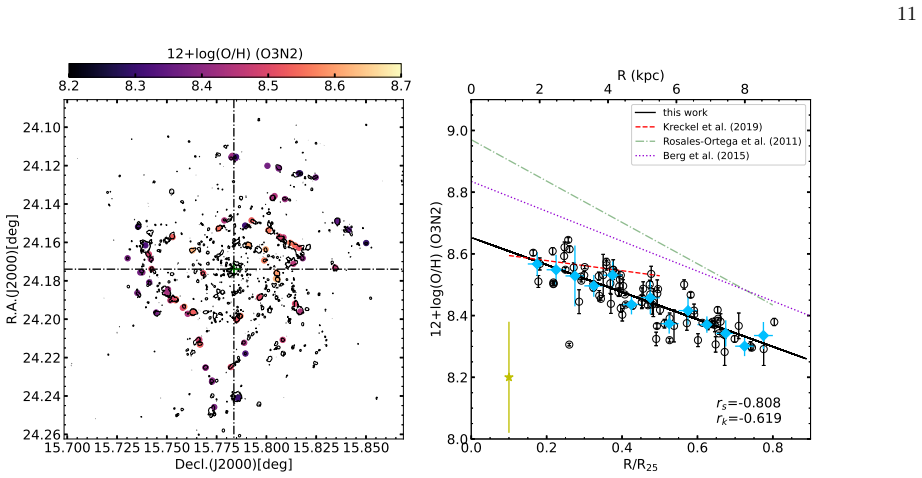
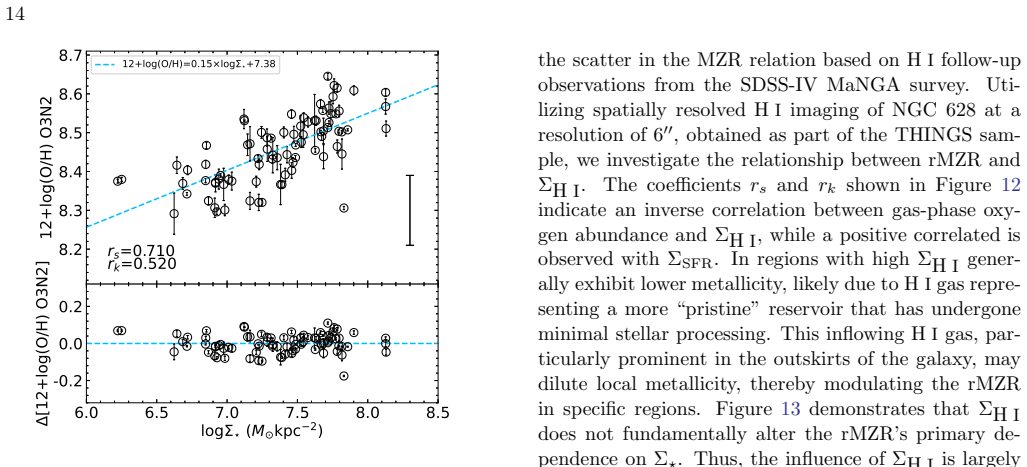
Using 85 H II regions with S/N > 5 in H$\alpha$, H$\beta$, [O III], and [N II], the authors find a resolved mass–metallicity relation of slope $0.15 \pm 0.02$ dex per log $\Sigma_\star$ over $0.15 < R/R_{25} < 0.9$, consistent with comparable ~100 pc studies. They find no significant secondary dependence of the rMZR on E(B − V), $\Sigma_{\rm SFR}$, EW(H$\alpha$), or $\Sigma_{\rm HI}$. The oxygen abundance gradient is $-0.443 \pm 0.037$ dex $R_{25}^{-1}$, close to the direct-Te gradient from earlier work but with a lower normalization. FAST H I imaging reveals an extended disk of ~90 kpc at $N_{\rm HI} \geq 10^{19}$ cm$^{-2}$ and a total H I mass of $7.1 \times 10^9$ $M_\odot$, 1.86 times the value from the THINGS survey, with regular kinematics that indicate an isolated galaxy with ongoing gas accretion into an inner disk. The resolved star formation main sequence has slope $0.48 \pm 0.08$ dex per log $\Sigma_\star$, and both gas-phase extinction and EW(H$\alpha$) rise with $\Sigma_{\rm SFR}$.
Load-bearing premise
The 85 H II regions with S/N > 5 are assumed to be a fair sample of NGC 628's disk, but the faintest and outermost regions are likely missing, so if missing regions correlate with metallicity or H I column, both the gradient and the null secondary dependence could be biased.
Editorial extensions
If this is right
- Within NGC 628, metallicity is predictable from stellar mass surface density alone at ~100 pc scales, so local metal maps can be reconstructed from stellar maps.
- The null secondary dependence constrains gas-regulator models: in this galaxy, neither star formation rate nor H I column leaves a detectable imprint on the rMZR.
- The steep negative abundance gradient and positive EW(H$\alpha$) gradient support an “inside-out” growth scenario for NGC 628.
- The FAST H I disk extends to ~90 kpc and holds $7.1 \times 10^9$ $M_\odot$, implying a large reservoir of low-column-density gas that is not yet chemically processed.
- The resolved star formation main sequence slope of 0.48 matches the low-density end of other ~100 pc studies, confirming the relation holds at sub-kiloparsec scales.
Reading between the lines
- The null result may reflect the limited dynamic range of $\Sigma_{\rm HI}$ at the H II region positions; galaxies with stronger radial H I variations could still show a secondary dependence.
- If the null holds across a larger galaxy sample, the H I-based secondary dependencies seen in integrated MZR studies may be driven by galaxy-to-galaxy variations rather than by local gas physics.
- A direct-Te recalibration of the same spectra could shift the gradient’s normalization but should preserve the null if the secondary dependence truly is absent.
Editorial analysis
A structured set of objections, weighed in public.
Referee Report
Summary. The paper compiles long-slit spectroscopy of 85 H II regions in NGC 628, multi-band photometry from UV to IR, and FAST/THINGS H I imaging to derive gas-phase extinction, SFR surface density, stellar mass surface density, oxygen abundance (O3N2 calibration), and resolved scaling relations. It reports a negative oxygen gradient (-0.443 dex R25^-1), a mild extinction gradient, a resolved SFMS slope of 0.48, and an extended FAST H I disk (~90 kpc, total mass 7.1e9 M_sun). The headline claim is that the resolved mass-metallicity relation (rMZR) shows no secondary dependence on SFR surface density or H I mass surface density. The paper also interprets the azimuthal uniformity and H I kinematics as evidence that NGC 628 is isolated and follows an inside-out growth scenario.
Significance. If the null secondary dependence is correct, the result would provide a useful single-galaxy constraint on resolved scaling relations in a low-inclination, isolated disk, complementing statistical MaNGA or MUSE samples. The FAST detection of extended H I and the revised total H I mass are valuable additions, and the paper offers a reference set of H II region measurements in Table 2. However, the statistical support for the headline null is currently insufficient: it rests on color-coded diagrams and unpartialled Spearman coefficients rather than residual or partial-correlation tests, and one section of the text explicitly states that the Sigma_SFR dependence is unclear. The claim should therefore be treated as tentative until the missing analysis is supplied.
major comments (4)
- [Abstract and §4.2.1] The central claim is internally inconsistent. Section 4.2.1 states, 'It remains unclear whether the relationship between rMZR and Sigma_SFR arises from the rSFMS or is influenced by SFR as a secondary parameter within rMZR,' and §4.2.2 opens by repeating this ambiguity. The Abstract and Summary (iii) nevertheless assert 'no secondary dependency of the resolved MZR on SFR surface density or H I mass surface density.' The abstract and summary must be limited to what the analysis supports, or the analysis must be extended to remove the ambiguity.
- [§4.2.1, Figures 10-13] The claimed null is not demonstrated statistically. Figure 12 reports whole-sample Spearman coefficients (e.g., r_s = 0.395 for 12+log(O/H) versus Sigma_SFR and r_s = -0.260 versus Sigma_HI), but these are marginal correlations that do not remove the dominant dependence on Sigma_star. The residual plot in Figure 10 shows Delta[12+log(O/H)] only against Sigma_star, not against any third parameter. Figures 11 and 13 color-code the rMZR by Sigma_SFR, EW(Ha), E(B-V), and Sigma_HI but perform no quantitative test. To support a null, the authors should compute partial Spearman correlations or residual-based correlations of the rMZR residuals with each third parameter, including uncertainties, and verify consistency with zero.
- [§4.2.2, Table 2] The resolved H I surface density used in the rMZR test is the THINGS 6-arcsec map (Table 2, columns 14-15), not the new FAST data. The extended low-column-density H I detected by FAST (column densities down to 5.2 x 10^18 cm^-2) is therefore excluded from the rMZR analysis. The abstract's 'no secondary dependency on H I mass surface density' is broader than the analysis supports. Please restrict the claim to the THINGS-resolution disk or construct a FAST-based Sigma_HI map at matched resolution and repeat the test.
- [§2.1, Table 2] The sample selection and completeness are not quantified. From 183 extracted spectra, 56 are rejected at the visual-inspection stage and only 85 have S/N > 5 in all four lines. The faintest and outermost H II regions are likely under-represented; if this selection correlates with metallicity or Sigma_HI, it could bias both the radial gradient in §4.1.3 and the null secondary-dependence claim. Please provide a radial completeness analysis and a check of whether including fainter regions (where possible) or simulating the selection changes the residual correlations.
minor comments (4)
- [§3.4, §3.6, Table 2] There is a unit inconsistency: Eqs. (3) and (6) define Sigma_SFR and Sigma_star in M_sun yr^-1 pc^-2 and M_sun pc^-2, respectively, while Table 2 lists logarithmic values in M_sun yr^-1 kpc^-2 and M_sun kpc^-2. The figures also vary between pc^-2 and kpc^-2. Please standardize the units in the text, table, and figures, or explicitly state the conversion used.
- [Throughout] The manuscript contains numerous typographical errors and unicode artifacts (e.g., 'parmeters', 'disbribution', 'esitmated', 'derivied', 'hightened', and rendered symbols such as '/uni2218' or 'M/uni2299' in figure axis labels). These should be corrected before publication.
- [§4.1.3] The comparison with Kreckel et al. (2019) uses their gradient of -0.164 dex R25^-1 over 0.1 < R/R25 < 0.5, while the present fit is over 0.15 < R/R25 < 0.9. A like-for-like radial-range fit would make the comparison more meaningful.
- [§4.2.3] In the text, the rSFMS intercept is quoted without units; since the accompanying figure uses pc^-2 units and Table 2 uses kpc^-2, specifying the units of the intercept is necessary to avoid ambiguity.
Circularity Check
No circular reduction: the resolved relations are direct fits to externally calibrated measurements, and the self-citations supply data products or methodology rather than the derived result.
full rationale
The derivation chain is not circular. Gas-phase metallicity comes from the O3N2 ratio with the external Marino et al. (2013) calibration (Eq. 5); SFR surface density comes from extinction-corrected H-alpha luminosity with the external Hao et al. (2011) calibration (Eq. 2); stellar mass surface density comes from SED fitting to multi-band photometry; and H I surface density comes from THINGS/FAST observations. The rMZR and rSFMS are then direct fits to these independently measured quantities, with no parameter fitted to a subset and then renamed as a prediction for the same data. The self-citations to Zou et al. (2011) and Wei et al. (2020, 2021) supply previously published imaging data and SED-fitting methodology; they are not used as unverified uniqueness theorems or to forbid alternative interpretations. The 'inside-out' interpretation is a consistency argument based on the observed gradients, not an output forced by the fitting procedure. The main weakness is evidentiary rather than circular: the claim of 'no secondary dependency' of the rMZR on Sigma_SFR or Sigma_HI is supported by color-coded visual inspection (Figs. 11 and 13) rather than a partial-correlation or residual test, and Section 4.2.1 itself states that 'it remains unclear whether the relationship between rMZR and Sigma_SFR arises from the rSFMS or is influenced by SFR as a secondary parameter within rMZR.' This internal tension affects the strength of the null claim, and the use of THINGS rather than FAST H I for the resolved rMZR test narrows its scope, but neither issue makes the claim equivalent to its inputs by construction. No circular step can be exhibited from the paper's equations or cited load-bearing premises.
Assumptions & free parameters
free parameters (2)
- O3N2 calibration coefficients =
intercept 8.533, slope -0.214
- H-alpha SFR conversion factor =
5.4e-42 Msun/yr per (erg/s)
assumptions (7)
- domain assumption O3N2 strong-line ratio is a single-valued, monotonic tracer of oxygen abundance over the range -1.1 < O3N2 < 1.7
- standard math The intrinsic Balmer decrement is H-alpha/H-beta = 2.86 for case B recombination at Te = 10^4 K, ne = 10^2 cm^-3
- domain assumption The Cardelli et al. (1989) extinction law with R_V = 3.1 describes the dust attenuation toward H II regions
- domain assumption Chabrier (2003) IMF and Bruzual & Charlot (2003) SSP templates give reliable stellar masses and SFRs
- domain assumption The 85 BPT-classified star-forming H II regions are representative of the ISM; DIG, shocks, and AGN contribute negligibly in the selected apertures
- domain assumption The FAST single-dish reduction (Wang et al. 2023) correctly separates extended H I from baseline systematics
- domain assumption NGC 628 is at distance 7.3 Mpc with inclination 7 degrees
Cite this review
Pith. "Pith review of Characterizing Stellar and Gas Properties in NGC 628: Spatial Distributions, Radial Gradients, and Resolved Scaling Relations." pith.science (2026). https://pith.science/paper/MKWHQ6PE
@misc{pith2026241116150,
  author       = {Pith},
  title        = {Pith review of: Characterizing Stellar and Gas Properties in NGC 628: Spatial Distributions, Radial Gradients, and Resolved Scaling Relations},
  year         = {2026},
  howpublished = {\url{https://pith.science/paper/MKWHQ6PE}},
  note         = {Machine review of arXiv:2411.16150}
}
abstract
Building on our previous research of multi-wavelength data from UV to IR, we employ spectroscopic observations of ionized gas, as well as neutral hydrogen gas obtained from the Five-hundred Meter Aperture Spherical Telescope (FAST), to explore the intrinsic processes of star formation and chemical enrichment within NGC 628. Our analysis focuses on several key properties, including gas-phase extinction, star formation rate (SFR) surface density, oxygen abundance, and H I mass surface density. The azimuthal distributions of these parameters in relation to the morphological and kinematic features of FAST H I reveal that NGC 628 is an isolated galaxy that has not undergone recent interactions. We observe a mild radial extinction gradient accompanied by a notable dispersion. The SFR surface density also shows a gentle radial gradient, characteristic of typical spiral galaxies. Additionally, we find a negative radial metallicity gradient of $-0.44$ dex $R_{25}^{-1}$, supporting the "inside-out" scenario of galaxy formation. We investigate the resolved Mass-Metallicity Relation (MZR) and the resolved Star Formation Main Sequence (SFMS) alongside their dependencies on the physical properties of both ionized and neutral hydrogen gas. Our findings indicate no secondary dependency of the resolved MZR on SFR surface density or H I mass surface density. Furthermore, we observe that gas-phase extinction and the equivalent width of H{\alpha} both increase with SFR surface density in the resolved SFMS.
Figures


Figures from the paper (12 more)






Reference graph
Works this paper leans on
-
[1]
thebibliography [1] 20pt to REFERENCES 6pt =0pt 10pt plus 3pt =0pt =0pt =1pt plus 1pt =0pt =0pt -12pt =13pt plus 1pt =20pt =13pt plus 1pt \@M =10000 =-1.0em =0pt =0pt 0pt =0pt =1.0em @enumiv\@empty 10000 10000 `\.\@m \@noitemerr \@latex@warning Empty `thebibliography' environment \@ifnextchar \@reference \@latexerr Missing key on reference command Each re...
-
[2]
Baldwin, J. A., Phillips, M. M., & Terlevich, R.\ 1981, , 93, 5. doi:10.1086/130766
doi:10.1086/130766 1981
-
[3]
K., Heckman, T
Barrera-Ballesteros, J. K., Heckman, T. M., Zhu, G. B., et al.\ 2016, , 463, 2513
2016
-
[4]
Barrera-Ballesteros, J. K., S \'a nchez, S. F., Espinosa-Ponce, C., et al.\ 2023, , 59, 213. doi:10.22201/ia.01851101p.2023.59.02.06
-
[5]
Berg, D. A., Skillman, E. D., Croxall, K. V., et al.\ 2015, , 806, 16. doi:10.1088/0004-637X/806/1/16
-
[6]
S., Maiolino, R., Cicone, C., et al.\ 2016, , 595, A48
Bothwell, M. S., Maiolino, R., Cicone, C., et al.\ 2016, , 595, A48. doi:10.1051/0004-6361/201527918
-
[7]
Bradley, L., Sip o cz, B., Robitaille, T., et al.\ 2022, Zenodo
work page 2022
-
[9]
Brown, T., Cortese, L., Catinella, B., et al.\ 2018, , 473, 1868. doi:10.1093/mnras/stx2452
Show all 81 references
-
[10]
doi:10.1046/j.1365-8711.2003.06897.x
Bruzual, G., & Charlot, S.\ 2003, , 344, 1000. doi:10.1046/j.1365-8711.2003.06897.x
2003
-
[11]
A., Law, D
Bundy, K., Bershady, M. A., Law, D. R., et al.\ 2015, , 798, 7. doi:10.1088/0004-637X/798/1/7
2015 doi
-
[12]
F., Zibetti, S., et al.\ 2016, , 821, L26
Cano-D \' az, M., S \'a nchez, S. F., Zibetti, S., et al.\ 2016, , 821, L26. doi:10.3847/2041-8205/821/2/L26
2016 doi
-
[13]
F., et al.\ 2019, , 488, 3929
Cano-D \' az, M., \'A vila-Reese, V., S \'a nchez, S. F., et al.\ 2019, , 488, 3929. doi:10.1093/mnras/stz1894
2019 doi
-
[14]
C., et al.\ 2000, , 533, 682
Calzetti, D., Armus, L., Bohlin, R. C., et al.\ 2000, , 533, 682. doi:10.1086/308692
2000 doi
-
[15]
A., Clayton, G
Cardelli, J. A., Clayton, G. C., & Mathis, J. S.\ 1989, , 345, 245. doi:10.1086/167900
1989 doi
-
[16]
doi:10.1051/0004-6361/201526023
Catal \'a n-Torrecilla, C., Gil de Paz, A., Castillo-Morales, A., et al.\ 2015, , 584, A87. doi:10.1051/0004-6361/201526023
2015 doi
- [17]
-
[18]
doi:10.3847/1538-4357/ac70d0
Chen, X., Wang, J., & Kong, X.\ 2022, , 933, 39. doi:10.3847/1538-4357/ac70d0
2022 doi
- [19]
-
[20]
doi:10.1111/j.1365-2966.2005.08752.x
Cid Fernandes, R., Mateus, A., Sodr \'e , L., et al.\ 2005, , 358, 363. doi:10.1111/j.1365-2966.2005.08752.x
2005
-
[21]
E., Urban, S
Corbin, T. E., Urban, S. E., & Warren, W. H.\ 1991, Astrographic Catalogue Reference Stars (Corbin and Urban 1991). Documentation for the machine-readable version., by Corbin, T. E.; Urban, S. E.; Warren, W. H., Jr.. National Aeronautics and Space Administration (NASA), Greenb...
1991
-
[22]
G., et al.\ 1995, VizieR Online Data Catalog, VII/155
de Vaucouleurs, G., de Vaucouleurs, A., Corwin, H. G., et al.\ 1995, VizieR Online Data Catalog, VII/155
1995
-
[23]
M., den Brok, M., et al.\ 2019, , 484, 5009
Erroz-Ferrer, S., Carollo, C. M., den Brok, M., et al.\ 2019, , 484, 5009. doi:10.1093/mnras/stz194
2019 doi
-
[24]
doi:10.1086/497385
Fabricant, D., Fata, R., Roll, J., et al.\ 2005, , 117, 1411. doi:10.1086/497385
2005 doi
-
[25]
doi:10.1086/118039
Fan, X., Burstein, D., Chen, J.-S., et al.\ 1996, , 112, 628. doi:10.1086/118039
1996 doi
-
[26]
doi:10.1088/1538-3873/128/969/115005
Fan, Z., Wang, H., Jiang, X., et al.\ 2016, , 128, 115005. doi:10.1088/1538-3873/128/969/115005
2016 doi
-
[27]
doi:10.3847/1538-4357/aae9f1
Gao, Y., Wang, E., Kong, X., et al.\ 2018, , 868, 89. doi:10.3847/1538-4357/aae9f1
2018 doi
-
[28]
M., P \'e rez, E., et al.\ 2019, , 621, A120
Garc \' a-Benito, R., Gonz \'a lez Delgado, R. M., P \'e rez, E., et al.\ 2019, , 621, A120. doi:10.1051/0004-6361/201833993
2019 doi
-
[29]
F., et al.\ 2007, , 173, 185
Gil de Paz, A., Boissier, S., Madore, B. F., et al.\ 2007, , 173, 185. doi:10.1086/516636
2007 doi
-
[30]
M., Cid Fernandes, R., P \'e rez, E., et al.\ 2016, , 590, A44
Gonz \'a lez Delgado, R. M., Cid Fernandes, R., P \'e rez, E., et al.\ 2016, , 590, A44. doi:10.1051/0004-6361/201628174
2016 doi
-
[31]
doi:10.1093/mnras/stad114
Groves, B., Kreckel, K., Santoro, F., et al.\ 2023, , 520, 4902. doi:10.1093/mnras/stad114
2023 doi
-
[32]
C., Johnson, B
Hao, C.-N., Kennicutt, R. C., Johnson, B. D., et al.\ 2011, , 741, 124. doi:10.1088/0004-637X/741/2/124
2011 doi
-
[33]
doi:10.3847/1538-4357/aaa6ca
Hu, N., Wang, E., Lin, Z., et al.\ 2018, , 854, 68. doi:10.3847/1538-4357/aaa6ca
2018 doi
-
[34]
C., Lin, L., Lin, J
Hsieh, B. C., Lin, L., Lin, J. H., et al.\ 2017, , 851, L24. doi:10.3847/2041-8213/aa9d80
2017 doi
-
[35]
doi:10.1007/s11433-018-9376-1
Jiang, P., Yue, Y., Gan, H., et al.\ 2019, Science China Physics, Mechanics, and Astronomy, 62, 959502. doi:10.1007/s11433-018-9376-1
2019 doi
-
[36]
doi:10.1088/1674-4527/20/5/64
Jiang, P., Tang, N.-Y., Hou, L.-G., et al.\ 2020, Research in Astronomy and Astrophysics, 20, 064. doi:10.1088/1674-4527/20/5/64
2020 doi
-
[37]
M., Tremonti, C., et al.\ 2003, , 346, 1055
Kauffmann, G., Heckman, T. M., Tremonti, C., et al.\ 2003, , 346, 1055. doi:10.1111/j.1365-2966.2003.07154.x
2003
-
[38]
Kennicutt, R. C. & Garnett, D. R.\ 1996, , 456, 504. doi:10.1086/176675
1996 doi
-
[39]
C., Armus, L., Bendo, G., et al.\ 2003, , 115, 928
Kennicutt, R. C., Armus, L., Bendo, G., et al.\ 2003, , 115, 928. doi:10.1086/376941
2003 doi
-
[40]
Kennicutt, R. C. & Evans, N. J.\ 2012, , 50, 531. doi:10.1146/annurev-astro-081811-125610
2012 doi
-
[41]
J., Dopita, M
Kewley, L. J., Dopita, M. A., Sutherland, R. S., et al.\ 2001, , 556, 121. doi:10.1086/321545
2001 doi
-
[42]
Kewley, L. J. & Dopita, M. A.\ 2002, , 142, 35. doi:10.1086/341326
2002 doi
-
[44]
rong ., et al.\ 2014, , 38, 427
Kong, X., Lin, L., Li, J.-. rong ., et al.\ 2014, , 38, 427. doi:10.1016/j.chinastron.2014.10.009
2014 doi
-
[45]
A., et al.\ 2019, , 887, 80
Kreckel, K., Ho, I.-T., Blanc, G. A., et al.\ 2019, , 887, 80. doi:10.3847/1538-4357/ab5115
2019 doi
-
[46]
& Weidner, C.\ 2003, , 598, 1076
Kroupa, P. & Weidner, C.\ 2003, , 598, 1076. doi:10.1086/379105
2003 doi
-
[47]
doi:10.3847/1538-4357/aa6f14
Lin, Z., Hu, N., Kong, X., et al.\ 2017, , 842, 97. doi:10.3847/1538-4357/aa6f14
2017 doi
-
[48]
A., Rosales-Ortega, F
Marino, R. A., Rosales-Ortega, F. F., S \'a nchez, S. F., et al.\ 2013, , 559, A114. doi:10.1051/0004-6361/201321956
2013 doi
-
[49]
M., Heckman, T
Moran, S. M., Heckman, T. M., Kauffmann, G., et al.\ 2012, , 745, 66. doi:10.1088/0004-637X/745/1/66
2012 doi
- [50]
-
[51]
Moustakas, J., Zaritsky, D., Brown, M., et al.\ 2011, arXiv:1112.3300
2011 arXiv
-
[52]
doi:10.1142/S0218271811019335
Nan, R., Li, D., Jin, C., et al.\ 2011, International Journal of Modern Physics D, 20, 989. doi:10.1142/S0218271811019335
2011 doi
-
[53]
Osterbrock, D. E. & Ferland, G. J.\ 2006, Astrophysics of gaseous nebulae and active galactic nuclei, 2nd. ed. by D.E. Osterbrock and G.J. Ferland. Sausalito, CA: University Science Books, 2006
2006
-
[54]
doi:10.1093/mnras/stab449
Parikh, T., Thomas, D., Maraston, C., et al.\ 2021, , 502, 5508. doi:10.1093/mnras/stab449
2021 doi
-
[55]
doi:10.1051/0004-6361/202140733
Pessa, I., Schinnerer, E., Belfiore, F., et al.\ 2021, , 650, A134. doi:10.1051/0004-6361/202140733
2021 doi
-
[56]
& Pagel, B
Pettini, M. & Pagel, B. E. J.\ 2004, , 348, L59. doi:10.1111/j.1365-2966.2004.07591.x
2004
-
[57]
Pilyugin, L. S. & Thuan, T. X.\ 2005, , 631, 231. doi:10.1086/432408
2005 doi
-
[58]
& Peng, Y.-
Renzini, A. & Peng, Y.-. jie .\ 2015, , 801, L29. doi:10.1088/2041-8205/801/2/L29
2015 doi
-
[59]
F., D \' az, A
Rosales-Ortega, F. F., D \' az, A. I., Kennicutt, R. C., et al.\ 2011, , 415, 2439. doi:10.1111/j.1365-2966.2011.18870.x
2011
-
[60]
F., S \'a nchez, S
Rosales-Ortega, F. F., S \'a nchez, S. F., Iglesias-P \'a ramo, J., et al.\ 2012, , 756, L31. doi:10.1088/2041-8205/756/2/L31
2012 doi
-
[61]
F., M \'e ndez-Abreu, J., et al.\ 2014, , 570, A6
S \'a nchez-Bl \'a zquez, P., Rosales-Ortega, F. F., M \'e ndez-Abreu, J., et al.\ 2014, , 570, A6. doi:10.1051/0004-6361/201423635
2014 doi
-
[62]
doi:10.1093/mnras/stt1984
S \'a nchez-Bl \'a zquez, P., Rosales-Ortega, F., Diaz, A., et al.\ 2014, , 437, 1534. doi:10.1093/mnras/stt1984
2014 doi
-
[64]
F., Rosales-Ortega, F
S \'a nchez, S. F., Rosales-Ortega, F. F., Iglesias-P \'a ramo, J., et al.\ 2014, , 563, A49
2014
-
[65]
F., Barrera-Ballesteros, J
S \'a nchez, S. F., Barrera-Ballesteros, J. K., L \'o pez-Cob \'a , C., et al.\ 2019, , 484, 3042. doi:10.1093/mnras/stz019
2019 doi
-
[66]
F.\ 2020, , 58, 99
S \'a nchez, S. F.\ 2020, , 58, 99. doi:10.1146/annurev-astro-012120-013326
2020 doi
-
[67]
F., P \'e rez, I., et al.\ 2018, , 609, A119
S \'a nchez-Menguiano, L., S \'a nchez, S. F., P \'e rez, I., et al.\ 2018, , 609, A119. doi:10.1051/0004-6361/201731486
2018 doi
-
[68]
Schlafly, E. F. & Finkbeiner, D. P.\ 2011, , 737, 103. doi:10.1088/0004-637X/737/2/103
2011 doi
-
[69]
J., Finkbeiner, D
Schlegel, D. J., Finkbeiner, D. P., & Davis, M.\ 1998, , 500, 525. doi:10.1086/305772
1998 doi
-
[70]
S., Steinhardt, C
Speagle, J. S., Steinhardt, C. L., Capak, P. L., et al.\ 2014, , 214, 15. doi:10.1088/0067-0049/214/2/15
2014 doi
-
[71]
A., Heckman, T
Tremonti, C. A., Heckman, T. M., Kauffmann, G., et al.\ 2004, , 613, 898. doi:10.1086/423264
2004 doi
-
[72]
C.\ 2007, , 466, 883
van der Kruit, P. C.\ 2007, , 466, 883. doi:10.1051/0004-6361:20066941
2007 doi
-
[73]
Walter, F., Brinks, E., de Blok, W. J. G., et al.\ 2008, , 136, 2563. doi:10.1088/0004-6256/136/6/2563
2008 doi
-
[74]
doi:10.1111/j.1365-2966.2010.17962.x
Wang, J., Kauffmann, G., Overzier, R., et al.\ 2011, , 412, 1081. doi:10.1111/j.1365-2966.2010.17962.x
2011
-
[75]
doi:10.3847/1538-4357/acafe8
Wang, J., Yang, D., Oh, S.-H., et al.\ 2023, , 944, 102. doi:10.3847/1538-4357/acafe8
2023 doi
-
[76]
doi:10.1088/1538-3873/ab9d92
Wei, P., Zou, H., Kong, X., et al.\ 2020, , 132, 094101. doi:10.1088/1538-3873/ab9d92
2020 doi
-
[77]
doi:10.1088/1674-4527/21/1/6
Wei, P., Zou, H., Lin, L., et al.\ 2021, Research in Astronomy and Astrophysics, 21, 006. doi:10.1088/1674-4527/21/1/6
2021 doi
-
[78]
doi:10.3847/1538-4357/ac26b7
Xu, J.-L., Zhang, C.-P., Yu, N., et al.\ 2021, , 922, 53. doi:10.3847/1538-4357/ac26b7
2021 doi
-
[79]
G., Adelman, J., Anderson, J
York, D. G., Adelman, J., Anderson, J. E., et al.\ 2000, , 120, 1579. doi:10.1086/301513
2000 doi
-
[80]
J., Rosado, M., et al.\ 2018, , 234, 35
Zaragoza-Cardiel, J., Smith, B. J., Rosado, M., et al.\ 2018, , 234, 35. doi:10.3847/1538-4365/aaa255
2018 doi
-
[81]
doi:10.1093/mnrasl/slz093
Zaragoza-Cardiel, J., Fritz, J., Aretxaga, I., et al.\ 2019, , 487, L61. doi:10.1093/mnrasl/slz093
2019 doi
-
[82]
doi:10.1088/0004-637X/710/1/663
Zhao, Y., Gao, Y., & Gu, Q.\ 2010, , 710, 663. doi:10.1088/0004-637X/710/1/663
2010 doi
-
[83]
doi:10.1088/0004-6256/142/1/16
Zou, H., Zhang, W., Yang, Y., et al.\ 2011, , 142, 16. doi:10.1088/0004-6256/142/1/16
2011 doi
- [84]
Reviewed August 12, 2026 · model on record in the stance chip above.
Discussion (0). Continue with ORCID to comment.