REVIEW 3 major objections 4 minor 55 references
Test-Time Scalable AI-RAN: Inference Time Allocation for Cell-Free MIMO
T0 review · 3 major / 4 minor · reviewed 2026-08-05 · deepseek-v4-flash
Pith's one-line read The paper proposes allocating test-time compute between an AI precoder and an AI fronthaul quantizer based on channel temporal correlation, claiming the resulting finite-blocklength sum-rate beats fixed splits across all tested channel-agin
desk verdict A useful compute-allocation framework for test-time scalable AI modules in cell-free MIMO, but the evaluation is closed-loop and the headline claims need statistical tightening before they are convincing. read the letter →
The pith
A machine-rendered reading of the paper's core claim, the machinery that carries it, and where it could break.
The reading
What carries the argument
The machinery has three parts. First, test-time scalability: each module is a stochastic candidate generator, G_W(H; theta'_W) for precoder initializations and G_Q, G_{Q,m} for quantizer parameters, and the number of candidates J_W(t1), J_Q(t2) grows with the time budget; a fixed ordered seed sequence makes the candidate set nested, so best-candidate rate never decreases with compute. Second, joint selection: rule (29) scores every precoder-quantizer pair from the two candidate lists using the finite-blocklength sum-rate surrogate R_epsilon, which for the quantizer is evaluated through a Bussgang decomposition. Third, allocation: problem (31) maximizes the expected block sum-rate over (t1, t
What would settle it
Take the same trained modules and a second ray-tracing environment with different building geometry, re-run the Sec. VI-E comparison across rho, and check whether the (t1, t2) chosen by grid search (31) still beats every fixed split; the paper's own mismatched-CSI appendix suggests the ordering can break, and a clean measurement of that inversion would settle how general the claim is.
Extended reading notes
Core claim
On its own terms, the paper establishes that separately designed AI modules can be made jointly test-time scalable by sampling multiple stochastic candidates from each module and selecting the combination that maximizes the end-to-end finite-blocklength sum-rate. The precoder module draws initial precoders from a trained stochastic initializer and refines each with a fixed number of WMMSE iterations; the quantizer module draws stochastic perturbations of a learned task-based quantization-dequantization pair. A fixed ordered random seed sequence guarantees that spending more time only appends candidates, so the selected rate is monotone in the time budget. Within a coherence block, the centra
Load-bearing premise
The whole benefit rests on the trained candidate generators producing high-quality candidates on the deployment channel distribution; Appendix E shows that when training and deployment environments differ, the data-driven modules degrade noticeably, so if channel statistics shift, the allocation gains can vanish.
Editorial extensions
If this is right
- A network operator that knows or estimates the Doppler-driven correlation rho can set the per-block inference-time split from a precomputed grid, without per-block search, and keep the sum-rate near its achievable peak.
- The monotone-candidate construction means more compute is at worst neutral for each module's output quality; the observed rate peak is a duration effect, not a quality plateau, so the framework clarifies where added compute is wasted.
- Joint selection (29) recovers gains from two independently trained modules using only a shared rate evaluator, suggesting a practical interface for multi-vendor AI-RAN: modules expose candidate lists, and the central processor scores and splits.
- Fast channels (low rho) favor re-adapting precoder and quantizer every block; slow channels favor carrying the previous design and spending the budget on data symbols, and the paper shows the crossover is quantitative, not binary.
- The same formulation applies to any pair of modules with a tractable end-to-end rate metric, including future sequential-decision modules, which the paper names as future work.
Reading between the lines
- The allocation logic is likely transferable beyond precoding and quantization: any AI-RAN component that can be run as sampled candidates scored by a finite-blocklength metric fits the same nested-seed construction, so the paper's main contribution is the allocation template rather than the two specific modules.
- A testable extension would replace the grid search over the Jakes-model assumption with a learned mapping from channel statistics to (t1, t2); if the mapping replicates the grid-search gains on held-out environments, it would also absorb some of the mismatched-CSI degradation reported in Appendix E.
- Because the gains hinge on candidate generators trained on a matched distribution, a practical deployment would need periodic recalibration of the generators; without it, the optimal-split claim is limited to the training distribution, an explicit caveat of the paper itself.
- The fixed-ordered-seed nested candidate construction implies a compute-duration Pareto frontier: for a given total budget, the frontier of (t1, t2) splits can be precomputed offline, and online the central processor only indexes into it by rho.
Editorial analysis
A structured set of objections, weighed in public.
Referee Report
Summary. The paper proposes a framework for allocating inference time between test-time scalable AI-based precoding and fronthaul quantization modules in a cell-free MIMO downlink under the precode-and-compress functional split. The precoder module uses a stochastic initialization rule followed by WMMSE refinement; the quantizer module uses randomized deep task-based quantizer tuples. Both modules generate multiple candidates and select the one maximizing a finite-blocklength sum-rate surrogate. The paper then formulates an inference-time allocation problem (t1 for precoding, t2 for quantization) over the coherence block and solves it by grid search. Simulation results are presented for Deep-MIMO channels with temporal correlation, showing test-time scalability of the individual modules, joint scalability, and the benefit of optimizing the (t1,t2) allocation across the correlation coefficient rho.
Significance. If the empirical claims held as stated, the paper would make a useful contribution to AI-RAN resource management by identifying inference-time allocation as a new design dimension and by providing a concrete system model for two AI modules. The underlying building blocks (WMMSE, Bussgang decomposition, finite-blocklength dispersion) are standard and appear correctly used. The paper also shows appropriate awareness of generalization limits in Appendix E. However, the central validation is weakened by a closed-loop evaluation: the same noisy Monte Carlo surrogate is used for training, candidate selection, and performance comparison, and the monotone scalability results are direct consequences of nested candidate sets. These issues need to be addressed before the main claims can be accepted.
major comments (3)
- [Sec. VI-E and Fig. 7; Appendix B, Eqs. (44)-(45)] The claim that the allocation in (31) "achieves the highest sum-rate irrespective of the values of rho" is supported only by the Monte Carlo rate surrogate R_q,epsilon computed with N_MC=100 samples. Candidate selection in (26) and (29) is an argmax over J_Q(t2) such noisy estimates, and J_Q(t2) increases with t2 via (25). Since the maximum of many noisy estimates is upward-biased and the bias grows with J_Q(t2), fixed-time comparisons with different t2 are not on an equal footing, and the grid search in (31) may prefer larger t2 partly because of selection noise rather than a genuinely better quantizer. Please validate the Fig. 7 ordering with an independent high-accuracy rate estimate (e.g., N_MC much larger or direct covariance evaluation) and report confidence intervals or error bars.
- [Sec. IV-A, IV-B, V-A; Eqs. (21), (22), (27), (28), (30)] The monotone scalability results are mathematical identities once the fixed-seed nested candidate construction in (21) and (27) is adopted: the argmax over a larger set cannot yield a smaller value. They are therefore not empirical evidence of test-time scalability. The empirical content lies in whether the trained stochastic generators produce candidates whose best rate improves with the number of candidates, and this must be evaluated with a metric that is not the same noisy surrogate used in the argmax. Please clarify the role of these identities and provide an evaluation of strict improvement against an independent metric.
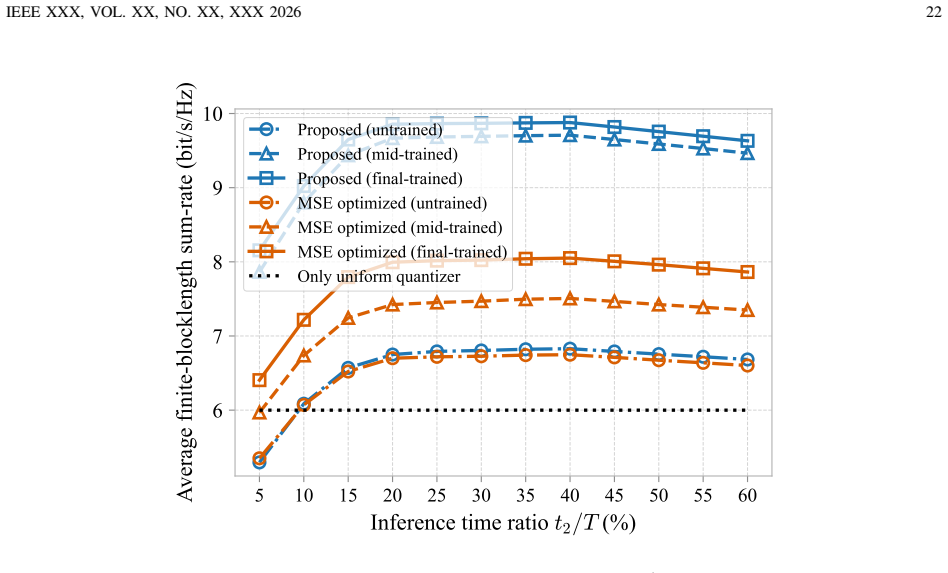
- [Sec. VI-C and Appendix C-D; Eqs. (47), (50)] The training objectives for the stochastic generators also use the same N_MC=100 Monte Carlo surrogate that is used for candidate selection and for the final performance comparison. This closed loop means the generators may be optimized to exploit the noise in R_q,epsilon rather than to improve true achievable rate. The reported advantage of rate-driven selection over MSE-based selection in Fig. 5 could partly reflect overfitting to the surrogate. Please demonstrate robustness by, for example, training with one estimate and evaluating with an independent larger-sample estimate, or using a differentiable proxy for training and an independent metric for evaluation.
minor comments (4)
- [Appendix C/D duplication] The full-text version contains duplicated blocks of Appendix C and D (the paragraph beginning "with the output normalized or projected onto W if needed" appears twice, and the Appendix E text is repeated). This should be cleaned up before publication.
- [Sec. VI-A] The wall-clock times t_init, t_WMMSE, t_p_eval, t_q_eval are measured on one GPU model (RTX 3090). The sensitivity of the optimal allocation to these hardware-specific values is not discussed; a short remark would help the reader interpret the numerical results.
- [Eq. (31)] The grid search over [0, Delta_t, ..., G Delta_t]^2 is stated without specifying Delta_t or G in the experiments, or the number of Monte Carlo draws used for the empirical expectation in (31). Please report these values for reproducibility.
- [Appendix E, Fig. 9] Appendix E reports noticeable degradation under mismatched CSI, but Fig. 9 is not described in the main text. Please add a pointer from Sec. VI to this appendix so the limitation is visible to the reader.
Circularity Check
Test-time scalability and allocation-optimality are built into the argmax/fixed-seed construction; the closed-loop N_MC=100 surrogate prevents independent validation.
-
self definitional
[Sec. IV-A, Eqs. (20)-(22); repeated in (27)-(28) and (30)]
"let us first fix the random seed for the sampling from G_W (H; θ ′ W ) so that {W0,j}JW(t) j=1 ⊆ {W0,j}JW(t′) j=1 , (21) holds for any t ′ ≥ t. Accordingly, we have Rp,ϵ (H, Alg W (t′;H)) ≥ R p,ϵ (H, Alg W (t;H)) , (22)"
Alg_W in (20) is defined as the argmax over the candidate set {W_j}. With fixed-seed nesting (21), the candidate set only grows with t, so the maximum over a larger set is automatically at least the maximum over a smaller set. Thus the test-time scalability inequality (22) is a logical consequence of the argmax definition and the fixed-seed rule, not an empirical prediction. The same construction is repeated for the quantizer ((27)-(28)) and joint selection (30). Consequently, the monotone increases in Figs. 4-6 are mathematical identities once the generators are fixed; they provide no independent evidence of scalability, only of the magnitude and strictness of the gain for trained generators.
-
fitted input called prediction
[Sec. VI-E, Eq. (31), Fig. 7]
"The proposed allocation in (31) balances the quality of the selected precoder and quantization-dequantization functions with the remaining data transmission duration, and achieves the highest sum-rate irrespective of the values of rho."
Equation (31) is the optimization problem solved by grid search; the plotted proposed point is the argmax over (t1,t2) of the empirical average of the same sum-rate objective. Fixed-time baselines are grid points, so the maximizer is no worse by definition. Thus 'achieves the highest sum-rate' is a restatement of the optimization, not an independently observed outcome. Moreover, the objective R_epsilon uses the same N_MC=100 Monte Carlo surrogate used to train the generators (47),(50) and to select candidates (26),(29), so the evaluation is closed-loop and no independent true-rate validation is provided.
1 more flagged steps
-
other
[Appendix B, Eqs. (44)-(45); Sec. VI-E]
"throughout our whole work, we always approximate the matrices (40)–(41) with N MC = 100 Monte Carlo samples whose randomness comes from the random input symbol vectors ∼ P s."
J_Q(t2) in (25) grows with t2, and candidate selection in (26) is an argmax over that many noisy R_q,epsilon estimates. The maximum of more noisy estimates carries a larger upward selection bias, so larger t2 can win the grid search in (31) because of Monte Carlo noise rather than because the selected quantizer is genuinely better. Since the generators are trained with the same noisy R_q,epsilon in (50), the entire chain (train -> select -> allocate -> evaluate) is evaluated on the same surrogate, so the reported ordering in Fig. 7 is not independently validated against a true achievable-rate metric.
full rationale
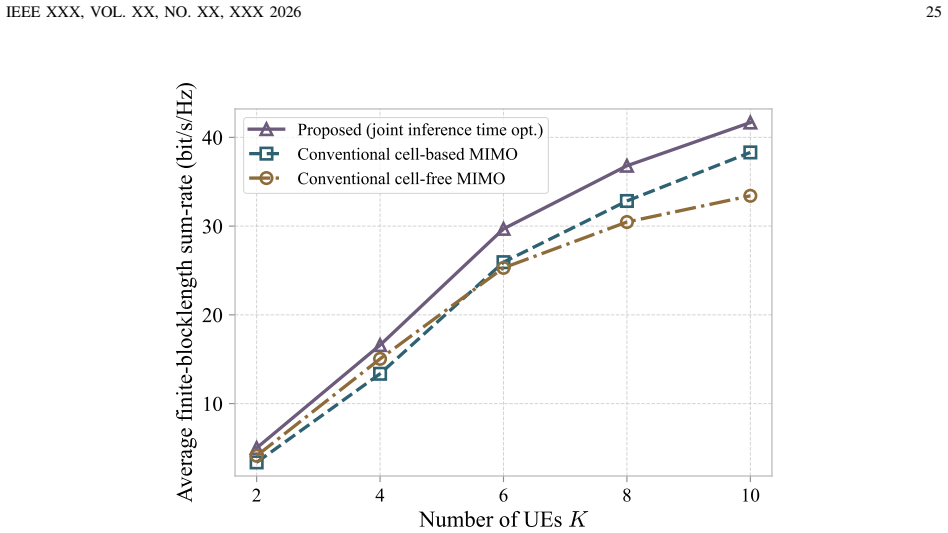
The paper is transparent about the fixed-seed construction, and it does include external benchmarks (conventional WMMSE, uniform quantizer, cell-based MIMO), so this is not a case of complete fabrication or a pure self-citation chain. However, the headline 'test-time scalability' property in (22)/(28)/(30) is guaranteed by the argmax-over-nested-candidate-sets design, making the monotonicity part of Figs. 4-6 a mathematical identity rather than an empirical discovery. The central allocation claim in Sec. VI-E is likewise the definition of the grid-search maximizer of (31), so 'achieves the highest sum-rate' is forced by the optimization. Appendix E's admission that the proposed data-driven methods suffer noticeable degradation under CSI mismatch further limits the generality of the effectiveness claim, though this is a stated limitation rather than circularity. The N_MC=100 Monte Carlo surrogate is shared across training, candidate selection, allocation, and evaluation, creating a closed loop in which the reported gains are not validated against a noise-free or true transmission metric. These issues make the central empirical claims partially circular or at least not independently established, supporting a score of 6 rather than a higher score that would require the entire framework to reduce to a single self-citation or definition.
Assumptions & free parameters
free parameters (4)
- Log-sum-exp temperature eta_W and eta_Q =
not reported
- Monte Carlo sample count N_MC =
100
- Wall-clock time model (t_init, t_WMMSE, t_p_eval, t_q_eval) =
not reported, measured on RTX 3090
- Grid resolution Delta_t for allocation search =
not reported
assumptions (5)
- domain assumption Fixed ordered random seed sequence yields nested candidate sets: {W_{0,j}}_{j=1}^{J_W(t)} subset of {W_{0,j}}_{j=1}^{J_W(t')} for t' >= t (Eq. 21, 27).
- domain assumption Flat-fading channel with perfect CSI at the CP at the start of each coherence block (Sec. II-A).
- domain assumption Finite-blocklength rate is accurately given by the Gaussian-approximation dispersion formula with i.i.d. Gaussian codebooks and nearest-neighbor decoding (Appendix A, Eq. 33).
- domain assumption Bussgang decomposition with worst-case uncorrelated additive noise gives a valid rate surrogate for the learned quantizers (Appendix B, Eq. 39-43).
- domain assumption Temporal channel variation follows the first-order Markov Jakes model (32), with rho = J_0(2 pi f_D T).
Cite this review
Pith. "Pith review of Test-Time Scalable AI-RAN: Inference Time Allocation for Cell-Free MIMO." pith.science (2026). https://pith.science/paper/MMJLWELY
@misc{pith2026260803614,
  author       = {Pith},
  title        = {Pith review of: Test-Time Scalable AI-RAN: Inference Time Allocation for Cell-Free MIMO},
  year         = {2026},
  howpublished = {\url{https://pith.science/paper/MMJLWELY}},
  note         = {Machine review of arXiv:2608.03614}
}
read the original abstract
Artificial intelligence-enabled radio access networks (AI-RANs) are envisioned to consist of multiple AI-based modules, potentially developed independently by different vendors. In this work, we study AI-RAN-enabled cell-free MIMO systems, with a particular focus on the system implications of modern AI models. Specifically, we focus on the phenomenon of test-time scalability popularized by large language models (LLMs), under which model performance improves as additional computational resources are allocated at testing time. By noting that the optimal amount of additional computational resources for each AI module should in general depend on its interaction with the other modules as well as with the underlying wireless channels, we propose a generic framework that enables optimal resource allocation for each test-time scalable module in cell-free MIMO systems. Experimental results demonstrate the effectiveness of the proposed framework in fully exploiting the potential of test-time scalable AI-RANs in cell-free MIMO systems.
Figures


Figures from the paper (6 more)




Reference graph
Works this paper leans on
-
[1]
Ultradense cell-free massive MIMO for 6G: Technical overview and open questions,
H. Q. Ngo, G. Interdonato, E. G. Larsson, G. Caire, and J. G. Andrews, “Ultradense cell-free massive MIMO for 6G: Technical overview and open questions,”Proc. IEEE, vol. 112, no. 7, pp. 805–831, 2024
2024
-
[2]
Study on artificial intelligence (AI)/machine learning (ML) for NR air interface,
3GPP, “Study on artificial intelligence (AI)/machine learning (ML) for NR air interface,” TR 38.843, Jan. 2024, release 18, v18.0.0
work page 2024
-
[3]
Scalable cell-free massive MIMO systems,
E. Bj ¨ornson and L. Sanguinetti, “Scalable cell-free massive MIMO systems,”IEEE Trans. Commun., vol. 68, no. 7, pp. 4247–4261, 2020
2020
-
[4]
A survey of the functional splits proposed for 5G mobile crosshaul networks,
L. M. P. Larsen, A. Checko, and H. L. Christiansen, “A survey of the functional splits proposed for 5G mobile crosshaul networks,”IEEE Commun. Surveys Tuts., vol. 21, no. 1, pp. 146–172, 2019
work page 2019
-
[5]
¨O. T. Demir, M. Masoudi, E. Bj ¨ornson, and C. Cavdar, “Cell-free massive MIMO in O-RAN: Energy-aware joint orchestration of cloud, fronthaul, and radio resources,”IEEE J. Sel. Areas Commun., vol. 42, no. 2, pp. 356–372, 2024
work page 2024
-
[6]
Joint sparse beamforming and network coding for downlink multi-hop cloud radio access networks,
L. Liu and W. Yu, “Joint sparse beamforming and network coding for downlink multi-hop cloud radio access networks,” inProc. IEEE Global Commun. Conf. (GLOBECOM), Washington, DC, USA, Dec. 2016
work page 2016
-
[7]
Fronthaul-aware design for cloud radio access networks,
L. Liu, W. Yu, and O. Simeone, “Fronthaul-aware design for cloud radio access networks,”Key Technologies for 5G Wireless Systems, pp. 48–75, 2017
work page 2017
-
[8]
Fronthaul quantization-aware MU-MIMO precoding for sum rate maximization,
Y . Khorsandmanesh, E. Bj ¨ornson, and J. Jald ´en, “Fronthaul quantization-aware MU-MIMO precoding for sum rate maximization,” inProc. IEEE Int. Conf. Commun. (ICC), Rome, Italy, May 2023, pp. 1332–1337
work page 2023
Show all 55 references
-
[9]
Joint precoding and fronthaul compression for cell-free MIMO downlink with radio stripes,
S. Jo, H. Lee, and S.-H. Park, “Joint precoding and fronthaul compression for cell-free MIMO downlink with radio stripes,” inProc. IEEE GLOBECOM, Kuala Lumpur, Malaysia, Dec. 2023
2023
-
[10]
Scalable multivariate fronthaul quantization for cell-free massive MIMO,
S. Park, A. H. Gokceoglu, L. Wang, and O. Simeone, “Scalable multivariate fronthaul quantization for cell-free massive MIMO,”IEEE Trans. Signal Process., vol. 73, pp. 1658–1673, 2025
2025
-
[11]
Joint precoding and multivariate backhaul compression for the downlink of cloud radio access networks,
S.-H. Park, O. Simeone, O. Sahin, and S. Shamai, “Joint precoding and multivariate backhaul compression for the downlink of cloud radio access networks,”IEEE Trans. Signal Process., vol. 61, no. 22, pp. 5646–5658, 2013
2013
-
[12]
Local partial zero-forcing precoding for cell-free massive MIMO,
G. Interdonato, M. Karlsson, E. Bj ¨ornson, and E. G. Larsson, “Local partial zero-forcing precoding for cell-free massive MIMO,”IEEE Trans. Wireless Commun., vol. 19, no. 7, pp. 4758–4774, 2020
2020
-
[13]
Meta-learning-based fronthaul compression for cloud radio access networks,
R. Qiao, T. Jiang, and W. Yu, “Meta-learning-based fronthaul compression for cloud radio access networks,”IEEE Trans. Wireless Commun., vol. 23, no. 9, pp. 11 015–11 029, 2024
2024
-
[14]
Calibrating wireless AI via meta-learned context-dependent conformal prediction,
S. Yoo, S. Park, P. Popovski, J. Kang, and O. Simeone, “Calibrating wireless AI via meta-learned context-dependent conformal prediction,”IEEE Trans. Signal Process., vol. 74, pp. 423–438, 2026
2026
-
[15]
Empowering the 6G cellular architecture with open RAN,
M. Polese, M. Dohler, F. Dressler, M. Erol-Kantarci, R. Jana, R. Knopp, and T. Melodia, “Empowering the 6G cellular architecture with open RAN,”IEEE J. Sel. Areas Commun., vol. 42, no. 2, pp. 245–262, 2024
2024
-
[16]
Open RAN xApps design and evaluation: Lessons learnt and identified challenges,
M. Hoffmann, S. Janji, A. Samorzewski, Kułacz, C. Adamczyk, M. Dryja ´nski, P. Kryszkiewicz, A. Kliks, and H. Bogucka, “Open RAN xApps design and evaluation: Lessons learnt and identified challenges,”IEEE J. Sel. Areas Commun., vol. 42, no. 2, pp. 473–486, 2024
2024
-
[17]
ToDMA: Large model-driven massive token communi- cations for semantic multiple access,
L. Qiao, M. B. Mashhadi, Z. Gao, R. Schober, and D. G ¨und¨uz, “ToDMA: Large model-driven massive token communi- cations for semantic multiple access,”arXiv:2505.10946, 2025
2025 arXiv
-
[18]
Large language models for wireless communications: From adaptation to autonomy,
L. Liang, H. Ye, Y . Sheng, O. Wang, J. Wang, S. Jin, and G. Y . Li, “Large language models for wireless communications: From adaptation to autonomy,”IEEE Commun. Mag., vol. 64, no. 5, pp. 140–147, 2026. IEEE XXX, VOL. XX, NO. XX, XXX 2026 32
2026
-
[19]
Scaling LLM test-time compute optimally can be more effective than scaling parameters for reasoning,
C. Snell, J. Lee, K. Xu, and A. Kumar, “Scaling LLM test-time compute optimally can be more effective than scaling parameters for reasoning,” inProc. Int. Conf. Learn. Represent. (ICLR), Singapore, Apr. 2025
2025
-
[20]
A theory of inference compute scaling: Reasoning through directed stochastic skill search,
A. R. Ellis-Mohr, A. K. Nayak, and L. R. Varshney, “A theory of inference compute scaling: Reasoning through directed stochastic skill search,”Philos. Trans. R. Soc. A, vol. 384, no. 20240510, 2025
2025
-
[21]
A survey on test-time scaling in large language models: What, how, where, and how well?
Q. Zhang, F. Lyu, Z. Sun, L. Wang, W. Zhang, W. Hua, H. Wu, Z. Guo, Y . Wang, N. Muennighoff, I. King, X. Liu, and C. Ma, “A survey on test-time scaling in large language models: What, how, where, and how well?”arXiv:2503.24235, 2025
2025 arXiv
-
[22]
Test-time scaling of diffusion models via noise trajectory search,
V . Ramesh and M. Mardani, “Test-time scaling of diffusion models via noise trajectory search,” inAdv. Neural Inf. Process. Syst., vol. 38, San Diego, CA, USA, Dec. 2025, pp. 87 284–87 317
2025
-
[23]
Snapshot ensembles: Train 1, get M for free,
G. Huang, Y . Li, G. Pleiss, Z. Liu, J. E. Hopcroft, and K. Q. Weinberger, “Snapshot ensembles: Train 1, get M for free,” inProc. Int. Conf. Learn. Represent. (ICLR), Toulon, France, Apr. 2017
2017
-
[24]
A reliable Bayesian deep learning framework with rectified flow for fault diagnosis under limited data,
S. Tao, X. Meng, and H. Wang, “A reliable Bayesian deep learning framework with rectified flow for fault diagnosis under limited data,”IEEE Trans. Autom. Sci. Eng., vol. 23, pp. 9472–9487, 2026
2026
-
[25]
Calibrated computation-aware gaussian processes,
D. Hegde, M. Adil, and J. Cockayne, “Calibrated computation-aware gaussian processes,” inProc. Int. Conf. Artif. Intell. Statist. (AISTATS), vol. 258, Mai Khao, Thailand, May 2025, pp. 2098–2106
2025
-
[26]
Weighted sum rate maximization of the mmWave cell-free MIMO downlink relying on hybrid precoding,
C. Feng, W. Shen, J. An, and L. Hanzo, “Weighted sum rate maximization of the mmWave cell-free MIMO downlink relying on hybrid precoding,”IEEE Trans. Wireless Commun., vol. 21, no. 4, pp. 2547–2560, 2022
2022
-
[27]
InterfO-RAN: Real-time in-band cellular uplink interference detection with GPU-accelerated dApps,
N. Neasamoni Santhi, D. Villa, M. Polese, and T. Melodia, “InterfO-RAN: Real-time in-band cellular uplink interference detection with GPU-accelerated dApps,” inProc. ACM Int. Symp. Mobile Ad Hoc Netw. Comput. (MobiHoc), Houston, TX, USA, Oct. 2025, pp. 71–80
2025
-
[28]
Decentralized ai service placement, selection and routing in mobile networks,
J. Zhang, S. Vlaski, and K. Leung, “Decentralized ai service placement, selection and routing in mobile networks,” in Proc. IEEE Int. Conf. Commun. (ICC), Glasgow, Scotland, UK, May 2026
2026
-
[29]
Deep task-based quantization,
N. Shlezinger and Y . C. Eldar, “Deep task-based quantization,”Entropy, vol. 23, no. 1, p. 104, 2021
2021
-
[30]
Large language monkeys: Scaling inference compute with repeated sampling,
B. Brown, J. Juravsky, R. Ehrlich, R. Clark, Q. V . Le, C. R ´e, and A. Mirhoseini, “Large language monkeys: Scaling inference compute with repeated sampling,”arXiv:2407.21787, 2024
2024 arXiv
-
[31]
A flexible 100-antenna testbed for massive MIMO,
J. Vieira, S. Malkowsky, K. Nieman, Z. Miers, N. Kundargi, L. Liu, I. Wong, V . ¨Owall, O. Edfors, and F. Tufvesson, “A flexible 100-antenna testbed for massive MIMO,” inProc. IEEE Globecom Workshops (GC Wkshps), Austin, TX, USA, Dec. 2014
2014
-
[32]
Deep-learning-based millimeter-wave massive MIMO for hybrid precoding,
H. Huang, Y . Song, J. Yang, G. Gui, and F. Adachi, “Deep-learning-based millimeter-wave massive MIMO for hybrid precoding,”IEEE Trans. Veh. Technol., vol. 68, no. 3, pp. 3027–3032, 2019
2019
-
[33]
A deep learning-based framework for low-complexity multiuser MIMO precoding design,
M. Zhang, J. Gao, and C. Zhong, “A deep learning-based framework for low-complexity multiuser MIMO precoding design,”IEEE Trans. Wireless Commun., vol. 21, no. 12, pp. 11 193–11 206, 2022
2022
-
[34]
Model-based deep learning,
N. Shlezinger and Y . C. Eldar, “Model-based deep learning,”Found. Trends Signal Process., vol. 17, no. 4, pp. 291–416, 2023
2023
-
[35]
Deep unfolding: Model-based inspiration of novel deep architectures,
J. R. Hershey, J. L. Roux, and F. Weninger, “Deep unfolding: Model-based inspiration of novel deep architectures,” arXiv:1409.2574, 2014
2014 arXiv
-
[36]
An iteratively weighted MMSE approach to distributed sum-utility maximization for a MIMO interfering broadcast channel,
Q. Shi, M. Razaviyayn, Z.-Q. Luo, and C. He, “An iteratively weighted MMSE approach to distributed sum-utility maximization for a MIMO interfering broadcast channel,”IEEE Trans. Signal Process., vol. 59, no. 9, pp. 4331–4340, 2011
2011
-
[37]
Matrix-inverse-free deep unfolding of the weighted MMSE beamforming algorithm,
L. Pellaco, M. Bengtsson, and J. Jald ´en, “Matrix-inverse-free deep unfolding of the weighted MMSE beamforming algorithm,”IEEE Open J. Commun. Society, vol. 3, pp. 65–81, 2021. IEEE XXX, VOL. XX, NO. XX, XXX 2026 33
2021
-
[38]
Iterative algorithm-induced deep-unfolding neural networks: Precoding design for multiuser MIMO systems,
Q. Hu, Y . Cai, Q. Shi, K. Xu, G. Yu, and Z. Ding, “Iterative algorithm-induced deep-unfolding neural networks: Precoding design for multiuser MIMO systems,”IEEE Trans. Wireless Commun., vol. 20, no. 2, pp. 1394–1410, 2021
2021
-
[39]
The dispersion of nearest-neighbor decoding for additive non-gaussian channels,
J. Scarlett, V . Y . Tan, and G. Durisi, “The dispersion of nearest-neighbor decoding for additive non-gaussian channels,” IEEE Trans. Inf. Theory, vol. 63, no. 1, pp. 81–92, Jan. 2017
2017
-
[40]
MIMO design for internet of things: Joint optimization of spectral efficiency and error probability in finite blocklength regime,
J. Choi and J. Park, “MIMO design for internet of things: Joint optimization of spectral efficiency and error probability in finite blocklength regime,”IEEE Internet Things J., vol. 8, no. 20, pp. 15 512–15 521, 2021
2021
-
[41]
Rethinking WMMSE: Can its complexity scale linearly with the number of BS antennas?
X. Zhao, S. Lu, Q. Shi, and Z.-Q. Luo, “Rethinking WMMSE: Can its complexity scale linearly with the number of BS antennas?”IEEE Trans. Signal Process., vol. 71, pp. 433–446, 2023
2023
-
[42]
Simeone,Machine Learning for Engineers
O. Simeone,Machine Learning for Engineers. Cambridge Univ. Press, 2022
2022
-
[43]
Multivariate fronthaul quantization for downlink C-RAN,
W. Lee, O. Simeone, J. Kang, and S. Shamai, “Multivariate fronthaul quantization for downlink C-RAN,”IEEE Trans. Signal Process., vol. 64, no. 19, pp. 5025–5037, 2016
2016
-
[44]
Crosscorrelation functions of amplitude-distorted gaussian signals,
J. J. Bussgang, “Crosscorrelation functions of amplitude-distorted gaussian signals,”Res. Lab. Electron., Massachusetts Inst. Technol., 1952
1952
-
[45]
How much training is needed in multiple-antenna wireless links?
B. Hassibi and B. M. Hochwald, “How much training is needed in multiple-antenna wireless links?”IEEE Trans. Inf. Theory, vol. 49, no. 4, pp. 951–963, 2003
2003
-
[46]
Fast context adaptation via meta-learning,
L. Zintgraf, K. Shiarli, V . Kurin, K. Hofmann, and S. Whiteson, “Fast context adaptation via meta-learning,” inProc. Int. Conf. Mach. Learn. (ICML), vol. 97, Long Beach, CA, USA, Jun. 2019, pp. 7693–7702
2019
-
[47]
Learning to demodulate from few pilots via offline and online meta-learning,
S. Park, H. Jang, O. Simeone, and J. Kang, “Learning to demodulate from few pilots via offline and online meta-learning,” IEEE Trans. Signal Process., vol. 69, pp. 226–239, 2020
2020
-
[48]
Massive MIMO networks: Spectral, energy, and hardware efficiency,
E. Bj ¨ornson, J. Hoydis, and L. Sanguinetti, “Massive MIMO networks: Spectral, energy, and hardware efficiency,”Found. Trends Signal Process., vol. 11, no. 3-4, pp. 154–655, 2017
2017
-
[49]
Robust resource allocation for MIMO wireless powered communication networks based on a non-linear EH model,
E. Boshkovska, D. W. K. Ng, N. Zlatanov, A. Koelpin, and R. Schober, “Robust resource allocation for MIMO wireless powered communication networks based on a non-linear EH model,”IEEE Trans. Commun., vol. 65, no. 5, pp. 1984–1999, 2017
1984
-
[50]
DeepMIMO: A generic deep learning dataset for millimeter wave and massive MIMO applications,
A. Alkhateeb, “DeepMIMO: A generic deep learning dataset for millimeter wave and massive MIMO applications,” arXiv:1902.06435, 2019
1902 arXiv
-
[51]
W. C. Jakes,Microwave Mobile Communications. Wiley, 1974
1974
-
[52]
Towards AI-native RAN: An operator’s perspective of 6G day 1 standardization,
N. Li, Q. Sun, L. Wang, X. Xu, J. Huang, C. Liu, J. Gao, Y . Huang, and C.-L. I, “Towards AI-native RAN: An operator’s perspective of 6G day 1 standardization,”arXiv preprint arXiv:2507.08403, 2025
2025 arXiv
-
[53]
Timely CPU scheduling for computation-intensive status updates,
M. Zhou, M. Zhang, H. H. Yang, and R. D. Yates, “Timely CPU scheduling for computation-intensive status updates,” IEEE Trans. Inf. Theory, vol. 72, no. 8, pp. 6164–6188, 2026
2026
-
[54]
The Bussgang decomposition of nonlinear systems: Basic theory and MIMO extensions,
¨O. T. Demir and E. Bj ¨ornson, “The Bussgang decomposition of nonlinear systems: Basic theory and MIMO extensions,” IEEE Signal Process. Mag., vol. 38, no. 1, pp. 131–136, 2021
2021
-
[55]
Lattice quantization for centralized and scalable cell-free massive MIMO with realistic fronthaul,
Z. Ren, A. Doufexi, and M. A. Beach, “Lattice quantization for centralized and scalable cell-free massive MIMO with realistic fronthaul,” inProc. IEEE Int. Mediterranean Conf. Commun. Netw. (MeditCom), Athens, Greece, Sep. 2022, pp. 298–303
2022
Reviewed August 5, 2026 · model on record in the stance chip above.
Discussion (0). Sign in to comment.