pith. sign in

arxiv: 2606.26274 · v1 · pith:MNZHCPDFnew · submitted 2026-06-24 · ✦ hep-ex

Charged-lepton identification at Belle~II

Belle II Collaboration: M. Abumusabh , I. Adachi , A. Aggarwal , H. Ahmed , Y. Ahn , H. Aihara , M. Akdag , N. Akopov
show 403 more authors
S. Alghamdi M. Alhakami N. Althubiti K. Amos M. Angelsmark N. Anh Ky C. Antonioli K. Arai H. Atmacan V. Aushev R. Ayad V. Babu H. Bae N. K. Baghel P. Bambade Sw. Banerjee S. Bansal M. Barrett M. Bartl J. Baudot A. Beaubien F. Becherer J. Becker G. F. Benfratello J. V. Bennett F. U. Bernlochner V. Bertacchi M. Bertemes E. Bertholet M. Bessner S. Bettarini V. Bhardwaj B. Bhuyan F. Bianchi T. Bilka D. Biswas A. Bobrov D. Bodrov G. Bonvicini A. Boschetti A. Bozek M. Bra\v{c}ko P. Branchini R. A. Briere T. E. Browder A. Budano S. Bussino F. Callet Q. Campagna M. Campajola L. Cao M. Carminati G. Casarosa C. Cecchi P. Cheema L. Chen B. G. Cheon C. Cheshta H. Chetri K. Chilikin K. Chirapatpimol H.-E. Cho K. Cho S.-J. Cho S.-K. Choi S. Choudhury S. Chutia J. Cochran J. A. Colorado-Caicedo I. Consigny L. Corona H. Crotte Ledesma S. Cuccuini J. X. Cui E. De La Cruz-Burelo S. A. De La Motte G. De Nardo G. De Pietro R. de Sangro M. Destefanis S. Dey R. Dhayal A. Di Canto J. Dingfelder Z. Dole\v{z}al X. Dong G. Dujany P. Ecker D. Epifanov J. Eppelt R. Farkas P. Feichtinger T. Ferber T. Fillinger C. Finck G. Finocchiaro F. Forti A. Frey B. G. Fulsom A. Gabrielli P. Gagneja R. Garg G. Gaudino V. Gaur V. Gautam A. Gaz A. Gellrich G. Ghevondyan D. Ghosh H. Ghumaryan R. Giordano A. Giri P. Gironella Gironell A. Glazov B. Gobbo R. Godang O. Gogota W. Gradl E. Graziani D. Greenwald Y. Guan K. Gudkova I. Haide H. Haigh Y. Han K. Hayasaka H. Hayashii S. Hazra M. T. Hedges A. Heidelbach G. Heine I. Heredia de la Cruz M. Hern\'andez Villanueva T. Higuchi M. Hoek M. Hohmann R. Hoppe P. Horak X. T. Hou C.-L. Hsu T. Humair T. Iijima K. Inami N. Ipsita A. Ishikawa R. Itoh M. Iwasaki P. Jackson D. Jacobi W. W. Jacobs E.-J. Jang S. Jia Y. Jin A. Johnson K. K. Joo H. Kakuno D. Kalita K. H. Kang G. Karyan T. Kawasaki F. Keil C. Kiesling C. Kim D. Y. Kim H. Kim J.-Y. Kim K.-H. Kim H. Kindo K. Kinoshita P. Kody\v{s} S. Kohani A. Korobov S. Korpar E. Kovalenko R. Kowalewski P. Kri\v{z}an P. Krokovny T. Kuhr Y. Kulii J. Kumar R. Kumar K. Kumara T. Kunigo A. Kuzmin Y.-J. Kwon S. Lacaprara Y.-T. Lai T. Lam J. S. Lange T. S. Lau R. Leboucher H. Lee M. J. Lee P. Leo P. M. Lewis C. Li L. K. Li Q. M. Li S. X. Li W. Z. Li Y. Li Y. B. Li Y. P. Liao J. Libby J. Lin S. Lin Z. Liptak V. Lisovskyi C. Liu M. H. Liu Q. Y. Liu Z. Q. Liu D. Liventsev S. Longo A. Lozar C. Lyu J. L. Ma Y. Ma M. Maggiora R. Maiti G. Mancinelli R. Manfredi E. Manoni M. Mantovano D. Marcantonio M. Marfoli C. Marinas C. Martellini A. Martens T. Martinov L. Massaccesi M. Masuda T. Matsuda K. Matsuoka D. Matvienko S. K. Maurya M. Maushart J. A. McKenna Z. Mediankin Gruberov\'a R. Mehta F. Meier D. Meleshko M. Merola C. Miller M. Mirra K. Miyabayashi H. Miyake G. B. Mohanty S. Moneta A. L. Moreira de Carvalho H.-G. Moser N. Mudgal Th. Muller H. Murakami R. Mussa K. R. Nakamura Y. Nakazawa Z. Natkaniec A. Natochii M. Neu S. Nishida R. Nomaru A. Novosel S. Ogawa R. Okubo H. Ono Y. Onuki G. Pakhlova S. Pardi J. Park K. Park S.-H. Park A. Passeri S. Patra T. K. Pedlar R. Pestotnik L. E. Piilonen P. L. M. Podesta-Lerma T. Podobnik L. Polat A. Prakash V. Prasad C. Praz S. Prell E. Prencipe M. T. Prim S. Privalov H. Purwar P. Rados S. Raiz K. Ravindran J. U. Rehman M. Reif S. Reiter L. Reuter D. Ricalde Herrmann I. Ripp-Baudot G. Rizzo S. H. Robertson J. M. Roney A. Rostomyan N. Rout G. Russo S. Saha D. A. Sanders S. Sandilya L. Santelj C. Santos V. Savinov B. Scavino J. Schmitz S. Schneider K. Schoenning C. Schwanda Y. Seino K. Senyo J. Serrano M. E. Sevior C. Sfienti W. Shan C. P. Shen X. D. Shi T. Shillington T. Shimasaki J.-G. Shiu D. Shtol A. Sibidanov F. Simon J. B. Singh J. Skorupa A. Soffer A. Sokolov E. Solovieva S. Spataro K. \v{S}penko B. Spruck M. Stari\v{c} P. Stavroulakis S. Stefkova R. Stroili M. Sumihama M. Takahashi M. Takizawa U. Tamponi K. Tanida A. Thaller D. V. Thanh T. Tien Manh O. Tittel R. Tiwary E. Torassa K. Trabelsi F. F. Trantou I. Tsaklidis M. Uchida I. Ueda E. Uenlue T. Uglov K. Unger Y. Unno K. Uno S. Uno Y. Ushiroda S. E. Vahsen R. van Tonder K. E. Varvell M. Veronesi A. Vinokurova V. S. Vismaya L. Vitale V. Vobbilisetti R. Volpe M. Wakai S. Wallner M.-Z. Wang X. L. Wang A. Warburton M. Watanabe S. Watanuki C. Wessel X. P. Xu B. D. Yabsley S. Yamada W. Yan W. P. Yan J. Yelton K. Yi J. H. Yin K. Yoshihara C. Z. Yuan J. Yuan L. Yuan Y. Yusa L. Zani F. Zeng M. Zeyrek B. Zhang X. Zhao V. Zhilich Q. D. Zhou X. Y. Zhou L. Zhu R. \v{Z}leb\v{c}\'ik
This is my paper

Pith reviewed 2026-06-26 00:47 UTC · model grok-4.3

classification ✦ hep-ex
keywords particle identificationelectron identificationmuon identificationBelle IIlepton tagginghadron rejection
0
0 comments X

The pith

Belle II describes algorithms for identifying electrons and muons and reports their performance in 428 fb^{-1} of Run 1 data.

A machine-rendered reading of the paper's core claim, the machinery that carries it, and where it could break.

The paper presents the methods developed at Belle II to tag charged leptons while suppressing misidentification from pions and kaons. It evaluates these methods on the full Run 1 dataset collected at the SuperKEKB collider near the Υ(4S) resonance. Accurate lepton identification directly affects the purity of samples used in B-physics and tau-physics measurements. If the reported efficiencies and fake rates hold, analyses searching for rare lepton-flavor-violating decays gain substantially reduced backgrounds.

Core claim

The algorithms combine information from the electromagnetic calorimeter, muon detector, drift chamber, and time-of-flight system to assign electron and muon likelihoods; when applied to the 428 fb^{-1} dataset, they deliver the measured identification efficiencies and hadron misidentification probabilities quoted in the paper.

What carries the argument

Likelihood-based or multivariate charged-lepton identification algorithms that integrate responses from the ECL, KLM, CDC, and TOP subsystems.

If this is right

  • Background levels in rare B and tau decay searches are reduced by the quoted lepton efficiencies.
  • Systematic uncertainties on lepton-tagging efficiencies become a limiting factor only at the level reported by the paper.
  • The same algorithms can be applied to future data-taking periods with only recalibration of the input variables.

Where Pith is reading between the lines

These are editorial extensions of the paper, not claims the author makes directly.

  • The quoted performance sets a quantitative target that any future detector upgrade at an e+e- collider must meet or exceed.
  • Control-sample methods described here could be adapted to measure lepton identification in other asymmetric-energy colliders.

Load-bearing premise

The performance numbers measured in data and simulation are taken to represent the true detector response for the selected events without significant unaccounted biases from trigger, reconstruction, or control-sample choices.

What would settle it

A statistically significant difference between the lepton identification efficiency measured in a high-purity control sample in data versus the value predicted from simulation would falsify the claimed performance.

Figures
Figures reproduced from arXiv: 2606.26274 by A. Aggarwal, A. Beaubien, A. Bobrov, A. Boschetti, A. Bozek, A. Budano, A. Di Canto, A. Frey, A. Gabrielli, A. Gaz, A. Gellrich, A. Giri, A. Glazov, A. Heidelbach, A. Ishikawa, A. Johnson, A. Korobov, A. Kuzmin, A. L. Moreira de Carvalho, A. Lozar, A. Martens, A. Natochii, A. Novosel, A. Passeri, A. Prakash, A. Rostomyan, A. Sibidanov, A. Soffer, A. Sokolov, A. Thaller, A. Vinokurova, A. Warburton, B. Bhuyan, B. D. Yabsley, Belle II Collaboration: M. Abumusabh, B. G. Cheon, B. G. Fulsom, B. Gobbo, B. Scavino, B. Spruck, B. Zhang, C. Antonioli, C. Cecchi, C. Cheshta, C. Finck, C. Kiesling, C. Kim, C.-L. Hsu, C. Li, C. Liu, C. Lyu, C. Marinas, C. Martellini, C. Miller, C. Praz, C. P. Shen, C. Santos, C. Schwanda, C. Sfienti, C. Wessel, C. Z. Yuan, D. A. Sanders, D. Biswas, D. Bodrov, D. Epifanov, D. Ghosh, D. Greenwald, D. Jacobi, D. Kalita, D. Liventsev, D. Marcantonio, D. Matvienko, D. Meleshko, D. Ricalde Herrmann, D. Shtol, D. V. Thanh, D. Y. Kim, E. Bertholet, E. De La Cruz-Burelo, E. Graziani, E.-J. Jang, E. Kovalenko, E. Manoni, E. Prencipe, E. Solovieva, E. Torassa, E. Uenlue, F. Becherer, F. Bianchi, F. Callet, F. Forti, F. F. Trantou, F. Keil, F. Meier, F. Simon, F. U. Bernlochner, F. Zeng, G. B. Mohanty, G. Bonvicini, G. Casarosa, G. De Nardo, G. De Pietro, G. Dujany, G. F. Benfratello, G. Finocchiaro, G. Gaudino, G. Ghevondyan, G. Heine, G. Karyan, G. Mancinelli, G. Pakhlova, G. Rizzo, G. Russo, H. Ahmed, H. Aihara, H. Atmacan, H. Bae, H. Chetri, H. Crotte Ledesma, H.-E. Cho, H. Ghumaryan, H.-G. Moser, H. Haigh, H. Hayashii, H. Kakuno, H. Kim, H. Kindo, H. Lee, H. Miyake, H. Murakami, H. Ono, H. Purwar, I. Adachi, I. Consigny, I. Haide, I. Heredia de la Cruz, I. Ripp-Baudot, I. Tsaklidis, I. Ueda, J. A. Colorado-Caicedo, J. A. McKenna, J. Baudot, J. Becker, J. B. Singh, J. Cochran, J. Dingfelder, J. Eppelt, J.-G. Shiu, J. H. Yin, J. Kumar, J. Libby, J. Lin, J. L. Ma, J. M. Roney, J. Park, J. Schmitz, J. Serrano, J. Skorupa, J. S. Lange, J. U. Rehman, J. V. Bennett, J. X. Cui, J. Yelton, J.-Y. Kim, J. Yuan, K. Amos, K. Arai, K. Chilikin, K. Chirapatpimol, K. Cho, K. E. Varvell, K. Gudkova, K. Hayasaka, K. H. Kang, K.-H. Kim, K. Inami, K. Kinoshita, K. K. Joo, K. Kumara, K. Matsuoka, K. Miyabayashi, K. Park, K. Ravindran, K. R. Nakamura, K. Schoenning, K. Senyo, K. Tanida, K. Trabelsi, K. Unger, K. Uno, K. \v{S}penko, K. Yi, K. Yoshihara, L. Cao, L. Chen, L. Corona, L. E. Piilonen, L. K. Li, L. Massaccesi, L. Polat, L. Reuter, L. Santelj, L. Vitale, L. Yuan, L. Zani, L. Zhu, M. Akdag, M. Alhakami, M. Angelsmark, M. Barrett, M. Bartl, M. Bertemes, M. Bessner, M. Bra\v{c}ko, M. Campajola, M. Carminati, M. Destefanis, M. E. Sevior, M. Hern\'andez Villanueva, M. H. Liu, M. Hoek, M. Hohmann, M. Iwasaki, M. J. Lee, M. Maggiora, M. Mantovano, M. Marfoli, M. Masuda, M. Maushart, M. Merola, M. Mirra, M. Neu, M. Reif, M. Stari\v{c}, M. Sumihama, M. Takahashi, M. Takizawa, M. T. Hedges, M. T. Prim, M. Uchida, M. Veronesi, M. Wakai, M. Watanabe, M. Zeyrek, M.-Z. Wang, N. Akopov, N. Althubiti, N. Anh Ky, N. Ipsita, N. K. Baghel, N. Mudgal, N. Rout, O. Gogota, O. Tittel, P. Bambade, P. Branchini, P. Cheema, P. Ecker, P. Feichtinger, P. Gagneja, P. Gironella Gironell, P. Horak, P. Jackson, P. Kody\v{s}, P. Kri\v{z}an, P. Krokovny, P. Leo, P. L. M. Podesta-Lerma, P. M. Lewis, P. Rados, P. Stavroulakis, Q. Campagna, Q. D. Zhou, Q. M. Li, Q. Y. Liu, R. A. Briere, R. Ayad, R. de Sangro, R. Dhayal, R. Farkas, R. Garg, R. Giordano, R. Godang, R. Hoppe, R. Itoh, R. Kowalewski, R. Kumar, R. Leboucher, R. Maiti, R. Manfredi, R. Mehta, R. Mussa, R. Nomaru, R. Okubo, R. Pestotnik, R. Stroili, R. Tiwary, R. van Tonder, R. Volpe, R. \v{Z}leb\v{c}\'ik, S. A. De La Motte, S. Alghamdi, S. Bansal, S. Bettarini, S. Bussino, S. Choudhury, S. Chutia, S. Cuccuini, S. Dey, S. E. Vahsen, S. Hazra, S.-H. Park, S. H. Robertson, S.-J. Cho, S. Jia, S.-K. Choi, S. K. Maurya, S. Kohani, S. Korpar, S. Lacaprara, S. Lin, S. Longo, S. Moneta, S. Nishida, S. Ogawa, S. Pardi, S. Patra, S. Prell, S. Privalov, S. Raiz, S. Reiter, S. Saha, S. Sandilya, S. Schneider, S. Spataro, S. Stefkova, S. Uno, S. Wallner, S. Watanuki, Sw. Banerjee, S. X. Li, S. Yamada, T. Bilka, T. E. Browder, T. Ferber, T. Fillinger, T. Higuchi, Th. Muller, T. Humair, T. Iijima, T. Kawasaki, T. K. Pedlar, T. Kuhr, T. Kunigo, T. Lam, T. Martinov, T. Matsuda, T. Podobnik, T. Shillington, T. Shimasaki, T. S. Lau, T. Tien Manh, T. Uglov, U. Tamponi, V. Aushev, V. Babu, V. Bertacchi, V. Bhardwaj, V. Gaur, V. Gautam, V. Lisovskyi, V. Prasad, V. Savinov, V. S. Vismaya, V. Vobbilisetti, V. Zhilich, W. Gradl, W. P. Yan, W. Shan, W. W. Jacobs, W. Yan, W. Z. Li, X. Dong, X. D. Shi, X. L. Wang, X. P. Xu, X. T. Hou, X. Y. Zhou, X. Zhao, Y. Ahn, Y. B. Li, Y. Guan, Y. Han, Y. Jin, Y.-J. Kwon, Y. Kulii, Y. Li, Y. Ma, Y. Nakazawa, Y. Onuki, Y. P. Liao, Y. Seino, Y.-T. Lai, Y. Unno, Y. Ushiroda, Y. Yusa, Z. Dole\v{z}al, Z. Liptak, Z. Mediankin Gruberov\'a, Z. Natkaniec, Z. Q. Liu.

Figure 1
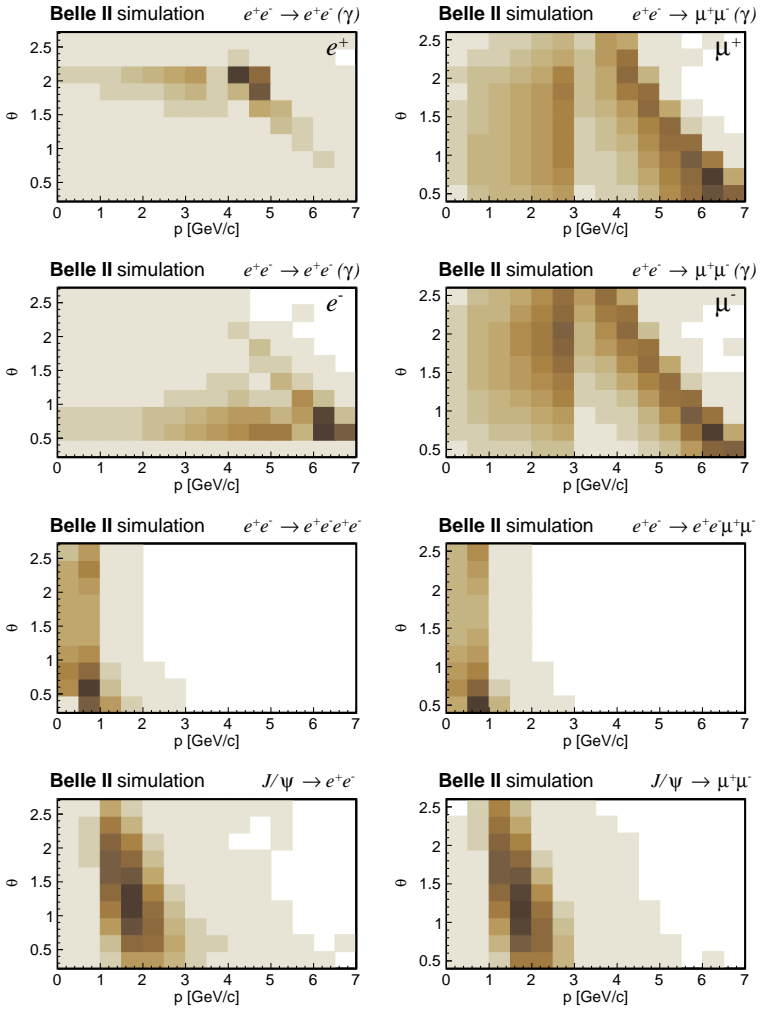
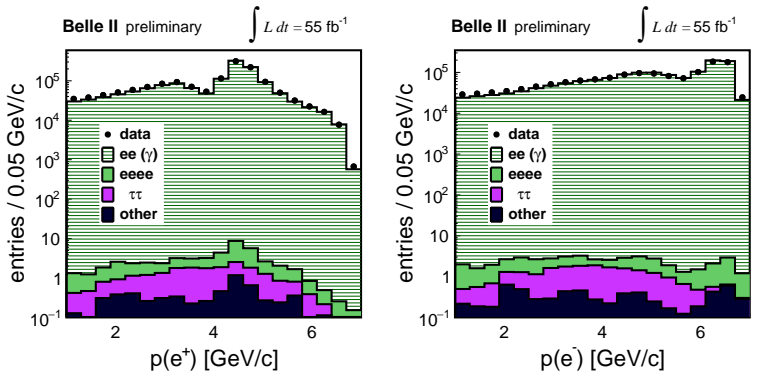
Figure 1. Figure 1: Laboratory-frame momentum distributions of probe positrons (left) [PITH_FULL_IMAGE:figures/full_fig_p008_1.png] view at source ↗
Figure 2
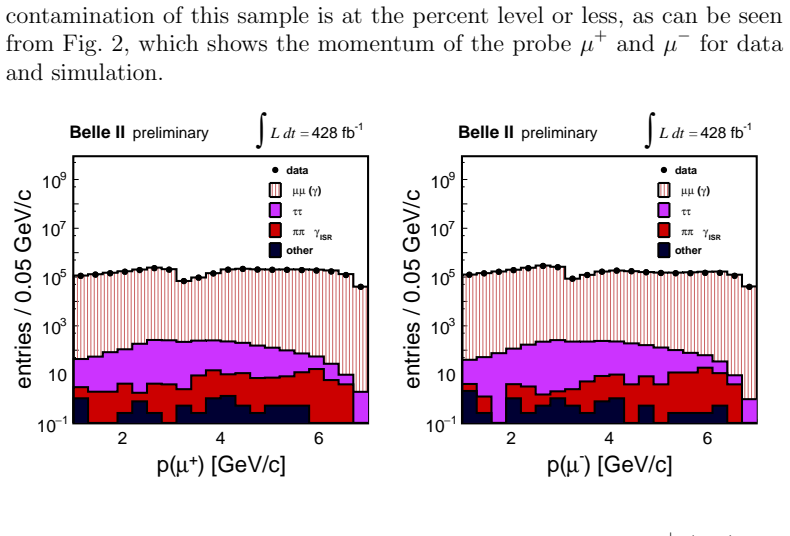
Figure 2. Figure 2: Laboratory-frame momentum distributions of probe [PITH_FULL_IMAGE:figures/full_fig_p009_2.png] view at source ↗
Figure 3
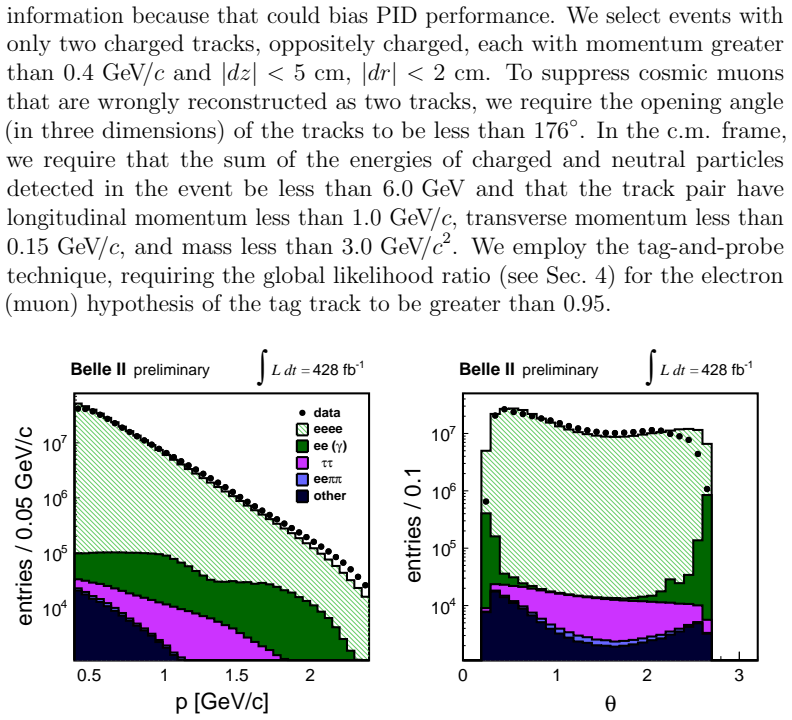
Figure 3. Figure 3: Distributions of the momentum (left) and polar angle (right) for [PITH_FULL_IMAGE:figures/full_fig_p010_3.png] view at source ↗
Figure 4
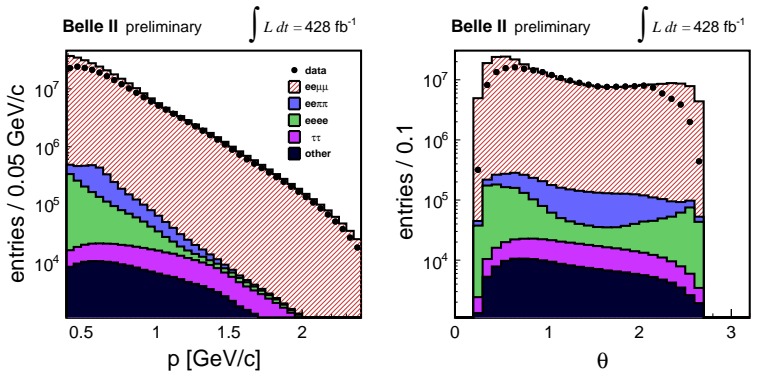
Figure 4. Figure 4: Distributions of the momentum (left) and polar angle (right) for [PITH_FULL_IMAGE:figures/full_fig_p011_4.png] view at source ↗
Figure 5
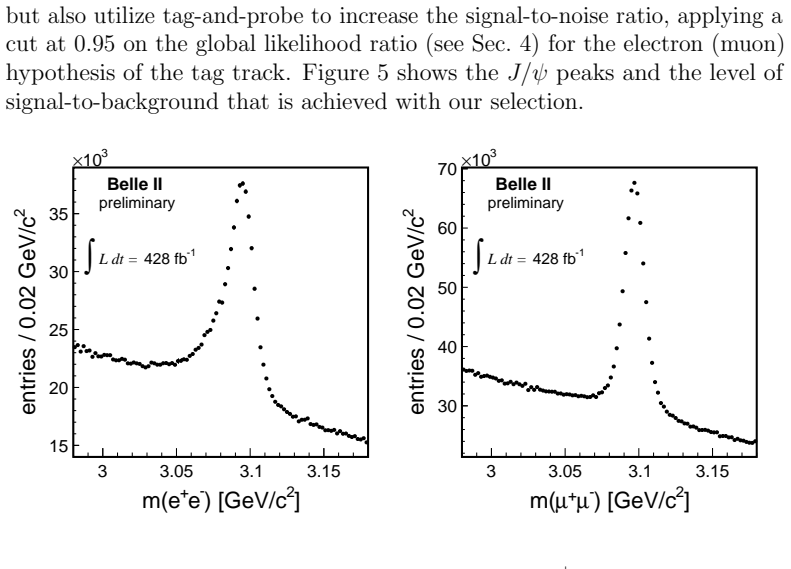
Figure 5. Figure 5: Invariant mass distribution for the J/ψ → e + e − (left) and J/ψ → µ + µ − (right) candidates in which at least one of the tracks passes the tag PID selection [PITH_FULL_IMAGE:figures/full_fig_p012_5.png] view at source ↗
Figure 6
Figure 6. Figure 6: Density (in linear scale) of the polar angle and momentum distri [PITH_FULL_IMAGE:figures/full_fig_p013_6.png] view at source ↗
Figure 7
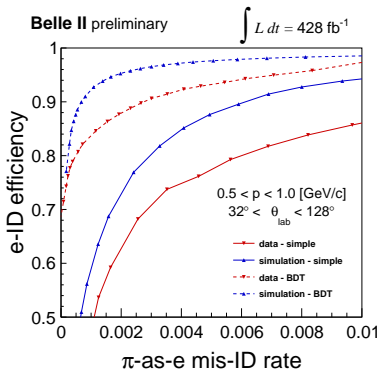
Figure 7. Figure 7: Electron identification efficiency as a function of the [PITH_FULL_IMAGE:figures/full_fig_p020_7.png] view at source ↗
Figure 8
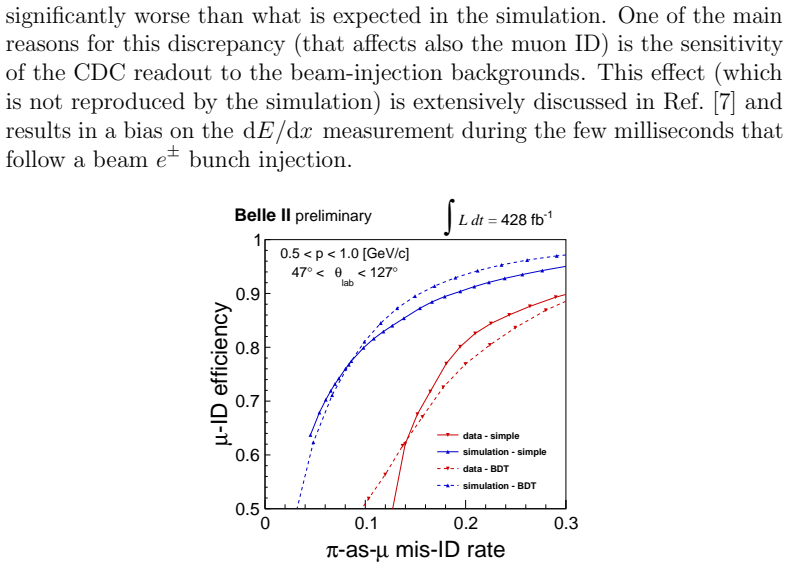
Figure 8. Figure 8: Muon identification efficiency as a function of the [PITH_FULL_IMAGE:figures/full_fig_p021_8.png] view at source ↗
Figure 9
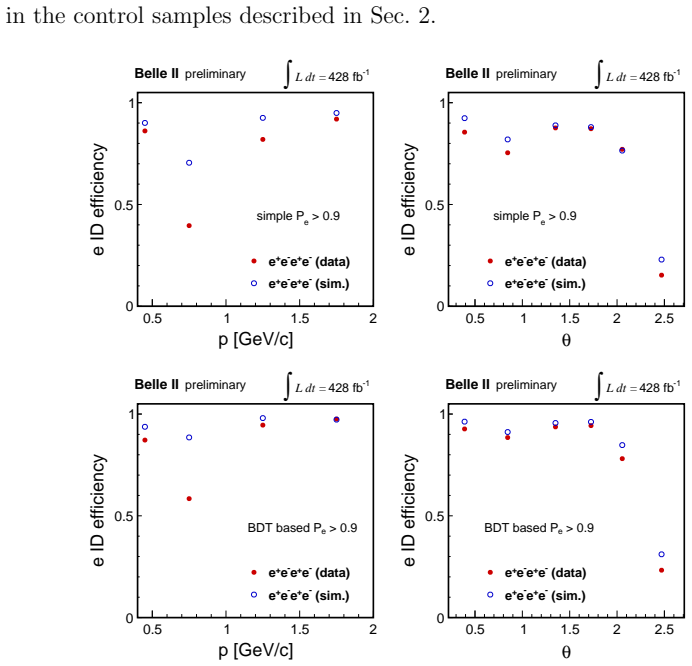
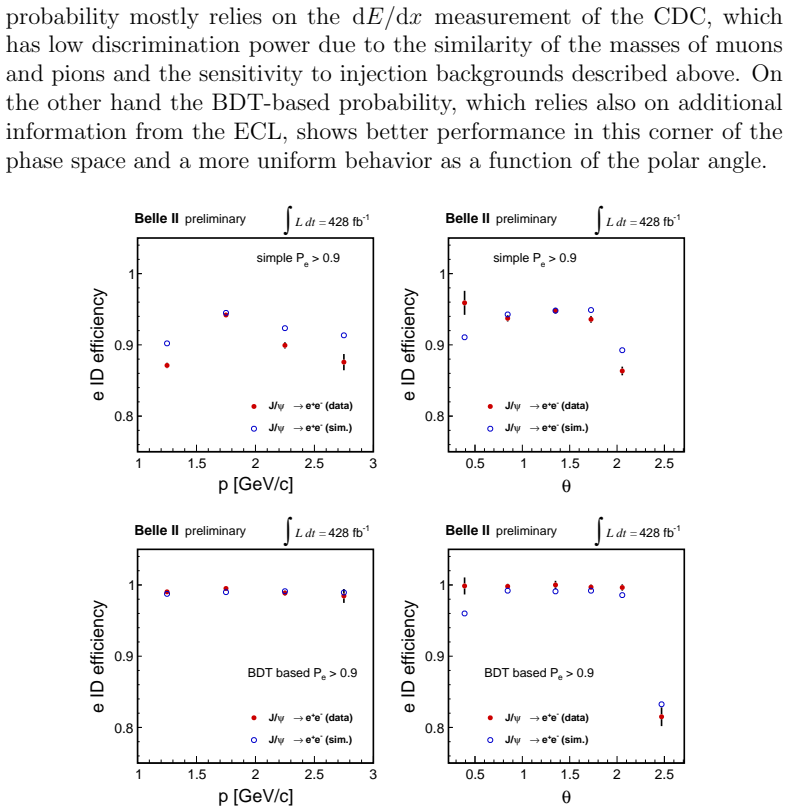
Figure 9. Figure 9: Electron ID efficiency as a function of the momentum (left) and polar [PITH_FULL_IMAGE:figures/full_fig_p022_9.png] view at source ↗
Figure 10
Figure 10. Figure 10: Muon ID efficiency as a function of the momentum (left) and polar [PITH_FULL_IMAGE:figures/full_fig_p023_10.png] view at source ↗
Figure 11
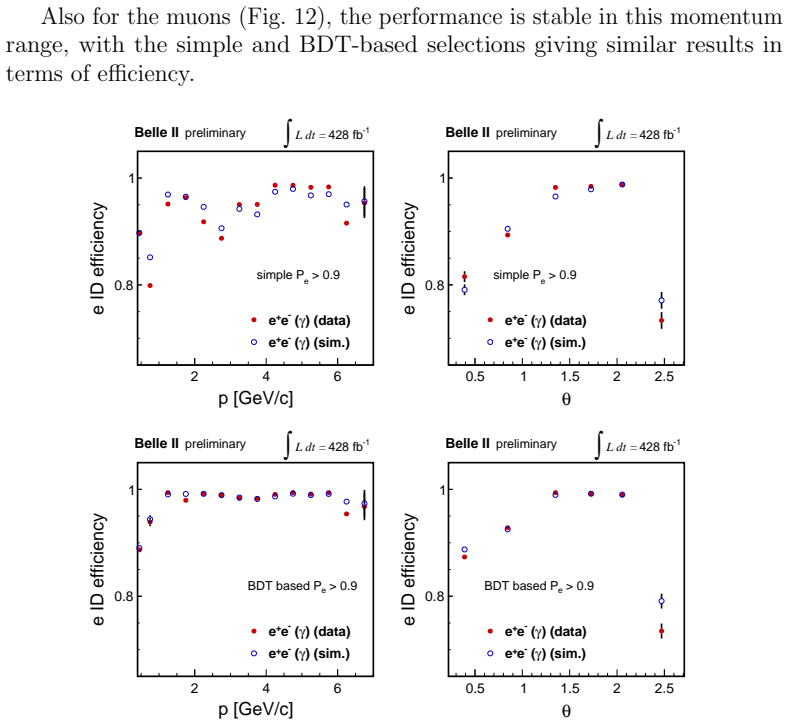
Figure 11. Figure 11: Electron ID efficiency as a function of the momentum (left) and [PITH_FULL_IMAGE:figures/full_fig_p024_11.png] view at source ↗
Figure 12
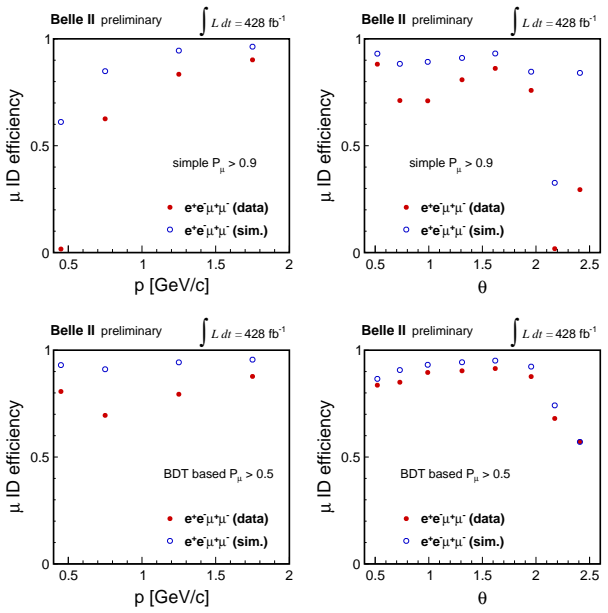
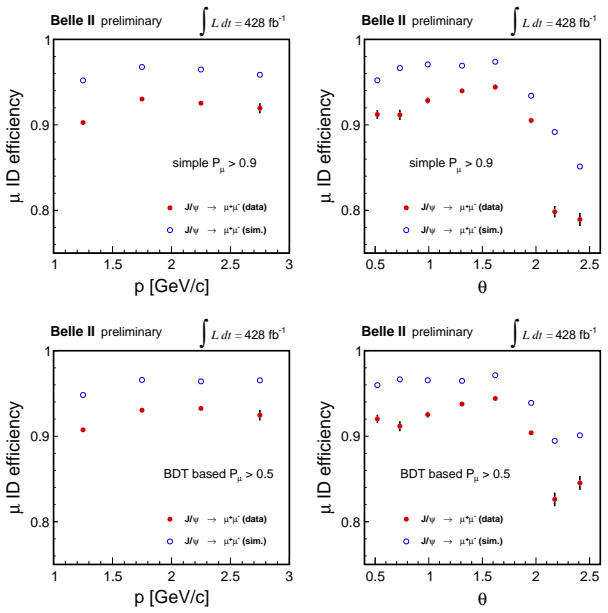
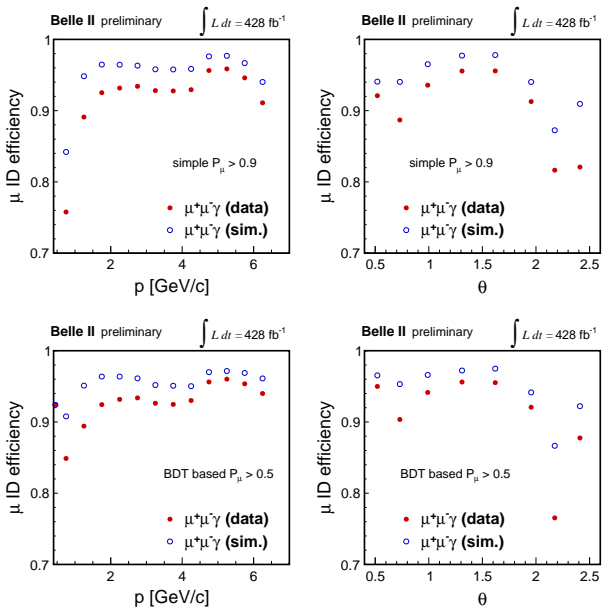
Figure 12. Figure 12: Muon ID efficiency as a function of the momentum (left) and [PITH_FULL_IMAGE:figures/full_fig_p025_12.png] view at source ↗
Figure 13
Figure 13. Figure 13: Electron ID efficiency as a function of the momentum (left) and [PITH_FULL_IMAGE:figures/full_fig_p026_13.png] view at source ↗
Figure 14
Figure 14. Figure 14: Muon ID efficiency as a function of the momentum (left) and [PITH_FULL_IMAGE:figures/full_fig_p027_14.png] view at source ↗
Figure 15
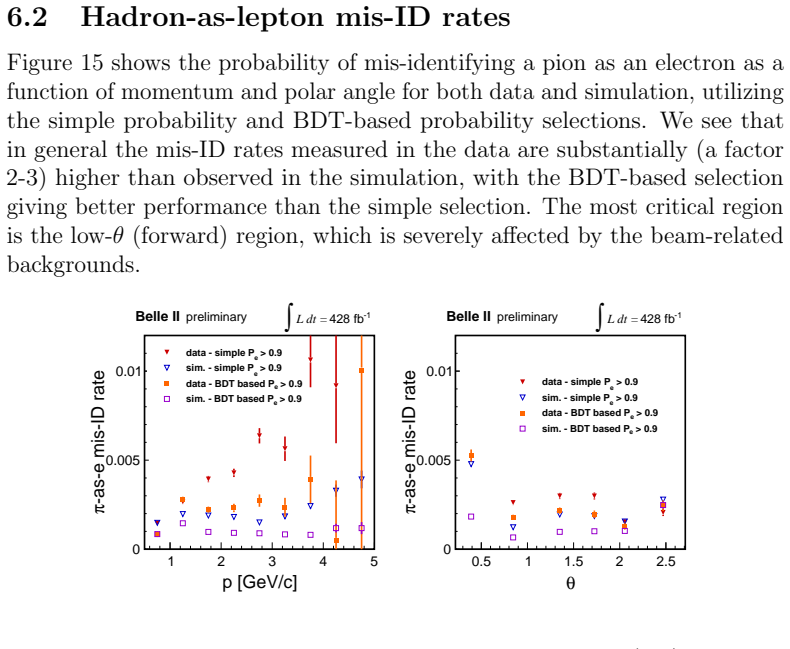
Figure 15. Figure 15: shows the probability of mis-identifying a pion as an electron as a function of momentum and polar angle for both data and simulation, utilizing the simple probability and BDT-based probability selections. We see that in general the mis-ID rates measured in the data are substantially (a factor 2-3) higher than observed in the simulation, with the BDT-based selection giving better performance than the simp… view at source ↗
Figure 16
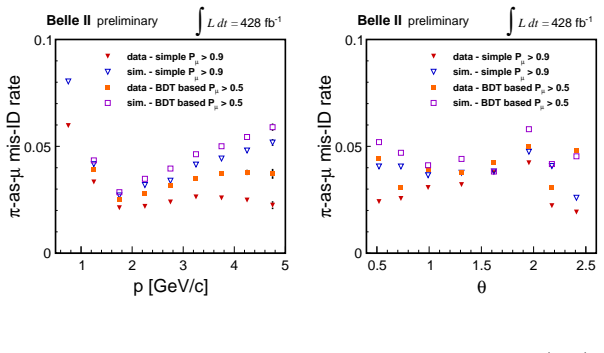
Figure 16. Figure 16 [PITH_FULL_IMAGE:figures/full_fig_p029_16.png] view at source ↗
Figure 17
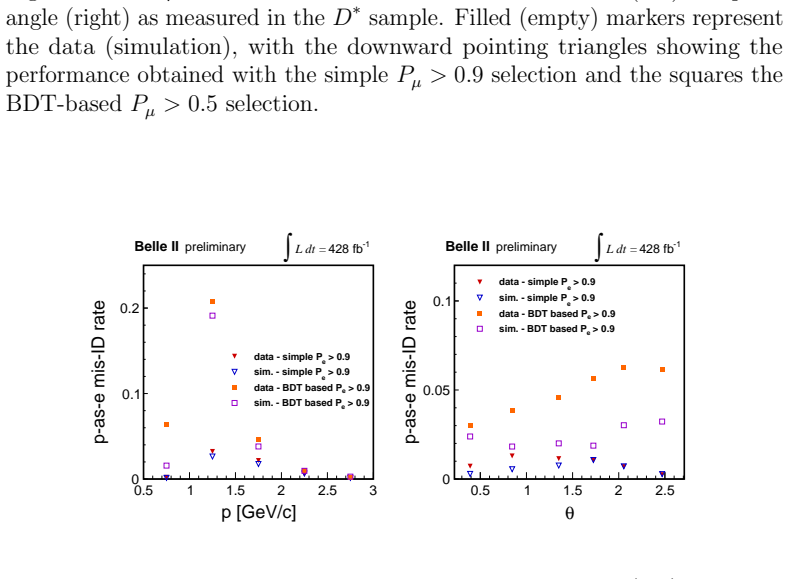
Figure 17. Figure 17: p-as-e mis-ID rate as a function of the momentum (left) and polar angle (right) as measured in the Λ sample. Filled (empty) markers represent the data (simulation), with the downward pointing triangles showing the performance obtained with the simple Pe > 0.9 selection and the squares the BDT-based Pe > 0.9 selection. 26 [PITH_FULL_IMAGE:figures/full_fig_p029_17.png] view at source ↗
Figure 18
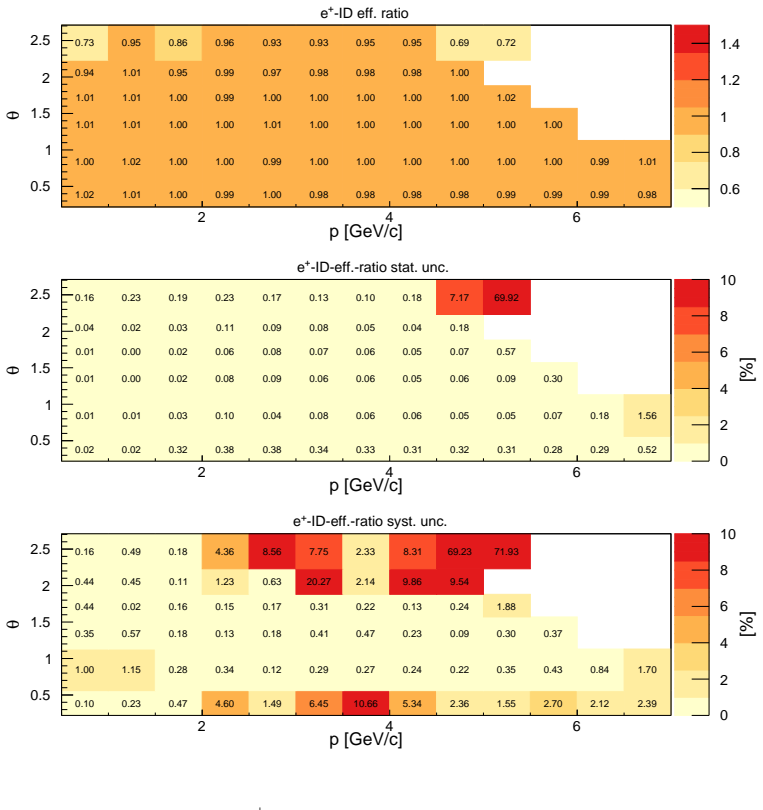
Figure 18. Figure 18: Ratio of the e + ID efficiency in data to that in simulation (top) and its relative statistical (center) and systematic (bottom) uncertainties for the BDT-based Pe > 0.9 selection in subregions of momentum and polar angle. 28 [PITH_FULL_IMAGE:figures/full_fig_p031_18.png] view at source ↗
Figure 19
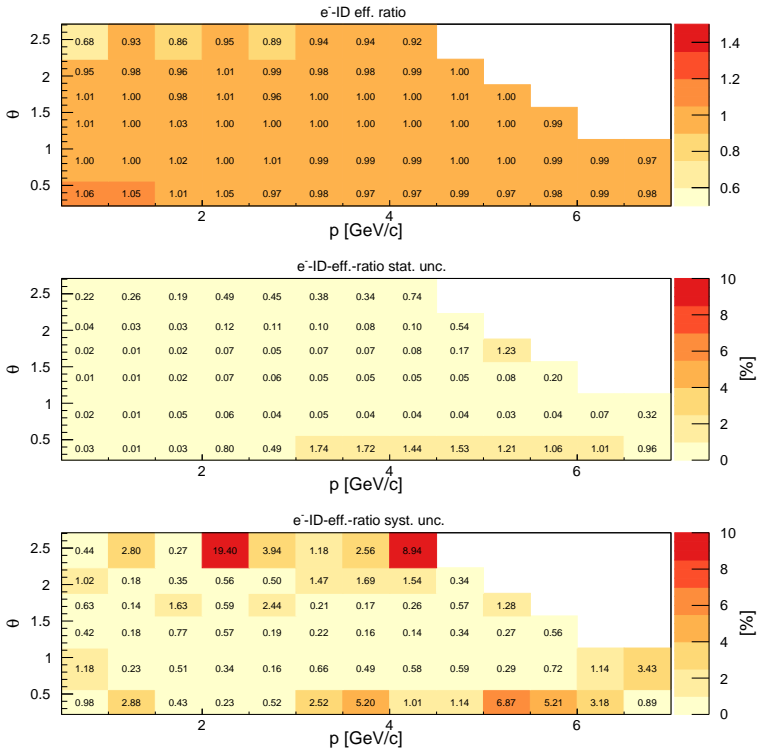
Figure 19. Figure 19: Ratio of the e − ID efficiency in data to that in simulation (top) and its relative statistical (center) and systematic (bottom) uncertainties for the BDT-based Pe > 0.9 selection in subregions of momentum and polar angle. 29 [PITH_FULL_IMAGE:figures/full_fig_p032_19.png] view at source ↗
Figure 20
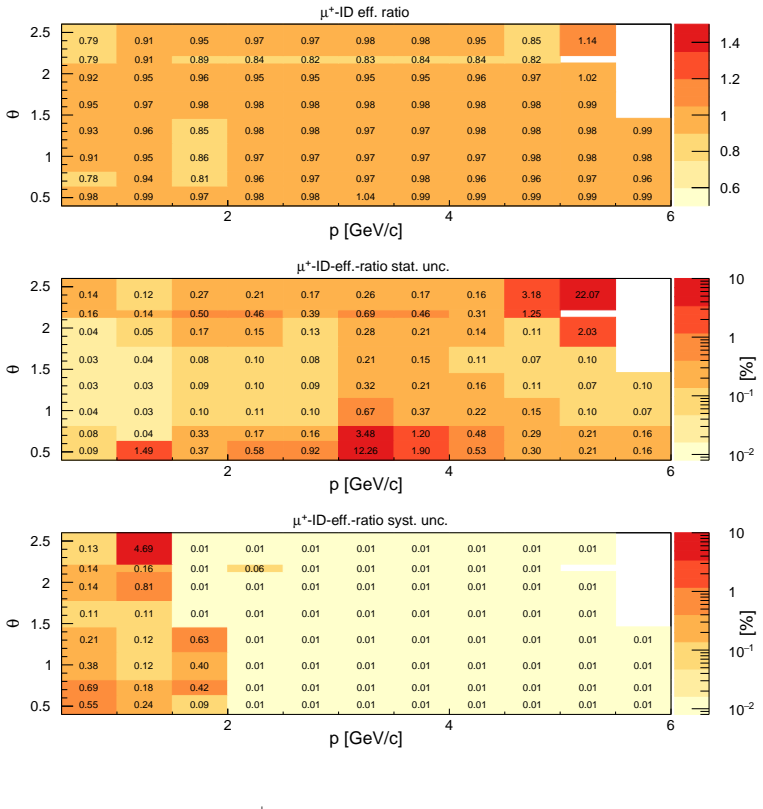
Figure 20. Figure 20: Ratio of the µ + ID efficiency in data to that in simulation (top) and its relative statistical (center) and systematic (bottom) uncertainties for the simple Pµ > 0.9 selection in subregions of momentum and polar angle. We use a logarithmic color scale for the uncertainties. 30 [PITH_FULL_IMAGE:figures/full_fig_p033_20.png] view at source ↗
Figure 21
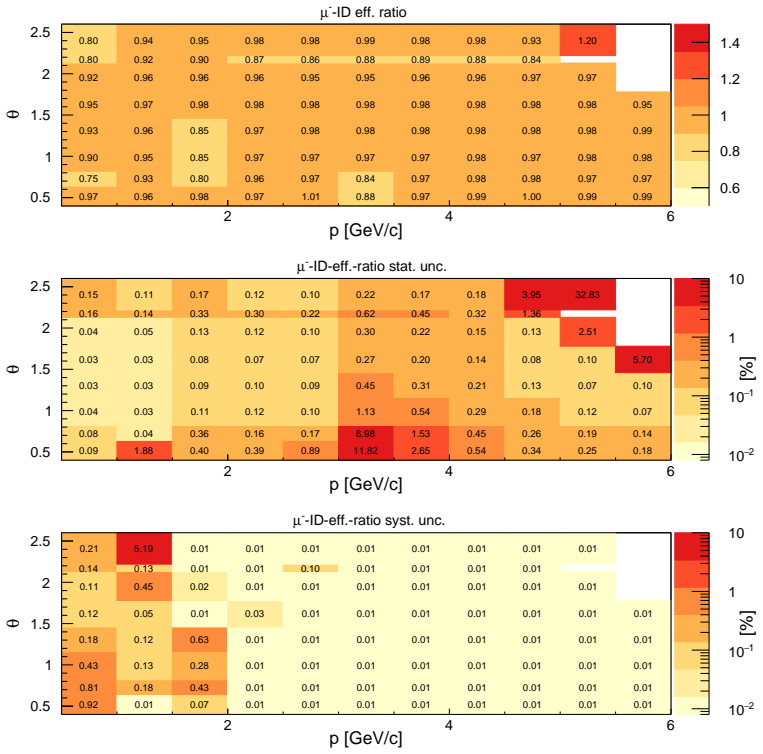
Figure 21. Figure 21: Ratio of the µ − ID efficiency in data to that in simulation (top) and its relative statistical (center) and systematic (bottom) uncertainties for the simple Pµ > 0.9 selection in subregions of momentum and polar angle. We use a logarithmic color scale for the uncertainties. 31 [PITH_FULL_IMAGE:figures/full_fig_p034_21.png] view at source ↗
Figure 22
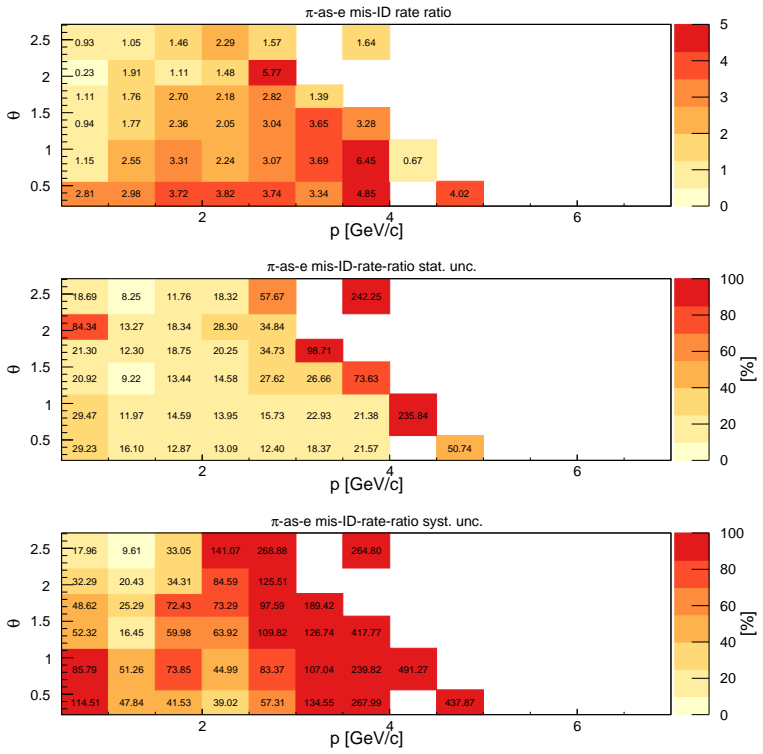
Figure 22. Figure 22: Ratio of the π-as-e mis-ID rate in data to that in simulation (top) and its relative statistical (center) and systematic (bottom) uncertainties for the BDT-based Pe > 0.9 selection in subregions of momentum and polar angle. 32 [PITH_FULL_IMAGE:figures/full_fig_p035_22.png] view at source ↗
Figure 23
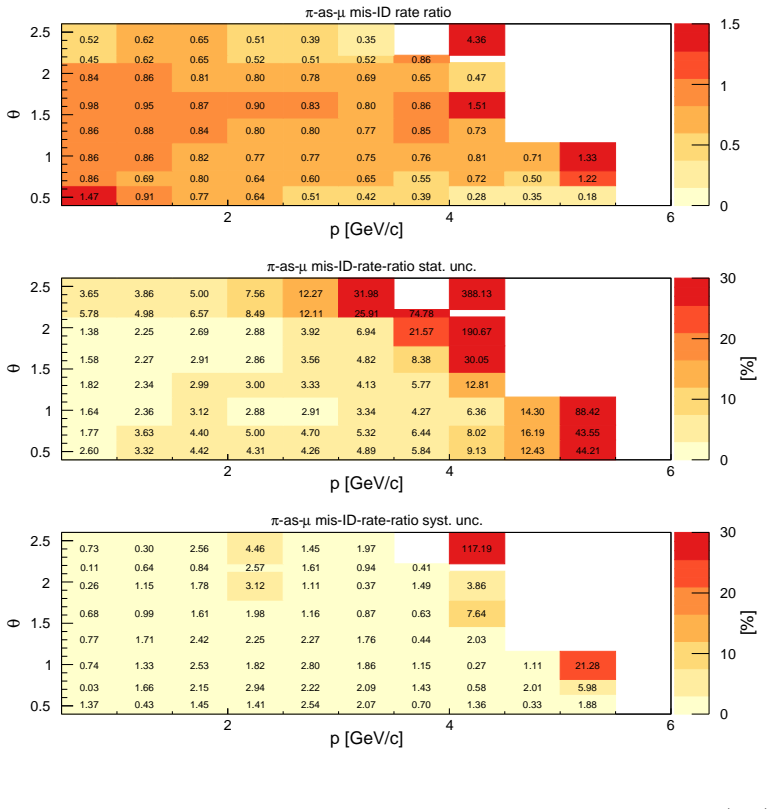
Figure 23. Figure 23: Ratio of the π-as-µ mis-ID rate in data to that in simulation (top) and its relative statistical (center) and systematic (bottom) uncertainties for the simple Pµ > 0.9 selection in subregions of momentum and polar angle. 33 [PITH_FULL_IMAGE:figures/full_fig_p036_23.png] view at source ↗
read the original abstract

Effective particle identification capabilities are a strategic priority for the physics program of the Belle~II experiment. We describe the algorithms used at Belle~II for identifying electrons and muons and separating them from charged hadrons. We present the performance obtained by the experiment during Run 1, which consists of 428 fb$^{-1}$ of data collected at the energy-asymmetric $e^+e^-$ collider SuperKEKB between 2019 and 2022 at center-of-mass energies near the mass of the $\Upsilon(4S)$.

Editorial analysis

A structured set of objections, weighed in public.

Desk editor's note, referee report, simulated authors' rebuttal, and a circularity audit. Tearing a paper down is the easy half of reading it; the pith above is the substance, this is the friction.

Referee Report

0 major / 1 minor

Summary. The manuscript describes the algorithms used at Belle II for identifying electrons and muons while separating them from charged hadrons, and reports the performance metrics obtained with the 428 fb^{-1} Run 1 dataset collected at SuperKEKB between 2019 and 2022 near the Υ(4S) resonance.

Significance. Lepton identification is a core capability for Belle II's flavor-physics program. If the reported efficiencies and misidentification rates are validated on the stated data sample, the paper supplies the community with the empirical performance figures needed to evaluate systematic uncertainties in lepton-based analyses. The work's strength is its direct use of collected data rather than purely simulated samples.

minor comments (1)
  1. The abstract states the integrated luminosity and data-taking period but does not quote any numerical performance figures; adding one or two headline numbers (e.g., electron efficiency at a given momentum) would improve immediate readability without altering the manuscript's scope.

Simulated Author's Rebuttal

0 responses · 0 unresolved

We thank the referee for their positive assessment of the manuscript and for recommending acceptance.

Circularity Check

0 steps flagged

No significant circularity

full rationale

The paper is a methods report describing charged-lepton identification algorithms and reporting empirical performance metrics measured directly on 428 fb^{-1} of Run 1 collision data. No derivations, first-principles predictions, fitted parameters renamed as predictions, or load-bearing self-citations appear in the text. All performance figures are presented as direct measurements on collected data, rendering the work self-contained against external benchmarks with no reduction of claims to inputs by construction.

Axiom & Free-Parameter Ledger

0 free parameters · 0 axioms · 0 invented entities

No mathematical derivations, free parameters, axioms, or new physical entities are present; the work is a purely empirical description of detector algorithms and measured performance.

pith-pipeline@v0.9.1-grok · 7838 in / 1163 out tokens · 25787 ms · 2026-06-26T00:47:12.969221+00:00 · methodology

discussion (0)

Sign in with ORCID, Apple, or X to comment. Anyone can read and Pith papers without signing in.

Reference graph

Works this paper leans on

37 extracted references · 1 canonical work pages

  1. [1]

    K. Akai, K. Furukawa, and H. Koiso, SuperKEKB,SuperKEKB Collider, Nucl. Instrum. Meth. A907(2018) 188,arXiv:1809.01958 [physics.acc-ph]

  2. [2]

    Abudin´ en et al., Belle II Collaboration,B-flavor tagging at Belle II, Eur

    F. Abudin´ en et al., Belle II Collaboration,B-flavor tagging at Belle II, Eur. Phys. J. C82(2022) no. 4, 283,arXiv:2110.00790 [hep-ex]

  3. [3]

    Adachi et al., Belle II Collaboration,New graph-neural-network flavor tagger for Belle II and measurement ofsin 2ϕ 1 inB 0→J/ψK 0 S decays, Phys

    I. Adachi et al., Belle II Collaboration,New graph-neural-network flavor tagger for Belle II and measurement ofsin 2ϕ 1 inB 0→J/ψK 0 S decays, Phys. Rev. D110(2024) no. 1, 012001,arXiv:2402.17260 [hep-ex]

  4. [4]

    Adachi et al., Belle II Collaboration,Novel method for the identification of the production flavor of neutral charmed mesons, Phys

    I. Adachi et al., Belle II Collaboration,Novel method for the identification of the production flavor of neutral charmed mesons, Phys. Rev. D107(2023) no. 11, 112010,arXiv:2304.02042 [hep-ex]

  5. [5]

    Keck et al.,The Full Event Interpretation: An Exclusive Tagging Algorithm for the Belle II Experiment, Comput

    T. Keck et al.,The Full Event Interpretation: An Exclusive Tagging Algorithm for the Belle II Experiment, Comput. Softw. Big Sci.3(2019) no. 1, 6,arXiv:1807.08680 [hep-ex]

  6. [6]

    Ed. A. J. Bevan, B. Golob, Th. Mannel, S. Prell, and B. D. Yabsley, The physics of theBFactories, Eur. Phys. J.C74(2014) 3026, arXiv:1406.6311 [hep-ex]

  7. [7]

    Adachi et al., Belle II Collaboration,Charged-hadron identification at Belle II, Eur

    I. Adachi et al., Belle II Collaboration,Charged-hadron identification at Belle II, Eur. Phys. J. C85(2025) no. 11, 1237,arXiv:2506.04355 [hep-ex]

  8. [8]

    Altmannshofer et al., Belle II Collaboration,The Belle II Physics Book, PTEP2019(2019) no

    W. Altmannshofer et al., Belle II Collaboration,The Belle II Physics Book, PTEP2019(2019) no. 12, 123C01,arXiv:1808.10567 [hep-ex]. [Erratum: PTEP2020(2020), 029201]

  9. [9]

    Abe et al., Belle II Collaboration,Belle II Technical Design Report, arXiv:1011.0352 [physics.ins-det]

    T. Abe et al., Belle II Collaboration,Belle II Technical Design Report, arXiv:1011.0352 [physics.ins-det]

  10. [10]

    Moser,The Belle II DEPFET pixel detector, Nucl

    H.-G. Moser,The Belle II DEPFET pixel detector, Nucl. Instrum. Meth. A831(2016) 85–87.https://www.sciencedirect.com/science/ article/pii/S0168900216002540

  11. [11]

    Adamczyk et al., Belle II SVD Group,The design, construction, operation and performance of the Belle II silicon vertex detector, JINST 17(2022) no

    K. Adamczyk et al., Belle II SVD Group,The design, construction, operation and performance of the Belle II silicon vertex detector, JINST 17(2022) no. 11, P11042,arXiv:2201.09824 [physics.ins-det]. 37

  12. [12]

    Atmacan et al.,The imaging Time-of-Propagation detector at Belle II, Nucl

    H. Atmacan et al.,The imaging Time-of-Propagation detector at Belle II, Nucl. Instrum. Meth. A1080(2025) 170627,arXiv:2504.19090 [hep-ex]

  13. [13]

    Yonenaga et al.,Performance evaluation of the aerogel RICH counter for the Belle II spectrometer using early beam collision data, PTEP 2020(2020) no

    M. Yonenaga et al.,Performance evaluation of the aerogel RICH counter for the Belle II spectrometer using early beam collision data, PTEP 2020(2020) no. 9, 093H01,arXiv:2008.06251 [physics.ins-det]

  14. [14]

    Kuzmin, Belle II Calorimeter Team,Electromagnetic calorimeter of Belle II, Nucl

    A. Kuzmin, Belle II Calorimeter Team,Electromagnetic calorimeter of Belle II, Nucl. Instrum. Meth. A958(2020) 162235

  15. [15]

    Ketter et al.,Design and commissioning of readout electronics for a K 0 L andµdetector at the Belle II experiment, Nucl

    C. Ketter et al.,Design and commissioning of readout electronics for a K 0 L andµdetector at the Belle II experiment, Nucl. Instrum. Meth. A 1082(2026) 170893

  16. [16]

    Jadach, B

    S. Jadach, B. F. L. Ward, and Z. Was,The Precision Monte Carlo event generator K K for two fermion final states ine +e− collisions, Comput. Phys. Commun.130(2000) 260,arXiv:hep-ph/9912214

  17. [17]

    Sj¨ ostrand, S

    T. Sj¨ ostrand, S. Ask, J. R. Christiansen, R. Corke, N. Desai, P. Ilten, S. Mrenna, S. Prestel, C. O. Rasmussen, and P. Z. Skands,An Introduction to PYTHIA 8.2, Comput. Phys. Commun.191(2015) 159, arXiv:1410.3012 [hep-ph]

  18. [18]

    D. J. Lange,The EvtGen particle decay simulation package, Nucl. Instrum. Meth. A462(2001) 152

  19. [19]

    Davidson, G

    N. Davidson, G. Nanava, T. Przedzinski, E. Richter-Was, and Z. Was, Universal Interface of TAUOLA Technical and Physics Documentation, Comput. Phys. Commun.183(2012) 821, arXiv:1002.0543 [hep-ph]

  20. [20]

    Balossini, C

    G. Balossini, C. Bignamini, C. M. C. Calame, G. Montagna, O. Nicrosini, and F. Piccinini,Photon pair production at flavour factories with per mille accuracy, Phys. Lett. B663(2008) 209–213, arXiv:0801.3360 [hep-ph]

  21. [21]

    F. A. Berends, P. H. Daverveldt, and R. Kleiss,Complete Lowest Order Calculations for Four Lepton Final States in electron-Positron Collisions, Nucl. Phys. B253(1985) 441–463

  22. [22]

    Agostinelli et al., GEANT4 Collaboration,GEANT4–a simulation toolkit, Nucl

    S. Agostinelli et al., GEANT4 Collaboration,GEANT4–a simulation toolkit, Nucl. Instrum. Meth. A506(2003) 250–303. 38

  23. [23]

    T. Kuhr, C. Pulvermacher, M. Ritter, T. Hauth, and N. Braun, Belle II Framework Software Group,The Belle II Core Software, Comput. Softw. Big Sci.3(2019) no. 1, 1,arXiv:1809.04299 [physics.comp-ph]

  24. [24]

    Belle II Collaboration,Belle II Analysis Software Framework (basf2), https://doi.org/10.5281/zenodo.5574115

  25. [25]

    G. C. Fox and S. Wolfram,Observables for the Analysis of Event Shapes ine +e− Annihilation and Other Processes, Phys. Rev. Lett.41(1978) 1581

  26. [26]

    D. E. Groom and S. R. Klein,Passage of Particles Through Matter, in Particle Data Group, Review of particle physics, Phys. Rev. D110 (2024) no. 3, Chapter 34

  27. [27]

    Stariˇ c et al.,Likelihood analysis of patterns in a time-of-propagation (TOP) counter, Nucl

    M. Stariˇ c et al.,Likelihood analysis of patterns in a time-of-propagation (TOP) counter, Nucl. Instrum. Meth. A595(2008) 252–255

  28. [28]

    K. S. Cranmer,Kernel estimation in high-energy physics, Comput. Phys. Commun.136(2001) 198,arXiv:hep-ex/0011057

  29. [29]

    S. Longo et al.,CsI(Tl) pulse shape discrimination with the Belle II electromagnetic calorimeter as a novel method to improve particle identification at electron–positron colliders, Nucl. Instrum. Meth. A982 (2020) 164562,arXiv:2007.09642 [physics.ins-det]

  30. [30]

    Milesi, J

    M. Milesi, J. Tan, and P. Urquijo,Lepton identification in Belle II using observables from the electromagnetic calorimeter and precision trackers, EPJ Web Conf.245(2020) 06023

  31. [31]

    Gaiser,Charmonium spectroscopy from radiative decays of theJ/ψ andψ ′

    J. Gaiser,Charmonium spectroscopy from radiative decays of theJ/ψ andψ ′. PhD thesis, Stanford University, 1982

  32. [32]

    Skwarnicki,A study of the radiative CASCADE transitions between the Upsilon-Prime and Upsilon resonances

    T. Skwarnicki,A study of the radiative CASCADE transitions between the Upsilon-Prime and Upsilon resonances. PhD thesis, Cracow, INP, 1986

  33. [33]

    Pivk and F

    M. Pivk and F. R. Le Diberder,SPlot: A Statistical tool to unfold data distributions, Nucl. Instrum. Meth. A555(2005) 356–369, arXiv:physics/0402083

  34. [34]

    Adachi et al., Belle II Collaboration,Test of light-lepton universality inτdecays with the Belle II experiment, JHEP08(2024) 205

    I. Adachi et al., Belle II Collaboration,Test of light-lepton universality inτdecays with the Belle II experiment, JHEP08(2024) 205. 39

  35. [35]

    Adachi et al., Belle II Collaboration,Test of lepton flavor universality with measurements of R(D+)and R(D∗+)using semileptonic B tagging at the Belle II experiment, Phys

    I. Adachi et al., Belle II Collaboration,Test of lepton flavor universality with measurements of R(D+)and R(D∗+)using semileptonic B tagging at the Belle II experiment, Phys. Rev. D112(2025) 032010

  36. [36]

    Novosel, A

    A. Novosel, A. Narimani Charan, L. ˇSantelj, T. Ferber, P. Kriˇ zan, and B. Golob,Identification of light leptons and pions in the electromagnetic calorimeter of Belle II, Nucl. Instrum. Meth. A1056(2023) 168630, arXiv:2301.05074 [hep-ex]

  37. [37]

    Wang et al.,Muon identification with Deep Neural Network in the Belle II K-Long and Muon detector, Nucl

    Z. Wang et al.,Muon identification with Deep Neural Network in the Belle II K-Long and Muon detector, Nucl. Instrum. Meth. A1081 (2026) 170814,arXiv:2503.11351 [hep-ex]. 40