REVIEW 3 major objections 3 minor 14 references
Gap phenomena for constant mean curvature surfaces
T0 review · 3 major / 3 minor · reviewed 2026-08-14 · deepseek-v4-flash
Pith's one-line read For a compact free-boundary constant-mean-curvature surface in the unit ball, a sharp pointwise pinching on the traceless second fundamental form leaves exactly two possibilities: a spherical cap, or a portion of a Delaunay surface.
desk verdict A genuinely useful sharp CMC analog of the Ambrozio-Nunes gap theorem, but the equality-case argument has a load-bearing gap and the abstract overreaches the actual content. read the letter →
The pith
A machine-rendered reading of the paper's core claim, the machinery that carries it, and where it could break.
The reading
What carries the argument
The proof is carried by the Hessian of $\varphi(x)=|x|^2/2$ restricted to the surface. Its eigenvalues are $\lambda_i=1+k_i\langle x,N\rangle$, where $k_i$ are the principal curvatures, and the identity $$4\lambda_1\lambda_2=(2+H\langle x,N\rangle)^2-2|\Phi|^2\langle x,N\$rangle^{2}$$$ shows that the pinching is exactly the statement that the product of the two eigenvalues is nonnegative. The remaining work is to show the sum $v=2+H\langle x,N\rangle$ is nonnegative; this uses the free-boundary condition $v=2$ on $\partial\Sigma$ and the classical fact that a non-totally-umbilical CMC surface in $\mathbb R^3$ has only isolated umbilical points. Once $\varphi$ is convex, a strictly positive pinching forces a single minimum and a disk, hence a spherical cap by the classical free-boundary disk classification, while equality produces a continuum of minima; a rotation Killing field then satisfies the Jacobi equation along the surface, and a nodal-set theorem for solutions of that equation forces the Killing field to be tangent everywhere, making the surface rotational and therefore Delaunay.
What would settle it
Numerically search among compact free-boundary constant-mean-curvature surfaces in the unit ball for one that satisfies the pointwise pinching but whose set of minima of $|x|^2$ is not a single geodesic arc; the equality-case argument predicts any such surface must be a surface of revolution, so a non-rotational example would refute Theorem 1.4.
Extended reading notes
Core claim
On the paper's own terms, the central discovery is Theorem 1.4: for a compact free-boundary CMC surface $\Sigma\subset B^3$, the condition $$|\Phi|^2\langle x,N\$rangle^{2}$\le \tfrac12(2+H\langle x,N\rangle)^2$$ at every point forces either $|\Phi|^2\langle x,N\rangle^2\equiv 0$, in which case $\Sigma$ is a spherical cap, or equality at some point, in which case $\Sigma$ is a portion of a Delaunay surface. Here $\Phi$ is the traceless part of the second fundamental form, $H$ is the unnormalized mean curvature, and $N$ is the unit normal. The strict case yields a convex distance-squared function with a single minimum and a topological disk; the equality case yields a continuum of minima and, through a Jacobi-field argument, a rotational surface. An extended version of the same argument is claimed for hyperbolic space, the upper hemisphere, and higher dimensions.
Load-bearing premise
The load-bearing premise is that a non-totally-umbilical constant-mean-curvature surface in $\mathbb R^3$ has only isolated umbilical points; the proof of Proposition 2.1 uses this to rule out a second zero of $v=2+H\langle x,N\rangle$ in a small disk, and without it the convexity of the distance function—and hence the gap conclusion—need not follow.
Editorial extensions
If this is right
- If the pinching is strict at every point, the surface must be a spherical cap; if equality is attained somewhere, it must be a portion of a Delaunay surface.
- The pinching is sharp: explicit free-boundary unduloid and nodoid portions in a ball satisfy the inequality, and longer portions of the same Delaunay surfaces violate it.
- Any free-boundary CMC surface in $B^3$ meeting the pinching is therefore topologically a disk or an annulus; higher-genus surfaces cannot satisfy the condition.
- The same inequality makes the distance-squared function convex on the surface, so the set of its minima is totally convex; this convexity is the mechanism behind the rigidity.
- Analogous gap statements are announced for hyperbolic space, the upper hemisphere, and higher dimensions.
Reading between the lines
- Beyond the paper: because the key identity is $4\lambda_1\lambda_2=(2+H\langle x,N\rangle)^2-2|\Phi|^2\langle x,N\rangle^2$, the same computation gives a general criterion for convexity of the squared-distance function on any CMC surface in $\mathbb R^3$, independent of free-boundary conditions.
- Beyond the paper: the proof's reliance on isolated umbilical points and nodal-set rigidity suggests the classification might survive in other rotationally symmetric ambient spaces if the analogue of the support function $2+H\langle x,N\rangle$ can be shown nonnegative.
- Beyond the paper: the construction of violating long unduloid portions hints that the pinching encodes a quantitative shape constraint—roughly, a free-boundary Delaunay piece in the unit ball can satisfy the inequality only while its profile stays inside a certain convexity window, which could be mapped numerically across the full $(B,H)$ parameter range.
Signed reviews
Editorial analysis
A structured set of objections, weighed in public.
Referee Report
Summary. The manuscript proves a pinching theorem for compact free boundary constant mean curvature (CMC) surfaces in the Euclidean unit ball. Theorem 1.4 states that if |Φ|^2⟨x,N⟩^2 ≤ 1/2(2+H⟨x,N⟩)^2 on Σ, then either |Φ|^2⟨x,N⟩^2 ≡ 0 and Σ is a spherical cap, or equality is attained at some point and Σ is a portion of a Delaunay surface. The proof studies the distance function φ=|x|^2/2, shows under the pinching that its Hessian on Σ is nonnegative, analyzes the minimum set C, and uses a Killing-field argument in the equality case. Section 3 constructs explicit Delaunay examples to show the pinching is sharp.
Significance. The result is a natural and nontrivial extension of the Ambrozio–Nunes gap theorem to nonzero mean curvature, and the pinching condition is new and sharp. The use of the distance function and the identity relating the pinching to the Hessian eigenvalues is elegant, and the identification of the equality case with Delaunay surfaces is a strong conclusion. The explicit examples in Section 3 are valuable. However, the proof of the equality case has a significant gap, and the manuscript as submitted overclaims results in the abstract; these issues must be addressed before the paper can be accepted.
major comments (3)
- [Section 2.1, proof of Theorem 1.4, after Corollary 2.1] The statement 'If equality occurs in (1.2) at some point then C has more than one point' is asserted without proof. Equality in (1.2) gives 4λ1λ2=0 at some point, i.e., a degenerate eigenvalue of HessΣφ. This does not by itself imply that the minimum set C of φ contains more than one point: a smooth convex function on a compact surface with strictly convex boundary can have a unique minimum with a degenerate Hessian (for instance h(t)=t^4 on an interval has h''(0)=0 and a unique minimum). The subsequent Killing-field argument requires C to contain a nontrivial geodesic segment, so this implication is load-bearing. Please supply a proof or a reference, or adjust the theorem.
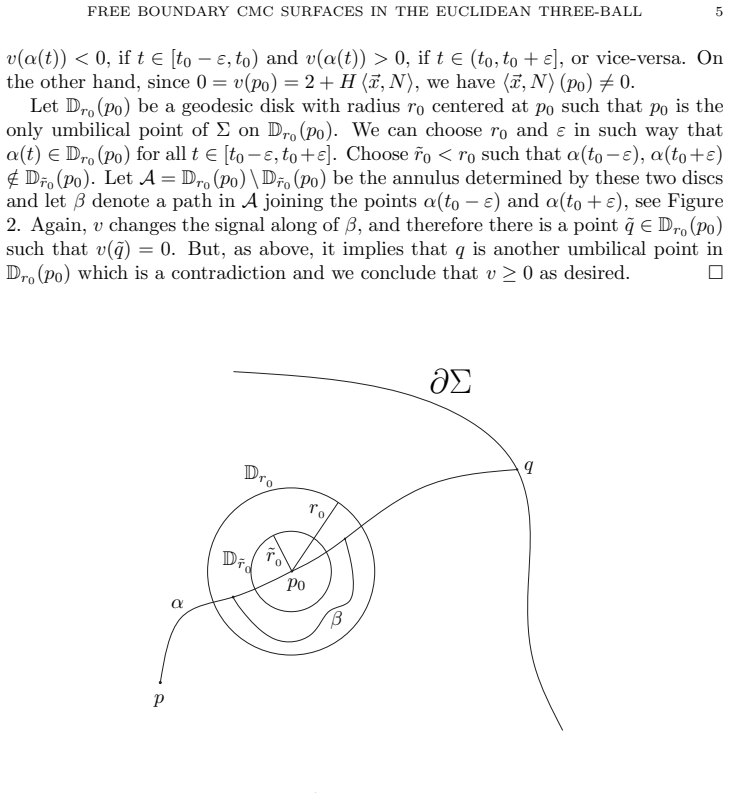
- [Section 2, Proposition 2.1] The proof that v=2+H⟨x,N⟩ is nonnegative uses the fact that a non-totally-umbilical CMC surface in R^3 has isolated umbilic points. This is a classical consequence of the Hopf differential, but the manuscript neither proves it nor gives a precise reference; the introduction mentions it but no citation is provided. Since the contradiction argument near p0 depends on this isolation property, please add a proof or a reference.
- [Abstract] The abstract as provided claims results for complete properly embedded CMC surfaces in Euclidean space, for hyperbolic space, for the upper hemisphere, and in higher dimensions. None of these appear in the body, which proves only Theorem 1.4 for compact free boundary CMC surfaces in B^3. The abstract must be rewritten to match the actual content, or the additional theorems must be stated and proved.
minor comments (3)
- [Section 3, Proposition 3.1] The claim that the constructed Delaunay portion satisfies all conditions of Lemma 3.1 is left to an 'easy check'. Please spell out the verification of (3.6)–(3.8), since the sharpness of the pinching depends on it.
- [Title] The title given in the submission ('Gap results for free boundary CMC surfaces in the Euclidean three-ball') differs from the arXiv listing title ('Gap phenomena for constant mean curvature surfaces'). Please make them consistent.
- [Throughout] There are several typos: 'condidion' in Lemma 3.1, 'Propostion' before Proposition 3.2, 'cconsider' in Lemma 3.4, 'Finaly' in the proof of Lemma 3.1, and 'resul ts' in the running title.
Circularity Check
No circularity found: the pinching inequality is an input assumption, and the classification steps rely on external theorems.
full rationale
The paper's derivation chain contains no circular step of the enumerated kinds. The pinching condition (1.2) is an assumed inequality, not a fitted parameter or a consequence of the conclusion. Proposition 2.1 derives the convexity of the distance function by direct algebraic manipulation, using only the definition of the traceless second fundamental form and the principal-curvature formula for the Hessian; no quantity is renamed as a prediction. The strict-inequality case invokes Nitsche's classification of stationary disks, and the equality case invokes Cheng's nodal-set theorem for Jacobi fields, both external and independent of the paper's own assumptions. The Delaunay examples in Section 3 are verified by explicit curvature computations from the standard parametrization, so the sharpness claim is not manufactured from the theorem's conclusion. Self-citations to Ambrozio-Nunes [2] and to the authors' related papers [3], [4] are contextual and not load-bearing: Theorem 1.1 is prior work, while [3] and [4] are only mentioned as related results. The skeptic's objection that equality in (1.2) is not shown to force the minimum set C to contain more than one point is a potential proof gap in the equality-case argument, not a reduction of a claimed result to its own input; a missing implication is distinct from circularity. The paper is therefore self-contained against external benchmarks for the purposes of this analysis.
Assumptions & free parameters
assumptions (5)
- domain assumption The umbilical points of a CMC surface in R^3 that is not totally umbilical are isolated.
- domain assumption Nitsche's theorem: a compact CMC disk with suitable boundary conditions in a ball is a spherical cap.
- domain assumption Cheng's theorem: critical points on the nodal set of a solution to Δv+|A|^2v=0 are isolated.
- standard math The function v=<V,N> for a Killing field V on a CMC surface satisfies the Jacobi equation Δv+|A|^2v=0.
- standard math Complete rotational CMC surfaces in R^3 are exactly the Delaunay surfaces.
Cite this review
Pith. "Pith review of Gap phenomena for constant mean curvature surfaces." pith.science (2026). https://pith.science/paper/MO6RLYMS
@misc{pith2026190809952,
  author       = {Pith},
  title        = {Pith review of: Gap phenomena for constant mean curvature surfaces},
  year         = {2026},
  howpublished = {\url{https://pith.science/paper/MO6RLYMS}},
  note         = {Machine review of arXiv:1908.09952}
}
abstract
In this paper, we prove gap results for constant mean curvature (CMC) surfaces. Firstly, we find a natural inequality for CMC surfaces which imply convexity for distance function. We then show that if $\Sigma$ is a complete, properly embedded CMC surface in the Euclidean space satisfying this inequality, then $\Sigma$ is either a sphere or a right circular cylinder. Next, we show that if $\Sigma$ is a free boundary CMC surface in the Euclidean 3-ball satisfying the same inequality, then either $\Sigma$ is a totally umbilical disk or an annulus of revolution. These results complete the picture about gap theorems for CMC surfaces in the Euclidean 3-space. We also prove similar results in the hyperbolic space and in the upper hemisphere, and in higher dimensions.
Figures

Reference graph
Works this paper leans on
-
[1]
Hil´ ario Alencar and Manfredo do Carmo, Hypersurfaces with constant mean curvature in spheres, Proc. Amer. Math. Soc. 120 (1994), no. 4, 1223–1229. MR 1172943
work page 1994
-
[2]
Lucas Ambrozio and Ivaldo Nunes, A gap theorem for free boundary minimal surfaces in the three-ball, arXiv:1608.05689 [math.DG] to appear in Comm. Anal. Geom. (2016)
work page Pith review arXiv 2016
-
[3]
Ezequiel Barbosa, Edno Pereira, and Rosivaldo A. Gon¸ calves, Uniqueness results for free-boundary minimal hypersurfaces in conformally euclidean balls and annular domains , arXiv:1807.10780 [math.DG] (2016)
work page Pith review arXiv 2016
-
[4]
Marcos P. Cavalcante, Abra˜ ao Mendes, and Feliciano Vit´ orio, Vanishing theorems for the cohomology groups of free boundary submanifolds, Ann. Global Anal. Geom. 56 (2019), no. 1, 137–146. MR 3962030
work page 2019
-
[5]
Shiu Yuen Cheng, Eigenfunctions and nodal sets , Comment. Math. Helv. 51 (1976), no. 1, 43–55. MR 0397805
work page 1976
-
[6]
S. S. Chern, M. do Carmo, and S. Kobayashi, Minimal submanifolds of a sphere with second fundamental form of constant length , Functional Analysis and Related Fields (Proc. Conf. for M. Stone, Univ. Chicago, Chicago, Ill., 1968), Springer, New York, 1970, pp. 59–75. MR 0273546
work page 1968
-
[7]
Abigail Folha, Frank Pacard, and Tatiana Zolotareva, Free boundary minimal surfaces in the unit 3-ball, Manuscripta Math. 154 (2017), no. 3-4, 359–409. MR 3713919
work page 2017
-
[8]
Ailana Fraser and Richard Schoen, Sharp eigenvalue bounds and minimal surfaces in the ball , Invent. Math. 203 (2016), no. 3, 823–890. MR 3461367
work page 2016
Show all 14 references
-
[9]
Nicolaos Kapouleas and David Wiyguli, Free-boundary minimal surfaces with connected boundary in the 3-ball by tripling the equatorial disc , arXiv:1711.00818 [math.DG] (2017)
2017 arXiv
-
[10]
Katsuei Kenmotsu, Surfaces of revolution with prescribed mean curvature , Tohoku Math. J. (2) 32 (1980), no. 1, 147–153. MR 567837
1980
-
[11]
Daniel Ketover, Free boundary minimal surfaces of unbounded genus , arXiv:1612.08691 [math.DG] (2016)
2016 arXiv
-
[12]
Blaine Lawson, Jr., Local rigidity theorems for minimal hypersurfaces , Ann
H. Blaine Lawson, Jr., Local rigidity theorems for minimal hypersurfaces , Ann. of Math. (2) 89 (1969), 187–197. MR 0238229
1969
-
[13]
Johannes C. C. Nitsche, Stationary partitioning of convex bodies, Arch. Rational Mech. Anal. 89 (1985), no. 1, 1–19. MR 784101
1985
-
[14]
Dedicata 56 (1995), no
Antonio Ros and Enaldo Vergasta, Stability for hypersurfaces of constant mean curvature with free boundary, Geom. Dedicata 56 (1995), no. 1, 19–33. MR 1338315 Universidade Federal de Minas Gerais, Departamento de Matem ´atica, Caixa Postal 702, 30123-970, Belo Horizonte, MG, B...
1995
Reviewed August 14, 2026 · model on record in the stance chip above.
Discussion (0). Continue with ORCID to comment.