REVIEW 3 major objections 5 minor 26 references
Tests of nematic-mediated superconductivity applied to Ba$_{1-x}$Sr$_x$Ni$_2$As$_2$
T0 review · 3 major / 5 minor · reviewed 2026-08-14 · deepseek-v4-flash
Pith's one-line read Strain response of Tc grows sharply under nematic-mediated pairing
desk verdict Useful, honest proposal for testing nematic-mediated pairing, but the flashy strain-scaling exponent loses its leading term in the paper's own mean-field model. read the letter →
The pith
A machine-rendered reading of the paper's core claim, the machinery that carries it, and where it could break.
The reading
What carries the argument
The load-bearing machinery is a weak-coupling treatment of a Fermi surface coupled to a nematic boson φ, combined with a scaling analysis of how a symmetry-breaking field suppresses the boson propagator. The boson has B1g form factor f(k) = sin(k_x a) sin(k_y a) and propagator D(q) = χ0/(1 + ξ² q²) Θ(Λ − |q|); integrating it out produces a nearly momentum-diagonal attractive interaction whose dimensionless strength is g ∝ (χ0 $a^{{2−d}}$/V0)(a/ξ)^{d−1}. The key scaling relations are δχ0/χ0 ≈ −bχ u κ² $χ0^{{y_ε}}$ ε² and δξ/ξ ≈ −bξ u κ² $χ0^{{y_ε}}$ ε², with y_ε = 2 + 2β/γ, derived from the quantum-critical scaling form of the nematic propagator. Feeding these into the BCS relation Tc ∝ exp(−1/λ) gives dTc/Tc ∝ ([(d−1)bξ − bχ]/λ0) g u κ² $χ0^{{y_ε}}$ ε², the predicted fingerprint of nematic-mediated pairing.
What would settle it
Measure the coefficient of $\epsilon^2$ in $\mathrm{d}T_c/T_c$ of Ba1−xSrxNi2As2 at several strontium concentrations between x = 1.0 and x ≈ 0.7, using elastoresistance to determine the corresponding nematic susceptibility $\chi_0$. If the magnitude of this coefficient does not grow substantially faster than $\chi_0^2$ (the band-structure rate) as $\chi_0$ increases—for instance, if it stays flat or grows only like $\chi_0^2$—the predicted fluctuation-cutoff effect is not present, and the central strain signature of nematic-mediated pairing is refuted.
Extended reading notes
Core claim
On the paper's own terms, the central claim is that weak coupling to nematic fluctuations, added on top of a conventional attractive interaction, can account for the observed rise of Tc in Ba1−xSrxNi2As2 as x goes from 1.0 to 0.7, and that this hypothesis has a distinct experimental fingerprint. The mechanism is an increase in the pairing eigenvalue λ by a small amount δλ; because Tc ∝ exp(−1/λ), even δλ ≪ λ0 is exponentially amplified into a large enhancement of Tc. The same fluctuations imprint a momentum-dependent anisotropy on the superconducting gap. The sharpest prediction is for B1g uniaxial strain: strain both alters the band structure, contributing to dTc/Tc a term proportional to χ0² ε², and cuts off nematic fluctuations, contributing a term whose coefficient grows as $χ0^{{y_ε}}$ with y_ε = 2 + 2β/γ, where β and γ are the order-parameter and susceptibility exponents of the nematic critical theory. Because y_ε > 2, the fluctuation-cutoff contribution is asymptotically dominant, so a rapidly growing strain sensitivity of Tc with doping is the predicted signature of nematic-mediated pairing; its sign, however, is not fixed by the model.
Load-bearing premise
The dramatic strain signature depends on the assumption that the nematic fluctuations in this material behave like a system approaching a zero-temperature ordering transition, so that uniaxial strain suppresses them according to the paper's scaling law with prefactors that are not accidentally tiny.
Editorial extensions
If this is right
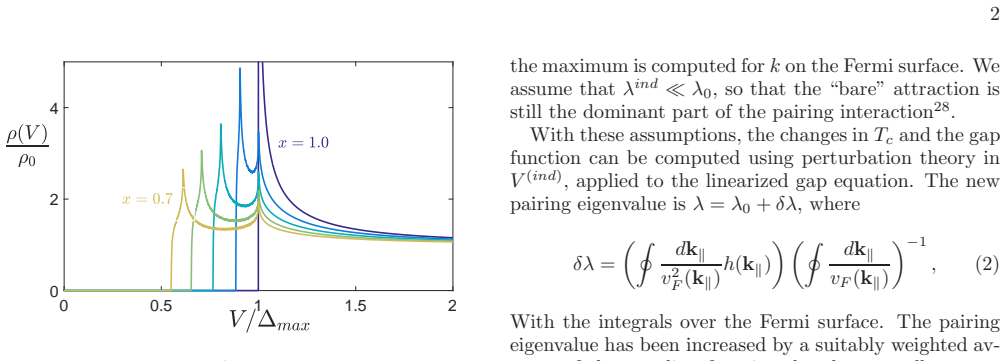
- If nematic fluctuations mediate pairing, the gap function in Ba1−xSrxNi2As2 should become increasingly anisotropic as x is lowered, so tunneling spectroscopy should show split coherence peaks rather than a single BCS peak.
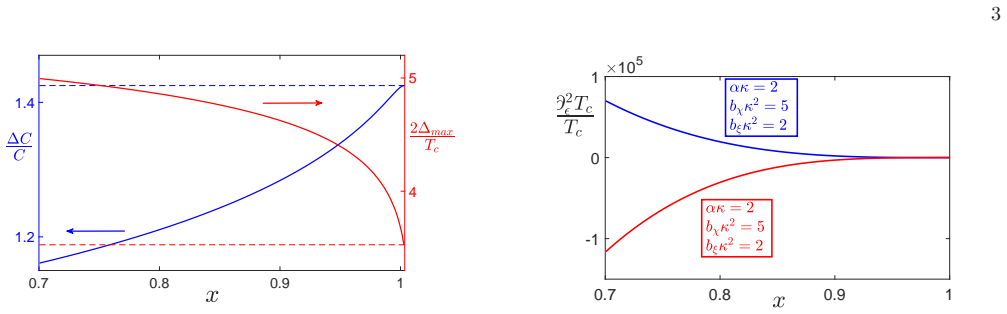
- The ratio $2\Delta_0/T_c$ should rise above the BCS value 3.53, and the specific-heat jump $\Delta C/C$ should fall below 1.43, with both deviations growing with the nematic susceptibility.
- Under B1g uniaxial strain, Tc should vary quadratically in strain, with the magnitude of the quadratic coefficient growing much faster than the band-structure contribution as nematic fluctuations strengthen; the sign is material-specific and not predicted.
- The strain sensitivity at a given doping x should track the elastoresistance-measured nematic susceptibility, so combining strain and elastoresistance measurements provides a direct test.
- If confirmed, strain experiments would provide a controlled, non-phonon analogue of the isotope effect, establishing electronic nematic fluctuations as the pairing glue in this material.
Reading between the lines
- Editorial extension: because the predicted strain coefficient's sign is not fixed, the falsifiable content is the growth in magnitude; a strain experiment can test the magnitude even if the sign turns out positive or negative.
- Editorial extension: the same strain protocol could be exported to other candidates for nematic-mediated superconductivity, especially systems where magnetic fluctuations complicate the interpretation, since strain targets the nematic channel specifically.
- Editorial extension: measuring the doping dependence of the strain coefficient could in principle distinguish two- and three-dimensional nematic fluctuations, since the predicted exponent differs (2.26 vs 3), though the paper does not make this comparison.
- Editorial extension: the paper's normal-state speculation—that photoemission should see strong anisotropy in effective mass and linewidth that grows with χ0—could be turned into a quantitative prediction by computing these quantities in the same model.
Signed reviews
Editorial analysis
A structured set of objections, weighed in public.
Referee Report
Summary. This manuscript investigates whether nematic fluctuations can explain the increase of the superconducting critical temperature in Ba1-xSrxNi2As2 as x is reduced toward the nematic end, and it proposes experimental tests of nematic-mediated pairing. The authors set up a weak-coupling model with a four-pocket band structure and a B1g nematic mode, solve the linearized gap equation, and compute Tc, gap anisotropy, density of states, the specific-heat jump, and 2Delta0/Tc. They then argue that uniaxial B1g strain affects Tc through two mechanisms: a band-structure term of order chi0^2 epsilon^2, and a fluctuation-cutoff term whose coefficient grows as chi0^{y_epsilon} with y_epsilon = 2 + 2 beta/gamma, making strain the sharpest proposed test. The supplemental material derives anisotropic BCS formulas for the specific-heat jump and gap-to-Tc ratio, and gives scaling arguments for the strain dependence of the nematic propagator.
Significance. If the central strain-scaling claim were correct, the paper would provide a valuable experimental blueprint: strain would act as an isotope-effect-like probe of nematic-mediated pairing, and the anisotropic-gap formulas in the supplement are a useful byproduct. The paper is also explicit about the role of the free parameter lambda0 in Figure 1, which is a strength. However, the load-bearing asymptotic prediction embodied in Eq. (11) is not actually justified by the model used to derive it once the mean-field relation between chi0 and xi is inserted, and there are internal inconsistencies in the quoted strain exponent. The gap-anisotropy predictions, by contrast, follow from the stated weak-coupling calculation and are largely unaffected by these concerns. The paper is worth publishing after the strain-scaling argument is corrected or substantially qualified.
major comments (3)
- [Main text, Eq. (11); Supplement II.A] In the mean-field Ginzburg-Landau theory used in Supplement II.A, the uniform susceptibility and the correlation length are locked: from the free energy in Supplement Eq. (32), chi0 = 1/(r + 3u phi^2) and xi^2 = kappa/(r + 3u phi^2), so delta chi0/chi0 = 2 delta xi/xi to leading order in the strain field, i.e., b_chi = 2 b_xi. Substituting this relation into Eq. (11) for d=3 gives ([d-1]b_xi - b_chi) = 2 b_xi - 2 b_xi = 0, so the leading term proportional to chi0^{2 + 2 beta/gamma} cancels identically; the surviving fluctuation contribution is only the log[1 + (Lambda xi)^2] term and the dF/F form-factor term, both of which are subleading. The central claim that the strain coefficient grows as chi0^3 in d=3 and asymptotically dominates the band-structure chi0^2 term is therefore not a consequence of the model presented, unless a non-mean-field mechanism that breaks the chi0 proportional-to-xi^2 relation is explicitly identified and its exponents are derived. This point needs to be fixed or the asymptotic statement substantially qualified.
- [Main text, Eq. (11); Supplement II.C] The exponent values quoted in the main text are not consistent with the stated formula. The scaling derivation in Supplement II.C gives y_epsilon = 2(gamma + beta)/gamma = 2 + 2 beta/gamma, but the numerical value 2.26 for d=2 corresponds instead to 2 + beta/gamma with 3D Ising exponents (beta approximately 0.326, gamma approximately 1.237), not to 2 + 2 beta/gamma. The supplement line 'y_epsilon = 2 x_h/gamma = 2 + beta/gamma' is also sign- and factor-inconsistent with x_h = -(gamma + beta). If d=2 is meant to refer to the 2+1-dimensional Ising universality class, the correct value is about 2.53; with 2D Ising exponents it is about 2.14. Please specify the universality class and recompute both the formula and the numerical values, since Eq. (11) is the basis for the paper's sharpest prediction.
- [Main text, Eqs. (10)-(11); Supplement II.B] The derivation of Eq. (11) assumes the quantum-critical scaling form of Supplement Eq. (37) with well-defined exponents beta and gamma, but the main text states that there is no indication of a zero-temperature nematic quantum critical point in Ba1-xSrxNi2As2, and the prefactors u, kappa, b_chi, and b_xi are left unspecified. As a result, Eq. (11) cannot be used as a quantitative prediction for the doping range studied; at best it is a conditional scaling statement. The paper should either provide evidence that the system is close enough to a nematic QCP for the asymptotic scaling regime to apply, or explicitly mark the predicted chi0^{y_epsilon} growth as a model-dependent possibility rather than a sharp empirical test, and specify what experimental observable would confirm the scaling regime.
minor comments (5)
- [Figure 4] The caption does not list the values of b_chi, b_xi, u, and kappa used to produce the curves; because the sign and magnitude of the plotted strain sensitivity depend on these unspecified parameters, the figure should state representative values or explicitly label the curves as schematic.
- [Abstract and Figure 1] The abstract describes the calculations as 'quantitative', but the Figure 1 caption states that 'both the extent of Tc enhancement and the shape of the Tc(x) curve are sensitive to the choice of lambda0, so these results should be understood only qualitatively when compared with experiment'; please align the abstract with this caveat.
- [Supplement II.C] The line 'y_epsilon = 2 x_h/gamma = 2 + beta/gamma' appears to contain a sign and factor typo; as written it is inconsistent with x_h = -(gamma + beta) and with the main-text formula, and it should be corrected to avoid confusion.
- [Throughout] There are several typographical artifacts, such as 'New Yor k' and 'fluctuations' in the affiliations, and the supplement title differs in wording from the main-text title; these should be cleaned up in revision.
- [Figure 2] The amount of broadening applied to the density-of-states curves is not specified; since the splitting of the peaks is the proposed experimental signature, specifying the broadening would help the reader judge the visibility of the effect.
Circularity Check
No significant circularity: the gap-anisotropy and strain-scaling predictions are derived from independent perturbative/scaling arguments, while the Fig. 1 Tc enhancement is an explicitly labeled qualitative consistency check, not a fitted prediction.
full rationale
Walking the derivation chain, the sharp testable claims do not reduce to their inputs. The gap-anisotropy formulas (Eqs. 2-4 and Supplement Sec. I) follow from the linearized gap equation with the symmetry-dictated form factor f(k); no Tc data are used to set the predicted anisotropy. The strain prediction (Eq. 11, Supplement Eq. 58) is obtained from the scaling form G(q,r,h)~r^{-gamma} g(q*xi, h*r^{x_h}) with x_h=-(gamma+beta), giving y_epsilon=2+2*beta/gamma; this is an independent scaling derivation, not a definition of the predicted Tc response. The only place experimental input enters quantitatively is chi0, taken from elastoresistance to illustrate the model; the Fig. 1 caption explicitly states lambda0 is chosen and that the results are qualitative, so Fig. 1 is a consistency check rather than a fitted prediction. Self-citations to Refs. [5] and [9] supply the weak-coupling formalism and normal-state context, but the central conclusions do not rest on an unverified uniqueness theorem or ansatz smuggled through citation; the formalism is also supported by numerous independent groups. The mean-field cancellation issue in the d=3 strain term ([d-1]b_xi-b_chi=0 in Supplement II.A) is a robustness caveat about an unspecified coefficient, not a circular reduction: a vanishing leading coefficient does not make Eq. 11 equivalent to its inputs. Hence no circular step meets the evidentiary bar.
Assumptions & free parameters
free parameters (5)
- lambda0 (bare pairing eigenvalue) =
0.1
- g (nematic coupling constant) =
4.4
- Momentum cutoff Lambda =
pi/6
- chi0-xi^2 prefactor =
0.1
- Strain prefactors (u*kappa^2, b_chi, b_xi, a_lambda, a_F) =
unspecified
assumptions (6)
- domain assumption lambda_ind << lambda0 (weak nematic-mediated pairing)
- domain assumption Forward-scattering delta-function approximation V_ind(k,p) approximately -h(k) delta(k-p)
- domain assumption Static nematic propagator D(q) = chi0/(1+xi^2 q^2) Theta(Lambda - |q|)
- domain assumption Quantum-critical scaling form G(q,r,h) ~ r^{-gamma} g(q*xi, h*r^{x_h}) for the nematic boson
- domain assumption Single-component nematic order parameter (B1g)
- domain assumption Nematic fluctuations are effectively 2D or 3D with the stated dimensionality
Cite this review
Pith. "Pith review of Tests of nematic-mediated superconductivity applied to Ba$_{1-x}$Sr$_x$Ni$_2$As$_2$." pith.science (2026). https://pith.science/paper/MOQGE6TI
@misc{pith2026190803224,
  author       = {Pith},
  title        = {Pith review of: Tests of nematic-mediated superconductivity applied to Ba$_1-x$Sr$_x$Ni$_2$As$_2$},
  year         = {2026},
  howpublished = {\url{https://pith.science/paper/MOQGE6TI}},
  note         = {Machine review of arXiv:1908.03224}
}
abstract
In many unconventional superconductors, nematic quantum fluctuations are strongest where the critical temperature is highest, inviting the conjecture that nematicity plays an important role in the pairing mechanism. Recently, Ba$_{1-x}$Sr$_x$Ni$_2$As$_2$ has been identified as a tunable nematic system that provides an ideal testing ground for this proposition. We therefore propose several sharp empirical tests, supported by quantitative calculations in a simple model of Ba$_{1-x}$Sr$_x$Ni$_2$As$_2$. The most stringent predictions concern experiments under uniaxial strain, which has recently emerged as a powerful tuning parameter in the study of correlated materials. Since uniaxial strain so precisely targets nematic fluctuations, such experiments may provide compelling evidence for nematic-mediated pairing, analogous to the isotope effect in conventional superconductors.
Figures

Reference graph
Works this paper leans on
-
[1]
author H. Yamase and author R. Zeyher , journal Phys. Rev. B volume 88 , pages 180502 ( year 2013 )
work page 2013
-
[2]
author T. A. Maier and author D. J. Scalapino , journal Phys. Rev. B volume 90 , pages 174510 ( year 2014 ), ://link.aps.org/doi/10.1103/PhysRevB.90.174510
-
[3]
author S. Raghu , author G. Torroba , and author H. Wang , journal Phys. Rev. B volume 92 , pages 205104 ( year 2015 ), ://link.aps.org/doi/10.1103/PhysRevB.92.205104
-
[4]
author M. A. Metlitski , author D. F. Mross , author S. Sachdev , and author T. Senthil , journal Physical Review B volume 91 , pages 115111 ( year 2015 )
work page 2015
-
[5]
author S. Lederer , author Y. Schattner , author E. Berg , and author S. A. Kivelson , journal Phys. Rev. Lett. volume 114 , pages 097001 ( year 2015 )
work page 2015
-
[6]
author J. Kang and author R. M. Fernandes , journal Phys. Rev. Lett. volume 117 , pages 217003 ( year 2016 ), ://link.aps.org/doi/10.1103/PhysRevLett.117.217003
-
[7]
author Y. Wang , author A. Abanov , author B. L. Altshuler , author E. A. Yuzbashyan , and author A. V. Chubukov , journal Phys. Rev. Lett. volume 117 , pages 157001 ( year 2016 ), ://link.aps.org/doi/10.1103/PhysRevLett.117.157001
-
[8]
Superconductivity around nematic quantum critical point in two-dimensional metals
author G.-Z. Liu and author J.-R. Wang , journal arXiv e-prints eid arXiv:1706.02583 ( year 2017 ), 1706.02583
work page Pith review arXiv 2017
Show all 26 references
-
[9]
Lederer , author Y
author S. Lederer , author Y. Schattner , author E. Berg , and author S. A. Kivelson , journal Proceedings of the National Academy of Sciences volume 114 , pages 4905 ( year 2017 ), ISSN issn 0027-8424 , https://www.pnas.org/content/114/19/4905.full.pdf , ://www.pnas.org/conte...
2017
-
[10]
Klein and author A
author A. Klein and author A. Chubukov , journal Phys. Rev. B volume 98 , pages 220501 ( year 2018 ), ://link.aps.org/doi/10.1103/PhysRevB.98.220501
2018 doi
-
[11]
Klein , author Y.-M
author A. Klein , author Y.-M. Wu , and author A. Chubukov , journal arXiv e-prints eid arXiv:1812.00521 ( year 2018 ), 1812.00521
2018 arXiv
-
[12]
Abanov , author Y.-M
author A. Abanov , author Y.-M. Wu , author Y. Wang , and author A. V. Chubukov , journal arXiv e-prints eid arXiv:1812.07634 ( year 2018 ), 1812.07634
2018 arXiv
-
[13]
Wu , author A
author Y.-M. Wu , author A. Abanov , author Y. Wang , and author A. V. Chubukov , journal Phys. Rev. B volume 99 , pages 144512 ( year 2019 ), ://link.aps.org/doi/10.1103/PhysRevB.99.144512
2019 doi
-
[14]
Kuo , author J.-H
author H.-H. Kuo , author J.-H. Chu , author J. C. Palmstrom , author S. A. Kivelson , and author I. R. Fisher , journal Science volume 352 , pages 958 ( year 2016 ), ISSN issn 0036-8075 , https://science.sciencemag.org/content/352/6288/958.full.pdf , ://science.sciencemag.org...
2016
-
[15]
Abdel-Hafiez , author Y.-Y
author M. Abdel-Hafiez , author Y.-Y. Zhang , author Z.-Y. Cao , author C.-G. Duan , author G. Karapetrov , author V. M. Pudalov , author V. A. Vlasenko , author A. V. Sadakov , author D. A. Knyazev , author T. A. Romanova , et al. , journal Phys. Rev. B volume 91 , pages 1651...
2015 doi
-
[16]
Hosoi , author K
author S. Hosoi , author K. Matsuura , author K. Ishida , author H. Wang , author Y. Mizukami , author T. Watashige , author S. Kasahara , author Y. Matsuda , and author T. Shibauchi , journal Proceedings of the National Academy of Sciences volume 113 , pages 8139 ( year 2016 ...
2016
-
[17]
Ronning , author N
author F. Ronning , author N. Kurita , author E. D. Bauer , author B. L. Scott , author T. Park , author T. Klimczuk , author R. Movshovich , and author J. D. Thompson , journal Journal of Physics: Condensed Matter volume 20 , pages 342203 ( year 2008 ), https://doi.org/10.1088
2008
-
[18]
author A. S. Sefat , author M. A. McGuire , author R. Jin , author B. C. Sales , author D. Mandrus , author F. Ronning , author E. D. Bauer , and author Y. Mozharivskyj , journal Phys. Rev. B volume 79 , pages 094508 ( year 2009 ), ://link.aps.org/doi/10.1103/PhysRevB.79.094508
2009 doi
-
[19]
Kothapalli , author F
author K. Kothapalli , author F. Ronning , author E. D. Bauer , author A. J. Schultz , and author H. Nakotte , journal Journal of Physics: Conference Series volume 251 , pages 012010 ( year 2010 ), https://doi.org/10.1088
2010
-
[20]
Eckberg , author D
author C. Eckberg , author D. J. Campbell , author T. Metz , author J. Collini , author H. Hodovanets , author T. Drye , author P. Zavalij , author M. H. Christensen , author R. M. Fernand es , author S. Lee , et al. , journal arXiv e-prints eid arXiv:1903.00986 ( year 2019 ),...
1903 arXiv
-
[21]
author C. W. Hicks , author D. O. Brodsky , author E. A. Yelland , author A. S. Gibbs , author J. A. N. Bruin , author M. E. Barber , author S. D. Edkins , author K. Nishimura , author S. Yonezawa , author Y. Maeno , et al. , journal Science volume 344 , pages 283 ( year 2014 ...
2014
-
[22]
Zhou , author M
author B. Zhou , author M. Xu , author Y. Zhang , author G. Xu , author C. He , author L. X. Yang , author F. Chen , author B. P. Xie , author X.-Y. Cui , author M. Arita , et al. , journal Phys. Rev. B volume 83 , pages 035110 ( year 2011 ), ://link.aps.org/doi/10.1103/PhysRe...
2011 doi
-
[23]
Dell'Anna and author W
author L. Dell'Anna and author W. Metzner , journal Phys. Rev. B volume 73 , pages 045127 ( year 2006 )
2006
-
[24]
Zacharias , author I
author M. Zacharias , author I. Paul , and author M. Garst , journal Phys. Rev. Lett. volume 115 , pages 025703 ( year 2015 ), ://link.aps.org/doi/10.1103/PhysRevLett.115.025703
2015 doi
-
[25]
Labat and author I
author D. Labat and author I. Paul , journal Phys. Rev. B volume 96 , pages 195146 ( year 2017 ), ://link.aps.org/doi/10.1103/PhysRevB.96.195146
2017 doi
-
[26]
Paul and author M
author I. Paul and author M. Garst , journal Phys. Rev. Lett. volume 118 , pages 227601 ( year 2017 ), ://link.aps.org/doi/10.1103/PhysRevLett.118.227601
2017 doi
Reviewed August 14, 2026 · model on record in the stance chip above.
Discussion (0). Continue with ORCID to comment.