A density matrix renormalization group approach to quantum point contacts
Pith reviewed 2026-07-03 05:45 UTC · model grok-4.3
The pith
Strong interactions in one-dimensional fermions erase visible signatures of harmonic confinement from the local density of states.
A machine-rendered reading of the paper's core claim, the machinery that carries it, and where it could break.
Core claim
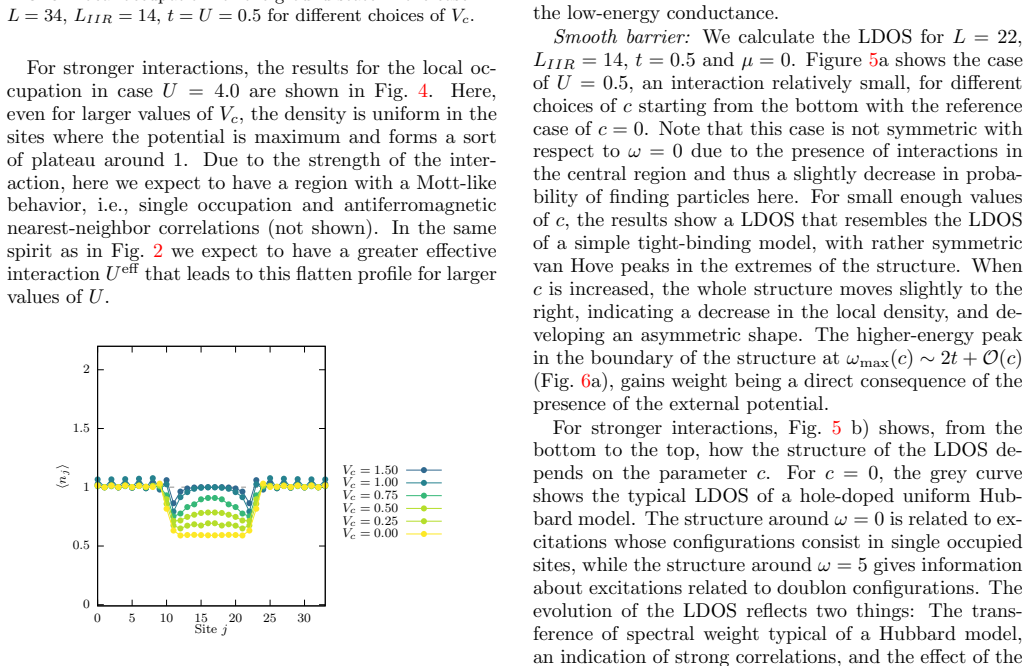
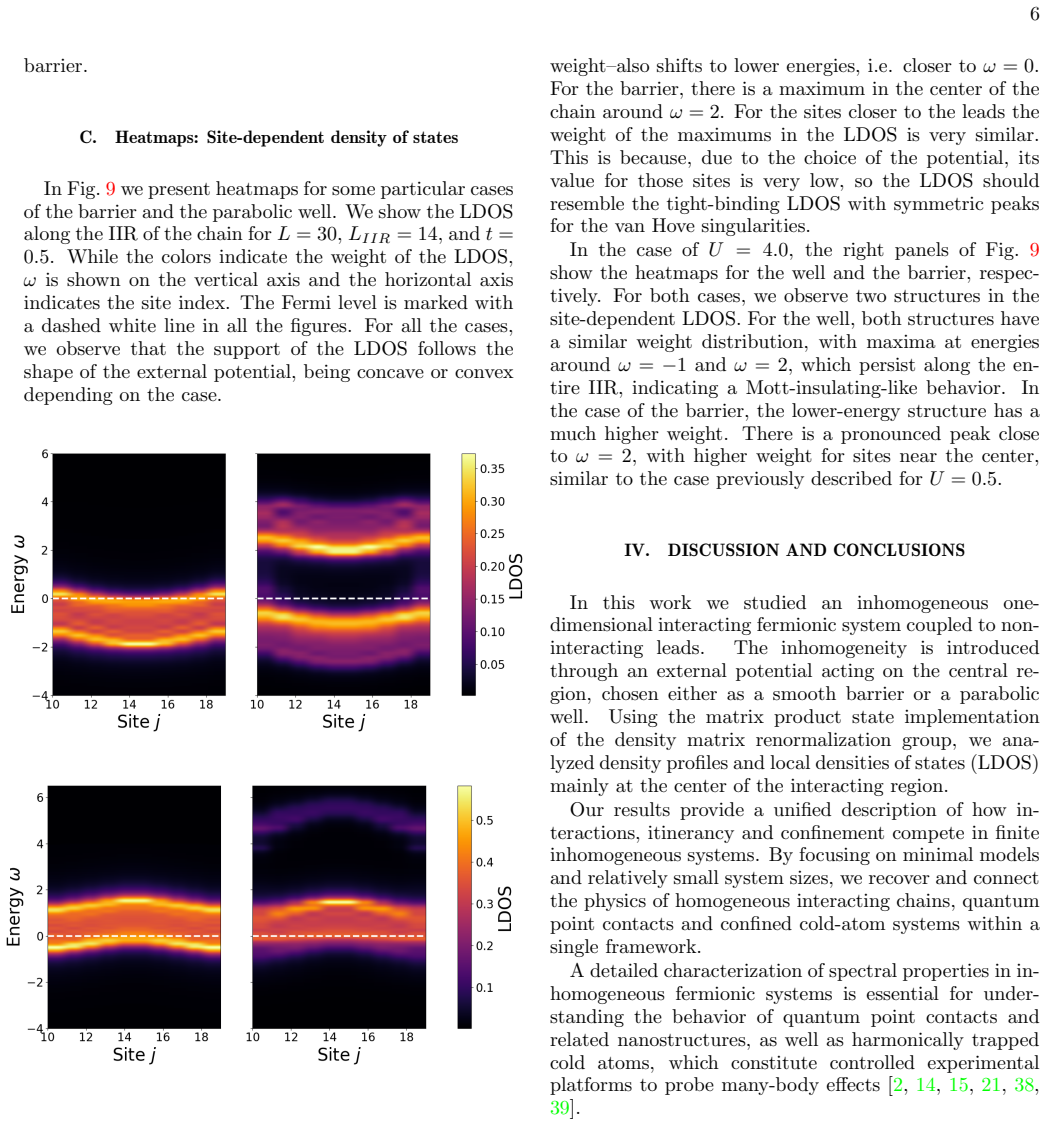
In the barrier regime a localized peak appears in the electron part of the spectrum as a direct consequence of the potential; in the well regime and for weak interactions a localized feature persists but shifts to the hole sector; for stronger interactions the local density of states no longer displays clear signatures of the external potential.
What carries the argument
Density matrix renormalization group combined with the correction-vector method, used to obtain the local density of states throughout the crossover from well to barrier regimes.
If this is right
- In the barrier configuration the external potential produces a localized peak at positive frequencies in the electron spectrum.
- In the well configuration with weak repulsion the corresponding localized feature moves to negative frequencies in the hole spectrum.
- Increasing the interaction strength causes the local density of states to lose all visible imprints of the single-particle confinement.
Where Pith is reading between the lines
- Interaction effects may mask the influence of potential barriers in spectroscopic probes of quantum point contacts realized in strongly correlated wires.
- The same competition between confinement and correlations could be examined in systems with different interaction ranges or additional disorder.
- The length scale at which correlations begin to dominate might be extracted by repeating the calculation on longer chains.
Load-bearing premise
The combination of DMRG and the correction-vector method produces an accurate local density of states for the full range of interaction strengths and potential curvatures.
What would settle it
An experimental or numerical measurement that continues to show a clear potential-induced peak in the local density of states at interaction strengths where the paper predicts the peak has vanished.
Figures




read the original abstract
Using the density matrix renormalization group (DMRG) combined with the correction-vector method, we investigate the competition between an harmonic potential and repulsive interactions in a one-dimensional fermionic system. The parabolic confinement induces spatial inhomogeneity, and by tuning its curvature one can continuously interpolate between a potential well--relevant for cold-atom setups--and a quantum barrier, as realized in mesoscopic systems such as quantum point contacts. We analyze how the ground-state particle distribution evolves with the strength and sign of the confining potential and how the confinement reshapes the spectral weight of the local density of states (LDOS) at the center of the chain. In the barrier regime, a localized peak emerges in the electron part of the spectrum ($\omega >0$) as a direct consequence of the potential. In contrast, in the well configuration and for weak interactions, a localized feature persists but shifts to the hole sector ($\omega <0$). However, for stronger interactions, the LDOS no longer displays clear signatures of the external potential, indicating that correlations dominate over single-particle confinement.
Editorial analysis
A structured set of objections, weighed in public.
Referee Report
Summary. The manuscript uses DMRG combined with the correction-vector method to study a one-dimensional fermionic chain subject to a tunable harmonic potential that interpolates between a confining well and a barrier. It reports the evolution of the ground-state particle distribution and the local density of states (LDOS) at the chain center as functions of potential curvature and interaction strength. The central claim is that signatures of the external potential in the LDOS (a localized peak in the electron sector for the barrier and in the hole sector for the well at weak U) are suppressed at stronger interactions, indicating that correlations dominate over single-particle confinement.
Significance. If the LDOS results are shown to be numerically converged, the work would supply concrete benchmarks for the competition between interactions and confinement in quantum point contacts and cold-atom systems. The direct use of established DMRG plus correction-vector techniques for spectral functions is a methodological strength, but the lack of reported convergence data prevents assessment of whether the headline claim is quantitatively supported.
major comments (3)
- [Abstract] Abstract: the stated conclusions on LDOS behavior at strong interactions are presented without any mention of system sizes, bond dimensions, truncation errors, or convergence checks, making it impossible to judge whether the data support the claim that correlations dominate the external potential.
- [Methods and Results] Method description and results paragraphs: no bond-dimension extrapolation, broadening-parameter scan, or small-system exact-diagonalization benchmark is reported for the interacting barrier/well regimes; the correction-vector LDOS can mix truncation error into spectral weight near ω=0, which directly affects the reliability of the central claim that potential signatures disappear at strong U.
- [Results on LDOS] LDOS figures and discussion of strong-interaction regime: the assertion that 'the LDOS no longer displays clear signatures of the external potential' is load-bearing for the headline result, yet no error estimates or fidelity tests against the non-interacting limit or weak-U cases are provided to confirm that the observed suppression is physical rather than numerical artifact.
minor comments (2)
- [Introduction] Notation for the potential curvature and interaction strength should be defined explicitly in the text rather than only in figure captions.
- [Figures] Figure captions would benefit from stating the specific values of bond dimension and broadening used for each panel.
Simulated Author's Rebuttal
We thank the referee for the careful reading of our manuscript and the constructive comments. We agree that additional details on numerical convergence are necessary to support the claims and will revise the manuscript accordingly.
read point-by-point responses
-
Referee: [Abstract] Abstract: the stated conclusions on LDOS behavior at strong interactions are presented without any mention of system sizes, bond dimensions, truncation errors, or convergence checks, making it impossible to judge whether the data support the claim that correlations dominate the external potential.
Authors: We will revise the abstract to include information on the system sizes, bond dimensions, and truncation errors employed in our DMRG calculations. This will allow readers to better assess the reliability of the LDOS results. revision: yes
-
Referee: [Methods and Results] Method description and results paragraphs: no bond-dimension extrapolation, broadening-parameter scan, or small-system exact-diagonalization benchmark is reported for the interacting barrier/well regimes; the correction-vector LDOS can mix truncation error into spectral weight near ω=0, which directly affects the reliability of the central claim that potential signatures disappear at strong U.
Authors: In the revised manuscript, we will add bond-dimension extrapolations and a scan of the broadening parameter for the LDOS in the interacting regimes. We will also include exact diagonalization benchmarks for small systems. We will discuss the control of truncation errors to ensure they do not affect the spectral weight near ω=0. revision: yes
-
Referee: [Results on LDOS] LDOS figures and discussion of strong-interaction regime: the assertion that 'the LDOS no longer displays clear signatures of the external potential' is load-bearing for the headline result, yet no error estimates or fidelity tests against the non-interacting limit or weak-U cases are provided to confirm that the observed suppression is physical rather than numerical artifact.
Authors: We will include error estimates in the LDOS figures and add fidelity tests comparing the strong-interaction results to the non-interacting and weak-U limits to demonstrate that the suppression is physical. revision: yes
Circularity Check
No circularity: direct numerical DMRG simulation with established methods
full rationale
The paper reports results from applying the density matrix renormalization group combined with the correction-vector method to compute ground-state densities and local density of states in a 1D interacting fermionic chain under tunable parabolic confinement. No analytical derivation chain exists; the LDOS features (localized peaks in electron or hole sectors, their disappearance at strong U) are direct numerical outputs rather than quantities fitted or redefined inside the same calculation. The abstract and method description invoke standard algorithms without self-citation load-bearing steps or ansatz smuggling. The study is self-contained against external benchmarks in the sense that its claims rest on the fidelity of the numerical technique itself, which is not shown to reduce to its own inputs by construction.
Axiom & Free-Parameter Ledger
free parameters (2)
- potential curvature
- interaction strength
axioms (1)
- domain assumption The 1D fermionic Hamiltonian with added parabolic term faithfully represents both cold-atom wells and mesoscopic quantum point contacts
Reference graph
Works this paper leans on
-
[1]
Giamarchi, Thierry,Quantum Physics in One Dimen- sion.Oxford University Press, 2003
work page 2003
- [2]
-
[3]
Wen, Xiao-Gang,Colloquium: Zoo of quantum- topological phases of matter, Rev. Mod. Phys.89, 041004 (2017)
work page 2017
-
[4]
Patel, N.D., Kaushal, N., Nocera, A.et al.,Emergence of superconductivity in doped multiorbital Hubbard chains, npj Quantum Mater.5, 27 (2020)
work page 2020
-
[5]
D. A. Wharam, T. J. Thornton, R. Newbury, M. Pepper, H. Ahmed, J. E. F. Frost, D. G. Hasko, D. C. Peacock, D. A. Ritchie and G. A. C. Jones,One-dimensional transport and the quantisation of the ballistic resistance, J. Phys. C: Solid State Phys.21L209 (1988)
work page 1988
-
[6]
Zhao, Zihan and Zhang, Zhongchi and Wang, Huaichuan and Deng, Ken and Chen, Wenlan and Hu, Jiazhong, Stark Many-Body Localization in One-Dimensional Bose Gas under the Continuous LimitPRX Quantum7, 010307 (2026)
work page 2026
-
[7]
Martins, F., Faniel, S., Rosenow, B.et al.,Coherent tun- nelling across a quantum point contact in the quantum Hall regime, Sci. Rep.3, 1416 (2013)
work page 2013
-
[8]
Yang, Bing and Chen, Yang-Yang and Zheng, Yong- Guang and Sun, Hui and Dai, Han-Ning and Guan, Xi- Wen and Yuan, Zhen-Sheng and Pan, Jian-Wei,Quan- tum criticality and the Tomonaga-Luttinger liquid in one- dimensional Bose gases, Phys. Rev. Lett.119, 165701 (2017)
work page 2017
-
[9]
Martin Bollet al.,Spin- and density-resolved mi- croscopy of antiferromagnetic correlations in Fermi- Hubbard chains, Science353, 1257-1260 (2016)
work page 2016
-
[10]
Dominik Husmannet al.,Connecting strongly correlated superfluids by a quantum point contact, Science350, 1498- 1501 (2015)
work page 2015
-
[12]
Corman, Laura and Fabritius, Philipp and H ¨ausler, Samuel and Mohan, Jeffrey and Dogra, Lena H. and Husmann, Dominik and Lebrat, Martin and Esslinger, Tilman,Quantized conductance through a dissipative atomic point contact, Phys. Rev. A103, 059902 (2021)
work page 2021
-
[13]
Volosniev, A., Fedorov, D., Jensen, A.et al.,Strongly interacting confined quantum systems in one dimension Nat. Commun.5, 5300 (2014)
work page 2014
-
[14]
K. Matsuki, C. Hotta and K. Asano.Scan calculation of the density of states: Real-space cluster perturbation theory applied to the inhomogeneous Hubbard model in one dimension.Phys. Rev. B112, 045146 (2025)
work page 2025
-
[15]
Daniel Greifet al.,Site-resolved imaging of a fermionic Mott insulator, Science351, 953-957 (2016)
work page 2016
-
[16]
N. Aucar Boidi, K. Hallberg, Amnon Aharony, Ora Entin-Wohlman,Coexistence of insulating phases in con- fined fermionic chains with a Wannier-Stark potential. Phys. Rev. B109, L041404 (2024)
work page 2024
-
[17]
and Stone, Michael,Landauer con- ductance of Luttinger liquids with leads, Phys
Maslov, Dmitrii L. and Stone, Michael,Landauer con- ductance of Luttinger liquids with leads, Phys. Rev. B52, R5539(R) (1995)
work page 1995
-
[18]
V.,Renormalization of the one- dimensional conductance in the Luttinger-liquid model, Phys
Ponomarenko, V. V.,Renormalization of the one- dimensional conductance in the Luttinger-liquid model, Phys. Rev. B52, R8666(R) (1995)
work page 1995
-
[19]
Safi, I. and Schulz, H. J.,Transport in an inhomoge- neous interacting one-dimensional system, Phys. Rev. B 52, R17040(R) (1995)
work page 1995
-
[20]
Rejec, T., Meir, Y.Magnetic impurity formation in quan- tum point contacts, Nature442, 900-903 (2006)
work page 2006
-
[21]
et al.Microscopic origin of the ‘0.7-anomaly’ in quantum point contacts
Bauer, F., Heyder, J., Schubert, E. et al.Microscopic origin of the ‘0.7-anomaly’ in quantum point contacts. Nature501, 73–78 (2013). 8
work page 2013
-
[22]
Nakamura, J. and Liang, S. and Gardner, G. C. and Manfra, M. J.,Half-Integer Conductance Plateau at the ν= 2/3Fractional Quantum Hall State in a Quantum Point Contact, Phys. Rev. Lett.130, 076205 (2023)
work page 2023
-
[23]
Ponomarenko, Vadim and Lyanda-Geller, Yuli,Unusual Quasiparticles and Tunneling Conductance in Quantum Point Contacts inν= 2/3Fractional Quantum Hall Sys- tems, Phys. Rev. Lett.133, 076503 (2024)
work page 2024
-
[24]
Park, Jinhong and Sp˚ ansl ¨att, Christian and Mirlin, Alexander D.,Fingerprints of Anti-Pfaffian Topological Order in Quantum Point Contact Transport, Phys. Rev. Lett.132, 256601 (2024)
work page 2024
-
[25]
Dominik Husmann and Shun Uchino and Sebastian Krin- ner and Martin Lebrat and Thierry Giamarchi and Tilman Esslinger and Jean-Philippe Brantut,Connecting strongly correlated superfluids by a quantum point con- tact, Science350, 6267 (2015)
work page 2015
-
[26]
Huang, Meng-Zi and Mohan, Jeffrey and Visuri, Anne- Maria and Fabritius, Philipp and Talebi, Mohsen and Wili, Simon and Uchino, Shun and Giamarchi, Thierry and Esslinger, Tilman,Superfluid Signatures in a Dis- sipative Quantum Point Contact, Phys. Rev. Lett.130, 200404 (2023)
work page 2023
-
[27]
Entropy transport through a superfluid quantum point contact: A Keldysh field-theory approach
Davide Bertolusso, C.J. Bolech, Thierry Giamarchi,En- tropy transport through a superfluid quantum point con- tact: A Keldysh field-theory approach, arXiv:2605.00679
work page internal anchor Pith review Pith/arXiv arXiv
-
[28]
White, S.,Density matrix formulation for quantum renormalization groups, Phys. Rev. Lett.69, 2863, (1992)
work page 1992
-
[29]
Ulrich Schollw ¨ock,The density-matrix renormalization group in the age of matrix product states, Annals of Physics326, 96–192, 2011
work page 2011
-
[30]
Ramasesha, S. and Pati, Swapan K. and Krishnamurthy, H. R. and Shuai, Z. and Br´ edas, J. L.,Symmetrized density-matrix renormalization-group method for excited states of Hubbard models.Phys. Rev. B54, 7598 (1996)
work page 1996
-
[31]
A. Nocera and G. Alvarez,Spectral functions with the density matrix renormalization group: Krylov-space ap- proach for correction vectors, Phys. Rev. E94, 053308 (2016)
work page 2016
-
[32]
B. J. van Wees, H. van Houten, C. W. J. Beenakker, and J. G. Williamson, L. P. Kouwenhoven and D. van der Marel and C. T. Foxon,Quantized Conductance of Point Contacts in a Two-Dimensional Electron Gas, Phys. Rev. Lett.60, 848 (1988)
work page 1988
-
[33]
B ¨uttiker,Quantized transmission of a saddle-point constriction, Phys
M. B ¨uttiker,Quantized transmission of a saddle-point constriction, Phys. Rev. B41, 7906(R) (1990)
work page 1990
-
[34]
Ando,Quantum point contacts in magnetic fields, Phys
T. Ando,Quantum point contacts in magnetic fields, Phys. Rev. B44, 8017 (1991)
work page 1991
-
[35]
L.I. Glazman, G.B. Lesovik, D. E. Khmel’nitskii, and R. I. Shekhter,Reflectionless quantum transport and funda- mental ballistic-resistance steps in microscopic constric- tions,JETP Lett.48, 238 (1988)
work page 1988
-
[36]
The latter translates in the conditionc≪L ′2t/4. In all of the results we usedt= 0.5 and the shorter length for the CCR wasL IIR = 14 so the condition is fulfilled for all the choices ofc
-
[37]
Liu, Donghao and Gutman, Dmitri,Conductance anomaly in a partially open adiabatic quantum point con- tact, Phys. Rev. B113, 235412 (2023)
work page 2023
-
[38]
Weidinger, Lukas and Bauer, Florian and von Delft, Jan,Functional renormalization group approach for in- homogeneous one-dimensional Fermi systems with finite- ranged interactions, Phys. Rev. B95, 035122 (2017)
work page 2017
-
[39]
C. Karrasch, T. Enss, and V. Meden,Functional renor- malization group approach to transport through correlated quantum dots, Phys. Rev. B73, 235337 (2006)
work page 2006
discussion (0)
Sign in with ORCID, Apple, or X to comment. Anyone can read and Pith papers without signing in.