REVIEW 3 major objections 5 minor 17 references
Frequency-Domain Modeling of OFDM Transmission with Insufficient Cyclic Prefix using Toeplitz Matrices
T0 review · 3 major / 5 minor · reviewed 2026-08-14 · deepseek-v4-flash
Pith's one-line read An exact frequency-domain formula describes OFDM interference from an insufficient cyclic prefix, showing the distortion is localized to nearby subcarriers.
desk verdict Correct Toeplitz-DFT formula and a real banding insight, undercut by two normalization errors in the power analysis that need fixing. read the letter →
The pith
A machine-rendered reading of the paper's core claim, the machinery that carries it, and where it could break.
The reading
What carries the argument
The central object is the interference matrix $\Phi = F B F^{\dagger}$, where $B$ is the zero-padded upper-triangular Toeplitz matrix built from the channel taps that spill beyond the cyclic prefix. The load-bearing identity is the closed-form DFT of such a matrix, proved in the appendix: off-diagonal entries are $\frac{1}{\sqrt{N}}(1-w^{n-m})^{-1}([\xi]_m-[\xi]_n)$ and diagonal entries are $\frac{1}{\sqrt{N}} F^{\dagger}([N,N-1,\ldots,1]^T \circ \rho)$. This splits $\Phi$ into a time-invariant envelope matrix $E$ with entries $1/(1-w^{n-m})$ and a channel-dependent skew-symmetric matrix $\Gamma$ with entries $[\xi]_m-[\xi]_n$; this split is what makes the banded approximation and its complexity savings work.
What would settle it
Simulate the exact time-domain block transmission in (8) with a fixed channel tap profile, compute the empirical frequency-domain interference matrix by taking F of the received blocks, and compare its off-diagonal entries and their averaged squared magnitudes to (17) and (28) for subcarrier distances up to N/4; any deviation above floating-point precision would show the closed-form DFT proof or the averaging step fails. Alternatively, repeat with a channel whose taps change within one symbol and verify whether nonzero $\Delta H$ and $\Delta B$ terms appear, as the block-fading assumption predicts they should not.
Extended reading notes
Core claim
Under the block-fading assumption that the channel impulse response is constant during one OFDM symbol, the received signal in the frequency domain is $r_u = G s_u + \Phi(s_{u-1} - W s_u) + \eta_u$. The paper's central discovery is that $\Phi = F B F^{\dagger}$ has fully explicit entries: for $n \neq m$, $[\Phi]_{n,m} = \frac{1}{\sqrt{N}} \frac{1}{1-w^{n-m}} ([\xi]_m - [\xi]_n)$, where $w = e^{-j2\pi/N}$ and $\xi$ is the (reversed-phase) transform of the first row $\rho$ of $B$; the diagonal is the transform of $[N, N-1, \ldots, 1]^T \circ \rho$. The paper also proves an expected-power expression whose dependence on subcarrier distance is governed by $\cot^2(\pi(m-n)/N)+1$ multiplied by a power-delay-profile sum. Because of this decay, the strong interference lives in a band around the diagonal, so only nearby subcarriers need to be tracked in equalization or simulation.
Load-bearing premise
The derivation assumes the channel impulse response is unchanging during a single OFDM symbol; if the channel drifts inside a symbol, the channel matrix is no longer circulant and the simple Toeplitz formulas for Phi stop holding.
Editorial extensions
If this is right
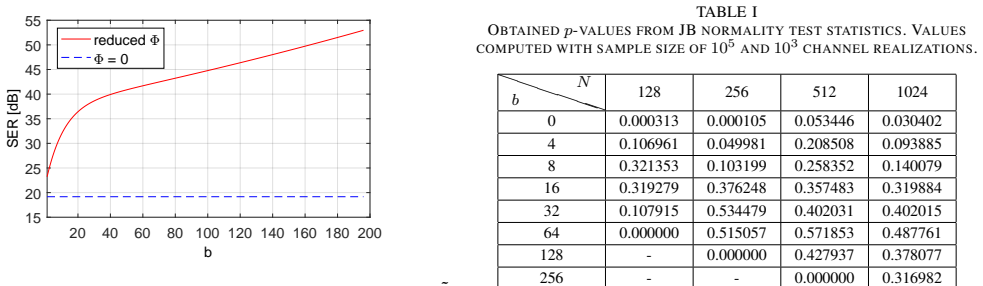
- A receiver or precoder that cancels only the $b$ closest subcarriers on each side of the diagonal of $\Phi$ removes most of the ISI; the numerical experiment in the paper raises the signal-to-error ratio by more than 12 dB compared with ignoring $\Phi$ entirely.
- For band widths around $N/16$ to $N/8$, the leftover interference is close to Gaussian, so it can be folded into the noise covariance and handled by standard soft-decision decoding.
- When the same channel realization is reused over many OFDM symbols and many users share the band, frequency-domain simulation with a banded $\Phi$ needs fewer MAC operations than a time-domain tapped-delay-line simulator.
- The framework also covers OFDM without any cyclic prefix, since the formulas are stated for general prefix length $v$, including $v=0$.
Reading between the lines
- If the same leakage structure holds when Doppler-induced ICI is included, one could unify cyclic-prefix ISI and mobility ICI into a single banded matrix inversion; the paper only draws the analogy, it does not develop this.
- The envelope-decay formula suggests an adaptive-cyclic-prefix scheduler: the required band width, and hence receiver complexity, is set by the taps that fall just beyond the prefix, so the prefix length could be tuned against a complexity budget.
- A natural test is to measure the residual-ISI distribution for alphabets other than 16-QAM; the normality claim was demonstrated for 16-QAM and may change with the constellation.
Signed reviews
Editorial analysis
A structured set of objections, weighed in public.
Referee Report
Summary. The paper develops a frequency-domain framework for modeling OFDM transmission with insufficient cyclic prefix. The channel is decomposed into a circulant matrix H plus an upper-triangular Toeplitz matrix B, and the paper derives closed-form expressions for the frequency-domain interference matrix Φ = F B F†: off-diagonal entries in Eq. (17), diagonal entries in Eq. (18), with a proof in the appendix. The central claim is that the interference power decays with subcarrier distance, so Φ is effectively banded. The authors derive expected-power formulas (23) and (28), and then validate the banded approximation via SER simulations (Section IV-A), a normality test of residual ISI (Section IV-B), and a complexity comparison (Section IV-C).
Significance. The structural result (17)-(18) is a non-obvious and useful contribution to the OFDM literature; the appendix proof is clear and appears correct (I verified it on a small N=2 example). The paper also provides a convincing demonstration that a banded interference matrix suffices to capture most of the ISI, and the complexity analysis is relevant for frequency-domain channel simulation. The main weakness is that the expected-power analysis contains normalization errors that affect the quantitative values in Fig. 1; the qualitative banding claim survives because it is also supported by direct simulation in Section IV-A. The paper is likely to be of interest to researchers working on interference mitigation and channel simulation for OFDM.
major comments (3)
- [Section III, Eq. (28)] Equation (28) is missing a factor 1/N. From (21), for n ≠ m, [Φ]_{n,m} = (1/√N)[E]_{n,m}[Γ]_{n,m}, so E{|[Φ]_{n,m}|^2} = (1/N)|[E]_{n,m}|^2 E{|[Γ]_{n,m}|^2}. Using (22), |[E]_{n,m}|^2 = (1/4)(1+cot^2(π(m-n)/N)), and from (16) and (27), E{|[Γ]_{n,m}|^2} = (4/N) ∑_{k=0}^{N-1} (|[ρ]_k| |sin(π(m-n)k/N)|)^2. The product is (1/N^2)(1+cot^2(π(m-n)/N)) times the sum, so the printed RHS of (28), which divides by only one N, overestimates the interference power by a factor N. This error directly affects the quantitative levels shown in Fig. 1.
- [Section III, Eq. (23)] Equation (23) contains a spurious 1/N. With the normalized DFT matrix F defined in Section III and a circulant H under the block-fading assumption, the diagonal of G = F H F† is the unnormalized DFT of the first row of H, so E{|[G]_{n,n}|^2} = ∑_{m=0}^{N-1} E{|h(n,m)|^2}, not (1/N) times that sum. Together with the error in (28), the relative interference powers in Fig. 1 are shifted by a factor of N^2 (about 54 dB at N=512), so Fig. 1 as printed is not quantitatively reliable.
- [Section III, Eq. (25)] Equation (25) omits the factor 1/√N from the definition ξ = F†ρ in (16). Since [ξ]_m = (1/√N) ∑_{k=0}^{N-1} [ρ]_k e^{j2πmk/N}, the first equality in (25) should carry a 1/√N factor. The later expression (27) appears to include this factor implicitly, but the intermediate derivation is inconsistent with (16) and should be corrected for clarity and correctness.
minor comments (5)
- [Section III, Eq. (28)] Please clarify the fraction in Eq. (28) after correction; the intended form is E{|[Φ]_{n,m}|^2} = (1+cot^2(π(m-n)/N))/N^2 times the sum, and the typesetting should make that unambiguous.
- [Section III, Eq. (23)] In Eq. (23), the notation h(n,m) is confusing for a time-invariant block-fading channel, where h(n,m) = h_m; consider writing h_m or h(m) to avoid implying time dependence.
- [Fig. 1] The y-axis label in Fig. 1 should explicitly state that the quantity is the interference power relative to the desired-subcarrier power and indicate the normalization used, since the levels are affected by the N-scaling errors discussed above.
- [Abstract] There is a typo in the abstract: 'inducted' should be 'induced'.
- [Section IV-B, Table I] Some p-values in Table I are reported as exactly 0.000000; please note whether this is a numerical artefact of the finite sample size, or consider reporting them with more significant digits.
Circularity Check
No significant circularity: the Toeplitz-DFT derivation and the banded-interference claim are self-contained; the flagged normalization issues are accuracy concerns, not circular reductions.
full rationale
The paper's central claim is the closed-form DFT of an upper-triangular Toeplitz matrix, Eq. (17)-(18), proved directly in the appendix from the definition Phi = F B F^dagger by summing geometric series (Eqs. (31)-(36)); no fitted parameter or target quantity enters the derivation. The banding/decay claim follows algebraically from Eq. (28) (modulo the independent normalization-error concern) and is separately supported by Monte-Carlo simulations in Sec. IV-A using the external COST259 HT profile and an independent SER comparison. The block-fading assumption in Sec. III is an explicitly stated modeling assumption, not an input secretly equivalent to the output. Self-citations [9] and [10] are used only to position prior frequency-domain simulator work and to borrow a complexity-counting methodology; they do not carry the mathematical derivation or the empirical validation. The normalization errors alleged in Eqs. (23) and (28) are numerical correctness issues, not circular reductions: Eq. (28) is not fitted to the quantities it predicts. No step in the derivation reduces by construction to its own input. Score 0.
Assumptions & free parameters
free parameters (1)
- band width b =
N/16 to N/8 (e.g., 32 for N=512)
assumptions (4)
- domain assumption The channel is constant during one OFDM symbol (block fading), so the ICI matrices Delta-H and Delta-B are zero.
- domain assumption Channel taps are independent, zero-mean complex Gaussian processes, so cross terms vanish in the expectation of squared interference.
- domain assumption Transmit symbols have uniform unit power, E{||s_u[n]||^2}=1.
- standard math The DFT matrix is unitary with 1/sqrt(N) normalization, and standard geometric series apply.
Cite this review
Pith. "Pith review of Frequency-Domain Modeling of OFDM Transmission with Insufficient Cyclic Prefix using Toeplitz Matrices." pith.science (2026). https://pith.science/paper/MPX3LRZF
@misc{pith2026190808900,
  author       = {Pith},
  title        = {Pith review of: Frequency-Domain Modeling of OFDM Transmission with Insufficient Cyclic Prefix using Toeplitz Matrices},
  year         = {2026},
  howpublished = {\url{https://pith.science/paper/MPX3LRZF}},
  note         = {Machine review of arXiv:1908.08900}
}
read the original abstract
A novel mathematical framework is proposed to model Intersymbol Interference (ISI) phenomenon in wireless communication systems based on Orthogonal Frequency Division Multiplexing (OFDM) with or without cyclic prefix. The framework is based on a new formula to calculate the Fast Fourier Transform (FFT) of a triangular Toeplitz matrix, which is derived and proven in this paper. It is shown that distortion inducted by the ISI from a given subcarrier is the most significant for the closest subcarriers and the contribution decays as the distance between subcarriers grows. According to numerical experiments, knowledge of ISI coefficients concentrated around the diagonal of Channel Frequency Response (CFR) matrix improves the receiver's error floor significantly. The potential use of the framework for real-time frequency domain channel simulation was also investigated and demonstrated to be more efficient than conventional time domain Tapped Delay Line (TDL) model when a number of simulated users is high.
Figures


Reference graph
Works this paper leans on
-
[1]
G. R. Parsaee, A. Yarali and H. Ebrahimzad, ”MMSE-DFE Equalizer Design for OFDM Systems with Insufficient Cyclic Prefix,” in IEEE 60th V eh. Technol. Conf. (VTC 2004-Spring) , Sept. 2004
work page 2004
-
[2]
M. D. Nisar et. al. , ”On Channel Estimation and Equalization of OFDM Systems with Insufficient Cyclic Prefix,” IEEE 65th V eh. Technol. Conf. (VTC 2007-Spring) , April 2007
work page 2007
-
[3]
A. Molisch, M. Toeltsch and S. Vermani, ”Iterative Methods for Cancel- lation of Intercarrier Interference in OFDM Systems,” IEEE Trans. V eh. Technol., vol. 56, no. 4, pp. 2158-2167, July 2007
work page 2007
-
[4]
T. Pham et. al. , ”Channel Estimation and Data Detection for Insufficient Cyclic Prefix MIMO-OFDM,” IEEE Trans. V eh. Technol., vol. 66, no. 6, pp. 4756-4768, June 2017
work page 2017
- [5]
-
[6]
N. Kim et. al., ”Precoding Design for Cyclic Prefix Overhead Reduction in a MISO-OFDM System,” in IEEE Wireless Commun. Lett. , vol. 6, no. 5, pp. 578-581, Oct. 2017
work page 2017
- [7]
-
[8]
H. Wu, ”Analysis and Characterization of Intercarrier and Interblock Interferences for Wireless Mobile OFDM Systems,” IEEE Trans. Broad- cast., vol. 52, no. 2, pp. 203-210, June 2006
work page 2006
Show all 17 references
-
[9]
Cisek and T
G. Cisek and T. Zielinski, ”Frequency Domain Multipath Fading Channel Simulator Integrated with OFDM Transmitter for E-UTRAN Baseband Traffic Generator,” in 25th Eur . Signal. Process. Conf. (EUSIPCO) , Aug. 2017
2017
-
[10]
Cisek and T
G. Cisek and T. Zielinski, ”Frequency-Domain Multi-User OFDMA Fast Fading Channel Simulation in High-Mobility Scenarios,” in 15th Int. Symp. Wireless Commun. Syst. (ISWCS) , Aug. 2018
2018
-
[11]
M. Zhao, Z. Shi and M. Reed, ”Iterative Turbo Channel Estimation for OFDM System over Rapid Dispersive Fading Channel,” IEEE Trans. Wireless Commun., vol. 7, no. 8, pp. 3174-3184, Aug. 2008
2008
-
[12]
Huckle, ”Some Aspects of Circulant Preconditioners,” SIAM J
T. Huckle, ”Some Aspects of Circulant Preconditioners,” SIAM J. Sci. Comput., vol. 14, no. 3, pp. 531-541, May 1993
1993
-
[13]
T. F. Chan, ”An Optimal Circulant Preconditioner for Toeplitz Systems,” SIAM J. Sci. Stat. Comput. , vol. 9, no. 3, pp. 766–771, July 1988
1988
-
[14]
A Low Complexity ICI Cancellation Method for High Mobility OFDM Systems,
K. Kim and H. Park, “A Low Complexity ICI Cancellation Method for High Mobility OFDM Systems,” in IEEE 63rd V eh. Technol. Conf. (VTC 2006), May 2006
2006
-
[15]
3GPP TR 25.943, Deployment aspects, version 14.0.0, Release 14, Mar. 2017
2017
-
[16]
3GPP TS 36.104, Evolved Universal Terrestrial Radio Access (E- UTRA); Base Station (BS) radio transmission and reception , version 15.1.0, Jan. 2017
2017
-
[17]
Jarque and A
C. Jarque and A. Bera, ”A Test for Normality of Observations and Regression Residuals,” International Statistical Review , vol. 55, no. 2, pp. 163–172, Aug. 1987
1987
Reviewed August 14, 2026 · model on record in the stance chip above.
Discussion (0). Continue with ORCID to comment.