REVIEW 2 major objections 1 minor 1 cited by
TriAlignGR: Triangular Multitask Alignment with Multimodal Deep Interest Mining for Generative Recommendation
T0 review · 2 major / 1 minor · reviewed 2026-07-01 · grok-4.3
Pith's one-line read TriAlignGR encodes visual semantics directly into Semantic IDs and jointly trains eight generation tasks to fix content loss and opacity in generative recommendation.
desk verdict TriAlignGR proposes a multitask multimodal setup to fix SID degradation and opacity but the abstract shows no experiments, so the joint training claim stays untested. read the letter →
The pith
A machine-rendered reading of the paper's core claim, the machinery that carries it, and where it could break.
The reading
What carries the argument
Triangular Multitask training that jointly optimizes eight generation tasks, including the two new visual-semantic mappings VisDesc to SID and VisDesc to Title, to close the SID-Text-Image triangle.
What would settle it
A controlled comparison showing whether models trained with the eight-task setup produce fewer hallucinations or higher semantic match scores on held-out visual-to-SID mappings than models trained only on text-SID alignment.
Extended reading notes
Core claim
TriAlignGR resolves SID Content Degradation and SID Semantic Opacity by establishing two-stage multimodal semantic propagation: encoding visual semantics into SIDs through multimodal embeddings and VLM descriptions, then enabling decoding via visual description tasks, all achieved through Cross-Modal Semantic Alignment, Multimodal Deep Interest Mining, and Triangular Multitask training on eight complementary tasks under a single loss.
Load-bearing premise
The eight generation tasks can be trained together under one autoregressive loss without task interference or the need for extra model components.
Editorial extensions
If this is right
- SIDs produced by the system carry both visual content and mined user interests by construction.
- The model learns to decode semantics from SIDs rather than treating them as opaque tokens.
- Generative recommendation can use a single shared autoregressive head instead of separate towers.
- Visual description inputs become usable for both SID generation and title generation within the same training run.
Reading between the lines
- The same triangular alignment pattern could be tested on audio or video modalities to enrich SIDs beyond images.
- If the joint training holds, recommendation systems might reduce the need for separate interest modeling stages that currently run before generation.
- Cold-start items with rich visuals could see improved handling because the framework forces explicit visual-to-SID mappings during training.
Signed reviews
Editorial analysis
A structured set of objections, weighed in public.
Referee Report
Summary. The paper introduces TriAlignGR, a unified multitask-multimodal framework for generative recommendation that identifies two problems in Semantic ID (SID) pipelines—SID Content Degradation (SCD), where cascaded encoding discards multimodal semantics, and SID Semantic Opacity (SSO), where models generate SIDs without comprehending their meaning. It proposes to resolve both via three components: Cross-Modal Semantic Alignment (CMSA) that encodes visual semantics into SIDs using VLM-generated descriptions and multimodal embeddings; Multimodal Deep Interest Mining (MDIM) that applies LLM Chain-of-Thought to extract latent user intents; and Triangular Multitask (TMT) that jointly trains on eight generation tasks (including novel VisDesc→SID and VisDesc→Title) under a single autoregressive loss without task-specific towers or loss weighting to complete the SID-Text-Image triangle.
Significance. If the claims are validated experimentally, the framework could advance generative recommendation by enabling richer multimodal semantic propagation into SIDs and improving model comprehension of generated tokens, potentially reducing hallucinations and enhancing generalization. The design of TMT as a parameter-efficient multitask setup and the addition of visual-semantic bridging tasks represent a concrete contribution to multimodal alignment techniques in recommendation systems.
major comments (2)
- [Abstract] Abstract: The central claim that CMSA, MDIM, and TMT resolve SCD and SSO is asserted without any experimental results, datasets, metrics, ablation studies, or validation provided in the manuscript text. This absence is load-bearing because the resolution of the two problems is the paper's primary contribution and cannot be assessed without evidence that the components produce the claimed improvements.
- [Abstract] TMT description (Abstract): The assertion that eight heterogeneous generation tasks (text-to-SID, VisDesc→SID, VisDesc→Title, etc.) can be jointly trained under a single autoregressive loss without negative task interference, task-specific towers, or loss weighting is presented without analysis of gradient conflicts, sampling schedules, or empirical checks. This is load-bearing for the claim that TMT completes the SID-Text-Image triangle, as differing output vocabularies and conditioning signals commonly induce interference in autoregressive multitask settings.
minor comments (1)
- [Abstract] The abstract introduces many acronyms (SCD, SSO, CMSA, MDIM, TMT, SID, VLM) without a short expansion list; adding one would improve readability for readers outside the immediate subfield.
Simulated Author's Rebuttal
We thank the referee for the constructive comments on our work. We address each major comment below, clarifying the placement of evidence in the manuscript and offering targeted revisions to the abstract where helpful.
read point-by-point responses
-
Referee: [Abstract] Abstract: The central claim that CMSA, MDIM, and TMT resolve SCD and SSO is asserted without any experimental results, datasets, metrics, ablation studies, or validation provided in the manuscript text. This absence is load-bearing because the resolution of the two problems is the paper's primary contribution and cannot be assessed without evidence that the components produce the claimed improvements.
Authors: The abstract is intentionally concise and summarizes the framework's design goals. The full manuscript provides the requested validation in Sections 4 and 5, including results on standard recommendation datasets, standard metrics (e.g., Recall@K, NDCG@K), ablation studies isolating each component, and comparisons against SID baselines. We will revise the abstract to include one or two key quantitative outcomes (e.g., relative gains from the full TriAlignGR model) so that the central claims are anchored by evidence already present in the body. revision: partial
-
Referee: [Abstract] TMT description (Abstract): The assertion that eight heterogeneous generation tasks (text-to-SID, VisDesc→SID, VisDesc→Title, etc.) can be jointly trained under a single autoregressive loss without negative task interference, task-specific towers, or loss weighting is presented without analysis of gradient conflicts, sampling schedules, or empirical checks. This is load-bearing for the claim that TMT completes the SID-Text-Image triangle, as differing output vocabularies and conditioning signals commonly induce interference in autoregressive multitask settings.
Authors: The manuscript reports that the eight tasks are trained jointly under a single autoregressive loss with shared parameters and no task-specific heads or explicit weighting. Empirical support appears in the ablation studies (Section 5.3), where multi-task performance exceeds single-task baselines across all tasks, indicating absence of harmful interference. We acknowledge that an explicit discussion of gradient conflict diagnostics or sampling schedule details is not present; we will add a short paragraph in the revised TMT section summarizing the uniform sampling strategy used and confirming that no task-specific degradation was observed in the reported runs. revision: partial
Circularity Check
No circularity: new framework components presented without reduction to self-defined inputs or self-citations
full rationale
The provided manuscript text (abstract and description) introduces TriAlignGR as a new construction with three components (CMSA, MDIM, TMT) that jointly train eight generation tasks under a single autoregressive loss. No equations, derivations, fitted parameters, or load-bearing self-citations appear. The claims rest on the architectural novelty of completing the SID-Text-Image triangle via the listed tasks, without any step that reduces a prediction or result to its own inputs by construction. This is a standard case of an independent proposal whose validity would be assessed by external experiments rather than internal definitional equivalence.
Assumptions & free parameters
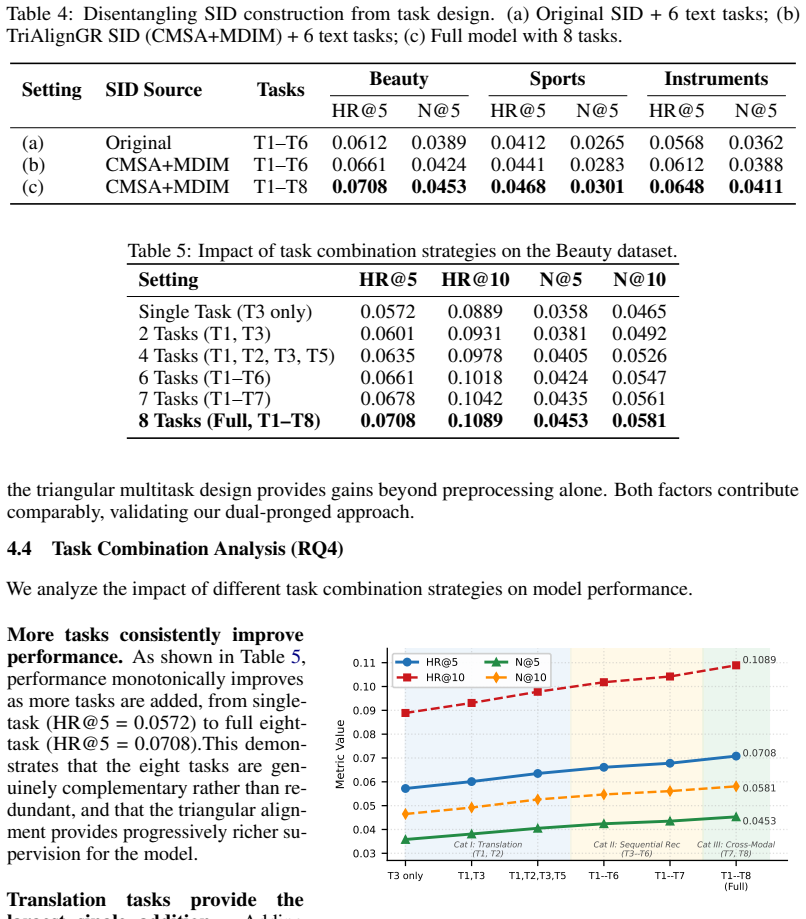
assumptions (1)
- domain assumption A single autoregressive loss suffices for joint training of eight complementary generation tasks without task-specific towers or complex loss weighting
Cite this review
Pith. "Pith review of TriAlignGR: Triangular Multitask Alignment with Multimodal Deep Interest Mining for Generative Recommendation." pith.science (2026). https://pith.science/paper/MQJ74E2E
@misc{pith2026260505249,
  author       = {Pith},
  title        = {Pith review of: TriAlignGR: Triangular Multitask Alignment with Multimodal Deep Interest Mining for Generative Recommendation},
  year         = {2026},
  howpublished = {\url{https://pith.science/paper/MQJ74E2E}},
  note         = {Machine review of arXiv:2605.05249}
}
abstract
We introduce TriAlignGR, a unified multitask-multimodal framework for generative recommendation that establishes two-stage multimodal semantic propagation: (i) encoding visual semantics directly into SIDs via multimodal embeddings, and (ii) enabling the model to decode these semantics through visual description tasks. Existing Semantic ID (SID) pipelines suffer from two fundamental but underexplored problems: \textbf{SID Content Degradation (SCD)}, where cascaded encoding and residual quantization discard critical multimodal and interest-level semantics; and \textbf{SID Semantic Opacity (SSO)}, where models autoregressively generate SID sequences without truly comprehending their underlying meaning, leading to hallucination and poor generalization. Prior work addresses at most text-SID alignment, leaving visual semantics and latent user interests entirely unexploited. TriAlignGR resolves both problems through three tightly integrated components: (1)~\textbf{Cross-Modal Semantic Alignment (CMSA)} integrates visual content into SID construction through both VLM-generated textual descriptions and a multimodal embedding model that directly encodes image features alongside text, ensuring that SIDs inherently carry multimodal semantics; (2)~\textbf{Multimodal Deep Interest Mining (MDIM)} leverages LLM Chain-of-Thought reasoning to extract latent user intents (\eg ``productivity-focused lifestyle'' from noise-canceling headphones) beyond surface attributes, enriching SID semantics before discretization; and (3)~\textbf{Triangular Multitask (TMT)} jointly trains on eight complementary generation tasks under a single autoregressive loss -- including two novel visual-semantic tasks (VisDesc$\to$SID, VisDesc$\to$Title) that map VLM-generated image descriptions to SIDs and titles, completing the SID-Text-Image triangle -- without requiring task-specific towers or complex loss weighting.
Figures


Figures from the paper (2 more)


Forward citations
Cited by 1 Pith paper
-
Meta-Modal Agent: Sequential Evidence Routing for Missing-Modality Candidate Reranking
MMA uses LLM agents with RL to rerank candidate pools from first-stage retrievers under missing modalities, reporting 4.0% and 12.7% NDCG@10 gains on OOMA and fixed-pool tasks over baselines.
Reference graph
Works this paper leans on
-
[1]
Tran, Jonah Samost, Maciej Kula, Ed H
Shashank Rajput, Nikhil Mehta, Anima Singh, Raghunandan Hulikal Keshavan, Trung Vu, Lukasz Heldt, Lichan Hong, Yi Tay, Vinh Q. Tran, Jonah Samost, Maciej Kula, Ed H. Chi, and Maheswaran Sathiamoorthy. Recommender systems with generative retrieval. InNeurIPS, 2023
work page 2023
-
[2]
Recgpt technical report.arXiv preprint arXiv:2507.22879, 2025
Chao Yi, Dian Chen, Gaoyang Guo, Jiakai Tang, Jian Wu, Jing Yu, Mao Zhang, Sunhao Dai, Wen Chen, Wenjun Yang, et al. Recgpt technical report.arXiv preprint arXiv:2507.22879, 2025
-
[3]
GME: Improving Universal Multimodal Retrieval by Multimodal LLMs
Xin Zhang, Yanzhao Zhang, Wen Xie, Mingxin Li, Ziqi Dai, Dingkun Long, Pengjun Xie, Meishan Zhang, Wenjie Li, and Min Zhang. Gme: Improving universal multimodal retrieval by multimodal llms.arXiv preprint arXiv:2412.16855, 2024
work page Pith review arXiv 2024
-
[4]
Lamra: Large multimodal model as your advanced retrieval assistant
Yikun Liu, Yajie Zhang, Jiayin Cai, Xiaolong Jiang, Yao Hu, Jiangchao Yao, Yanfeng Wang, and Weidi Xie. Lamra: Large multimodal model as your advanced retrieval assistant. In Proceedings of the Computer Vision and Pattern Recognition Conference, pages 4015–4025, 2025
work page 2025
-
[5]
Jun Zhang, Yi Li, Yue Liu, Changping Wang, Yuan Wang, Yuling Xiong, Xun Liu, Haiyang Wu, Qian Li, Enming Zhang, et al. Gpr: Towards a generative pre-trained one-model paradigm for large-scale advertising recommendation.arXiv preprint arXiv:2511.10138, 2025
-
[6]
ADS-POI: Agentic Spatiotemporal State Decomposition for Next Point-of-Interest Recommendation
Zhenyu Yu, Chunlei Meng, Yangchen Zeng, Mohd Yamani Idna Idris, and Shuigeng Zhou. Ads-poi: Agentic spatiotemporal state decomposition for next point-of-interest recommendation. arXiv preprint arXiv:2604.20846, 2026
work page Pith review arXiv 2026
-
[7]
CaST-POI: Candidate-Conditioned Spatiotemporal Modeling for Next POI Recommendation
Zhenyu Yu, Chunlei Meng, Yangchen Zeng, Mohd Yamani Idna Idris, and Shuigeng Zhou. Cast-poi: Candidate-conditioned spatiotemporal modeling for next poi recommendation.arXiv preprint arXiv:2604.20845, 2026
work page Pith review arXiv 2026
-
[8]
Reasoning over Semantic IDs Enhances Generative Recommendation
Yingzhi He, Yan Sun, Junfei Tan, Yuxin Chen, Xiaoyu Kong, Chunxu Shen, Xiang Wang, An Zhang, and Tat-Seng Chua. Reasoning over semantic ids enhances generative recommenda- tion.arXiv preprint arXiv:2603.23183, 2026
work page Pith review arXiv 2026
Show all 56 references
-
[9]
Chi, and Xinyang Yi
Anima Singh, Trung Vu, Nikhil Mehta, Raghunandan Keshavan, Maheswaran Sathiamoorthy, Yilin Zheng, Lichan Hong, Lukasz Heldt, Li Wei, Devansh Tandon, Ed H. Chi, and Xinyang Yi. Better generalization with semantic ids: A case study in ranking for recommendations. In RecSys, 2024
2024
-
[10]
Learnable item tokenization for generative recommendation
Wenjie Wang, Honghui Bao, Xinyu Lin, Jizhi Zhang, Yongqi Li, Fuli Feng, See-Kiong Ng, and Tat-Seng Chua. Learnable item tokenization for generative recommendation. InProceedings of the 33rd ACM International Conference on Information and Knowledge Management, pages 2400–2409, 2024
2024
-
[11]
Session-based recommendation with graph neural networks
Shu Wu, Yuyuan Tang, Yanqiao Zhu, Liang Wang, Xing Xie, and Tieniu Tan. Session-based recommendation with graph neural networks. InAAAI, 2019
2019
-
[12]
Recjpq: training large-catalogue sequential recom- menders
Aleksandr V Petrov and Craig Macdonald. Recjpq: training large-catalogue sequential recom- menders. InProceedings of the 17th ACM International Conference on Web Search and Data Mining, pages 538–547, 2024
2024
-
[13]
Learning vector-quantized item representation for transferable sequential recommenders
Yupeng Hou, Zhankui He, Julian McAuley, and Wayne Xin Zhao. Learning vector-quantized item representation for transferable sequential recommenders. InProceedings of the ACM Web Conference 2023, pages 1162–1171, 2023
2023
-
[14]
Hyperman: Hypergraph- enhanced meta-learning adaptive network for next poi recommendation
Jinze Wang, Tiehua Zhang, Lu Zhang, Yang Bai, Xin Li, and Jiong Jin. Hyperman: Hypergraph- enhanced meta-learning adaptive network for next poi recommendation. In2025 IEEE Interna- tional Conference on Multimedia and Expo (ICME), pages 1–6. IEEE, 2025. 10
2025
-
[15]
Onerec-v2 technical report.arXiv preprint arXiv:2508.20900, 2025
Guorui Zhou, Hengrui Hu, Hongtao Cheng, Huanjie Wang, Jiaxin Deng, Jinghao Zhang, Kuo Cai, Lejian Ren, Lu Ren, Liao Yu, et al. Onerec-v2 technical report.arXiv preprint arXiv:2508.20900, 2025
2025 arXiv
-
[16]
A survey of generative recommendation from a tri-decoupled perspective: Tokenization, architecture, and optimization
Xiaopeng Li, Bo Chen, Junda She, Shiteng Cao, You Wang, Qinlin Jia, Haiying He, Zheli Zhou, Zhao Liu, Ji Liu, et al. A survey of generative recommendation from a tri-decoupled perspective: Tokenization, architecture, and optimization. 2025
2025
-
[17]
Align 3gr: Unified multi-level alignment for llm-based generative recommendation
Wencai Ye, Mingjie Sun, Shuhang Chen, Wenjin Wu, and Peng Jiang. Align 3gr: Unified multi-level alignment for llm-based generative recommendation. InProceedings of the AAAI Conference on Artificial Intelligence, volume 40, pages 16154–16162, 2026
2026
-
[18]
Generating long semantic ids in parallel for recom- mendation
Yupeng Hou, Jiacheng Li, Ashley Shin, Jinsung Jeon, Abhishek Santhanam, Wei Shao, Kaveh Hassani, Ning Yao, and Julian McAuley. Generating long semantic ids in parallel for recom- mendation. InProceedings of the 31st ACM SIGKDD Conference on Knowledge Discovery and Data Mining ...
2025
-
[19]
Recommendation as language processing (RLP): A unified pretrain, personalized prompt & predict paradigm (P5)
Shijie Geng, Shuchang Liu, Zuohui Fu, Yingqiang Ge, and Yongfeng Zhang. Recommendation as language processing (RLP): A unified pretrain, personalized prompt & predict paradigm (P5). InRecSys, 2022
2022
-
[20]
A survey of generative search and recommendation in the era of large language models.arXiv preprint arXiv:2404.16924, 2024
Yongqi Li, Xinyu Lin, Wenjie Wang, Fuli Feng, Liang Pang, Wenjie Li, Liqiang Nie, Xiangnan He, and Tat-Seng Chua. A survey of generative search and recommendation in the era of large language models.arXiv preprint arXiv:2404.16924, 2024
2024
-
[21]
Generative large recommendation models: Emerging trends in llms for recommendation
Hao Wang, Wei Guo, Luankang Zhang, Jin Yao Chin, Yufei Ye, Huifeng Guo, Yong Liu, Defu Lian, Ruiming Tang, and Enhong Chen. Generative large recommendation models: Emerging trends in llms for recommendation. InCompanion Proceedings of the ACM on Web Conference 2025, pages 49–52, 2025
2025
-
[22]
Wang-Cheng Kang and Julian J. McAuley. Self-attentive sequential recommendation. InICDM, 2018
2018
-
[23]
Bert4rec: Sequential recommendation with bidirectional encoder representations from transformer
Fei Sun, Jun Liu, Jian Wu, Changhua Pei, Xiao Lin, Wenwu Ou, and Peng Jiang. Bert4rec: Sequential recommendation with bidirectional encoder representations from transformer. InPro- ceedings of the 28th ACM international conference on information and knowledge management, pages...
2019
-
[24]
Mtgr: Industrial-scale generative recommendation framework in meituan
Ruidong Han, Bin Yin, Shangyu Chen, He Jiang, Fei Jiang, Xiang Li, Chi Ma, Mincong Huang, Xiaoguang Li, Chunzhen Jing, et al. Mtgr: Industrial-scale generative recommendation framework in meituan. InProceedings of the 34th ACM International Conference on Information and Knowle...
2025
-
[25]
Longer: Scaling up long sequence modeling in industrial recommenders
Zheng Chai, Qin Ren, Xijun Xiao, Huizhi Yang, Bo Han, Sijun Zhang, Di Chen, Hui Lu, Wenlin Zhao, Lele Yu, et al. Longer: Scaling up long sequence modeling in industrial recommenders. InProceedings of the Nineteenth ACM Conference on Recommender Systems, pages 247–256, 2025
2025
-
[26]
Onetrans: Unified feature interaction and sequence modeling with one transformer in industrial recommender
Zhaoqi Zhang, Haolei Pei, Jun Guo, Tianyu Wang, Yufei Feng, Hui Sun, Shaowei Liu, and Aixin Sun. Onetrans: Unified feature interaction and sequence modeling with one transformer in industrial recommender. InProceedings of the ACM Web Conference 2026, pages 8162–8170, 2026
2026
-
[27]
Towards large-scale generative ranking.arXiv preprint arXiv:2505.04180, 2025
Yanhua Huang, Yuqi Chen, Xiong Cao, Rui Yang, Mingliang Qi, Yinghao Zhu, Qingchang Han, Yaowei Liu, Zhaoyu Liu, Xuefeng Yao, et al. Towards large-scale generative ranking.arXiv preprint arXiv:2505.04180, 2025
2025
-
[28]
Hllm: Enhancing sequential recom- mendations via hierarchical large language models for item and user modeling.arXiv preprint arXiv:2409.12740, 2024
Junyi Chen, Lu Chi, Bingyue Peng, and Zehuan Yuan. Hllm: Enhancing sequential recom- mendations via hierarchical large language models for item and user modeling.arXiv preprint arXiv:2409.12740, 2024. 11
2024
-
[29]
Unlocking scaling law in industrial recommendation systems with a three-step paradigm based large user model
Bencheng Yan, Shilei Liu, Zhiyuan Zeng, Zihao Wang, Yizhen Zhang, Yujin Yuan, Langming Liu, Jiaqi Liu, Di Wang, Wenbo Su, et al. Unlocking scaling law in industrial recommendation systems with a three-step paradigm based large user model. InProceedings of the Nineteenth ACM In...
2026
-
[30]
Llm-fe: Automated feature engi- neering for tabular data with llms as evolutionary optimizers.arXiv preprint arXiv:2503.14434, 2025
Nikhil Abhyankar, Parshin Shojaee, and Chandan K Reddy. Llm-fe: Automated feature engi- neering for tabular data with llms as evolutionary optimizers.arXiv preprint arXiv:2503.14434, 2025
2025 arXiv
-
[31]
Optimized feature generation for tabular data via llms with decision tree reasoning.Advances in neural information processing systems, 37:92352–92380, 2024
Jaehyun Nam, Kyuyoung Kim, Seunghyuk Oh, Jihoon Tack, Jaehyung Kim, and Jinwoo Shin. Optimized feature generation for tabular data via llms with decision tree reasoning.Advances in neural information processing systems, 37:92352–92380, 2024
2024
-
[32]
Large language models make sample-efficient recommender systems.Frontiers of Computer Science, 19(4):194328, 2025
Jianghao Lin, Xinyi Dai, Rong Shan, Bo Chen, Ruiming Tang, Yong Yu, and Weinan Zhang. Large language models make sample-efficient recommender systems.Frontiers of Computer Science, 19(4):194328, 2025
2025
-
[33]
Actions speak louder than words: Trillion-parameter sequential transducers for generative recommendations
Jiaqi Zhai, Lucy Liao, Xing Liu, Yueming Wang, Rui Li, Xuan Cao, Leon Gao, Zhaojie Gong, Fangda Gu, Jiayuan He, et al. Actions speak louder than words: Trillion-parameter sequential transducers for generative recommendations. InInternational Conference on Machine Learning, pag...
2024
-
[34]
Generative recommender with end-to-end learnable item tokenization
Enze Liu, Bowen Zheng, Cheng Ling, Lantao Hu, Han Li, and Wayne Xin Zhao. Generative recommender with end-to-end learnable item tokenization. InProceedings of the 48th Interna- tional ACM SIGIR Conference on Research and Development in Information Retrieval, pages 729–739, 2025
2025
-
[35]
Openonerec technical report.arXiv preprint arXiv:2512.24762, 2025
Guorui Zhou, Honghui Bao, Jiaming Huang, Jiaxin Deng, Jinghao Zhang, Junda She, Kuo Cai, Lejian Ren, Lu Ren, Qiang Luo, et al. Openonerec technical report.arXiv preprint arXiv:2512.24762, 2025
2025
-
[36]
Onesug: The unified end-to-end generative framework for e-commerce query suggestion
Xian Guo, Ben Chen, Siyuan Wang, Ying Yang, Mingyue Cheng, Chenyi Lei, Yuqing Ding, and Han Li. Onesug: The unified end-to-end generative framework for e-commerce query suggestion. InProceedings of the AAAI Conference on Artificial Intelligence, volume 40, pages 14774–14782, 2026
2026
-
[37]
One model, two markets: Bid-aware generative recommendation.arXiv preprint arXiv:2603.22231, 2026
Yanchen Jiang, Zhe Feng, Christopher P Mah, Aranyak Mehta, and Di Wang. One model, two markets: Bid-aware generative recommendation.arXiv preprint arXiv:2603.22231, 2026
2026
-
[38]
Higr: Efficient generative slate recommendation via hierar- chical planning and multi-objective preference alignment.arXiv preprint arXiv:2512.24787, 2025
Yunsheng Pang, Zijian Liu, Yudong Li, Shaojie Zhu, Zijian Luo, Chenyun Yu, Sikai Wu, Shichen Shen, Cong Xu, Bin Wang, et al. Higr: Efficient generative slate recommendation via hierar- chical planning and multi-objective preference alignment.arXiv preprint arXiv:2512.24787, 2025
2025 arXiv
-
[39]
Pixrec: Leveraging visual context for next-item prediction in sequential recommendation.arXiv preprint arXiv:2601.06458, 2026
Sayak Chakrabarty and Souradip Pal. Pixrec: Leveraging visual context for next-item prediction in sequential recommendation.arXiv preprint arXiv:2601.06458, 2026
2026
-
[40]
Plum: Adapting pre-trained language models for industrial-scale generative recommendations
Ruining He, Lukasz Heldt, Lichan Hong, Raghunandan Keshavan, Shifan Mao, Nikhil Mehta, Zhengyang Su, Alicia Tsai, Yueqi Wang, Shao-Chuan Wang, et al. Plum: Adapting pre-trained language models for industrial-scale generative recommendations. InProceedings of the ACM Web Confer...
2026
-
[41]
Entire space multi-task model: An effective approach for estimating post-click conversion rate
Xiao Ma, Liqin Zhao, Guan Huang, Zhi Wang, Zelin Hu, Xiaoqiang Zhu, and Kun Gai. Entire space multi-task model: An effective approach for estimating post-click conversion rate. In The 41st International ACM SIGIR Conference on Research & Development in Information Retrieval, p...
2018
-
[42]
Progressive layered extraction (ple): A novel multi-task learning (mtl) model for personalized recommendations
Hongyan Tang, Junning Liu, Ming Zhao, and Xudong Gong. Progressive layered extraction (ple): A novel multi-task learning (mtl) model for personalized recommendations. InProceedings of the 14th ACM conference on recommender systems, pages 269–278, 2020. 12
2020
-
[43]
Mmoe: Enhancing multimodal models with mixtures of multi- modal interaction experts
Haofei Yu, Zhengyang Qi, Lawrence Keunho Jang, Russ Salakhutdinov, Louis-Philippe Morency, and Paul Pu Liang. Mmoe: Enhancing multimodal models with mixtures of multi- modal interaction experts. InProceedings of the 2024 Conference on Empirical Methods in Natural Language Proc...
2024
-
[44]
Residual multi-task learner for applied ranking
Cong Fu, Kun Wang, Jiahua Wu, Yizhou Chen, Guangda Huzhang, Yabo Ni, Anxiang Zeng, and Zhiming Zhou. Residual multi-task learner for applied ranking. InProceedings of the 30th ACM SIGKDD Conference on Knowledge Discovery and Data Mining, pages 4974–4985, 2024
2024
-
[45]
Hinet: Novel multi-scenario & multi-task learning with hierarchical information extraction
Jie Zhou, Xianshuai Cao, Wenhao Li, Lin Bo, Kun Zhang, Chuan Luo, and Qian Yu. Hinet: Novel multi-scenario & multi-task learning with hierarchical information extraction. In2023 IEEE 39th International Conference on Data Engineering (ICDE), pages 2969–2975. IEEE, 2023
2023
-
[46]
Minionerec: An open-source framework for scaling generative recommendation
Xiaoyu Kong, Leheng Sheng, Junfei Tan, Yuxin Chen, Jiancan Wu, An Zhang, Xiang Wang, and Xiangnan He. Minionerec: An open-source framework for scaling generative recommendation. arXiv preprint arXiv:2510.24431, 2025
2025
-
[47]
McAuley, Christopher Targett, Qinfeng Shi, and Anton van den Hengel
Julian J. McAuley, Christopher Targett, Qinfeng Shi, and Anton van den Hengel. Image-based recommendations on styles and substitutes. InSIGIR, 2015
2015
-
[48]
switch modes
Kun Zhou, Hui Wang, Wayne Xin Zhao, Yutao Zhu, Sirui Wang, Fuzheng Zhang, Zhongyuan Wang, and Ji-Rong Wen. S3-rec: Self-supervised learning for sequential recommendation with mutual information maximization. InCIKM, 2020. A Experimental Setup Datasets.We conduct experiments on...
2020
-
[49]
CMSA preprocessing.For each item image, we generate a concise but semantically rich textual description with Qwen2.5-VL
-
[50]
MDIM preprocessing.We concatenate title, description, and the CMSA caption, and then use Qwen2.5-7B-Instruct to mine 2–4 deep interest tags per item
-
[51]
We then train the RQ-V AE tokenizer offline with 3 quantization levels and codebook sizes of 4096, 2048, and 1024, and generate fixed SID targets for all items
RQ-V AE fitting.We encode each item using gme-Qwen2-VL, which jointly processes the enriched text (title, description, CMSA caption, MDIM interests) and the original product image to produce a unified multimodal embedding. We then train the RQ-V AE tokenizer offline with 3 qua...
-
[52]
The CMSA captions, MDIM interests, and SID targets are cached offline and reused during training
Multitask fine-tuning.We jointly train the LLM on all eight tasks using a single autoregressive cross-entropy loss with uniform task sampling. The CMSA captions, MDIM interests, and SID targets are cached offline and reused during training. This keeps the recommendation traini...
-
[53]
Bright yellow and white soccer ball with traditional panel design
Multimodal Integration:The CMSA-generated visual description ("Bright yellow and white soccer ball with traditional panel design") captures visual attributes not explicitly stated in the textual metadata, providing complementary information for the embedding model
-
[54]
soccer ball,
Deep Interest Mining:MDIM extracts latent user motivations beyond surface-level attributes. While the title only describes a "soccer ball," MDIM identifies deeper interests such as "youth athletic development" and "parent purchasing for child’s recreational soccer activity," w...
-
[55]
This enriched representation ensures that the resulting SID carries both explicit attributes and latent user motivations
Semantic Enrichment:The final interest-enhanced representation combines the original product information with mined interests, creating a richer input for the gme-Qwen2-VL multimodal 21 embedding model. This enriched representation ensures that the resulting SID carries both e...
-
[56]
This case study demonstrates how MDIM and CMSA work synergistically to addressSID Content Degradation (SCD)by enriching item representations before quantization
Quality Control:Confidence scores associated with each mined interest allow filtering of low- confidence predictions, ensuring only high-quality semantic signals are injected into the SID construction pipeline. This case study demonstrates how MDIM and CMSA work synergisticall...
Reviewed July 1, 2026 · model on record in the stance chip above.
Discussion (0). Continue with ORCID to comment.