REVIEW 3 major objections 5 minor 42 references
Observation of an Optical Spring in a Robustly Controlled Signal-Recycled Michelson Interferometer
T0 review · 3 major / 5 minor · reviewed 2026-08-16 · deepseek-v4-flash
Pith's one-line read An optical spring has been observed for the first time in a signal-recycled Michelson interferometer without arm cavities, with a detuning-dependent resonance that matches conventional optomechanical cavity theory.
desk verdict A credible first optical spring in an SRMI without arm cavities, with a genuinely useful control scheme; the quantitative claim mostly rests on a two-parameter fit, but the effect is probably real. read the letter →
The pith
A machine-rendered reading of the paper's core claim, the machinery that carries it, and where it could break.
The reading
What carries the argument
The carrying object is the optical spring constant $K_{\mathrm{os}}(\alpha)$ derived from the SRMI input–output relations, whose real part $k_{\mathrm{os}}$ adds to the mechanical stiffness and whose imaginary part gives optical damping. In the small-phase-delay limit the spring frequency reduces to the fitted form $\tilde{\omega}_{\mathrm{os}}$ that includes the fourfold folding enhancement of radiation pressure and the signal-recycling mirror (SRM) transmissivity. The measurement side is the closed-loop transfer function $G_{\mathrm{CL}}$, whose optomechanical component $G_{\mathrm{opt}}$ is modeled as a single damped harmonic oscillator with an added optical rigidity; fitting this model to swept-frequency data at each detuning angle extracts $f_{\mathrm{os}}$. Around these two formulas, the experimental scheme's two auxiliary-laser control loops make the detuning-angle sweep possible in the first place.
What would settle it
Measure the mirror's mechanical transfer function with the laser blocked: if it shows a second resonance or strongly frequency-dependent damping in the 26–40 Hz band, the fitted $f_{\mathrm{os}}$ values could not be attributed to a pure optical spring.
Extended reading notes
Core claim
The central claim is that a signal-recycled Michelson interferometer without arm cavities supports a genuine optical spring, not merely a perturbation of the mechanical response. The paper derives the optical spring constant from the input–output relations of the SRMI, including radiation-pressure (ponderomotive) coupling, and shows that for small round-trip phase delay the spring takes the form of a modified harmonic rigidity with an optical damping term. The folded arm places the suspended mirror at a point receiving a fourfold radiation-pressure enhancement. Experimentally, the authors lock the interferometer using two auxiliary light fields—a frequency-doubled green beam to control the Michelson length and a phase-locked subcarrier to control the signal-recycling cavity length—and measure the optomechanical response from the closed-loop transfer function. The fitted optical spring frequency increases with detuning angle and tracks the theoretical curve, with an effective mass of about 0.8 g and a round-trip intensity loss of about 2% used as the only free parameters. The paper concludes that the observed response is consistent with a conventional optomechanical cavity and remains consistent over the full range of detuning angles tested.
Load-bearing premise
The extraction of the optical spring frequency assumes the suspended mirror with its double-spiral suspension responds as a single damped harmonic oscillator at all measured frequencies, with no extra mechanical modes or spurious couplings distorting the fit.
Editorial extensions
If this is right
- A signal-recycled Michelson interferometer without arm cavities can host a tunable optical spring, so the detuning angle of the signal-recycling cavity can set the effective mechanical resonance frequency of the suspended mirror.
- The detuning dependence of the observed resonance matches standard optomechanical cavity theory, indicating that the same radiation-pressure mechanism acts in this topology as in a simple cavity.
- The auxiliary-laser control scheme (green beam for the Michelson dark fringe, phase-locked subcarrier for the recycling cavity) provides a practical template for holding an SRMI lock across a wide detuning range.
- With an intracavity optical parametric amplifier, the paper's modified spring-frequency formula predicts enhanced optical rigidity beyond a parametric gain of about 1 dB, making SRMI a candidate for kilohertz-band gravitational-wave sensitivity.
- The same platform could be used to study OPA-induced anti-damping and to test active damping techniques that would be needed for stable operation.
Reading between the lines
- A natural extension of the reported control scheme would be to sweep the detuning continuously and map the optical spring frequency as a live-tunable mechanical filter, which could be used for targeted narrowband searches.
- If the same setup is refitted with a phase-matched nonlinear crystal, the model predicts a sharp rise in $f_{\mathrm{os}}$ as the parametric gain approaches about 1 dB; measuring $f_{\mathrm{os}}$ versus pump gain would test that threshold directly.
- The fourfold folding enhancement hints that further geometrical increases in radiation-pressure leverage (for example, additional folds or placing the suspension at a higher-intensity point) could raise spring stiffness without raising laser power.
- The dual-laser locking architecture, with a detuning-insensitive green loop for the Michelson length, could be transferred to other small optomechanical sensors that need tunable rigidity without radio-frequency sideband coupling.
Signed reviews
Editorial analysis
A structured set of objections, weighed in public.
Referee Report
Summary. The paper reports what it claims to be the first experimental observation of an optical spring in a signal-recycled Michelson interferometer (SRMI) without arm cavities. The experiment uses a 1064-nm carrier, a green second-harmonic beam to stabilize the Michelson arm length, and a frequency-offset subcarrier to control the signal-recycling cavity detuning; the test mass is a 0.2-g mirror suspended by double-spiral springs with eddy-current damping. Closed-loop transfer functions are measured at detuning angles from 0.4° to 40.6°, and the response is fitted with a damped-oscillator model containing an optical-rigidity term, Eq. (15). The extracted optical spring frequency varies with detuning in a way that is claimed to agree with the theoretical prediction, Eq. (16), with R²=0.96. The paper argues that this establishes SRMI as a platform for OPA-enhanced optical springs for future gravitational-wave detectors.
Significance. If the observation is genuine, it is a notable first: no prior experiment has demonstrated an optical spring in a signal-recycled Michelson interferometer without arm cavities, and the multi-color control scheme is an inventive solution to the detuning-stability problem. The detuning scan over 0.4°-40.6° and the fixed mechanical dip with a shifting higher-frequency peak are exactly the signature expected from an optical spring, and the functional form of the detuning dependence is nontrivial. The manuscript would be substantially stronger if it reported an independent measurement of the open-loop plant G_SRMI or a parameter-free prediction; the current fit-based evidence is suggestive but not fully convincing.
major comments (3)
- [Section 3.3, Eqs. (14)-(15)] The extraction of G_opt from the measured closed-loop transfer function is not self-contained. The paper states that the measured transfer function was fitted using Eq. (15) as a complex function, but Eq. (15) is G_opt, and Eq. (14) relates G_CL to G_opt through the unknown open-loop plant G_SRMI. Unless G_SRMI is independently measured or modeled with a validated transfer function, the fit parameters f_os and gamma_os can absorb any detuning-dependent frequency structure in G_SRMI, including PZT1 resonances, control-loop shaping, or an additional suspension mode. Because Eq. (15) contains the optical-spring resonance by construction, a nonzero f_os is returned even if the true frequency dependence is not optical. Please provide either a measured G_SRMI (for example, with the laser blocked or at zero detuning) and show that the extracted f_os is unchanged, or an explicit model of G_SRMI with all parameters fixed by independent measurements.
- [Section 4, Fig. 5(b), Eq. (16)] The R²=0.96 comparison is not an independent test of the theoretical model. The two parameters m_eff and epsilon are fitted from the same measured transfer functions that produce f_os, so the detuning curve in Fig. 5(b) is a two-parameter fit, not a prediction. The authors should report the full covariance matrix of the fits, perform a fit with m_eff and epsilon fixed to independently measured values (e.g., from a ringdown measurement with the laser off and from a cavity loss measurement), or vary the fit band and show that the extracted f_os values are stable. This is necessary to establish that the detuning dependence is not an artifact of the fitting model.
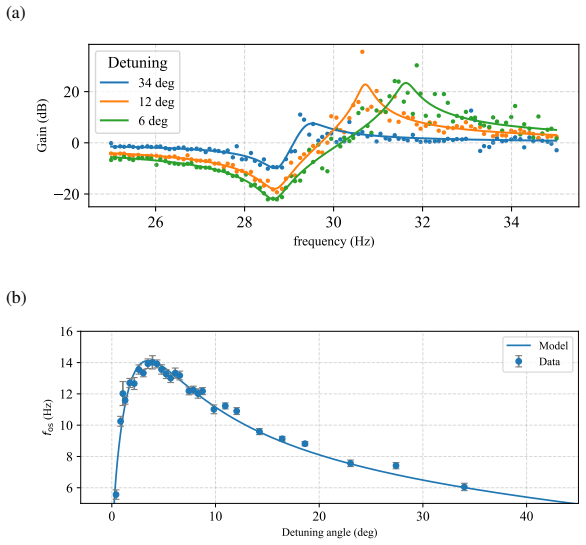
- [Section 4, Fig. 5(a)] The measurement frequency band is only 26-34 Hz, and the authors acknowledge that acoustic and seismic noise is worst near the spring resonance, which falls inside this band. The error bars in Fig. 5(b) are described only as standard errors estimated from the measured transfer function; it is not clear whether they include the noise-induced systematic uncertainty in the fitted peak position, especially for detuning angles where the peak lies near the edge of the measurement band. Please provide a noise-floor measurement and quantify the systematic uncertainty on f_os as a function of detuning, or restrict the claim to detunings where the peak is well inside the measured band.
minor comments (5)
- [Eq. (7)] The small-alpha expansion appears to give a factor 2T_s alpha/(1+r_s^2-2r_s cos 2phi_s) for the imaginary correction, while Eq. (7) has T_s alpha/(1+r_s^2-2r_s cos 2phi_s) without the factor 2; please check the algebra.
- [Section 3.3] The statement 'The gain response was subsequently converted into the optomechanical response |G_opt(omega)|' is ambiguous; please specify the exact inversion of Eq. (14) and the assumed form of G_SRMI used in that conversion.
- [Eq. (16)] The loss parameter epsilon appears inside the denominator as r_s*sqrt(1-epsilon); please state clearly whether epsilon is a round-trip power loss and how it enters the effective amplitude reflectivity, since a reader might otherwise misassign the square-root factors.
- [Fig. 5(a)] Fig. 5(a) shows only detuning angles of 6 deg, 12 deg, and 34 deg while the text says measurements spanned 0.4 deg to 40.6 deg; please clarify whether the figure shows representative curves and include all measured curves in supplementary material.
- [Data Availability] Consider releasing the measured transfer functions and fitted parameters as supplementary data, since 'upon reasonable request' makes it difficult for other groups to verify the R²=0.96 claim and the extraction procedure.
Circularity Check
Quantitative f_os-vs-detuning agreement is partly self-confirming: the 'theoretical prediction' curve uses m_eff and ε fitted from the same f_os data, though the visible detuning-dependent peak shift provides independent qualitative support.
-
fitted input called prediction
[Section 4, Fig. 5, Eqs. (15)-(16)]
"The measured transfer function was fitted using Eq. (15) as a complex function to extract the system parameters. ... In the fitting procedure, two free parameters were introduced: the effective mass m_eff and the round-trip intensity loss ε. ... The theoretical model was adapted from Eq. (9) ... The modified expression for the optical spring frequency is given by Eq. (16) ... Data points show the measured optical spring frequencies f_os=ω_os/2π as a function of detuning angle, while the solid line indicates the theoretical prediction."
The 'theoretical prediction' in Fig. 5(b) is not parameter-free: m_eff and ε are fitted from the same f_os data before being inserted into Eq. (16). The R²=0.96 agreement therefore partly reflects the flexibility of the two fitted parameters rather than an independent prediction of the absolute optical spring frequency. Additionally, f_os itself is extracted by fitting Eq. (15), which contains ω_os as a free parameter, so the measured spring frequency is a fit output; the conversion from G_CL to G_opt also assumes a detuning-independent G_SRMI that is not reported. The detuning-dependent peak shift visible in Fig. 5(a) is a non-circular qualitative signature, so the circularity is partial rather than total.
full rationale
The theoretical derivation in Section 2 (Eqs. (4)-(9)) is self-contained: the optical spring constant is obtained from input-output relations and the mirror equation of motion without using the experimental results. The experimental analysis, however, introduces a fitted-input-called-prediction element. The measured closed-loop transfer function is fit to Eq. (15), which already contains the optical-spring frequency as a free parameter, and the resulting f_os values are then compared with Eq. (16), whose m_eff and ε are also fit from the same f_os data. Thus the quantitative R²=0.96 agreement is partly a test of the assumed functional form rather than a parameter-free prediction. Still, the prominent detuning-dependent peak shift near sqrt(ω_m²+ω_os²), visible in Fig. 5(a), is an independent qualitative fingerprint of an optical spring, so the central observation does not reduce entirely to the fit. The self-citations (Refs. 14, 21, 38) motivate the OPA outlook and prior group results but are not load-bearing for the present measurement. The acknowledged acoustic/seismic noise near the spring resonance is a robustness concern, not a circularity. Overall, there is one partial circular step, and the central claim retains independent observational content, giving a score of 4.
Assumptions & free parameters
free parameters (2)
- effective mass m_eff =
~0.8 g
- round-trip intensity loss epsilon =
~2%
assumptions (4)
- domain assumption Arm mirrors are perfectly reflecting and arm asymmetry is negligible, with alpha_x ~ alpha_y and a dark port condition, when deriving K_os in Eq. (4).
- domain assumption The suspended mirror is a single harmonic oscillator, so G_opt in Eq. (15) fully describes the optomechanical response.
- domain assumption The sideband phase delay alpha is small, justifying the linearized optical spring expression in Eq. (7).
- domain assumption The green control beam and the subcarrier do not perturb the carrier optomechanical dynamics.
Cite this review
Pith. "Pith review of Observation of an Optical Spring in a Robustly Controlled Signal-Recycled Michelson Interferometer." pith.science (2026). https://pith.science/paper/MQV45SBL
@misc{pith2026250418374,
  author       = {Pith},
  title        = {Pith review of: Observation of an Optical Spring in a Robustly Controlled Signal-Recycled Michelson Interferometer},
  year         = {2026},
  howpublished = {\url{https://pith.science/paper/MQV45SBL}},
  note         = {Machine review of arXiv:2504.18374}
}
read the original abstract
We present, to the best of our knowledge, the first demonstration of an optical spring in a signal-recycled Michelson interferometer without arm cavities. The setup utilizes multiple laser fields to achieve stable and precisely controllable detuning and incorporates a compliant suspension system comprising two double-spiral springs. These results support optical spring-enhanced interferometers with intracavity amplification, offering a promising avenue for improving high-frequency sensitivity in future gravitational-wave detectors.
Figures


Figures from the paper (2 more)

Reference graph
Works this paper leans on
-
[1]
Observation of gravitational waves from a binary black hole merger,
B. P. Abbott, R. Abbott, T. D. Abbott,et al., “Observation of gravitational waves from a binary black hole merger,” Phys. Rev. Lett.116, 061102 (2016)
2016
-
[2]
Gravitational-WaveCandidateEventDatabase,
LIGOScientificCollaboration,“Gravitational-WaveCandidateEventDatabase,”Availableat: https://gracedb.ligo.org (accessed Aug. 24, 2025)
work page 2025
-
[3]
Theevolutionofbinaryneutronstarpost-mergerremnants: areview,
N.SarinandP.D.Lasky,“Theevolutionofbinaryneutronstarpost-mergerremnants: areview,”Gen.Relativ.Gravit. 53, 59 (2021)
work page 2021
-
[4]
LIGO Scientific Collaboration, J. Aasi, B. P. Abbott,et al., “Advanced LIGO,” Class. Quantum Gravity32, 074001 (2015)
work page 2015
-
[5]
Advanced Virgo: a second-generation interferometric gravitational wave detector,
F. Acernese, M. Agathos, K. Agatsuma,et al., “Advanced Virgo: a second-generation interferometric gravitational wave detector,” Class. Quantum Gravity32, 024001 (2014)
2014
-
[6]
KAGRA: 2.5 generation interferometric gravitational wave detector,
T. Akutsu, M. Ando, K. Arai,et al., “KAGRA: 2.5 generation interferometric gravitational wave detector,” Nat. Astron.3, 35–40 (2019)
work page 2019
-
[7]
A gravitational wave observatory operating beyond the quantum shot-noise limit
J. Abadie, B. P. Abbott, R. Abbott,et al., “A gravitational wave observatory operating beyond the quantum shot-noise limit.” Nat. Phys.7, 962–965 (2011)
work page 2011
-
[8]
Broadband quantum enhancement of the ligo detectors with frequency- dependent squeezing,
D. Ganapathy, W. Jia, M. Nakano,et al., “Broadband quantum enhancement of the ligo detectors with frequency- dependent squeezing,” Phys. Rev. X13, 041021 (2023)
2023
Show all 42 references
-
[9]
Frequency-dependent squeezed vacuum source for the advanced Virgo gravitational-wave detector,
F. Acernese, M. Agathos, A. Ain,et al., “Frequency-dependent squeezed vacuum source for the advanced Virgo gravitational-wave detector,” Phys. Rev. Lett.131, 041403 (2023)
2023
-
[10]
Cavity optomechanics,
M. Aspelmeyer, T. J. Kippenberg, and F. Marquardt, “Cavity optomechanics,” Rev. Mod. Phys.86, 1391–1452 (2014)
2014
-
[11]
Observation and characterization of an optical spring,
B. S. Sheard, M. B. Gray, C. M. Mow-Lowry,et al., “Observation and characterization of an optical spring,” Phys. Rev. A69, 051801 (2004)
2004
-
[12]
Thermallensinginrecyclinginterferometricgravitationalwavedetectors,
K.Strain,K.Danzmann,J.Mizuno,et al.,“Thermallensinginrecyclinginterferometricgravitationalwavedetectors,” Phys. Lett. A194, 124–132 (1994)
1994
-
[13]
Observation of parametric instability in advanced ligo,
M. Evans, S. Gras, P. Fritschel,et al., “Observation of parametric instability in advanced ligo,” Phys. Rev. Lett.114, 161102 (2015)
2015
-
[14]
Parametric signal amplification to create a stiff optical bar,
K. Somiya, Y. Kataoka, J. Kato,et al., “Parametric signal amplification to create a stiff optical bar,” Phys. Lett. A 380, 521–524 (2016)
2016
-
[15]
Beating the standard sensitivity-bandwidth limit of cavity-enhanced interferometers with internal squeezed-light generation,
M. Korobko, L. Kleybolte, S. Ast,et al., “Beating the standard sensitivity-bandwidth limit of cavity-enhanced interferometers with internal squeezed-light generation,” Phys. Rev. Lett.118, 143601 (2017)
2017
-
[16]
Observationofopticalspringeffectinamicrotoroidaloptomechanicalresonator,
M.Hossein-ZadehandK.J.Vahala,“Observationofopticalspringeffectinamicrotoroidaloptomechanicalresonator,” Opt. Lett.32, 1611–1613 (2007)
2007
-
[17]
Near-field cavity optomechanics with nanomechanical oscillators,
G. Anetsberger, O. Arcizet, Q. Unterreithmeier,et al., “Near-field cavity optomechanics with nanomechanical oscillators,” Nat. Phys.5, 909–914 (2009)
2009
-
[18]
Measurement of optical response of a detuned resonant sideband extraction gravitational wave detector,
O. Miyakawa, R. Ward, R. Adhikari,et al., “Measurement of optical response of a detuned resonant sideband extraction gravitational wave detector,” Phys. Rev. D74, 022001 (2006)
2006
-
[19]
Measurement of radiation-pressure-induced optomechanical dynamics in a suspended Fabry-Perot cavity,
T. Corbitt, D. Ottaway, E. Innerhofer,et al., “Measurement of radiation-pressure-induced optomechanical dynamics in a suspended Fabry-Perot cavity,” Phys. Rev. A74, 021802 (2006)
2006
-
[20]
Observation of an optical spring with a beam splitter,
J. Cripe, B. Danz, B. Lane,et al., “Observation of an optical spring with a beam splitter,” Opt. Lett.43, 2193–2196 (2018)
2018
-
[21]
Kerr-enhanced optical spring,
S. Otabe, W. Usukura, K. Suzuki,et al., “Kerr-enhanced optical spring,” Phys. Rev. Lett.132, 143602 (2024)
2024
-
[22]
Amplifying optical spring effect in an optical cavity with an optical parametric amplifier,
J. Liu, J. Pan, C. Blair,et al., “Amplifying optical spring effect in an optical cavity with an optical parametric amplifier,” Opt. Lett.50, 2578–2581 (2025)
2025
-
[23]
Photothermal effect in macroscopic optomechanical systems with an intracavity nonlinear optical crystal,
S. Otabe, K. Komori, K. Harada,et al., “Photothermal effect in macroscopic optomechanical systems with an intracavity nonlinear optical crystal,” Opt. Express30, 42579–42593 (2022)
2022
-
[24]
Quantumnoiseofawhite-lightcavityusingadouble-pumpedgainmedium,
Y.Ma, H.Miao,C.Zhao,andY.Chen, “Quantumnoiseofawhite-lightcavityusingadouble-pumpedgainmedium,” Phys. Rev. A92, 023807 (2015)
2015
-
[25]
Attempts to measure the optical spring in GEO600,
S. Hild, “Attempts to measure the optical spring in GEO600,” inGEO Simulation Meeting,(2008)
2008
-
[26]
Upgrade of the 40m interferometer,
R. Adhikari, Y. Aso, S. Ballmer,et al., “Upgrade of the 40m interferometer,” Tech. Rep. LIGO-T080074-00-R, California Institute of Technology and Massachusetts Institute of Technology (2008)
2008
-
[27]
Arm-length stabilisation for interferometric gravitational-wave detectors using frequency-doubled auxiliary lasers,
A. J. Mullavey, B. J. J. Slagmolen, J. Miller,et al., “Arm-length stabilisation for interferometric gravitational-wave detectors using frequency-doubled auxiliary lasers,” Opt. Express20, 81–89 (2012)
2012
-
[28]
Mathematical framework for simulation of quantum fields in complex interferometers using the two-photon formalism,
T. Corbitt, Y. Chen, and N. Mavalvala, “Mathematical framework for simulation of quantum fields in complex interferometers using the two-photon formalism,” Phys. Rev. A72, 013818 (2005)
2005
-
[29]
Conversion of conventional gravitational-wave interferometers into quantum nondemolition interferometers by modifying their input and/or output optics,
H. J. Kimble, Y. Levin, A. B. Matsko,et al., “Conversion of conventional gravitational-wave interferometers into quantum nondemolition interferometers by modifying their input and/or output optics,” Phys. Rev. D65, 022002 (2001)
2001
-
[30]
Quantum noise and radiation pressure effects in high power optical interferometers,
T. R. Corbitt, “Quantum noise and radiation pressure effects in high power optical interferometers,” Ph.D. thesis, Georgia Institute of Technology (2001)
2001
-
[31]
Squeezed-input, optical-spring, signal-recycled gravitational-wave detectors,
J. Harms, Y. Chen, S. Chelkowski,et al., “Squeezed-input, optical-spring, signal-recycled gravitational-wave detectors,” Phys. Rev. D68, 042001 (2003)
2003
-
[32]
Results of 40m prototype,
O. Miyakawa, “Results of 40m prototype,” inLSC meeting at LHO,(2006)
2006
-
[33]
GEO600 beam splitter thermal compensation system: new design and commissioning,
S. Nadji, H. Wittel, N. Mukund,et al., “GEO600 beam splitter thermal compensation system: new design and commissioning,” arXiv:2408.02804 (2024)
2024 arXiv
-
[34]
DC-readout of a signal-recycled gravitational wave detector,
S. Hild, H. Grote, J. Degallaix,et al., “DC-readout of a signal-recycled gravitational wave detector,” Class. Quantum Gravity26, 055012 (2009)
2009
-
[35]
Heterodyne optical phase-locking of extended-cavity semiconductor lasers at 9 GHz,
G. Santarelli, A. Clairon, S. Lea, and G. Tino, “Heterodyne optical phase-locking of extended-cavity semiconductor lasers at 9 GHz,” Opt. Commun.104, 339–344 (1994)
1994
-
[36]
Python red pitaya lockbox (PyRPL): An open source software package for digital feedback control in quantum optics experiments,
L. Neuhaus, M. Croquette, R. Metzdorff,et al., “Python red pitaya lockbox (PyRPL): An open source software package for digital feedback control in quantum optics experiments,” Rev. Sci. Instruments95, 033003 (2024)
2024
-
[37]
Broadband measurement and reduction of quantum radiation pressure noise in the audio band,
J. D. Cripe, “Broadband measurement and reduction of quantum radiation pressure noise in the audio band,” Ph.D. thesis, Louisiana State University and Agricultural and Mechanical College (2018)
2018
-
[38]
Intracavity signal amplification system for next-generation gravitational-wave detectors,
K. Somiya, K. Suzuki, S. Otabe, and K. Harada, “Intracavity signal amplification system for next-generation gravitational-wave detectors,” Phys. Rev. D107, 122005 (2023)
2023
-
[39]
Optical spring effect enhanced by optical parametric amplifier,
J. Zhang, H. Sun, H. Guo,et al., “Optical spring effect enhanced by optical parametric amplifier,” Appl. Phys. Lett. 122, 261106 (2023)
2023
-
[40]
An all-optical trap for a gram-scale mirror,
T. Corbitt, Y. Chen, E. Innerhofer,et al., “An all-optical trap for a gram-scale mirror,” Phys. Rev. Lett.98, 150802 (2007)
2007
-
[41]
Stable optical trap from a single optical field utilizing birefringence,
R. Singh, G. D. Cole, J. Cripe, and T. Corbitt, “Stable optical trap from a single optical field utilizing birefringence,” Phys. Rev. Lett.117, 213604 (2016)
2016
-
[42]
Optical spring tracking for enhancing quantum-limited interferometers,
S. Aronson, R. Pagano, T. Cullen,et al., “Optical spring tracking for enhancing quantum-limited interferometers,” Opt. Lett.49, 6980–6983 (2024)
2024
Reviewed August 16, 2026 · model on record in the stance chip above.
Discussion (0). Continue with ORCID to comment.