REVIEW 3 major objections 5 minor 1 cited by
MarketGPT: Developing a Pre-trained transformer (GPT) for Modeling Financial Time Series
T0 review · 3 major / 5 minor · reviewed 2026-08-12 · deepseek-v4-flash
Pith's one-line read A GPT trained on Nasdaq message data generates realistic stock order flow at message scale inside a discrete event simulator.
desk verdict A useful GPT-based LOB message generator proof-of-concept, but the realism claim is partly an artifact of a hand-written error-correction filter that reshapes ~7% of the output. read the letter →
The pith
A machine-rendered reading of the paper's core claim, the machinery that carries it, and where it could break.
The reading
What carries the argument
The machinery is a token-level autoregressive transformer that treats each order message as a sequence of 24 tokens drawn from a vocabulary of about 12,111 (covering symbol, side, order type, size, relative price, and timestamp fields) and is trained with cross-entropy loss to predict the next token. The model is a roughly 100-million-parameter decoder-only transformer using RMSNorm, rotary position embeddings, a KV cache, and a single dedicated attention-sink token that gives attention an explicit place to offload scores when the sliding context window moves beyond the training length. Generated messages are passed into a discrete event simulator, where an error-correction procedure checks whether referenced orders exist in the book; for the roughly 7% of messages that fail (mostly hallucinated replace orders), the simulator either substitutes the first order in the priority queue or discards the message and re-runs the timestep.
What would settle it
Re-run the same model with error correction disabled (or log raw token sequences before correction) and count: (i) the fraction of cancel/replace messages that refer to nonexistent orders, (ii) the message-type and order-size distributions of the raw stream. If a large share of referential messages are invalid or the raw distributions diverge strongly from the empirical ones, the realism is produced by the simulator's rule-based correction rather than by the learned token distribution.
Extended reading notes
Core claim
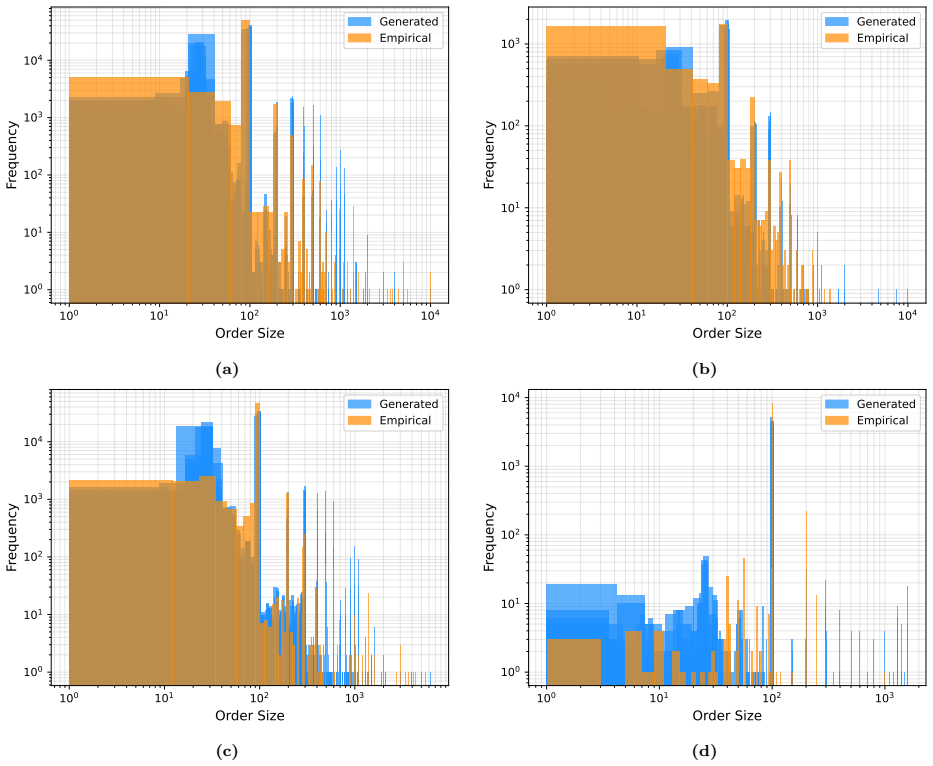
The central claim is that a GPT trained to predict the next token of a tokenized Nasdaq ITCH message stream generates 'highly realistic order flow' and, to the authors' knowledge, is the first study to validate many market stylized facts at the message scale. Acting as a conditional world agent inside a discrete event simulator, the model reproduces the distribution of message types, order sizes, and inter-arrival times; its generated mid-price returns show heavy tails (excess kurtosis about 4.9 vs. an empirical 2.4), volatility clustering, and power-law autocorrelation decay of absolute returns (DFA exponent α ≈ 0.73 vs. 0.64, Hurst exponent H ≈ 0.77 vs. 0.68), even though none of these properties appears in the loss function. The authors also claim that a dedicated sink token in the attention mechanism lets the model sustain realistic generation long after the original prompt has left the context window.
Load-bearing premise
The claim that the GPT itself generates realistic order flow rests on statistics computed after a rule-based error-correction pass that discards or rewrites roughly 7% of the model's messages; the paper does not show the raw, uncorrected output.
Editorial extensions
If this is right
- The model can produce long synthetic streams of limit-order-book messages that satisfy market stylized facts at message scale, making it a candidate data generator for training or stress-testing trading agents without exposing real order flow.
- Because the attention-sink streaming mechanism keeps the model fluent beyond its training context, whole trading days can be simulated from a short initial prompt rather than restarting the context.
- Including all price levels of the book (not just the top) lets the simulator represent cancellation dynamics and order-book imbalances, which the authors argue matters for periods such as flash crashes.
- The paper's platform is positioned as a first step toward interactive market simulators for ex-ante evaluation of market rules and for market-impact studies where a user trades against the world agent.
Reading between the lines
- The paper does not ablate the error-correction step, so a decisive test is to compare raw, uncorrected model samples against the corrected streams; if a large fraction of raw referential messages point to nonexistent orders, the rule-based correction, not the learned token distribution, is doing the load-bearing work for realism.
- The generated series overshoot the empirical heavy tails, volatility clustering, and spread/liquidity metrics, which suggests the model has learned price-change scaling without yet reproducing the order-book depth that gives rise to it; conditioning on a compact book state may reduce this bias.
- The need to hand-tune temperature and top-p per finetuned ticker, and the high inference cost of 24 tokens per message, mean the framework as presented is not yet a drop-in simulator for arbitrary assets; adaptive sampling and faster tokenization (or speculative decoding) would be natural extensions.
- The reported long-range dependence extending beyond the context window could also be probed by checking whether the persistence survives when the error-correction substitution is randomized; that would separate the model's learned dynamics from the simulator's book-keeping.
Editorial analysis
A structured set of objections, weighed in public.
Referee Report
Summary. The paper presents MarketGPT, a roughly 100M-parameter decoder-only transformer that generates limit-order-book messages from Nasdaq ITCH data inside a discrete event simulator. The authors tokenize order messages, pretrain on multiple tickers, fine-tune per ticker, and sample autoregressively with attention sinks and a rolling KV cache. Evaluation compares generated and empirical order flow via message-type frequencies, inter-arrival times, order-size distributions, return kurtosis, volatility clustering, DFA and Hurst exponents, and price/volume trajectories. The stated central claim is that the model generates highly realistic order flow and is the first to validate many stylized facts at message scale, including beyond the training context length.
Significance. If the attribution is established, this is a useful step toward bottom-up, token-level market simulation: the model operates on full LOB message flow, includes replace orders, uses all price levels, and demonstrates stable streaming inference beyond the trained context via attention sinks. The code is publicly available under an MIT license. The empirical fidelity results are plausible and several comparisons are carefully done. However, the paper's central claim is currently weakened by the unseparated effect of a hand-written error-correction filter, by hand-tuned sampling parameters, and by acknowledged large liquidity deviations; these issues must be resolved or the conclusions substantially softened.
major comments (3)
- [Discrete event simulator / Results] The evaluation does not isolate the GPT's raw sampled distribution from the post-correction message stream. The DES section states that messages failing error correction are discarded (~7%) and that, when the referenced price level exists but the order time or size is invalid, 'the first order in the priority queue of that price level' is substituted. All statistics reported in Figs. 3–8 are computed after this correction. The paper's own explanation for the add-vs-replace discrepancy ('Whenever this replace order placement error occurred, the message was discarded and it is likely that a limit order was placed next') demonstrates that the filter changes the message-type distribution. Therefore the central conclusion that 'our model generates highly realistic order flow' is not established: the realism may come from the hand-written rule rather than the learned token distribution. Please report the raw sampled output statistics and/or run an ablation with and without the error-correction filter, quantifying changes in message-type frequencies, order-size and inter-arrival distributions, and return statistics.
- [Results / Model Limitations] The sampling temperature (1.02) and top-p (0.98) were selected by trial and error to balance fidelity and rare-event generation, and the Model Limitations section concedes that the same parameters did not work for models fine-tuned on other tickers. Because these parameters directly control tail probabilities and message-type frequencies, the claim that the stylized facts emerge without being 'explicitly part of the loss function' is overstated unless the authors provide a sensitivity analysis or a principled, parameter-free inference rule. At minimum, the dependence of each reported stylized fact on temperature and top-p should be shown.
- [Results, Fig. 6] The generated limit order book shows substantially different average volume at the best bid and ask levels and a lower average spread; the authors call this 'arguably the most glaring issue' and attribute other statistical deviations to it. This is not a minor caveat: it directly affects the 'highly realistic order flow' claim, since the spread and depth are core LOB properties. The conclusions should be softened unless the authors can show that this liquidity mismatch does not materially inflate the reported agreement in message-type, order-size, and return statistics.
minor comments (5)
- [Abstract] The phrase 'in a steaming manner' should be 'in a streaming manner'.
- [Fig. 8 caption] The caption contains the typo 'ans' for 'and' in 'money ans shares exchanged'.
- [Materials and Methods] The PyTorch reference is a placeholder ('[ ? ]'); please supply the proper citation.
- [Fig. 5 caption] The caption says 'Data across all simulation trials (N=100)', while the rest of the paper reports N=10 simulation trials; please clarify which is correct.
- [Results and Discussion] The DFA and Hurst estimates for the empirical series are given without confidence intervals or estimation details, while the generated series reports mean ± SD; please provide comparable uncertainty measures for both.
Circularity Check
Reported realism is partly enforced by the DES error-correction filter; the raw GPT output is not isolated, so the central attribution of realistic order flow to the model itself is partially circular.
-
fitted input called prediction
[Discrete event simulator; Simulated order flow (Fig. 3a discussion)]
"If a message did not pass the error correction procedure, then the message was discarded and the simulator would re-run the timestep. This would occur for a relatively low number of messages (~7%). ... Whenever this replace order placement error occurred, the message was discarded and it is likely that a limit order was placed next (since it is the most abundant message type in the training data)—so this may explain why limit orders are placed more frequently at roughly the same frequency that replace orders are placed less."
All reported evaluation statistics (message-type frequencies, order-size and inter-arrival-time distributions, return kurtosis, volatility clustering, long-range dependence) are computed on the post-correction message stream, not on the transformer's raw sampled output. The error-correction procedure is a hand-coded input that discards or rewrites invalid referential messages, and the authors' own explanation shows it increases add frequencies and decreases replace frequencies. Thus the 'realistic order flow' attributed to the model is in part produced by this fixed rule, not by the learned token distribution.
full rationale
The paper does not contain a formal derivation chain with equations that could be circular by construction; no load-bearing self-citation chain, imported uniqueness theorem, or renamed known result is present. The only meaningful circularity concern is empirical: the GPT is embedded in a discrete event simulator whose error-correction step modifies roughly 7% of messages, and all validation statistics are computed after this correction. The authors explicitly link the add-versus-replace frequency discrepancy to this filter, showing that the filter changes the very message-type distribution used as evidence of model realism. Additionally, the sampling temperature (1.02) and top-p (0.98) were hand-tuned by trial and error to balance fidelity and rare-event generation, so some of the observed match to the target distribution is selected for rather than independently predicted. However, the heavy-tailed returns, volatility clustering, and long-range dependence emerge from the simulated book dynamics rather than being directly hard-coded by the correction rule, so the model still contributes independent content. The finding is a partial attribution gap, not a full by-construction equivalence, hence a moderate score of 3.
Assumptions & free parameters
free parameters (7)
- temperature (sampling) =
1.02
- top-p (nucleus sampling) =
0.98
- inference context length =
L = 2,688 messages
- relative price truncation =
999 ticks from mid-price
- order size truncation =
9,999 shares
- error correction filter =
approximately 7% of messages discarded/rewritten
- architecture hyperparameters (12 layers, 12 heads, 768 embedding dims) =
12/12/768
assumptions (6)
- domain assumption The Nasdaq TotalView-ITCH 5.0 message feed, after preprocessing, contains all information needed to reconstruct the limit order book faithfully enough for evaluating stylized facts.
- domain assumption Tokenizing message fields into discrete vocabularies (price as ticks from mid-price, inter-arrival times, sizes) preserves the statistical properties of order flow.
- domain assumption An autoregressive transformer trained with next-token cross-entropy can learn the conditional message distribution sufficiently to generate coherent order flow.
- domain assumption The stylized facts used (heavy tails, volatility clustering, long-range dependence) are sufficient and appropriate measures of 'realistic order flow'.
- domain assumption Attention sinks plus a rolling KV cache allow valid generation beyond the training context length.
- standard math Standard probabilistic and optimization background (softmax, cross-entropy, Adam) is valid.
Cite this review
Pith. "Pith review of MarketGPT: Developing a Pre-trained transformer (GPT) for Modeling Financial Time Series." pith.science (2026). https://pith.science/paper/MSFG4JLZ
@misc{pith2026241116585,
  author       = {Pith},
  title        = {Pith review of: MarketGPT: Developing a Pre-trained transformer (GPT) for Modeling Financial Time Series},
  year         = {2026},
  howpublished = {\url{https://pith.science/paper/MSFG4JLZ}},
  note         = {Machine review of arXiv:2411.16585}
}
read the original abstract
This work presents a generative pre-trained transformer (GPT) designed for modeling financial time series. The GPT functions as an order generation engine within a discrete event simulator, enabling realistic replication of limit order book dynamics. Our model leverages recent advancements in large language models to produce long sequences of order messages in a steaming manner. Our results demonstrate that the model successfully reproduces key features of order flow data, even when the initial order flow prompt is no longer present within the model's context window. Moreover, evaluations reveal that the model captures several statistical properties, or 'stylized facts', characteristic of real financial markets and broader macro-scale data distributions. Collectively, this work marks a significant step toward creating high-fidelity, interactive market simulations.
Figures


Figures from the paper (5 more)



Forward citations
Cited by 1 Pith paper
-
Prospects of Imitating Trading Agents in the Stock Market
A state-space generative model trained on synthetic limit order book data can partially imitate trading agent behavior, matching some action distributions while underestimating cancellations, with results limited by h...
Reference graph
Works this paper leans on
-
[1]
Journal of Financial Economics 7: 229–263
Cox JC, Ross SA, Rubinstein M (1979) Option pricing: A simplified approach. Journal of Financial Economics 7: 229–263
work page 1979
-
[2]
Journal of Economic Perspectives 15: 157–168
Engle R (2001) GARCH 101: The use of ARCH/GARCH models in applied economet- rics. Journal of Economic Perspectives 15: 157–168
work page 2001
-
[3]
In: Time Series and Statistics, Palgrave Macmil- lan UK
Harvey AC (1990) ARIMA models. In: Time Series and Statistics, Palgrave Macmil- lan UK. pp. 22–24. doi:10.1007/978-1-349-20865-4 2. URL https://doi.org/10.1007/ 978-1-349-20865-4 2
-
[4]
Journal of Economic Perspectives 15: 101–115
Stock JH, Watson MW (2001) Vector autoregressions. Journal of Economic Perspectives 15: 101–115
work page 2001
-
[5]
Journal of Political Economy 81: 637–654
Black F, Scholes M (1973) The pricing of options and corporate liabilities. Journal of Political Economy 81: 637–654
work page 1973
-
[6]
(2014) Gener- ative adversarial nets
Goodfellow IJ, Pouget-Abadie J, Mirza M, Xu B, Warde-Farley D, et al. (2014) Gener- ative adversarial nets. In: Proceedings of the 27th International Conference on Neural Information Processing Systems - Volume 2. Cambridge, MA, USA: MIT Press, NIPS’14, pp. 2672–2680
work page 2014
-
[7]
Generative adversarial networks in finance: an overview
Eckerli F, Osterrieder J (2021). Generative adversarial networks in finance: an overview. doi:10.48550/ARXIV.2106.06364. URL https://arxiv.org/abs/2106.06364
-
[8]
In: Proceedings of the 2020 ACM SIGSIM Conference on Principles of Advanced Discrete Simulation
Byrd D, Hybinette M, Balch TH (2020) Abides: Towards high-fidelity multi-agent mar- ket simulation. In: Proceedings of the 2020 ACM SIGSIM Conference on Principles of Advanced Discrete Simulation. ACM, SIGSIM-PADS ’20. doi:10.1145/3384441.3395986. URL http://dx.doi.org/10.1145/3384441.3395986
arXiv 2020
Show all 57 references
-
[9]
Computational Economics
Lussange J, Vrizzi S, Bourgeois-Gironde S, Palminteri S, Gutkin B (2022) Stock price formation: Precepts from a multi-agent reinforcement learning model. Computational Economics
2022
- [10]
- [11]
- [12]
-
[13]
Quantitative Finance 23: 931–958
Hultin H, Hult H, Proutiere A, Samama S, Tarighati A (2023) A generative model of a limit order book using recurrent neural networks. Quantitative Finance 23: 931–958
2023
-
[15]
In: Proceedings of the 14th conference on Computational linguistics -
Webster JJ, Kit C (1992) Tokenization as the initial phase in nlp. In: Proceedings of the 14th conference on Computational linguistics -. Association for Computational Lin- 14 guistics. doi:10.3115/992424.992434. URL http://dx.doi.org/10.3115/992424.992434
1992
-
[16]
(2017) Attention is all you need
Vaswani A, Shazeer N, Parmar N, Uszkoreit J, Jones L, et al. (2017) Attention is all you need. In: Proceedings of the 31st International Conference on Neural Information Processing Systems. Red Hook, NY, USA: Curran Associates Inc., NIPS’17, pp. 6000– 6010
2017
-
[17]
Quantitative Finance 1: 223–236
Cont R (2001) Empirical properties of asset returns: stylized facts and statistical issues. Quantitative Finance 1: 223–236
2001
-
[18]
empir- ical facts
Chakraborti A, Toke IM, Patriarca M, Abergel F (2011) Econophysics review: I. empir- ical facts. Quantitative Finance 11: 991–1012
2011
-
[19]
(2013) Limit order books
Gould MD, Porter MA, Williams S, McDonald M, Fenn DJ, et al. (2013) Limit order books. Quantitative Finance 13: 1709–1742
2013
-
[20]
(2020) Get real: realism metrics for robust limit order book market simulations
Vyetrenko S, Byrd D, Petosa N, Mahfouz M, Dervovic D, et al. (2020) Get real: realism metrics for robust limit order book market simulations. In: Proceedings of the First ACM International Conference on AI in Finance. ACM, ICAIF ’20. doi:10.1145/3383455. 3422561. URL http://dx...
2020
-
[21]
martinobdl/itch: Itch50converter
Bernasconi-De-Luca M, Fusco L, Dragi´ c O (2021). martinobdl/itch: Itch50converter. doi:10.5281/ZENODO.5209267. URL https://zenodo.org/record/5209267
2021
-
[23]
In: 4th ACM International Conference on AI in Finance
Coletta A, Jerome J, Savani R, Vyetrenko S (2023) Conditional generators for limit order book environments: Explainability, challenges, and robustness. In: 4th ACM International Conference on AI in Finance. ACM, ICAIF ’23. doi:10.1145/3604237. 3626854. URL http://dx.doi.org/10...
2023
-
[24]
SSRN Electronic Journal
Hautsch N, Huang R (2011) Limit order flow, market impact and optimal order sizes: Evidence from nasdaq totalview-itch data. SSRN Electronic Journal
2011
-
[25]
SSRN Electronic Journal
Huang R, Polak T (2011) Lobster: Limit order book reconstruction system. SSRN Electronic Journal
2011
- [26]
- [27]
- [28]
-
[29]
J Mach Learn Res 13: 281–305
Bergstra J, Bengio Y (2012) Random search for hyper-parameter optimization. J Mach Learn Res 13: 281–305
2012
-
[30]
In: Ad- vances in Neural Information Processing Systems 32
Zhang B, Sennrich R (2019) Root Mean Square Layer Normalization. In: Ad- vances in Neural Information Processing Systems 32. Vancouver, Canada. URL https: //openreview.net/references/pdf?id=S1qBAf6rr
2019
- [31]
- [32]
- [33]
-
[34]
In: International Conference on Learning Represen- tations
Press O, Smith N, Lewis M (2022) Train short, test long: Attention with linear biases enables input length extrapolation. In: International Conference on Learning Represen- tations. URL https://openreview.net/forum?id=R8sQPpGCv0
2022
- [35]
- [36]
- [37]
-
[38]
In: Gurevych I, Miyao Y, editors, Proceedings of the 56th Annual Meeting of the Association for Computational Linguistics (Volume 1: Long Papers)
Fan A, Lewis M, Dauphin Y (2018) Hierarchical neural story generation. In: Gurevych I, Miyao Y, editors, Proceedings of the 56th Annual Meeting of the Association for Computational Linguistics (Volume 1: Long Papers). Melbourne, Australia: Association for Computational Linguis...
2018 doi
-
[39]
In: International Conference on Learning Representations
Holtzman A, Buys J, Du L, Forbes M, Choi Y (2020) The curious case of neural text degeneration. In: International Conference on Learning Representations. URL https: //openreview.net/forum?id=rygGQyrFvH
2020
-
[40]
(2021) Abides-gym: gym environments for multi-agent discrete event simulation and application to financial markets
Amrouni S, Moulin A, Vann J, Vyetrenko S, Balch T, et al. (2021) Abides-gym: gym environments for multi-agent discrete event simulation and application to financial markets. In: Proceedings of the Second ACM International Conference on AI in Fi- nance. ACM, ICAIF’21. doi:10.11...
2021
-
[41]
Physica A: Statistical Mechanics and its Applications 300: 285–299
Challet D, Stinchcombe R (2001) Analyzing and modeling 1+1d markets. Physica A: Statistical Mechanics and its Applications 300: 285–299
2001
-
[42]
The Journal of Business 36: 394
Mandelbrot B (1963) The variation of certain speculative prices. The Journal of Business 36: 394
1963
-
[43]
In: Fractals in Engineering, Springer-Verlag
Cont R Long range dependence in financial markets. In: Fractals in Engineering, Springer-Verlag. pp. 159–179. doi:10.1007/1-84628-048-6 11. URL https://doi.org/10. 1007/1-84628-048-6 11
-
[44]
(1994) Mosaic organi- zation of dna nucleotides
Peng CK, Buldyrev SV, Havlin S, Simons M, Stanley HE, et al. (1994) Mosaic organi- zation of dna nucleotides. Physical Review E 49: 1685–1689
1994
-
[45]
(2012) Detrended 16 fluctuation analysis: A scale-free view on neuronal oscillations
Hardstone R, Poil SS, Schiavone G, Jansen R, Nikulin VV, et al. (2012) Detrended 16 fluctuation analysis: A scale-free view on neuronal oscillations. Frontiers in Physiology 3
2012
-
[46]
(1995) Long- range correlation properties of coding and noncoding dna sequences: Genbank analysis
Buldyrev SV, Goldberger AL, Havlin S, Mantegna RN, Matsa ME, et al. (1995) Long- range correlation properties of coding and noncoding dna sequences: Genbank analysis. Physical Review E 51: 5084–5091
1995
-
[47]
SSRN Electronic Journal
Cont R, Potters M, Bouchaud JP (1997) Scaling in stock market data: Stable laws and beyond. SSRN Electronic Journal
1997
-
[48]
Physica A: Statistical Mechanics and its Applications 245: 437–440
Liu Y, Cizeau P, Meyer M, Peng CK, Eugene Stanley H (1997) Correlations in economic time series. Physica A: Statistical Mechanics and its Applications 245: 437–440
1997
-
[49]
Physical Review E 60: 5305– 5316
Gopikrishnan P, Plerou V, Amaral LAN, Meyer M, Stanley HE (1999) Scaling of the distribution of fluctuations of financial market indices. Physical Review E 60: 5305– 5316
1999
-
[50]
Transactions of the American Society of Civil Engineers 116: 770–799
Hurst HE (1951) Long-term storage capacity of reservoirs. Transactions of the American Society of Civil Engineers 116: 770–799
1951
-
[51]
Biometrika 63: 111–116
ANNIS AA, LLOYD EH (1976) The expected value of the adjusted rescaled hurst range of independent normal summands. Biometrika 63: 111–116
1976
-
[52]
In: Econometrica
Mandelbrot B (1971) Analysis of long-run dependence in economics-r/s technique. In: Econometrica. WILEY-BLACKWELL 111 RIVER ST, HOBOKEN 07030-5774, NJ USA, volume 39, pp. 68–+
1971
- [53]
- [54]
- [55]
- [56]
- [57]
- [58]
- [59]
Reviewed August 12, 2026 · model on record in the stance chip above.
Discussion (0). Continue with ORCID to comment.