REVIEW 3 major objections 5 minor 63 references
Amplifying Minority Voices: AI-Mediated Devil's Advocate System for Inclusive Group Decision-Making
T0 review · 3 major / 5 minor · reviewed 2026-08-08 · deepseek-v4-flash
Pith's one-line read This paper proposes an AI devil's advocate that restates minority members' dissenting views as its own so the group can engage with the idea without exposing the member to social pressure.
desk verdict A clear design proposal with an untested core mechanism; the effectiveness claims outrun the evidence, but the system and taxonomy are worth discussing. read the letter →
The pith
A machine-rendered reading of the paper's core claim, the machinery that carries it, and where it could break.
The reading
What carries the argument
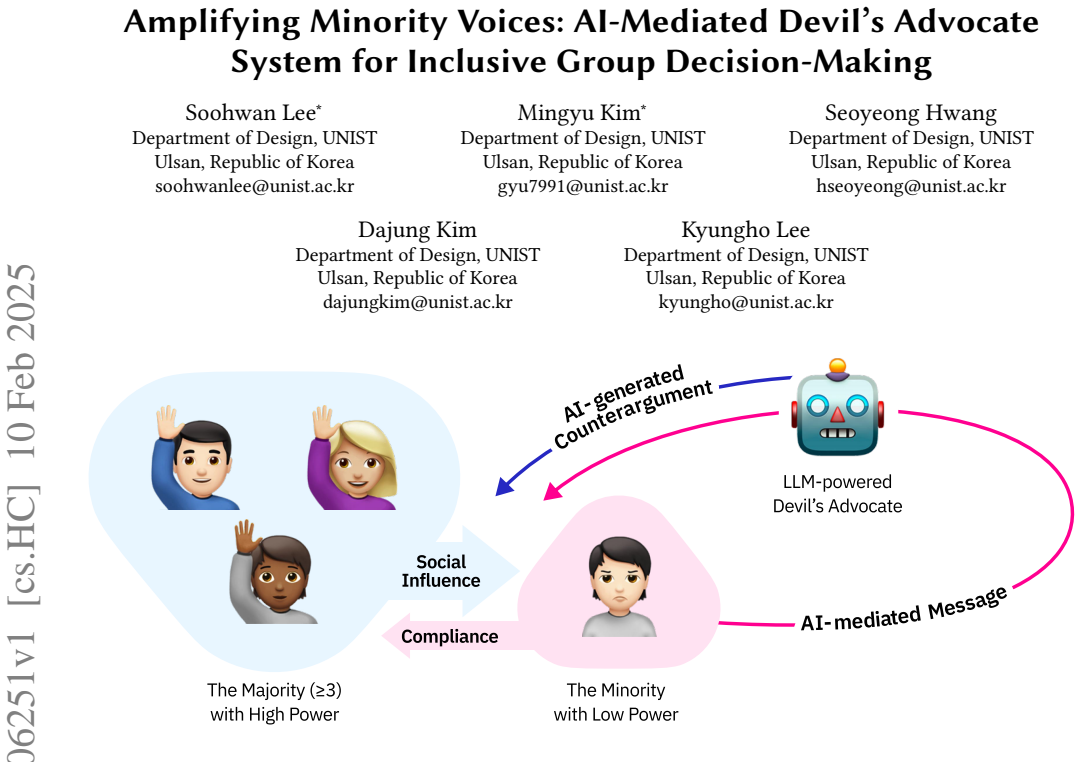
The load-bearing object is the Paraphrase Agent, one of four cooperating agents on the server: the Summary Agent condenses public opinion to compensate for LLM limits on long context; the Paraphrase Agent responds only to private DMs, rewrites the dissenting view as if the AI itself held it, and marks the DM as used so the same view is not aired twice; the Conversation Agent offers empathetic, Socratic counterarguments; and the AI Duplicate Checker uses cosine similarity between sentence embeddings to suppress repeated messages. The design leans on the idea that computers are treated as social actors, so the group can accept the AI as an independent voice, and the AI intervenes roughly once every eight human turns.
What would settle it
Run a controlled group-decision experiment with three conditions: unmediated chat, a human-assigned devil's advocate, and this system. If the system condition shows that the minority member judges the paraphrased message as distorted, that group members correctly guess which participant is feeding the AI, or that minority dissent and self-reported psychological safety do not rise above the human devil's advocate condition, the claimed mechanism fails.
Extended reading notes
Core claim
The central claim is that an AI can absorb the social cost of dissent. By having the paraphrase agent rearticulate a minority member's direct-message content as system-generated text, the system uncouples the idea from its human source; the group can then evaluate the idea on its merits while the minority member watches safely. The paper further claims that this reduces compliance, mitigates bias, and fosters critical discussion, and that the multi-agent arrangement of summary, conversation, paraphrase, and duplicate-checking makes the AI an effective participant rather than a repetitive intruder.
Load-bearing premise
The entire mechanism depends on the paraphrase agent faithfully preserving the minority member's intended meaning while the group perceives the AI as the source and not as a mouthpiece for a hidden participant.
Editorial extensions
If this is right
- If the system works as proposed, minority members should express dissenting views more often because the social cost of the AI's messages falls on the AI, not on them.
- Groups should assess the paraphrased arguments on their substance, since identity markers and status cues are stripped away.
- The multi-agent pipeline should keep the AI coherent over long conversations and avoid repeating itself, preventing the fatigue that kills adversarial input.
- The design offers an updated form of the devil's advocate technique in which no human teammate has to risk their standing to raise the counterargument.
Reading between the lines
- The paper leaves implicit that a test of this design could compare conditions with and without telling the group the AI is relaying a human member's view; if transparency destroys the safety benefit, anonymity is the active ingredient.
- One testable extension is to audit paraphrase fidelity by having the minority member rate whether each AI-aired message preserves their intended point before any psychological-safety measure is trusted.
- A further extension would apply the architecture to other power-imbalanced settings, such as medical rounds or community planning, where the same anonymity mechanism could surface unpopular expertise.
- A longer-term question the paper does not address is whether minorities who rely on the AI intermediary grow less able or willing to advocate directly, so the benefit might decay once the system is removed.
Editorial analysis
A structured set of objections, weighed in public.
Referee Report
Summary. The paper proposes an AI-mediated devil's advocate system intended to amplify minority voices in power-imbalanced group decision-making. Minority members privately send dissenting views via direct message to an LLM-powered agent, which paraphrases and presents them as system-generated messages. The architecture comprises a summary agent, a paraphrase agent, a conversation agent, and an AI duplicate checker. The manuscript claims that this design increases psychological safety, mitigates bias, and fosters critical discussion, but it contains no user study, baseline comparison, or measurement of these outcomes. It is best read as a design/position paper with candid limitations.
Significance. The problem is important and timely, and the architecture usefully synthesizes prior work on AI-mediated communication, the computers-are-social-actors paradigm, and devil's advocacy. The four-pattern taxonomy in Figure 2 and the explicit design rationale (persuasive style, Socratic questioning, non-repetition) provide a clear starting point for building such a system. The paper is also honest about its limitations. However, the central effect claims are unvalidated, and the two load-bearing assumptions—paraphrase fidelity and perceived AI authorship—are neither tested nor supported by prior evidence. If these assumptions were tested and held, the approach would be a meaningful contribution to inclusive group decision-making; as written, the contribution is a plausible design proposal rather than a demonstrated mechanism.
major comments (3)
- [Abstract; §1; Figure 1 caption] The central claim that the system 'increases psychological safety, mitigates bias, and fosters critical discussion' is asserted without empirical support. No user study, baseline comparison, or measurement of these constructs appears anywhere in the manuscript. Section 4 itself concedes that 'amplifying minority opinions without proper validation may introduce new biases,' which undercuts the causal phrasing used in the Abstract and Figure 1. The authors should either provide an evaluation of these outcomes or explicitly reframe the Abstract, Section 1, and the Figure 1 caption as design goals or hypotheses rather than demonstrated effects.
- [§3, Paraphrase Agent] The core mechanism depends on two untested assumptions: that the Paraphrase Agent preserves the minority member's intended meaning when it 'rearticulat[es] dissenting views as though originating from the AI itself,' and that group members perceive the message as AI-generated rather than as a mouthpiece for a hidden participant. The manuscript cites Hohenstein et al. [14] in related work, and that line of research suggests AI-mediated messages are often attributed, at least in part, to the human communicator, which would undermine the anonymity premise. Even a small pilot study measuring paraphrase fidelity and source attribution would substantially strengthen the paper.
- [§3, intervention timing] The system is designed to 'intervene once after approximately eight human turns,' but no rationale, sensitivity analysis, or exact protocol is provided for this free parameter. Because the timing of AI interventions directly shapes whether the system can 'foster critical discussion' without disrupting group flow, this parameter needs justification or robustness testing. The paper should also specify whether the count includes AI messages and how 'approximately' is operationalized.
minor comments (5)
- [§1] The phrase 'this thesis proposes' should be 'this paper proposes' or 'this work proposes.'
- [Abstract] The word 'prequel' is unusual in this context; the authors likely mean 'paper' or 'work.'
- [§3] The AI Duplicate Checker uses cosine similarity with the 'paraphrase-multilingual-MiniLM-L12-v2' model, but no similarity threshold is specified, leaving the non-repetition mechanism underspecified.
- [§2.1 and References] Reference [5] has the nearly identical title 'Enhancing AI-Assisted Group Decision Making through LLM-Powered Devil's Advocate'; the authors should state explicitly what is new in their system relative to that prior work (apparently the anonymous DM channel and paraphrase agent).
- [References] Reference [24] is a URL-only citation with no author or title information; several other references mix arXiv identifiers and DOIs inconsistently.
Circularity Check
No circularity: the paper presents an untested system proposal with no derivation chain, fitted parameters, or load-bearing self-citations.
full rationale
The manuscript is a system design proposal rather than a derivation or empirical validation. Its central claim that hiding minority identities behind an LLM devil's advocate increases psychological safety is an assertion about a proposed mechanism, not a result derived from inputs that already contain it. There are no equations, no fitted parameters, and no prediction validated against data. The design choices (Summary Agent, Paraphrase Agent, Conversation Agent, AI Duplicate Checker) are described as motivated by prior literature, not as conclusions forced by the paper's own assumptions. The external citations, including the CASA reference to computers as social actors and the 'lost in the middle' LLM context reference, do not form a self-citation chain, and no cited work overlaps with the authors' identities. The limitations section explicitly concedes that 'amplifying minority opinions without proper validation may introduce new biases' and calls for future empirical studies, so the safety and inclusiveness benefits are framed as goals to be tested rather than demonstrated outcomes. Concern that the mechanism's effectiveness is unvalidated is an empirical-support or soundness issue, not circularity.
Assumptions & free parameters
free parameters (1)
- AI intervention interval =
approximately 8 human turns
assumptions (5)
- domain assumption Anonymity in text-based communication increases psychological safety and reduces social influence in group discussions.
- ad hoc to paper An LLM can paraphrase a minority member's private dissenting view into a system-generated message without distorting the intended meaning.
- domain assumption The group will treat the AI devil's advocate as an independent social actor rather than as a mouthpiece for a hidden member.
- domain assumption Socratic-style empathetic counterarguments stimulate critical thinking without causing frustration or over-reliance.
- ad hoc to paper Intervening once every eight human turns is a reasonable pacing mechanism.
invented entities (1)
-
LLM-powered Devil's Advocate agent
Cite this review
Pith. "Pith review of Amplifying Minority Voices: AI-Mediated Devil's Advocate System for Inclusive Group Decision-Making." pith.science (2026). https://pith.science/paper/MSGIOHUG
@misc{pith2026250206251,
  author       = {Pith},
  title        = {Pith review of: Amplifying Minority Voices: AI-Mediated Devil's Advocate System for Inclusive Group Decision-Making},
  year         = {2026},
  howpublished = {\url{https://pith.science/paper/MSGIOHUG}},
  note         = {Machine review of arXiv:2502.06251}
}
read the original abstract
Group decision-making often benefits from diverse perspectives, yet power imbalances and social influence can stifle minority opinions and compromise outcomes. This prequel introduces an AI-mediated communication system that leverages the Large Language Model to serve as a devil's advocate, representing underrepresented viewpoints without exposing minority members' identities. Rooted in persuasive communication strategies and anonymity, the system aims to improve psychological safety and foster more inclusive decision-making. Our multi-agent architecture, which consists of a summary agent, conversation agent, AI duplicate checker, and paraphrase agent, encourages the group's critical thinking while reducing repetitive outputs. We acknowledge that reliance on text-based communication and fixed intervention timings may limit adaptability, indicating pathways for refinement. By focusing on the representation of minority viewpoints anonymously in power-imbalanced settings, this approach highlights how AI-driven methods can evolve to support more divergent and inclusive group decision-making.
Figures


Reference graph
Works this paper leans on
-
[14]
Kizilcec, Dominic DiFranzo, Zhila Aghajari, Hannah Mieczkowski, Karen Levy, Mor Naaman, Jeffrey Hancock, and Malte F
Jess Hohenstein, Rene F. Kizilcec, Dominic DiFranzo, Zhila Aghajari, Hannah Mieczkowski, Karen Levy, Mor Naaman, Jeffrey Hancock, and Malte F. Jung
-
[1]
Solomon E. Asch. 1955. Opinions and Social Pressure. https://www.scientificamerican.com/article/opinions-and-social-pressure/
work page 1955
-
[2]
Carolyn Brahm and Brian H. Kleiner. 1996. Advantages and Disadvantages of Group Decision- Making Approaches. Team Performance Management: An International Journal 2, 1 (Jan. 1996), 30–35. doi:10.1108/13527599610105538
-
[3]
Zana Buçinca, Maja Barbara Malaya, and Krzysztof Z. Gajos. 2021. To Trust or to Think: Cognitive Forcing Functions Can Reduce Overreliance on AI in AI-assisted Decision-making. Proceedings of the ACM on Human-Computer Interaction 5, CSCW1 (April 2021), 188:1–188:21. doi:10.1145/3449287
doi:10.1145/3449287 2021
-
[4]
Chun-Wei Chiang, Zhuoran Lu, Zhuoyan Li, and Ming Yin. 2023. Are Two Heads Better Than One in AI-Assisted Decision Making? Comparing the Behavior and Performance of Groups and Individuals in Human-AI Collaborative Recidivism Risk Assessment. In Proceedings of the 2023 CHI Conference on Human Factors in Computing Systems (CHI ’23) . Association for Computi...
arXiv 2023
-
[5]
Chun-Wei Chiang, Zhuoran Lu, Zhuoyan Li, and Ming Yin. 2024. Enhancing AI-Assisted Group Decision Making through LLM-Powered Devil’s Advocate. In Proceedings of the 29th International Conference on Intelligent User Interfaces (IUI ’24). Association for Computing Machinery, New York, NY, USA, 103–119. doi:10.1145/3640543.3645199
arXiv 2024
-
[6]
Valdemar Danry, Pat Pataranutaporn, Yaoli Mao, and Pattie Maes. 2023. Don’t Just Tell Me, Ask Me: AI Systems That Intelligently Frame Explanations as Questions Improve Human Logical Discernment Accuracy over Causal AI Explanations. In Proceedings of the 2023 CHI Conference on Human Factors in Computing Systems (CHI ’23) . Association for Computing Machine...
arXiv 2023
-
[7]
Maira Gatti de Bayser, Paulo Cavalin, Claudio Pinhanez, and Bianca Zadrozny
Show all 63 references
-
[8]
Hyo Jin Do, Ha-Kyung Kong, Jaewook Lee, and Brian P. Bailey. 2022. How Should the Agent Communicate to the Group? Communication Strategies of a Conversational Agent in Group Chat Discussions. Proceedings of the ACM on Human-Computer Interaction 6, CSCW2 (Nov. 2022), 387:1–387:...
2022
-
[9]
Erik Ekstedt and Gabriel Skantze. 2020. TurnGPT: A Transformer-based Language Model for Predicting Turn-taking in Spoken Dialog. InFindings of the Association for Computational Linguistics: EMNLP 2020 . 2981–2990. doi:10.18653/v1/2020. findings-emnlp.268 arXiv:2010.10874 [cs]
2020 arXiv
-
[10]
Donelson R. Forsyth. 2018. Group Dynamics. Cengage Learning
2018
-
[11]
Glick and Kelley Staley
Jill C. Glick and Kelley Staley. 2007. Inflicted Traumatic Brain Injury: Advances in Evaluation and Collaborative Diagnosis. Pediatric Neurosurgery 43, 5 (Sept. 2007), 436–441. doi:10.1159/000106400
2007 doi
-
[12]
Jeffrey T Hancock, Mor Naaman, and Karen Levy. 2020. AI-Mediated Commu- nication: Definition, Research Agenda, and Ethical Considerations. Journal of Computer-Mediated Communication 25, 1 (March 2020), 89–100. doi:10.1093/ jcmc/zmz022
2020
-
[13]
Geert Hofstede. 2011. Dimensionalizing Cultures: The Hofstede Model in Context. Online Readings in Psychology and Culture 2, 1 (Dec. 2011). doi:10.9707/2307- 0919.1014
2011
-
[15]
Ross, Dario Andres Silva Moran, Gabriel Enrique Gonzalez, Siya Kunde, Morgan A
Stephanie Houde, Kristina Brimijoin, Michael Muller, Steven I. Ross, Dario Andres Silva Moran, Gabriel Enrique Gonzalez, Siya Kunde, Morgan A. Fore- man, and Justin D. Weisz. 2025. Controlling AI Agent Participation in Group Conversations: A Human-Centered Approach. doi:10.114...
2025
-
[16]
Cheng-Ju Hsieh, Mario Fifić, and Cheng-Ta Yang. 2020. A New Measure of Group Decision-Making Efficiency. Cognitive Research: Principles and Implications 5, 1 (Sept. 2020), 45. doi:10.1186/s41235-020-00244-3
2020 doi
-
[17]
Wan-Chi Jackie Hsu, James J. H. Liou, and Huai-Wei Lo. 2021. A Group Decision- Making Approach for Exploring Trends in the Development of the Healthcare Industry in Taiwan. Decision Support Systems 141 (Feb. 2021), 113447. doi:10. 1016/j.dss.2020.113447
2021
-
[18]
Angel Hsing-Chi Hwang and Andrea Stevenson Won. 2024. The Sound of Support: Gendered Voice Agent as Support to Minority Teammates in Gender-Imbalanced Team. In Proceedings of the CHI Conference on Human Factors in Computing Systems (CHI ’24). Association for Computing Machiner...
2024
-
[19]
Jamieson, Piercarlo Valdesolo, and Brett J
Jeremy P. Jamieson, Piercarlo Valdesolo, and Brett J. Peters. 2014. Sympathy for the Devil? The Physiological and Psychological Effects of Being an Agent (and Target) of Dissent during Intragroup Conflict. Journal of Experimental Social Psychology 55 (Nov. 2014), 221–227. doi:...
2014 doi
-
[20]
Irving L. Janis. 1972.Victims of Groupthink: A Psychological Study of Foreign-Policy Decisions and Fiascoes. Houghton Mifflin, Oxford, England. viii, 277 pages
1972
-
[21]
(Irving Lester) Janis
Irving L. (Irving Lester) Janis. 1982. Groupthink : Psychological Studies of Policy Decisions and Fiascoes. Boston : Houghton Mifflin
1982
-
[22]
Herbert C. Kelman. 1958. Compliance, Identification, and Internalization Three Processes of Attitude Change. Journal of Conflict Resolution 2, 1 (March 1958), 51–60. doi:10.1177/002200275800200106
1958 doi
-
[23]
Soomin Kim, Jinsu Eun, Changhoon Oh, Bongwon Suh, and Joonhwan Lee. 2020. Bot in the Bunch: Facilitating Group Chat Discussion by Improving Efficiency and Participation with a Chatbot. In Proceedings of the 2020 CHI Conference on Human Factors in Computing Systems (CHI ’20) . ...
2020
-
[24]
Vera Liao, Alison Smith-Renner, and Chenhao Tan
Vivian Lai, Chacha Chen, Q. Vera Liao, Alison Smith-Renner, and Chenhao Tan
-
[25]
Eun-Ju Lee. 2008. Social Identity Model of Deindividuation Effects: Theoretical Implications and Future Directions. Communication Theories 4, 1 (June 2008), 7–31
2008
-
[26]
Shyam Sundar
Q.Vera Liao and S. Shyam Sundar. 2022. Designing for Responsible Trust in AI Systems: A Communication Perspective. In Proceedings of the 2022 ACM Conference on Fairness, Accountability, and Transparency (FAccT ’22) . Association for Computing Machinery, New York, NY, USA, 1257...
2022 doi
-
[27]
Liu, Kevin Lin, John Hewitt, Ashwin Paranjape, Michele Bevilacqua, Fabio Petroni, and Percy Liang
Nelson F. Liu, Kevin Lin, John Hewitt, Ashwin Paranjape, Michele Bevilacqua, Fabio Petroni, and Percy Liang. 2023. Lost in the Middle: How Language Models Use Long Contexts. doi:10.48550/arXiv.2307.03172 arXiv:2307.03172 [cs] Amplifying Minority Voices: AI-Mediated Devil’s Adv...
- [28]
-
[29]
Keyu Lu and Huchang Liao. 2022. A Survey of Group Decision Making Methods in Healthcare Industry 4.0: Bibliometrics, Applications, and Directions. Applied Intelligence (Dordrecht, Netherlands) 52, 12 (2022), 13689–13713. doi:10.1007/ s10489-021-02909-y
2022
- [30]
-
[31]
Colin MacDougall and Frances Baum. 1997. The Devil’s Advocate: A Strategy to Avoid Groupthink and Stimulate Discussion in Focus Groups. Qualitative Health Research 7, 4 (Nov. 1997), 532–541. doi:10.1177/104973239700700407
1997 doi
-
[32]
Budescu, and Patrick Bernau
Boris Maciejovsky, Matthias Sutter, David V. Budescu, and Patrick Bernau. 2013. Teams Make You Smarter: How Exposure to Teams Improves Individual Decisions in Probability and Reasoning Tasks. Management Science 59, 6 (June 2013), 1255–
2013
-
[33]
Richard O. Mason. 1969. A Dialectical Approach to Strategic Planning. Manage- ment Science 15, 8 (April 1969), B–403. doi:10.1287/mnsc.15.8.B403
1969 doi
-
[34]
Hancock, Mor Naaman, Malte Jung, and Jess Hohenstein
Hannah Mieczkowski, Jeffrey T. Hancock, Mor Naaman, Malte Jung, and Jess Hohenstein. 2021. AI-Mediated Communication: Language Use and Interpersonal Effects in a Referential Communication Task. Proc. ACM Hum.-Comput. Interact. 5, CSCW1 (April 2021), 17:1–17:14. doi:10.1145/3449091
2021 doi
-
[35]
Federico Milana, Enrico Costanza, and Joel E Fischer. 2023. Chatbots as Advisers: The Effects of Response Variability and Reply Suggestion Buttons. In Proceedings of the 5th International Conference on Conversational User Interfaces (CUI ’23) . Association for Computing Machin...
2023
-
[36]
Serge Moscovici and Elisabeth Lage. 1976. Studies in Social Influence III: Majority versus Minority Influence in a Group. European Journal of Social Psychology 6, 2 (1976), 149–174. doi:10.1002/ejsp.2420060202
1976 doi
-
[37]
Clifford Nass, Jonathan Steuer, and Ellen R. Tauber. 1994. Computers Are Social Actors. In Proceedings of the SIGCHI Conference on Human Factors in Computing Systems (CHI ’94). Association for Computing Machinery, New York, NY, USA, 72–78. doi:10.1145/191666.191703
1994
- [38]
-
[39]
Charlan Nemeth, Keith Brown, and John Rogers. 2001. Devil’s Advocate versus Authentic Dissent: Stimulating Quantity and Quality. European Journal of Social Psychology 31, 6 (2001), 707–720. doi:10.1002/ejsp.58
2001 doi
-
[40]
Ritika Poddar, Rashmi Sinha, Mor Naaman, and Maurice Jakesch. 2023. AI Writing Assistants Influence Topic Choice in Self-Presentation. In Extended Abstracts of the 2023 CHI Conference on Human Factors in Computing Systems (CHI EA ’23) . Association for Computing Machinery, New...
2023
-
[41]
I Can’t Reply with That
Ronald E Robertson, Alexandra Olteanu, Fernando Diaz, Milad Shokouhi, and Peter Bailey. 2021. “I Can’t Reply with That”: Characterizing Problematic Email Reply Suggestions. In Proceedings of the 2021 CHI Conference on Human Factors in Computing Systems (CHI ’21) . Association ...
2021
-
[42]
Stefan Schulz-Hardt, Marc Jochims, and Dieter Frey. 2002. Productive Conflict in Group Decision Making: Genuine and Contrived Dissent as Strategies to Counteract Biased Information Seeking. Organizational Behavior and Human Decision Processes 88, 2 (July 2002), 563–586. doi:10...
2002 doi
-
[43]
Schweiger, William R
David M. Schweiger, William R. Sandberg, and James W. Ragan. 1986. Group Approaches for Improving Strategic Decision Making: A Comparative Analysis of Dialectical Inquiry, Devil’s Advocacy, and Consensus. Academy of Management Journal 29, 1 (March 1986), 51–71. doi:10.5465/255859
1986 doi
-
[44]
Valacich
Charles Schwenk and Joseph S. Valacich. 1994. Effects of Devil′s Advocacy and Dialectical Inquiry on Individuals versus Groups. Organizational Behavior and Human Decision Processes 59, 2 (Aug. 1994), 210–222. doi:10.1006/obhd.1994.1057
1994
-
[45]
Sarah Sebo, Brett Stoll, Brian Scassellati, and Malte F. Jung. 2020. Robots in Groups and Teams: A Literature Review. Proc. ACM Hum.-Comput. Interact. 4, CSCW2 (Oct. 2020), 176:1–176:36. doi:10.1145/3415247
2020 doi
-
[46]
Vishakha Sharma, Andrew Stranieri, Frada Burstein, Jim Warren, Sharon Daly, Louise Patterson, John Yearwood, and Alan Wolff. 2016. Group Decision Making in Health Care: A Case Study of Multidisciplinary Meetings. Journal of Decision Systems 25, sup1 (June 2016), 476–485. doi:1...
2016
-
[47]
Taylor, and Coleen Hanna
Garold Stasser, Laurie A. Taylor, and Coleen Hanna. 1989. Information Sampling in Structured and Unstructured Discussions of Three- and Six-Person Groups. Journal of Personality and Social Psychology 57, 1 (1989), 67–78. doi:10.1037/0022- 3514.57.1.67
1989 doi
-
[48]
Dimitri Staufer, Frank Pallas, and Bettina Berendt. 2024. Silencing the Risk, Not the Whistle: A Semi-automated Text Sanitization Tool for Mitigating the Risk of Whistleblower Re-Identification. In Proceedings of the 2024 ACM Conference on Fairness, Accountability, and Transpa...
2024
-
[49]
Thitaree Tanprasert, Sidney S Fels, Luanne Sinnamon, and Dongwook Yoon. 2024. Debate Chatbots to Facilitate Critical Thinking on YouTube: Social Identity and Conversational Style Make A Difference. In Proceedings of the CHI Conference on Human Factors in Computing Systems (CHI...
2024
-
[50]
John E. Tropman. 2013. Effective Meetings: Improving Group Decision Making . SAGE Publications
2013
-
[51]
Brian Uzzi, Satyam Mukherjee, Michael Stringer, and Ben Jones. 2013. Atypical Combinations and Scientific Impact. Science 342, 6157 (Oct. 2013), 468–472. doi:10.1126/science.1240474
2013 doi
-
[52]
Vogler and Daniel H
Jane S. Vogler and Daniel H. Robinson. 2016. Team-Based Testing Improves Individual Learning. The Journal of Experimental Education 84, 4 (Oct. 2016), 787–803. doi:10.1080/00220973.2015.1134420
2016
-
[53]
Qiaosi Wang, Ida Camacho, Shan Jing, and Ashok K. Goel. 2022. Understanding the Design Space of AI-Mediated Social Interaction in Online Learning: Chal- lenges and Opportunities. Proc. ACM Hum.-Comput. Interact. 6, CSCW1 (April 2022), 130:1–130:26. doi:10.1145/3512977
2022 doi
- [54]
-
[55]
J. E. Wold. 1986. Group Decision Making: Teaching the Process–an Introductory Guided Design Project. The Journal of Nursing Education 25, 9 (Nov. 1986), 388–389. doi:10.3928/0148-4834-19861101-10
1986 doi
-
[56]
Mao Xuetao, François Bouchet, and Jean-Paul Sansonnet. 2009. Impact of Agent’s Answers Variability on Its Believability and Human-Likeness and Consequent Chatbot Improvements. In Proceedings of AISB
2009
- [57]
-
[58]
Chengbo Zheng, Yuheng Wu, Chuhan Shi, Shuai Ma, Jiehui Luo, and Xiaojuan Ma
-
[63]
In Proceedings of the 2023 CHI Conference on Human Factors in Computing Systems (CHI ’23)
Competent but Rigid: Identifying the Gap in Empowering AI to Participate Equally in Group Decision-Making. In Proceedings of the 2023 CHI Conference on Human Factors in Computing Systems (CHI ’23) . Association for Computing Machinery, New York, NY, USA, 1–19. doi:10.1145/3544...
2023
-
[1270]
doi:10.1287/mnsc.1120.1668
- [2019]
-
[2021]
https://arxiv.org/abs/2112.11471v1
Towards a Science of Human-AI Decision Making: A Survey of Empirical Studies. https://arxiv.org/abs/2112.11471v1
-
[2023]
Scientific Reports 13, 1 (April 2023), 5487
Artificial Intelligence in Communication Impacts Language and Social Relationships. Scientific Reports 13, 1 (April 2023), 5487. doi:10.1038/s41598-023- 30938-9
2023 doi
Reviewed August 8, 2026 · model on record in the stance chip above.
Discussion (0). Continue with ORCID to comment.