A new CIGALE module for modeling AGN emission lines
Pith reviewed 2026-06-27 04:27 UTC · model grok-4.3
The pith
A new CIGALE module uses Cloudy to model AGN broad and narrow line region emission from X-ray and accretion disk continua.
A machine-rendered reading of the paper's core claim, the machinery that carries it, and where it could break.
Core claim
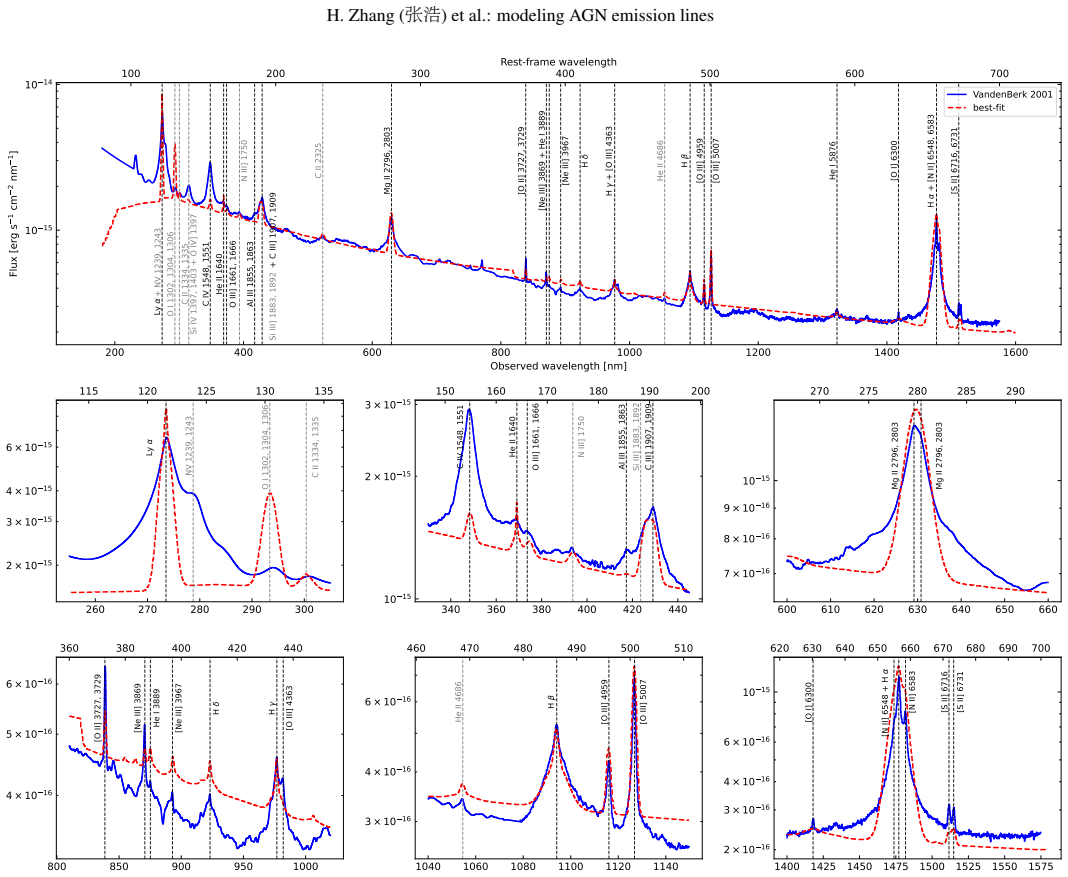
The nebular_AGN module, built from Cloudy models driven by CIGALE's X-ray and accretion-disk continua together with its AGN geometry and dust settings, approximately reproduces the majority of quasar emission-line profiles, spans the key emission-line ratios seen in AGN samples, and returns estimates of the physical properties of the line-emitting gas. For certain parameter combinations the module's derived metallicity matches the empirical calibration formula.
What carries the argument
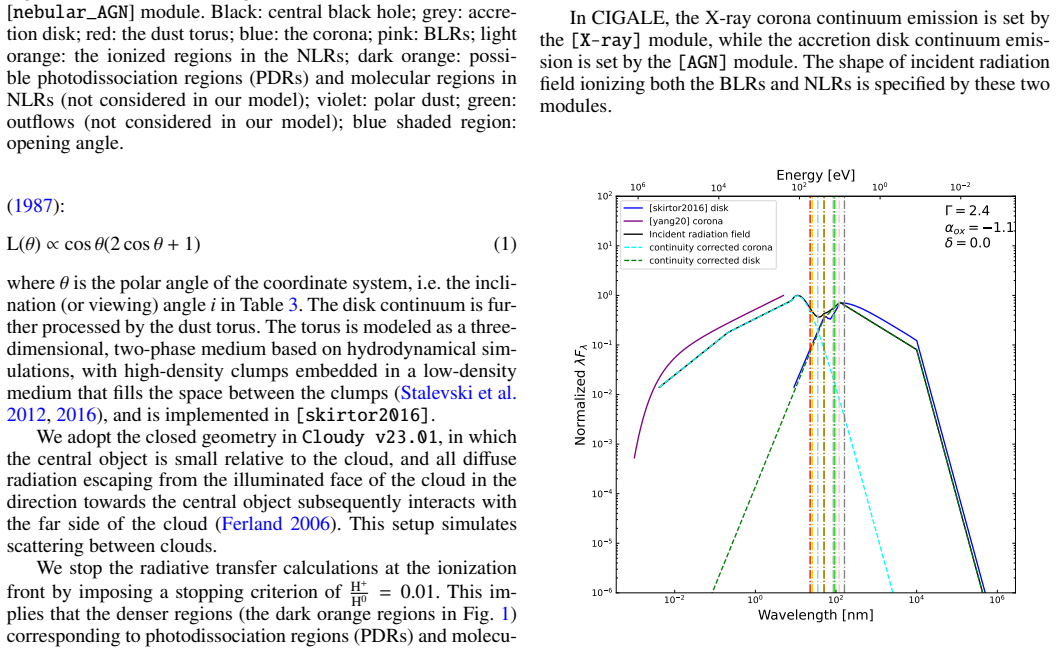
The nebular_AGN module, a pre-computed database of emission-line spectra generated by Cloudy photoionization calculations on gas clouds whose incident radiation fields come from CIGALE's X-ray and accretion-disk continua.
If this is right
- Users can now derive BLR and NLR physical properties such as metallicity directly inside CIGALE SED fits of AGN spectra.
- The module covers the main observed emission-line ratios, allowing consistent modeling of both continuum and lines in a single fit.
- A line-sensitivity analysis within the module identifies which diagnostic lines respond most strongly to each input parameter.
- The dust attenuation law remains a dominant factor in the overall SED fit even after the new line module is included.
Where Pith is reading between the lines
- The same Cloudy-based approach could be adapted to other SED codes that already contain X-ray and disk continua.
- Running the module on large spectroscopic surveys would test whether the parameter grid is dense enough to avoid interpolation biases.
- Discrepancies between module metallicities and empirical calibrations at extreme parameter values could point to missing physics such as non-solar abundance patterns.
Load-bearing premise
The AGN geometry and dust settings already implemented in CIGALE, together with the X-ray and accretion-disk continua, produce incident radiation fields that are sufficiently realistic for the Cloudy models to match real AGN observations.
What would settle it
A systematic mismatch between the module's predicted line ratios and the observed ratios in the same X-ray-selected AGN sample used for benchmarking would falsify the claim that the generated database adequately represents real AGN emission.
Figures
read the original abstract
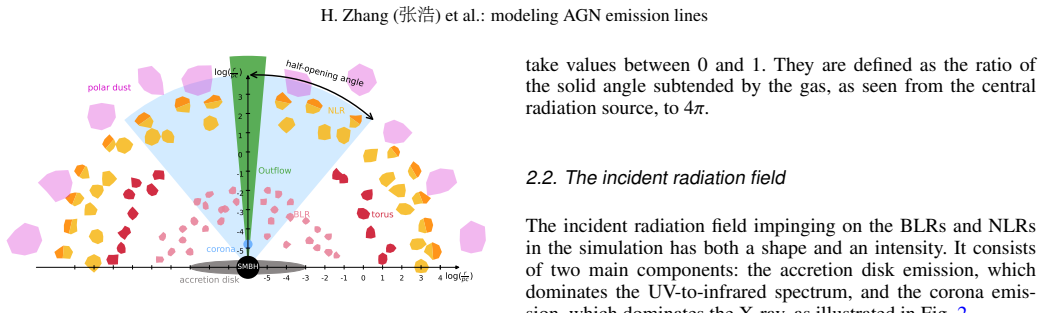
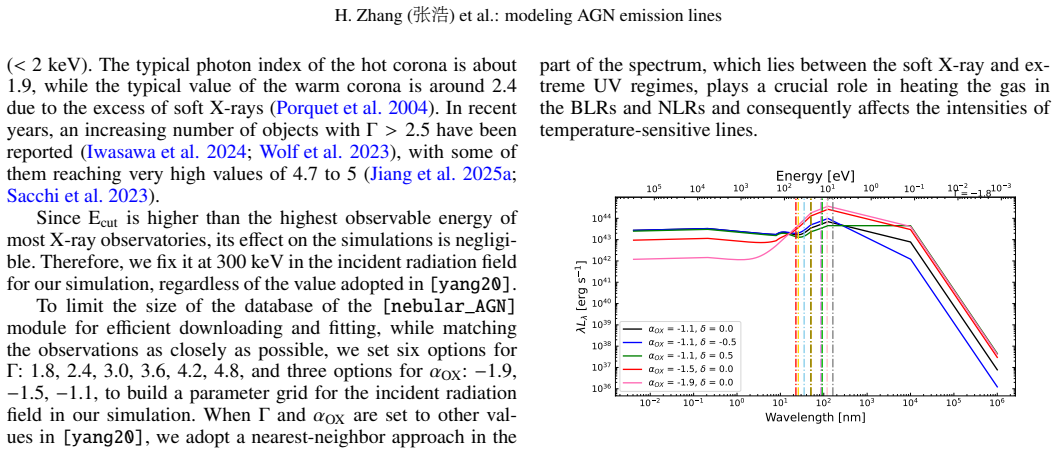
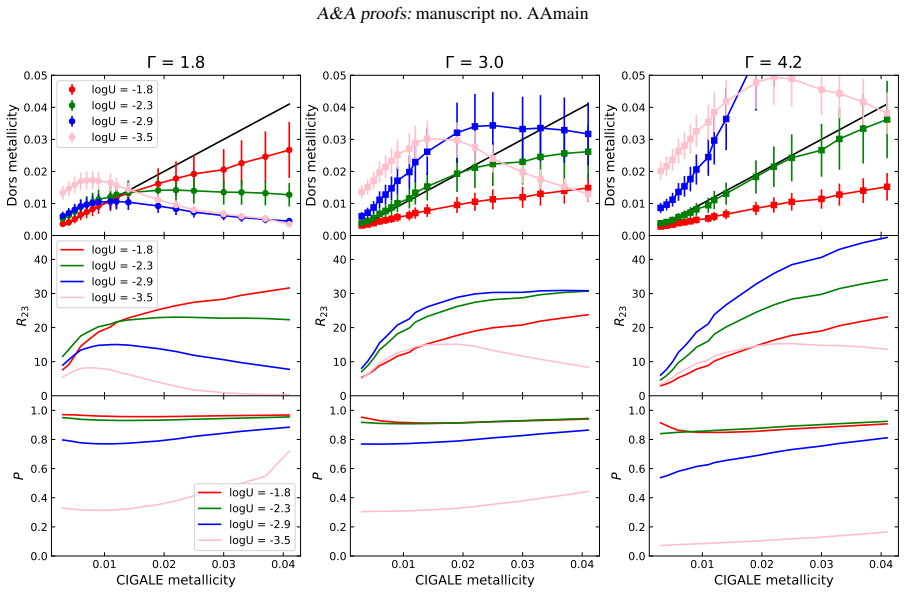
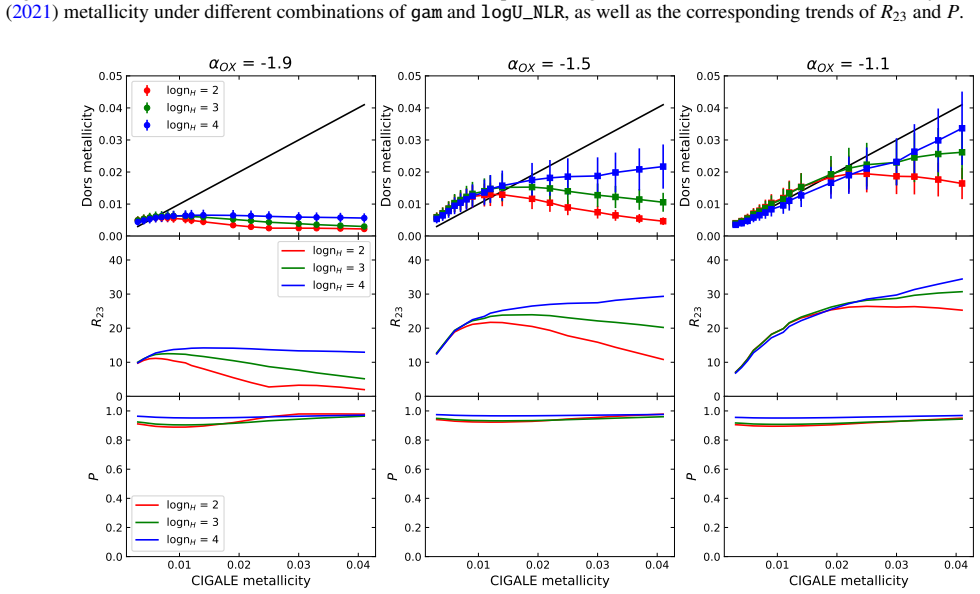
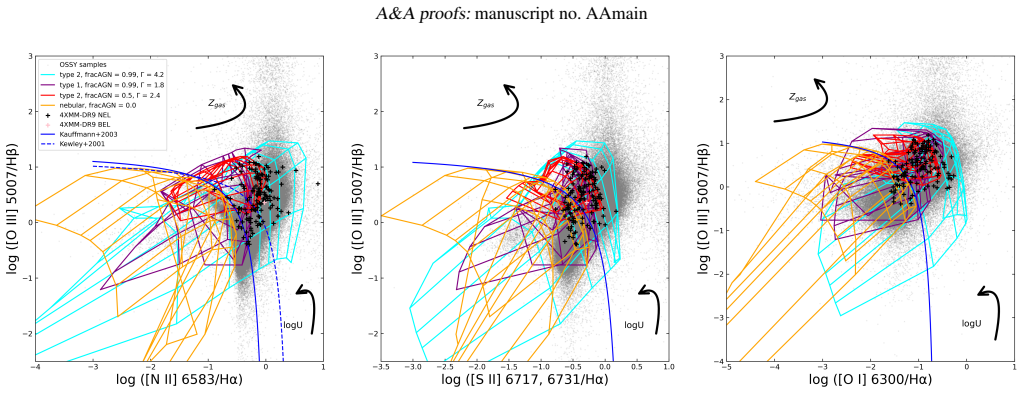
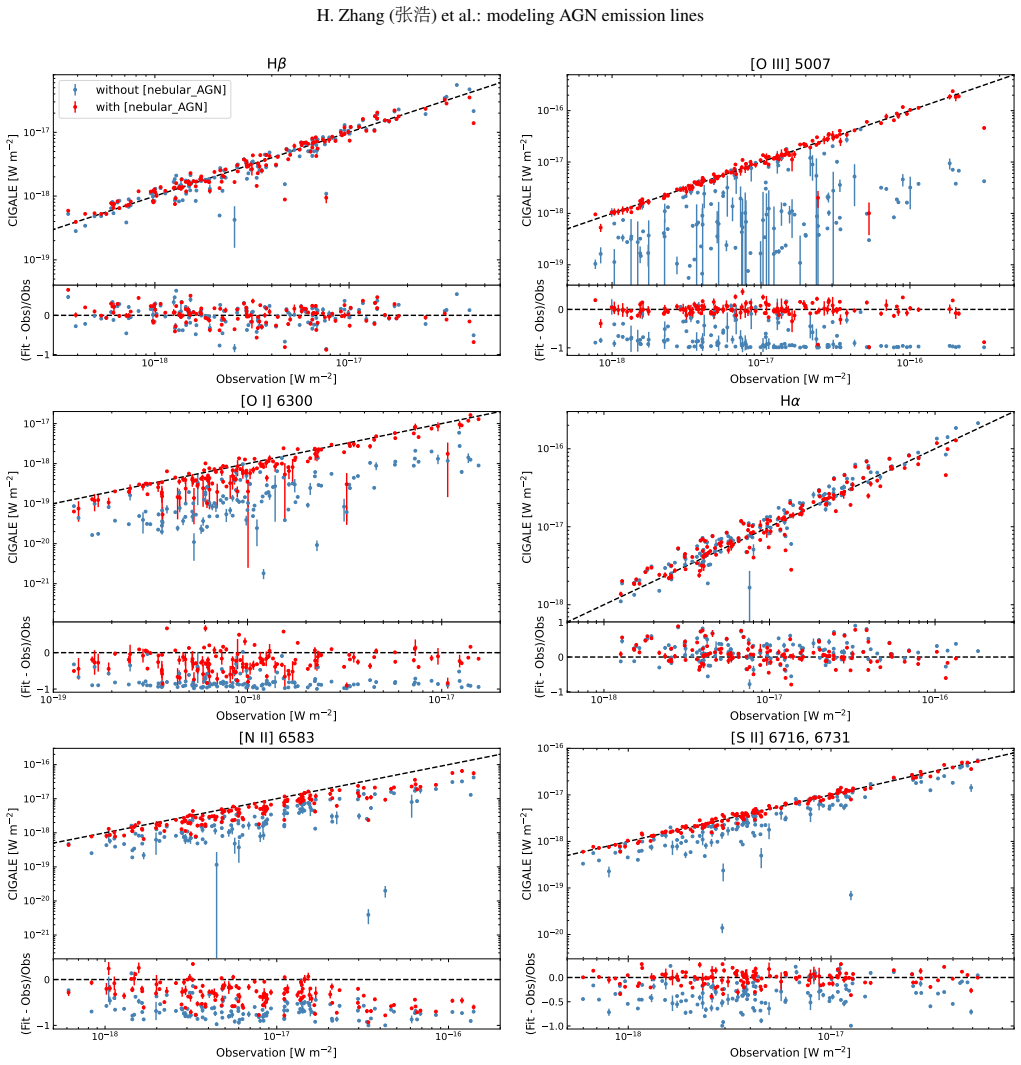
Aims. The increasing discovery of high-redshift AGNs in recent years imposes more stringent requirements on spectral analysis tools for deriving the properties of AGNs and their host galaxies from emission-line diagnostics. To address this need, we develop a new module for the popular SED-fitting tool Code Investigating GALaxy Emission (CIGALE), the [nebular_AGN] module, which enables the efficient and flexible simulation and fitting of emission lines originating from the broad-line regions (BLRs) and narrow-line regions (NLRs) of AGNs, and allows the estimation of the physical properties of these regions. Methods. We use the spectral synthesis code Cloudy to construct the database for the new module. Based on the X-ray and accretion disk continua implemented in CIGALE, we generate the incident radiation fields of the models. We then adopt the AGN geometry and dust settings implemented in CIGALE to define a flexible set of physical parameters for the gas clouds, thereby producing a comprehensive database for the [nebular_AGN] module. Results. We benchmark the [nebular_AGN] module using a quasar composite spectrum, an empirical metallicity calibration, and observational data from X-ray-selected AGNs. Our module can approximately reproduce the majority of quasar emission-line profiles, cover the key emission-line ratios observed in AGN samples, and provide an assessment of their physical properties. For specific combinations of parameters, the metallicity derived by our module is consistent with the empirical formula. We further compare our models with other photoionization models used to simulate AGN NLR emission, and perform a line-sensitivity study to identify the most effective diagnostic lines for each parameter in our module. Finally, we confirm that the dust attenuation law plays an important role in SED fitting.
Editorial analysis
A structured set of objections, weighed in public.
Referee Report
Summary. The manuscript introduces the [nebular_AGN] module for CIGALE. The module builds a Cloudy grid of BLR and NLR emission lines whose incident radiation fields are taken from CIGALE's existing X-ray and accretion-disk continua; gas-cloud parameters are set using CIGALE's pre-existing AGN geometry and dust prescriptions. The module is benchmarked against a quasar composite spectrum, an empirical metallicity calibration, and X-ray-selected AGN data, with claims that it approximately reproduces the majority of quasar line profiles, covers observed line ratios, and yields metallicities consistent with the empirical relation for some parameter combinations. A line-sensitivity analysis and comparison to other NLR photoionization models are also presented.
Significance. If the adopted incident continua are sufficiently realistic, the module would supply a practical, integrated tool for simultaneous SED and emission-line fitting of AGN hosts inside the widely used CIGALE framework, supporting physical-property estimates for high-redshift samples. The line-sensitivity study and explicit comparison to other Cloudy-based NLR grids constitute concrete strengths that aid users in choosing diagnostics.
major comments (2)
- [Methods] Methods section: The incident radiation fields are generated directly from CIGALE's pre-existing X-ray and accretion-disk continua without any quantitative comparison to observed mean quasar SEDs (e.g., Elvis et al. or Richards et al. composites) or to the ionizing-photon distributions employed in standard AGN photoionization grids. This assumption is load-bearing for the central claim that the module can 'assess physical properties' and match real AGN samples.
- [Results] Results section: Benchmarking against the quasar composite is described only qualitatively ('approximately reproduce'). No quantitative metrics (reduced χ², fractional residuals on key ratios such as [O III]/Hβ or C IV/Lyα) are reported, leaving open the possibility that systematic offsets remain undetected.
minor comments (2)
- [Results] The abstract states that 'the dust attenuation law plays an important role,' but the quantitative impact on derived parameters is not shown in a dedicated figure or table.
- Sample selection criteria, redshift range, and number of objects for the X-ray-selected AGN comparison should be stated explicitly rather than referenced only at abstract level.
Simulated Author's Rebuttal
We thank the referee for the constructive comments on our manuscript. We address each major comment below and will incorporate revisions to strengthen the presentation of the methods and results.
read point-by-point responses
-
Referee: [Methods] Methods section: The incident radiation fields are generated directly from CIGALE's pre-existing X-ray and accretion-disk continua without any quantitative comparison to observed mean quasar SEDs (e.g., Elvis et al. or Richards et al. composites) or to the ionizing-photon distributions employed in standard AGN photoionization grids. This assumption is load-bearing for the central claim that the module can 'assess physical properties' and match real AGN samples.
Authors: The nebular_AGN module is designed for direct integration with CIGALE, so the incident continua are taken from the same X-ray and accretion-disk prescriptions already implemented in the code to ensure consistency between continuum and line modeling. We acknowledge that an explicit quantitative comparison to observed quasar SED composites (e.g., Elvis et al., Richards et al.) and to the ionizing spectra used in other standard photoionization grids would provide useful context. We will add this comparison, including a description of the ionizing photon distributions, to the revised Methods section. revision: yes
-
Referee: [Results] Results section: Benchmarking against the quasar composite is described only qualitatively ('approximately reproduce'). No quantitative metrics (reduced χ², fractional residuals on key ratios such as [O III]/Hβ or C IV/Lyα) are reported, leaving open the possibility that systematic offsets remain undetected.
Authors: We agree that the current description of the quasar composite benchmark is qualitative. In the revised Results section we will add quantitative metrics, specifically reduced χ² for the overall fit to the composite spectrum and fractional residuals (or equivalent percentage differences) for key line ratios including [O III]/Hβ and C IV/Lyα. revision: yes
Circularity Check
No significant circularity; new module grids validated externally
full rationale
The paper builds the [nebular_AGN] module by feeding CIGALE's existing X-ray/accretion-disk continua and AGN geometry/dust settings into Cloudy to generate a new parameter grid. Central results (reproduction of quasar composite profiles, coverage of observed line ratios, and partial match to empirical metallicity) are obtained by direct comparison to independent external datasets (quasar composites, X-ray-selected AGN observations, and an empirical calibration formula) rather than by fitting parameters inside the paper or reducing to self-citations. No self-definitional, fitted-input-renamed-as-prediction, or load-bearing self-citation steps appear in the derivation chain.
Axiom & Free-Parameter Ledger
free parameters (1)
- gas cloud physical parameters
axioms (2)
- domain assumption X-ray and accretion-disk continua already present in CIGALE constitute appropriate incident radiation fields for AGN NLR and BLR modeling.
- domain assumption AGN geometry and dust settings already implemented in CIGALE are flexible enough to represent real BLR and NLR conditions.
Reference graph
Works this paper leans on
-
[1]
N., Adelman-McCarthy, J
Abazajian, K. N., Adelman-McCarthy, J. K., Agüeros, M. A., et al. 2009, ApJS, 182, 543
2009
-
[2]
D., Allende Prieto, C., et al
Alam, S., Albareti, F. D., Allende Prieto, C., et al. 2015, ApJS, 219, 12
2015
-
[3]
G., Groves, B
Allen, M. G., Groves, B. A., Dopita, M. A., Sutherland, R. S., & Kewley, L. J. 2008, ApJS, 178, 20
2008
-
[4]
1993, ARA&A, 31, 473
Antonucci, R. 1993, ARA&A, 31, 473
1993
-
[5]
Arnaud, K. A. 1996, in Astronomical Society of the Pacific Conference Series, V ol. 101, Astronomical Data Analysis Software and Systems V , ed. G. H. Jacoby & J. Barnes, 17
1996
-
[6]
1999, MNRAS, 310, 540
Arnouts, S., Cristiani, S., Moscardini, L., et al. 1999, MNRAS, 310, 540
1999
-
[7]
F., & Gandhi, P
Asmus, D., Hönig, S. F., & Gandhi, P. 2016, ApJ, 822, 109
2016
-
[8]
J., & Scott, P
Asplund, M., Grevesse, N., Sauval, A. J., & Scott, P. 2009, ARA&A, 47, 481
2009
-
[9]
A., Phillips, M
Baldwin, J. A., Phillips, M. M., & Terlevich, R. 1981, PASP, 93, 5
1981
-
[10]
2024, A&A, 689, A125
Bisigello, L., Gruppioni, C., Bolatto, A., et al. 2024, A&A, 689, A125
2024
-
[11]
2000, A&A, 363, 476
Bolzonella, M., Miralles, J.-M., & Pelló, R. 2000, A&A, 363, 476
2000
-
[12]
2019, A&A, 622, A103
Boquien, M., Burgarella, D., Roehlly, Y ., et al. 2019, A&A, 622, A103
2019
-
[13]
B., van Dokkum, P
Brammer, G. B., van Dokkum, P. G., & Coppi, P. 2008, ApJ, 686, 1503
2008
-
[14]
Brinchmann, J., Charlot, S., White, S. D. M., et al. 2004, MNRAS, 351, 1151
2004
-
[15]
2021, A&A, 654, A93
Buat, V ., Mountrichas, G., Yang, G., et al. 2021, A&A, 654, A93
2021
-
[16]
2005, MNRAS, 360, 1413
Burgarella, D., Buat, V ., & Iglesias-Páramo, J. 2005, MNRAS, 360, 1413
2005
-
[17]
2025, A&A, 699, A336
Burgarella, D., Buat, V ., Theulé, P., et al. 2025, A&A, 699, A336
2025
-
[18]
2008, A&A, 477, 735 Calabrò, A., Pentericci, L., Feltre, A., et al
Caccianiga, A., Severgnini, P., Della Ceca, R., et al. 2008, A&A, 477, 735 Calabrò, A., Pentericci, L., Feltre, A., et al. 2023, A&A, 679, A80 Calistro Rivera, G., Lusso, E., Hennawi, J. F., & Hogg, D. W. 2016, ApJ, 833, 98
2008
-
[19]
C., et al
Calzetti, D., Armus, L., Bohlin, R. C., et al. 2000, ApJ, 533, 682
2000
-
[20]
& Emsellem, E
Cappellari, M. & Emsellem, E. 2004, PASP, 116, 138
2004
-
[21]
C., McLure, R
Carnall, A. C., McLure, R. J., Dunlop, J. S., & Davé, R. 2018, MNRAS, 480, 4379
2018
-
[22]
2023, Rev
Chatzikos, M., Bianchi, S., Camilloni, F., et al. 2023, Rev. Mexicana Astron. Astrofis., 59, 327
2023
-
[23]
& Charlot, S
Chevallard, J. & Charlot, S. 2016, MNRAS, 462, 1415
2016
-
[24]
2020, The Messenger, 180, 10
Cirasuolo, M., Fairley, A., Rees, P., et al. 2020, The Messenger, 180, 10
2020
-
[25]
2024, A&A, 684, A75 da Cunha, E., Charlot, S., & Elbaz, D
Curti, M., Maiolino, R., Curtis-Lake, E., et al. 2024, A&A, 684, A75 da Cunha, E., Charlot, S., & Elbaz, D. 2008, MNRAS, 388, 1595
2024
-
[26]
2008, A&A, 485, 417
Dadina, M. 2008, A&A, 485, 417
2008
-
[27]
2020, MNRAS, 498, 4150 Article number, page 18 H
Davies, R., Baron, D., Shimizu, T., et al. 2020, MNRAS, 498, 4150 Article number, page 18 H. Zhang (张浩) et al.: modeling AGN emission lines
2020
-
[28]
Dopita, M. A. & Sutherland, R. S. 1995, ApJ, 455, 468
1995
-
[29]
Dors, O. L. 2021, MNRAS, 507, 466
2021
-
[30]
L., Maiolino, R., Cardaci, M
Dors, O. L., Maiolino, R., Cardaci, M. V ., et al. 2020, MNRAS, 496, 3209
2020
-
[31]
2016, MNRAS, 456, 3354
Feltre, A., Charlot, S., & Gutkin, J. 2016, MNRAS, 456, 3354
2016
-
[32]
Ferland, G. J. 2006, Hazy, A Brief Introduction to Cloudy 06.02
2006
-
[33]
2006, MNRAS, 366, 767
Fritz, J., Franceschini, A., & Hatziminaoglou, E. 2006, MNRAS, 366, 767
2006
-
[34]
M., Goosmann, R
Gaskell, C. M., Goosmann, R. W., Antonucci, R. R. J., & Whysong, D. H. 2004, ApJ, 616, 147
2004
-
[35]
J., & Scott, P
Grevesse, N., Asplund, M., Sauval, A. J., & Scott, P. 2010, Ap&SS, 328, 179
2010
-
[36]
A., Dopita, M
Groves, B. A., Dopita, M. A., & Sutherland, R. S. 2004, ApJS, 153, 9
2004
-
[37]
2023, ApJ, 959, 39
Harikane, Y ., Zhang, Y ., Nakajima, K., et al. 2023, ApJ, 959, 39
2023
-
[38]
2023, MNRAS, 526, 3610 Hönig, S
Hirschmann, M., Charlot, S., Feltre, A., et al. 2023, MNRAS, 526, 3610 Hönig, S. F. 2019, ApJ, 884, 171
2023
-
[39]
F., Hernquist, L., Cox, T
Hopkins, P. F., Hernquist, L., Cox, T. J., et al. 2006, ApJS, 163, 1
2006
-
[40]
J., et al
Ilbert, O., Arnouts, S., McCracken, H. J., et al. 2006, A&A, 457, 841
2006
-
[41]
2024, A&A, 684, A153
Iwasawa, K., Liu, T., Boller, T., et al. 2024, A&A, 684, A153
2024
-
[42]
D., Leja, J., Conroy, C., & Speagle, J
Johnson, B. D., Leja, J., Conroy, C., & Speagle, J. S. 2021, ApJS, 254, 22 Juodžbalis, I., Conselice, C. J., Singh, M., et al. 2023, MNRAS, 525, 1353
2021
-
[43]
J., Dopita, M
Kewley, L. J., Dopita, M. A., Sutherland, R. S., Heisler, C. A., & Trevena, J. 2001, ApJ, 556, 121
2001
-
[44]
J., Nicholls, D
Kewley, L. J., Nicholls, D. C., & Sutherland, R. S. 2019, ARA&A, 57, 511
2019
-
[45]
D., Onoue, M., Inayoshi, K., et al
Kocevski, D. D., Onoue, M., Inayoshi, K., et al. 2023, ApJ, 954, L4
2023
-
[46]
G., Labbé, I., et al
Kriek, M., van Dokkum, P. G., Labbé, I., et al. 2018, FAST: Fitting and As- sessment of Synthetic Templates, Astrophysics Source Code Library, record ascl:1803.008
2018
-
[47]
S., et al
Lambrides, E., Chiaberge, M., Long, A. S., et al. 2024, ApJ, 961, L25
2024
-
[48]
J., & McDowell, J
Laor, A., Fiore, F., Elvis, M., Wilkes, B. J., & McDowell, J. C. 1997, ApJ, 477, 93
1997
-
[49]
D., Conroy, C., van Dokkum, P
Leja, J., Johnson, B. D., Conroy, C., van Dokkum, P. G., & Byler, N. 2017, ApJ, 837, 170
2017
-
[50]
L., Greene, J
Liu, G., Zakamska, N. L., Greene, J. E., Nesvadba, N. P. H., & Liu, X. 2013, MNRAS, 436, 2576
2013
-
[51]
2017, ApJS, 232, 8
Liu, T., Tozzi, P., Wang, J.-X., et al. 2017, ApJS, 232, 8
2017
-
[52]
2010, Astrophysics and Space Science Proceedings, 16, 379 López, I
Lodders, K. 2010, Astrophysics and Space Science Proceedings, 16, 379 López, I. E., Yang, G., Mountrichas, G., et al. 2024, A&A, 692, A209 López-Gonzaga, N., Burtscher, L., Tristram, K. R. W., Meisenheimer, K., &
2010
-
[53]
2016, A&A, 591, A47
Schartmann, M. 2016, A&A, 591, A47
2016
-
[54]
& Rieke, G
Lyu, J. & Rieke, G. H. 2018, ApJ, 866, 92
2018
-
[55]
1998, AJ, 115, 2285
Magorrian, J., Tremaine, S., Richstone, D., et al. 1998, AJ, 115, 2285
1998
-
[56]
2024, A&A, 691, A145
Maiolino, R., Scholtz, J., Curtis-Lake, E., et al. 2024, A&A, 691, A145
2024
-
[57]
& Hunt, L
Marconi, A. & Hunt, L. K. 2003, ApJ, 589, L21 Martínez-Ramírez, L. N., Calistro Rivera, G., Lusso, E., et al. 2024, A&A, 688, A46
2003
-
[58]
P., Brammer, G., et al
Matthee, J., Naidu, R. P., Brammer, G., et al. 2024, ApJ, 963, 129
2024
-
[59]
2024, A&A, 691, A345 Meléndez, M., Kraemer, S
Mazzolari, G., Übler, H., Maiolino, R., et al. 2024, A&A, 691, A345 Meléndez, M., Kraemer, S. B., Armentrout, B. K., et al. 2008, ApJ, 682, 94
2024
-
[60]
2013, pyCloudy: Tools to manage astronomical Cloudy photoion- ization code
Morisset, C. 2013, pyCloudy: Tools to manage astronomical Cloudy photoion- ization code
2013
-
[61]
2021, A&A, 646, A29
Mountrichas, G., Buat, V ., Yang, G., et al. 2021, A&A, 646, A29
2021
-
[62]
2025, A&A, 693, A50
Napolitano, L., Castellano, M., Pentericci, L., et al. 2025, A&A, 693, A50
2025
-
[63]
M., Nikutta, R., Ivezi ´c, Ž., & Elitzur, M
Nenkova, M., Sirocky, M. M., Nikutta, R., Ivezi ´c, Ž., & Elitzur, M. 2008, ApJ, 685, 160
2008
-
[64]
1987, MNRAS, 225, 55
Netzer, H. 1987, MNRAS, 225, 55
1987
-
[65]
2015, ARA&A, 53, 365
Netzer, H. 2015, ARA&A, 53, 365
2015
-
[66]
Nieva, M. F. & Przybilla, N. 2012, A&A, 539, A143
2012
-
[67]
2009, A&A, 507, 1793
Noll, S., Burgarella, D., Giovannoli, E., et al. 2009, A&A, 507, 1793
2009
-
[68]
Oh, K., Sarzi, M., Schawinski, K., & Yi, S. K. 2011, ApJS, 195, 13
2011
-
[69]
M., Assef, R
Padovani, P., Alexander, D. M., Assef, R. J., et al. 2017, A&A Rev., 25, 2
2017
-
[70]
Pei, Y . C. 1992, ApJ, 395, 130
1992
-
[71]
N., O’Brien, P., & Brinkmann, W
Porquet, D., Reeves, J. N., O’Brien, P., & Brinkmann, W. 2004, A&A, 422, 85 Ramos Almeida, C. & Ricci, C. 2017, Nature Astronomy, 1, 679
2004
-
[72]
J., et al
Ricci, C., Trakhtenbrot, B., Koss, M. J., et al. 2017, ApJS, 233, 17
2017
-
[73]
A., Kewley, L
Rich, J. A., Kewley, L. J., & Dopita, M. A. 2014, ApJ, 781, L12
2014
-
[74]
2023, A&A, 671, A33
Sacchi, A., Risaliti, G., & Miniutti, G. 2023, A&A, 671, A33
2023
-
[75]
L., et al
Sarzi, M., Falcón-Barroso, J., Davies, R. L., et al. 2006, MNRAS, 366, 1151
2006
-
[76]
2005, A&A, 437, 861
Schartmann, M., Meisenheimer, K., Camenzind, M., Wolf, S., & Henning, T. 2005, A&A, 437, 861
2005
-
[77]
2025, A&A, 697, A175
Scholtz, J., Maiolino, R., D’Eugenio, F., et al. 2025, A&A, 697, A175
2025
-
[78]
2017, Publications of the Astronomical Society of Australia, 34
Spinoglio, L., Alonso-Herrero, A., Armus, L., et al. 2017, Publications of the Astronomical Society of Australia, 34
2017
-
[79]
& Malkan, M
Spinoglio, L. & Malkan, M. A. 1992, ApJ, 399, 504
1992
-
[80]
2005, MNRAS, 361, 776
Springel, V ., Di Matteo, T., & Hernquist, L. 2005, MNRAS, 361, 776
2005
discussion (0)
Sign in with ORCID, Apple, or X to comment. Anyone can read and Pith papers without signing in.