REVIEW 3 major objections 3 minor 49 references
Magnetic hedgehog lattices in noncentrosymmetric metals
T0 review · 3 major / 3 minor · reviewed 2026-08-14 · deepseek-v4-flash
Pith's one-line read Zero-field magnetic hedgehog lattices in noncentrosymmetric metals are stabilized by the combined action of spin-orbit-induced antisymmetric exchange and spin-charge-induced multiple-spin interactions.
desk verdict Zero-field 3Q and 4Q hedgehog lattices in an effective itinerant spin model—new, solidly argued within the model, with the main caveat being the explicitly acknowledged truncation of spin-orbit-induced anisotropic exchanges. read the letter →
The pith
A machine-rendered reading of the paper's core claim, the machinery that carries it, and where it could break.
The reading
What carries the argument
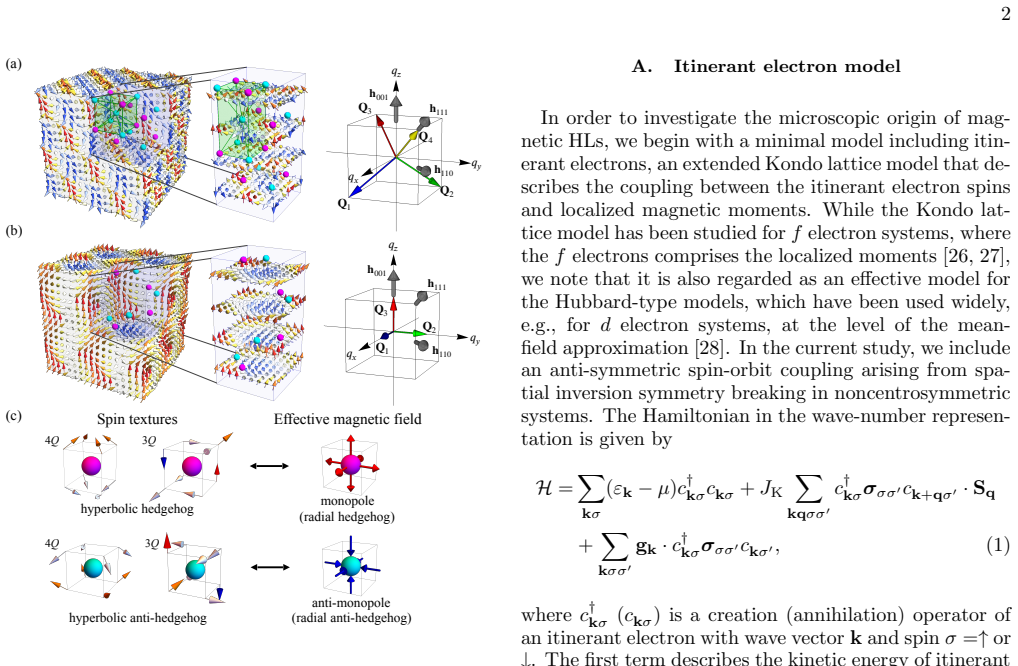
The load-bearing object is the effective spin Hamiltonian of Eq. (2): $H = \sum_{\eta}\bigl[-J\,\mathbf{S}_{\mathbf{Q}_\eta}\cdot \mathbf{S}_{-\mathbf{Q}_\eta} + \frac{K}{N}(\mathbf{S}_{\mathbf{Q}_\eta}\cdot \mathbf{S}_{-\mathbf{Q}_\eta})^2 - i\,\mathbf{D}_\eta\cdot(\mathbf{S}_{\mathbf{Q}_\eta}\times \mathbf{S}_{-\mathbf{Q}_\eta})\bigr] - \sum_l \mathbf{h}\cdot\mathbf{S}_{r_l}$. It combines a long-range RKKY bilinear exchange (from second-order perturbation in $J_K$), a positive biquadratic interaction $K$ (the leading higher-order spin-charge coupling), and a DM-type antisymmetric exchange $\mathbf{D}_\eta$ parallel to the ordering vector $\mathbf{Q}_\eta$ (from spin-orbit coupling). The ordering vectors are assumed to be the tetrahedral set for the 4Q-HL and the cubic set for the 3Q-HL, with $Q=\pi/4$. The argument works by showing that the DM term alone gives only a 1Q helical state, the biquadratic alone gives nonchiral multiple-Q states or a 2Q chiral stripe, and only when both are present do the chiral hedgehog lattices win. The biquadratic interaction biases the system toward noncoplanar multiple-Q order while the DM interaction fixes the chirality and spin-space handedness, and the interplay is resolved by comparing variational states and confirmed by simulated annealing.
What would settle it
A first-principles or experimental determination of the magnetic ordering wave vectors of MnSi$_{1-x}$Ge$_x$ that finds the dominant susceptibility maxima at wave vectors other than the assumed tetrahedral/cubic sets with $Q\approx\pi/4$ would falsify the scenario. More directly, an angle-resolved photoemission measurement showing no Fermi-surface nesting at those wave vectors, or a microscopic calculation including additional anisotropic exchange terms that finds no HL, would also do so.
Extended reading notes
Core claim
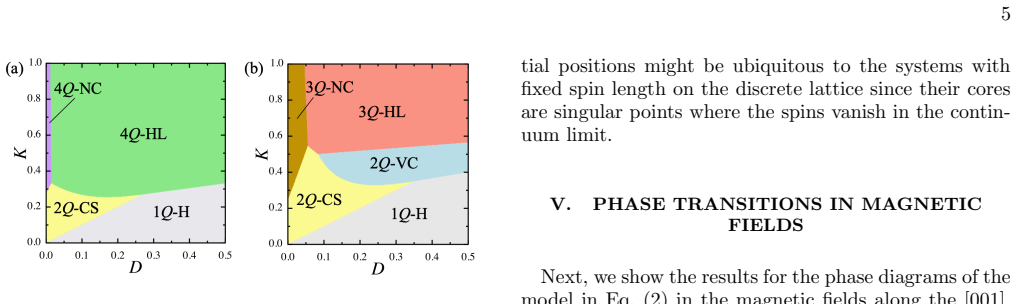
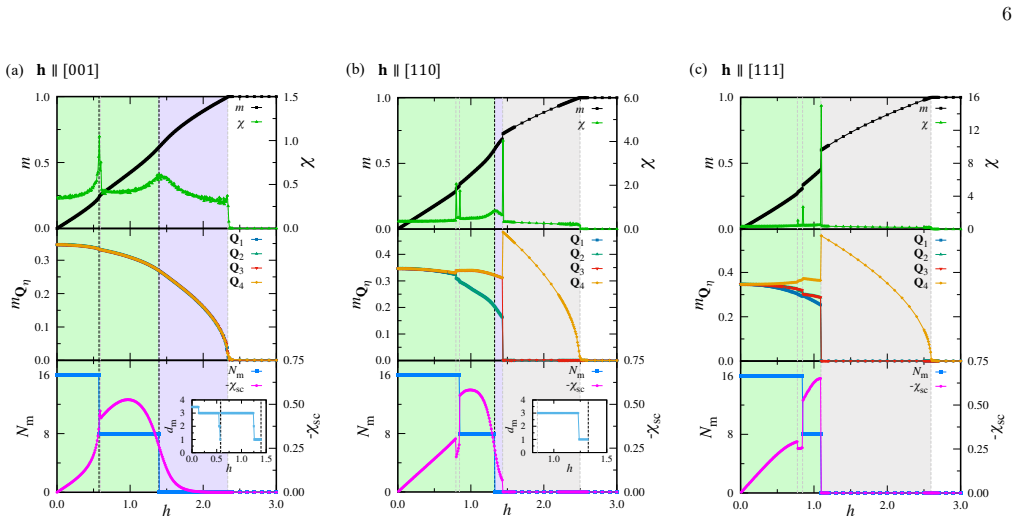
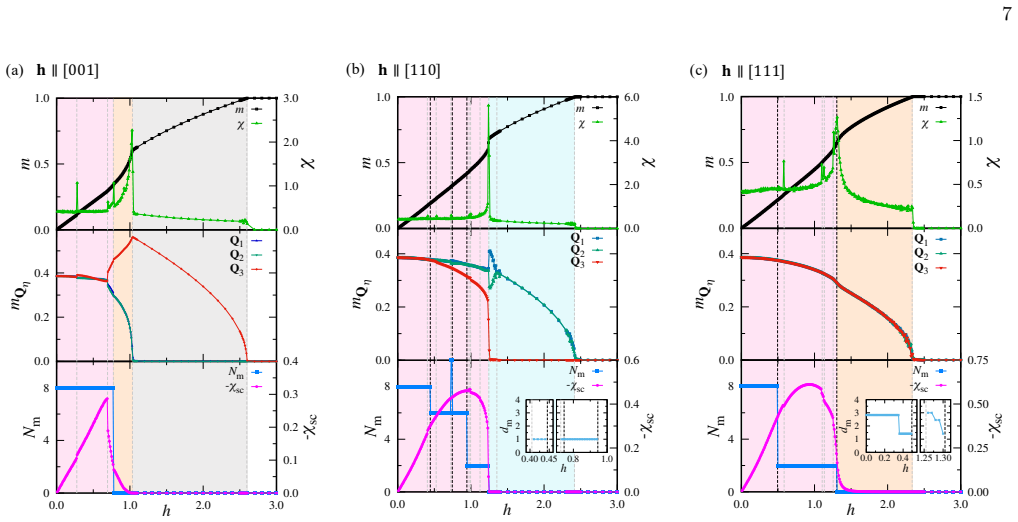
The central claim is that in the effective model of Eq. (2), with long-range bilinear (RKKY), biquadratic, and DM-type interactions at wave vectors $\mathbf{Q}_\eta$, the 4Q- and 3Q-hedgehog lattices are stabilized in the ground state at zero magnetic field by the synergetic effect of the anti-symmetric exchange interactions generated by the spin-orbit coupling and the multiple-spin interactions generated by the spin-charge coupling. This is established for parameter sets such as $D=0.3$, $K=0.6$ (4Q) and $D=0.3$, $K=0.7$ (3Q), and the monopoles and anti-monopoles sit at interstitial positions, forming interpenetrating lattices. In an applied field along [001], [110], or [111], the model produces a sequence of 4Q and 3Q phases distinguished by higher Fourier components, and several of the transitions are topological: the number of monopoles and anti-monopoles is halved or reduced stepwise as pairs move together and annihilate, with the minimum monopole–anti-monopole distance decreasing toward the transition.
Load-bearing premise
The load-bearing premise is that the truncated effective spin model in Eq. (2) captures the physics of the real material: the perturbation expansion in $J_K$ keeps only biquadratic and DM-type terms, assumes the ordering vectors are the tetrahedral/cubic sets with $Q=\pi/4$ and $\mathbf{D}_\eta \parallel \mathbf{Q}_\eta$, and takes $K>0$ as the dominant higher-order coupling; if any of these choices fails, the zero-field hedgehog lattices may not survive.
Editorial extensions
If this is right
- If the central claim is right, zero applied field is not an obstacle to hedgehog-lattice order: the short-period HLs observed in MnSi$_{1-x}$Ge$_x$ can be understood as a consequence of itinerant-electron couplings rather than a large local DM interaction.
- The model predicts that the field-driven evolution of each HL passes through several distinct multiple-Q phases, distinguished by higher Fourier components of the spin structure factor, before reaching the forced ferromagnetic state.
- Several of those transitions are topological, with monopole and anti-monopole numbers changing by pair annihilation; these transitions leave a signature in the net scalar spin chirality, and therefore in the topological Hall effect.
- The field-direction dependence matters: [001], [110], and [111] sweeps differ in the number and order of transitions, including cases where no continuous topological transition appears because a conical state intervenes.
- Because the ordering vectors are set by Fermi-surface nesting in this scenario, the HL period is determined by the band structure rather than by the ratio of ferromagnetic exchange to DM interaction, which is consistent with very short observed periods.
Reading between the lines
- If Fermi-surface nesting at the assumed wave vectors is confirmed in real materials, the scenario would directly connect band geometry to zero-field monopole lattices; if the nesting is absent, the model would need revision.
- The same combination of antisymmetric exchange and multiple-spin couplings might apply to short-period skyrmion lattices in other noncentrosymmetric or even centrosymmetric itinerant magnets.
- The ground-state annealing results leave open the finite-temperature behavior; thermal fluctuations could either widen or destroy the stability regions, and the chirality Hall response would then show temperature dependence tied to monopole pair separation.
- The pair-annihilation transitions suggest a control knob: stress or doping that shifts Fermi-surface nesting could move the annihilation fields and tune the emergent magnetic field in a material realization.
Signed reviews
Editorial analysis
A structured set of objections, weighed in public.
Referee Report
Summary. The manuscript constructs a weak-coupling effective spin Hamiltonian, Eq. (2), for noncentrosymmetric itinerant magnets, consisting of a long-range RKKY exchange, a positive biquadratic coupling K, a DM-type antisymmetric exchange, and a Zeeman term. The authors assume the tetrahedral (4Q) and cubic (3Q) ordering-wave-vector sets with Q=pi/4, solve the model by variational comparison among 1Q, 2Q, 3Q, and 4Q states, and by simulated annealing, and find that zero-field ground states in finite regions of the D-K phase diagram are the 4Q and 3Q hedgehog lattices. Field sweeps along [001], [110], and [111] produce phase diagrams with several 4Q/3Q states, 1Q and 2Q states, and forced ferromagnetism, including transitions in which the monopole/anti-monopole count changes. The central claim is that the zero-field HLs are stabilized by the cooperation of the SOC-induced DM exchange and the spin-charge-coupling-induced multiple-spin interactions.
Significance. If the effective model is a faithful weak-coupling expansion, this is an important result: it provides a concrete itinerant-electron mechanism for zero-field hedgehog lattices, with short periods set by the assumed ordering wave vectors, and it identifies observable signatures through field-induced topological transitions and changes in scalar spin chirality. The evidence within the model is reasonably strong: the variational comparison includes the relevant competing 1Q, 2Q, 3Q, and 4Q states, and simulated annealing independently reproduces the HLs. The monopole/anti-monopole tracking using Nm and dm is a clean and informative diagnostic. The main weaknesses are the uncontrolled truncation of other SOC-induced anisotropic exchanges and the assumed rather than derived ordering wave vectors, which together mean the paper establishes a plausible scenario rather than a demonstrated microscopic origin for MnSi1-xGex.
major comments (3)
- [§II B, Eq. (2)] The stability of the 4Q- and 3Q-HLs is demonstrated only within the truncated effective Hamiltonian. The paper states immediately after Eq. (2) that other anisotropic exchange interactions originating from the anti-symmetric spin-orbit coupling are ignored for simplicity. This omission is load-bearing because the retained DM term is second order in J_K and first order in the g-vector, while the retained biquadratic term is fourth order in J_K; omitted spin-orbit-induced terms such as chiral biquadratic interactions (Refs. [24], [25], [37]) can enter at comparable orders in J_K and g. No estimate of their coefficients is given, and no argument is provided that they are negligible at D=0.3, K=0.6–0.7. Without such an estimate, the claimed synergy mechanism could be modified or destroyed by the omitted terms. The authors should either compute or bound these terms, or explicitly state that the result applies only to the truncated model and adjust the abstract and Sec. VII accordingly.
- [§II B, ordering wave vectors] The model assumes rather than derives the ordering wave vectors: the tetrahedral set for the 4Q case and the cubic set for the 3Q case, with Q=pi/4, and it also assumes K>0 because that sign is known to prefer noncollinear and noncoplanar configurations. These quantities are inputs, not outputs, of the weak-coupling expansion for the band structure of MnSi1-xGex. The paper says the results remain qualitatively the same for other choices of Q but shows no quantitative data, and the phase diagram in Fig. 2 is presented only in the D–K plane at fixed Q. The abstract and introduction present the model as the microscopic origin for the experimental HLs; this requires at least a demonstration that realistic susceptibility maxima can produce the tetrahedral/cubic Q sets in some simple band model, or a clear caveat that the scenario is conditional on the assumed ordering vectors. As written, the claim in Sec. VII that the periods in the HLs are dictated by nesting properties of the Fermi surface is not supported by any susceptibility calculation in the manuscript.
- [§V and Appendix B, Figs. 3–4 and 9–10] The detailed field-phase diagrams, in particular the ten 3Q states reported for h||[110] in Fig. 4(b) and Fig. 10(b), are identified from kinks and stepwise changes in m, chi, m_Qeta, and Nm measured along a single annealing path with field steps Delta h=0.01. Several transitions are very close together (for example, h approximately 0.975, 0.995, 1.125, and 1.245 in the 3Q-[110] case), and the phases are sometimes distinguished only by higher Fourier components. Because the topological pair-annihilation transitions are one of the paper's main advertised results, the identification should be backed by a reproducibility check, such as multiple independent annealing runs or field sweeps in opposite directions to test for hysteresis, and, where possible, by direct energy comparison of the competing variational states. As it stands, the precise number of distinct phases and the exact transition fields are not established to the same standard as the zero-field HL stability.
minor comments (3)
- [§III A, after Eq. (4)] The text says the phases phi_eta are varied from 0 to Q, which is a restricted interval; please clarify that this range is sufficient by translational symmetry, since a reader would otherwise expect the full range 0 to 2*pi.
- [Fig. 3(c)] The y-axis label in the bottom panel of Fig. 3(c) appears as '-csc' rather than '-chi_sc'; please correct this typo.
- [§II B] The description of the biquadratic term as a higher-order perturbation is vague; specifying that it is fourth order in J_K and referring to the derivation in Ref. [36] would help the reader assess the truncation discussed in the first major comment.
Circularity Check
No significant circularity: the zero-field 4Q/3Q hedgehog-lattice result is obtained by energy minimization and simulated annealing within the stated effective model; model truncation is an explicit assumption, not a self-referential reduction.
full rationale
The claimed derivation is the effective spin model Eq. (2), whose inputs are J, D, K, h, and the ordering vectors Qeta. The paper's central claim is that for D=0.3, K=0.6 (4Q) and D=0.3, K=0.7 (3Q) the zero-field ground state is the chiral hedgehog lattice. That is established by comparing energies of 1Q-H, 2Q-CS, 2Q-VC, and nonchiral multi-Q states (Fig. 2), and confirmed by simulated annealing that does not start from the HL ansatz. Although Qeta are chosen to be the HL ordering vectors and the variational set includes the HL states, the target is not produced by definition: the same Qeta also admit nonchiral states with no DM energy, and the HL phase occupies only a finite region of the D-K plane, losing to 1Q-H and 2Q-CS elsewhere. Thus no fitted parameter is renamed as a prediction and no equation reduces to another by construction. The self-citations (Refs. [35]-[37]) support the derivation of the RKKY, biquadratic, and DM terms; they do not assert the zero-field HL stability found here, so they are not load-bearing for the central numerical result. The stated omission of other spin-orbit-induced anisotropic exchanges in Sec. II B ('we ignore other anisotropic exchange interactions originating from the anti-symmetric spin-orbit coupling, for simplicity') and the assumed Qeta from Fermi-surface nesting are modeling limitations that affect applicability to MnSi1-xGex, but they are acknowledged assumptions rather than circular steps. The concluding remarks also explicitly call for first-principles checks of the relevant wave numbers, showing that the authors do not present the assumed Qeta as derived within this paper.
Assumptions & free parameters
free parameters (3)
- D (DM interaction strength) =
0.3 (used in field-phase calculations; varied in zero-field phase diagrams)
- K (biquadratic interaction strength) =
0.6 for 4Q, 0.7 for 3Q field-phase calculations; varied in zero-field diagrams
- Q (ordering wave vector magnitude) =
pi/4 (period of eight lattice sites)
assumptions (6)
- domain assumption The weak-coupling perturbation expansion in J_K is valid and produces the effective model in Eq. (2) with RKKY, biquadratic, and DM-type terms.
- domain assumption The bare spin susceptibility has maxima at the assumed tetrahedral (4Q) or cubic (3Q) Q sets, so these wave vectors dominate.
- domain assumption The antisymmetric spin-orbit coupling produces DM-type interactions with D eta parallel to Q eta.
- ad hoc to paper Other anisotropic exchange interactions from spin-orbit coupling are negligible.
- domain assumption A classical spin description with fixed |S|=1 is adequate.
- domain assumption Simulated annealing with the stated cooling schedule finds the ground states on 16^3 lattices.
Cite this review
Pith. "Pith review of Magnetic hedgehog lattices in noncentrosymmetric metals." pith.science (2026). https://pith.science/paper/MTE6WCZA
@misc{pith2026190805044,
  author       = {Pith},
  title        = {Pith review of: Magnetic hedgehog lattices in noncentrosymmetric metals},
  year         = {2026},
  howpublished = {\url{https://pith.science/paper/MTE6WCZA}},
  note         = {Machine review of arXiv:1908.05044}
}
read the original abstract
The magnetic hedgehog lattice (HL) is a noncoplanar magnetic texture with a periodic array of magnetic monopoles and anti-monopoles. Despite phenomenological and numerical studies thus far, there remain open issues on the microscopic origin, especially with respect to the recent experimental findings of two different types of HLs even at zero magnetic field. Here, we study the stability of the HLs for an effective spin model with long-range interactions arising from itinerant nature of electrons. By variational calculations and simulated annealing, we find that the HLs are stabilized in the ground state at zero magnetic field by the synergetic effect of the anti-symmetric exchange interactions generated by the spin-orbit coupling and the multiple-spin interactions generated by the spin-charge coupling. We also clarify the phase diagram in the magnetic fields, which includes topological phase transitions with pair annihilation of the monopoles and anti-monopoles depending on the field directions.
Figures
Figures from the paper (6 more)


Reference graph
Works this paper leans on
-
[16]
Topological Nernst effect in a three- dimensional skyrmion-lattice phase,
Y. Shiomi, N. Kanazawa, K. Shibata, Y. Onose, and Y. Tokura, “Topological Nernst effect in a three- dimensional skyrmion-lattice phase,” Phys. Rev. B 88, 064409 (2013)
work page 2013
-
[17]
Large magneto-thermopower in MnGe with topological spin texture,
Y. Fujishiro, N. Kanazawa, T. Shimojima, A. Nakamura, K. Ishizaka, T. Koretsune, R. Arita, A. Miyake, H. Mi- tamura, K. Akiba, M. Tokunaga, J. Shiogai, S. Kimura, S. Awaji, A. Tsukazaki, A. Kikkawa, Y. Taguchi, and Y. Tokura, “Large magneto-thermopower in MnGe with topological spin texture,” Nat. Commun. 9, 408 (2018)
work page 2018
-
[1]
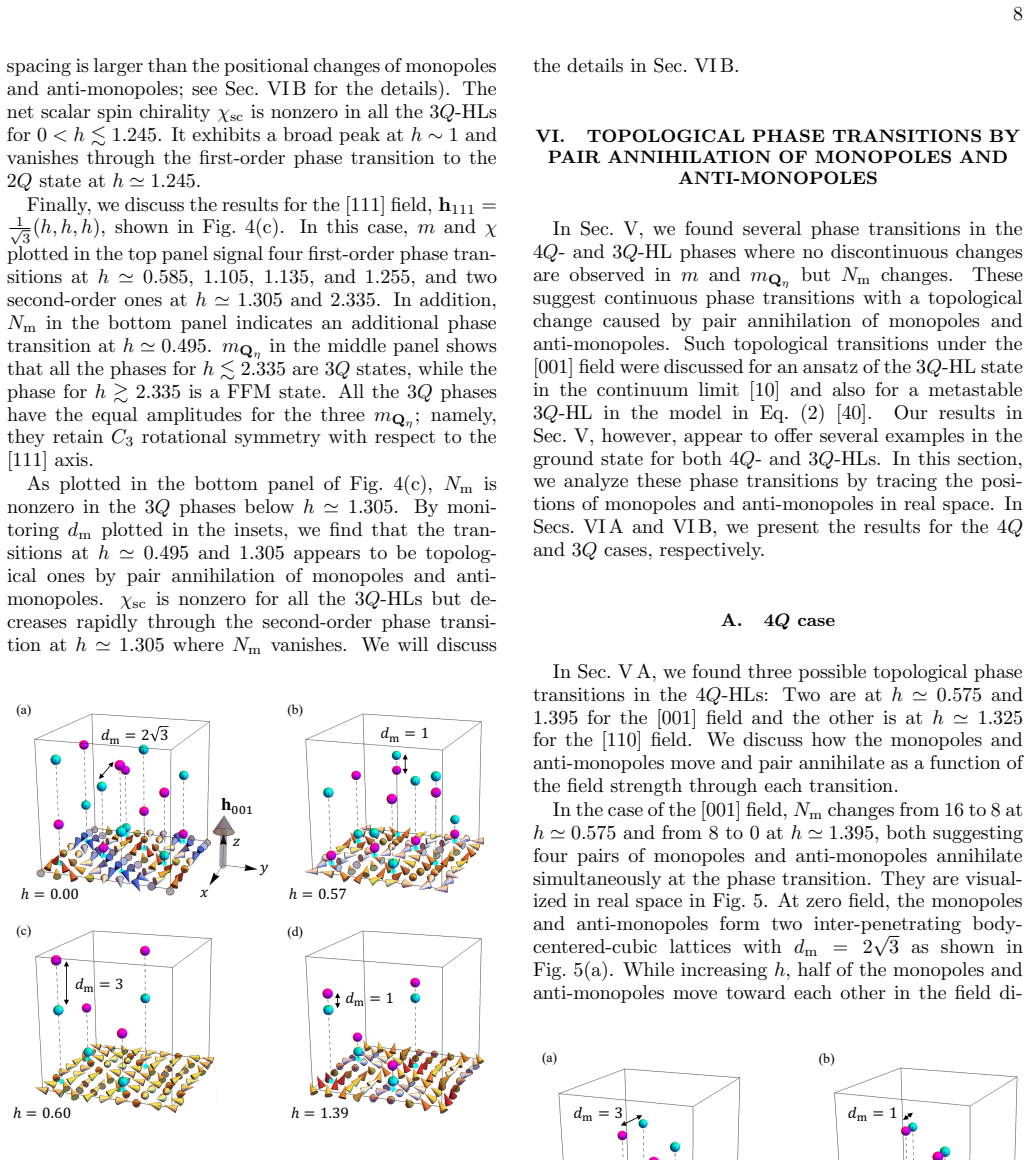
field were discussed for an ansatz of the 3Q-HL state in the continuum limit [10] and also for a metastable 3Q-HL in the model in Eq. (2) [40]. Our results in Sec. V, however, appear to offer several examples in the ground state for both 4 Q- and 3Q-HLs. In this section, we analyze these phase transitions by tracing the posi- tions of monopoles and anti-mon...
-
[110]
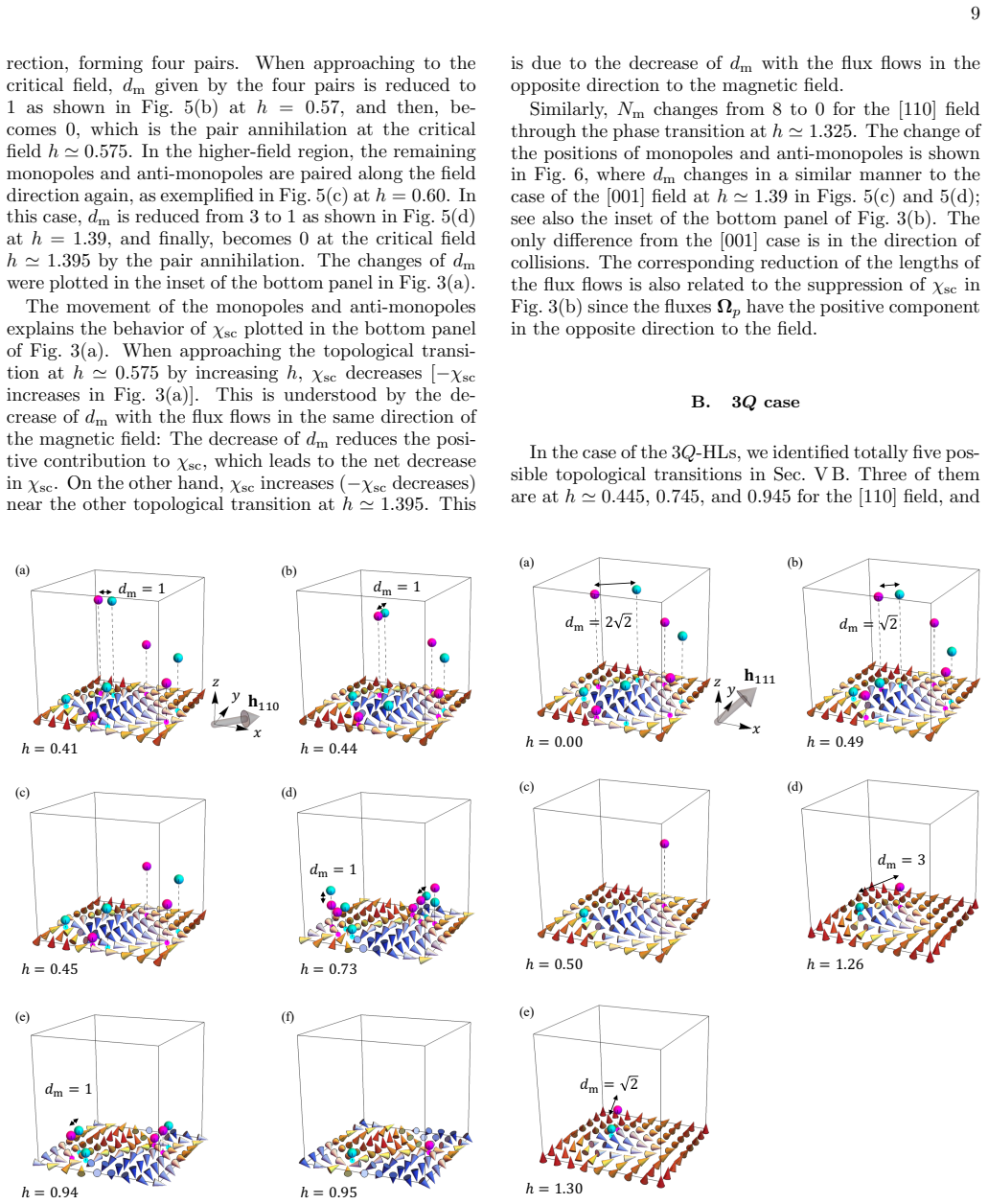
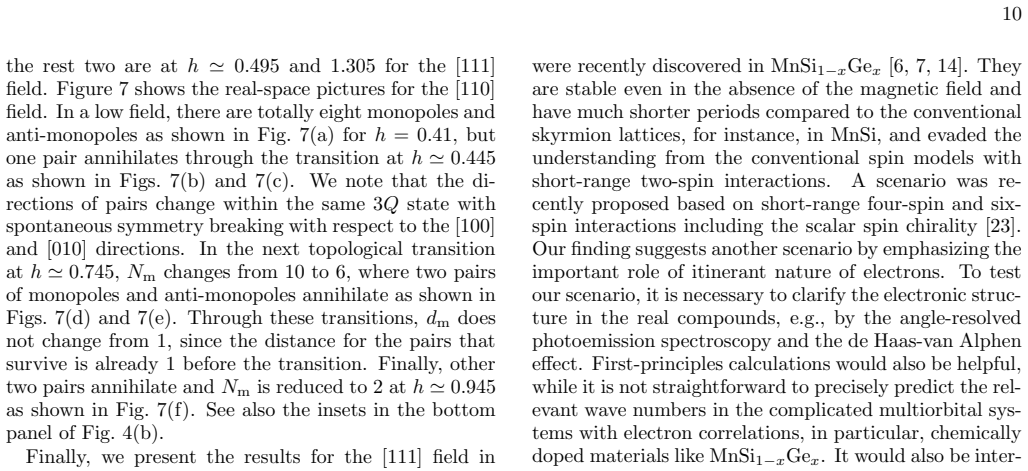
field in the 4Q case: (a) h = 0.85 and (b) h = 1.30. The notations are common to those in Fig. 5. 9 rection, forming four pairs. When approaching to the critical field, dm given by the four pairs is reduced to 1 as shown in Fig. 5(b) at h = 0 .57, and then, be- comes 0, which is the pair annihilation at the critical field h≃ 0.575. In the higher-field region,...
-
[111]
As plotted in the bottom panel of Fig
axis. As plotted in the bottom panel of Fig. 4(c), Nm is nonzero in the 3 Q phases below h≃ 1.305. By moni- toring dm plotted in the insets, we find that the tran- sitions at h≃ 0.495 and 1 .305 appears to be topolog- ical ones by pair annihilation of monopoles and anti- monopoles. χsc is nonzero for all the 3 Q-HLs but de- creases rapidly through the seco...
-
[24]
Dzyaloshinskii-Moriya Interaction and Hall Effects in the Skyrmion Phase of Mn 1−xFexGe,
J. Gayles, F. Freimuth, T. Schena, G. Lani, P. Mavropou- los, R. A. Duine, S. Bl¨ ugel, J. Sinova, and Y. Mokrousov, “Dzyaloshinskii-Moriya Interaction and Hall Effects in the Skyrmion Phase of Mn 1−xFexGe,” Phys. Rev. Lett. 115, 036602 (2015)
work page 2015
-
[25]
Control of Dzyaloshinskii-Moriya interaction in Mn 1−xFexGe: a first-principles study,
T. Koretsune, N. Nagaosa, and R Arita, “Control of Dzyaloshinskii-Moriya interaction in Mn 1−xFexGe: a first-principles study,” Sci. Rep. 5, 13302 (2015)
work page 2015
-
[37]
Magnetic Properties of Cu-Mn Alloys,
K. Yosida, “Magnetic Properties of Cu-Mn Alloys,” Phys. Rev. 106, 893–898 (1957)
work page 1957
Show all 49 references
-
[2]
Sym- metry, Structure, and Dynamics of Monoaxial Chiral Magnets,
Y. Togawa, Y. Kousaka, K. Inoue, and J. Kishine, “Sym- metry, Structure, and Dynamics of Monoaxial Chiral Magnets,” J. Phys. Soc. Japan 85, 112001 (2016)
2016
-
[3]
Multiferroics with Spiral Spin Orders,
Y. Tokura and S. Seki, “Multiferroics with Spiral Spin Orders,” Adv. Mater. 22, 1554 (2010)
2010
-
[4]
All the differences among the ten 3Q states are summarized in Fig
field,Szz(2Q1+2Q2), is zero for 0.975 ≲h ≲ 0.995, but nonzero for 0 .995 ≲ h ≲ 1.125. All the differences among the ten 3Q states are summarized in Fig. 10(b). Finally, in the case of the [111] field in Fig. 4(c), we found seven 3Q states belowh≃ 2.335, all of which have the equa...
-
[5]
Topological properties and dynamics of magnetic skyrmions,
N. Nagaosa and Y. Tokura, “Topological properties and dynamics of magnetic skyrmions,” Nat. Nano. 8, 899 (2013)
2013
-
[6]
Real-Space Ob- servation of Short-Period Cubic Lattice of Skyrmions in MnGe,
T. Tanigaki, K. Shibata, N. Kanazawa, X. Yu, Y. Onose, H. S. Park, D. Shindo, and Y. Tokura, “Real-Space Ob- servation of Short-Period Cubic Lattice of Skyrmions in MnGe,” Nano Lett. 15, 5438 (2015)
2015
-
[7]
Noncentrosym- metric Magnets Hosting Magnetic Skyrmions,
N. Kanazawa, S. Seki, and Y. Tokura, “Noncentrosym- metric Magnets Hosting Magnetic Skyrmions,” Adv. Mater. 29, 1603227 (2017)
2017
-
[8]
Dynamical magnetoelectric phenomena of multiferroic skyrmions,
M. Mochizuki and S. Seki, “Dynamical magnetoelectric phenomena of multiferroic skyrmions,” J. Phys.: Con- dens. Matter 27, 503001 (2015)
2015
-
[9]
Nonreciprocal responses from non-centrosymmetric quantum materials,
Y. Tokura and N. Nagaosa, “Nonreciprocal responses from non-centrosymmetric quantum materials,” Nat. Commun. 9, 3740 (2018)
2018
-
[10]
Electric transport in three-dimensional skyrmion/monopole crystal,
X.-X. Zhang, A. S. Mishchenko, G. De Filippis, and N. Nagaosa, “Electric transport in three-dimensional skyrmion/monopole crystal,” Phys. Rev. B 94, 174428 (2016)
2016
-
[11]
Large Topological Hall Effect in a Short- Period Helimagnet MnGe,
N. Kanazawa, Y. Onose, T. Arima, D. Okuyama, K. Ohoyama, S. Wakimoto, K. Kakurai, S. Ishiwata, and Y. Tokura, “Large Topological Hall Effect in a Short- Period Helimagnet MnGe,” Phys. Rev. Lett.106, 156603 (2011)
2011
-
[12]
Possible skyrmion-lattice ground state in the B20 chiral-lattice magnet MnGe as seen via small-angle neutron scatter- ing,
N. Kanazawa, J.-H. Kim, D. S. Inosov, J. S. White, N. Egetenmeyer, J. L. Gavilano, S. Ishiwata, Y. Onose, T. Arima, B. Keimer, and Y. Tokura, “Possible skyrmion-lattice ground state in the B20 chiral-lattice magnet MnGe as seen via small-angle neutron scatter- ing,” Phys. Rev....
2012
-
[13]
Critical phenomena of emergent magnetic monopoles in a chiral magnet,
N. Kanazawa, Y. Nii, X. X. Zhang, A. S. Mishchenko, G. De Filippis, F. Kagawa, Y. Iwasa, N. Nagaosa, and Y. Tokura, “Critical phenomena of emergent magnetic monopoles in a chiral magnet,” Nat. Commun. 7, 11622 (2016). 13
2016
-
[14]
Topological transitions among skyrmion- and hedgehog- lattice states in cubic chiral magnets,
Y. Fujishiro, N. Kanazawa, T. Nakajima, X. Z. Yu, K. Ohishi, Y. Kawamura, K. Kakurai, T. Arima, H. Mi- tamura, A. Miyake, K. Akiba, M. Tokunaga, A. Mat- suo, K. Kindo, T. Koretsune, R. Arita, and Y. Tokura, “Topological transitions among skyrmion- and hedgehog- lattice states ...
2019
-
[15]
Theory of helical spin crys- tals: Phases, textures, and properties,
B. Binz and A. Vishwanath, “Theory of helical spin crys- tals: Phases, textures, and properties,” Phys. Rev. B 74, 214408 (2006)
2006
-
[18]
A thermodynamic theory of weak ferromagnetism of antiferromagnetics,
I. Dzyaloshinsky, “A thermodynamic theory of weak ferromagnetism of antiferromagnetics,” J. Phys. Chem. Solids 4, 241 (1958)
1958
-
[19]
Anisotropic Superexchange Interaction and Weak Ferromagnetism,
T. Moriya, “Anisotropic Superexchange Interaction and Weak Ferromagnetism,” Phys. Rev. 120, 91–98 (1960)
1960
-
[20]
Zero-temperature phases for chiral magnets in three dimensions,
J.-H. Park and J. H. Han, “Zero-temperature phases for chiral magnets in three dimensions,” Phys. Rev. B 83, 184406 (2011)
2011
-
[21]
Formation of a topological monopole lattice and its dynamics in three- dimensional chiral magnets,
S.-G. Yang, Y.-H. Liu, and J. H. Han, “Formation of a topological monopole lattice and its dynamics in three- dimensional chiral magnets,” Phys. Rev. B 94, 054420 (2016)
2016
-
[22]
Dzyaloshinskii-Moriya Interaction as a Consequence of a Doppler Shift due to Spin-Orbit- Induced Intrinsic Spin Current,
Toru Kikuchi, Takashi Koretsune, Ryotaro Arita, and Gen Tatara, “Dzyaloshinskii-Moriya Interaction as a Consequence of a Doppler Shift due to Spin-Orbit- Induced Intrinsic Spin Current,” Phys. Rev. Lett. 116, 247201 (2016)
2016
-
[23]
Ab ini- tio analysis of magnetic properties of the prototype B20 chiral magnet FeGe,
S. Grytsiuk, M. Hoffmann, J.-P. Hanke, P. Mavropoulos, Y. Mokrousov, G. Bihlmayer, and S. Bl¨ ugel, “Ab ini- tio analysis of magnetic properties of the prototype B20 chiral magnet FeGe,” Phys. Rev. B 100, 214406 (2019)
2019
-
[26]
Heavy-fermion systems,
G. R. Stewart, “Heavy-fermion systems,” Rev. Mod. Phys. 56, 755–787 (1984)
1984
-
[27]
Quantum criti- cality in heavy-fermion metals,
P. Gegenwart, Q. Si, and F. Steglich, “Quantum criti- cality in heavy-fermion metals,” Nat. Phys. 4, 186–197 (2008)
2008
-
[28]
The chiral biquadratic pair interaction,
S. Brinker, M. dos S. Dias, and S. Lounis, “The chiral biquadratic pair interaction,” New J. Phys. 21, 083015 (2019)
2019
-
[29]
Topologicalchiral magnetic interactions driven by emergent orbital magnetism,
S. Grytsiuk, J.-P. Hanke, M. Hoffmann, J. Bouaziz, O. Gomonay, G. Bihlmayer, Y. Mokrousov, and S. Bl¨ ugel, “Topologicalchiral magnetic interactions driven by emergent orbital magnetism,” Nat. Commun. 11, 511 (2020)
2020
-
[30]
Considerations on Double Exchange,
P. W. Anderson and H. Hasegawa, “Considerations on Double Exchange,” Phys. Rev. 100, 675 (1955)
1955
-
[31]
Indirect Exchange Cou- pling of Nuclear Magnetic Moments by Conduction Elec- trons,
M. A. Ruderman and C. Kittel, “Indirect Exchange Cou- pling of Nuclear Magnetic Moments by Conduction Elec- trons,” Phys. Rev. 96, 99–102 (1954)
1954
-
[32]
Itinerant Electron-Driven Chiral Magnetic Ordering and Spontaneous Quantum Hall Effect in Triangular Lattice Models,
I. Martin and C. D. Batista, “Itinerant Electron-Driven Chiral Magnetic Ordering and Spontaneous Quantum Hall Effect in Triangular Lattice Models,” Phys. Rev. Lett. 101, 156402 (2008)
2008
-
[33]
Interaction between thed-Shells in the Transi- tion Metals. II. Ferromagnetic Compounds of Manganese with Perovskite Structure,
C. Zener, “Interaction between thed-Shells in the Transi- tion Metals. II. Ferromagnetic Compounds of Manganese with Perovskite Structure,” Phys. Rev. 82, 403 (1951)
1951
-
[34]
Hidden Multiple-Spin Interactions as an Origin of Spin Scalar Chiral Order in Frustrated Kondo Lattice Models,
Y. Akagi, M. Udagawa, and Y. Motome, “Hidden Multiple-Spin Interactions as an Origin of Spin Scalar Chiral Order in Frustrated Kondo Lattice Models,” Phys. Rev. Lett. 108, 096401 (2012)
2012
-
[35]
Multiple- Q instability by (d−2)-dimensional connections of Fermi surfaces,
S. Hayami and Y. Motome, “Multiple- Q instability by (d−2)-dimensional connections of Fermi surfaces,” Phys. Rev. B 90, 060402 (2014)
2014
-
[36]
A Theory of Metallic Ferro- and Antiferro- magnetism on Zener’s Model,
T. Kasuya, “A Theory of Metallic Ferro- and Antiferro- magnetism on Zener’s Model,” Prog. Theor. Phys. 16, 45 (1956)
1956
-
[38]
(1) leads to Dη ‖ Qη [37]
The perturbation expansion for Eq. (1) leads to Dη ‖ Qη [37]
-
[39]
Vortex Crystals with Chiral Stripes in Itinerant Magnets,
R. Ozawa, S. Hayami, K. Barros, G.-W. Chern, Y. Mo- tome, and C. D. Batista, “Vortex Crystals with Chiral Stripes in Itinerant Magnets,” J. Phys. Soc. Japan 85, 103703 (2016)
2016
-
[40]
Effective bilinear-biquadratic model for noncoplanar ordering in itinerant magnets,
S. Hayami, R. Ozawa, and Y. Motome, “Effective bilinear-biquadratic model for noncoplanar ordering in itinerant magnets,” Phys. Rev. B 95, 224424 (2017)
2017
-
[41]
N´ eel- and Bloch-Type Mag- netic Vortices in Rashba Metals,
S. Hayami and Y. Motome, “N´ eel- and Bloch-Type Mag- netic Vortices in Rashba Metals,” Phys. Rev. Lett. 121, 137202 (2018)
2018
-
[42]
Giant Hall Resis- tivity and Magnetoresistance in Cubic Chiral Antiferro- magnet EuPtSi,
M. Kakihana, D. Aoki, A. Nakamura, F. Honda, M. Nakashima, Y. Amako, S. Nakamura, T. Sakakibara, M. Hedo, T. Nakama, and Y. nuki, “Giant Hall Resis- tivity and Magnetoresistance in Cubic Chiral Antiferro- magnet EuPtSi,” J. Phys. Soc. Japan 87, 023701 (2018)
2018
-
[43]
Unique Helical Magnetic Order and Field-Induced Phase in Trillium Lat- tice Antiferromagnet EuPtSi,
K. Kaneko, M. D. Frontzek, M. Matsuda, A. Nakao, K. Munakata, T. Ohhara, M. Kakihana, Y. Haga, M. Hedo, T. Nakama, and Y. Onuki, “Unique Helical Magnetic Order and Field-Induced Phase in Trillium Lat- tice Antiferromagnet EuPtSi,” J. Phys. Soc. Japan 88, 013702 (2019)
2019
-
[44]
Tracing Monopoles and Anti-monoploes in a Magnetic Hedgehog Lattice,
S. Okumura, S. Hayami, Y. Kato, and Y. Motome, “Tracing Monopoles and Anti-monoploes in a Magnetic Hedgehog Lattice,” arXiv:1909.01316
1909 arXiv
-
[45]
Chirality induced anomalous-Hall effect in helical spin crystals,
B. Binz and A. Vishwanath, “Chirality induced anomalous-Hall effect in helical spin crystals,” Physica B 403, 1336 (2008)
2008
-
[48]
Magnetic Field versus Temperature Phase Di- agram forH‖ [001] in the Trillium Lattice Antiferromag- net EuPtSi,
T. Takeuchi, M. Kakihana, M. Hedo, T. Nakama, and Y. Onuki, “Magnetic Field versus Temperature Phase Di- agram forH‖ [001] in the Trillium Lattice Antiferromag- net EuPtSi,” J. Phys. Soc. Japan 88, 053703 (2019). 14
2019
-
[49]
Skyrmion lattice with a giant topo- logical Hall effect in a frustrated triangular-lattice mag- net,
Takashi Kurumaji, Taro Nakajima, Max Hirschberger, Akiko Kikkawa, Yuichi Yamasaki, Hajime Sagayama, Hi- ronori Nakao, Yasujiro Taguchi, Taka-hisa Arima, and Yoshinori Tokura, “Skyrmion lattice with a giant topo- logical Hall effect in a frustrated triangular-lattice mag- net,” ...
2019
Reviewed August 14, 2026 · model on record in the stance chip above.
Discussion (0). Continue with ORCID to comment.